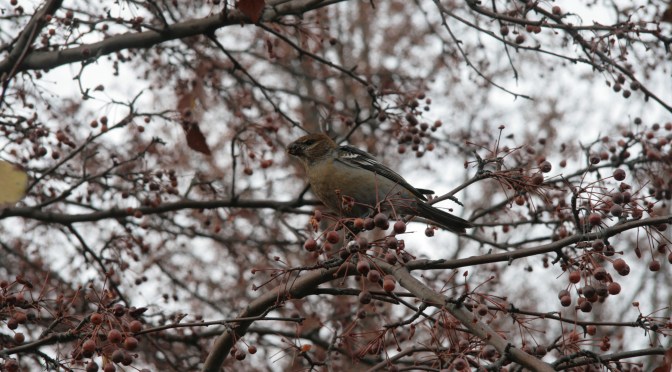
The Pine Grosbeak is one of the largest members of the finch family, and a rare winter visitor to New York. This bird species generally breeds between Alaska and Newfoundland, and south in the western mountains to California and Arizona. They winter further south, in the Dakotas, New York, and also Eurasia. These birds use their short, curved beaks to eat seeds, buds, and berries from trees such as Mountain Ash, cedar, and Juniper. Look for Pine Grosbeaks in scattered forests where these kinds of trees are plentiful. Pine Grosbeak’s tame and slow-moving behavior has earned them an unusual name in Newfoundland, where they are called “mopes.”
As the largest salamander in the Western hemisphere, you wouldn’t think that hellbenders could easily slip under the radar. However, these well-camouflaged, aquatic creatures are rarely seen, and due to loss of suitable habitat, they are being seen with increasing rarity.
In New York, hellbender salamanders live exclusively in the Susquehanna and Allegheny river drainages, including their associated tributaries. Numbers are declining in both of these ranges, particularly in the former, where hellbenders are all but extirpated. A “hellbender head-start program” has focused on the Allegany Region, where earlier this year a number of captive-raised hellbenders were released into the park’s streams. The captive-rearing program has been a collaboration between the New York State Department of Environmental Conservation, the Bronx Zoo, the Buffalo Zoo, the Seneca Park Zoo in Rochester, NY, and the Seneca Nation of Indians. More information on that project can be found here.
Check out this cool video featuring awesome hellbender action produced by Freshwaters Illustrated, an organization which produces educational media about the life, study and conservation of freshwater ecosystems.
featured image is hellbender habitat in Allgany State Park, by Andrea M. Chaloux. Post by Paris Harper
The bee fly is an adorable insect which can be seen buzzing around wildflowers in spring and summer. The one in this photo was seen near the shoreline at Harriman State Park. Bee flies are named for their round, fuzzy bodies and habit of flying from flower to flower in search of food. Unlike bees, however, these flies don’t sting! That long nose is called a proboscis, and it serves the same function as a hummingbird’s beak, allowing the bee fly to sip nectar from flowers. But as cute and harmless as the adult bee flies are, they start their lives as ferocious little larva! Bee Flies lay their eggs in the same burrows solitary bees dig for their own eggs. When the fly larvae hatch, they eat the bee’s winter cache of pollen, and then they eat the baby bees, too!
We think these guys are the cutest fly species! Photo by Paris Harper
A research study out of the State University of New York College of Environmental Science and Forestry (SUNY-ESF) is collaborating with Fahnstock State Park and Wonder Lake State Park in Putnam County to look at predator populations as part of an ongoing study of the declining population of New England cottontails (NEC), Sylvilagus transitionalis. NEC is a rabbit native to the northeastern U.S., but studies indicate that in the past decade, the population of NEC has decreased by as much as 50%. Some populations of the cottontails are in New York State Parks, and learning more about best management practices is critical to protecting this species.
As the New England cottontail (NEC) is a declining species being considered for listing on the federal Endangered Species Act, there are a lot of ongoing efforts to create habitat for these rabbits in the Northeast. The hope is these efforts will preemptively restore populations of NEC in the region, making it unnecessary to list the species as endangered.
The two greatest contributing factors to the decline of NECs are loss of habitat and the introduction of the Eastern cottontail, Sylvilagus floridanus. While the two cottontail species are almost identical in appearance, the Eastern Cottontail generally outcompetes NECs for food and habitat, edging the native species out of its former range. While loss of habitat and the introduction of the Eastern cottontail are both factors contributing to the decline of New England Cottontail, this study looks at predation in conjunction with other management practices.
Predation accounts for almost all natural mortality in NECs. As such, increases or decreases in the predator community would have serious consequences for the cottontail population. Most management projects have focused on enhancing habitat for NECs, but this study considers whether those projects might have the unintended consequence of altering the predator communities in such a way that cottontail survival is reduced. If that’s the case, then it will be necessary to consider predator management strategies when managing habitat for NEC. Results from this study will help inform habitat managers and recover NEC populations.
The project, led by PhD student Amanda Cheeseman and Dr. Jonathan Cohen, both from SUNY-ESF, together with Scott Silver of the Wildlife Conservation Society and Putnam Highlands Audubon, uses trail cameras targeting mammal predators, in combination with visual and auditory surveys for hawks, owls, and eagles, to examine predator communities in areas where different ways of controlling and managing NEC habitat are already being practiced. The project is taking place across multiple sites in Putnam and Dutchess counties. The pictures above were taken in Fahnstock State ParkThe information from the predator study will be compared to data from radio-collared cottontails in order to get a complete picture of the predator-prey relationships in New England Cottontail habitats.
featured image is of the New England Cottontail, Sylvilagus transitionalis, by Michael Merchand, NYNHP
On May 3, 2014, over a hundred volunteers with scientific backgrounds gathered at Minnewaska State Park Preserve in Ulster County and Clark Reservation State Park in Onondaga county for two concurrent Bioblitzes, 24-hour inventories of the park’s biodiversity. Our objectives were to search the park for as many rare species and natural communities in the park as we could find. This was a collaborative effort between NY Natural Heritage Program (NYNHP), State Parks, and Parks & Trails New York. Participants included biologists with various specialties and affiliations including NYS DEC, NatureServe, Syracuse University, SUNY-ESF, Mohonk Preserve, U.S. Geological Survey, and the Student Conservation Association. At least 9 different organizations were represented.
Rhodora (Rhododendron canadense), a rare plant documented at Minnewaska. Photo by Alyssa Reid
The main survey period was between 9am and 5pm on May 3rd, but some intrepid volunteers stayed through the night to look for nocturnal animals, while others arose on May 4th between 5am and 11am to identify spring migratory birds. In both parks, small teams sought out rare species and high biodiversity areas. The weather was overcast and cool on May 3rd, which made some of the surveys particularly difficult.
At Minnewaska State Park, we were able to document approximately 262 plants, animals, and fungi, as well as 7 of the NYNHP significant natural communities. The summary of our findings includes at least 100 plants and 150 animal species: 89 birds, 6 fish, 16 herps (amphibians and reptiles), 16 mammals, and 23 invertebrates. The species included cool mammals like the American mink (Neovison vison), shy amphibians like the northern dusky salamander (Desmognathus fuscus), delicate insects like the spring azure (Celastrina ladon), and steadfast trees like the American chestnut (Castanea dentata).
Painted turtle, by Matt Schlesinger, NYNHP
At Clark Reservation, we documented over 372 different species of plants, animals, and fungi and updated records for the 4 high-quality natural communities known in the park. The tally includes 193 species of plants (including lichens) and 96 species of animals, including 6 mammals, 7 herps, 46 birds, 4 fish, and 116 invertebrates. Of the many invertebrates identified, some of the largest groups were beetles (18), millipedes (10), caddisflies (10), and snails (6). The list of species included some entertaining names, such as bugle sprite (a snail), poverty grass, tortured tortella moss and seductive entodon moss. The Bioblitz proved to be an invaluable opportunity to get experts out in the park cataloging groups of species, like mosses and snails, which are often overlooked in typical biological inventories.
Due to the timing of the Bioblitz to coincide with I Love My Parks Day on May 3rd, our bird surveys included both passing migrants and potential park residents. Whip-poor-wills (Caprimulgus vociferous), a species of special concern, were sighted in several locations at Minnewaska, and based on last year’s NYNHP surveys, they are known to nest in the park. At Clark, the highlights were osprey (Pandion haliaetus) and sharp-shinned hawk (Accipiter striatus), both of which are species of special concern in New York.
The invertebrate team working hard at Clark Reservation. Photo by Julie Lundgren
The bioblitz was an extension of the long-standing partnership between NYNHP and State Parks to document rare species and natural communities in New York State Parks. Scientists found a wealth of biodiversity and enjoyed collaborating across organizations and areas of expertise in a beautiful natural setting. We hope to continue these valuable efforts to bring experts together to share knowledge, contribute to our understanding of the biota in New York State Parks, and to encourage further opportunities for park staff and the public to learn more about the special features in parks.
featured image is a spring azure butterfly by Mike Adamovic, post by Paris Harper, Erin White and Julie Lundgren



 New York State Parks and Historic Sites Blog