Now that summer is here, when you head to the boat launch for a day on the water, you will often run into a friendly face in a blue vest. These are Boat Stewards! Boat Stewards are educators who share their knowledge of invasive species and how to prevent boats from spreading such species into other waterbodies.
You can expect to run into stewards across much of New York State, since there are more than 200 Stewards who are part of various programs. Here at the state Office of Parks, Recreation and Historic Preservation, our Boat Steward program is run in collaboration with the SUNY College of Environmental Science and Forestry (ESF).
Beginning the Memorial Day weekend, 20 Stewards are stationed at 25 different State Park boat launches. These experts can answer your questions about aquatic invasive species (AIS) within New York State, provide educational information on many species, and will help check that there are no aquatic hitchhikers on your boat or trailer!
All our stewards within the state will be wearing masks and social distancing for your protection and theirs during the COVID-19 pandemic. Please arrive with your boats and equipment already clean, drained, and dried and be willing to help our stewards conduct inspections while maintaining social distance. Please follow the protocols for social distancing and wearing masks in public while at the launches.
When you arrive or leave a boat launch, a Steward will ask to perform a voluntary inspection on your watercraft and encourage you to join them. Remember, please practice social distancing, and stay six feet away from Stewards while they perform their duties.
Inspections apply to both power boats and paddlecraft, like canoes and kayaks.
While completing the inspection, Stewards are on a mission to find all visible plant or animal material attached to the watercraft and trailer and will point out places on the boat where aquatic invasive species often get caught. Stewards also gather information from boaters through a short survey to help understand the movement of AIS across the New York State.
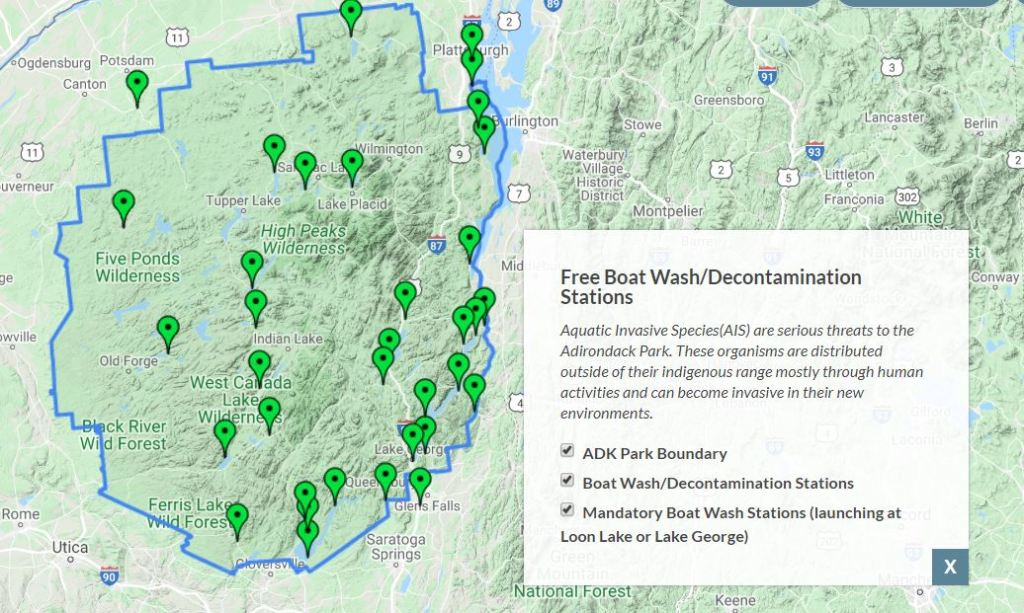
At many locations across the state, Stewards operate Watercraft Decontamination Stations, also known as Boat Wash Stations. Decontamination stations are a free high-temperature, high-pressure wash for your boat.
Phpto 4
A boat steward at Conesus Lake State Boat Launch, Livington County, at the uses a high-pressure wash to remove invasive species from a boat.
Boat Wash Stations are highly effective at eradicating aquatic invasive species we might not be able to see with our naked eye, such as young Zebra Mussels or Spiny Waterfleas. The ESF-NYS OPRHP program operates two such units located at Allan Treman State Marine Park on Cayuga Lake and Conesus Lake State Boat Launch.
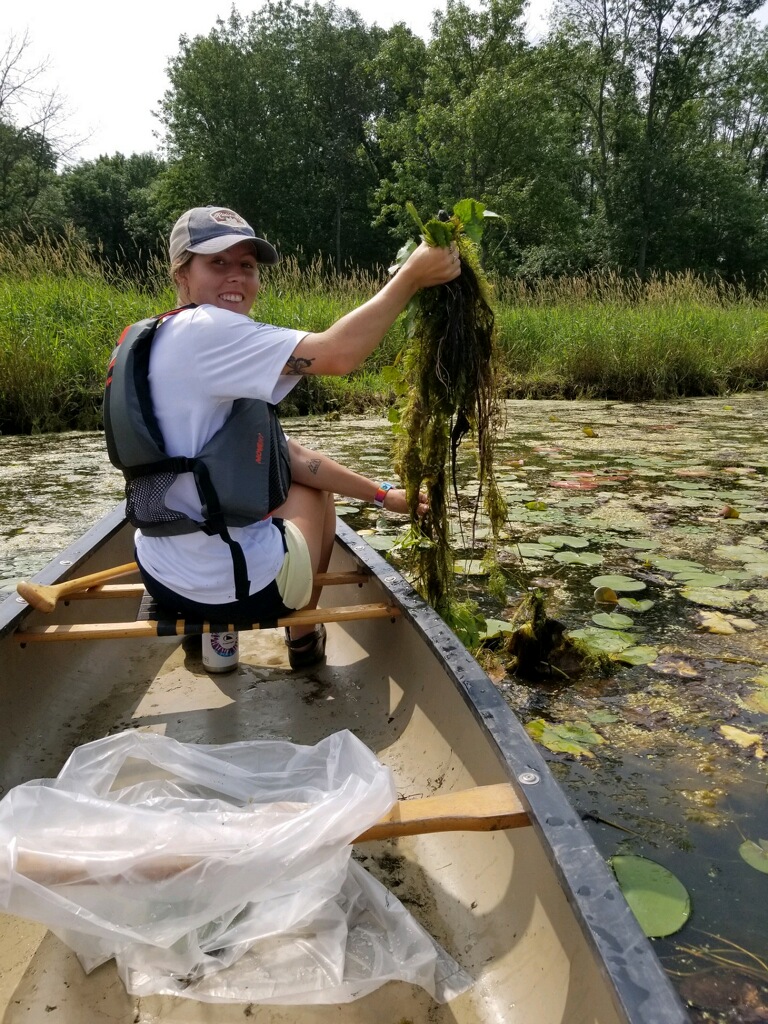
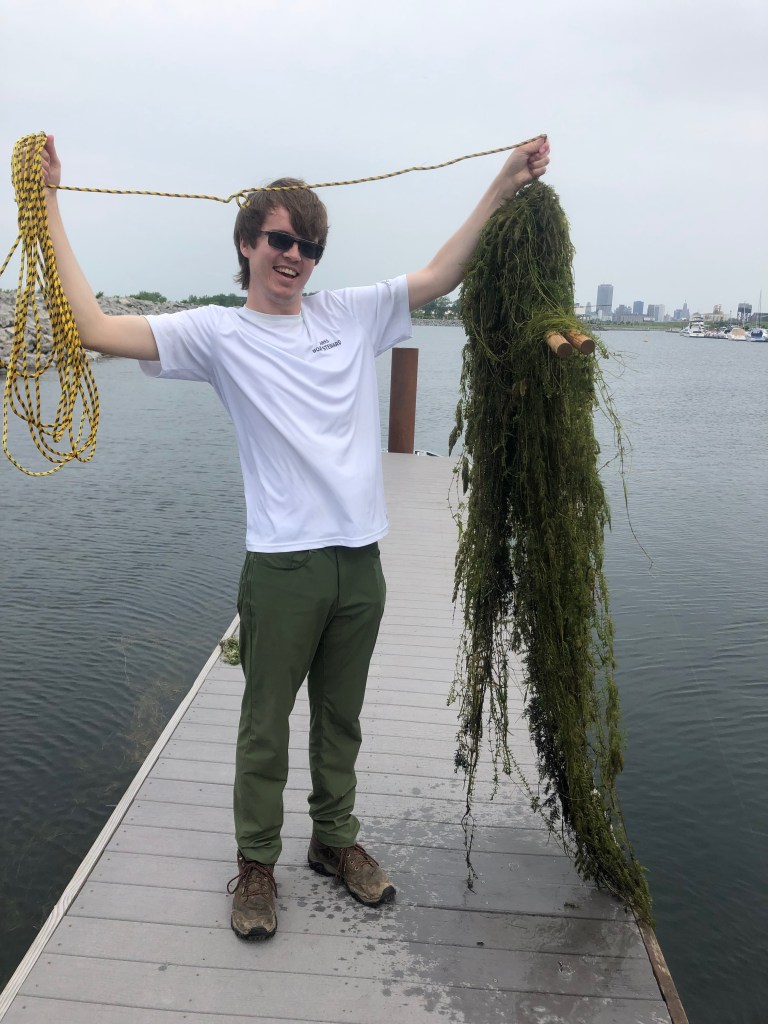
When stewards are not at the launch, they are busy collaborating with many partner organizations to partake in all levels of invasive species management. They participate in sampling for AIS, mapping new infestations, and large-scale removals of invasive species such as Water Chestnut.
Since the program’s inception in 2014, our boat stewards have conducted more than 100,000 inspections and interacted with more than 250,000 boaters. In 2019, stewards intercepted 3,803 boats that were carrying invasive species.
Each of these boats could have led to a new introduction that has potential to cause significant harm to ecological, economic, and human health.
Cover shot- Boat stewards at the start of the 2019 season. (All photographs from NYS Parks and reflect 2019 boating season)
Post by Mallory Broda, Program Coordinator (Program Support Specialist), ESF- NYS OPRHP Boat Steward Program
Help Do Your Part to Protect Our Waterways
* Clean, drain, and dry your watercraft and equipment thoroughly before visiting other waterbodies.
* Inspect and remove debris and mud from boats, trailers, and equipment before and after each use.
* Dispose of all debris and bait in trash cans or above the waterline on dry land.
* Drain all water-holding compartments including live wells, bait wells, and bilge areas. If possible, disinfect with hot water (140°F) for at least 30 seconds.
* Dry boats, trailers, and all equipment before use in another water body. A minimum of 5-7 days in dry, warm conditions is recommended.
* Do not dispose of unwanted aquarium pets or bait fish in waterbodies, ditches, or canals.
Growing up in Western New York, I always looked forward to my family’s annual fall trip to Allegany State Park. Late every October we would pack a picnic lunch, put the dogs in the car, and head down to Allegany for a day of leaf peeping, hiking, rock climbing, and wilderness peace.
Some years it was sunny and 65 degrees, while others were a rain/snow mix in the 40s. Whatever the weather, it was always fun, always an adventure, and always absolutely beautiful.
Almost 15 years later, when I took the job as Becoming an Outdoors-Woman (BOW) Coordinator for New York’s Department of Environmental Conservation, one of my goals was to help New Yorkers learn to love our long winters. That is when I knew exactly where I wanted to host a new annual winter workshop.
BOW workshops are designed to teach women a variety of outdoor skills over a three-day weekend. These programs provide information, encouragement, and hands-on instruction in outdoor activities including fishing, shooting, archery, hunting, trapping, outdoor photography, map and compass, survival, camping, canoeing, and outdoor cooking.
These workshops are designed primarily for women who have little or no experience with outdoor recreation.
For 26 years, BOW programs have offered women a unique learning experience, putting everyone on an even playing field to learn new skills from a dedicated group of qualified volunteer instructors.
Since then, close to 4,500 women from all over the state, aged 18-80+ have attended BOW workshops in New York, have embraced outdoor activities, met like-minded women, and challenged themselves. Participants leave our workshops feeling empowered, accomplished, and often with a new group of lifelong friends to join in outdoor adventures.
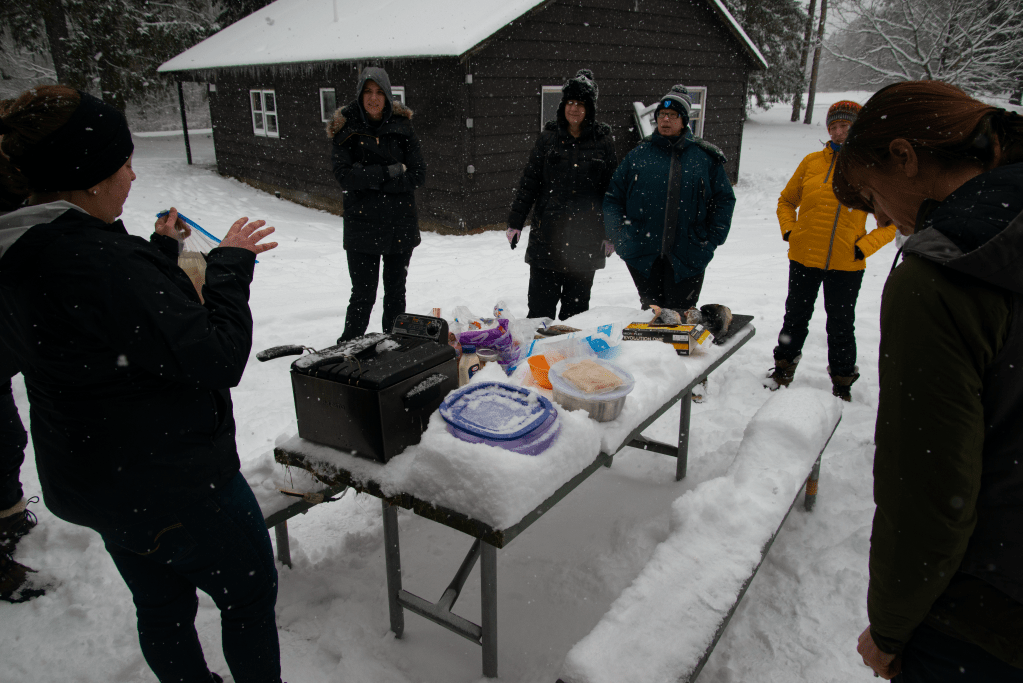
The first annual ‘BOW in the SNOW Winter Workshop’, was held February 7-9, 2020 at Allegany State Park. The workshop was a success, hosting 55 participants from 23 counties in New York State, as well as three other states.
Participants ranged in age from 18 to 69 years old. Over the course of three days, these women learned a variety of outdoor skills including snowshoeing, Nordic skiing, fat tire biking, trapping, firearms safety, Dutch oven cooking, winter camping & survival, K-9 first aid, tree stand safety, ice fishing, and much more!
Allegany State Park was an ideal and beautiful location that delivered on snow just in time. Leading up to the workshop weekend, the normally snowy Southern Tier had seen little accumulation, and even less ice-up on its lakes. While I was getting a bit nervous, I had faith that the lake effect storms of Lake Erie would come through.
Sure enough, the week of the workshop, all of New York experienced an intense winter storm that delivered the perfect amount of snow for our weekend. While we ended up seeing some participants drop out due to travel restrictions and safety concerns, we had many who braved the storm and made it just in time to enjoy the weekend in an idyllic setting.
The Art Roscoe Nordic ski trails, the snowshoe trail at Stone Tower, and the fat tire bike trails hosted our classes with near perfect conditions. Although we didn’t have enough solid ice for the ice fishing class to go out on Red House Lake, our instructors adapted and offered fishing instruction on land followed by a delicious tutorial on cleaning and frying our winter catch!
BOW offers a three-day workshop every fall and now a three-day workshop every winter. If you’re interested in joining us or learning more about BOW, please visit dec.ny.gov and search ‘becoming an outdoors woman’ to find out about all of our upcoming events.
(Editors note: Check back on the DEC page for future updates as to scheduling.)
Post by Katrina Talbot, Wildlife Biologist & Becoming an Outdoors-Woman Coordinator
Interested in taking part in a future workshop? Here are just a few comments from last winter’s workshop evaluations, underscoring the popularity and benefits of the program:
“Working together with women in a group has been amazing. I learned to snowshoe and ski, and this weekend has made me so grateful.“
“This experience has taught me skills to allow me to enjoy winter in NY! I enjoyed sharing the weekend with strong, capable, empowered women!“
“This weekend was so much more to me than being curious and wanting to learn a new skill. Although both of those were true (I learned to ice fish and obtained my trapping certificate, neither of which I had previous experience with), this was more of a personal goal. Every single person I met at BOW, including the instructors, were amazing, patient, kind, friendly, warm, knowledgeable, fun… just good people. I commend the DEC for offering this program and from the bottom of my heart thank the volunteers and Katrina for her time, warm welcome, and dedication to this program. The spirit and energy of the instructors was contagious. “
As the Revolutionary War was drawing to an end, General George Washington wanted an award that recognized merit in the common soldier. So, he created the Badge of Military Merit _ the precursor to the Purple Heart _ while at his Newburgh headquarters in the Hudson Valley.
It was more than 150 years later when a New York resident and immigrant became the first woman to receive the Purple Heart for suffering wounds in wartime. And she was a nurse, a profession that has again finds itself at risk in the front lines during the current COVID-19 pandemic.
One night in August 1917 during World War I, a German aerial bomb exploded at a military field hospital in Belgium. It was about four miles behind trenches where hundreds of thousands of British, French, Belgian and German troops were fighting the Third Battle of Ypres, also known as Passchendaele.
Metal shrapnel ripped through a tent at Casualty Clearing Station #61, where 36-year-old U.S. Army nurse Beatrice Mary MacDonald was rising from her cot to start her shift caring for wounded Allied soldiers. Jagged shards struck her face, damaging her right eye so badly that it later had to removed by doctors.
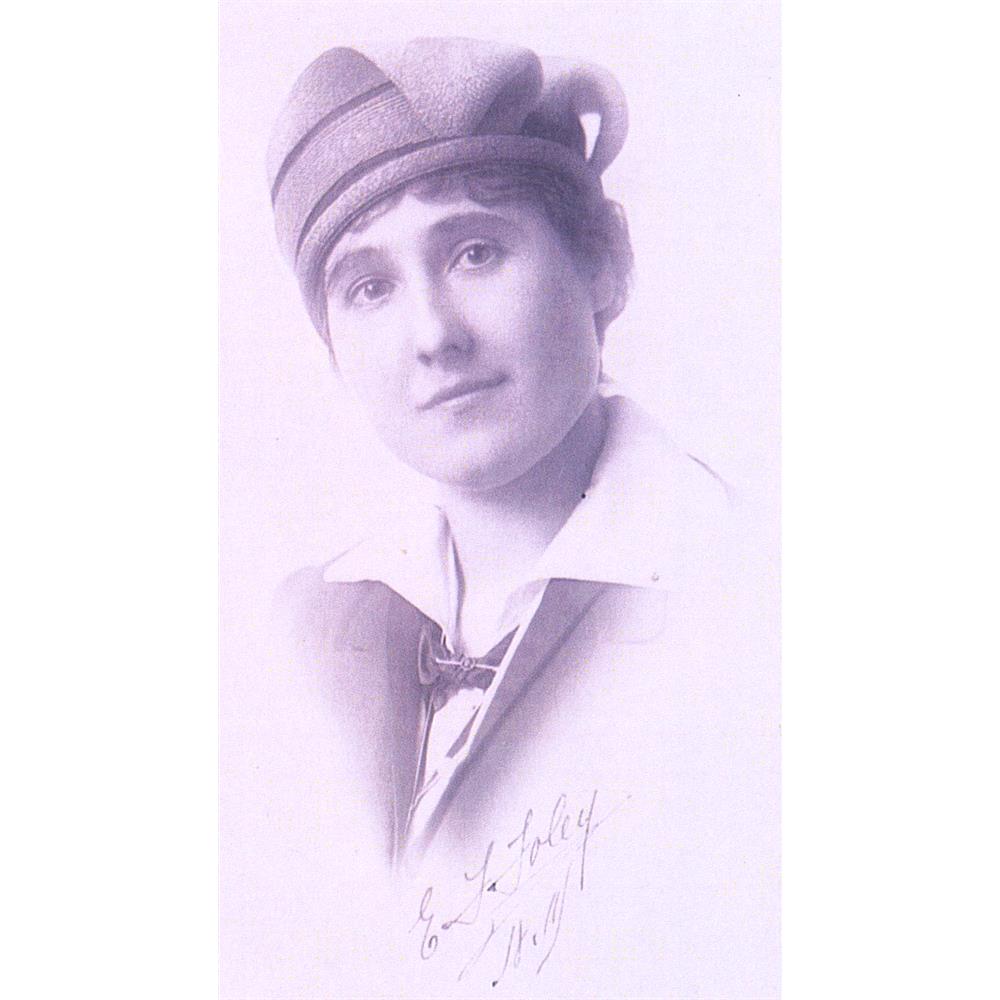
Beatrice Mary MacDonald in 1905 after completing her nurses’ training.
Although serving in the U.S. Army Nurse Corps, MacDonald was a native of Canada, where she grew up in a large family on Prince Edward Island. She had come to New York to get her nursing training in 1905 and chose to live there afterward to pursue her career. When war came, she volunteered for the American war effort. She was part of a unit organized by Presbyterian Hospital, now part of New York-Presbyterian Hospital.
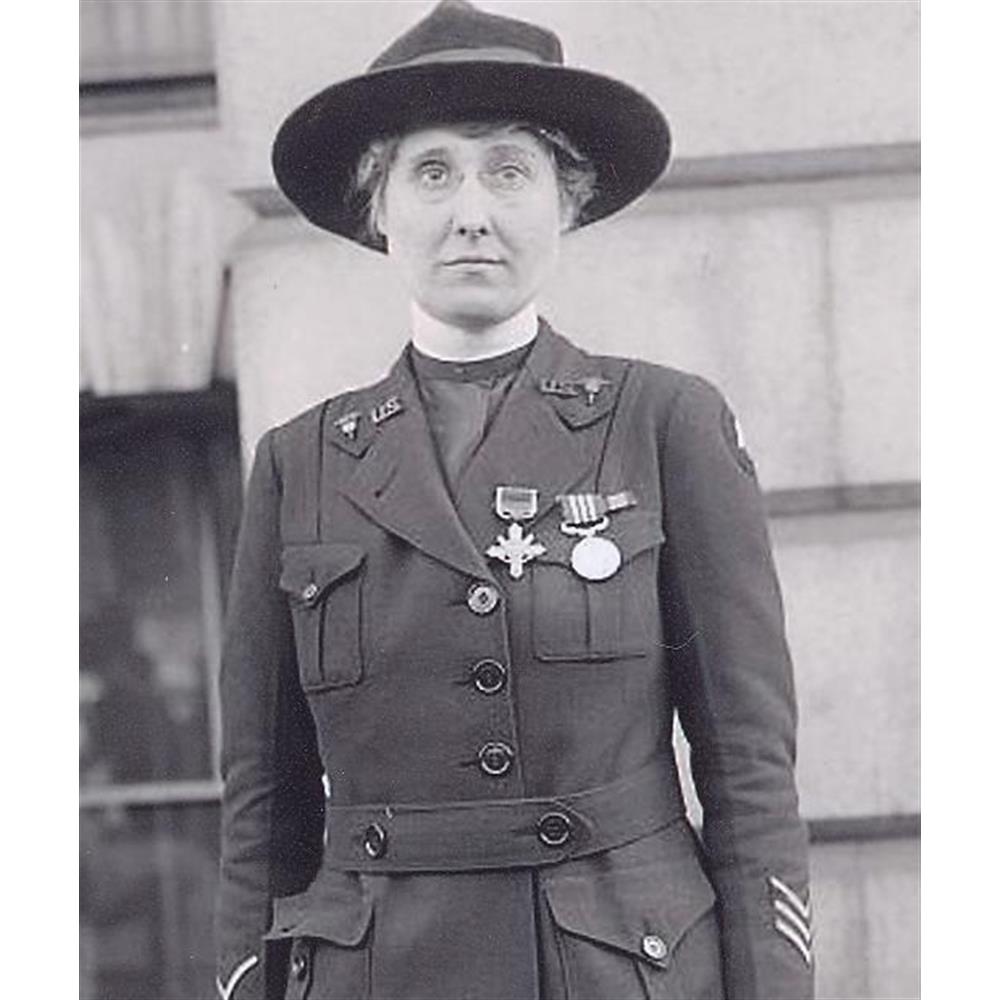
Beatrice Mary MacDonald in her military uniform after recovering from her wounds.
After a six-week recovery from her injury, Macdonald returned to duty serving in military hospitals in France and Belgium. “I’ve only started doing my bit,” she said, according to material from her wartime scrapbook, which is now in the collection of the Radcliffe Institute for Advanced Study at Harvard University.
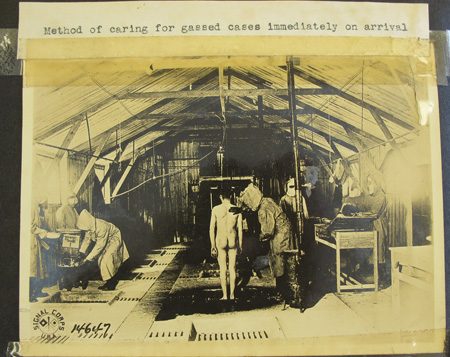
In her scrapbook, the young nurse described her training to deal with one of the horrors of the battlefield _ poison gas. That included “. . . entering chambers containing a certain amount of Phosgene and other gasses, in order that we should be able to recognize them in case of an attack, and to become adept in adjusting our gas masks in less than ten seconds.”
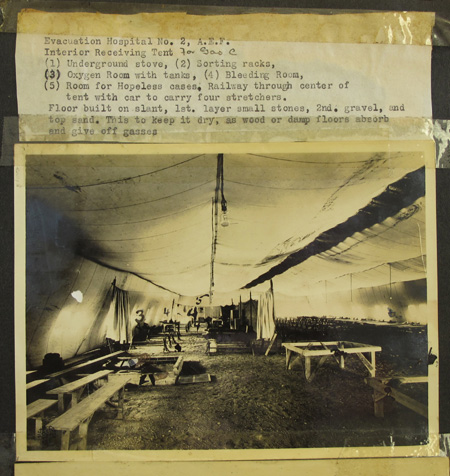
She kept photographs of the tent where gas casualties were treated, including a shot of one area that was set aside for “hopeless cases.”
A gassed soldier being treated as the military field hospital where Nurse Beatrice Mary MacDonald was stationed. (Photo Credit- Ann Fraser Brewer papers, Radcliffe Institute for Advanced Study, Harvard University)
The area at the military hospital set aside for the “hopeless cases” of gas attacks. (Photo Credit- Ann Fraser Brewer papers, Radcliffe Institute for Advanced Study, Harvard University)
After the war ended in 1918, MacDonald served with Allied forces in Germany until returning to the U.S. There, she resumed living in New York City to continue her profession, and later served as director of the Pennsylvania Hospital School of Nursing for 23 years until her retirement in 1956.
The war had been over for years when MacDonald received her Purple Heart in 1936, four years after the award has been reestablished under an order by President Herbert Hoover. The modern award was meant as a tribute to Washington’s original award, which he represented with a cloth or silk purple heart.
In authorizing the Purple Heart, the award was made retroactive to living World War I veterans like MacDonald, who was among thousands of male soldiers who subsequently applied for and received the award.
MacDonald received numerous awards in recognition of her bravery and is perhaps one of the most highly decorated women of World War I. Her commendation for the Distinguished Service Cross states:
“It is interesting to note that this cross is to be conferred upon a woman and a nurse. This war has, of course, taken the nurses, who are the ministers of mercy, up to the very front lines of battle, and because of the carrying of the war into the third dimension the airplane has, of course, made their task more perilous.”
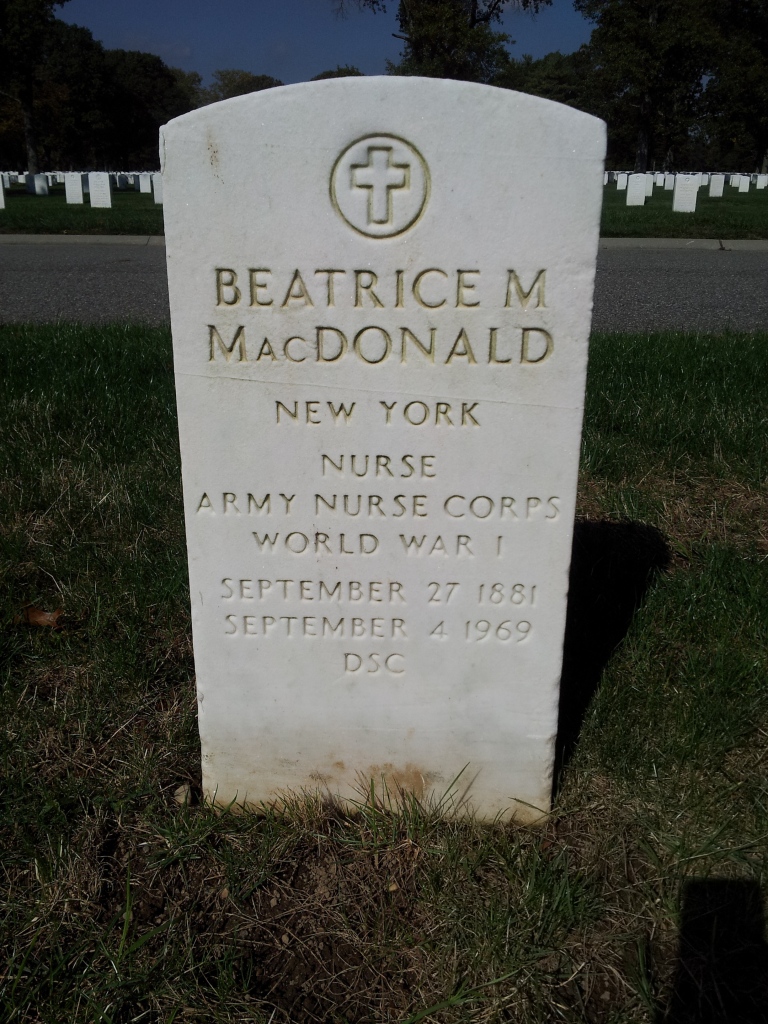
MacDonald died in 1969, at age 88, in a nursing home in White Plains, Westchester County. MacDonald received a full military funeral at Long Island National Cemetery in Suffolk County.
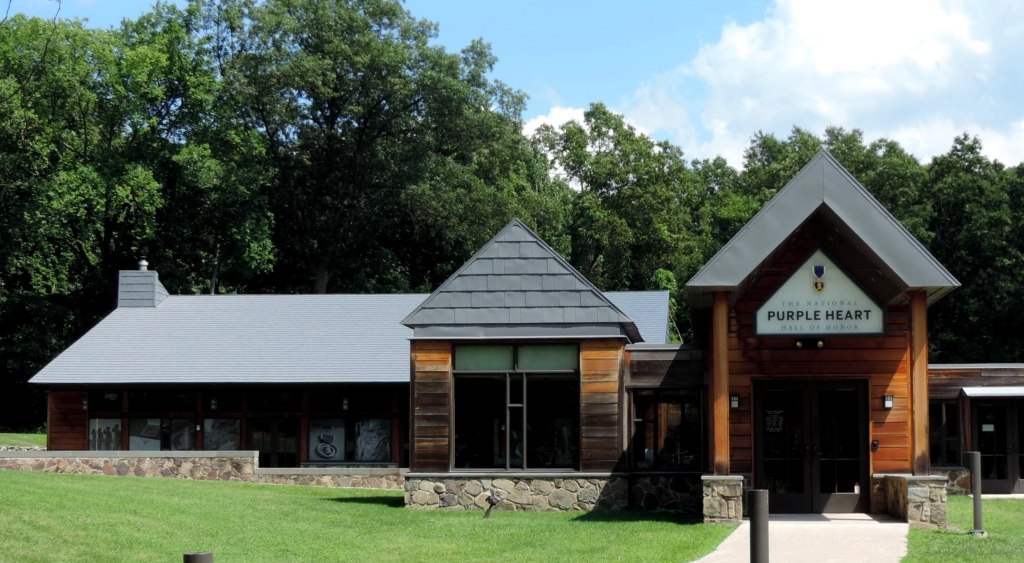
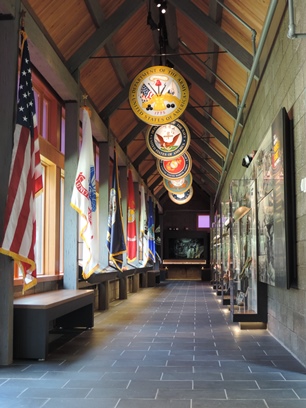
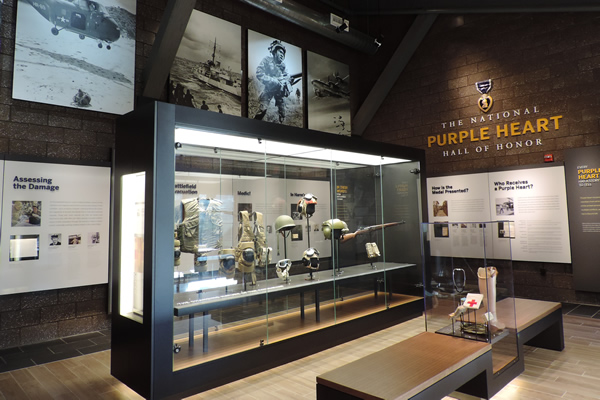
MacDonald is one of many stories found at the National Purple Heart Hall of Honor in New Windsor, Orange County. Opened in 2006, it is the first facility in the nation dedicated to the estimated 1.8 million recipients of the Purple Heart, which is awarded to American military personnel who have been wounded or killed by enemy action.
The National Purple Heart Hall of Honor is undergoing a $17 expansion and renovation.
Other famous Purple Heart recipients include President John F. Kenney, and U.S. senators John McCain, Bob Dole, Tammy Duckworth and Daniel Inouye.
The Hall of Honor maintains an online database, which can be used to explore the stories of Purple Heart recipients like MacDonald and others. Purple Heart recipients or families of recipients can enroll in the database. Enrollment is voluntary and more information on that can be found here.
A 2020 expansion project incorporated integrated audio-visual and media presentations, as well as museum-quality casework for each area with interpretive graphics, locally controlled lighting, touch-screen interactive monitors, and multiple large-format graphic displays. It also created new exhibits that tell stories about joining the service, the day of the incident, field treatment and evacuation, the changing nature of warfare, the consequences of war, road to recovery and the ultimate sacrifice. The expanded exhibits include more personal stories, interactive displays, and artifacts highlighting the experiences of featured Purple Heart recipients.
Currently, the online Roll of Honor database represents Purple Heart recipients from all 50 states, Washington, D.C., Puerto Rico, Guam, Samoa and the Philippines.
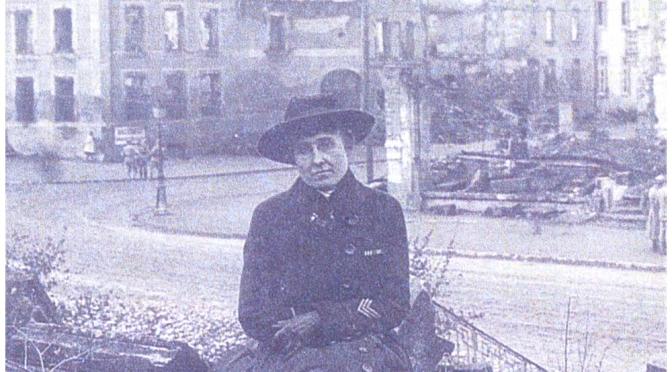
Cover Photo- U.S. Army Nurse Beatrice Mary MacDonald in the ruins of a French town. All photographs from NYS Parks unless otherwise noted.
By Brian Nearing, Deputy Public Information Officer, NYS Parks
COMMON MISPERCEPTIONS ABOUT THE PURPLE HEART
George Washington created the Purple Heart: FALSE
General Washington created the award called Badge of Military Merit in 1782. It was a heart shaped piece of cloth or silk. It was to be awarded for a “singularly meritorious act”. It all but disappeared after the American Revolution. It was never referred to as the “Purple Heart” in Washington’s time. That language was used in General Order #3, establishing the Purple Heart award in 1932.
All casualties receive the Purple Heart: FALSE
Only those casualties resulting from enemy action are eligible for the Purple Heart. “Non-hostile” injuries or deaths (e.g. disease or accidents) are not eligible. The injury must require medical attention, be treated by a medical professional and documented. Numerous instances have occurred where the award was not made due to clerical errors, confusion after a battle or lack of proper documentation.
If you are wounded you automatically get a Purple Heart: FALSE
If the wounding was caused by the enemy, required professional medical attention and was documented, then the individual is eligible and should receive the award. However, there is a “paperwork process” that must be completed. Also, from 1932-1942 the majority of recipients had to apply for their awards as they were WWI (and earlier wars) wounded veterans, and therefore no longer in the military.
General Douglas MacArthur received the 1st Purple Heart: FALSE
While General MacArthur did sign General Order number 3 creating the modern Purple Heart on 22 February 1932, he did not apply for his Purple Heart until July 1932. By that time many WWI wounded veterans had applied for and received their awards (including the 136 veterans at the Temple Hill Ceremony held on the Grounds of what is now the Hall of Honor, 28 May 1932). General MacArthur’s medal however, was numbered “1”
The Government has a list of all Purple Heart recipients: FALSE
There is no list of Purple Heart recipients maintained by the Federal Government. The information is found on the record of the individual, or in copies of General Orders. This information has never been extracted to generate a list of all recipients.
Those wounded or killed in all wars are eligible for the Purple Heart: FALSE
When the award was created in 1932, it was open to any living veteran who felt that he or she was qualified. This resulted in a small number of recipients from the American Civil War and Spanish-American War. However, current regulations limit the award to those killed or wounded after 5 April 1917.
You have to be in combat to receive a Purple Heart: FALSE
The term “enemy action” has a much wider application than traditional combat. Changes in the regulations now recognize: injury or death while a prisoner of war; certain instances of friendly fire; as well as considering international and specific types of domestic terrorist acts.
Lt. Annie G. Foxwas the first women to be awarded the Purple Heart: FALSE
Lt. Fox was the first known woman to receive a Purple Heart during World War II. For many years it was believed that she was the first female recipient. However (as you now know), Beatrice Mary MacDonald, an Army Nurse during World War I was wounded on 17 Aug. 17, 1917, when German planes bombed her hospital. The resulting wound caused her to lose her right eye. As with all other WWI veterans, she had to apply for her Purple Heart (Remember there was no Purple Heart prior to 1932). She was officially awarded her Purple Heart Jan. 4, 1936.
The first 136 Purple Hearts were awarded May 28, 1932 at Temple Hill, now the site for the National Purple Heart Hall of Honor: FALSE
Purple Hearts had been awarded prior to May 28, 1932. We know of one Civil War veteran who received his in April 1932. One of the Temple Hill day recipients also received his in late April and was formally awarded the medal at the Temple Hill Day ceremony.







 New York State Parks and Historic Sites Blog