While conducting field work in Clarence Fahnestock State Park the Environment Management Bureau’s Wildlife Unit came across this large female snapping turtle in early June. This female snapping turtle was observed digging a hole in the sandy soil to lay her eggs. This time of the year a variety of wildlife are giving birth or nesting to produce this year’s offspring. Turtles, as you may know, do not move very fast on land and tend to get hit by vehicles while attempting to cross the road. Please watch out for them on the roadways! Snapping turtles and turtles in general look for sandy soils that are easy to dig in to create their nest and lay their eggs. Nesting can take place quite a far distance from water. This is okay! Once hatched, the baby turtles will find their way back to a water source nearby. Get out in nature, experience our beautiful wilderness and all it holds, but please remember to not disturb these natural processes and give wildlife some space to be wild.
Post by Kelly Starkweather, OPRHP Wildlife Unit.
Photos taken at Clarence Fahnestock State Park by Lilly Schelling, OPRHP Wildlife Unit.
Have you ever been to a greenhouse and observed a carnivorous plant, such as a Venus fly trap or a pitcher plant and thought…where do these come from? Well not only can you find carnivorous plants growing native in New York State, we have four different types and 19 different species (New York State Flora Altas)! Carnivorous plants are plants that have adapted to depend on catching insects to supply the nutrients they need for survival, thereby allowing them to live in nutrient poor habitats. NYS is home to pitcher plants (Sarracenia), bladderworts (Utricularia), butterworts (Pinguicula), and sundews (Drosera); each having different methods for catching insects. All of these species thrive in wet, sunny conditions. Some of the best viewing opportunities for these fascinating plants are boardwalks over bogs or from a canoe/ kayak.
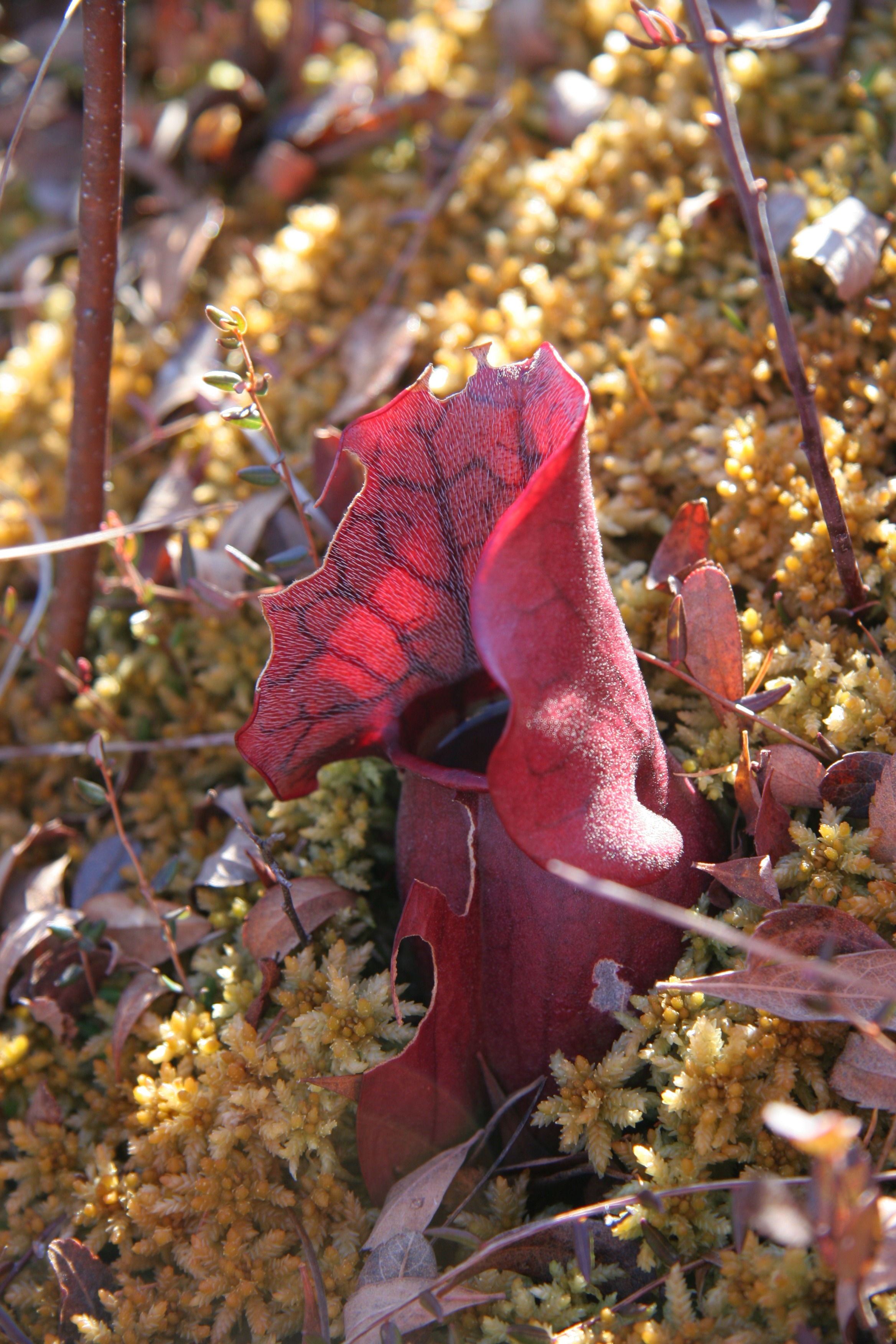
We will investigate the pitcher plant first. We have one species in New York, being the purple pitcher plant (Sarracenia purpurea). These plants are sometimes called ‘trumpet plants’ because of their shape. The pitcher is actually a modified leaf. In some species, the coloration of the pitcher is a mottling of red, green, and white to resemble raw meat – attracting flies and wasps. The mouth of the pitcher secretes a sugary nectar to draw insects to it, making the lip surface slippery, and downward pointing hairs on the lid make insects fall easily off the lid into the pitcher. Once an insect falls inside it cannot get out due to the slippery waxy surface on the inside of the pitcher. The insect is then digested in the juices that reside inside the pitcher, thereby nourishing the plant. The plant has a single flower on a long tall stalk. This is to keep the flower high away from the pitchers to protect the pollinators from becoming prey to the plant! These plants primarily grow in bog/fen habitats in sphagnum moss. Look for pitcher plants in these habitats throughout parks across the state.
Purple pitcher plant. Photo by Lilly Schelling, OPRHP.
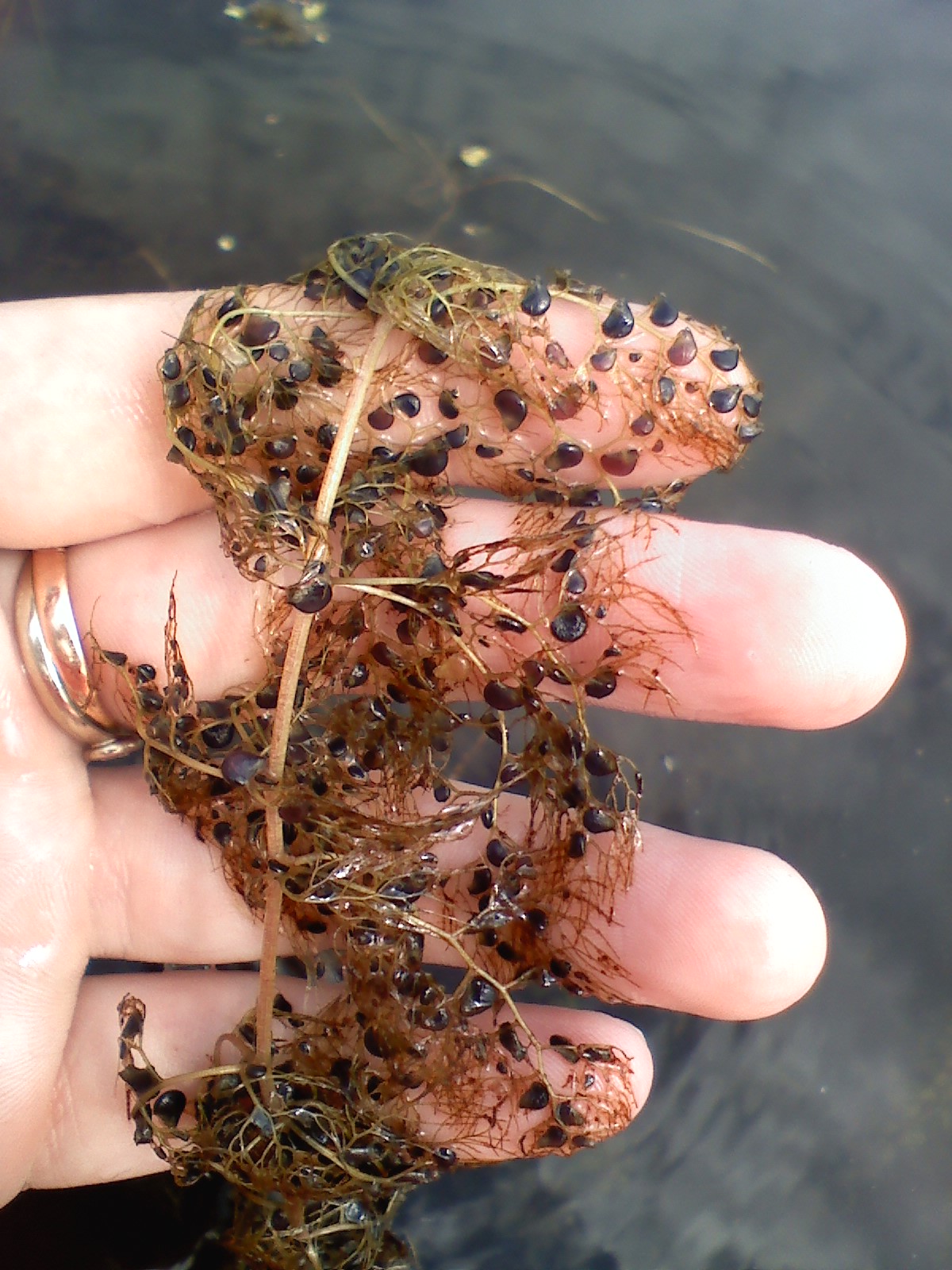
Purple pitcher plants have tall stalked flowers, keeping pollinators away from the hungry mouths of the pitchers. Photo by Andrew Nelson, SUNY Oswego.There are 14 species of bladderworts in the state, all of which are aquatic (living in water). Most of them have yellow flowers with one species having a purple flower. Primarily these plants grow in areas of very slow moving water or in pockets of still water off of rivers and brooks. They have a small bladder shaped trap. The plant has ‘trigger hairs’ at the mouth of the trap, that once touched by prey, opens the mouth and sucks the prey inside – where it is slowly digested by the plant. Bladderworts can be found across the state.
Bladderworts primarily have one flower per stalk. Most species in NY have yellow flowers. Photo by Andrew Nelson, SUNY Oswego.Bladderwort get their name form the bladder of the shaped traps they catch prey with. Photo by Lilly Schelling, OPRHP.
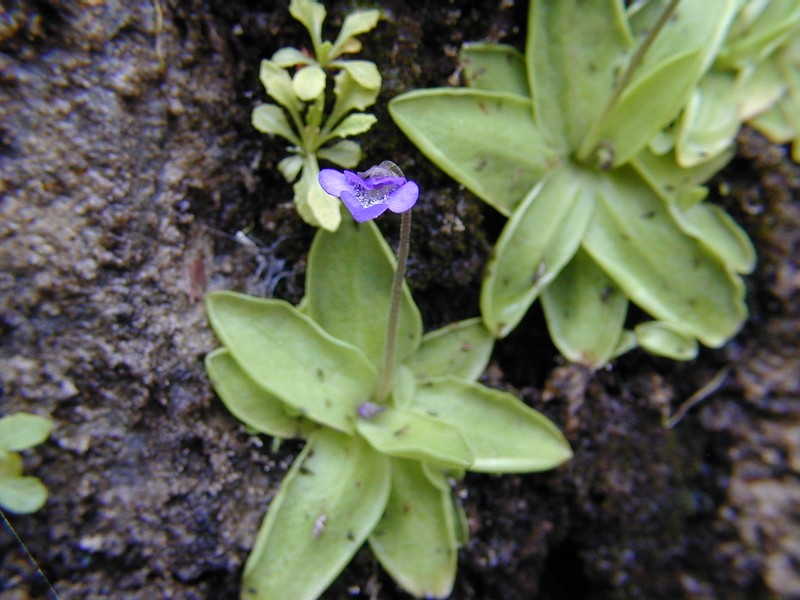
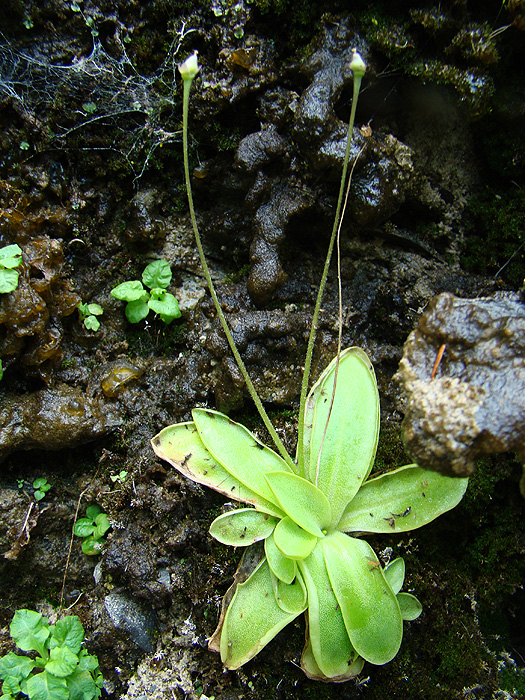
New York State has one species of butterwort (Pinguicula vulgaris). Though they do not look alike, bladderworts and butterworts are in the same family (Lentibulariaceae) because both have similar flower structure; though the method of insect catching for these plants is more akin to the sundew. The leaves have a greasy look and feel to them because they are covered in a sticky glue substance. Once an insect lands on the leaf, it is stuck and the more it thrashes around in an attempt to escape, the more it comes in contact with the sticky digestive juices of the leaf. The butterwort species we have in New York grows on permanently wet cliffs and can only be found in the central and western parts of the state.
The species we have in NY has purple flowers. Photo by Troy Weldy, The Nature Conservancy.Insects are caught and digested on the sticky leaves of the butterwort. Photo by Kim Smith, NYNHP.
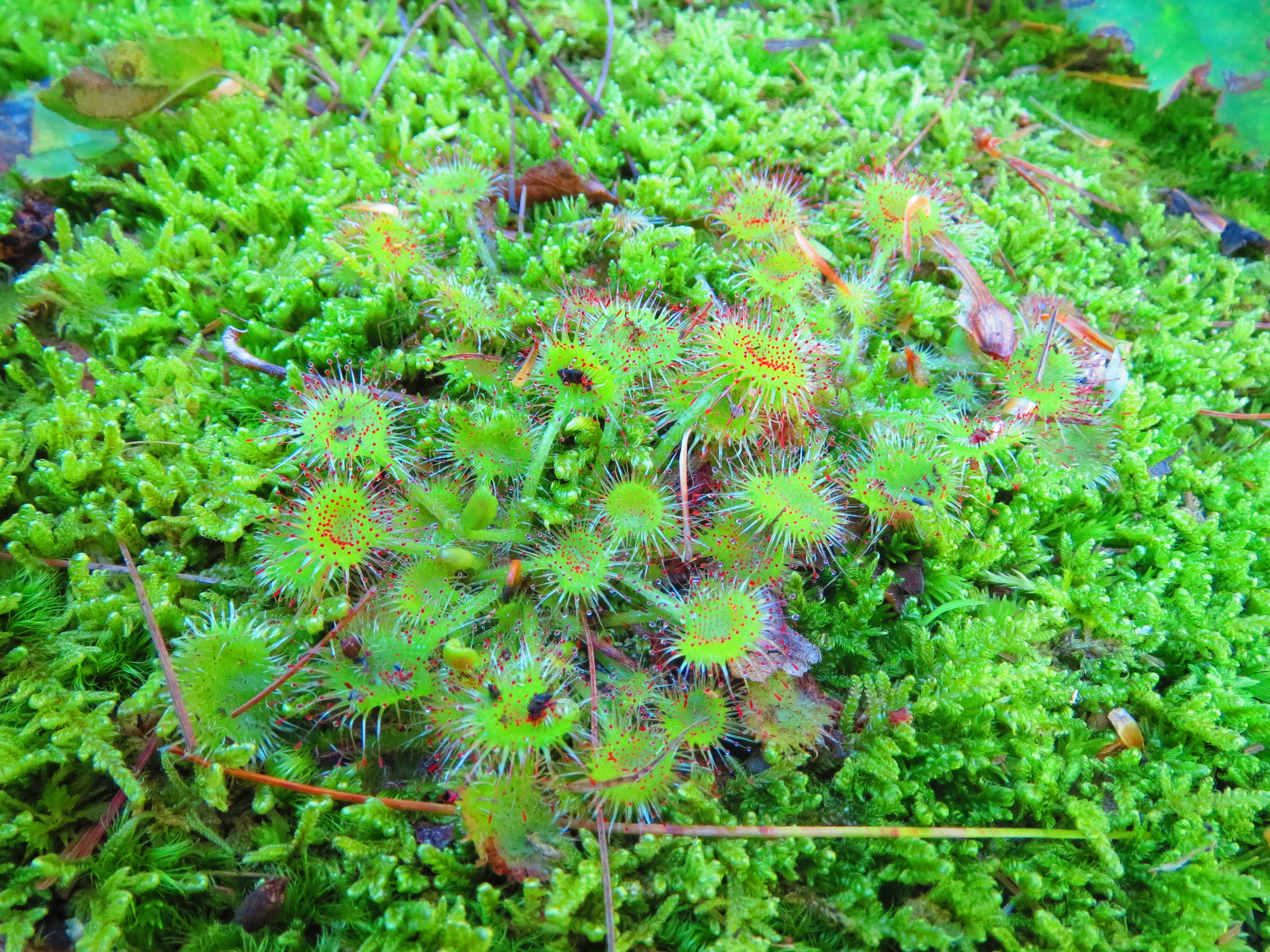
There are 3 species of sundews in New York, the round-leaved sundew (Drosera rotundifolia), thread-leaved sundew (Drosera filiformis) and the spatulate-leaved sundew (Drosera intermedia). Sundews get their name because their leaves look like they are covered in morning dew, however on closer inspection, this “dew” is actually tiny globs of digestive juices created by the plant. An insect will mistake the dew for water and upon landing, become ensnared in the sticky digestive juices of the plant. Large insects may leave legs and wings behind and smaller insects fall prey to the plant. Some species of sundew will curl their leaves around the insect to further trap their prey. Sundews can be found state wide in swampy/bog habitat, often growing alongside pitcher plants and bladderworts.
This is the round-leaved sundew. Notice the many fine hairs with droplets of shiny – glue like digestive juices that insects mistake for water. Photo by Lilly Schelling, OPRHP.
Conserving bog habitat is important for the survival of the various unique plant and animal species that have adapted over time to live there. This type of habitat faces many threats such as development and road and agricultural run-off. Run-off rich in fertilizer from road sides or farming can be disastrous for these habitats and the species that have adapted for living in nutrient poor conditions. Additionally, always remember to leave nature as it is. Though carnivorous plants are marvelously beautiful and fascinating, leave them where they are! If you wish to cultivate these plants in your own home try your local green house or the vast array of stores on the internet.
Post by Lilly Schelling (OPRHP Wildlife Unit).
Photos by OPRHP and NY Flora Atlas (see citation below).
In August 2011, Hurricane Irene and Tropical Storm Lee devastated the Catskill Mountains and Schoharie Valley with a torrent of wind and rain. Several bridges were washed out, including the historic Blenheim Covered Bridge located just north of Mine Kill State Park. A culvert over a tributary of the Mine Kill on the Long Path was subsequently destroyed. On June 6th, the Student Conservation Association (SCA), Long Path North Hiking Club and New York State Parks will join together to construct a new bridge spanning 40 feet over the drainage to once again allow safe passage over this creek for hikers.
SCA Hudson Valley AmeriCorps members remove invasive species in the Habitat Garden at Hudson River Park in Manhattan.
SCA Hudson Valley AmeriCorps members working to replace interpretive signage along the trail at Esopus Meadows Preserve.
SCA Hudson Valley AmeriCorps members are all smiles after completing a new section of trail including split rail fencing at Saratoga Spa State Park.
Every year, on the first Saturday in June all across the country, people celebrate National Trails Day by getting out and going hiking, biking, geocaching and more. National Trails Day is not only about getting out and recreating, but is a great day to give back and volunteer on projects helping to build and maintain trails that we all love and enjoy. This year, three Trails Day projects will be organized and led by SCA AmeriCorps members at Mine Kill State Park in North Blenheim, John Boyd Thacher State Park in Voorheesville, and Hudson River Park in Manhattan. These projects not only accomplish vital work on trails in the region, but also provide SCA members with valuable experience in project management and peer leadership.
For many years, the SCA Hudson Valley AmeriCorps program has been partnering with New York State Parks, Recreation and Historic Preservation as well as New York State Department of Environmental Conservation and several non-profit organizations providing internships across the Hudson Valley region. Currently, 46 SCA members serve for up to ten months at sites from Saratoga Springs to New York City. To learn more about the SCA and Trails Day projects you could get involved in, visit www.thesca.org/events.
Post by Nick Marcet, Student Conservation Association (SCA). Photos by SCA.
Each year staff from NYS Parks’ Environmental Management Bureau (EMB) Water Quality Unit coordinates water quality monitoring programs for State Park beaches and lakes. The overall goal of EMB’s Water Quality Unit is to balance safe and enjoyable recreational opportunities with the environmental protection of our water resources. Since a substantial portion of attendance within the State Park system is associated with water use and enjoyment, it is important to assure that these facilities are operated in a manner that is both safe for patrons and protects the resource for future visitors. Water resources also need protection since they provide critical habitat for wildlife and ensure the proper functioning of ecosystem-level processes.
Keeping Park Beaches Healthy
NYS State Parks operates 77 beaches with lifeguards at 60 state parks. These beaches are located on lakes (including small lakes found within the borders of state parks, the Finger Lakes, Lake Chautauqua, Lake Champlain, and the Great Lakes), streams (including Enfield Creek and Dry Creek), rivers (including the Niagara and St. Lawrence), and the ocean (including the open ocean, bays, and Long Island Sound).
To keep the beaches healthy, NYS Parks staff must properly maintain beaches, monitor water quality, close when necessary, train staff, and educate patrons about safe swimming practices. Some of the tasks that Water Quality Unit staff do to help sites safely operate beaches include:
provide water quality training and assist park staff with site-specific questions and needs
distribute water quality educational materials
conduct research studies to learn more about the water quality of select beaches
maintain databases of beach monitoring results, contacts, and closures
work with outside Agencies (e.g. DOH, EPA, USGS) to develop models of beach water quality and expand knowledge on beaches
Moreau Beach in the Saratoga-Capital Region.
Sandy Island Beach in the Central Region.
Cherry Plain Beach in the Saratoga-Capital Region.
Maintaining Healthy Lakes in NYS Parks
There are approximately 180 lakes and ponds in the State Park system. These lakes provide important habitat for fish and wildlife and are enjoyed by many park visitors each year.
EMB staff have monitored over 125 lakes, ponds, and reservoirs since 1999. The goals of EMB’s lake monitoring program are to:
conduct targeted monitoring studies of lakes of significance or concern
maintain databases on lake water quality
compile lake reports regarding lake characteristics for priority sites
determine the degree of impairment, if any, for each lake
assist regional and park staff in lake restoration projects and with site-specific questions and needs
Karen Terbush assists with a mycelium installation project at Lake Erie State Park. The aim of the project is to reduce bacteria levels in a stream that feeds into the former beach area.
Melyssa Smith and Dan Munsell monitor water quality on Lake Minnewaska.
Lauren Townley records water quality data in the Finger Lakes region.
2012 Water Quality Team Distinguished Service Award
Commissioner Rose Harvey presented EMB’s Water Quality Team with a Distinguished Service Award for their extraordinary team accomplishment and dedicated professional service in working to protect NYS Parks streams, lakes and bathing beaches.
For more information about the Water Quality Team’s work in NYS Parks please contact the Environmental Management Bureau.
Post by Susan Carver, OPRHP. Photos by John Rozell and Water Quality Unit.
Famed biologist E.O. Wilson claimed that the introduction of invasive species is second only to habitat destruction as the leading cause of biodiversity loss worldwide. The New York State Office of Parks, Recreation and Historic Preservation (Parks) is taking on this challenge to protect our biodiversity and reduce the introduction of invasive species in our waterbodies. The problems we have with invasive species in New York state, especially in aquatic ecosystems, are well known and pervasive. Aquatic invasive species (AIS) degrade habitat for native plants and animals, outcompete native species for food and resources, impair swimming, fishing, and boating opportunities, and cost the state millions of dollars to control them each year.
In an effort to protect our New York State Parks from the costly effects of AIS infestations, Parks has adopted a new regulation. The regulation states that a boater:
shall not launch or retrieve their watercraft from a Parks-owned boat launch facility unless the watercraft’s water-containing compartments (livewell, bilge, bait bucket) are dry
has inspected the watercraft to ensure that there is not plant or animal material attached to the motor, trailer, body of the vessel, etc.
A Parks Boat Steward conducting a watercraft inspection at Keewaydin State Park. Photo by Megan Phillips, OPRHP.
AIS watch cards and other educational materials are available at the Boat Steward stations. Photo courtesy of OPRHP.
Invasive water chestnuts collected from a watercraft in the Thousand Islands region during a routine inspection in 2014. Photo courtesy of OPRHP.
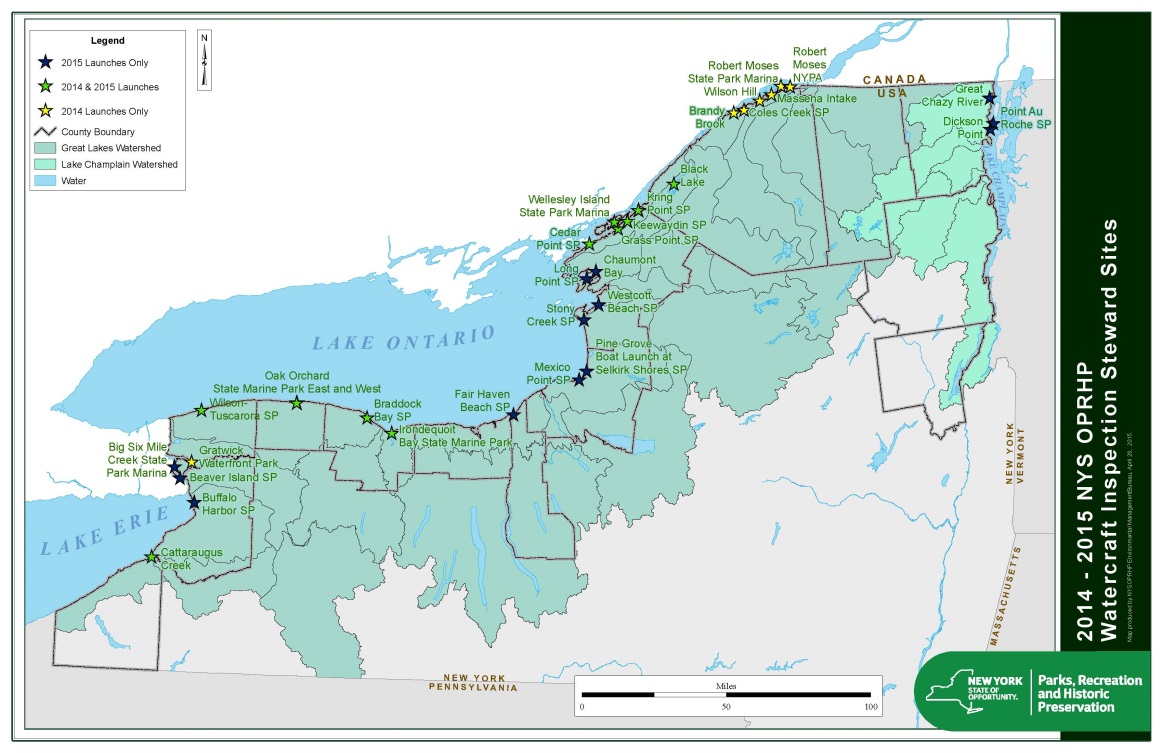
Boaters and anglers may also encounter a friendly Parks Boat Steward clad in red at facilities on the Great Lakes or Lake Champlain this summer. Stationed at twenty-one boat launches, the ten Boat Stewards conduct voluntary watercraft inspections for visiting boaters, and will work with the boater to remove any plant or animal material that may be on their vessel or trailer. The Boat Stewards are equipped with AIS publications, specimens, and information about the newly adopted regulation. They do not play a role in the enforcement of the regulation, but rather serve as educators for Parks visitors.
Map of boat launch sites where Boat Stewards will be on site. Created by Melyssa Smith, OPRHP. Click on map to enlarge.
Many Parks-owned boat launch facilities across the state are also equipped with disposal stations for aquatic plant or animal material. The disposal stations are specifically designed to provide a place for plant or animal material to dry out in an upland area.
A conveniently located AIS disposal station at the Buffalo Harbor boat launch.
For more information about AIS in New York State, please visit http://nyis.info.


 While conducting field work in Clarence Fahnestock State Park the Environment Management Bureau’s Wildlife Unit came across this large female snapping turtle in early June. This female snapping turtle was observed digging a hole in the sandy soil to lay her eggs. This time of the year a variety of wildlife are giving birth or nesting to produce this year’s offspring. Turtles, as you may know, do not move very fast on land and tend to get hit by vehicles while attempting to cross the road. Please watch out for them on the roadways! Snapping turtles and turtles in general look for sandy soils that are easy to dig in to create their nest and lay their eggs. Nesting can take place quite a far distance from water. This is okay! Once hatched, the baby turtles will find their way back to a water source nearby. Get out in nature, experience our beautiful wilderness and all it holds, but please remember to not disturb these natural processes and give wildlife some space to be wild.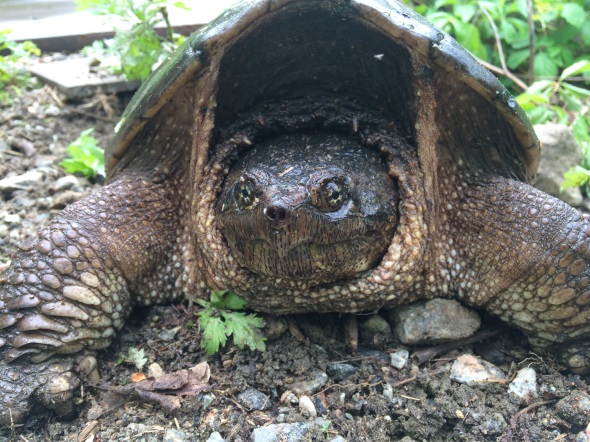
![Purple pitcher plants have tall stalked flowers, keeping pollinators away from the hungry mouths of the pitchers. Weldy, Troy, David Werier, and Andrew Nelson. 2015 New York Flora Atlas. [S. M. Landry and K. N. Campbell (original application development), USF Water Institute. University of South Florida]. New York Flora Association, Albany, New York.](https://nystateparks.blog/wp-content/uploads/2015/06/flower-sarracenia_purpurea_andrew-nelson_58.jpg)
![Bladderworts primarily have one flower per stalk. Most species in NY have yellow flowers. Weldy, Troy, David Werier, and Andrew Nelson. 2015 New York Flora Atlas. [S. M. Landry and K. N. Campbell (original application development), USF Water Institute. University of South Florida]. New York Flora Association, Albany, New York.](https://nystateparks.blog/wp-content/uploads/2015/06/bladderwort-flower-utricularia_gibba_andrew-nelson_020919_02.jpg)



 New York State Parks and Historic Sites Blog