All posts by New York State Parks

Blue Green Algae Alert!

Algae is usually just a fact of life when visiting natural bodies of water, whether it be the ocean, a lake, or a swimming beach at one of our New York State Parks. Unhealthy ponds can sometimes be choked with thick layers of goopy green algae but, for the most part, algae are a harmless and valuable part of a healthy ecosystem.

Some algae, however, produce toxins that are dangerous for people and animals. Blue-green algae (BGA) is one of these. BGA isn’t really an algae at all. It is a little organism called a cyanobacteria which which is naturally present in low numbers in our freshwater ecosystems.

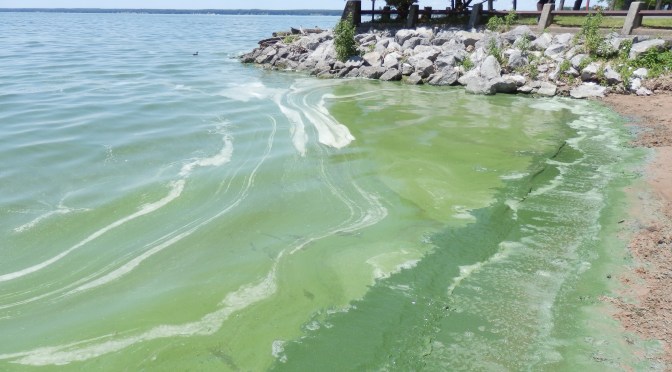
Blue Green Algae leaves a scummy layer on the shoreline

Like algae and other plants, these bacteria create energy using photosynthesis, but unlike plants, some species of cyanobacteria produce harmful toxins. In bodies of water with unnaturally high levels of nutrients, usually caused by fertilizers, stormwater runoff, or faulty septic systems, BGA can discolor the water and form a visible scum across the water’s surface. This is called an algal bloom.

Blue-green algae can be blue-green or green-brown in color, often resembling pea-soup. Unlike non-toxic algae, which is stringy or hairy in texture, blue-green algae is slick and slimy, appearing as spilled paint on the water’s surface. BGA is often accompanied by a musky odor. However, BGA can vary in appearance, and so all suspected BGA blooms should be avoided.

BGA leaves swimming areas unsafe for humans and animals

Unfortunately, many BGA incidents have directly affected dogs. Swimming in BGA-affected waters is risky for humans and pets, but dogs are more likely to jump into slimy and foul-smelling water, and then lick the algae off their fur. Contact with BGA can cause rashes and swelling, and ingestion can lead to difficulty breathing, stomach pain, nausea, and in severe cases, convulsions. Ingesting BGA can be fatal for dogs, and so if you suspect your pet has come into contact with BGA, wash her off with clean water immediately.

The best way to prevent BGA blooms is to prevent nutrient runoff into water bodies. Monitoring is being conducted around the state by state park staff and by private citizens.

If you see a suspected BGA bloom, be sure to keep children, pets and livestock away from the water. If you’re in a State Park, notify a lifeguard or any park staff immediately, or contact the Environmental Management Bureau’s Water Quality Unit (Water.Quality@parks.ny.gov; (518) 474-0409). Otherwise, contact your regional DEC office (http://www.dec.ny.gov/about/50230.html) or the Division of Water (518-402-8179)

Benthic Barriers in Rudd Pond

No one likes to hop into the water on a hot day and find a slimy, tangled forest of plants. In many state parks, aquatic invasives plants encroach on public swimming areas, ruining recreational areas as well as habitat for native species in the same lakes and ponds. At Rudd Pond in Taconic State Park in Columbia County, a simple management strategy may prove to be an effective way to protect a swim area against unpleasant and unwelcome weeds.

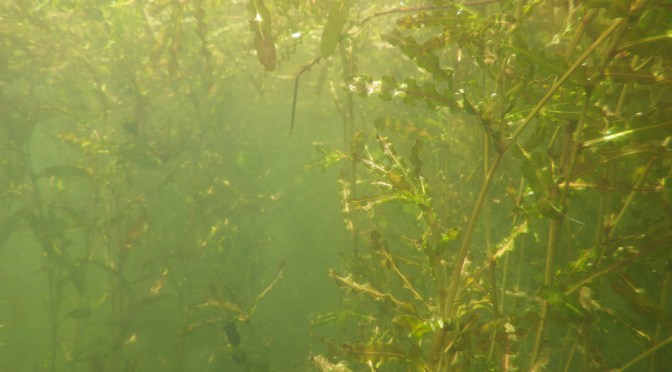
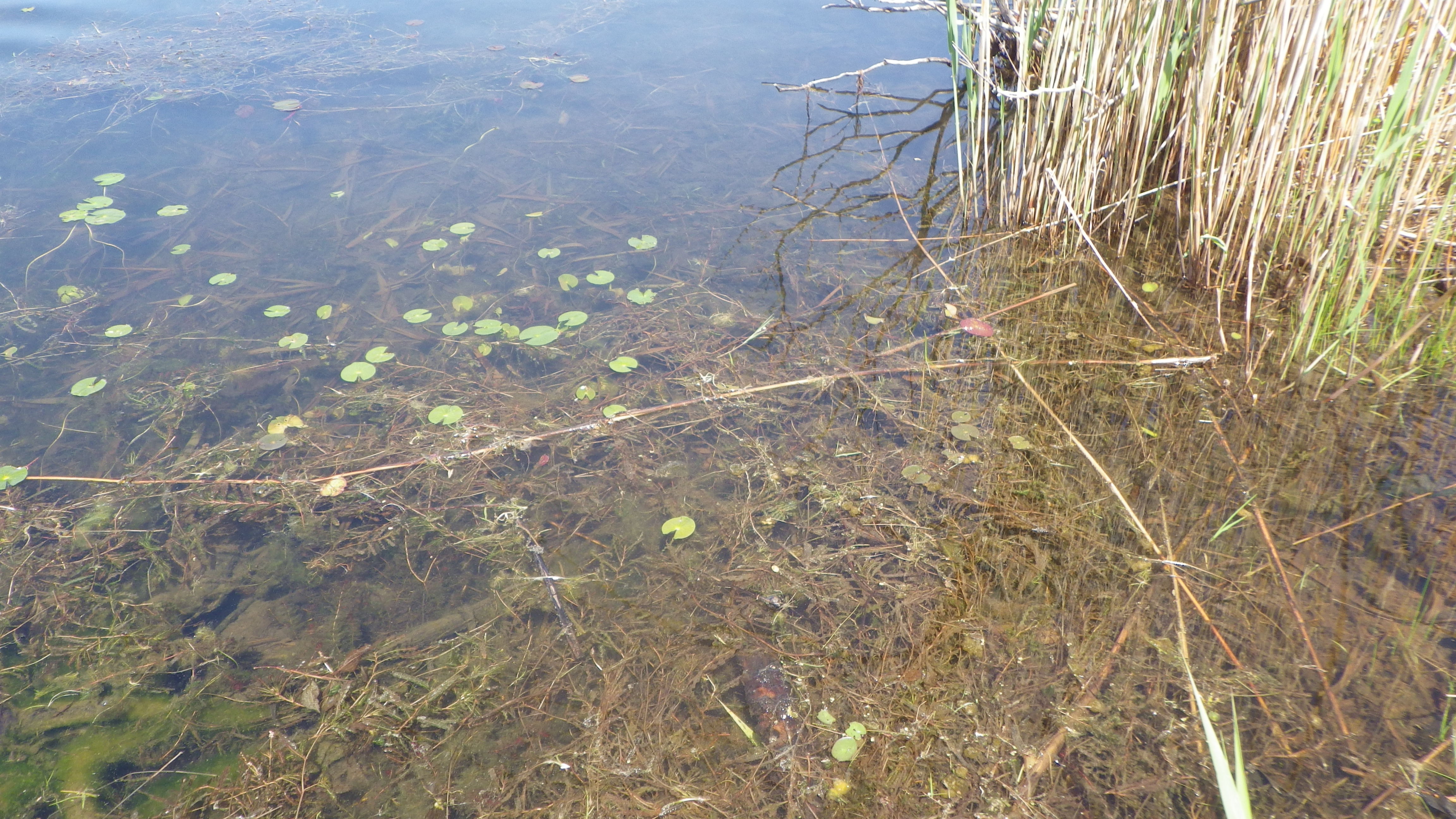
Eurasian watermilfoil and water chestnut grow densely along the shoreline of Rudd Pond.

Rudd Pond, at the southern end of Taconic State Park, is a popular swimming and fishing area, supporting populations of panfish, largemouth bass, and chain pickerel. Unfortunately, the pond also supports thriving populations of aquatic invasive species including water chestnut, curly pondweed, and Eurasian watermilfoil.

Benthic barriers are porous mats that are placed on the bottom of a lake or pond. They restrict sunlight from reaching the lake bottom in the areas where they are installed. The absence of sunlight restricts the growth of aquatic plants.

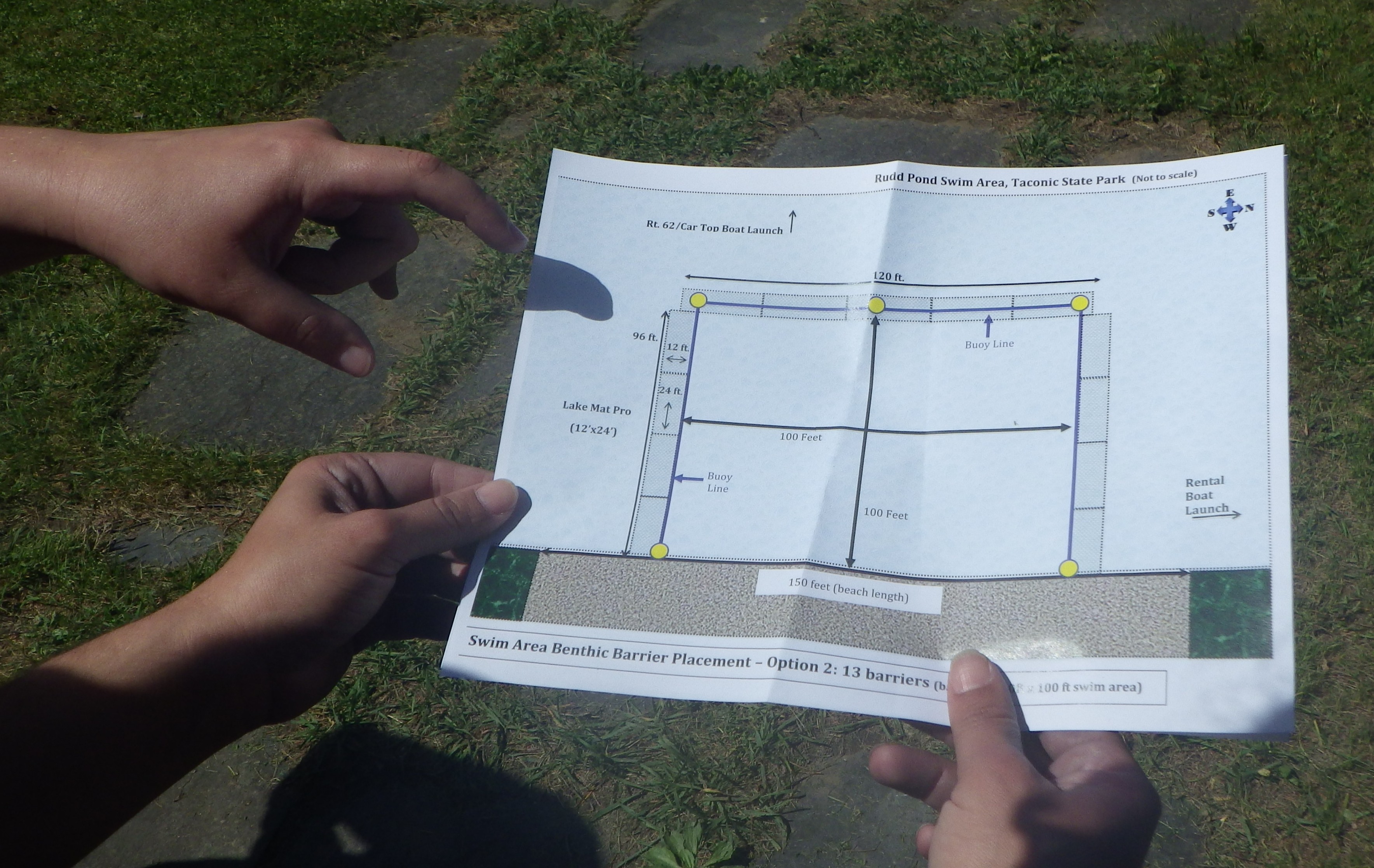
The benthic barrier mats were placed all around the swimming area.

The benthic mats are used to create a buffer zone to prevent aquatic invasive species from threatening the utility of the public swimming area. An aquatic weed harvester is used to cut the plants below the surface in the main part of the pond. However, harvesters do leave behind fragments of plants that can regrow. There is no single perfect solution to managing aquatic invasives, but the use of several management strategies continues to show improvement at Rudd Pond.

The mats were assembled on land, and then the water quality unit placed them in the water
The mats were assembled on land, and then the water quality unit placed them in the water. Some park staff donned SCUBA suits to position the deeper mats!

Check out the NYS Parks poster on preventing the spread of aquatic invasive species

Featured image is of curly-leafed pondwater underwater adjacent to the Rudd Pond swimming area. Photos and post by Paris Harper.

95 Years of Environmental Education

This August, the Regional Nature Museums at Harriman State Park, Orange County, will be celebrating 95 years of environmental education. Instituted in 1919 by Benjamin “Uncle Bennie” Babbit Talbot Hyde, the nature program at Harriman is one of the longest-running in the country. Currently, the Regional Nature Museums consists of four facilities at Tiorati, Twin Lakes, Kanawake, and Stahahe, supported by the Trailside Museum and Wildlife Center at Bear Mountain State Park.

Celebrate 95 of nature education at Kanawake Museum at 10am on August 8th. This free event will feature programs and games run by the museum staff, including storytelling, animal demonstrations, museum tours, local history, and much more!

For more information, see the NYS Parks events calendar

Green Parking At FDR State Park

A project at Franklin Delano Roosevelt State Park aims to redesign the 6.2 acre parking lot in order to greater serve the goals of environmental sustainability and stewardship. The project will rehabilitate the lot’s surface, improve the efficiency of the parking layout and improve drainage and storm water runoff quality. The new parking lot will feature native trees and vegetation to visually soften the hard surface of the parking lot. Ultimately, the redesign will create a more welcoming and pleasant entrance experience to patrons visiting the popular pool and provide important benefits to the park’s wetland and lake by reducing the amount of nutrients (e.g. phosphorus) and typical parking lot pollutants that are currently flowing into these resources untreated.

This is a joint project between NYS OPRHP and the NY Department of Transportation (DOT). DOT has been tasked with reducing phosphorus loading from storm water runoff from public highways and other impervious surfaces within the Croton watershed. They identified the large pool parking lot at FDR as a project that would help them meet their phosphorus reduction goals. As this lot is in need of rehabilitation, DOT’s assistance with its upgrade will result in a net benefit for both agencies. DOT will provide design and construction management funding and assistance. OPRHP will fund the construction contract.

 The Environmental Impact of Parking Lots

Parking lots can be bad for the environment for many reasons. More pavement means less green space, thereby reducing the number of trees and plants that serve as natural “air cleaners” by absorbing carbon dioxide in the air and releasing oxygen. It also means less open soil that can collect rainwater, which helps to replenish natural aquifers. Impervious surfaces, like asphalt, don’t allow rain to percolate into the ground; instead they channel rainwater to a storm drain. Stormwater runoff can be highly polluted with oil, grease, coolant, and other fluids which leak out of cars and collect on pavement until rain washes it into our lakes and streams, negatively impacting our health as well as the habitat and living conditions of fish and other aquatic life.

Another negative effect of parking lots is that they raise local temperatures through a process known as the “heat island” effect. Asphalt and concrete absorb and retain heat from the sun’s rays more than the surrounding ground. This in turn raises surrounding temperatures a few degrees.

The Project at FDR State Park

FDR State Park is located along the Taconic State Parkway, approximately 40 miles north of New York City. The park offers day use recreational facilities including picnicking, trails, fishing and boating and areas for field games. One of the central features of the park is a large outdoor pool that can accommodate up to 3,500 bathers at a time. The park is popular with local residents for walking, hosts many events throughout the year and is also used for winter activities.

To accommodate all these visitors, FDR State Park also has a very large parking area. The lot is 6.2 acres in size and primarily services the pool complex during the summer. It is also used year-round for access to nearby trails, picnic areas, and events. Storm water drainage from the existing lot is directed to storm drains that flow to a nearby wetland and then into Mohansic Lake, a large lake within the park.

Bioswales are landscape elements designed to filter silt and pollution from surface runoff water.

The primary elements of the proposed design include:

  • Parking Lot – The existing asphalt surface will be removed and replaced. The removed asphalt will be milled and reused or recycled. In addition, approximately 15,000 square feet of asphalt will be removed from an adjacent service road entrance and replaced with grass.
  •  Storm water treatment – The proposed plan includes the construction of new bioswales throughout the lot which will consist of a combination of soil, cobbles and native vegetation. Storm water drainage will flow into these areas before entering into the existing storm water drainage system. These bioswales will allow for biological filtration and treatment, breaking down many of the nutrients and pollutants found in typical storm water runoff. Native trees, shrubs, and ornamental grass species will be planted to reduce the lot’s heat island effect, improve aesthetics, and provide shade and wind breaks. Below is a photo of a typical bioswale that is similar to what will be installed.

green parking 1

BioBlitz results!

On May 3, 2014, over a hundred volunteers with scientific backgrounds gathered at Minnewaska State Park Preserve in Ulster County and Clark Reservation State Park in Onondaga county for two concurrent Bioblitzes, 24-hour inventories of the park’s biodiversity. Our objectives were to search the park for as many rare species and natural communities in the park as we could find. This was a collaborative effort between NY Natural Heritage Program (NYNHP), State Parks, and Parks & Trails New York. Participants included biologists with various specialties and affiliations including NYS DEC, NatureServe, Syracuse University, SUNY-ESF, Mohonk Preserve, U.S. Geological Survey, and the Student Conservation Association. At least 9 different organizations were represented.

Rhodora (Rhododendron canadense), a rare plant documented at Minnewaska. Photo by Alyssa Reid

The main survey period was between 9am and 5pm on May 3rd, but some intrepid volunteers stayed through the night to look for nocturnal animals, while others arose on May 4th between 5am and 11am to identify spring migratory birds. In both parks, small teams sought out rare species and high biodiversity areas. The weather was overcast and cool on May 3rd, which made some of the surveys particularly difficult.

At Minnewaska State Park, we were able to document approximately 262 plants, animals, and fungi, as well as 7 of the NYNHP significant natural communities. The summary of our findings includes at least 100 plants and 150 animal species: 89 birds, 6 fish, 16 herps (amphibians and reptiles), 16 mammals, and 23 invertebrates. The species included cool mammals like the American mink (Neovison vison), shy amphibians like the northern dusky salamander (Desmognathus fuscus), delicate insects like the spring azure (Celastrina ladon), and steadfast trees like the American chestnut (Castanea dentata).

Painted turtle, by Matt Schlesinger, NYNHP

At Clark Reservation, we documented over 372 different species of plants, animals, and fungi and updated records for the 4 high-quality natural communities known in the park. The tally includes 193 species of plants (including lichens) and 96 species of animals, including 6 mammals, 7 herps, 46 birds, 4 fish, and 116 invertebrates. Of the many invertebrates identified, some of the largest groups were beetles (18), millipedes (10), caddisflies (10), and snails (6). The list of species included some entertaining names, such as bugle sprite (a snail), poverty grass, tortured tortella moss and seductive entodon moss. The Bioblitz proved to be an invaluable opportunity to get experts out in the park cataloging groups of species, like mosses and snails, which are often overlooked in typical biological inventories.

Due to the timing of the Bioblitz to coincide with I Love My Parks Day on May 3rd, our bird surveys included both passing migrants and potential park residents. Whip-poor-wills (Caprimulgus vociferous), a species of special concern, were sighted in several locations at Minnewaska, and based on last year’s NYNHP surveys, they are known to nest in the park. At Clark, the highlights were osprey (Pandion haliaetus) and sharp-shinned hawk (Accipiter striatus), both of which are species of special concern in New York.

The invertebrate team working hard at Clark Reservation. Photo by Julie Lundgren

The bioblitz was an extension of the long-standing partnership between NYNHP and State Parks to document rare species and natural communities in New York State Parks. Scientists found a wealth of biodiversity and enjoyed collaborating across organizations and areas of expertise in a beautiful natural setting. We hope to continue these valuable efforts to bring experts together to share knowledge, contribute to our understanding of the biota in New York State Parks, and to encourage further opportunities for park staff and the public to learn more about the special features in parks.

featured image is a spring azure butterfly by Mike Adamovic, post by Paris Harper, Erin White and Julie Lundgren