All posts by New York State Parks

Wonders of the Winter Beach

Getting cabin fever? Well, bundle up and take a trip to a beach-front state park! Lake Ontario, Lake Erie, Lake Champlain, Long Island parks or the many parks on small lakes: Glimmerglass, Green Lakes, Long Point-Chatauqua Lake, Allegany, or many others.

This is the time to explore the many interesting patterns and colors of wintertime “icescapes.”


For now, enjoy some spectacular views from Southwick Beach State Park and its wild ice formations on the eastern shores of Lake Ontario. With no other visitors in sight on this day, there was no problem for this intrepid explorer to keep safe distances while enjoying the scenery.

During such visits, dress warmly and in layers, as shorelines can be chilly, as well as windy. But it is the wind that makes for fantastic ice sculptures along the shores. Sometimes the nearby trees or dune grasses will be laden with frost and salt spray. Or you may find some interesting driftwood and shells tossed up on the shore by the waves and wind.

Look way out to the water’s edge and you will realize that maybe that is not water but rather the frozen froth of waves forming an icy ridge on the beach.

Finding animal tracks in ice, snow or even frozen sand also is often easier than in other seasons. Look for footprints; can you figure out who has been there?

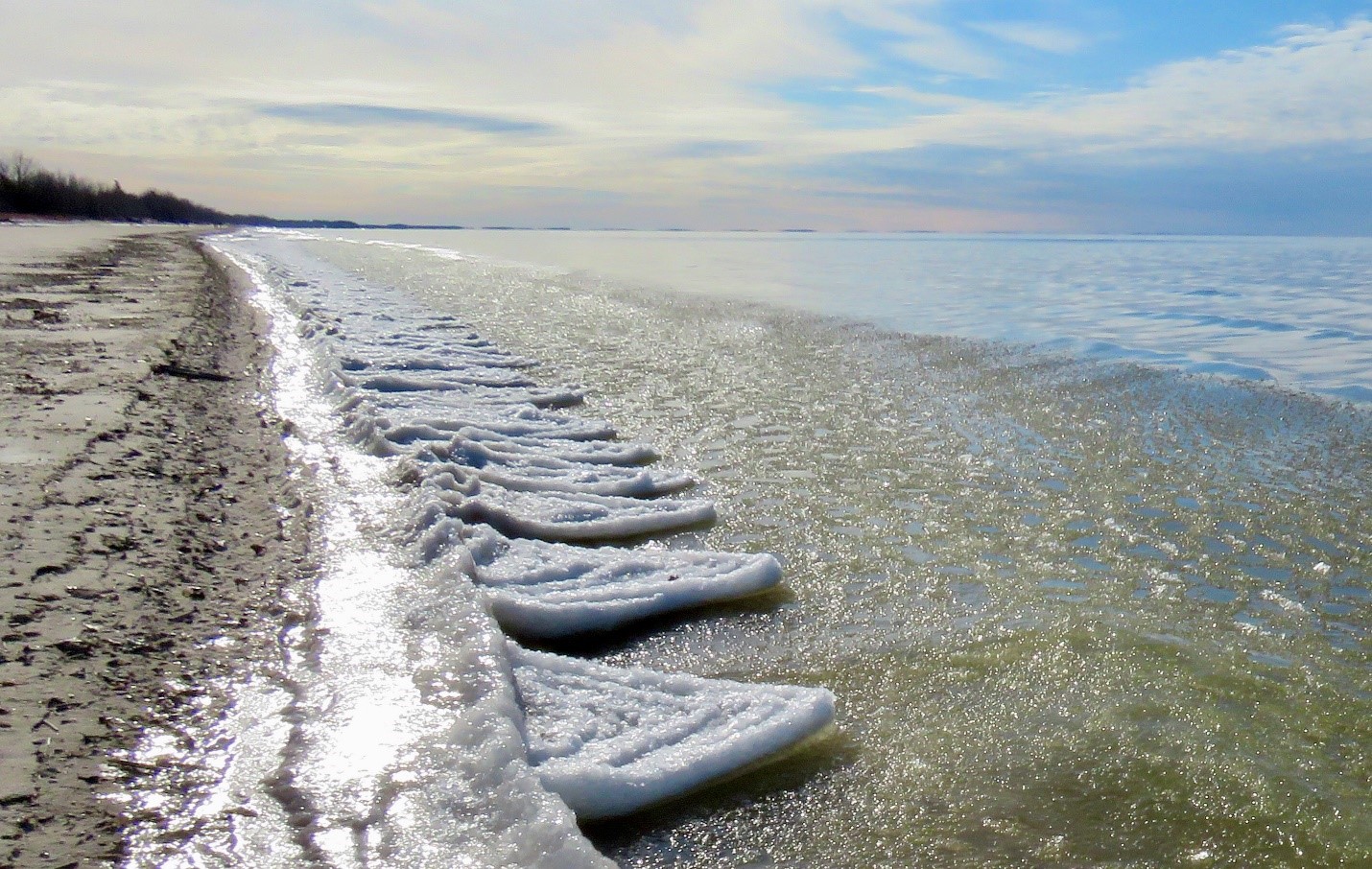
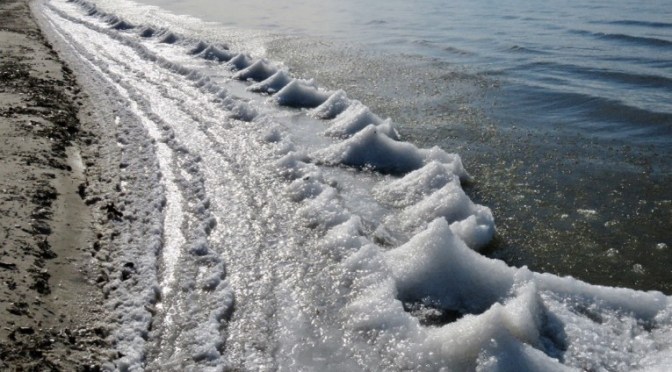
Ice can take interesting or fantastical shapes, as shown by the picture above at Southwick Beach.

How does the ice form shapes like this? A breeze pushes waves against the upper shore and the water at the top edge freezes as it hits the frozen sand. Then thin layers of water build up at the icy edge forming this wild pattern of ledges extending a mile down the beach.
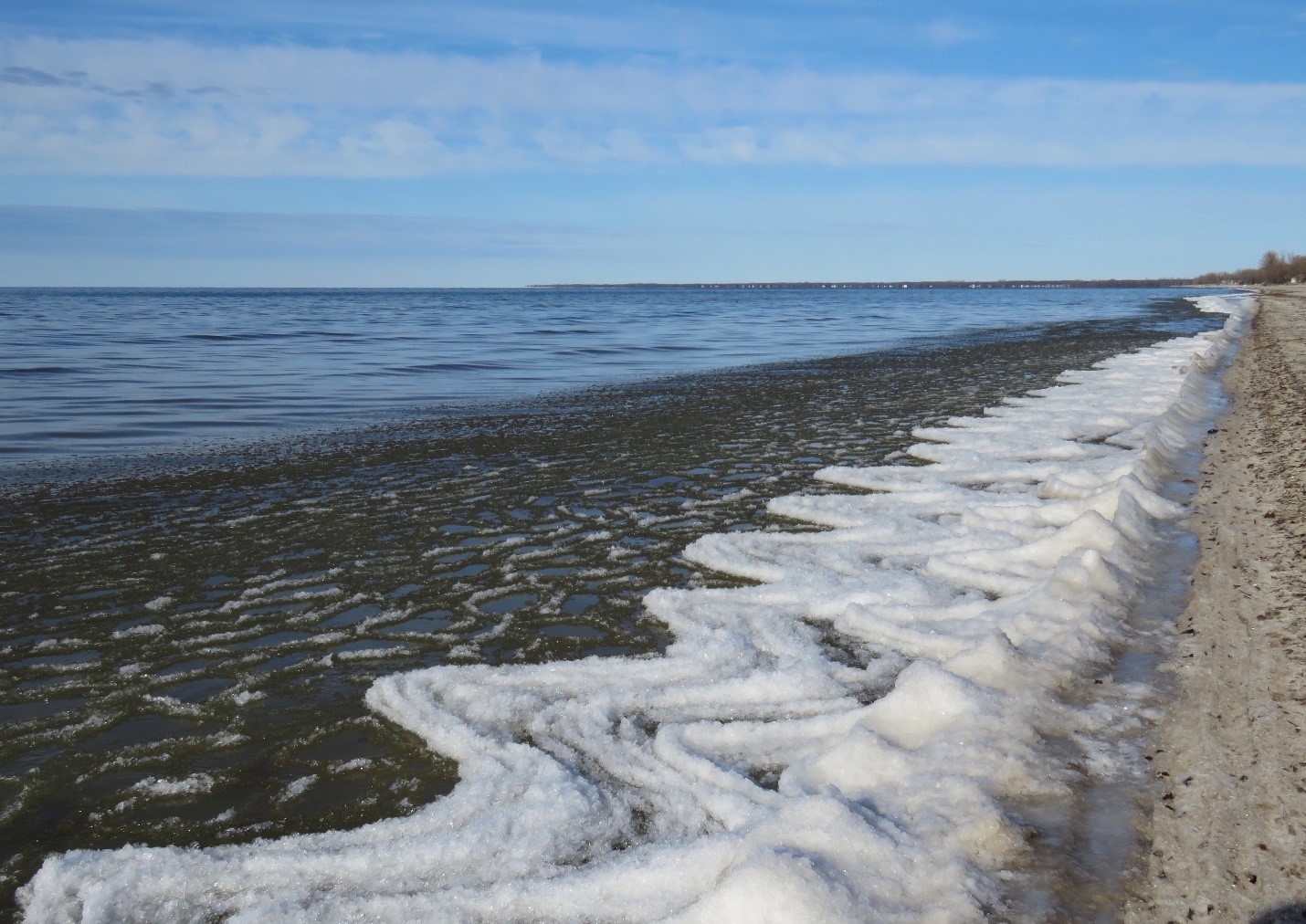
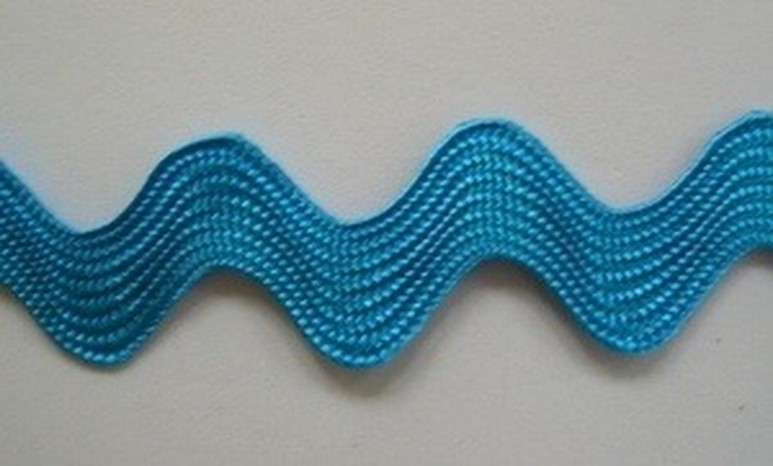
In a different section of beach, the ice forms a pattern much like rickrack, a form of braided trim in a zigzag pattern that was highly popular in the 1960s.


And wintertime can create its own interesting illusions, such as this picture above, in which it appears the forest is floating in the sky above the water. This phenomenon is known as a “superior mirage” which tends to happen in cooler weather, when the air is colder above your line of sight than below. In this case, the air temperature is colder than the lake water. On this day the air was about 20 degrees and the water 40 degrees.

Read more about the science of a superior mirage on Wikipedia.

There is so much to see along our shorelines even in winter. Get out in the fresh air, explore some winter beaches and take pictures to share.


All photos of Southwick Beach State courtesy of Kathy Faber-Langendoen

Post by Julie Lundgren, State Parks Ecologist, NY Natural Heritage Program


Prepare to Explore more of State Parks in the winter by reading these previous posts from the NYS Parks Blog.

Evangola State Park: Lake Erie’s Winter Playground!

Along the shores of Lake Erie, Evangola State Park becomes a winter sports mecca as the lake’s famous lake-effect snowstorms blanket the park! Lake-effect snow occurs when cold, Canadian air moves across Lake Erie evaporating its open waters and causing intense, local snow bands which can drop one to two inches of snow per hour.…

Enjoy Winter – Get the Kids Outside

It’s cold outside, it takes forever to get the kids bundled up and out the door. Is it worth all the trouble? You bet! You don’t need a lot of planning, just a few tips and tricks to encourage kids – and you – to enjoy the outdoors in winter. Bundle Up Look for hats…

Winter Tree Identification Part II: Evergreen Trees

Evergreen means these trees keep their “leaves” throughout the winter. Though we may call them pine needles, they are actually very skinny leaves that serve the same function as the leaves on a deciduous tree. Identifying evergreens during the winter months is almost the same as in spring and summer, with the added advantage of…
Remembering The Queen of The Mist

It is 1901 and the dawn of a new century. The Pan-American Exposition is going on in Buffalo, a world’s fair that was attracting people from all over the world, with many of those visitors taking train excursions to nearby world-famous Niagara Falls.

During the expo, visitation was running between 10,000 to 50,000 people daily at Niagara Falls Reservation State Park. And the attention of these crowds is exactly what Finger Lakes native Annie Edson Taylor wanted to grab.

A 63-year-old widow and retired schoolteacher living in Bay City, Michigan, Annie was in financial straights at that point in her life. Sensing an opportunity in Buffalo, she went there with the idea to become rich and famous by doing something no one had ever done – going over Niagara Falls in a barrel.

People had been barrel-riding the rapids below the falls to much popular acclaim during a time when there were no rules in place for such dangerous stunts. Today, there are laws in place at the falls making it illegal for anyone attempting such actions, which since the 1950s have been subject to prosecution and substantial fine by both the U.S. and Canadian governments.

Inspired by the daring barrel-riders in the Whirlpool Rapids below the falls, Annie had her own barrel made of white Kentucky oak to her specifications by a local company.  Cushions, pillows and a harness were placed inside for protection. The barrel had a tube through a hole so air could be pumped in when the barrel was sealed.

First, the rookie daredevil decided she had to test it. So Annie sent out the barrel with a cat inside for a run over Niagara’s Horseshoe Falls on Oct. 18, 1901. When the barrel washed to shore and was opened, the cat emerged unharmed, boosting Annie’s confidence that she too could survive the 167-foot plunge.

Annie Taylor with her barrel and a cat, possibly the cat that went in the test run over Horseshoe Falls. (Photo Credit – U.S. Library of Congress)

On Oct. 24 – her 63rd birthday – Annie set out with her two assistants, William Holleran and Fred Truesdale, to Port Day on the U.S. side of the river that led to the rapids above Horseshoe Falls on the Canadian side. She had announced her intentions, and onlookers had gathered.

The daredevil had changed into more comfortable clothes – a lightweight blue skirt and blue blouse for her journey. Her assistants tied the barrel to a rowboat, making sure Annie was secured inside before closing the lid. Some air was pumped inside the barrel using a hose, and the men rowed into the river with the barrel in tow.  With the rope cut, the barrel floated off toward the roaring falls.

Annie and her two assistants soak the barrel prior to the trip to help seal it. (Photo Credit – Niagara Falls Public Library)
Annie goes into the barrel before the top is sealed. (Photo credit – Niagara Falls Public Library)
Onlookers are onshore as Annie inside her barrel is rowed into the river above the rapids. (Photo credit – Niagara Falls Public Library)
Annie comes ashore after her plunge, suffering only a few cuts and bruises. (Photo credit – Niagara Falls Public Library)

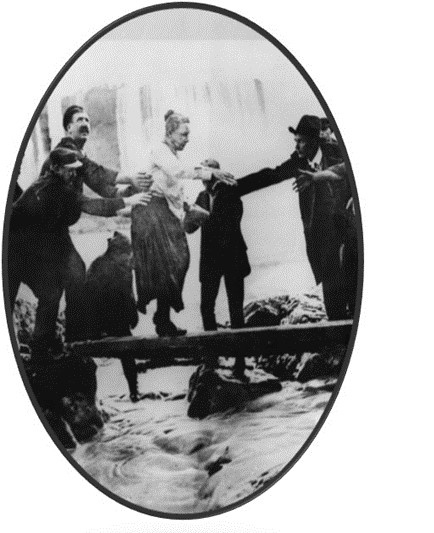
A few minutes later, several men waiting on shore drag the slightly beat-up barrel to the river’s edge on the Canadian side. They remove the lid to see how she has fared. And Annie is alive!

She gets out stumbling, with only minor injuries, for which she is brought back to the U.S. side and taken for medical treatment. Her stunt has worked, and she has made history as the first person to ever go over Niagara Falls in a barrel and survive.

Now, she must have believed her quest for fame and fortune would be rewarded. Making an appearance at the Pan-Am Expo’s last day on November 1 to sensational newspaper headlines, Annie posed next to a barrel, most likely labelled, “Queen of the Mist.”

After this feat, Annie made her home in Niagara Falls hoping to cash in. While she had some immediate fame, fortune was to elude her. She found little success on the lecture circuit and even lost her barrel after it was stolen by her manager.

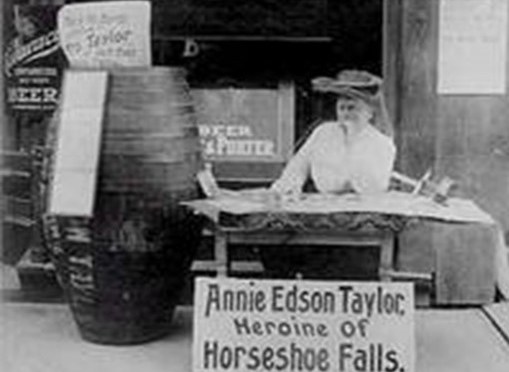
Rather than becoming rich, she was able only to eke out a meager living selling postcards and other souvenirs from a stand in front of a store near the falls. She never attempted any other stunt.

Indigent in her old age, Annie ended up becoming a resident of the County Home in Lockport. She became blind and passed away two decades after her famous plunge at age 82.

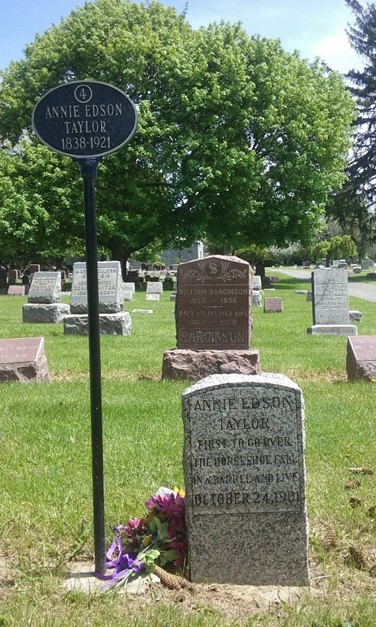
The people of Niagara Falls raised funds to help provide Annie with a burial plot at the historic Oakwood Cemetery in a section called “Stunters’ Rest” for daredevils who have braved the falls, either successfully or unsuccessfully, according to an entry on the cemetery in the National Register of Historic Places.

Other stunters buried there included Matthew Webb who died in 1883 in an attempt to swim the Niagara rapids and Carlisle Graham, who survived a trip through the rapids in a barrel in 1886.

While riches eluded Annie in life, her legacy from a bygone era of daredevils lives on. Her records as the first and oldest person to survive a trip over the falls remain intact, nearly a century after her death.

Annie Taylor’s final resting place in the Stunters’ Rest section of historic Oakwood Cemetery in Niagara Falls. (Photo Credit – Carol Rogers)

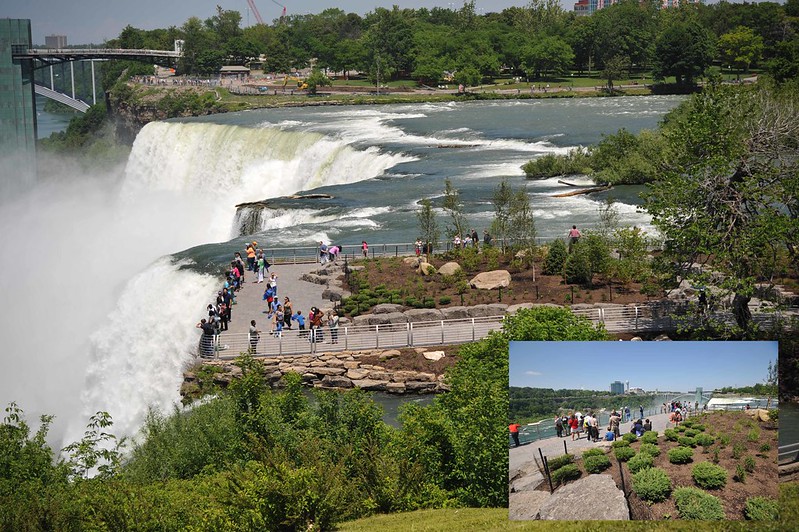
While Niagara Falls are essentially the same as they were in Annie’s time, Niagara Falls Reservation State Park, created in 1885 as the oldest state park in the United States, has undergone major improvements as part of the NY Parks 2020 initiative . The park remains open during the COVID-19 pandemic. Click through this slideshow to take a look…

Cover Photo – Annie Taylor on the street in Niagara Falls at her souvenir stand. (Photo Credit – Niagara Falls Public Library)

Post by Carol Rogers, Environmental Educator, Niagara Region Interpretive Programs Office, NYS Parks

Sources

Niagara Falls Public Library History Department, Niagara Falls

NYS Parks, Niagara Region, Interpretive Programs Archives

Oakwood Cemetery, Niagara Falls

Hope Floats Onto A State Parks Beach

Bill Bohach often walks the beach as manager of Orient Beach State Park at the wild eastern tip of the North Fork of Long Island, checking for erosion left by powerful ocean storms.

When he saw what had washed up one day in December of this year, along a remote section of beach about a mile from the park’s swimming area, he knew it was special. But there was no way he could have known it was the beginning a Christmas miracle for a family still grieving the loss of a daughter in a drunk-driving accident.

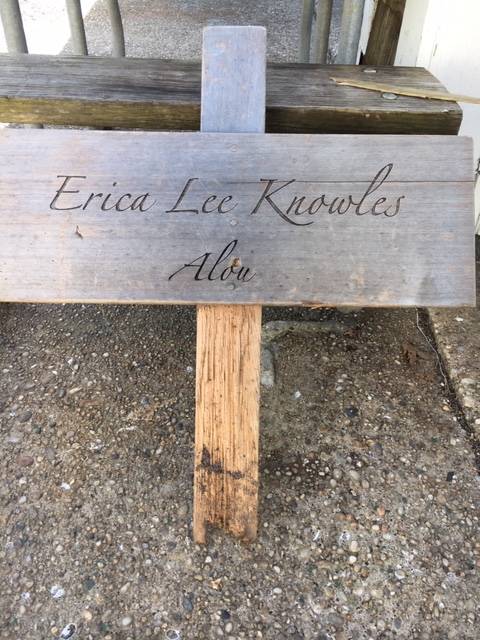
Bohach recognized that the simple wooden sign on a post, which bore the name “Erica Lee Knowles” and the word “Alou” meant something, to someone, somewhere. “The letters had been made with a router, so I knew someone had taken time to make it,” said the 21-year Parks veteran employee.

The weather-beaten memorial sign that Parks Manager Bill Bohach carried off a remote beach at Orient Beach State Park at the eastern tip of Long Island’s North Fork. (Photo Credit- NYS Parks)

So, he picked up the waterlogged sign, carried it the mile back to the park, and took it to the maintenance shop to dry out, placing a note on it warning not to throw it away. Next, came internet sleuthing by Jorge Eusebio, a parks aide, who Googled Erica’s name, and quickly learned of her 2012 death as a passenger in a Rhode Island car crash.

“Once I saw that, it made my mission stronger, to find out whose sign this was,” said Eusebio, who started with Parks in 2017. He located what he thought might be a relative’s name on Facebook, and sent a private message, but got no response. He persisted, locating another name and sending another private message about the sign.

Eusebio had located a cousin to Shiela and John Priore, Erica’s parents, who lived in Georgia, but were heading up to New York for the Christmas holidays in a few days. And Eusebio learned from them that they had placed the sign as a memorial to Erica on Black Point in Narragansett, Rhode Island, a few miles from the accident scene. Black Point is on Block Island Sound about 45 miles east from Orient Beach.

Sometime this year, the memorial had disappeared, apparently the work of vandals who cut the post and discarded it … by throwing it into the sea.

And from there, it had floated, borne by currents and winds, to wash up months later at Orient Beach. The map below shows Orient Beach State Park, on the eastern tip of Long Island’s North Fork (left) and Black Point in Narangansett, Rhode Island (right).

“There are no words to convey how much Bill and Jorge’s act of kindness has meant to us. It was our Christmas miracle,” said Shiela Priore.  “Anytime we get to share Erica with this world is a good one.  On top of recognizing that the cross meant something but to take the time and effort to search for us leaves me speechless.  Our family is forever grateful.  We feel as if Bill and Jorge honored her life and her memory.”

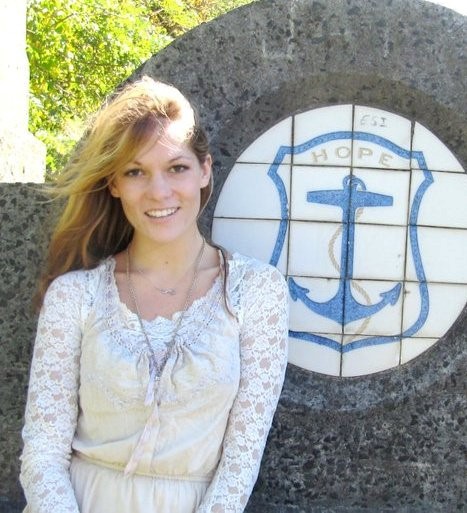
Erica was studying journalism and women’s studies at the University of Rhode Island when she was killed at age 23. The driver in the car she was in was later sentenced to prison time for driving under the influence of alcohol.

Erica L. Knowles (Photo Courtesy of The Priore Family)

Now that the memorial is recovered, Shiela said the family plans to have it placed at a family home on Martha’s Vineyard, a favorite place of their daughter’s where her ashes were spread.

And what of the word “Alou” that is on the sign? “It is how my kids said, `I love you’ when they were small children,” said Shiela.

Both Bill and Jorge recognize their roles in the amazing chain of events against long odds that the memorial would ever again find its way back home to the Priore family. And see the lesson that there is no telling how far a compassionate act might travel.

“I think during these difficult times, this is a message that everyone needs to hear. No matter how it might look, there is still hope,” said Jorge.


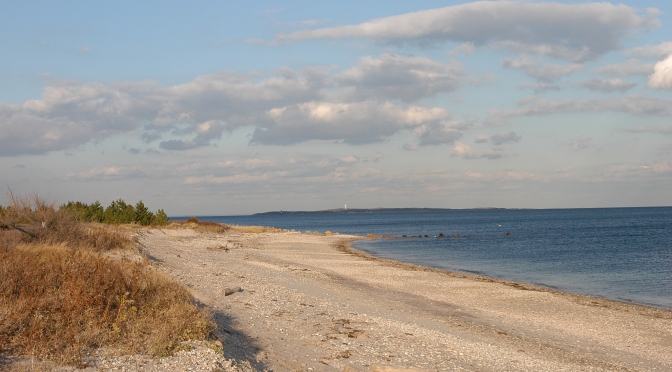
Cover Shot – Beach at Orient Beach State Park (Photo Credit – NYS Parks)

Post by Brian Nearing, Deputy Public Information Officer, NYS Parks.

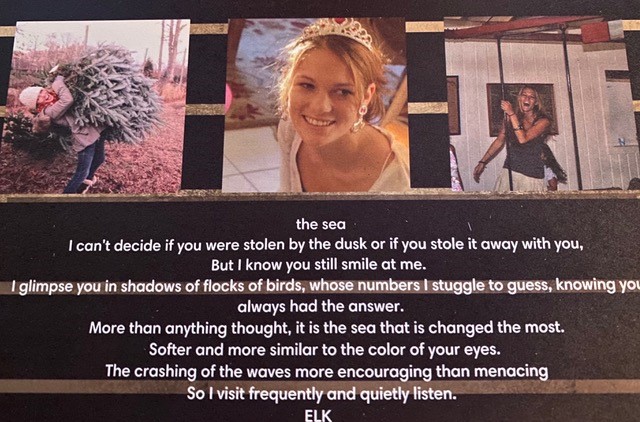
A poem about the ocean by Erica L. Knowles (Courtesy of The Priore Family)

More About Orient Beach State Park


Orient Beach State Park is a natural wonderland of waterfront with 45,000 feet of frontage on Gardiner’s Bay and a rare maritime forest with red cedar, black-jack oak trees and prickly-pear cactus. Its natural beauty earned designation as a National Natural Landmark in 1980. Other natural attractions in the park include the saltwater marsh and marine wildlife. Great Blue Herons, Egrets, Black Crowned Night Herons, and Osprey are common sights in the park, leading to its recognition as an Audubon Important Bird Area.

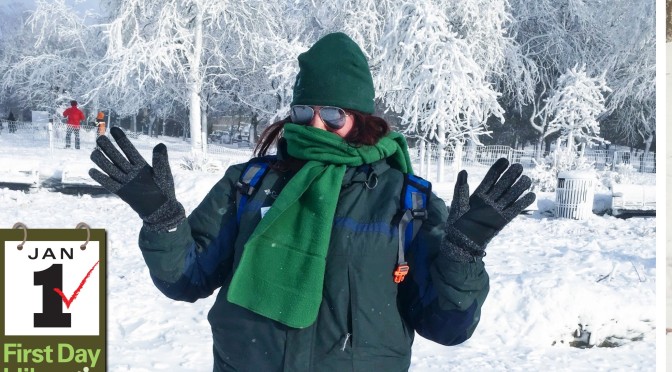
Welcome 2021 With a First Day Hike

It is almost time to put 2020 in the books, and bid farewell to a year that brought so much uncertainty and tribulation into so many people’s lives.

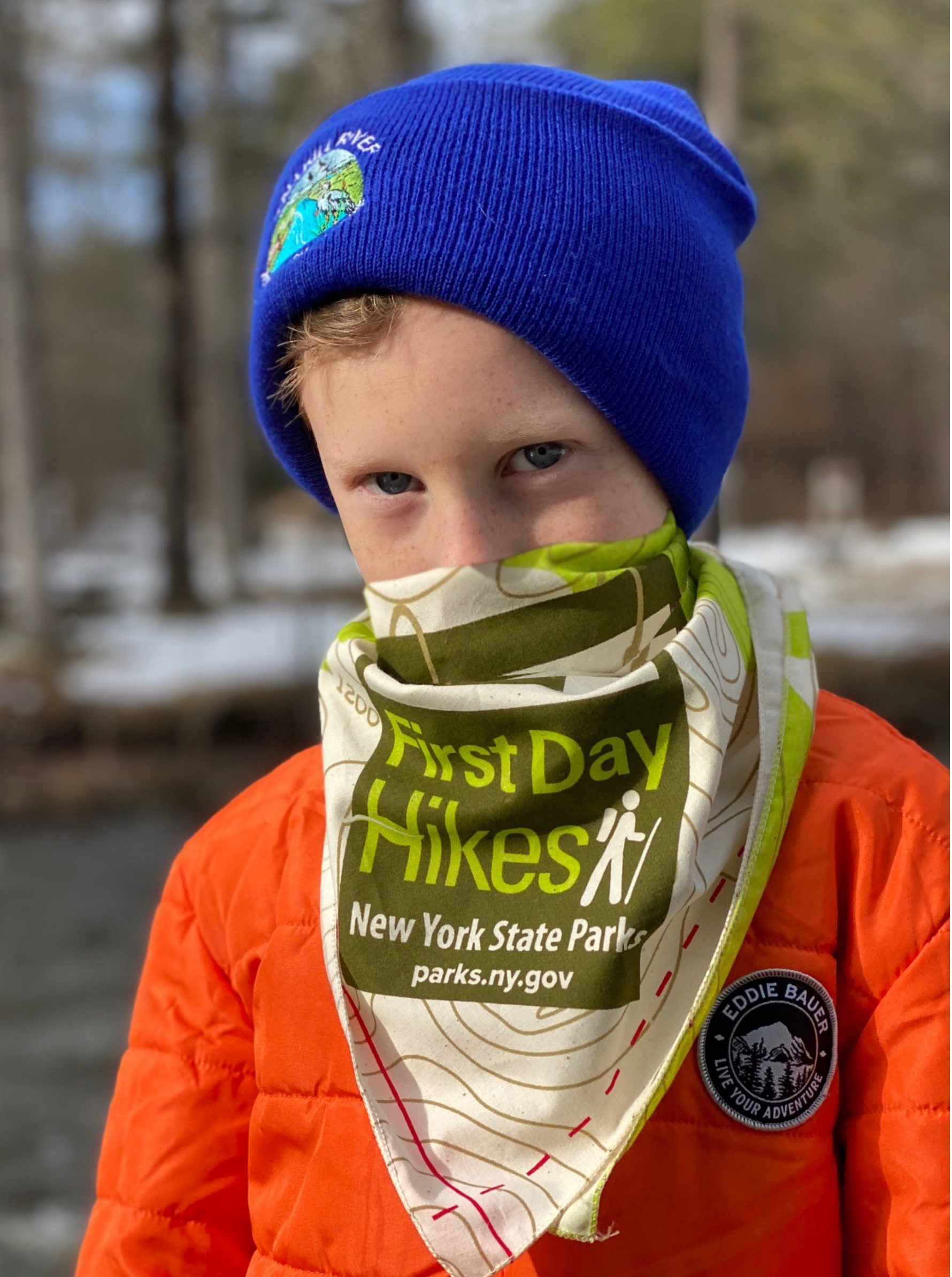
And to help New Yorkers do that, State Parks is again encouraging people to take part in the First Day Hikes program, now marking its tenth year in New York.


Of course, because of the ongoing COVID-19 pandemic, this series of outdoor events will be a little different than before, with the addition of many self-guided hikes, requirements for social distancing, masking and capacity limits.

So, it is more important than ever to check in advance with any specific site that you may be interested in and pre-register if necessary, since restrictions on staff- and volunteer-guided events may limit the number of people who can attend.

The walks, hikes, and self-guided options are family-friendly, and typically range from one to five miles depending on the location and conditions.

So, to give people more options for 2021, many First Day events will now be held multiple times over the course of the first weekend in January.

Hikes are being offered at more than 60 state parks, historic sites, state Department of Environmental Conservation lands, wildlife areas, Forest Preserve trails and environmental education centers.

Click here for a listing of Parks events, or use this interactive map below to locate hikes.

As New Yorkers adapted to COVID restrictions this year, which limited many forms of indoor activities, they turned to healthy and safer outdoor alternatives on hiking trails at State Parks and other state lands.

State Parks Commissioner Erik Kulleseid, who last year took part in a First Day Hike at Thacher State Park, is again encouraging New Yorkers to take part in this annual family-friendly event.

According to the Commissioner, “First Day Hikes have grown into a popular tradition for many New Yorkers and we look forward to welcoming families and friends out on the trail at many of our parks and historic sites.  While this year’s program may look a little different from previous events, exploring the outdoors is still the perfect way to enjoy the winter landscapes, unwind with loved ones and kick off the coming year.”

As always with winter hiking, remember to dress warmly and in layers, while keeping in mind this old Scandinavian saying: “There is no such thing as bad weather, only bad clothing.”

And with snow and ice possible on many hiking trails, make sure to use proper footwear, and consider adding traction devices, like Microspikes, for additional stability.

Whether maintaining a safe distance in a group or hiking on your own, remember that you are still part of something that is happening across the U.S. in all 50 states, and dates back to the initial First Day Hikes that started in Massachusetts in 1992.

So, get outside, keep safe, and let’s ring in 2021 to welcome better days ahead!


Post by NYS Parks Staff

Tasty Homemade Holiday Treats from Historic Family cookbooks

Holiday cooking is one tradition that most people partake in, even those who normally order take-out or nuke something frozen for dinner. Family recipes are unearthed from the back of the recipe box or perhaps your junk drawer. The house fills with the nostalgic smells of favorite treats. Recipes are often our most evident tie to our heritage and historians can glean a lot from one family recipe.

Lorenzo State Historic Site in Cazenovia has their own treasure trove of handwritten recipes from the families who have lived there. Spanning the early 1800s to the early 20th century, these cookbooks contain both handwritten recipes and clippings from newspapers. In addition to food, there are also entries for home remedies for health and cleaning.

Recently, these cookbooks were digitized so that the books themselves, which are quite fragile, no longer need to be handled and so can be protected from accidental damage. Researchers will be able access the books digitally, helping us better understand generations of the Lincklaens, Ledyards, and Fairchilds who lived at Lorenzo. Established in 1807, the Federal style home of John Lincklaen, Holland Land Company agent and founder of Cazenovia, Lorenzo was continually occupied by the family and its descendants until the property was conveyed to New York State in 1968.

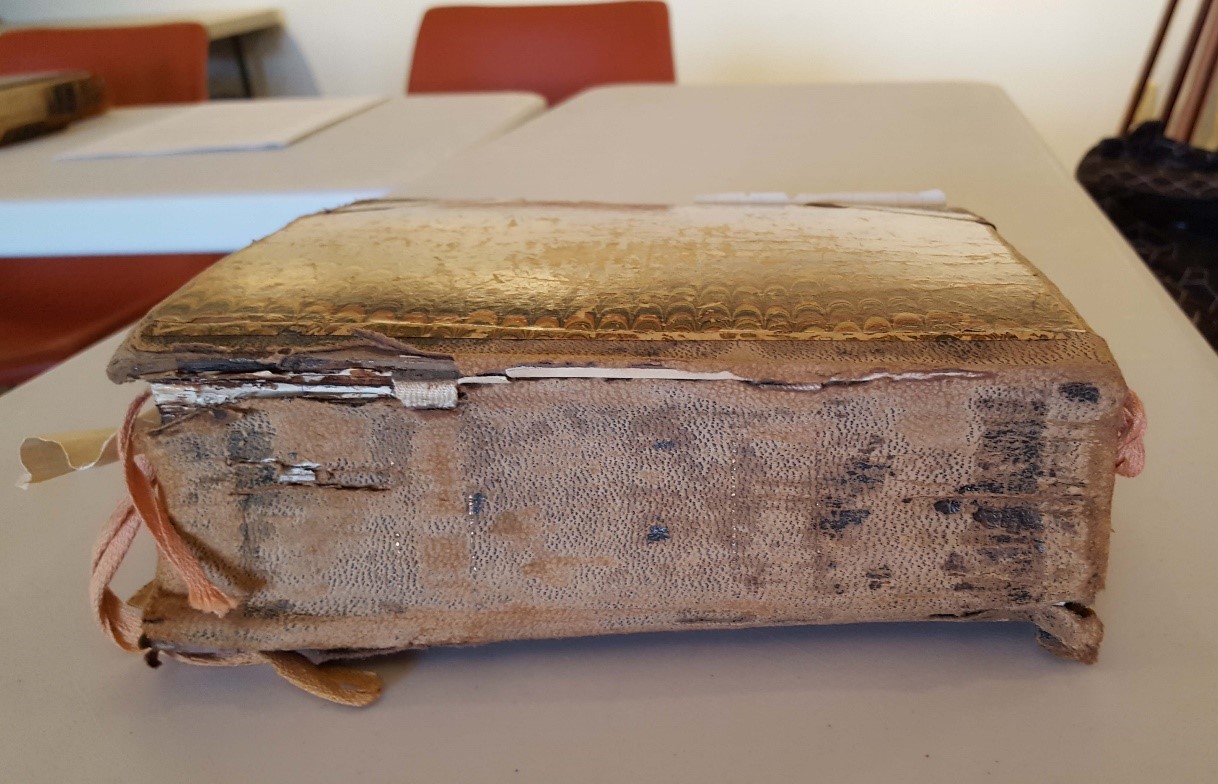
One of the fragile cookbooks that was digitized so it now can now be handled as little as possible. The cookbooks at the Lorenzo State Historic Site have been one of the most requested items for research. (Photo Credit – NYS Parks)

What can historians learn from recipes over the years? The foods we eat can tell us about media, transportation, technology, and trade.

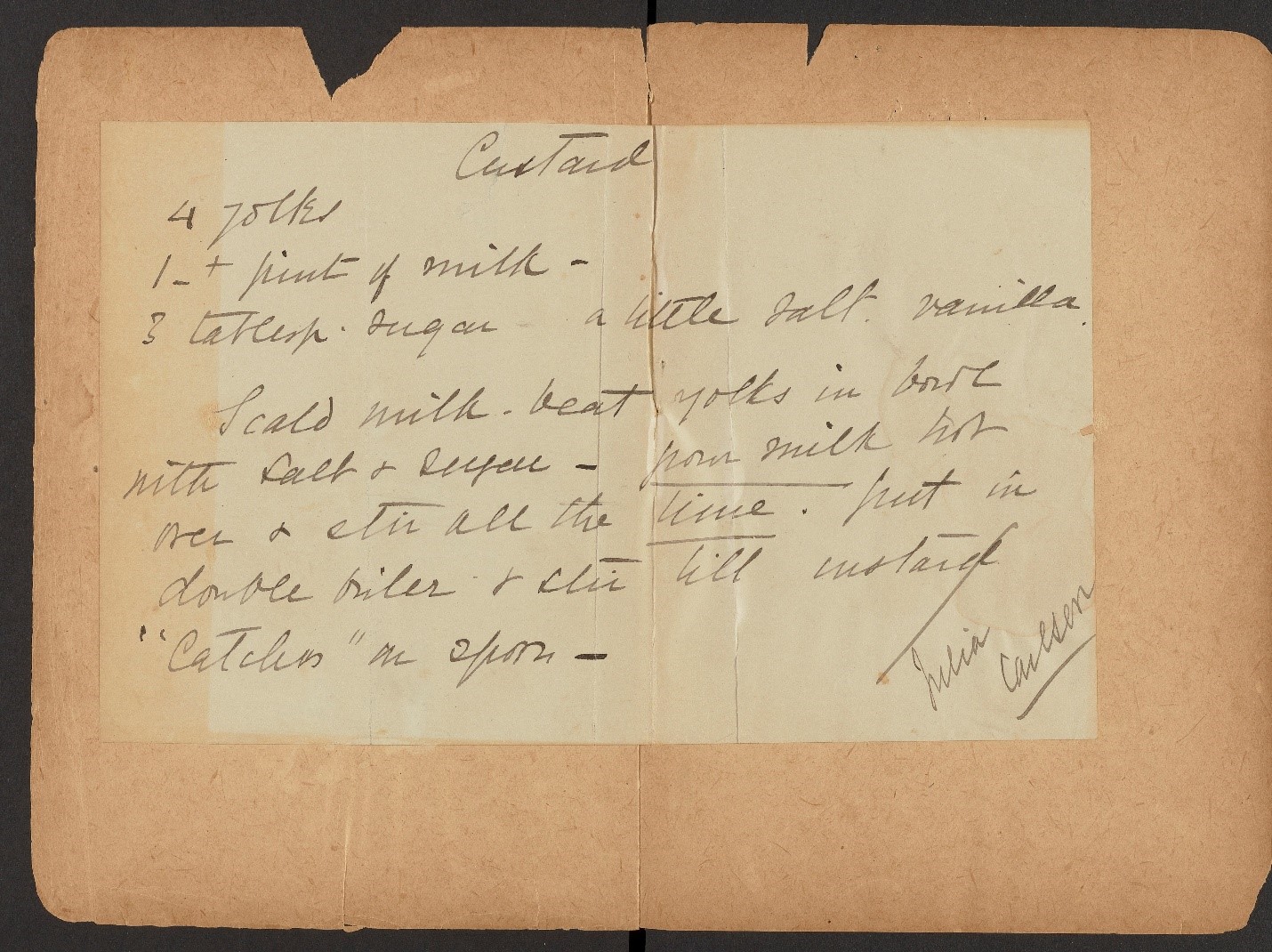
For example, vanilla was used sparingly prior to the mid-19th century. This fragrant spice is native to central and South America and vanilla orchids were brought to Europe and Africa through colonizers of the 16th, 17th and 18th centuries, but without successful cultivation of the fruit.

That all changed in 1841, a young enslaved man named Edmond Albius, living on the island of Réunion, a French island off the east coast of Madagascar in the Indian Ocean, developed a hand pollination technique for the orchid, which only blooms for 24 hours. With the agricultural production of vanilla beans now made possible, the vanilla industry was catapulted around the world, which made the spice much more affordable. Cookbooks started to fill with this popular flavor by the end of the 1800s. Since the plants are still hand pollinated today, vanilla is one of the most expensive spices, second only to saffron. Prior to vanilla being widely available, many foods were seasoned with rose water or orange flower water.

This hand-written custard recipe comes from one of the cookbooks and uses vanilla. It is likely that this recipe dates from the second half of the 19th century. It is from a cookbook estimated to have been kept between 1910 and 1917 by Helen L. Fairchild. (Photo Credit – Lorenzo State Historic Site)

Many earlier recipes used spices that are often associated with the holidays today such as nutmeg, ginger, allspice, cardamom, and candied citrus peel. These ingredients were imported to the United States and Europe at significant expense and added interest and flavor. Nutmeg was originally imported from Indonesia. The Dutch, in addition to colonizing New Netherland, which became New York when England took control, also colonized Indonesia, primarily for the profitable spice trade. Nutmeg continues to be an important ingredient in both sweet and savory holiday recipes. How spices are used also gives a hint to your family’s heritage.

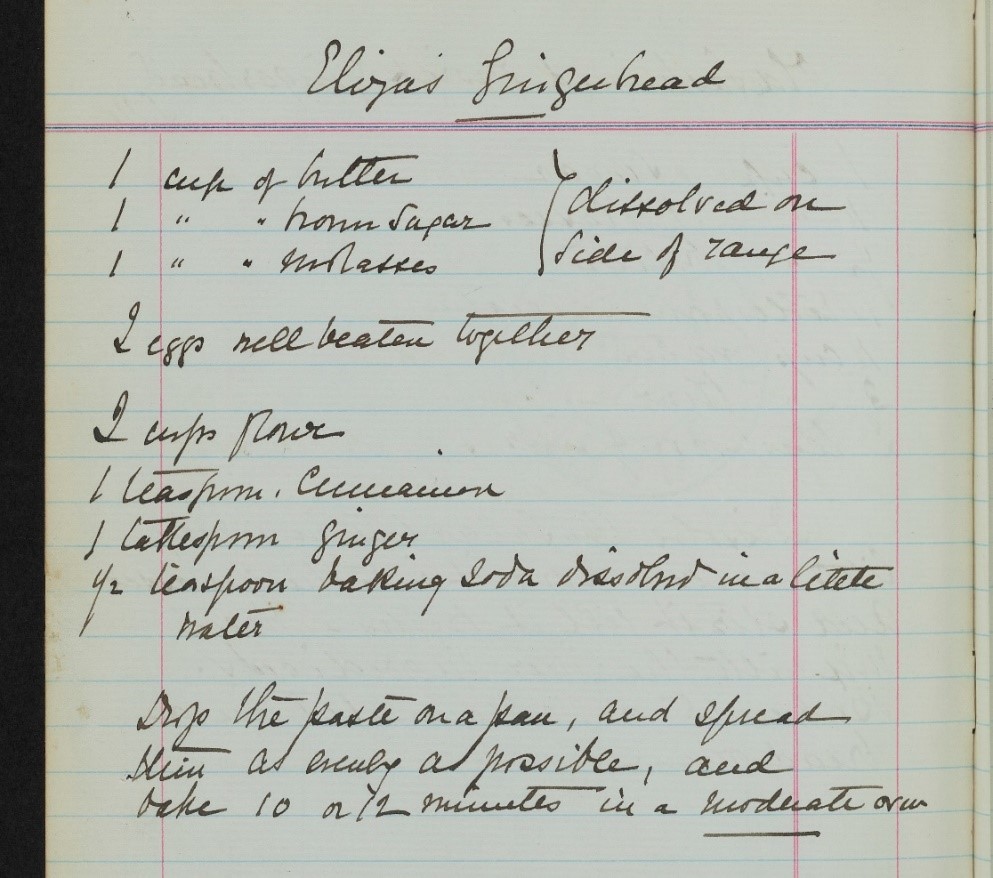
Also found in the cookbook kept by Helen L. Fairchild, “Eliza’s Gingerbread” recipe looks quite familiar to modern bakers. The earliest know gingerbread recipes originated in ancient Greece. Other recipes date to 10th century China. Europeans were eating gingerbread by the late Middle Ages, and its appeal continues to this day. (Photo Credit – Lorenzo State Historic Site)

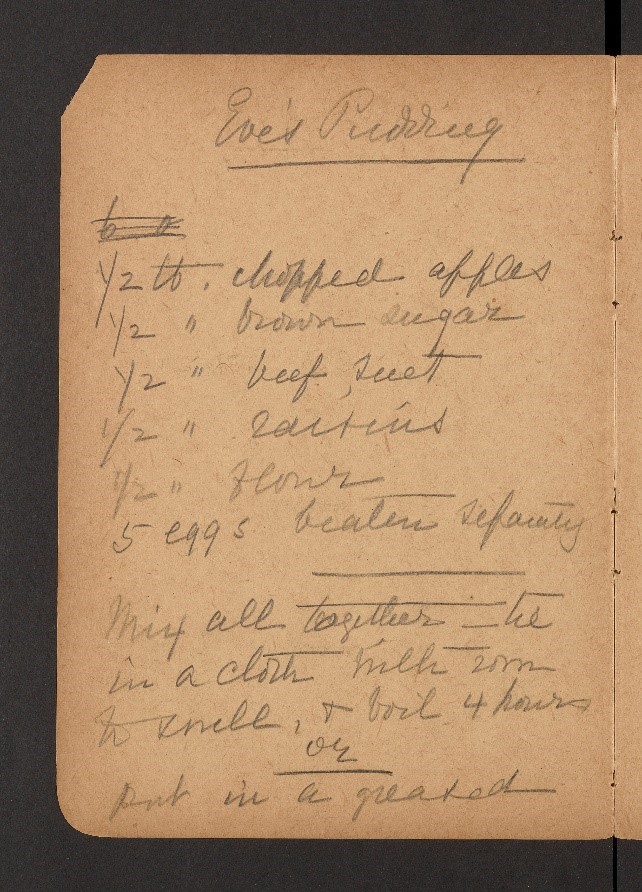
Not all the recipes in these books seem palatable to modern audiences. There are many ingredients that have gone out of fashion. Suet, the rendered fat of beef, is an ingredient in many puddings. Tongue, calves head, and terrapin (turtle) are also present in recipes. Folks were also willing to put just about anything into gelatin including little ham balls seasoned with cayenne pepper.

Whether these dishes were daily fare or for special occasions is hard to decipher from these cookbooks, although terrapin became quite popular by the end of the 19th century until overharvesting made the creatures quite rare and expensive.

It is interesting to note that a few recipes are repeated in more than one cookbook. Perhaps each generation of women passed down the recipes to the next. The recipes might have been recopied in a new book when the old one deteriorated.

Eve’s pudding recipe is for a traditional pudding much like those still eaten during holidays in the United Kingdom. Puddings were a common desert, especially before the widespread availability of leavening agents like baking soda and baking powder. This pudding contains apples and raisins, but other examples could have included other dried or candied fruits, breadcrumbs instead of flour, nutmeg, and, of course, some brandy for a holiday glow. (Photo Credit – Lorenzo State Historic Site)

Lorenzo State Historic Site can now keep these recipes safe and accessible for many generations to come. And that is something you can do at home, too.

Which recipes will you be serving at your holiday table? What do those recipes say about your family’s heritage or status?

Recipes are considered primary source documents if your grandmother or great-grandmother was the first to write it down. How will you preserve this tradition? Share a recipe with your family and friends. Tell the stories that surround your memory of that food. This is intangible history, but just as important as your recipes. Stay safe and well fed this holiday season.

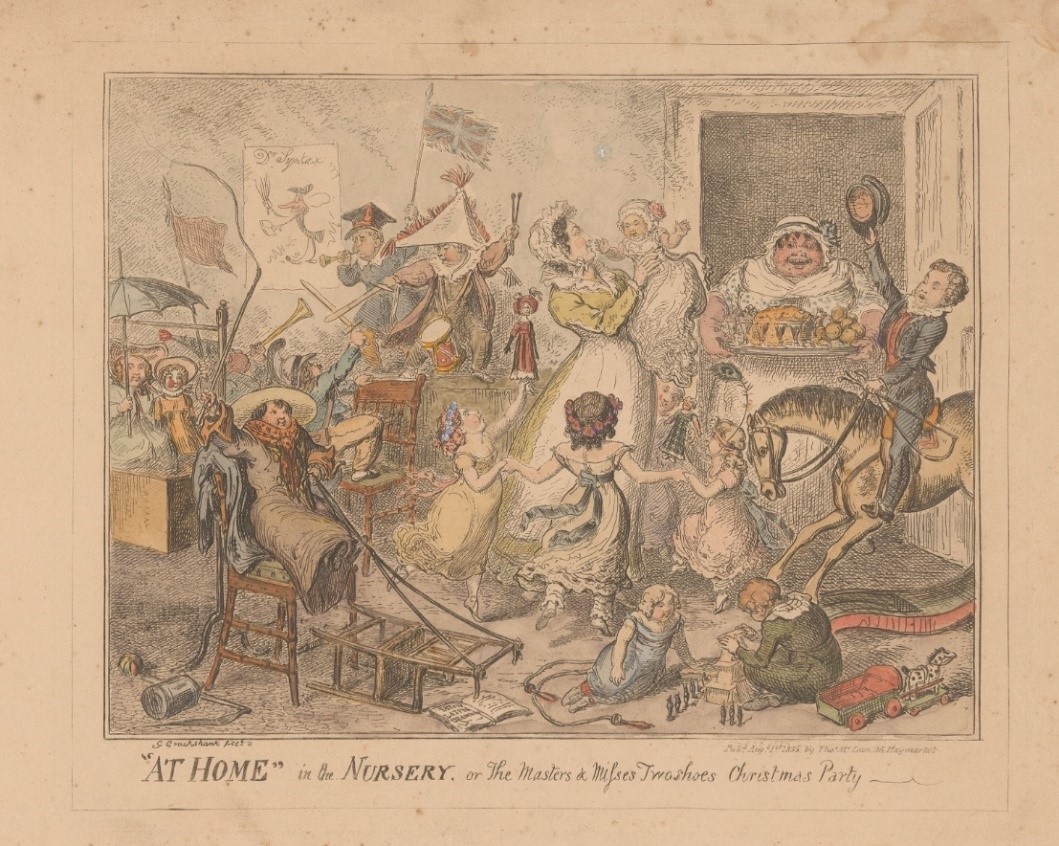
This satirical print made by George Cruikshank in 1835 is titled At Home in the Nursery, or The Masters and Misses Twoshoes Christmas Party. A popular English illustrator in the mid-19th century, Cruikshank portrayed the chaos of the nursery at Christmas that is well understood by any parent of small children. Of course, a tray of tasty treats is being brought into for their enjoyment. (Photo Credit – Rijksmuseum)

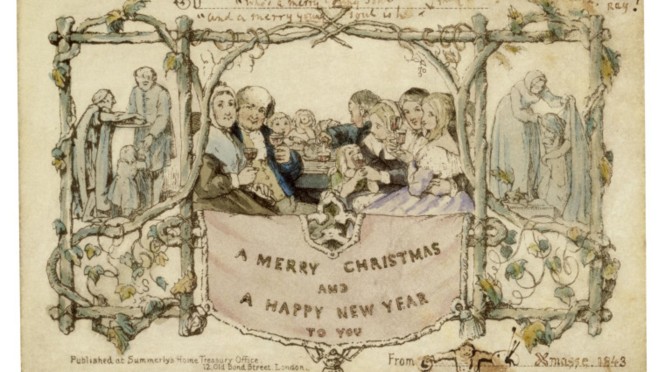
Cover Shot: The first commercial Christmas card, printed in 1843 in England and sent from John Callcott Horsely to Henry Cole, shows folks dining as a symbol of the holidays. In the same way so much of our celebrations revolve around food, with recipes often a cherished tradition passed to each generation. (Photo Credit – Victoria and Albert Museum, London)

Post by Amanda Massie, Curator at Bureau of Historic Sites, Division for Historic Preservation at NYS Parks.


Want to have some fun at home with historic recipes from Lorenzo State Historic Site? Here are some to try… And Happy Holidays to you and yours from New York State Parks!