All posts by New York State Parks

Seneca Lake surrenders its watery secrets

The cold, dark depths of Seneca Lake are revealing a rare glimpse of the state’s early maritime history to a high-tech research vessel as it finds long-lost shipwrecks in the deepest of the Finger Lakes.

Armed with a multibeam sonar array, researchers from Middlebury College and the Lake Champlain Maritime Museum are producing accurate three-dimensional images of the bottom that also pinpoint wrecks from Seneca’s heyday of commercial canal shipping nearly two centuries ago.

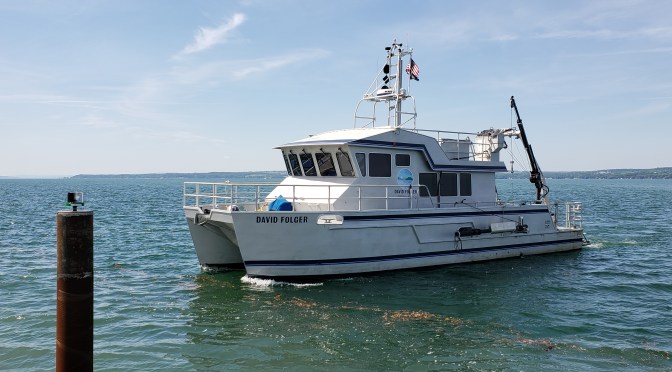
Starting in late June, the Research Vessel David Folger was based in the newly-rebuilt marina at Sampson State Park for a two-week survey, headed by Thomas Manley, an assistant geology professor at Middlebury College, and Art Cohn, co-founder and director emeritus of the Lake Champlain Maritime Museum.

The crew of the David Folger at Sampson State Park at the start of the two-week survey.

Called bathymetric mapping, the team’s work is providing valuable insights into an era when canals drove the state’s economy. The mission is being supported through a $15,000 grant from NYS Parks Historic Preservation Office and also by the NYS Canal Corp.

“On our first day on Seneca Lake, we found several shipwrecks,” said Cohn, pointing at a color-coded computer display that showed the crisp outline of one such vessel on the bottom. After a sighting, researchers sent down an unmanned, remote-operated vessel (ROV) to video, identify and document the scene.

“The vessels being found are intact ships, many with cargo, that have not been seen for more than 150 years,” he said.

Art Cohn speaks at the dedication of the new Sampson State Park marina.

Multibeam sonar works by sending sound waves in a fan shape into the water beneath a ship’s hull. The amount of time it takes sound waves to bounce off the bottom and return to a shipboard receiver is used to determine depth, with that data then used to produce detailed, color-coded maps.

These findings add to the eight shipwrecks located during a preliminary survey by the team in summer of 2018. So far, that brings the total number of confirmed shipwrecks to 14, with more potential finds still being analyzed, said Cohn.

A 3D multibeam sonar scan of the Seneca Lake bottom clearly shows the outline of a shipwreck. Source: Seneca Lake Archaeological Survey 2018 Final Report
The clear outline of a shipwreck. Source: Seneca Lake Archaeological Survey 2018 Final Report
Once a potential shipwreck is located, a remote-operated vessel (ROV) with a video camera is sent down to investigate. Source: Seneca Lake Archaeological Survey 2018 Final Report

The David Folger mapping project also will update lake navigation maps that date to the 1870s, when depth measurements were taken from ships by crews who dropped a lead weight from a metal chain into the lake until it hit bottom.

The newly-discovered Seneca Lake wrecks are canal boats that date from the mid-1820s to the 1850s, after the opening of the Erie Canal and construction the 20-mile Cayuga-Seneca Canal in helped make the lake part of the “superhighway” of the era.

The Erie (1825), Chemung (1833) and Crooked Lake (1833) canals helped make the lake commercially accessible from north, south and west, with hundreds of canal boats each year plying the 38-mile lake carrying cargoes of corn, coal, lumber, whiskey and other goods. But winds and storms on Seneca Lake posed a threat to such lake traffic, sometimes sending canal vessels to the bottom.

Canal traffic was a common sight on Seneca Lake from the 1820s to the 1850s. Source: Seneca Lake Archaeological Survey 2018 Final Report
The 38-mile lake is the longest and deepest of the Finger Lakes. Source: Seneca Lake Archaeological Survey 2018 Final Report

Seneca Lake is up to 625 feet deep, and water temperature at such depths is in the mid- to low-30s, said Cohn, making it the perfect low-oxygen environment for preserving wooden shipwrecks. In the ocean, salt water and aquatic organisms quickly corrode such wrecks

“The shipwrecks in Seneca Lake are in many way time capsules of the 19th century,” said Mark Peckham, a former maritime history expert with State Parks and now a trustee with the Hudson River Maritime Museum in Kingston.  “I dove on some wrecks in the 1990s and was struck by their state of preservation.  Some still had glass in their cabin windows and household items remaining inside.”

Underwater images taken by the David Folger of a sunken canal vessel. Source: Seneca Lake Archaeological Survey 2018 Final Report
The bow of a sunken canal vessel. Source: Seneca Lake Archaeological Survey 2018 Final Report

“These discoveries are especially significant as we are in the midst of the 200th anniversary of the construction of the NYS canal system.  2025 will mark the anniversary of the opening of the Erie Canal,” said Peckham. “More than anything else, the canals of the 1820s spurred economic development, settled broad swaths of the state, made New York State first in population and made the port of New York one of the greatest shipping ports in the world.  

The David Folger reached the lake from its home port on Lake Champlain by taking the Champlain, Erie and Cayuga-Seneca canals in the New York State Canal System.

The multibeam sonar array aboard the David Folger also allows researchers to understand the composition of the ground beneath the bottom of Seneca Lake, said Manley. Those sub-bottom images look almost like a slice through a layer cake.

Some images might offer clues into a long-running lake mystery _ the source of mysterious booming noises that seemingly come from the water itself. The sounds have been known locally as Seneca Guns, Lake Drums or Lake Guns.

One modern theory is that such sounds might be caused by the sudden collapse and depressurization of caverns or tunnels underneath the lake, which has a history of salt mining being done around and beneath it.

Middlebury College researcher Thomas Manley explains underwater mapping imagery to NYS Parks Police Capt. Michael Daddona

Manley pointed to a lake bottom image that shows such potential collapses _ a nearly-circular depression that is some 40 feet deep, and another such depression nearby that is shaped like a horseshoe.

As Seneca Lake shipwrecks are located, they will be protected as public resources under the Federal Abandoned Shipwreck Act of 1987. All shipwrecks located under this survey’s permit issued by the New York State Museum will be reported to the Museum and integrated into the state’s archaeological inventory.

Said Peckham, “These sites are subject to environmental degradation, such as silt deposit, erosion, organic deterioration, and the effects of mussel encrustation, and human intrusions like anchoring, diver handling, theft of artifacts, and construction of bulkheads, marinas, pipelines, and cable crossings. The latter threats can be addressed through improved public education and interpretation, law enforcement and by providing appropriate submerged heritage diving sites that foster and support responsible recreation and tourism.”

In Lake Erie, recreational diving on such historic wrecks has proved to be a popular tourist attraction. That could make Sampson State Park’ s rebuilt $7.5 million marina the perfect jumping-off point for such trips.

But not all mysteries have been uncovered yet _ researchers aboard the David Folger spotted no trace of potential relatives of a mythical Seneca Lake sea monster that was supposedly deliberately run over by the captain of a steamboat in 1899, according to a Rochester newspaper account at the time… But stay tuned.

A newspaper headline on the alleged monster encounter. Source: Seneca Lake Archaeological Survey 2018 Final Report
An artist imagines the legendary beast. Source: Seneca Lake Archaeological Survey 2018 Final Report

Posted by Brian Nearing, NYS Parks deputy public information officer
A View from the Treetops: life as a forest health specialist

My name is Abigail Pierson and I am a Forest Health Specialist for NYS Parks. The scope of my work covers almost all the state parks in the western half of New York state, making each week always something new and exciting.

My week begins with the usual desk work of contacting park managers and anything else to ensure a smooth work week. However, by 10 a.m. my coworker and I are hopping in the work van and traveling to a state park. Once we’ve arrived, my partner and I begin setting up our tents and going over our schedule for the week. When the work day comes to end, it’s time for arguably the most intricate task of the day, dinner.

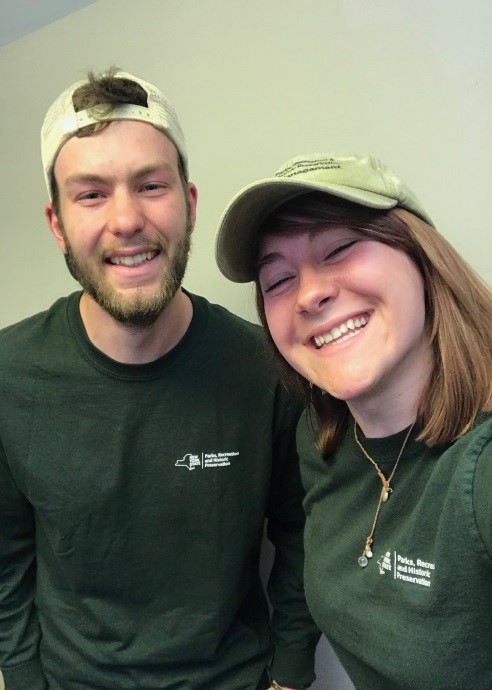
Abby and her current NYS Parks staffer and climbing partner, James Boyd.

Our meals are cooked on a two-burner camp stove, so chaos usually ensues when we are both starving and trying to prepare full course meals. Trying to make a full meal on one burner each serves as a microcosm of the balance of respect, teamwork, trust, and cooperation needed for the success of our team.  We spend every morning, afternoon, and night together for five days of the week. This job requires a lot of trust. We are climbing tall trees for research purposes, so our safety depends on each other. It is amazing to have a job/life experience like this where your co-worker becomes such an integral part of your life.

It’s always interesting climbing out of our dew-covered tents each morning; seeing everything in nature slowly coming to life all around us. Our days move by very fast. I eat a quick breakfast, after which I grab my climbing gear and data collection tools and begin the hike into a hemlock stand.

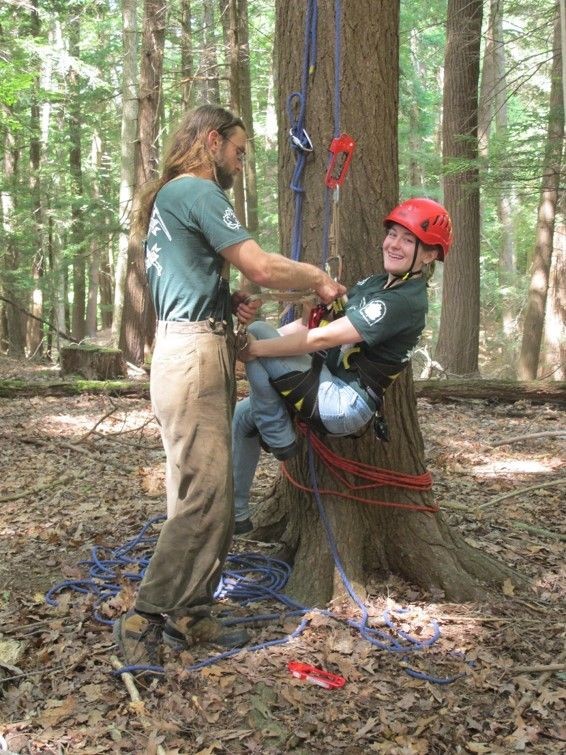
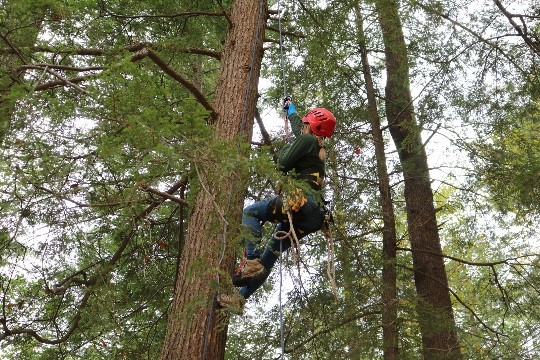
We are monitoring for hemlock wooly adelgid (HWA) an invasive insect species native to Japan that can kill entire hemlock stands in 4 to 10 years. Our hikes to these hemlock stands can range from a half mile to three miles, and this is where the real fun begins. We put on our helmets and safety glasses and begin sending our rope up and over one of the branches in the middle canopy of the tree. Once we have our single rope set up and secured on the tree, one of us straps on our climbing harness and begins the ascent, which can be a hundred feet or more up into the air.

Abby gears up with NYS Parks staffer Jake Sidey during a 2016 climb.
Abby having fun a phone app with NYS Parks staffer and 2017/18 climbing partner Ben Jablonski.

A beautiful thing about our climbing setup is we cause no damage to the tree. Our goal is to save these majestic giants, not injure them. Once I reach the top section of the rope, I attach myself directly to the tree using a flip line. A flip line is a short adjustable section of rope that goes around the trunk of the tree and attaches to both sides of my harness.

It’s a good thing I’m a tree hugger because I must hug the tree as I use flip lines to ascend to the top canopy of the tree. It is a very intense experience being on flip lines because it is up to myself and this tree to keep me safe. In many ways, we are trusting the trees with our lives just as much as the trees are trusting us with theirs.

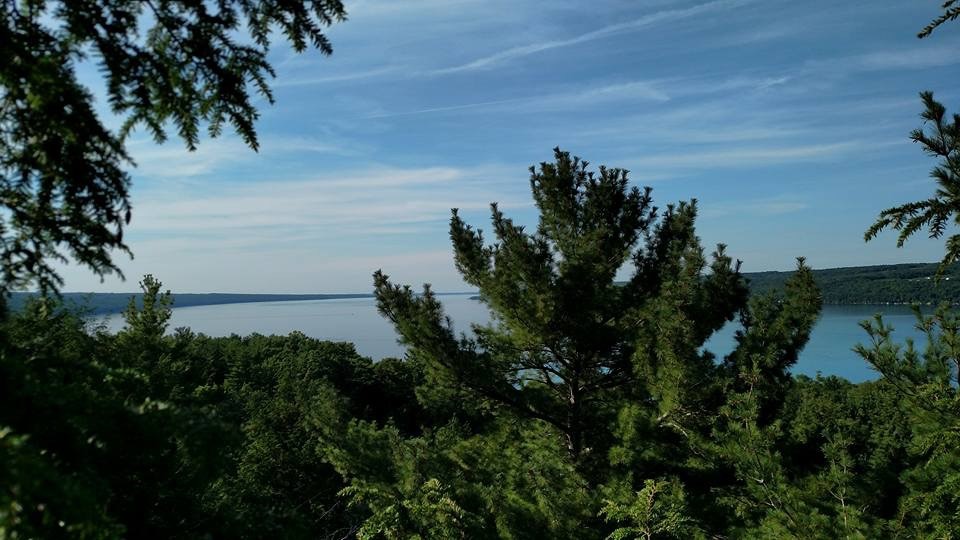
Climbing to the very top canopy of a tree that usually towers over the rest of the forest canopy is an indescribable experience. It feels as if, for a moment, you are larger than the forest itself. After all that hard work of getting to the top canopy I always take a moment to take in the beauty of nature that is surrounding me.

The View from the Top.

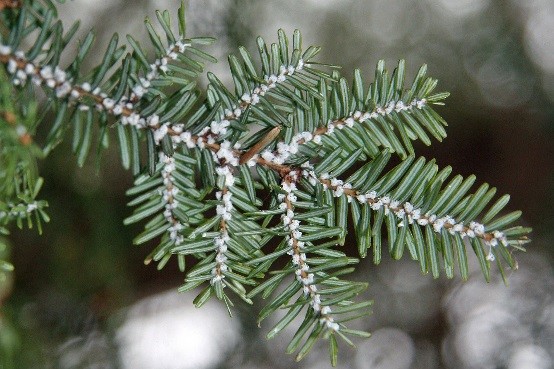
Once I’ve taken in the view it is right back to work. I take a small sample of a branch from the top canopy and put it into a labeled Baggie. As I descend back down the tree, I take samples from the middle and lower canopies. These samples allow us to identify if the tree is healthy or its level of infestation by HWA, a tiny aphid-like insect that gradually kills hemlocks by feeding on the juices in their needles.

The information that we gather helps show how widespread HWA is in the state and which hemlocks might still have the potential to be saved.

Here, and below, A close up of the telltale fluffy white insect egg masses that indicate HWA infestation.

If left unchecked, HWA could wipe out the majority of eastern hemlocks in New York, a species that is the third most common tree in the state. Hence the importance of slowing or even stopping its spread as quickly as possible. Widespread hemlock mortality would have a lasting impact on ecosystems, streams, flora and fauna, and even the look of the landscape.

Hemlock mortality in parks especially is a scary thing for me to imagine as patrons would no longer be able to enjoy the parks the same way that they can now. Some of our most well-known parks, including Letchworth, Allegany, Watkins Glen, and others like Stonybrook and Thacher, feature hemlocks along most major trails and vista points. Campgrounds and picnic areas of many parks enjoy cooling shade courtesy of hemlocks. If those hemlock stands were to die back the park would look barren, be unsafe due to erosion and dead limbs, and the internal ecosystems would be negatively impacted as well.

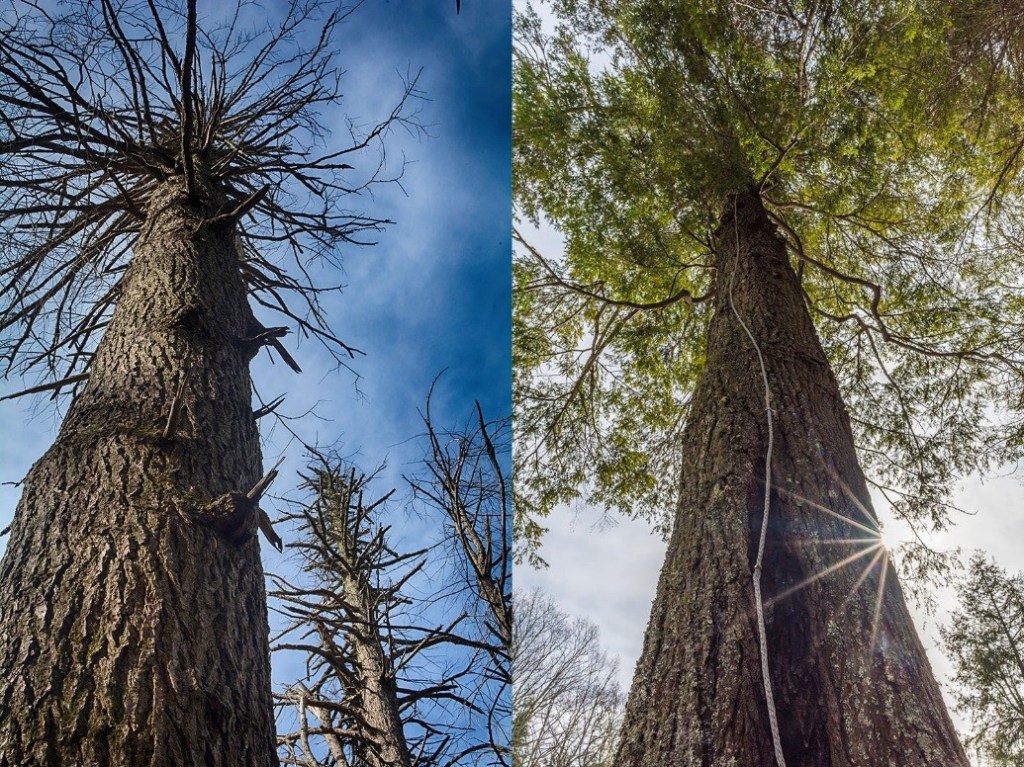
On the left, hemlock trees killed by HWA. On the right, a healthy, uninfested hemlock.

Click here for a map showing how HWA has spread in New York State.

What can you do to help? According to the state Department of Environmental Conservation, if you believe you have found HWA:

  • Take pictures of the infestation signs (include something for scale such as a coin or ruler).
  • Note the location (intersecting roads, landmarks or GPS coordinates).
  • Fill out the hemlock woolly adelgid survey form.
  • Email report and photos to DEC Forest Health foresthealth@dec.ny.gov or call the Forest Health Information Line at 1-866-640-0652.
  • Contact your local Partnership for Regional Invasive Species Management (PRISM) by visiting http://www.nyis.info/.
  • Report the infestation at iMapInvasives.
  • Slow the spread of HWA in our forests by cleaning equipment or gear after it has been near an infestation, and by leaving infested material where it was found.

Overall, tree climbing is a phenomenal experience that allows us to experience the sheer beauty of the hemlock tree and surrounding forest, while also allowing us make the in-depth assessment needed to ensure that the natural beauty is preserved.

Helping to save the amazing environment we live in, educating the public on invasive species, and being up close and personal with nature every day is an amazing gift. This job allows me to fulfill all my strongest passions simultaneously and I could not be luckier to have this opportunity.

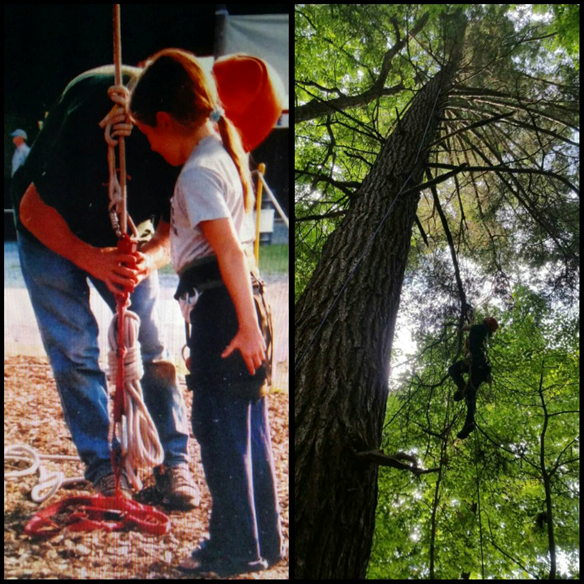
Born to climb: A young Abby is geared up for tree climbing up by her father, Dr. Timothy G. Pierson, during Penn State Agricultural Progress Days. Abby later got her bachelor’s degree in environmental science/biology from Penn State, where her father worked as a forester.

Post by Abigail Pierson, Forest Health Specialist

Hats Off to Lorenzo Driving Competition, a Summer Signature in Cazenovia

For lovers of horses and history, the annual Lorenzo Driving Competition is the jewel of Cazenovia’s summer traditions.

The click of hooves, the hum of carriage wheels, the shimmer of sunlight on canvas tents: It’s a singular weekend, a chance to be transported to a time when road trip meant four legs and a whip.


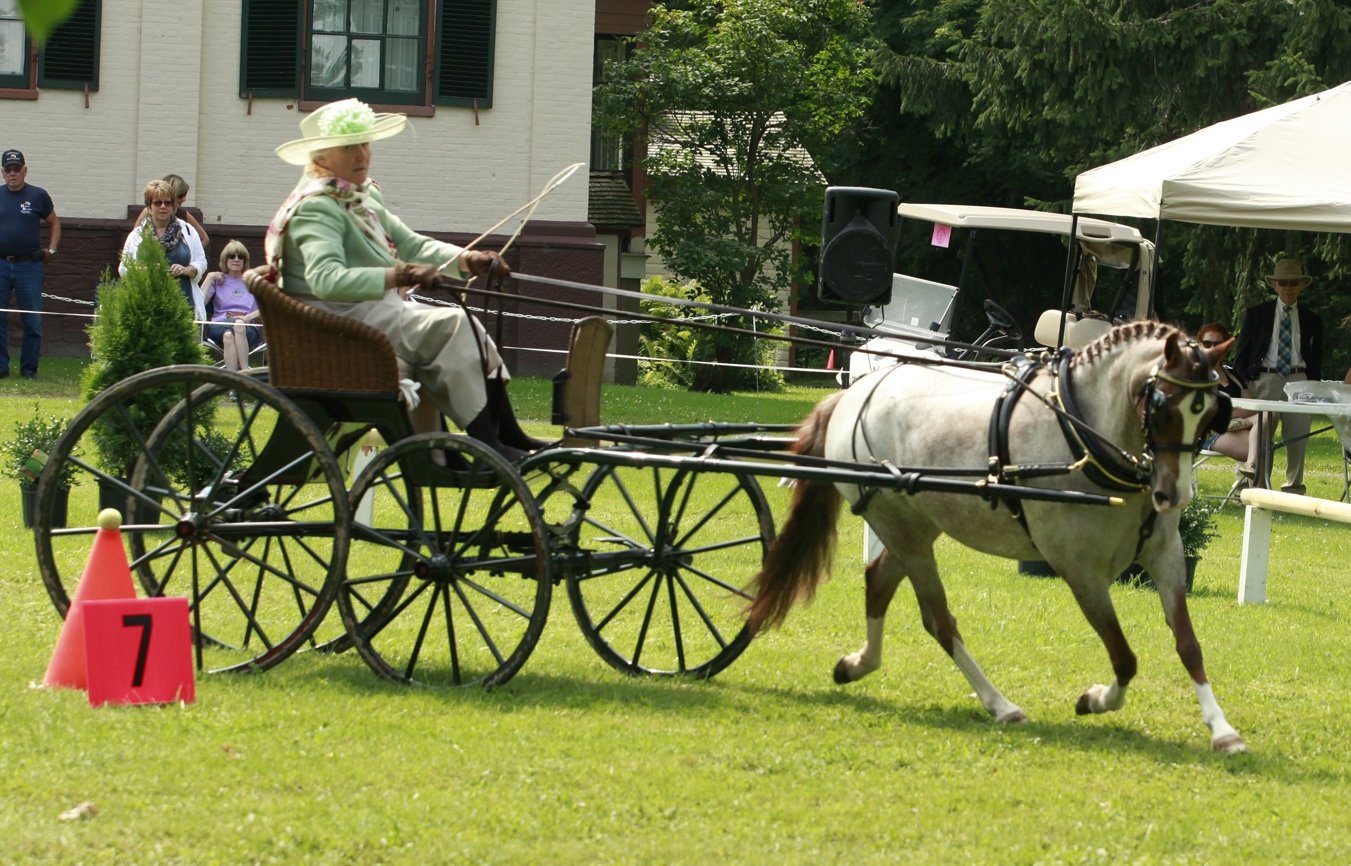
A driver puts her horse and carriage through the course. Photo courtesy of Janis Barth.

The competition, held July 19-21, is once again set on the central great lawn of the Lorenzo State Historic Site, once the home of John Lincklaen, a Holland Land Company agent who founded the town in 1793 and named it for his boss, Theophilus Cazenove.

Lincklaen’s neoclassical mansion is a signature surrounding, the gentle slope of the ring designed to recreate a traditional driving experience and show off the unique combination of skill, attire and showmanship that define the sport of pleasure driving.

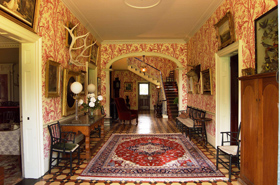
Interior hallway of the mansion.

For spectators, who are invited to bring chairs and blankets and find a comfortable vantage point, the restored historic buildings provide the perfect backdrop.

Plan for a full day, because the Lorenzo grounds and restored mansion beckon between classes. Wander the Dark Aisle Arboretum and the spectacular formal garden. Absolutely leave time to explore the carriage house and collection of antique vehicles that provide a link between the driving competition and Cazenovia’s rich equestrian history.  

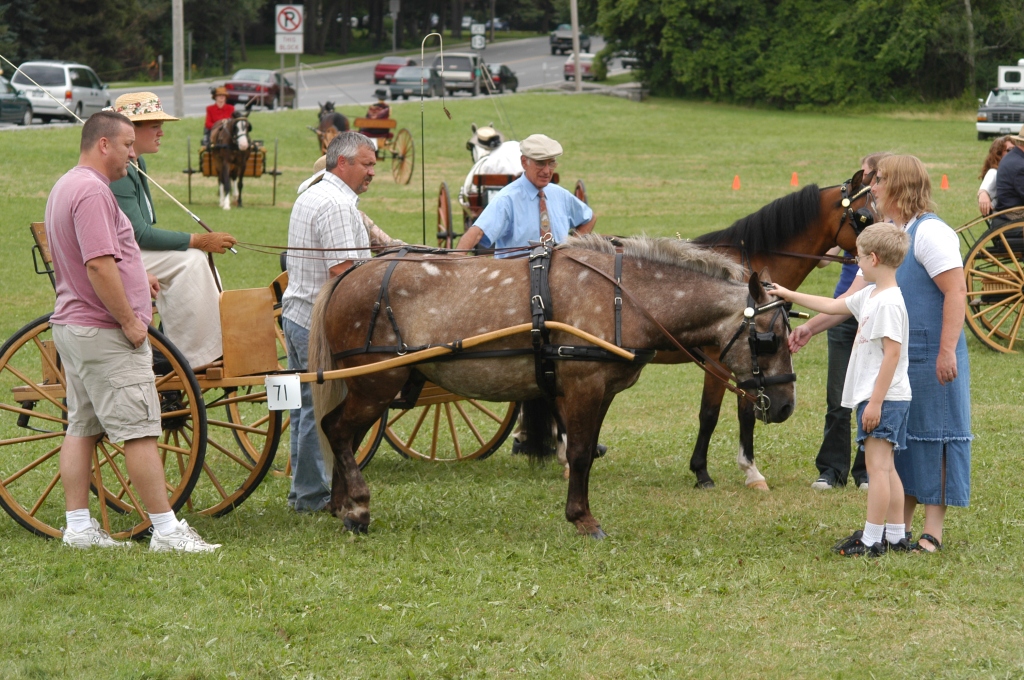
Visitors mingle with some of the horses and their drivers. Photo courtesy of Janis Barth.

The heart of the weekend, however, belongs to the polished pleasure-driving teams. Competition will take place in two rings: one featuring such crowd favorites as the Carriage Dog and Antique Vehicle classes, and one dedicated to a Christmas in July-themed obstacle class.

Yes, that is right! Carriage dogs… A carriage dog or coach dog refers to a type of dog rather than a specific breed. Originally, dogs of this type were bred and trained to trot alongside carriages to protect the occupants from banditry or other interference. They were usually owned and used by the wealthy or traders and merchants. Dalmations were once one of the most popular breed of carriage dog in England, starting in the 18th Century. The more carriage dogs that attended a carriage, the greater the indicator of the occupants’ wealth and prestige.

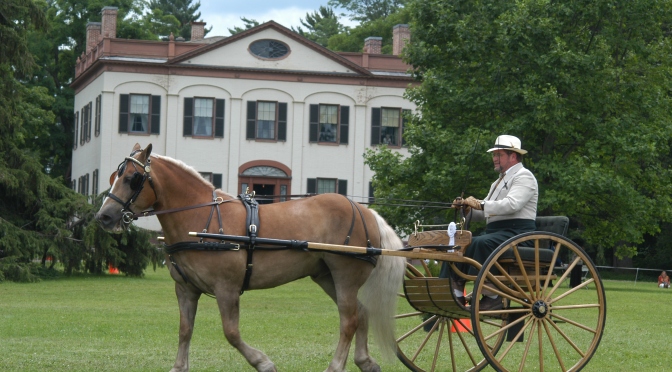
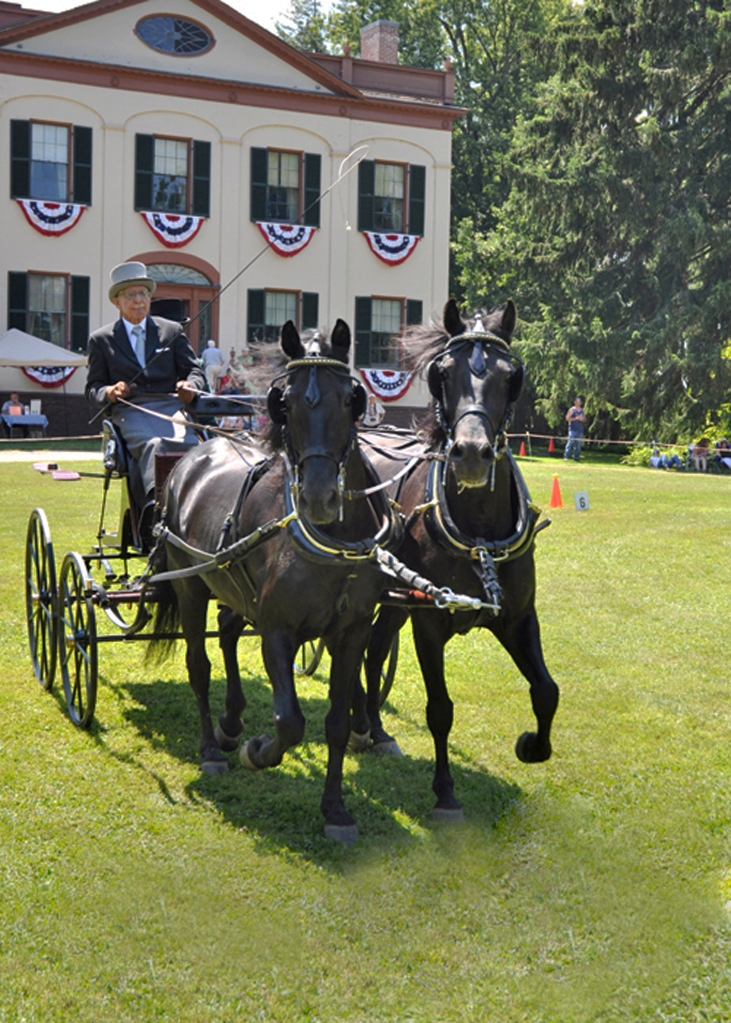
An elegantly-attired driver and his team in front of the neoclassical Lincklaen Mansion. Photo courtesy of Janis Barth.

Friday at Lorenzo starts with driven dressage classes, testing the skill of horse and driver as they perform prescribed patterns with circles, diagonals and changes of gait. Then it’s off through fields and woods to neighboring Empire Brewery. Pull up a chair and watch from the front lawn as teams weave between traffic cones topped with tennis balls – points lost for every ball knocked to the ground.

The day ends with something new: a Picnic Class, where competitors are judged on their ability to drive a horse and then set up a posh meal on tables around the main show ring. It’s an elegant nod to a bygone era and, as you might imagine, more fine china and silver and less plastic forks and paper plates. On Sunday morning look for Lorenzo’s signature 5-mile, Pleasure Drive-Pace through the lush countryside south of the mansion. During the lunch break, JK Percherons will dazzle in the main ring with their four-horse hitch.

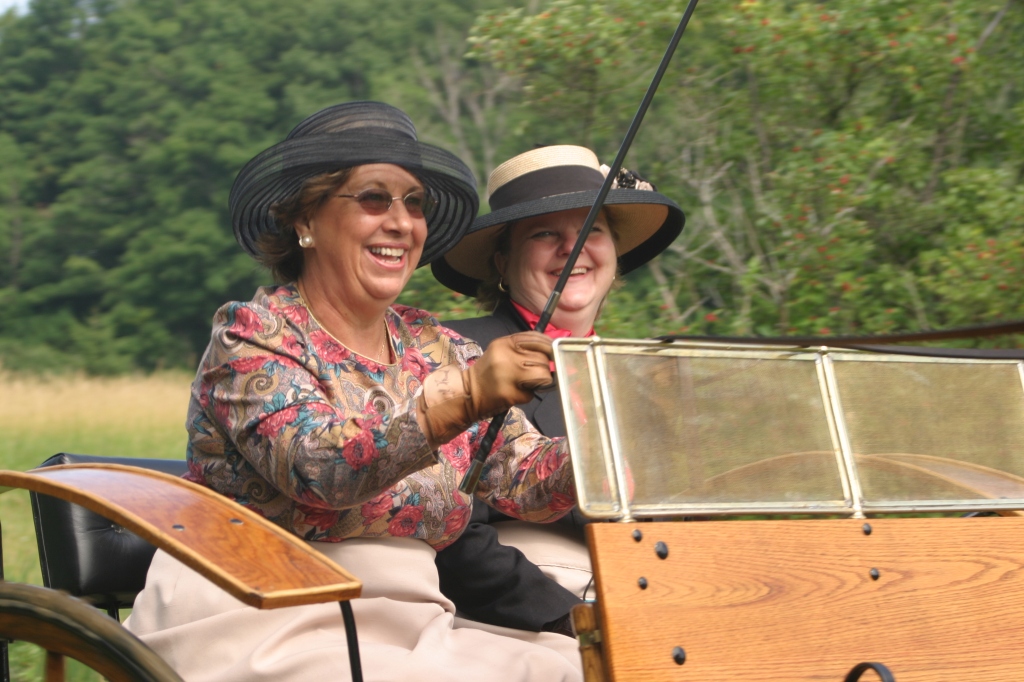
A driver and passenger show their joy on the course. Photo courtesy of Janis Barth.

Bring the littles and check out the Kids Korral, the many vendors along Market Lane and a silent auction featuring unique items – equestrian cocktail shaker, anyone?

As always, there is no charge for parking or to attend any day of the competition.

There’s something special about Lorenzo weekend– the mansion, the polished trophies, the gentle snort of horses and well-mannered woof of carriage dogs. This summer, plan to be part of the tradition.

For more information and updates go to lorenzodriving.org or follow the show on Facebook. Also, there are many other events at the Lorenzo site this season, and further information can be found here.


Hope to see you there! Photo courtesy of Janis Barth.

Post by Janis Barth, editor and publisher of New York Horse magazine and a member of the Lorenzo Driving Competition board.


Efforts to Control Invasive Species in Parks Gain a Four-Footed Team Member

One sniff at a time, an energetic Labrador retriever named Dia is changing the way we combat invasive species in New York State Parks.

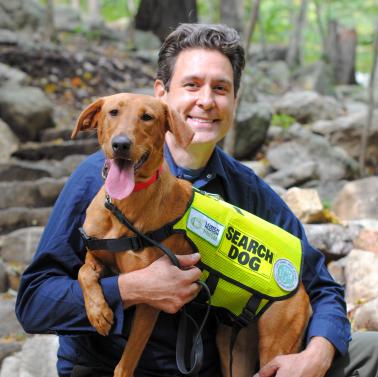
Along with her handler Joshua Beese, this invasives-fighting team from the nonprofit New York-New Jersey Trail Conference is on the hunt for Scotch broom, a threat to the native ecosystems in Bear Mountain and Harriman state parks in the Lower Hudson Valley.

Dia uses her powerful sense of smell to help find small and sparsely distributed invasive species that might be missed by human searchers. Since November 2018, her incredible nose has been specially trained to sniff out the invasive plant Scotch broom.

Joshua Beese with Dia. Photo by nynjtc.org

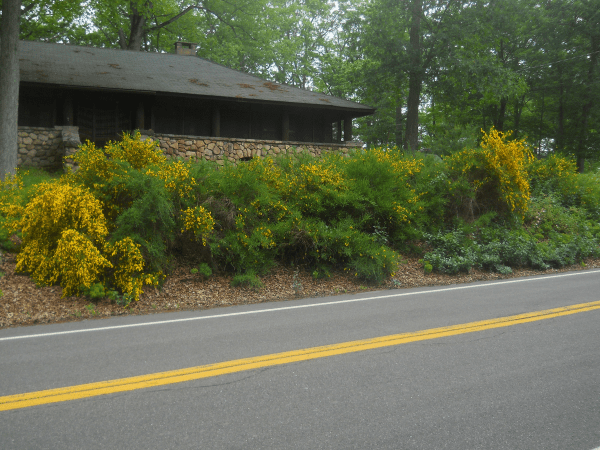
Scotch broom (Cytisus scoparius)is one of the most destructive invasives on the Pacific Coast, where it has had costly implications for agricultural industries. When it began showing up in New York’s parks, land managers became concerned. Scotch broom forms dense clusters that can displace native plant species and reduce biodiversity that is essential for a healthy ecosystem.

The Lower Hudson Partnership for Regional Invasive Species Management (LHPRISM), which works to minimize the harm caused by invasives, ranks Scotch broom as a tier 2 priority invasive species. That means it is present in such low numbers in the Lower Hudson Valley that with proper action it could be completely eradicated from the area before the population becomes established.

Scotch broom plant in flower on May 2015 at Harriman State Park. Photo by Shelby Timm, nynjtc.org.

The New York State Parks Invasive Species Strike Team and the Trail Conference’s Invasives Strike Force (ISF) Crew of AmeriCorps members, volunteers, and interns have collaborated over the past several years in a bid to eradicate Scotch broom in the region. The ISF Crew has been finding and removing Scotch broom in state parks since 2014, when 37 separate populations were recorded at Bear Mountain and Harriman.

A Scotch broom infestation at Harriman State Park in 2014. Photo by Jennifer Breen, nynjtc.org
After the Scotch broom removal . Photo by Jennifer Breen, nynjtc.org

While a few locations no longer have any plants, other locations are harder to manage. It becomes challenging to find the few remaining individuals among all the other vegetation, which means this destructive plant could still propagate. That’s where Dia comes in!

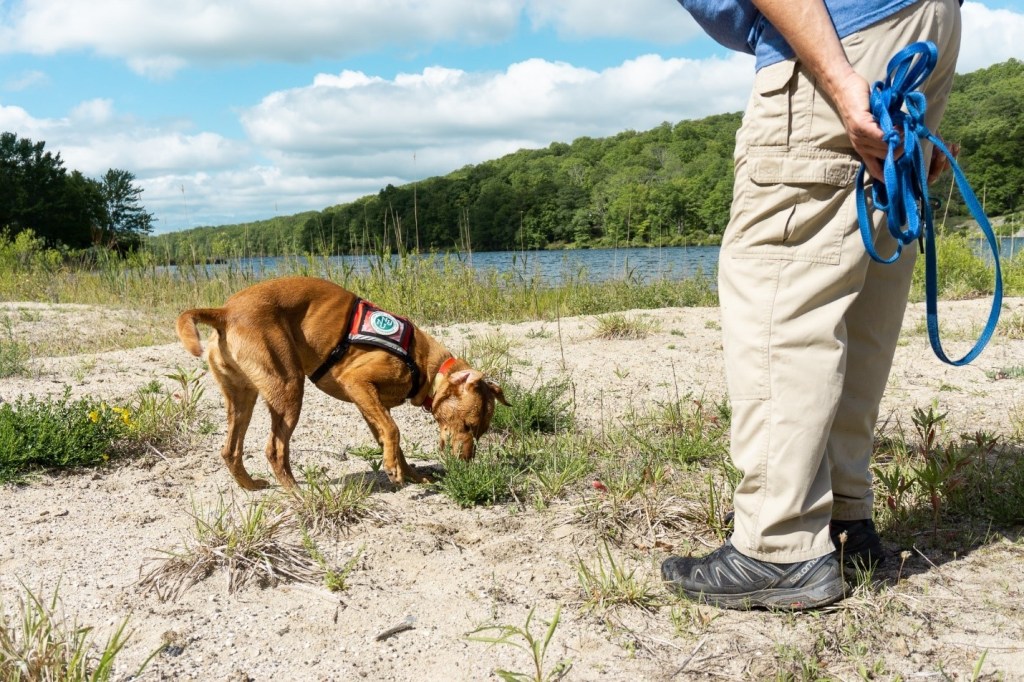
“Dia first comes into the field with her nose up, smelling what’s in the air, working to detect the Scotch broom scent,” explains handler Beese. “She’s using what are called scent cones; she works her way into a cone and uses that cone to help her narrow down the source.”

Once in a cone, she will search until she gets to the source and put her nose to the ground to sniff out smaller plants that may be tiny and low to the ground. She alerts Beese that she’s found the species by standing or sitting. “The most important thing is that she’s committed to an area where she’s detected the plant until I come and reward her,” Beese says. “Then we can mark it and remove it.”

Dia’s reward: Her ball on a rope with a game of tug and fetch. See Dia in action by following her on Instagram @diasavestheforest.

Dia on the hunt for invasives. Photo by Arden Blumenthal, nynjtc.org

Utilizing their exceptional sense of smell, dogs have been commonly used for search and rescue, as well as weapons and narcotics detection. These tracking and detection skills are now being used to protect our wild spaces. In 2010, the journal Invasive Plant Science and Management published a study that concluded trained dogs could smell and detect twice the number of invasive plants that humans could observe with their eyes.

Although other groups have used dogs for short projects to detect of invasive species, the Trail Conference’s Conservation Dog Program is the first permanent program of its kind in the Northeast.

This is Dia’s first season in the field; she has already been on more than 20 surveying trips. In several instances, the Trail Conference’s Invasives Strike Force Crew had been to a site and completely removed every plant they were able to find—and then Dia found a few more.

Trail Conference Conservation Corps members removing Scotch broom plants in 2016. The flags indicate where plants have been removed. Photo by Matt Simonelli, nynjtc.org

Dia came to the Trail Conference from a farm in Wisconsin that breeds dogs for hunting competitions. She was selected for the program by Beese, an experienced search and rescue dog handler, who is assisted by volunteer Arden Blumenthal. He has trained Dia with the mentorship of Aimee Hurt from Working Dogs for Conservation in Montana, an organization that has been working with dogs on conservation projects for more than 20 years.

In a metropolitan region highly prone to invasive infestations, early detection when populations are small is a key component of successful invasive species management. Not only does Dia make search-and-destroy efforts more thorough within infestations, she is also able to find stray plants outside the known boundaries where people had focused their searches. Dia helps make sure the area is really cleared to reduce the potential for reinfestation or further spread. With better search efficiency, it should be possible to declare New York State parks Scotch broom-free in the near future. 

Crew from New York State Parks Invasive Species Strike Team removing a Scotch broom plant. Phot by Linda Rohleder, nynjtc.org

Up next for Dia is slender false brome (Brachypodium sylvaticum), an invasive grass that can outcompete existing vegetation, including threatened and endangered species, and harm wildlife populations by altering food sources. Slender false brome has recently been found in Letchworth State Park, and this location will serve as a training ground for Dia.

***UPDATE: Dia and her team recently went to Letchworth State Park, where they did find the invasive slender false brome in areas where surveyors had missed it.

Conservation dogs can learn to detect up to three new species each year, meaning Dia’s incredible talents will continue to develop. “In three or four years,” Beese says, “we’ll be pushing forward the science on what can be done with invasive species detection using dogs.”

New York-New Jersey Trail Conference Conservation Dog team, from left, Arden Blumenthal, Dia, and Joshua Beese. Photo by Heather Darley, nynjtc.org

Post by Linda Rohleder, Director of Land Stewardship, New York – New Jersey Trail Conference and Coordinator, Lower Hudson Partnership for Regional Invasive Species Management (PRISM)

After Yorktown: The Path to Newburgh And VICTORY

Many visitors to The Hasbrouck House overlooking the Hudson River are surprised to learn that George Washington spent 16 and a half months headquartered and living in this fieldstone farmhouse in Newburgh, New York after the Siege of Yorktown (September 28-October 19, 1781).

To many the Siege of Yorktown, Virginia, was the end of the Revolutionary War. Although this decisive American/Franco victory did ultimately bring about the end of the war, it was not the end. In hindsight, the Siege of Yorktown created the path to Newburgh and victory! After all, the peace treaty was not signed until September 3, 1783—almost two years after the Yorktown victory. General Washington knew he and the military could not remain idle and expect to win.

1931 Postage Stamp
U.S. postage stamp commemorates 150th anniversary of Yorktown victory.

After Yorktown, the British regained the strategic upper hand on land and sea. Naval superiority had been compromised by the French with de Grasse’s victory in the Battle of the Capes in September 1781, but the British would reassert themselves with the defeat of de Grasse’s fleet in April 1782.

On land, three major American cities remained in the possession of the British after the siege. New York City had been taken in 1776 in a series of terrible losses. Savannah, Georgia had been captured in late 1778. Charleston, South Carolina, the gem of the South, had been lost on May 12, 1780.

In early 1782, the conflict awaited George Washington’s next move. His first inclination had been to liberate Charleston. After a conference with French Commander-in-Chief Rochambeau, Washington changed his mind. In a letter to Congress five days after Cornwallis’s surrender at Yorktown, Washington outlined his reasons to Congress and informed them of his next move:

“…having no means of water conveyance, the transportation by land, of the army, with all their baggage, artillery, ordnance, stores and other apparatus necessary for the siege of Charleston, would be impracticable and attended with such immense trouble, expense and delay, exclusive of the necessity of naval co-operation [with the French] to be sufficient to deter me from the undertaking, especially as the enemy, after regaining Naval superiority on this coast, could reinforce or withdraw the garrison at pleasure…Our Operations against the enemy in this state being concluded it becomes my duty to inform Congress…[that] I shall myself, with the troops of the States to the Northward of Pennsylvania, return to my former position on the North River.”

SANYO DIGITAL CAMERA
Reenactor portrays George Washington during event at Hasbrouck House.

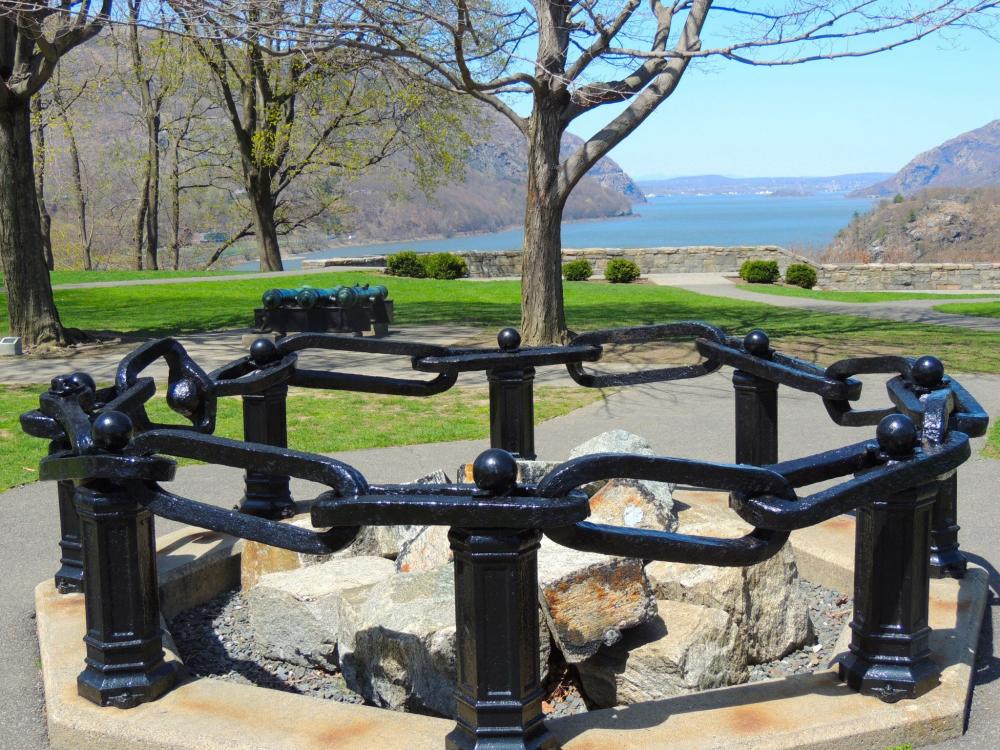
The to which Washington refers is the Hudson River, and his “former position” was the Newburgh area—the best place for Washington to go for both his army and the defense of our country. The New York City contingent of British troops was the largest in North America. Newburgh was in a sense out of reach of the British Navy because of the Great Chain at West Point, but the “North River” still held strategic importance as the British had tried earlier in the war to divide the states by conquering the North River.

Parts of the Great Chain

Loyalties and money played a role, too in Washington’s decision. The area around Newburgh was almost 100% patriotic. At earlier points in the war, Washington had headquartered where local loyalties were not so plain. In those areas, supplies were harder to come by and Congress could provide little to no financial support, so friendly country was a necessity. Around Newburgh, patriot supply lines and depots, communication lines, contractors, etc. had already been established earlier in the war.

Reenactors_with Cannon_PRK1039
Reenactors pose with Revolutionary War cannon.

Looking back on Yorktown, one can be forgiven for thinking the war was over, but that is only in hindsight. Had Washington thought that, we might be swearing allegiance to Queen Elizabeth today. After Yorktown, Washington worked hard to keep the army well positioned, battle ready, and under control. Newburgh gave him a relatively safe place from which to watch the British, strategically defend the country, and present a unified front at a time when internal turmoil threatened to undo all the hard work already done in defeating the British.

Come to Washington’s Headquarters in Newburgh to find out the rest of the story. For more information contact Washington’s Headquarters State Historic Site in Newburgh NY at 845-562-1195 or find us on Facebook.

_PRK_1175 copy
Schoolchildren learn about Washington at Hasbrouck House.

Post by Lynette Scherer, State Parks Recreation Aide at Washington’s Headquarters State Historic Site