All posts by New York State Parks

Weekend Forecast: Heavy Meteor Showers

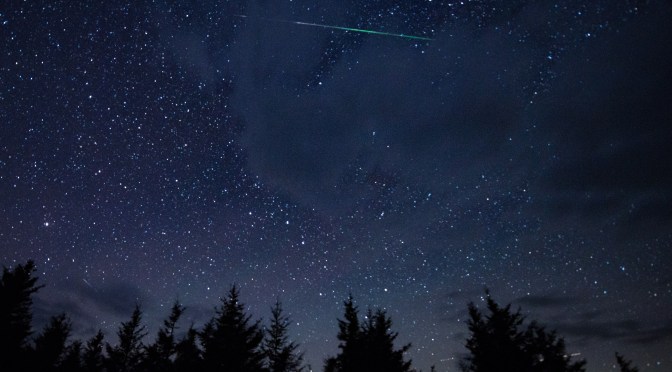
Each year when the second week of August rolls around, I know where my family will be. Loaded with blankets and camp chairs, we head to Lake Erie State Park to sit back, relax, and gaze at the stars. Why? Early August marks the peak of the Perseid meteor shower, one of the best displays of shooting stars every year.

This year, the predicted peak performance is on the night of August 12th (intensifying through the predawn hours, if you can stay up that long), though you may catch a glimpse of meteors any night between July 17th and August 24th. The Perseid meteor shower typically produces 50-100 meteors per hour, with outbursts up to a couple hundred meteors per hour in some years.

The meteors we see–particles ranging in size from a grain of sand to a small pebble—come from the debris of the comet Swift-Tuttle. Though this comet (think of a 16-mile-wide dusty snowball) orbits around the sun only once every 133 years, the Earth passes through its long-lasting trail of rocky and dusty debris around the same time every year, presenting us Earth-dwellers with the fiery flashes of the Perseid meteor shower.

As the tiny particles collide into the Earth’s atmosphere at a measly speed of 133,000 miles per hour (37 miles per second), they ignite due to the friction of the atmosphere. If you trace the paths of these meteors, they will appear to originate from around the same area; this point is called the radiant, and the Perseid meteor shower radiates from, you guessed it, the star constellation Perseus. Don’t worry though, you don’t need to know exactly where this constellation is to find the show; just look towards the northeast!
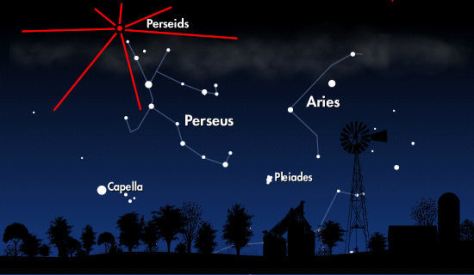
Direction_of_the_Perseids
Perseid meteors will appear to originate near the Perseus constellation, so look to the northeastern sky for the best view. Image from NASA

The number of meteors you see depends on several other factors as well, including lights, weather, location, and moon phase. The Northern Hemisphere is the place to be for these showers, and lucky for us, on August 12th the moon will be nearly brand new, which means that the night sky should be nice and dark. We can’t control the weather, so be sure to go out on a night with less cloud cover.

How do you throw a get-together for a meteor shower? You have to planet! The best way to see the Perseids is to find a safe, dark and secluded spot away from city lights – a local park perhaps? Be sure to check that the park will be open at night, and some State Parks are even offering programs for the big event! Leave the binoculars and telescopes at home, you will be able to see these meteors with just the naked eye, and the more open sky in your field of view, the better. Dress for the weather, bring blankets to lay on or comfortable chairs to sit in (reclining camp chairs are great for this), and don’t forget the snacks. The longer you sit out, the more meteors you are likely to see! It takes about 30 minutes for your eyes to fully adjust to the dark, and the number of shooting stars increases throughout the evening. So go outside, get settled, and enjoy the beauty of fiery space debris!

Click here to check out some upcoming star-related State Park events!

Post by Kelsey Ruffino, State Parks

Resources:

NASA Meteor and Meteorites Perseids In Depth

In The Sky Perseid Meteor Shower

Space.com Perseid Meteor Shower 2018: When, Where & How to See It This Month

DateandTime.com Perseid Meteor Shower 2018

Sky and Telescope The Best Meteor Showers in 2018

Stardate Meteors

Learn more about meteors:

Aronson, Billy; Meteors : the truth behind shooting stars; Franklin Watts, NY, 1996.

Rose, Simon; Meteors; Weigl Publishers, NY, 2012.

Featured image: NASA/Bill Ingalls

The Ellenville Fault Ice Caves – A National Natural Landmark

The most popular features of the Sam’s Point Area of Minnewaska State Park Preserve are the Ellenville Fault Ice Caves. This remarkable system of crevice caves fills up with ice and snow each winter, and retains some of its ice well into the summer. Even when the ice is completely gone, the caves remain cool all year round. This unusual phenomenon has drawn people to the caves for generations.

Postcard
A postcard from c. 1909 showing the snowed-over entrance to one of the caves. The man in the image is an illustration, and slightly exaggerates the scale.

The significance of the caves has even been recognized by the National Park Service. In 1967, the NPS designated the Ellenville Fault Ice Caves as a National Natural Landmark. This designation is given to natural sites that exemplify the special or unique biological or geological features of a region.

Geologically, the Ice Caves are unlike other caves in the Northeast. Most cave systems are made of limestone, which is easily eroded and dissolved by water. This results in the large, open caverns that most people imagine when they think of caves. The Ellenville Ice Caves, on the other hand, are formed out of extremely hard and insoluble quartz conglomerate. When underlying rock layers were folded by tectonic movement, the hard conglomerate separated along existing joints in the rock.

jackfagan.png
Cutaway images demonstrating two forms of crevice cave formation. Source: Jack Fagan, Scenes and Walks in the Northern Shawangunks

The caves remain cold because of the natural refrigeration system that exists within them. When air moves across the top of the crevices, the colder, heavier air sinks down into them. The cold air then becomes trapped in the caves, keeping them at a comfortable temperature even during the hottest days of the summer.

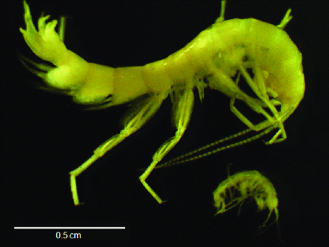
While they received the National Natural Landmark designation because of their unique geologic importance, the Ice Caves have a great deal of ecological impact as well. The NY Natural Heritage Program recognizes the ice cave talus community as globally uncommon and rare in the state and a priority for protection. Because of their cold microclimate, the Ice Caves are home to several species that are infrequent in the region. These include goldthread (Coptis trifolium), mountain ash (Sorbus americana), and black spruce (Picea mariana), among others. Scientists have also taken interest in the presence of a species of cave-dwelling crustacean (Stygobromus allegheniensis) that is only found in four states: New York, Pennsylvania, Maryland, and West Virginia. This little arthropod lacks eyes, as it does not need them in complete darkness. It is also able to survive being frozen, a necessary attribute for surviving winter conditions in the caves.

Espinansa et al. (2015)
Strygobromus allegheniensis. Note the pale coloration and lack of eyes, typical features of cave-bound organisms. Image source: Espinansa et al. (2015)

The Ice Caves have local cultural significance as well. Many residents of the Shawangunks remember the days of “Ice Caves Mountain,” when the Sam’s Point area was managed very differently than it is today. From the late 1960s to the early 1990s, much of Sam’s Point was privately owned and operated as a tourist attraction. Visitors could drive their cars right up to Ice Caves, while a pre-recorded cassette tape described the various features encountered along the way. Doors were placed over the caves to keep the ice inside year-round, and the ice was lit up by multicolored flood lights. A rock wall was built on the cliffs of Sam’s Point to dissuade visitors from getting too close to the edge. While it may have been somewhat kitschy by today’s standards, it cannot be denied that “Ice Caves Mountain” was an important step in allowing the greater public to experience this previously obscure natural wonder.

Minne_Sam_sPoint11_IceCaveEntrance_GJE
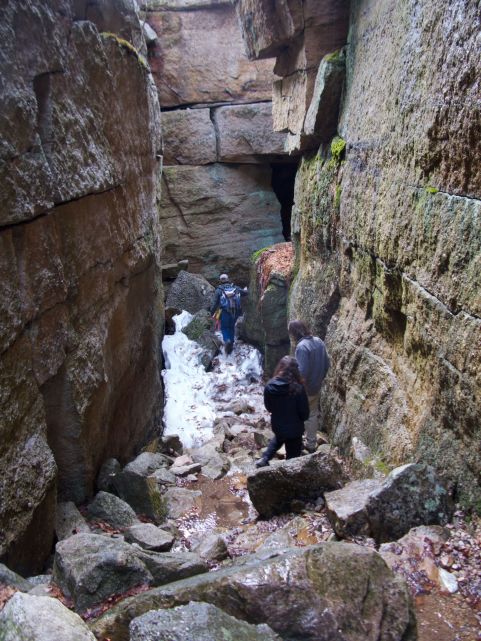
Gully with snow at Sam’s Point, photo by Greg Edinger, image courtesy of the New York Natural Heritage Program

Many things have changed since the Ice Caves Mountain days. While Sam’s Point is still managed for recreation, there has also been a large shift in focus towards conservation. Visitors may no longer drive through the park, and the cave doors have been removed in favor of letting the natural ice cycle of the caves take place. Interpretive displays within the park focus on the natural history of the caves, rather than just their physical spectacle.

While National Natural Landmark status highlights the importance of a site, it is up to the owners of that landmark to manage and protect it. Fortunately, Sam’s Point is part of a Park Preserve, meaning that all of the plant and animal life within it is protected. As such, those who appreciate the cultural, geological, and ecological significance of the Ellenville Fault Ice Caves are able to experience them to the fullest extent.

Tim Howard, NYNHP
Ice and trees in leaf – a late spring exploration of the ice caves. Tim Howard, NYNHP

Want to explore the Ice Caves? State Parks staff offer guided hikes to both Shingle Gully and the Sam’s Point Ice Caves; click here for the Sam’s Point Area calendar of events.

References:

Fagan, Jack (2006).  Scenes and Walks in the Northern Shawangunks (3rd Ed.). Mahwah, NJ: The New York-New Jersey Trail Conference.

Espinasa, L., McCahill, A., Kavanagh, A., Espinasa J., Scott, A., Cahill, A. (2015).  A troglobitic amphipod in the Ice Caves of the Shawangunk Ridge: Behavior and resistance to freezing.

NatureServe Explorer Allegheny Cave Amphipod

Ice Caves Talus Community Conservation Guide

Featured image courtesy of Mike Adamovic, from Ice Caves of the Shawangunk Ridge

Post by David Hendler, SCA Education and Stewardship Intern


THE HART OF THE MATTER: AMERICAN HART’S-TONGUE FERN IN NYS PARKS

Tucked away in cracks and crevices along the steep, rocky ravines and plunge basins of Clark Reservation and Chittenango Falls State Parks resides one of the rarest and most endangered ferns in the United States; the American hart’s-tongue fern (Asplenium scolopendrium var. americanum). In fact, 94% of all hart’s-tongue ferns in New York are contained within these two Central New York State Parks!

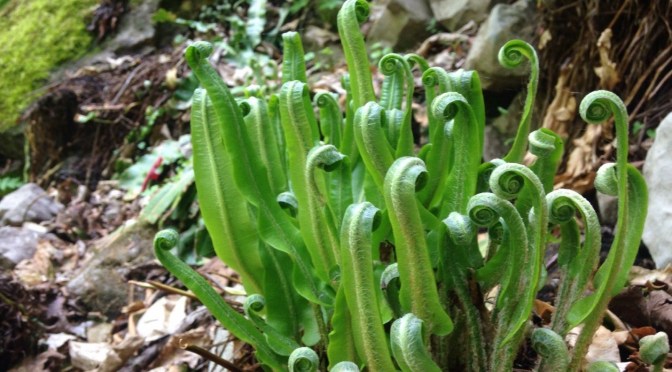
The name “hart’s-tongue” was given to this unique plant due to the resemblance of the fronds (leaves) to the tongue of an adult red deer, also known as a “hart.” The “American” moniker was placed in front to distinguish the North American variety from its closest relative, the European hart’s-tongue fern, which is common throughout much of Europe and the United Kingdom.

AHTF at Clark M Serviss
American hart’s-tongue ferns at Clark Reservation State Park. Note the resemblance of the frond to that of the tongue of a deer, also known as a hart.

Few people are likely to ever encounter this unusual looking fern in the wild due to the rugged nature of its unique habitat. Those who are fortunate enough to gaze upon the strange fronds of a hart’s-tongue might have a reaction similar to that of American photographer Dr. H. E. Ransier in 1926:

“Richer than millionaires! Happier than Kings! Envied by multitudes! May be said of hobnobbers with Hart’s-tongues.”

Dr. Ransier’s enthusiasm for the hart’s-tongue fern is one that has been shared by countless students, botanists, pteridomaniacs (fern enthusiasts), nature lovers, and park patrons alike over the 211 years since its discovery just outside of Syracuse, NY in 1807. Additional hart’s-tongue populations have since been discovered in Ontario, Canada, the upper peninsula of Michigan, and a few unusual relicts in southern Tennessee and northern Alabama. However, the loss of several populations due to limestone quarrying, deforestation, urban expansion, and illegal collection resulted in the placement of the fern on the United States Endangered Species List in 1989. Currently, drought induced by climate change and invasion of the habitat by non-native plants also threaten many hart’s-tongue populations.

Hart’s-tongues are extremely sensitive to changes in climate and have very specific habitat requirements. They are most often found on steep, rocky, moss-covered slopes with north to east aspects in partial to full shade. The soils are well-drained and rich in calcium and magnesium. Hart’s-tongue researchers in New York have found that these habitats remain significantly cooler and more humid than immediately adjacent forests. The availability of quality habitat is critical to the growth and reproduction of the ferns. Very few of these types of habitats exist in New York State, which is why conservation of the habitat of the ferns is essential for their recovery.

AHTF Habitat M Serviss
Steep, rocky ravines and plunge basins provide the typical habitat for hart’s-tongue fern in New York.

New York State Parks has become increasingly involved with hart’s-tongue fern conservation over the last 10 years. Seasonal teams of FORCES stewards (Friends of Recreation, Conservation, and Environmental Stewardship), affectionately referred to as “The Fern Crew”, have carefully dug out hundreds of thousands of invasive plants from Clark Reservation and Chittenango Falls State Parks in an ongoing effort to protect the fern’s very sensitive and rare habitat. The Fern Crew is largely made up of college interns pursuing degrees in conservation biology or related fields and is overseen by Park staff.

In 2015, after 100 years and several failed reintroduction efforts by various organizations, researchers were successful in reintroducing greenhouse-propagated hart’s-tongue ferns into the wild! As a result, two existing populations were expanded and New York State’s first new hart’s-tongue population was created! Reintroduction efforts were led by the SUNY College of Environmental Science and Forestry in Syracuse, NY and New York State Parks, working closely with the U.S. Fish and Wildlife Service and the NY Natural Heritage Program. The FORCES program contributed many hours of labor to make this project a success.

Forces
The FORCES Fern Crew transplanted 2,000 greenhouse propagated hart’s-tongue ferns in 2015 (left). A hart’s-tongue fern transplant looking spectacular after 3 years in the field (right).

Future plans to continue propagation of hart’s-tongues are currently in the works at one of only two greenhouse facilities within the New York State Park’s system, Sonnenberg Gardens and Mansion State Historic Park in Canandaigua, NY. In a remarkable historical twist, the greenhouses at Sonnenberg Gardens were built by the very same woman who donated Clark Reservation State Park to New York State in 1915, Mary Clark Thompson. Keep your eye out for the amazing American hart’s-tongue fern at Sonnenberg Gardens in the coming years, as it may be your only chance to catch a glimpse of the fern that has enchanted generations of enthusiasts!

Clark_Sonnenberg
Mary Clark Thompson (left) donated Clark Reservation State Park (top right) to New York in 1915, including several hart’s-tongue fern populations. She also built the greenhouses at Sonnenberg Gardens (bottom right) that will soon be used to propagate hart’s-tongue ferns for reintroduction back into Clark Reservation.

Click here to learn more about this rare fern.

Blog post by Mike Serviss, Conservation Project Coordinator for Clark Reservation and Chittenango Falls State Parks.

All photos by Mike Serviss (New York State Parks), except the photos of Mary Clark Thompson and Sonnenberg Gardens, which were obtained from https://www.sonnenberg.org/

Help Keep Wildlife Wild

A busy squirrel scurries through a picnic area.

 A sparrow hops around on the ground near the campsite fire pit.

 A small herd of deer graze on the short grass near the playground.

New York State Parks provide a home to countless species of wildlife. They also provide a way for us visitors to experience and enjoy endless wildlife encounters. It is important to remember that wild animals live in balance with their habitat, eating foods that provide them with the best nutrition. There are different reasons people may want to feed wild animals such as ducks, chipmunks, deer, or raccoons, but feeding wildlife can cause much more harm than good.

Reasons not to feed wild animals:

 It leads to poor nutrition.

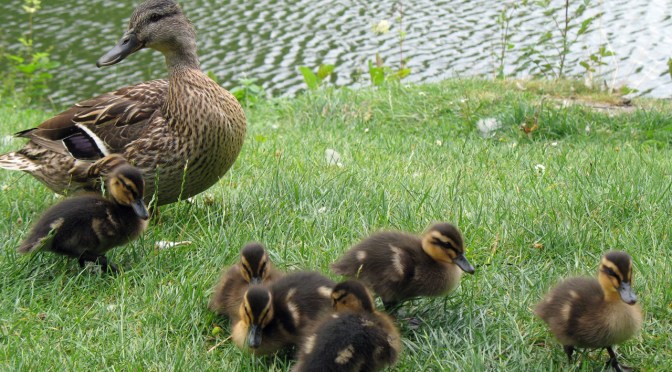
Feeding wild animals “people foods” like bread, marshmallows, or popcorn impacts their health in several ways. Animals have specific diets and these human foods do not contain the nutrients needed to keep the animal healthy. Like with people, poor nutrition in baby animals may even lead to health problems as the young animals grow. Young ducks and geese, for example, may develop a defect in their wings if fed an improper diet. This syndrome, commonly called “Angel Wing,” is incurable in adults and likely leads to an early death because the bird is unable to fly. In addition, when animals are continuously fed people food, they could become dependent on that food source and stop feeding on their natural foods. Young animals may not learn how to feed normally and could become less able to survive in their natural habitat.

It changes their behavior.

Have you ever had seagulls try to steal your French fries? Wildlife that are accustomed to being fed lose their natural fear of people. They might learn to associate all people with food, which leads them to become bolder towards humans. This could become a safety issue and unfortunately the animal may need to be permanently removed. Animals that are fed human food may also become more aggressive towards each other as they compete for food scraps. Feeding can influence migration as well; animals dependent on an unnatural food source may not migrate during the normal time of year.

It can increase the chance of disease.

Food provided by people can cause wildlife to gather in greater numbers than normal, which can increase the spread of disease. Some of these diseases can even be spread to people. This is another important reason to leave wild animals be.

State Park Signage.JPG

As you can see, feeding wildlife has many serious consequences. Animals do not understand the negative impacts of feeding; with your help, we can keep our park animals wild and healthy by not feeding them. And, it is State Parks’ policy to prohibit the feeding of wildlife by the public at all state parks and historic sites.

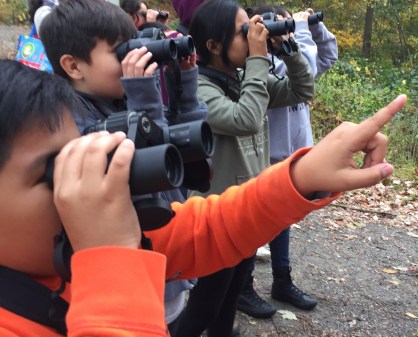
You do not need to feed the wildlife to enjoy their presence. Instead, try quietly watching the ducks from a nearby bench at the shore, snap some pictures of a deer from a safe distance, or break out the binoculars at a bird blind to get a better look at wildlife. If you don’t have binoculars, your local park nature center may have some available to share!

Ossining Grd 5 A Swaim
Ossining Fifth Graders watch birds at Rockefeller State Park Preserve. photo by Anne Swaim, Saw Mill River Audubon.

Post by Kelsey Ruffino, State Parks

Featured image: Petr Kratochvil – http://www.freestockphotos.biz/stockphoto/5756, Public Domain, https://commons.wikimedia.org/w/index.php?curid=13281242

Monitoring for Southern Pine Beetle

Earlier this year, the Invasive Species Management Team kicked off the spring with the installation of several southern pine beetle (SPB) traps at Minnewaska State Park Preserve and a few other locations. Southern pine beetle, Dendroctonus frontalis, is a 2-4mm long bark beetle, reddish brown to black in color, that hails from the southeastern United States and attacks pine trees. The female will locate a host tree, most commonly one with a compromised defense system as noted by the presence of alpha-pinene, a chemical released by stressed trees. The females then release the pheromone frontalin to attract males for mating, as well as other males and females. Males also secrete a pheromone, endo-brevicomin, summoning more beetles to congregate. The beetles enter the trees through cracks in the bark. In an effort to eject the beetle, pine trees will produce resin to push them out. The resulting little, lumpy sap nuggets are called pitch tubes and are a good indicator of SPB infestation. Once in the tree, SPB starts constructing curved tubes, or galleries, in the cambium to lay their eggs in. It is in the cambium that we find the xylem and phloem tissue, which transports water and nutrients through the tree and therefore helping the tree growth. Larvae move to the inner bark immediately after hatching, and then to the outer bark to feed as they mature. When they become adults, they chew round exit holes in a “shotgun” pattern, large enough only to fit a pencil tip. The exit holes are another sign of infestation to be on the lookout for. The chewing of galleries disrupts the flow of water and nutrients, resulting in the needles fading and ultimately tree death in as little as 2-4 months. The Long Island Central Pine Barrens have been particularly damaged by SPB. This may be due in part to the lack of fire as a management technique to thin stands, reducing competition and therefore resulting in healthier trees. Additionally, smoke from fires overpowers the beetle’s pheromonal communication, thus impeding their spread.

Because of how widespread SPB distribution has become, eradication of the species is simply not possible. The main method employed to suppress invasions is the cutting and removal of infested trees. A more proactive method includes monitoring pines for the early infestations of SPB to enable a rapid response to the arrival of SPB; bringing us back to Minnewaska State Park Preserve. The Sam’s Point area of Minnewaska is home to the only dwarf pine ridges ecosystem in the world, making it a globally unique and rare site. Therefore, monitoring for the arrival of SPB is imperative for the preservation of this rare pitch pine barrens as well as more common pitch pine communities of Minnewaska.

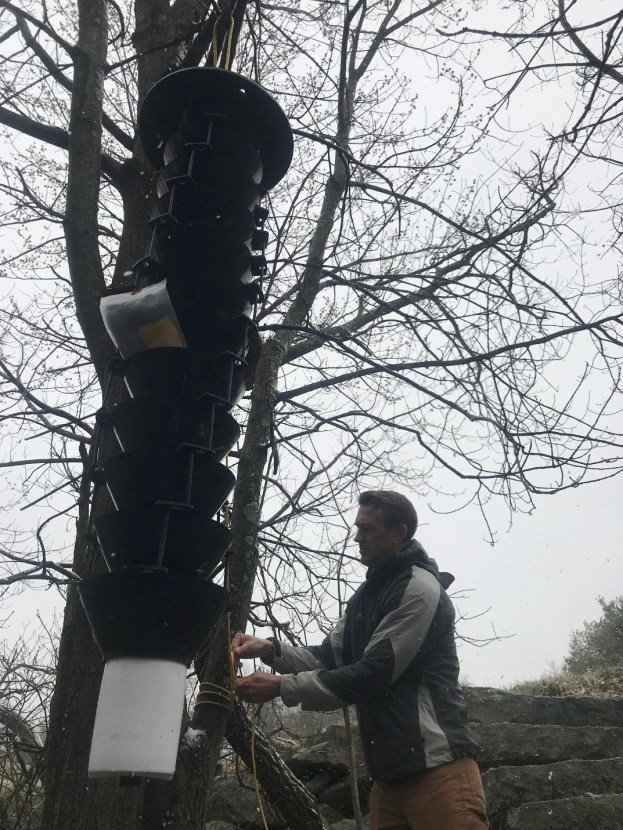
Nick and trap

Entomologist Tom Schmeelk with the Department of Environmental Conservation (DEC) came to Minnewaska to hoist the traps and explain how they work. The traps used are Lindgren funnel traps, with a chain of funnels that mimics a tree stem. Several lures, or packets of pheromoneswere placed inside the trap which is then hung in a hardwood tree several feet off the ground and from the trunk. The lures utilized are frontalin, the sex pheromone secreted by females, and endo-brevicomin, the aggregation pheromone secreted by males. In addition, alpha-pinene was attached, a host volatile produced by stressed trees. The beetles are lured to the trap and funneled into a collection cup, the contents of which are sent to DEC to be checked for the presence of SPB.

For those concerned that the traps will attract beetles into the park that otherwise would’ve remained absent, rest assured that these are short-range traps that would only lure beetles within a few mile radius- meaning they only attract beetles already in the area. Being unaware of their presence in the park would be the much bigger risk to the park’s pine dominated ecosystems and all the species that depend on these, including the rare dwarf pines. Last year all the traps remained empty, let’s hope for the same this year!

Post by Sarantia Mitsinikos, Invasive Species Project Steward with SCA/Americorps/State Parks

Featured image: southern pine beetle, Steven Valley, Oregon Department of Agriculture, Bugwood.org