Category Archives: Cool Science

An Update on the Rare ‘Chitt’ Snail from Staff Snailblazers

From the sculpted drumlins of Chimney Bluffs to the majesty of Niagara Falls, each of our parks are memorable in their own way. But Chittenango Falls State Park has something you’ll find nowhere else on earth: the Chittenango Ovate Amber Snail, or Novisuccinea chittenangoensis.

You’re looking at one of the world’s rarest snails: the Chittenango Ovate Amber Snail, found only at Chittenango Falls State Park in central New York.

First discovered in 1905, the Chittenango Ovate Amber Snail (known to its friends as “COAS” or “Chitt”) is what scientists call an endemic species, meaning it’s found in only one place. While this makes COAS a very special snail, it also makes it a very vulnerable snail. Flooding, drought, climate change, invasive species, and human activity threaten the small snail colony and its habitat. Never very numerous, the colony numbered only about 70 individuals during the 2023 census.

Continue reading An Update on the Rare ‘Chitt’ Snail from Staff Snailblazers
People and Safety Procedures Behind Water Quality Testing at NY State Parks

As New York splashes the summer away, a dedicated team works behind the scenes to make sure our beaches are swim-ready.  

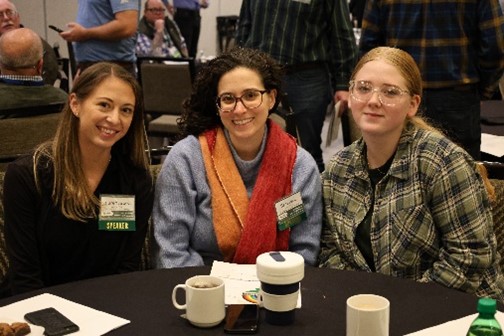
Meet the Water Quality Unit: Lauren Gallagher, Sarah Moss, and Veronica Mileski at a statewide convention. Since this photo was taken, Lauren Badinger has joined the unit as a seasonal assistant.

Consisting of three permanent staff and a summer intern, the Water Quality Unit at New York State Parks is charged with coordinating water sampling at the 75 monitoring stations at 49 beaches throughout New York State. Based in Albany they work closely with other agencies to report and track their results.  

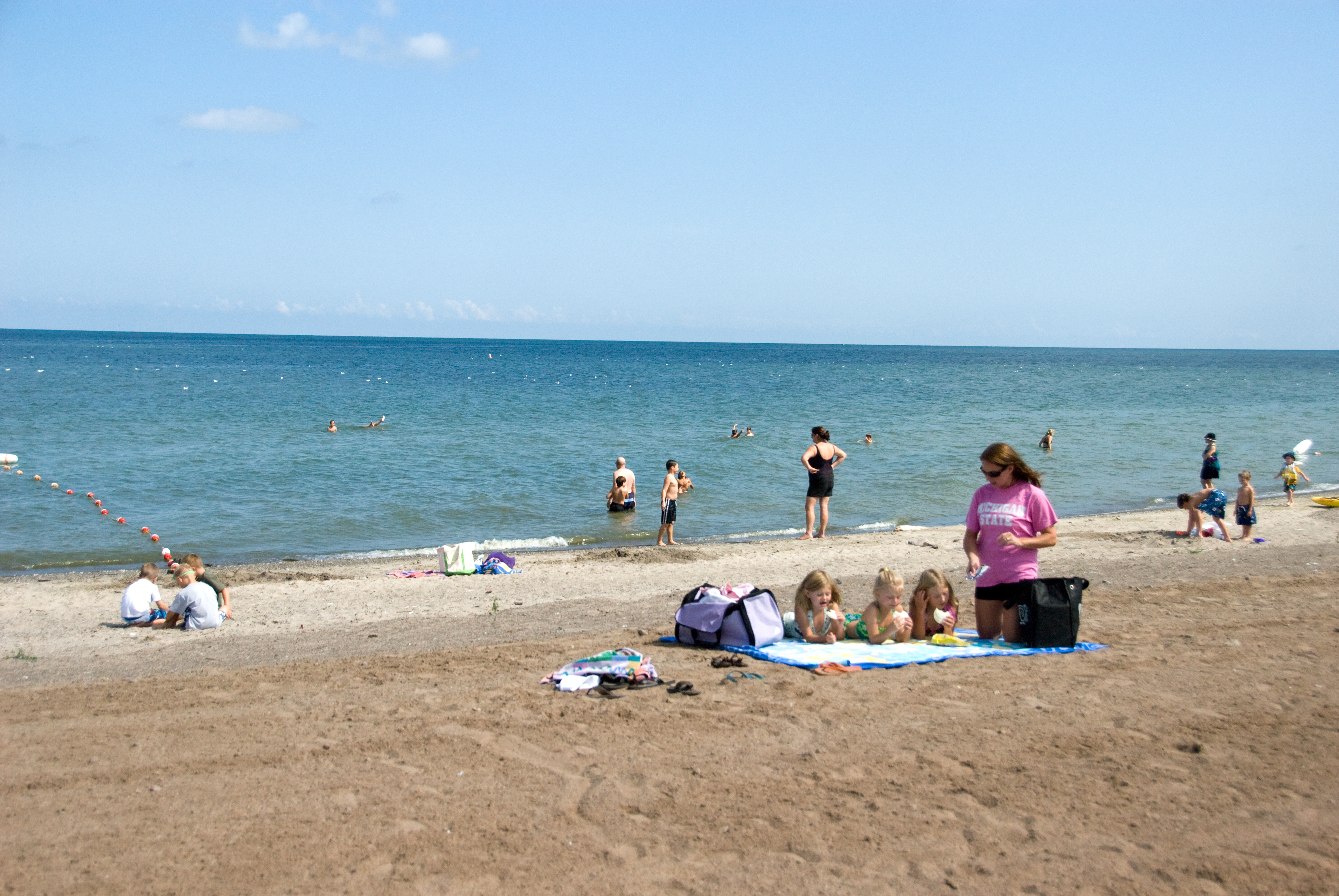
Guests enjoy Hamlin Beach on Lake Ontario, one of the 49 beaches monitored by our Water Quality Unit.

Water Quality Unit team members all agree that this is a job hiding in plain sight. While it’s essential to public health and appreciated by millions every summer, it’s generally under the radar of most of the people it benefits.   

Continue reading People and Safety Procedures Behind Water Quality Testing at NY State Parks

Total Eclipse Of The Parks

On April 8, New York State Parks and Historic Sites welcomed people from around the world to share a once-in-a-generation total solar eclipse. Thousands of people enjoyed a rich, memorable experience thanks to the hard work of our staff over a two-year period.

Public Information Officer Angela Berti of the Niagara Region led this effort on behalf of State Parks and represented our agency on the statewide Eclipse Task Force.

Our Park Police used their expertise in peacefully managing large crowds to keep our visitors safe. Countless staff worked behind the scenes and on the front lines to open selected campgrounds for the occasion, plan educational programming, get the word out to the public, make sure our parks were in top condition, and ensure the safety of our visitors.

As Chief of Staff and Commissioner Pro Tempore, I am filled with pride and gratitude for all the hard work of our staff in preparing for this remarkable event. Enjoy reliving the day with photos from around our parks and sites!

Continue reading Total Eclipse Of The Parks

What To Expect With the April 8 Eclipse, According to NASA 

A rare total solar eclipse is passing through western New York, the Finger Lakes, and the Adirondacks on April 8, 2024, and eclipse mania has begun! The eclipse will be fully visible in New York State across a narrow route, referred to as the path of totality, but all New York residents and visitors can still experience a partial eclipse throughout the rest of the state.  

Whether you’re in the path or not, what makes an eclipse-viewing experience so special? And what should we expect to see, feel, and be exposed to?

We spoke to David Cheney, Program Executive in NASA’s Heliophysics Division, to shed light on all the need-to-know information. Whether you’re planning to attend one of the eclipse-viewing gatherings scheduled at our parks and historic sites (featuring eclipse-themed activities, discussions and trivia, snacks, and distribution of solar viewing glasses to prevent severe eye injuries); register for and follow NASA’s livestream monitoring the path from Mazatlan, Mexico to Milton, Maine; or just pop outside that day; we’ve got you covered. 

NASA’s David Cheney (left) and Lester Morales (right) during our February 2024 interview.
Continue reading What To Expect With the April 8 Eclipse, According to NASA 

A Look Back At The Total Solar Eclipse Of 1925

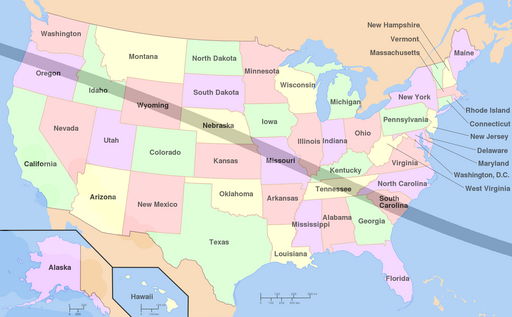
Many of us remember the last total solar eclipse in the United States, known as the Great American Eclipse in August 2017. The news coverage talked of the path of totality which travelled from coast to coast, starting in Oregon and arcing south across the country through South Carolina. Those who remained here in New York were treated to a view of between 59-75 percent obscuration (covering) of the sun as the moon passed between the sun and Earth. While it was definitely a national event, New York didn’t get the front-row seats that being in an eclipse’s path of totality provides.

Path of 2017 eclipse, courtesy of Wikicommons.

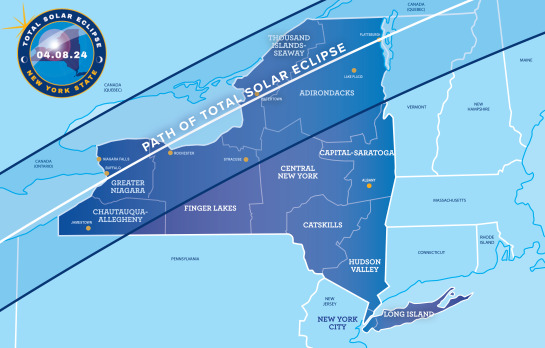
Thankfully, many New Yorkers will soon have the opportunity to see this celestial wonder for themselves from their own backyards or local parks. On April 8, 2024, another total solar eclipse will pass from Mexico through parts of 14 different states and into Canada. This time, New York is in the eclipse’s path.

The 2024 eclipse path in New York State, courtesy of I Love NY. To drill down on the path of totality for April 8, visit our interactive map.

Some people have been looking forward to the 2024 total solar eclipse for years, some for decades! But all of this anticipation has some of us looking backwards to the last total solar eclipse that passed through the skies of New York State in 1925.

Path of 1925 total solar Eclipse, Butler Papers, Archives of American Art, Smithsonian Institute.
Continue reading A Look Back At The Total Solar Eclipse Of 1925