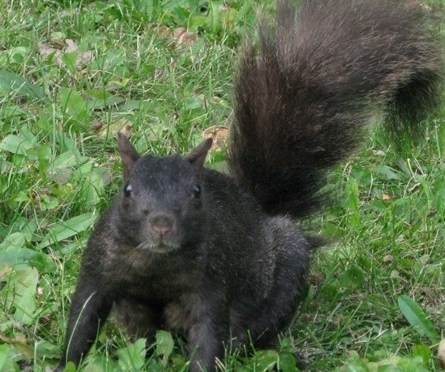
Most everyone has seen a gray, and glimpsed or at least heard of a red, but have you ever seen a black squirrel?!
An eye-catching squirrel at Whirlpool State Park with all black fur; Photo by M. Drahms OPRHP
Chances are if you have ever visited Niagara Falls State Park or any of the neighboring parks in the region you’ve seen what at first glance appears to be the shadow of a gray squirrel. That is, until it moves and starts chattering. Of the many types of squirrels in New York State, the black squirrel is not mentioned in most field guides but it most closely resembles the size and shape of the gray squirrel. It also eats the same diet of seeds and nuts with some fruits, fungi, and the occasional insect mixed in.
A bounty of nuts and acorns are found by squirrels at State Parks along the Niagara Gorge. Photo by M. Drahms OPRHP
There is a good reason for the similarities in appearance and habits as they are, in fact, the same species. The black squirrel is a color phase of the Eastern Gray Squirrel (Sciurus carolinensis), also known as a melanistic variant. Unlike species that change color seasonally, like the long-tailed weasel, these rodents retain the dark coloration their entire lives. The black fur is caused by a genetic mutation that is passed from generation to generation.
Both colors of Gray Squirrel can be seen throughout the year in parks along the Niagara Gorge. Photos by A. Weibel & M. Drahms OPRHP
During winters in Western New York the ground is normally covered in a layer of snow and ice that would make the darker black squirrel easier prey for predators such as coyote, owl and domestic cats. However, a darker coat means more absorption of heat energy from the sun and so less energy used by the animal itself. In the end, the two seem to cancel each other out and gray and black squirrels hold equal dominance around the Falls.
These adorable acorn gatherers garner much attention from the visitors who come to see the beauty of Niagara Falls, hike the Gorge Trail at Whirlpool and Devils Hole State Parks, or ice skate at DeVeaux Woods State Park.
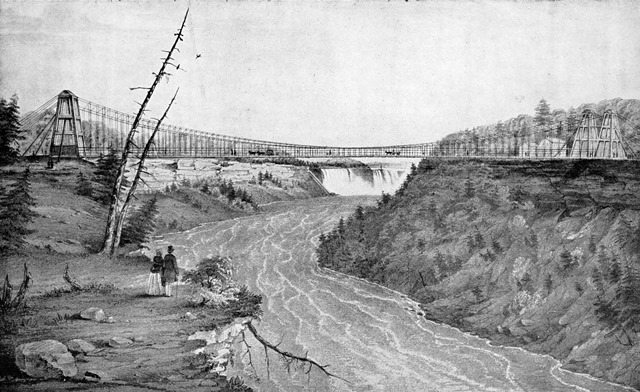
A lithograph created by Charles Parsons of Charles Ellet’s footbridge (completed 1848) commons.wikimedia.org/wiki/File:Charles_Parson_-_Niagara_Falls_Suspension_Bridge.jpg
As to when the variation first appeared in the area around the falls, it is largely unknown. Though there are historic records of black squirrels in the new world, there are none specifically referencing our area. And so, we are left with the urban legends. So the story goes, as the locals tell it, there were no black squirrels in Niagara Falls USA in the early 1800s, but there were across the river in Canada. When the first suspension bridge was built across the Niagara River, with the help of a young boy and his kite, the avenue was open and the black squirrels crossed the river to the USA. Whether the story is true, or whether it was simply over time that the genetic variation showed up in Niagara Falls too, we may never know. But when next you visit, make sure to keep an eye out for this not so common creature.
Post by Angelina Weibel, OPRHP, Environmental Educator, Niagara Region
“Ever since I was young, the story about bears was always the same. Bears hibernated all winter long, usually in a cave and would emerge in the spring. I have since learned a bit more about the environment and ecology and have found that there is much more to the story,” said State Parks staff member Patty Wakefield-Brown.
Hibernation occurs when an animal’s body temperature drops and its breathing and heart rate slows, thus lowering the metabolism of the animal, and conserving the animal’s energy. Bears are not “true” hibernators. They sleep for long periods of time but are easily awakened and, if the winter is mild, bears may wake to eat. This behavior is termed torpor, a state or inactivity achieved primarily by a greatly lowered (reduced) body temperature for hours, days or months. Only woodchucks, jumping mice, and cave bats are the “true” mammal hibernators in New York State.
Taking a long winter nap when food is scarce and weather is bad is a great adaptation for bears. While in a state of torpor, a bear will not urinate or defecate in the den. Their bodies absorb the urea and turn it into protein, which is needed during the long winter months.
During hibernation, female bears (sows) give birth and nurse their cubs. Females have delayed implantation, meaning that the egg is not implanted in the uterus unless the female bear has the energy, weight, or does not have the physical requirements to provide for the cubs during pregnancy and just after birth, the egg is released and there is no pregnancy. That is amazing. While in the den, sows wake up in January or February to give birth, generally 2-3 cubs. Black bear cubs are born altricial, which means helpless, hairless, and blind. Cubs remain with the mother for a year and a half or more before they disperse or she forces them out.
Bears generally emerge from their dens in late March and early April and are primarily interested in two things; eating and reproducing. Mating occurs in May or June. Males and females are sexually mature at around four years of age.
With the human population increasing and more and more land being transformed to accommodate this increase, the natural habitat of the American Black Bear is being minimized. Because of this, there is a greater likelihood that a person will have an encounter with a black bear. Wildlife biologists collar and collect data from bears to learn about their populations, home range, health and preferences for den sites. Like all wildlife that we share our environments with, keeping track of this data helps to create local and regional management plans.
Collecting Data on Sows and Cubs
“While a college student, I took a two- semester black bear management class. We worked with the New York State Department of Environmental Conservation (DEC) to assist in the creation of a database regarding den site criteria. We were able to accompany DEC staff on bear den visits in mid-March and collect data about the bears. The bears were outfitted with telemetry collars which enabled them to be found when they were in their dens during the winter months,” noted Patty Wakefield-Brown.
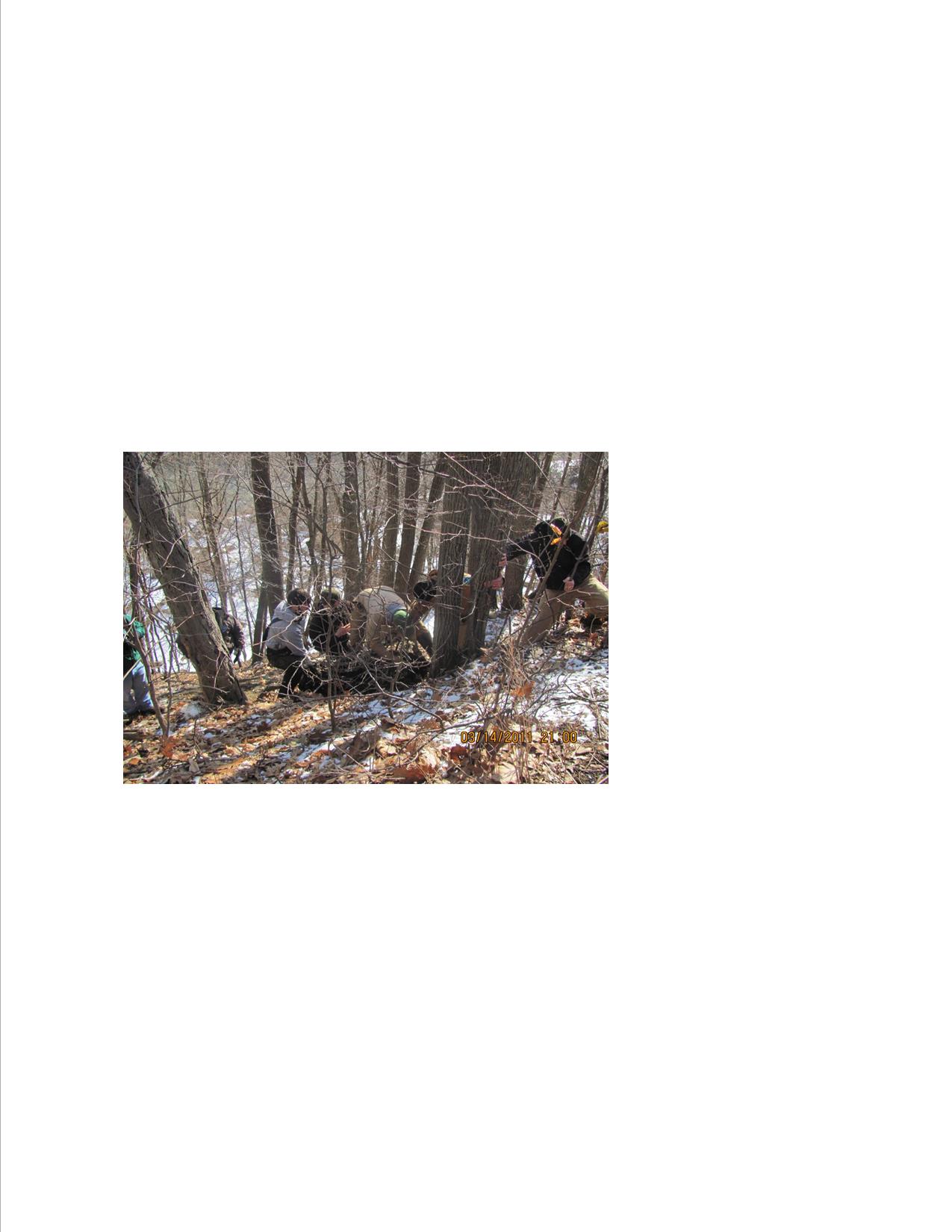
‘Photo 1’ below shows the DEC staff gently removing the tranquilized bear from the den; the entrance was on quite a steep slope.
Photo 1, by Patty Wakefield-Brown.
The bear was a female that had been previously collared. The purpose of the den visit was to change collars and to collect data including weight, visual appearance, take blood samples and note whether any cubs are present. DEC staff also inspected the den, described its location, (i.e. old log, brush/thicket, hillside, under porch, etc.), took measurements of the den’s interior, what materials den was comprised of, and the amount of cover, and noted the den’s proximity to humans, houses, and roads.
“On this day there were three cubs in the den with the sow. As the mom was being ‘processed’ we got to hold the cubs to determine their age. The way to age young cubs was to measure the hair on the tops of their heads (between their ears) or inside their ears, from the tragus to the tip of the ear (Photo 2) (Bridges et al. 2002). When all the data was collected, the mom was placed back into the den comfortably with her cubs (Photo 3)” recalled Patty Wakefield-Brown.
Photo 2, by Patty Wakefield-Brown.
Photo 3, by Patty Wakefield-Brown.
When bears disperse, they sometimes wander into populated areas creating human-bear conflicts. That was the case in October 2010, when a young male bear wander onto the Rochester Institute for Technology campus in Henrietta. The DEC natural resource managers ‘captured’ the bear and took him to a facility to collect data on him before he was relocated (Photo 4). The bear management class was invited to observe the event. After the bear was tranquilized, a patch was put over the bear’s eyes, so that they don’t dry out (the bears don’t blink when anesthetized). Blood samples were taken, ears were are tagged and a tooth was taken to age the bear, also the inside of the lip was ‘tattooed’ with a number and a radio collar was placed on the bear (Photo 5).The process was done very methodically and quickly. The bear was then released into the Hi-Tor Wilderness Area.
Photo 4, by Patty Wakefield-Brown.
Photo 5, by Patty Wakefield-Brown.
Winter slumbering bears are an essential part of the the ecosystems found in New York State parks. They are part of the splendor of the natural world that mesmerizes us and holds us captive in its magic. If you are lucky, you might get a chance to capture some of that magic if you see a bear in a New York State Park next summer.
Post and photos by Patty Wakefield-Brown, OPRHP.
Reference:
Bridges, A.S., Olfenbuttel, C Vaughan, M.R. (2002). A Mixed Regression Model to Estimate Neonatal Black Bear Cub Age . Wildlife Society Bulletin, Vol. 30, No. 4.
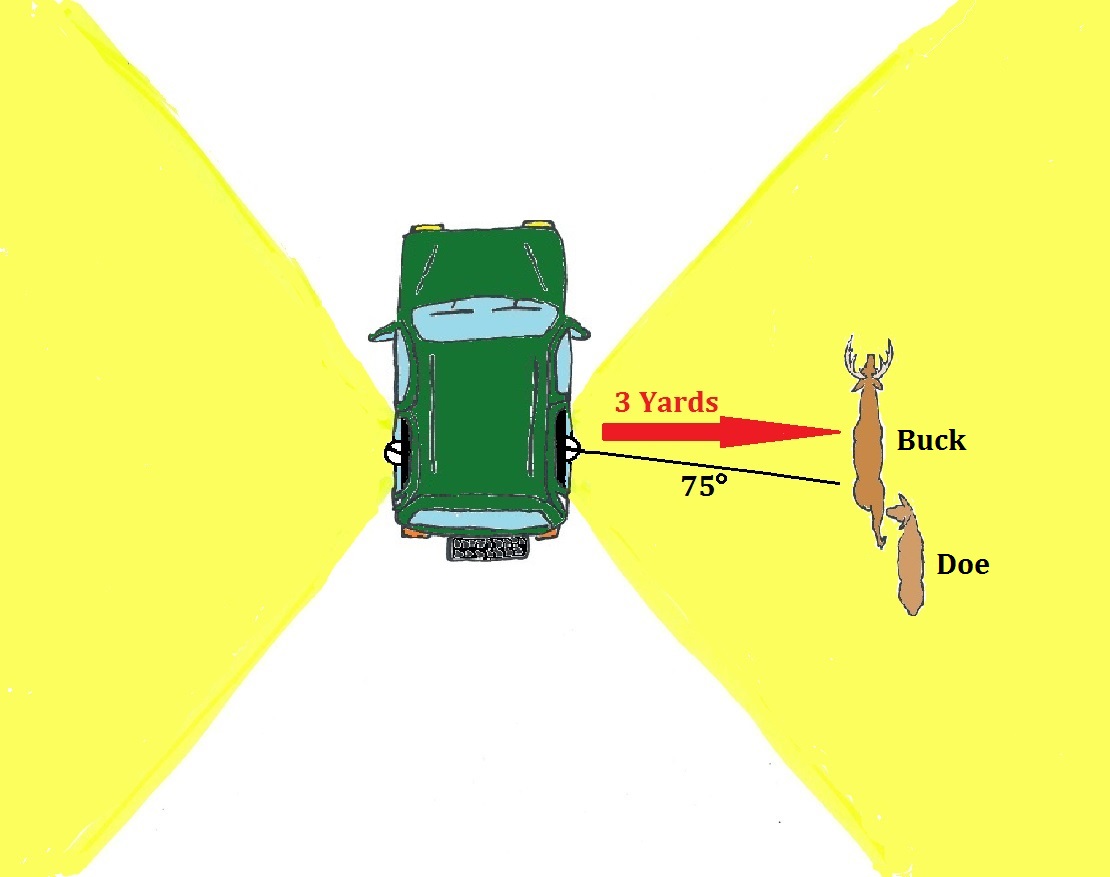
It is important to monitor wildlife populations to ascertain how a species is surviving and how that may impact other wildlife populations and forest biodiversity. In many of our state parks, especially in the Hudson Valley, we monitor the deer population and the effect that deer are having on the forest vegetation. One method we use to monitor the deer population is a “distance survey” conducted at night, using spotlights, a range finder (to determine the distance between the deer and the vehicle) and a protractor, for measuring the angle at which the deer were observed. Four people and a vehicle are needed in this survey. Two “spotlighters” sit in the back seat and search for deer, the driver keeps the vehicle at five mph and stops when a deer is seen to get the information on the deer, and a scribe sits in the passenger seat to record the data. Data recorded includes deer group size, sex, age, habitat type, distance in yards and angle from the vehicle. To determine a deer’s sex, the surveyor notes if the deer has antlers or not – age and sex are defined as fawn, doe or buck.
As an example, the above diagram shows a group of two deer at a distance of 3 yards and an angle of 75˚ from the side of the vehicle. The yellow color represents where the surveyors are shining their lights. The surveyor defines this as a group of a buck, due to the antlers, and a doe. These observed deer are in a mowed hayfield, so this habitat type would be recorded as agriculture.
Parks staff Erin Lennon uses a laser rangefinder to find the distance, in yards, that the deer below is from the vehicle, while someone else holds the spotlight on the deer. Note the protractor mounted on the window to determine the angle.
From left to right are the spotlight, rangefinder and protractor used in the survey.
This rattlesnake was about 3ft long and slowly slithered across the woods road in front of our vehicle.
The copper head was slightly more difficult to see, as it blends in very well with the fallen leaves and was staying perfectly still. Only its eye shine in the headlights gave it away.
Click on an image above to read the caption.
After driving the predetermined distance sampling routes, we headed home for the evening. Back in the office, the data obtained will be entered into a statistical program that will calculate the number of deer per square mile in this particular park. This data will be compared to previous year’s data to track the deer population and will help determine future wildlife management decisions.
As the northeast transitions from fall to winter, watch for changes in Parks lakes and ponds nearest you. You might notice that the water churns more than it did during the summer, or you might even notice ice beginning to form at the surface. Such phenomena can mean exciting happenings deeper in the water. One of the most fascinating changes to observe is lake-turnover, or the mixing of cool and warm waters.
Lakes that turn over twice a year are known as “dimictic”: di=twice, mictic= mixing. They are one of the most common types of lakes on Earth. Dimictic lakes freeze in the winter and melt completely by summer. These lakes mix during the spring and fall, after ice melts and before ice forms. Examples of dimictic lakes are seen across New York State, including Shaver Pond in Grafton Lakes State Park, Moreau Lake of Moreau Lake State Park, Lake George of the Adirondack region, and Lake Erie.
Long Pond at Grafton Lakes State Park during spring turnover: ice melting after winter (top), followed by water mixing into the lake (bottom). Fall turnover is the opposite: water mixing followed by ice forming in early winter. Ice photo by OPRHP. Mixing photo cropped from original by L. Schelling, OPRHP.
Without turnover, aquatic life in different areas of a lake may not have enough oxygen or nutrients to thrive. Calm waters tend to separate into layers – with denser, “heavier” waters sinking below less dense surface waters, creating an invisible boundary through which oxygen and nutrients cannot pass. Water is most dense 4 degrees Celsius above freezing (4 OC, or 39OF) and becomes less dense as it cools or warms from this point. In the summer, this means warmer water is at the surface, closer to the air and thus richer in oxygen for fish. Meanwhile a layer of cooler, 4oC water settles at the bottom – where many nutrients accumulate, but also where decomposition of dead animals and plants can lead to little to no oxygen in the water.
Dimictic lake temperature throughout the seasons, with the layering (“stratification”) and mixing of warmer (red) and cooler (blue) waters. Spring turnover results from ice melting, and fall turnover results from wind chilling and mixing surface waters. Image adapted from Figure 44.10 in “Ecology and the Biosphere” (Candela Learning).
As chilly, windy fall weather kicks in, some of the oxygen-rich surface water can cool, sink into the lower levels of the lake, and push the deeper, nutrient-rich waters up closer to the surface. The result is a well-mixed habitat for fish. In dimictic lakes, this turnover happens again in the spring, when the surface ice melts to that heavier, 4oC water and mixes into the deeper waters.
Why are some lakes dimictic and others not? One reason is lake location — dimictic lakes are more common in temperate regions with warm summers and cold winters, where lakes may freeze over completely. Another factor is lake size. Two lakes that are famous for not having complete mixing are Round Pond and Green Lake in Green Lakes State Park. These are the rare “meromictic” (mero=part) lakes which mix in the upper waters but are too deep to allow surface and bottom waters to mix. Alternatively, some lakes may be so shallow that they mix frequently (“polymictic”). NY Natural Heritage Program describes 7 different types of lakes in the state.
Seasonal turnover is important for lake recreation as well as for fish and plant life within lakes. Fishing can improve near the end of mixing periods in lakes that experience turnover, since now oxygen and nutrients will be better distributed throughout the water. Many fish and aquatic life are sensitive to changes in their habitat – oxygen and nutrient levels, as well as temperature changes. Keeping an eye on the changes in the water is useful to biologists and park enjoyers alike.
Post by Erin Lennon, State Parks Water Quality Unit.
The days start getting shorter, the nights are cooler, and the leaves start to turn vibrant colors. Fall is a time of change and when plants and animals start to prepare for the long winter months ahead. It is a great time to get outdoors and observe nature’s seasonal changes.
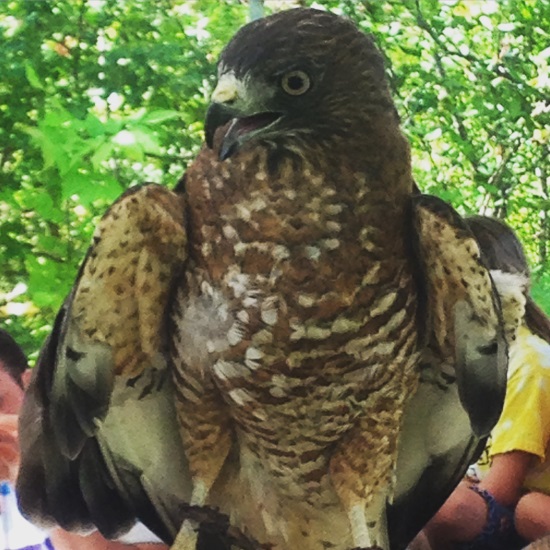
Broad Winged Hawk. Photo by April Thibaudeau, Thacher Park.
One of the Northeast’s finest wildlife spectacles happens in fall, the autumn migration of hawks. Beginning in early September until the end of November, broad-winged hawks, falcons, eagles, kestrels, harriers, and more travel from their northern breeding grounds south due to scarcity of food during the winter. The birds soar on thermal updrafts, minimizing energy expenditure. A group of birds in a thermal is termed a “kettle” and may resemble a spiral of ascending birds. The migrators utilize these updrafts to glide over ridges and down the coast to regions as far as Central and South America where food is plentiful. Thacher Park hosts an annual Hawk Migration Watch at the escarpment overlook where visitors can help count passing birds and learn more about the species they see.
Burr Oak nut showing the cupule of the acorn, which protects the fruit while it grows and matures. Photo by Ben VanderWeide, Oakland
Plants start dispersing their seeds in the fall by way of wind, water, animals, and even explosion or ballistic seed dispersal. It all starts at the end of August when blackberries, mulberries, and other fleshy fruits start to ripen and fall to the ground. These fruits contain small hard seeds and are dispersed after passing through the digestive system of animals, but make a yummy treat for us! Acorns are theseeds of oak trees and sprout rapidly after falling to the ground. Squirrels can be seen scurrying around this time of year, storing nuts to eat later in the winter. Luckily for trees, squirrels only find about 30% of the nuts they hide – allowing more seedlings to sprout in the spring.
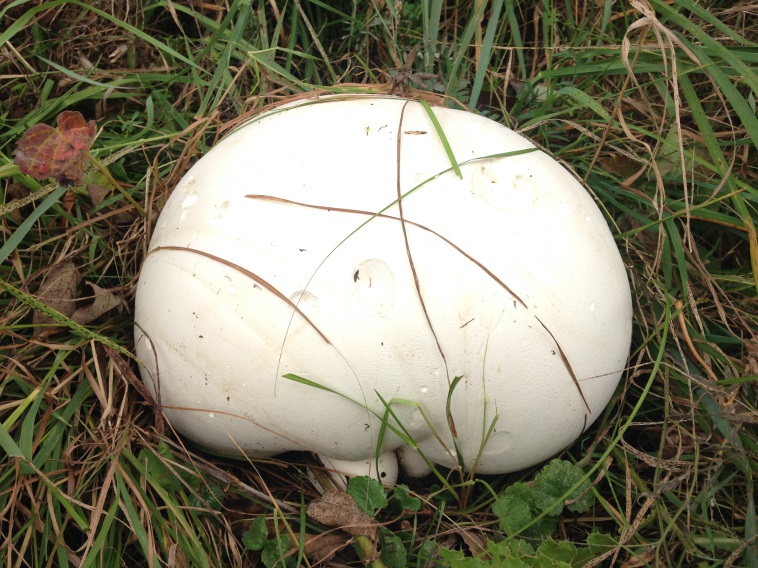
Puff ball mushroom. Photo by April Thibaudeau, Thacher Park.
A warm summer leading to damp September days is the perfect combination for mushrooms to sprout throughout the forest floor. Fungi are made up of a vast underground network called mycelia, which helps decompose leaf litter, dead animals, and rotting wood. The mushrooms we see above- ground are the fruiting bodies of the mycelium and are composed of spores that disperse in the fall to continue the growth of their kingdom. Puff balls, hen of the woods, oyster mushrooms, and fly agaric are just a few of the mushrooms to look for on a forest hike. It is important to have a great deal of knowledge on mushrooms before picking any to eat, as some can be fatally poisonous.
For fall hikes happening at Thacher State Park check out our Program Calendar.
Post by April Thibaudeau, Student Conservation Association Intern, Thacher State Park
For further information about these topics please consult:









 New York State Parks and Historic Sites Blog