Environmental conservation was a driving force in creating New York’s state parks system that you know and love today. From protecting Niagara Falls from industrial development to preserving the views outside of Albany at Thacher State Park, our agency has been working to preserve our lands and make them available for public enjoyment since its founding. This simple mission has taken on a different meaning in the face of climate change and the shift to clean energy. Here are some ways we’re meeting the challenges of environmental conservation in the 21st century.
Shifting to Renewable Energy
New York State Parks is charged with shifting all operations to renewable energy by 2030, either through the purchase of renewable energy or through generating our own.
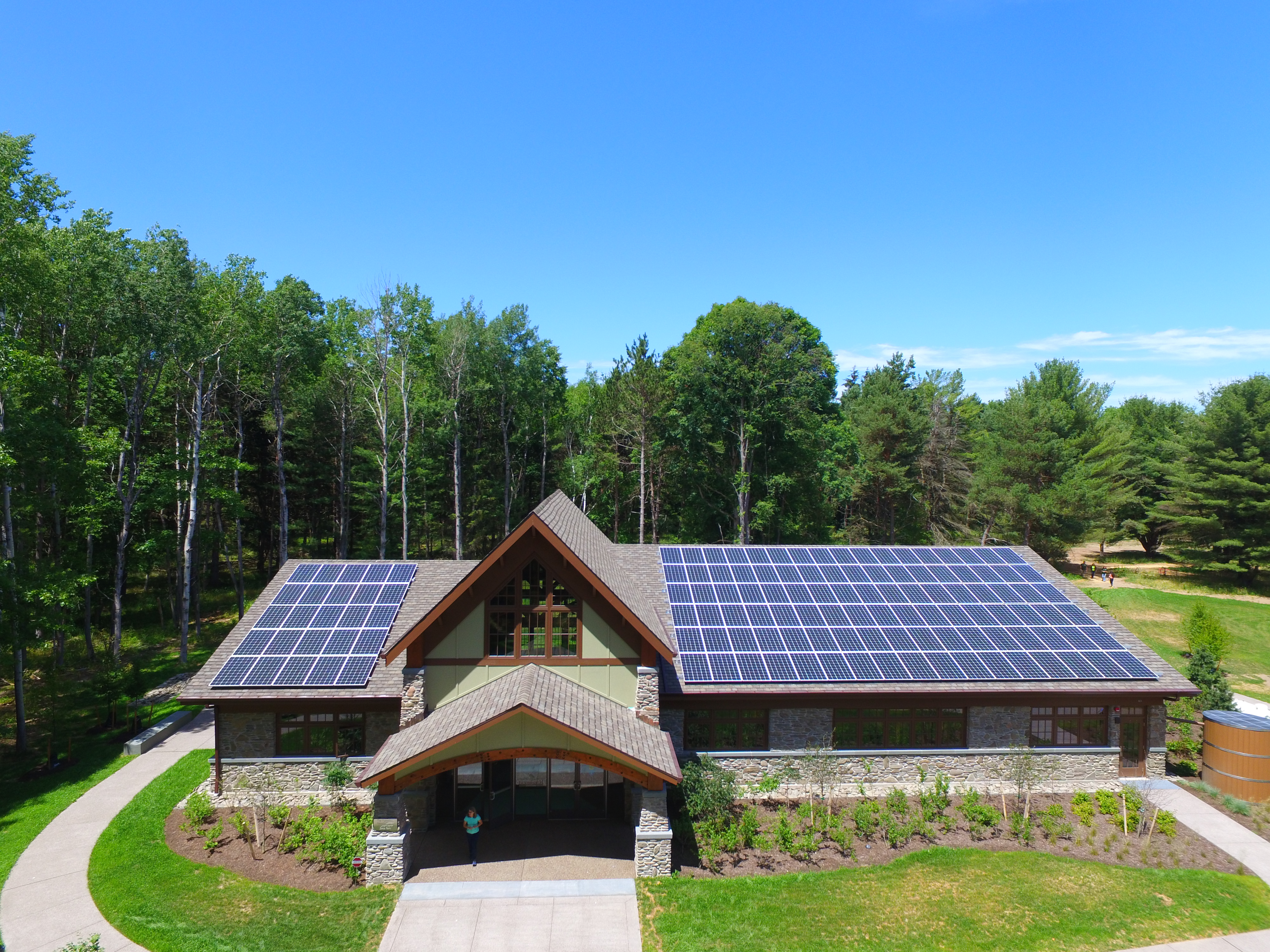
The solar array on the visitor center at Letchworth State Park in Livingston and Wyoming Counties.
Statewide, Parks operations consume around 45 million kilowatt hours of electricity (the same annual usage as about 4,000 homes). The agency currently has 50 solar arrays around the state generating more than 6MW, which help reduce carbon emissions and save money. This includes everything from roof-mount arrays to large ground-mounts built in pre-disturbed areas like the back of parking lots.
Longer days. Warmer temperatures. More birdsong. The signs of spring have been growing stronger in New York for weeks, and now the season has arrived. We’re proud to share some of the delights of spring with you at our parks and historic sites — here’s hoping we’ll see you out there.
Springing from the Earth
Getting out on the trail in the springtime is an exhilarating experience, as wildflowers begin to bloom, trees return to leaf, and the smells of nature fully return. If you enjoy identifying the plants, insects and animals you see on the trail, consider joining the global nonprofit iNaturalist project. You can use their app to identify flora and fauna you find, record your sightings, or find out from other users what’s been sighted nearby. Below are a few plants to look out for!
Saratoga Spa State Park is remarkable not only for its heralded mineral springs, but also for its architecture and historic theater. Now known as the Spa Little Theater, the space was originally designed for the scientists who studied the surrounding mineral springs to share their findings.
In September, the Spa Little Theater and nearby buildings and grounds were once again a place of scientific knowledge sharing, hosting the 2023 New York State Invasive Species Expo that brought land managers, researchers, and the public together for an immersive three-day interactive learning experience and conference.
Throughout the fall season, you’ve maybe found yourself outside at some point — around a cozy campfire or on a trail enjoying the beautiful autumn foliage — and heard a sound you didn’t quite recognize. Perhaps the sun was down, and you were startled?
If you’re thinking back on your fall adventures and this feels a little familiar, you wouldn’t be alone. There are so many different noises when you’re out in nature, and sometimes it’s hard to keep track of them all. With this article, we hope to demystify some of these sounds and show you they’re more interesting than unnerving!
Slowly scroll below to discover the thrilling world of five New York native animals that are often associated with autumn. Can you guess who each sound belongs to?
The Peregrine Falcon is the swiftest of all birds of prey, slightly larger than a crow, with and nondescript coloration of brown, grey, and white. Peregrine falcons are one of the most widely distributed species of birds, nesting on every continent except Antarctica. The world’s largest urban population of nesting Peregrine Falcons can be found in New York City.
A peregrine falcon can spot its prey from six miles away. Tucking in its wings, diving like a missile, changing direction with precision, ruffling its feathers to control speed, and slamming its talons into its quarry mid-air. Its beak has a type of tooth that acts like a wire cutter, severing the spine of its prey in an instant. Peregrines are avian predators and feed almost exclusively on other birds. Most of their prey is caught on the wing. Peregrine falcons diving at prey has been clocked at speeds of more than 200 mph, making them among the fastest animal on earth.
Peregrine falcons have never been very abundant. Studies in the 1930s and 1940s estimated that there were at least 200 breeding pairs of peregrine falcons in the eastern United States. Then, beginning in the late 1940s, peregrine falcons suffered a devastating and rapid decline. By the mid-1960s, the species had been eliminated from nearly all the eastern U.S.
In the mid-20th century, peregrine falcon populations took a nosedive due to the DDT pesticide poisoning. DDT moved through the food chain from insects, fish, and birds and moved up to larger carnivores, like the peregrine falcon. DDT caused harsh chemicals to build up in the falcons’ fat tissues, reducing the amount of calcium in their eggshells. With thinner shells, the eggs would be easily crushed when incubated by the parent falcons.
DDT was finally banned in 1972, and a partnership between scientists and falconers worked together to breed the birds in captivity and release them to places where they had traditionally nested, including New York City. Peregrines naturally prefer cliffs as a habitat, so the city’s canyons and skyscrapers provide desirable nesting spots for them, along with an abundance of food like pigeons, starlings, and sparrows.
Due to restrictions on the use of DDT, and intensive captive breeding and reintroduction programs across the United States and Canada, the peregrine falcon has made a remarkable comeback. Peregrines have been returned to much of their natural range and have reclaimed many historic breeding sites.
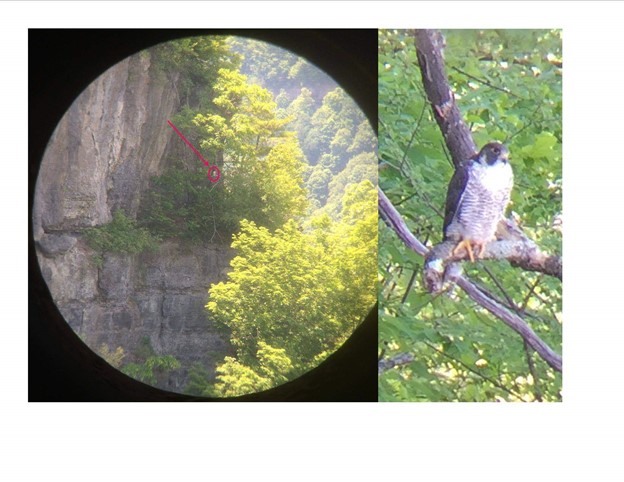
Thacher State Park is home to a 6-mile section of the Helderberg Escarpment, an exposed limestone cliff reaching several hundred feet high. An ideal nesting location for peregrines. Peregrines don’t build nests; they dig an indentation in the ground or in rock cliffs, called a “scrape”. The Helderbergs were a historic nesting ground in the 1950s and earlier. Since the ban on DDT, peregrines were not spotted around the Helderbergs until 2016 when a mated pair was discovered flying around the southern section of the park.
Since 2016, the Helderberg falcons have been monitored for nesting attempts. In 2021, the mated pair was found nesting with a clutch of eggs, but the nest was abandoned after a few weeks for unknown reasons. In 2022, the falcons have been spotted very early in the year, around February. With increased sightings and activity in the southern section of the park. Park staff and visitors are hopeful that this year will be a successful nesting season and may bring 3 to 5 new peregrine chicks into the world.




 New York State Parks and Historic Sites Blog