Tag Archives: climate change

Digging into Waste Diversion: the Finger Lakes and Thousand Islands

If you were out hiking, camping, or taking in a view at a state park or historic site this past summer, you may have spotted a few Parks employees snapping pictures of valuable infrastructure — trash cans, dumpsters, and dog waste bins.
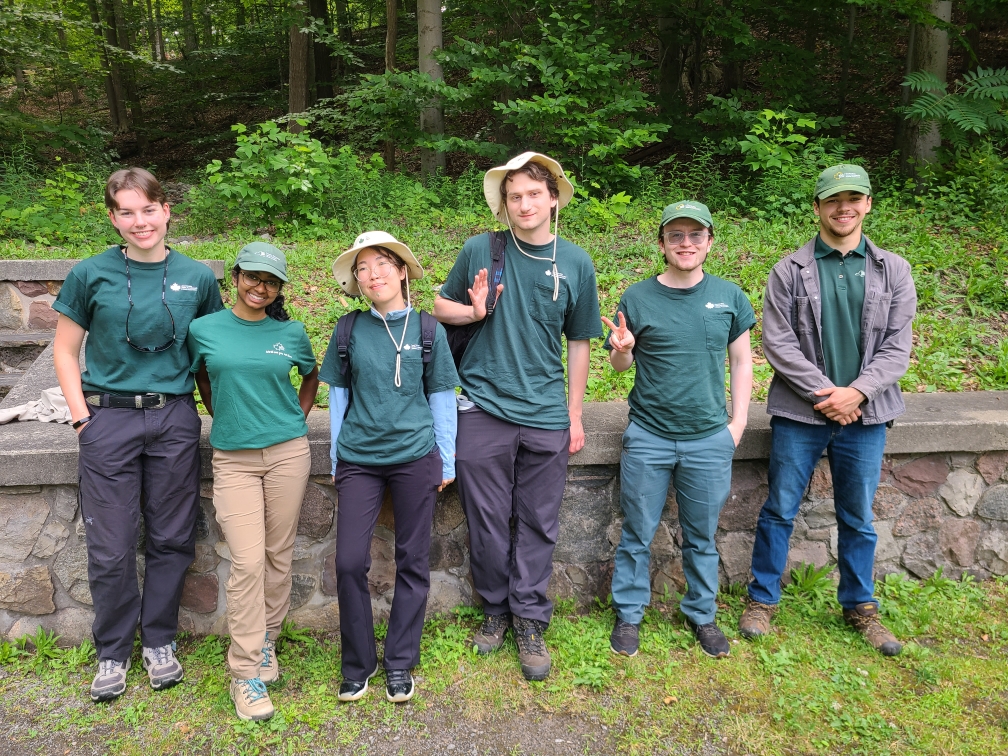
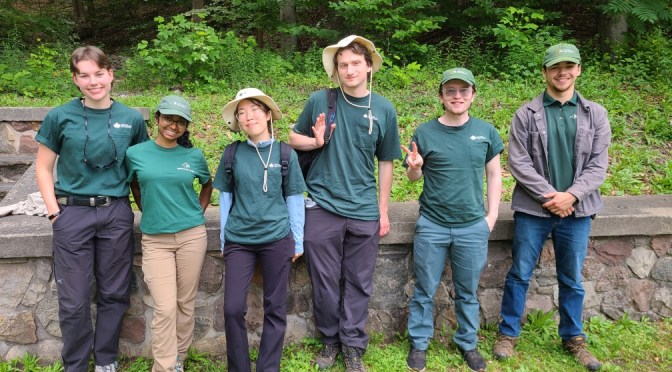
SUNY Climate Corps stewards from left to right: Emily Bridgeford, Venuri Atulugama, Soelma Purbueva, Adrian Elie, Samuel Scott, and Samuel Viteri. They conducted waste diversion audits at state parks in the Finger Lakes and Thousand Islands to evaluate the effectiveness of the agency’s waste management program.

These photos are part of a multi-year project of cataloging and mapping waste bins across all state parks to improve waste management. Building on the 2024 Green Lakes State Park pilot program, the 2025 season’s sustainability stewards took the waste challenge head-on in the Finger Lakes and Thousand Islands regions.

The Finger Lakes is home to abundant waterfalls and clear lakes, with Watkins Glen State Park drawing in nearly 1,400,000 visitors in 2024. Thousand Islands boasts the largest camping complex in the state at Wellesley Island State Park, with a mix of woodland and beach surroundings. As visitation to New York state parks and historic sites grows, the waste ecosystem in each region changes and faces new challenges. With these challenges comes renewed opportunity for waste-wise practices and sustainable adaptations.

Collecting data on waste infrastructure helps the Office of Parks, Recreation, and Historic Preservation adhere to state policy Executive Order 22. The goal of the policy is to reduce emissions and waste across New York State public agencies through materials management approaches, including reuse, recycling, and composting. Encompassing all these actions is waste diversion, the practice of keeping reusable or recyclable materials out of landfills and incinerators.

Facilitated by sustainability manager Jordan Elliott and regional staff, SUNY Climate Corps interns Soelma Purbueva, Adrian Elie, Samuel Viteri, and Samuel Scott began work in June 2025. At each site, data collection started with a facility tour led by the park manager to locate dumpsters, trash bins, dog waste bins, cigarette disposal towers, and everything in between. In addition to waste bin mapping, the stewards worked towards a more sustainable park system by engaging staff in waste reduction training and conducting waste assessments. Throughout the project, the insight of facility operations was key in developing diversion programing that addresses the challenges that maintenance staff face keeping our public lands and historic sites beautiful.
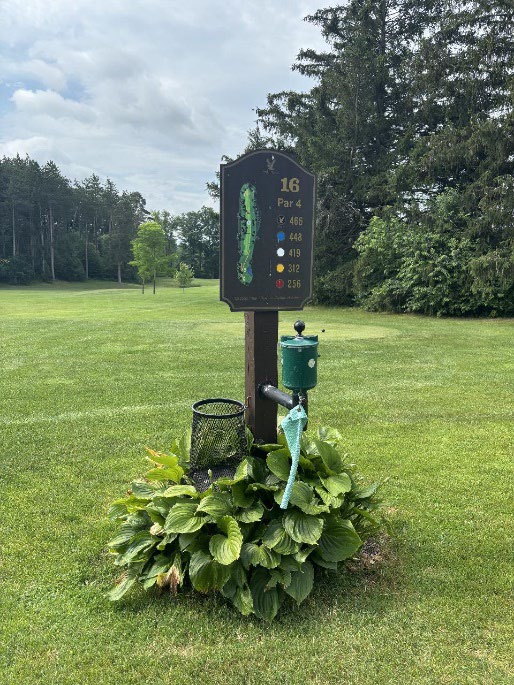
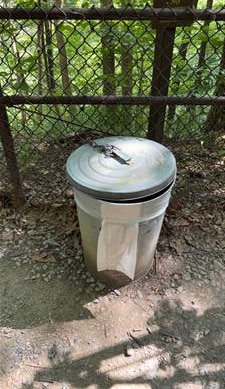
Waste infrastructure varies greatly from park to park and region to region. The waste bins above are only two of 1,050+ captured during the 2025 summer season.

Waste assessments were conducted at each park to evaluate the effectiveness of current programs, highlight where waste diversion efforts should be concentrated, and identify sites for signage and bin upgrades. Compostable organic material, recyclable items like plastic and paper, and trash items are separated out of a sample of available waste. From there, the piles are weighed. This data will inform changes to waste infrastructure, programming, and education efforts and is essential in monitoring effectiveness.
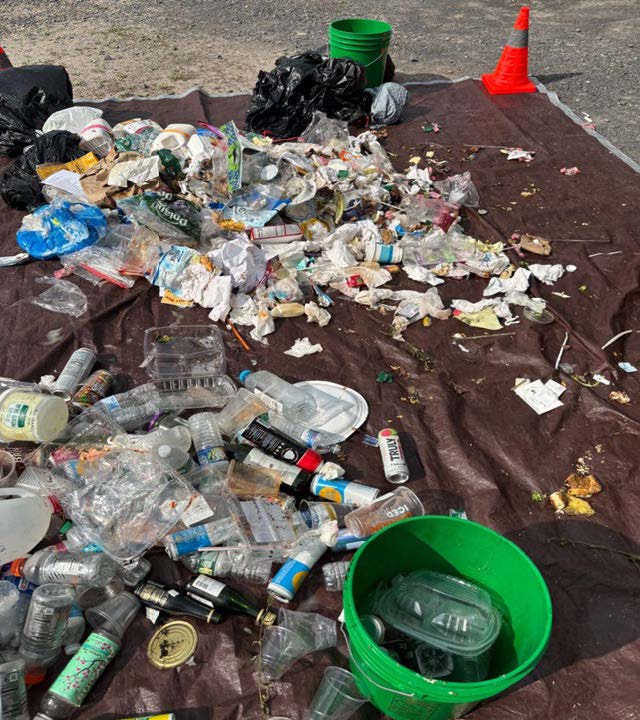
A waste assessment in progress at Sonnenberg State Historic Site. Stewards are looking for whether recyclable or compostable materials are thrown away, how much waste is thrown out, and how well people are complying with disposal signs.

A typical assessment at a state park or historic site varies, since grounds are diverse; campgrounds, museums, beaches, food concessionaires, golf courses, and fishing areas are all in the mix. Parsing the contents of a full trash bin reveals valuable information on how accurately visitors are recycling, highlights areas with excess food waste for composting programs, and flags where guidance and infrastructure can be improved. At carry-in carry-out parks with no trash bins, a litter audit can provide this information.
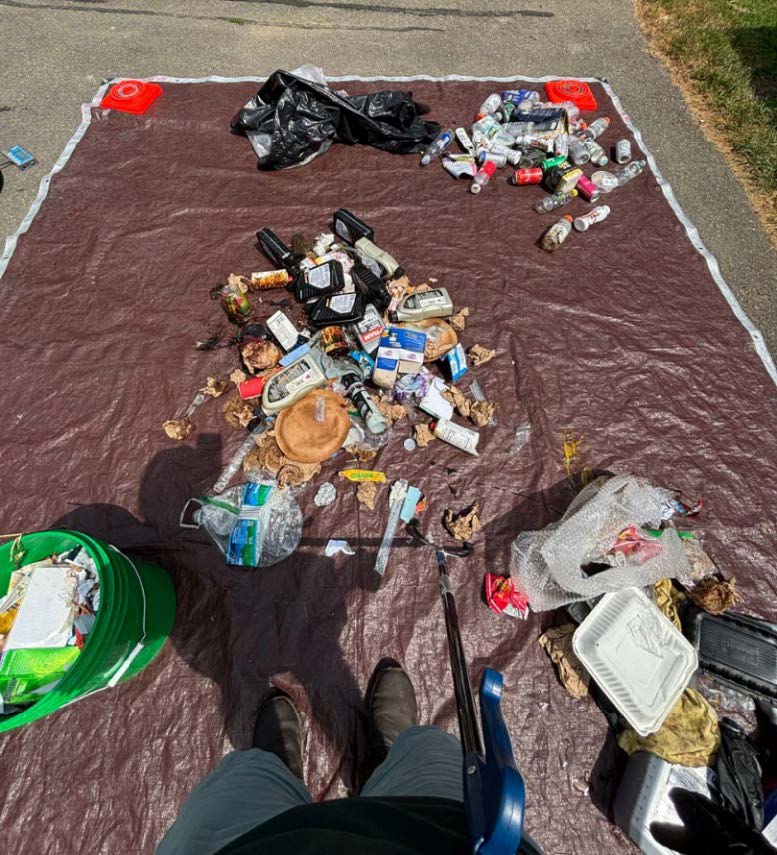
A waste audit in progress at Mark Twain State Park. The team conducted surveys at 68 locations and assessed 2,700 pounds of waste during the summer of 2025.

In total, waste assessments and waste infrastructure surveys were completed at 68 state parks, historic sites, and marinas. A total of 2,700 pounds of waste was assessed and over 1,050 infrastructure data points were recorded. The Finger Lakes region was found to have more waste infrastructure, with multiple composting programs and hundreds of indoor and outdoor bins. The Thousand Islands region is primarily carry-in carry-out and has substantially less waste infrastructure, a noteworthy difference. Recycling accuracy was an impressive 77 percent in recycling dumpsters in the Thousand Islands region and 61 percent in the Finger Lakes region. In trash dumpsters, 54 percent of items in the Thousand Islands region and 42 percent in the Finger Lakes region could have been diverted to recycling or composting.
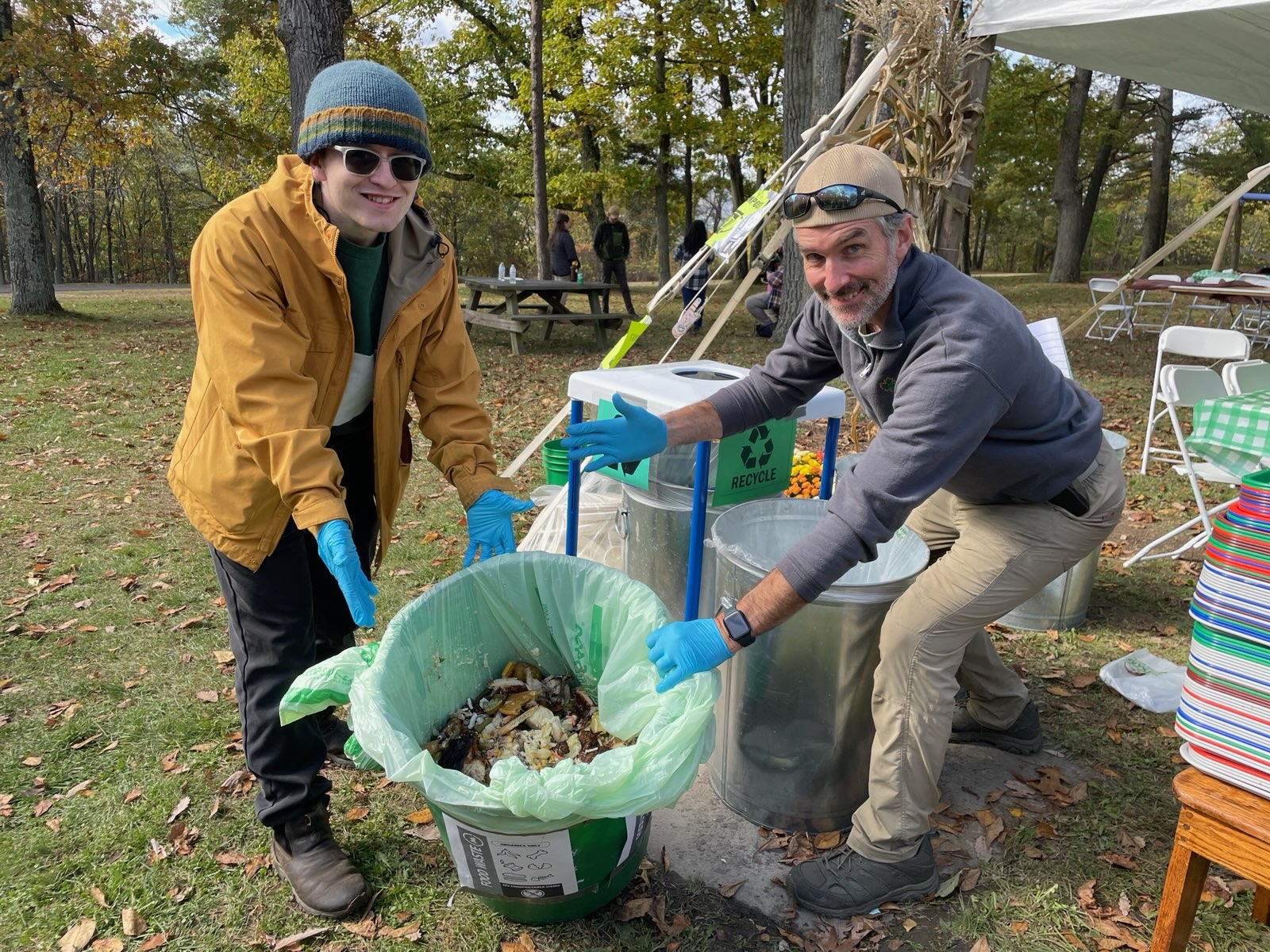
A full compost bin is a beautiful thing!

With these results in hand, the Parks Sustainable Operations team will continue to build on the two summers of data collection to inform regional waste management needs. The efforts of this project are ultimately designed to promote responsible stewardship of New York State’s valuable public resources and create safe and accessible outdoor spaces for all residents. Such regional changes are steps towards building a sustainable state park system, one bin at a time.

Written by Parks Sustainability Researcher Rheanna Fleming and SUNY Climate Corps Intern Samuel Scott

A Vision for the Future: The Final Chapter of ‘Blazing A Trail’ 

The final chapter of the interactive history timeline, Blazing a Trail: A History of NY State Parks and Historic Sites, has been released, completing the chronicling and sharing of our agency’s history in celebration of our Centennial anniversary. In detailing the future of New York State Parks and our ongoing efforts, we hope that this era leaves you inspired to not only learn more, but to take an active role in shaping the future of our park and historic site system. In the final installment of this eight-era series, “Tomorrow & Beyond” explores how New York State Parks will combat climate change, expand access to our parks and sites, share previously undertold history, use new technology, and improve and expand our system of 250 state parks, historic sites, golf courses, and boat launches. 

Continue reading A Vision for the Future: The Final Chapter of ‘Blazing A Trail’ 

Dutch Royalty Visit Schuyler Mansion, Talk Climate Change

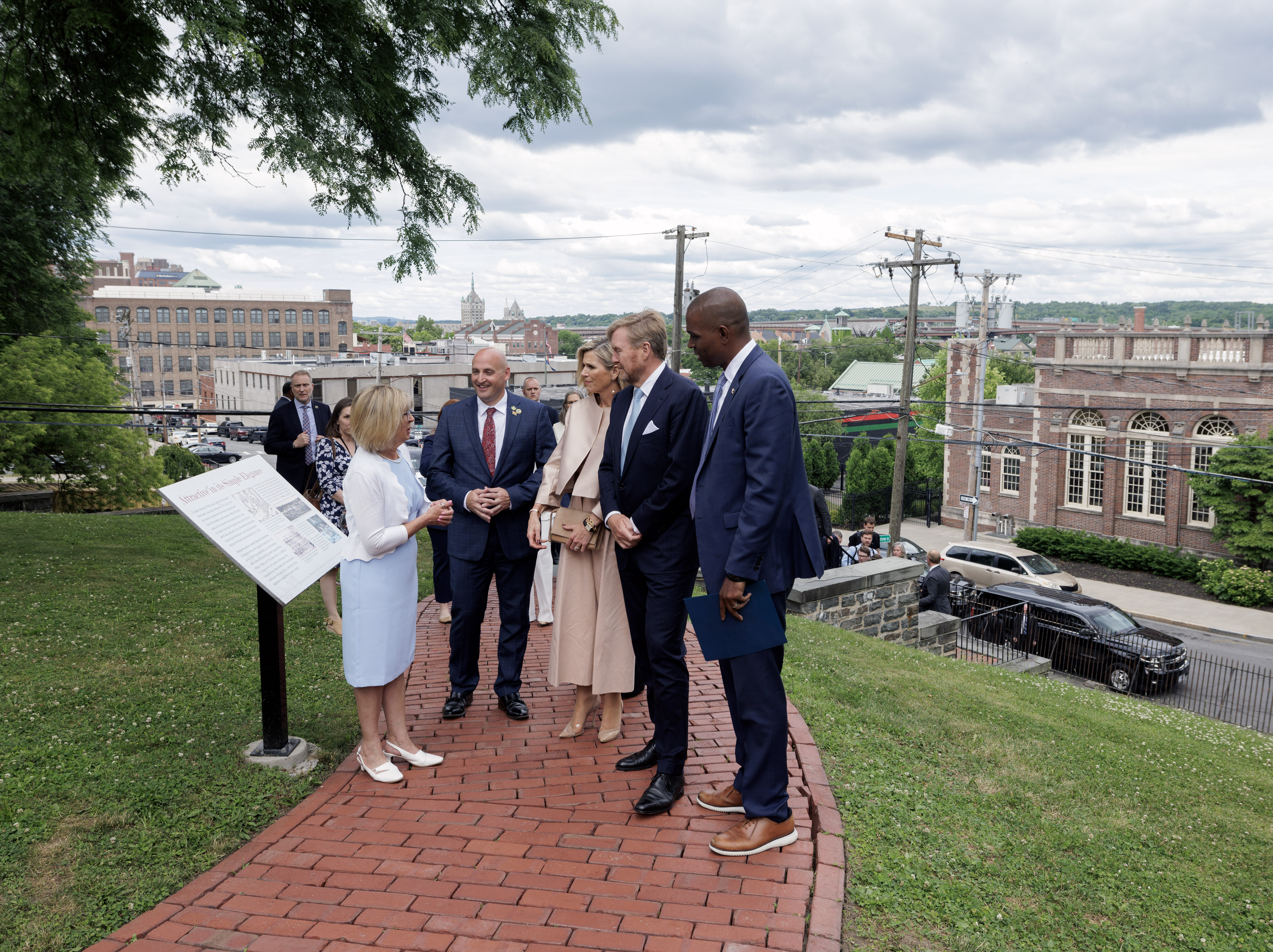
On June 12, New York State Parks, Recreation, and Historic Preservation proudly hosted their Majesties King Willem-Alexander and Queen Máxima of the Netherlands; Minister of Foreign Trade Liesje Schreinemacher; Ambassador of the Kingdom of the Netherlands to the US Birgitta Tazelaar; Consul General of the Netherlands in New York Ahmed Dadou; and Cultural Attaché Monique Ruhe at Schuyler Mansion State Historic Site. The group visited as part of their U.S. tour celebrating cultural ties and reinforcing economic opportunities, and Lieutenant Governor Antonio Delgado helped us welcome them.

Their Majesties King Willem-Alexander and Queen Máxima and New York Lt. Gov. Antonio Delgado are welcomed to Schuyler Mansion by Historic Site Manager Heidi Hill and Parks Commissioner Pro Tempore Randy Simons. Photo by Mike Groll/Office of Governor Kathy Hochul.

As part of their visit to New York, their Royal Majesties visited with next-generation environmentalists to engage in conversations about the impacts of climate change and positive actions that could be taken, both here and in the Netherlands, to foster climate resiliency in communities.

Continue reading Dutch Royalty Visit Schuyler Mansion, Talk Climate Change

Environmental Stewardship At NY State Parks

Environmental conservation was a driving force in creating New York’s state parks system that you know and love today. From protecting Niagara Falls from industrial development to preserving the views outside of Albany at Thacher State Park, our agency has been working to preserve our lands and make them available for public enjoyment since its founding. This simple mission has taken on a different meaning in the face of climate change and the shift to clean energy. Here are some ways we’re meeting the challenges of environmental conservation in the 21st century.

Shifting to Renewable Energy

New York State Parks is charged with shifting all operations to renewable energy by 2030, either through the purchase of renewable energy or through generating our own.

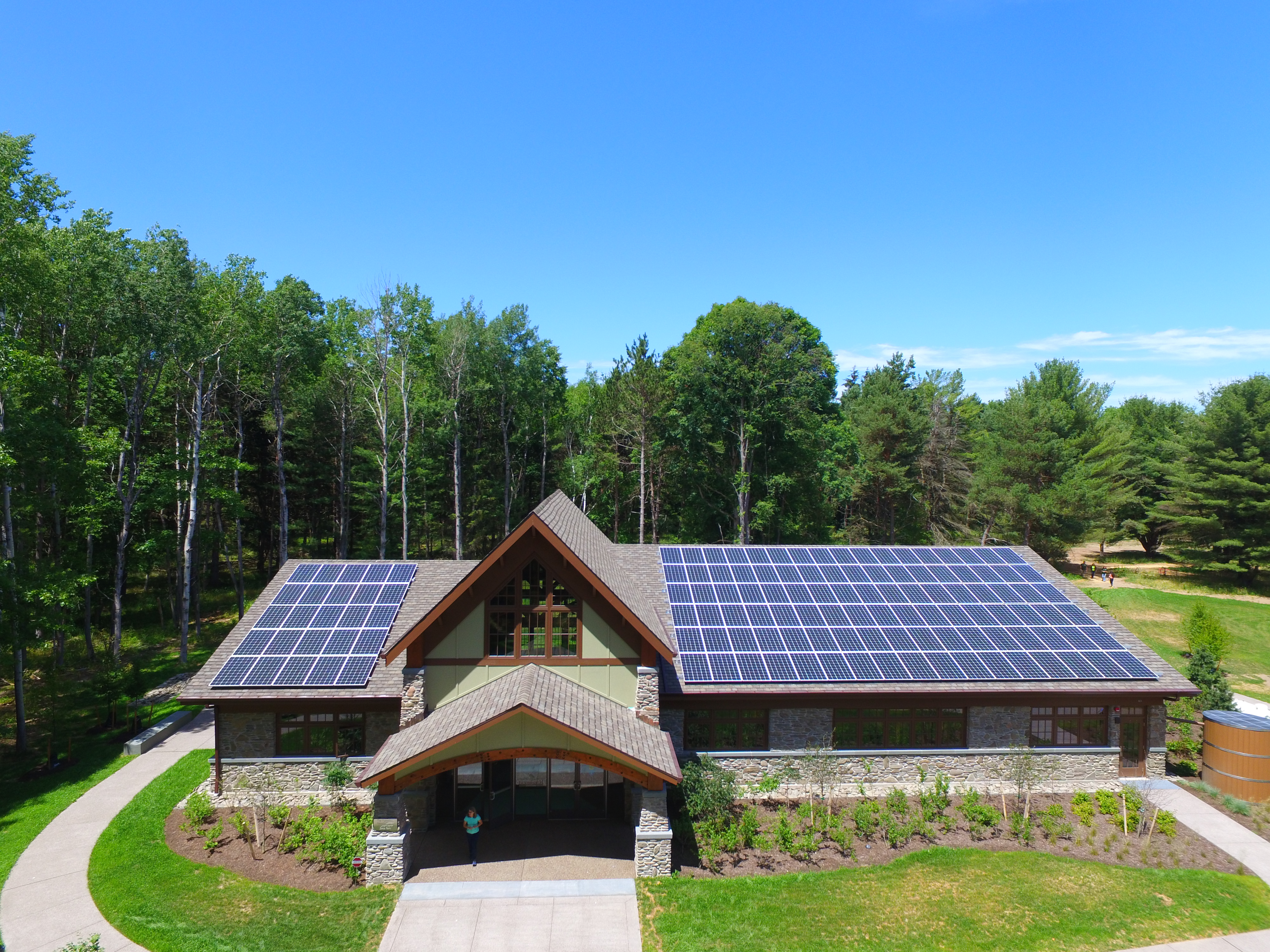
The solar array on the visitor center at Letchworth State Park in Livingston and Wyoming Counties.

Statewide, Parks operations consume around 45 million kilowatt hours of electricity (the same annual usage as about 4,000 homes). The agency currently has 50 solar arrays around the state generating more than 6MW, which help reduce carbon emissions and save money. This includes everything from roof-mount arrays to large ground-mounts built in pre-disturbed areas like the back of parking lots.

Continue reading Environmental Stewardship At NY State Parks

Help Brewing For Rare “Chitt” Snail at State Parks

Since Ice Age glaciers retreated from New York nearly 12,000 years ago, a snail slightly larger than a dime has lived in damp, shaded and rocky terrain at the base of a towering waterfall in Madison County.

A moist and mild micro-habitat, the “splash zone” around the namesake 167-foot cascade at Chittenango Falls State Park is the last wild place on earth where the Chittenango Ovate Amber snail is known to exist.  The species is named for its home; its ovate, egg-shaped shell; and its amber coloring.

A close-up of the Chittenango Ovate Amber Snail. There are currently about 100 of the tiny mollusks known to exist in Chittenango Falls State Park, the only wild place on earth with a known population. (Photo credit – SUNY-ESF)
The spray from the waterfall at Chittenango Falls State Park creates the moist and mild micro-habitat needed by the snail, which has occupied this place in Madison County since the last Ice Age. (Photo Credit – New York State Parks)

This delicate mollusk leads a precarious existence, as a population now estimated at less than a hundred faces threats from floods, droughts, rockslides, another species of snail, climate change, and even the feet of irresponsible hikers.

The snail was abundant when it was first discovered at the falls in 1905. By the early 1980s, the population was estimated at less than 500 individuals, and the population continued to plummet in the 1990s. The snail is listed as an endangered species by New York State and a threatened species by the federal government. Historically, the species was found in a handful of sites from Tennessee to Ontario, Canada, but now is known to only exist in New York.

To fend off potential extinction of what is affectionately known as the “chitt,” a captive breeding program started five years ago, supported by State Parks, SUNY College of Environmental Science and Forestry (SUNY-ESF), U.S. Fish and Wildlife Service, state Department of Environmental Conservation, and the Rosamond Gifford Zoo in Syracuse. Federal funding to support the program has come from the Great Lake Restoration Initiative.

Banding together on Facebook as the “Snailblazers,” these partners recently added another friend of the chitt – the Critz Farms brewery in Madison County, which has crafted an IPA dedicated to raise funds for the breeding program.


With each leisurely sip of the Endangered Species IPA, described as a “delightfully citrusy, medium-bodied beer,” funds go toward supporting a snail incubator program at SUNY-ESF in Syracuse and the hand collection of a mix of native plant leaves that form the diet of the finicky snail.

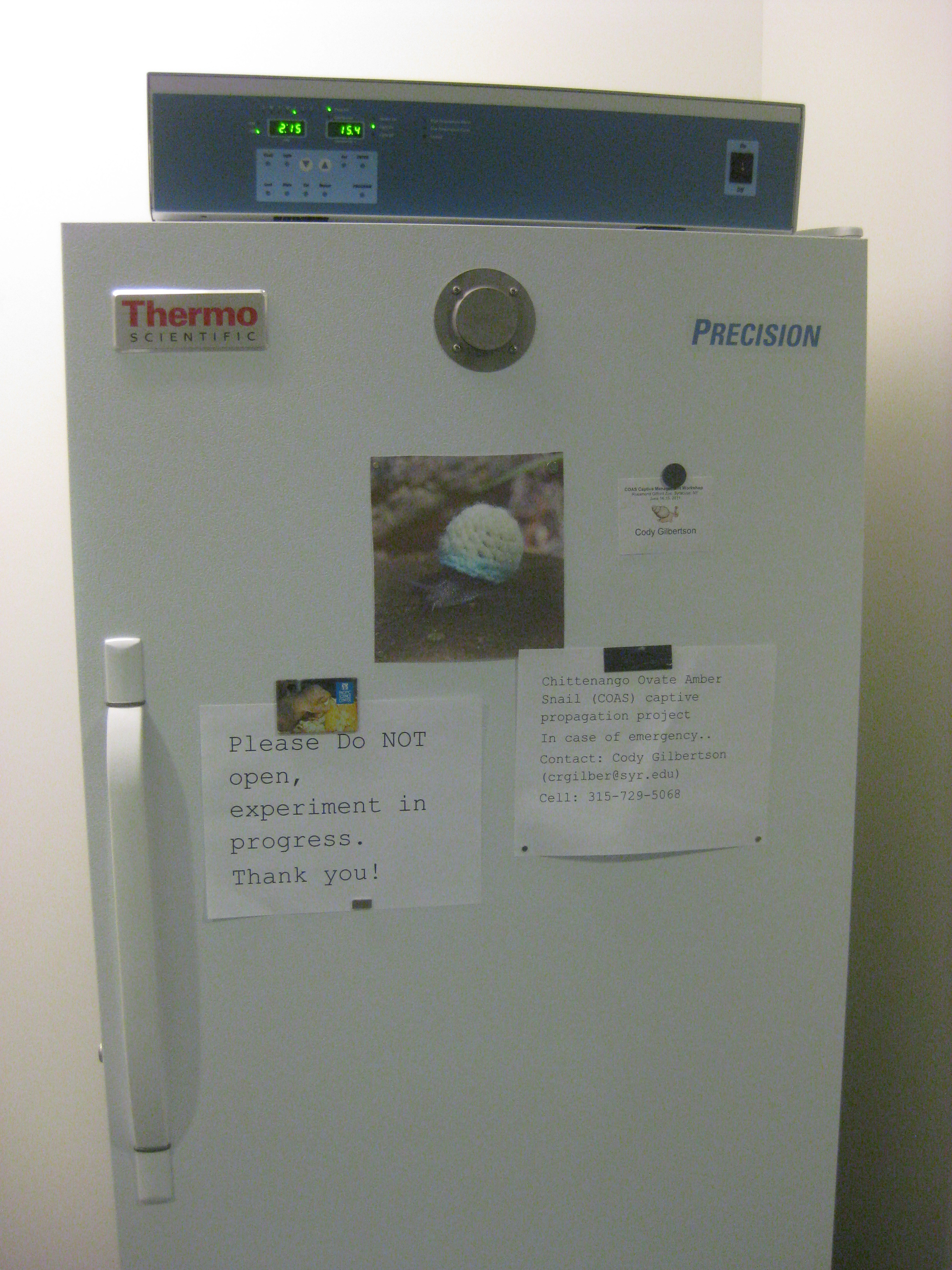
Since the program started, nearly 2,000 snails have been propagated in climate-controlled incubators at both SUNY-ESF and the Rosamond Gifford Zoo in Syracuse, said Cody Gilbertson, senior research support specialist at SUNY-ESF. Due to COVID restrictions this year, the zoo incubator program was consolidated into SUNY-ESF.

During field research at Chittenango Falls, SUNY-ESF researcher Cody Gilbertson holds an Ovate Amber snail (below). The captive-bred snails reside in a climate controlled unit back at SUNY-ESF in Syracuse. (Photo Credit – SUNY-ESF)

Of the captive-bred chitts, slightly more than 400 have been released into the park during this time, some as hatchlings and the rest as adults capable of reproduction. Even with these efforts, the snails are barely hanging onto their foothold.


About 500 snails reside in the incubators currently, protected as a “backup” population should some dire circumstances extinguish the Chittenango snails. Hundreds of snails have already lived their entire natural life spans – about two years – in the incubators.

When breeding started, there was an estimated population at the falls of about 350 snails, said Gilbertson. The most recent counts are now at about 100.

The habitat zone, a mix of boulders that have fallen from the limestone cliffs, is consistently moist from the mist of the falls. That nurtures water-loving plants, including a number of native wildflowers, including the snail’s favorite, Joe-Pye weed (Eutrochium purpureum), said Delaney Kalsman, project coordinator at State Parks.

Joe Pye weed, a favorite food of the snail. (Photo credit – State Department of Environmental Conservation)


Located along the park’s Gorge Trail, this area is fenced off and marked against trespassing. Anyone entering the area without authorization can be prosecuted under New York State Environmental Conservation Law and the federal Endangered Species Act.

Another count of the snail population is set for the summer of 2021, said Kalsman. The number of snails has been declining in recent years, with possible explanations including competition from a species of invasive snail and climate change.

“The environment is experiencing longer drought periods, reducing the flow and spray of the falls which the snail relies on,” she said. “When it does rain, large flooding events are happening at greater frequencies. In 2017, a major flood washed away large portions of Joe-Pye weed.”

Within such a small home, a potential extinction-level event can show up quickly. Such events like the 2017 flood, along with the other threats, put the chitt as “severe threat of extinction,” Gilbertson said. “This threat is further amplified because the entire wild population exists only at Chittenango Falls State Park.”

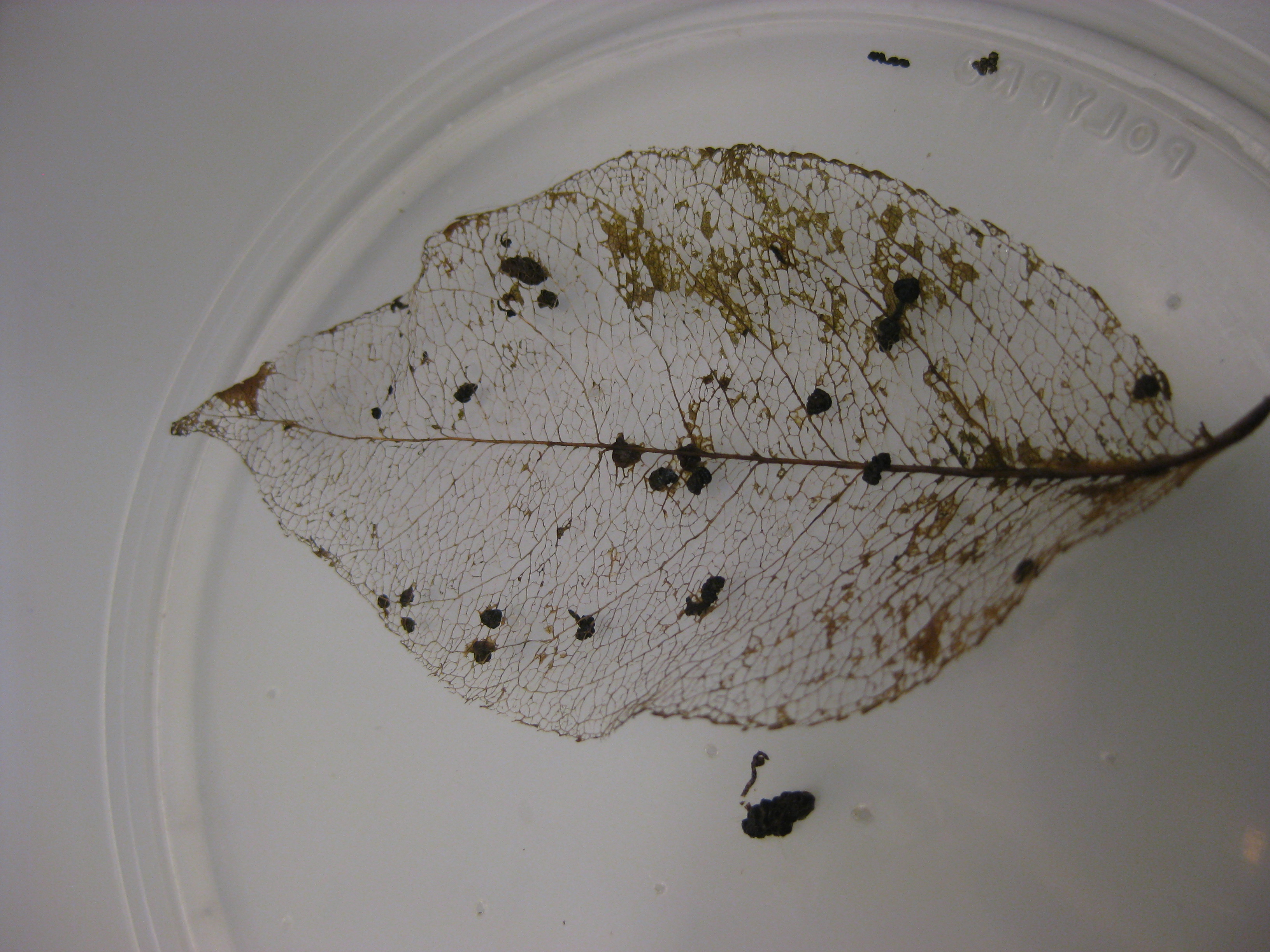
To propagate more snails, Gilbertson needed to understand what they ate from the flora and fauna around the falls. She learned the snails preferred the fallen leaves of black cherry trees collected in early spring, as well as leaves from pignut hickory, sugar maple and ash. And snails needed certain species of leaves at certain times, and at certain stages of decomposition. So, SUNY-ESF and Parks staff needed to collect leaves regularly and maintain a kind of “compost” menu for the snails. The leaves are stored dry and then rehydrated as needed.

“This diet for our snails is more natural than a synthetic paste or vegetables that is used in many other captive invertebrate programs. Survival was boosted by this natural diet,” she said.

A black cherry leave after being consumed by numerous snails. (Photo credit – SUNY-ESF)


State Parks staff is now designing a “garden” of native trees and plants in the park to supply the optimal forage that can be brought to the snails, as part of the efforts spearheaded by Kalsman, park Operations Manager  Shawn Jenkins, and SUNY-ESF FORCES (Friends of Recreation, Conservation and Environmental Stewardship) stewards Jordan Stransky, Sarah Petty, and David Rojek.

(And for the curious: Snails have a form of teeth, called “radula,” which is Latin for “little scraper.” The radula is a tongue-like ribbon with raised rasps, which the snail uses to scrape and tear away at whatever plant they are eating.)

Another issue to consider is that of a potential lack of genetic diversity, which could make the snails vulnerable to disease. To avoid having the captive offspring breeding only with other captive offspring, researchers periodically gather snails from the falls to be brought into the captive program.

Called “pulsing,” this method “brings new founders from the wild to breed and introduce hypothetically new genetic lines into our captive population,” Gilbertson said.

Snails mate between May and July, resulting in the female laying about a dozen tiny eggs. Each summer, about 200 to 300 snails are reared from those eggs. The hatchlings are so tiny that the safest way for researchers to move them around is by using paintbrushes, she said. The tiny creatures use their “foot,” a muscle that contracts to allow the snail to move, to grasp the bristles on the brush.

Each year, researchers bring more captive-bred snails to the falls to live and breed with the snails there. And this tiny population continues for another day, aided by the work of dedicated people at State Parks, other partners and now brewers and patrons of a farm-brewed IPA.

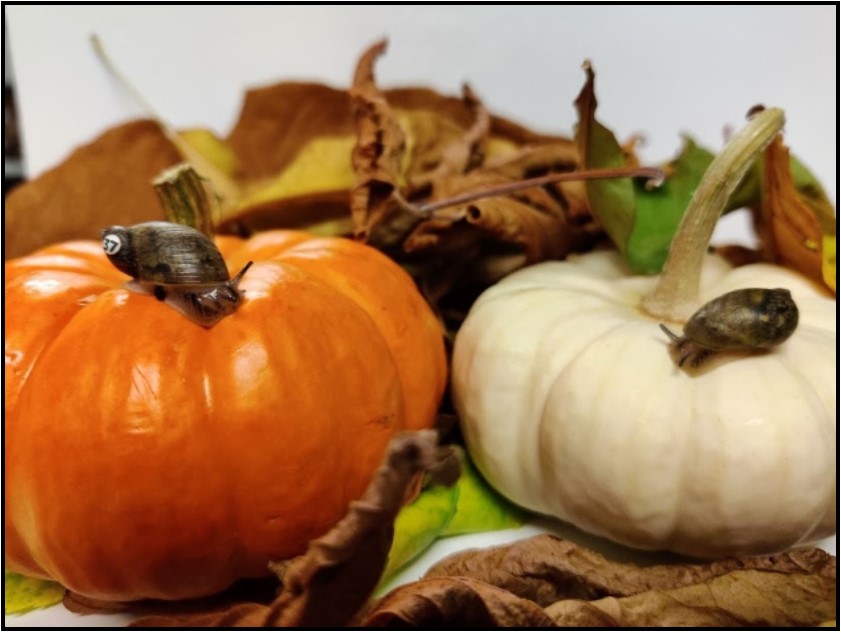
Happy Thanksgiving from the Chittenango Ovate Amber snail and New York State Parks! (Photo credit – NYS Parks)


(Cover Photo- Chittenango Ovate Amber Snail. Photo Credit- Cody Gilbertson, SUNY – ESF)

Post by Brian Nearing, Deputy Public Information Officer, NYS Parks


Resources

Read a five-year scientific review of the status of the Chittenango Ovate Amber snail by the U.S. Fish and Wildlife Service (USFW).

Discover more about the snail from USFW.

Learn more about the snail in a online book for children created by staffers at the Rosamond Gifford Zoo.

Donate to the zoo’s snail conservation program.