Category Archives: Nature Centers

Amphibians on the Move!

As temperatures rise, spring rains roll in, and the ground thaws, the amphibians of New York are preparing themselves for a great migration. On the 10th of March, a group of about 30 volunteers congregated near Hop Field at Thacher State Park armed with flashlights and buckets. With great excitement they looked along the road edges for salamanders and frogs, hoping to help them cross the road as the amphibians migrated to woodland pools. Throughout most of the year, mole salamanders and woodland frogs spend their time burrowed under rocks and leaves on the forest floor, but each spring salamanders and frogs can migrate up to a quarter mile to woodland pools to breed. The mass migrations to the vernal pools occur during spring rainstorms with temperatures above 40 degrees.

The rain was intermittent that night, and although spring peepers and leopard frogs were escorted across the road, no salamanders were found. The migrations typically happen in late March and early April, so there is still hope! On nights when the conditions are right, many nature enthusiasts can be seen on roadways close to wetlands helping the amphibians safely cross the road. If you are interested in getting involved in preventing vehicle related deaths during these mass migrations, contact your local State Park or local DEC office. These organizations sometimes coordinate volunteers to come together on rainy nights to help salamanders cross busy roads. The more volunteers there are to help, the more amphibians will successfully breed! Before you help the amphibians, be sure to brush up on your identification! Here is a sampling of the native amphibians that you could see in New York.

Mole Salamanders:

Blue Spotted
Blue spotted Salamander, By Greg Schechter [CC BY 2.0 (http://creativecommons.org/licenses/by/2.0)%5D, via Wikimedia Commons
The blue spotted salamander is black with pale blue flecks all over its body. It can grow from 3.5 to 5.5 inches long. They are frequently seen in woodlands.

The spotted salamander is black and has yellow spots. It can grow up to 8 inches long. It is one of the most common salamanders in the area, and if you go out on a migration night there is a good chance that you will see it!

Jefferson salamander
Jefferson Salamander, By Unspecified (Vermont Biology Technical Note 1) [Public domain], via Wikimedia Commons
The Jefferson salamander is dark brown and has pale blue spots on its limbs and lower sides. The blue speckling is best seen on younger salamanders. It can crossbreed with the blue spotted salamander and usually grows to 4.5 to 7 inches long.

Red eft
Red Eft, By Jason Quinn (Own work) [CC BY-SA 3.0 (http://creativecommons.org/licenses/by-sa/3.0)%5D, via Wikimedia Commons
This red eft/ red spotted newt can secrete poisonous toxins. When it is on land in its juvenile stage, it is orange. However, in its aquatic adult stage it is an olive brown color and has a wide paddle like tail.

Frogs:

Wood Frog
Wood Frog, By USFWS Mountain-Prairie (Wood Frog) [CC BY 2.0 (http://creativecommons.org/licenses/by/2.0)%5D, via Wikimedia Commons
The wood frog has an extremely high freeze tolerance and can live in a variety of habitats including forests, tundra, and bogs. It has the nickname “Lone Ranger” because the coloration on its face resembles a mask. Last year a bill was proposed by a class of 3rd graders to declare the wood frog the State Amphibian of New York. To see the bill’s progress check out this website.

Peeper
Spring Peeper, By Justin Meissen [CC BY-SA 2.0 (http://creativecommons.org/licenses/by-sa/2.0)%5D, via Wikimedia Commons
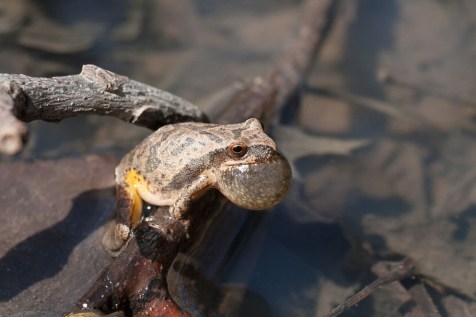
The spring peeper has large vocal sacs that it uses to create high pitched tones during the spring mating season. It typically grows to about one inch long and has a dark X marking on its back. Listen to the call of a male spring peeper.

Leopard frog
Leopard Frog, By Douglas Wilhelm Harder (Own work) [CC BY-SA 3.0 (http://creativecommons.org/licenses/by-sa/3.0)%5D, via Wikimedia Commons
The leopard frog gets its name from the irregularly shaped dark patches on its legs and back and can grow to be 3 to 5 inches long. They were once the most abundant frog species in North America, but they suffered large population declines in the 1970s.

Recommended Links:

Salamander Migration Extraordinaire” Check out this naturalist’s blog post  that has videos of spotted salamanders and Jefferson salamanders migrating to a vernal pool. There is amazing underwater footage of the salamanders at the breeding site!

Check out this video of Ranger Eric Powers from Your Connection to Nature to learn more information about vernal ponds and the animals that rely on them!

Post written by: Emily Crampe, SCA Member, Thacher State Park

Sources for text:

http://www.vernalpool.org/inf_mol.htm

http://www.dec.ny.gov/lands/82722.html

http://animals.nationalgeographic.com/animals/amphibians/northern-leopard-frog/

https://www.michigan.gov/dnr/0,4570,7-153-10370_12145_12201-32988–,00.html


Tracking The Elusive New England Cottontail

New England Cottontail
New York’s rarest native rabbit, the New England Cottontail, photo by Amanda Cheeseman


It is a typical morning at the Taconic Outdoor Education Center (TOEC) in Fahnestock State Park. The sunshine beams through the forest, a chorus of song birds are greeting the day, and 60 elementary school students are making their way to breakfast to fuel up for an active day of learning in the outdoors. Meanwhile, a familiar truck and crew rolls in to begin their workday visiting several small animal traps set in specific locations in hopes that at least one will contain a rabbit, particularly a New England Cottontail.

The State University of New York College of Environmental Science and Forestry (SUNY ESF) is collaborating with State Parks, and the Department of Environmental Conservation to conduct important research about the population decline of native New England Cottontail. Over the past decade, studies have indicated that their numbers have decreased about 50%. The two major factors contributing to the population decrease are loss of suitable habitat, and the expanding range of the Eastern Cottontail. The only native rabbit species east of the Hudson River is the New England Cottontail; however the range of the Eastern Cottontail has been expanding and now overlaps this territory which causes competition for resources. Predation is also playing a role in the decreasing population; part of this research project is keeping an eye on who’s eating New England Cottontails by using trail cameras. These cameras placed in baited locations and use a motion sensor to take pictures when an animal walks by. Different predators are “captured” in a photo as they come to investigate the bait, which shows the species that a present in the rabbit survey area.

Back at the TOEC, the students are gathering to meet with their instructors for their morning lesson, the phone suddenly rings. “We have a rabbit” says the voice on the other end. Flexibility is part of the job description of an outdoor educator, and no one passes up an opportunity to enjoy a teachable moment, especially when it involves a live animal. All plans are dropped for the moment and after a short walk the students quietly approach the researchers who are preparing to identify, collect data, and radio tag the small mammal.

Juvenile
Measuring a juvenile New England Cottontail, photo by Amanda Cheeseman

Many of students who visit the TOEC are from the New York City area and rarely get to experience being this close to a truly wild animal, and they have a lot of questions such as: “Why is it in a pillowcase?”, “How long are its feet?”, “Is that a baby?” and “What’s That!?”. Their sense of wonder is contagious and the SUNY ESF researchers return the enthusiasm by answering the barrage of questions being hurled at them, while also safely collecting data on their captive rabbit. Measurements are taken, and the data is recorded onto forms and will go into a large database to allow for comparison across the entire northeast. The final step is to attach a small antenna to the rabbit’s back so that the researchers will be able to locate the individual rabbit again through radio telemetry. Now comes the exciting part! The rabbit is released, and in a flash it darts away, immediately out-of-sight, camouflaged amongst the underbrush.

Camouflage
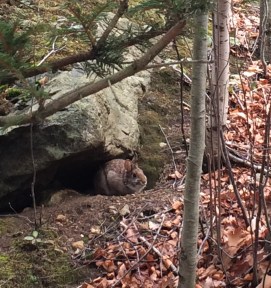
A well camouflaged New England Cottontail. Can you see the antennae? photo by Amanda Cheeseman

Upon reflection, many students will say seeing the rabbit was their favorite part of the week, and they walk away with the feeling of being included in something important. Nothing teaches better than experience; giving students the chance to interact with a living, breathing part of the ecosystem around them. It sure makes for a pretty great day.

Post by Dana Mark, environmental educator at TOEC

Sweet Days Are Coming

In the northeast, winter days can seem to drag on after the holiday season. Snowstorms seen to occur every three days and a constantly blowing wind chills the air to -10oF. It’s the type of weather that makes you wonder why humans don’t hibernate. While we can’t control the seasons; winter will always bring shorter days, the moon will revolve around the earth and the earth will revolve around the sun, we can change our mindset and that is what maple sugaring is about.

The maple sugaring season is almost a spiritual experience that lifts you through the last doldrums of winter. It ignites every sense. Imagine hearing the taps of sap into a metal bucket hung on a tree, the sweet steam lifting off the evaporator immersing your nose in warmth, the crackling fire fueling the evaporator, and of course the sweet taste of liquid gold. The whole experience does not occur unless the right weather conditions are present.

The release of sap in the spring is a sign that the trees are finally waking up from their winter rest. The ideal sap running conditions are warm days and cold nights. This temperature fluctuation causes the sap to run up and down the tree each day. The maple season may only last for as little as ten days, but they are an intense ten days.   Intense because of the time needed to collect and boil down the sap, and it is the boiling down of the sap that takes the most time.

Inserting_the_tap
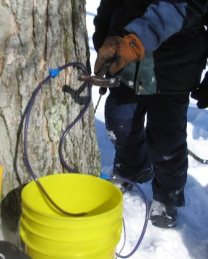
Tapping a maple tree, https://commons.wikimedia.org/wiki/Category:Maple_syrup_production#/media/File:Inserting_the_tap.jpg

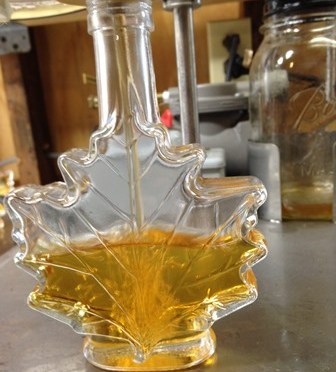
Do you ever wonder why pure maple syrup tends to cost five times more than pancake syrup? It because it takes 40 gallons of sap to make one gallon of pure maple syrup! There is a lot of energy involved to boil down the sap that contains 2% sugar to the sticky syrup containing 66% sugar content. Everyone around helps collect sap, tend to the evaporator, and bottle syrup. Tremendous effort goes into each gallon of syrup and it is all worth it in the end. There is no better feeling than creating something from start to finish and enjoying your success with the ones you cherish.

There are signs in nature that tell you when the maple season is over. The temperature stays above freezing during the night ceasing the sap to run up and down the tree. The buds on the trees start to burst open and the sap turns cloudy and is less sweet. A natural siren goes off-spring peepers serenade the woods as they emerge from their winter hibernation. It’s a bittersweet ending for the sugaring season. The transformation of sap to syrup is over for the year, but now the forest has come back to life and it is time for spring.

Learn more about maple sugaring by attending a program at a state park near you!

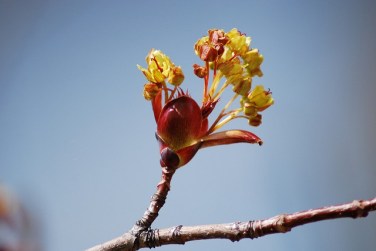
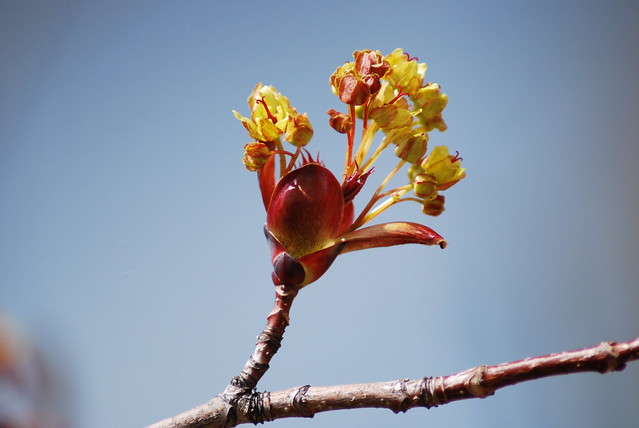
Flower
Sugar maple flower, http://farm4.staticflickr.com/3380/3497922622_2de9730b02_z.jpg

Post by Marlena Vera-Schockner, SCA Member served at Taconic Outdoor Education Center at Fahnestock State Park, 2015

Enjoy a Wintry Weekend at a New York State Park

The dog days of summer are a very distant memory, but many intrepid New Yorkers thrive in winter and are eager for falling temperatures and continued snowfalls.  To these hardy adventurers, a few extra layers of gear combined with the snowy terrain offer a winter wonderland of nature, fitness and fun.

In fact, a few of New York’s State Parks remain open and offer accommodations this time of year.  From cold-weather sports to the quiet beauty of snow-covered landscapes… snowshoe treks to winter carnivals, skating rinks to seal walks, New York State Parks are popular destinations for winter recreation and the perfect remedy for cabin fever.

Allegany State Park is not only the largest state park in New York at 65,000 acres, but this flagship property offers four seasons of adventure and is considered to be a premier winter-time destination for cold-weather fun in the northeast.  Allegany features 18 trails with 80 miles of hiking and snowshoeing, more than 25 miles of cross-country skiing and 90 miles of groomed snowmobile trails.  While the mercury may be dropping, the park heats up as families and outdoor enthusiasts enjoy winter activities and snow-based recreation in this vast wilderness setting.  Convenient and affordable winter lodging options at the park include year-round cabins and cottages available for rent.

Group camp5 Winter scene
Snowmobilers leaving Group Camp 5 at Allegany State Park. Photo by OPRHP.

With winterized cabins and the incredibly scenic Genesee Valley gorge as a backdrop, Letchworth State Park is another ideal destination for winter sports. Winter activities include snow tubing, cross-country skiing, and snowmobiling. Families can also rent the Maplewood Lodge, located in the middle of the park near the entrance to the Highbanks Camping Area.  A popular choice for snowmobilers, it connects to the New York State snowmobile trail system. The three-bedroom lodge sleeps up to eight people and consists of a furnished kitchen, living room with cozy fireplace, dining room and a full size bath and powder room.

Cross Country Skiing
Cross-country skiing is a popular activity in many State Parks over the winter months. Photo by OPRHP.

Wellesley Island State Park along the St. Lawrence Seaway in the Thousand Islands is another prime location with winterized accommodations to host weekend getaways or an impromptu overnight when available. The park’s Minna Anthony Common Nature Center is open year-round and includes nine miles of hiking trails, and five miles of cross country ski and snow shoe trails.  During the winter months visitors can warm up by the fireplace and meet other explorers. The trails have a diversity of habitat including field, forest, wetlands and views of the St. Lawrence River.

In Cooperstown, Glimmerglass State Park offers a variety of child-friendly activities such as tubing, ice skating and winter trail sports.  Reserve one of the cottages that sleep eight at nearby Betty and Wilbur Davis State Park and bring the whole family to enjoy a day of snowmobiling too.

For patrons enjoying New York’s state parks year-round, there is no ‘off-season” and every reason to get outside and embrace all types of cold- weather recreation among the wintry landscapes.

Post by Wendy Gibson and MaryAnn Corbisiero, OPRHP.

For more information, visit:

www.nysparks.com

www.newyorkstateparks.reserveamerica.com

Nature in Autumn: What to Look out for in the Ecological World

The days start getting shorter, the nights are cooler, and the leaves start to turn vibrant colors. Fall is a time of change and when plants and animals start to prepare for the long winter months ahead. It is a great time to get outdoors and observe nature’s seasonal changes.

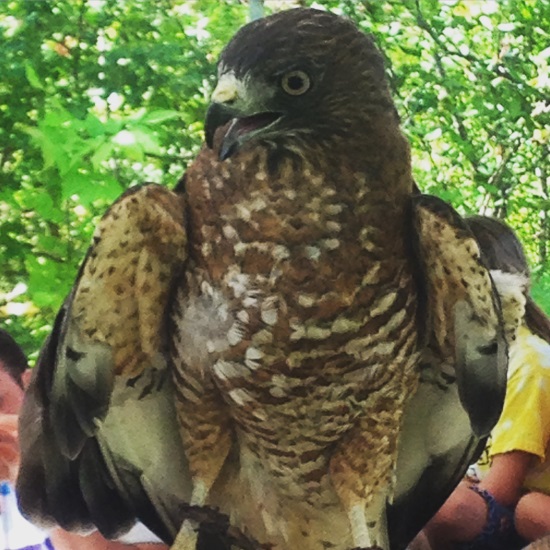
Broad Winged Hawk. Photo by April Thibaudeau, Thacher Park.

One of the Northeast’s finest wildlife spectacles happens in fall, the autumn migration of hawks. Beginning in early September until the end of November, broad-winged hawks, falcons, eagles, kestrels, harriers, and more travel from their northern breeding grounds south due to scarcity of food during the winter. The birds soar on thermal updrafts, minimizing energy expenditure. A group of birds in a thermal is termed a “kettle” and may resemble a spiral of ascending birds. The migrators utilize these updrafts to glide over ridges and down the coast to regions as far as Central and South America where food is plentiful. Thacher Park hosts an annual Hawk Migration Watch at the escarpment overlook where visitors can help count passing birds and learn more about the species they see.

Burr Oak nut showing the cupule of the acorn, which protects the fruit while it grows and matures. Photo by Ben VanderWeide, Oakland

Plants start dispersing their seeds in the fall by way of wind, water, animals, and even explosion or ballistic seed dispersal. It all starts at the end of August when blackberries, mulberries, and other fleshy fruits start to ripen and fall to the ground. These fruits contain small hard seeds and are dispersed after passing through the digestive system of animals, but make a yummy treat for us!  Acorns are theseeds of oak trees and sprout rapidly after falling to the ground. Squirrels can be seen scurrying around this time of year, storing nuts to eat later in the winter. Luckily for trees, squirrels only find about 30% of the nuts they hide – allowing more seedlings to sprout in the spring.

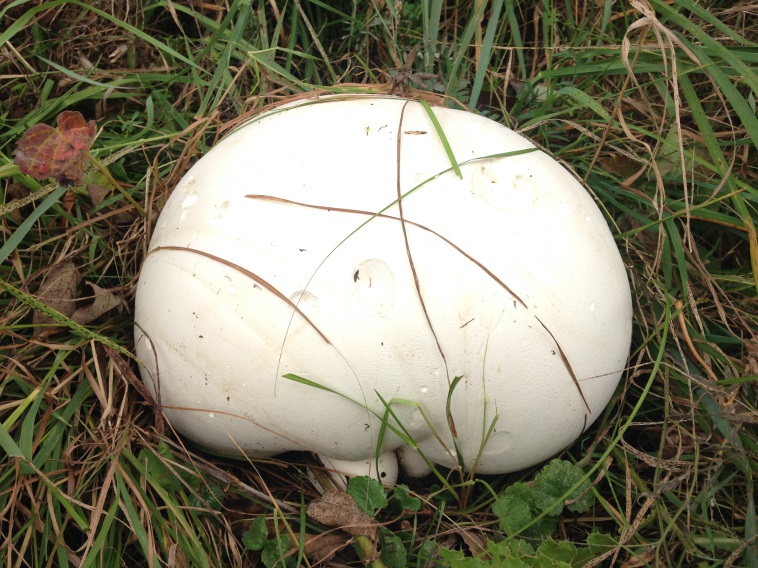
Puff ball mushroom. Photo by April Thibaudeau, Thacher Park.

A warm summer leading to damp September days is the perfect combination for mushrooms to sprout throughout the forest floor.  Fungi are made up of a vast underground network called mycelia, which helps decompose leaf litter, dead animals, and rotting wood. The mushrooms we see above- ground are the fruiting bodies of the mycelium and are composed of spores that disperse in the fall to continue the growth of their kingdom. Puff balls, hen of the woods, oyster mushrooms, and fly agaric are just a few of the mushrooms to look for on a forest hike. It is important to have a great deal of knowledge on mushrooms before picking any to eat, as some can be fatally poisonous.

For fall hikes happening at Thacher State Park check out our Program Calendar.

 Post by April Thibaudeau, Student Conservation Association Intern, Thacher State Park

For further information about these topics please consult:

Hawk Migration

http://www.hawkmountain.org/raptorpedia/migration-path/page.aspx?id=352

Seeds and Nuts

http://bioimages.vanderbilt.edu/pages/fruit-seed-dispersal.htm

Fungi

http://www.countrysideinfo.co.uk/fungi/struct.htm

http://www.fs.fed.us/nrs/pubs/gtr/gtr_nrs79.pdf