Happy 1st Birthday, Blog!

It is NatureTimes’ first birthday and it is spring! So get outside and celebrate, the snow will soon be melted and signs of life are appearing all around. Dust off your nature guides and your binoculars, get on your boots, and get out to a park near you. Last year, we posted some images of wildflowers that are the first to appear. Check that out – see how many you remember (hover over the photo to see the name). Here are some other flora and fauna to look for in the coming month.

To date, the Nature Times blog has 97 followers and 15,102 page visits. Thank you for keeping up with us, and be sure to tell your friends and family!

Post by Julie Lundgren, NYNHP.


Wondrous Woodcocks

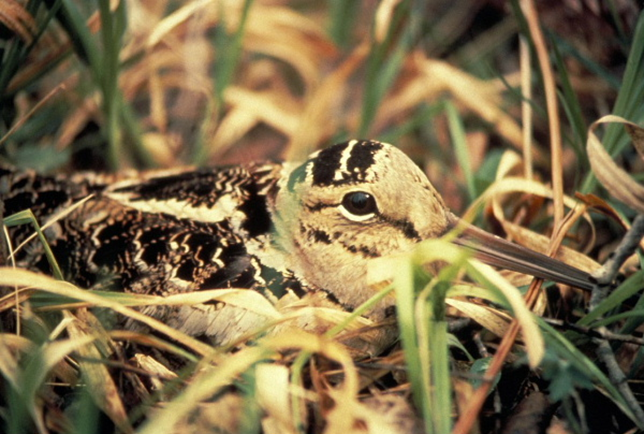
Roosting Woodcock
American Woodcock. NYSparks.com.


They are inconspicuous and well camouflaged for living on the forest floor, old fields, or wet spring meadows. Their eyes are nearly on the back of their heads, giving them the ability to see not only what is in front of them but what is behind them. Their bills look too long for their body; but this elongated bill helps them eat their weight in earthworms and other small invertebrates like spiders, beetles, and ants each day. And, in spring, males do an incredible “sky dance” at dusk and dawn, a mating display that is a highlight to any evening walk in springtime.

Who are they? They are American woodcock (woodcock), also known as the timberdoodle and Labrador twister. Woodcocks are mourning dove sized birds.  They have short necks and tails and large heads and beaks. They are one of the few shore birds that have adapted to living in the forest.

For many people, the mating “dance” of the male woodcock is a sure sign that spring has arrived. The courtship ritual starts at dusk with the male sitting on the ground in an opening in the forest or in a small field. He repeatedly utters a distinctive peent call. Next he takes off from the ground flying in a slow upward spiral. As the wind moves through the wings, a whistling sound can be heard as the bird rises. When he reaches 200-350 feet above the ground, the wing sounds become irregular and then cease as he starts a zig-zag descent. He also chirps as he goes down. He then lands silently next to a female woodcock, if she is present, and resumes peenting. The display starts again and will continue well into dark. He resumes the “dance” near dawn and will continue it until sunrise. Listen for them in the evening in wet meadows or fields in March or April, even before the snow has melted.  (Click here to listen to a woodcock.)

Woodcock dance
Diagram by Nate Kishbaugh.


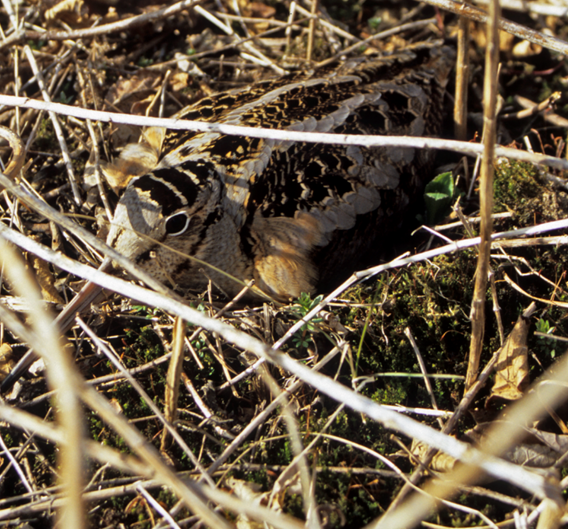
After mating, a female woodcocks lays her eggs in shallow depressions on the ground. She usually lays four eggs that take about 21 days to incubate. Once they are hatched out, the young chicks follow their mother, learning what to eat. They grow quickly on their earthworm and insect diet. By the time they are a month old, they are nearly the same size as their mothers.

In mid-fall woodcocks migrate from New York to the southeastern coast. They return to New York once the ground has thawed.

Woodcock nesting
Female Woodcock on a nest. NYSparks.com.


Post by Susan Carver, OPRHP.

Join us for a “Woodcock Walk” at:

Theodore Roosevelt Nature Center, Jones Beach State Park, Wantagh, Adult Ed-ventures, Friday, April 10, 7-8:30 pm, $4/person

Sources:

American woodcock, Cornell Lab of Ornithology, http://www.allaboutbirds.org/guide/american_woodcock/id

American woodcock, New York State Department of Conservation, http://www.dec.ny.gov/animals/45448.html


Harbinger of Spring: Skunk Cabbage

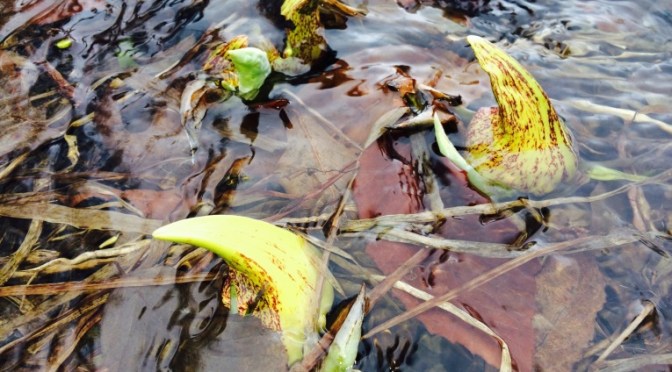
Walking in the woods this spring, especially in wet areas, you may notice these popping up through the snow. On closer inspection you will notice that it is, in fact, a plant! What you are seeing is the large spathe of the Skunk Cabbage plant. This plant has a very interesting flower structure and strategy for pollination.

Let’s learn about the flower structure first: The large fleshy hood is called the spathe; which encloses and protects the club-like spadix. The spadix is the surrounded by tiny flowers.

spadix
Diagram by Lilly Schelling.

Skunk Cabbage is one of the first wildflowers that emerge in spring. This is possible because the plant produces heat, thereby melting the snow around it. The coloration of the spathe varies from greenish to purple, often accompanied by spots or stripes. Two color variations are depicted below:

lilly photo
Photo by Lilly Schelling.
kelly photo
Photo by Kelly Starkweather.

Notice how the plant on the right resembles the look of raw meat, and if you smelled it you would notice a rather pungent skunky odor; hence the name Skunk Cabbage! These characteristics attract flies which pollinate these plants. You can experience the intense smell by scratching the leaf next time you see this plant in the woods.

Skunk Cabbage can be found in many of our state parks in swamp or wetland habitat. Though the plant has the “Cabbage” in name, it is not edible. The leaves contain calcium oxalate crystals that cause a painful burning sensation in the mouth when consumed. Even boiling the leaves does not rid them of all the irritating crystals.

Post by Lilly Schelling, OPRHP.


The History of Clay Pit Ponds

The Winant/Gericke House at Clay Pit Ponds State Park Preserve was constructed by the Winant family before 1874. The Winants were among Staten Island’s earliest European settlers and established their farm close to the ferry landing along the Arthur Kill, where boats traveled daily between Staten Island and New Brunswick, New Jersey.

In 1946, the Gericke Family purchased the farm and Herbert Gericke established himself as an organic gardener. Gericke was an innovator, as “organic produce” was not widely known at that time. Among the crops he grew were comfrey (a traditional healing herb), strawberries, pansies, tomatoes, and rhubarb. He also operated a health food store. When it was sold to the State of New York in 1979, the Gericke Farm was the last working Farm on Staten Island.

Today, Gericke Farm is one of the last working farms in New York City. P.S. 37, a special education school within the New York City Department of Education system, works in cooperation with the New York State Office of Parks, Recreation, and Historic Preservation to execute special programming. Students come to the farm every year to plant, cultivate, and harvest crops. The students then sell the crops to other students and family members at a Youth Market Program. It is a successful farm-to-table experience, which allows the students to gain a deeper understanding of where their food comes from, as well as teaching them teamwork skills and positive food attitudes through work in the garden.

photo1
Gericke persuaded a closing coffee factory to dump 56 truckloads of coffee beans on his land to help improve the land’s fertility. Picture courtesy of The Organic Farmer, 1949.
photo2
People traveled several miles to purchase produce from Gericke’s organic farm. Image courtesy The Organic Farmer, 1949.

Post by Elisabetta OConnor, Environmental Educator at Clay Pit Ponds State Park Preserve.


Native Spring Wildflowers

Spring is in the air and with warmer temperatures come the spring flowers everyone hopes to glimpse.  Most of the flowers people have come to associate with spring are not native to North America though.  Crocus, daffodils, hyacinths, and tulips, for example, are all European flowers.  There are, however, many native plants that “spring” up at this time of year.

Native plants are valuable for a variety of reasons.  They contribute to the biodiversity and health of ecosystems and provide habitat for birds, insects, and other wildlife.  Also, as they are acclimated to the local environment, native plants are often hardier and require less care than imported plants.

As you walk through the woods this spring, look for native plants growing beneath the trees.  In 1936, Minna Anthony Common made a list of plants that were native to the Thousand Islands Region in the journal she kept detailing her work on the Rock Ridges Nature Trail in Thousand Island Park.  These three were among the native plants that were already growing along the trail when she began to work on it.

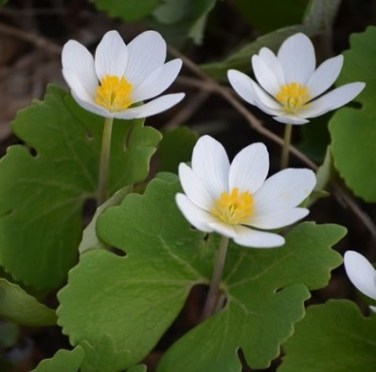
bloodroot

Bloodroot (Sanguinaria canadensis) has white flowers with 8 to 12 petals that are approximately 1¼ inch wide.  The flowers sprout on 3 to 6 inch stems through folded leaves.  The deeply lobed leaves open as the plant grows.  When the root of the plant is cut, it “bleeds” a reddish- orange liquid.  This is what gives the plant its name.  Bloodroot prefers moist soil and partial shade and is often found along the woodland edge.  At the Minna Anthony Common Nature Center, bloodroot can be found in the flower bed along the front of the museum building.

spring beauty

Spring Beauty (Claytonia virginica) has small (½ to ¾ inch) pink or white flowers with darker pink veins.  Each plant has a single pair of long narrow leaves.  These flowers also prefer moist woodland habitats.
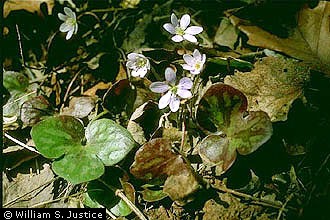
roundlobe hepatica

Hepatica (Hepatica nobilis) is a member of the buttercup family.  It has ½ to 1 inch wide blue, pink, or white flowers and three lobed leaves.  Hepatica begins blooming in early spring and will continue to bloom into the summer season.  Hepatica prefers partial shade and is often found in woodland habitats.

If you are interested in learning more about native plants, visit us at the Nature Center.  We have a many books about native plants in our library and gift shop.  We also have a copy of Minna Anthony Common’s journal available for our visitors to read.  Best of all, we have miles of trails where visitors can see these plants in their native habitat.  The best way to learn about nature is to experience it.

Post by Molly Farrell, Nature Center Director at Minna Anthony Common Nature Center (Wellesley Island State Park).

Sources:

Common, Minna.  Rock Ridges Nature Trail: Record of the Trail, journal kept by Common while developing the trail system

Newcomb, Lawrence. Newcomb’s Wildflower Guide. Little, Brown and Company, New York. 1977.

USDA Plants http://plants.usda.gov (accessed 3/10/2015)

Minnesota Wildflowershttp://www.minnesotawildflowers.info/flower/virginia-spring-beauty (accessed 3/10/2015)

Prairie Moon Nursery www.prairiemoon.com  (accessed 3/10/2015)


The official blog for the New York State Office of Parks, Recreation & Historic Preservation