Summer is in full swing, with flowers blooming and bees buzzing. Our native pollinators, which also include flies, butterflies, and beetles, are an important part of New York’s ecosystems. They work hard to pollinate our trees, wildflowers, gardens, and crops. Some of these native pollinators appear to be declining. To learn more, scientists have been evaluating the populations of pollinators throughout New York as part of the four year Empire State Native Pollinator Survey (ESNPS).
The ESNPS is a project that aims to determine the distribution and conservation status of target pollinator species in New York. This project is made possible through work by both scientists conducting statewide surveys and community members submitting pollinator pictures and specimens they have observed.
In the last few years, zoologists with New York Natural Heritage Program (NYNHP) have visited more than 60 State Parks throughout New York State searching for a variety of target pollinator species. Community scientists have also been contributing their finds with photos added to the ESNPS iNaturalist project page.
More than 21,000 observations had been submitted to this multi-year project byMarch 2021, with the project constantly growing. These observations have been submitted by over 600 people and represent over 1,400 species. The Empire State Native Pollinator Survey is accepting photo submissions through September 2021 and you can help!
Be A Community Scientist
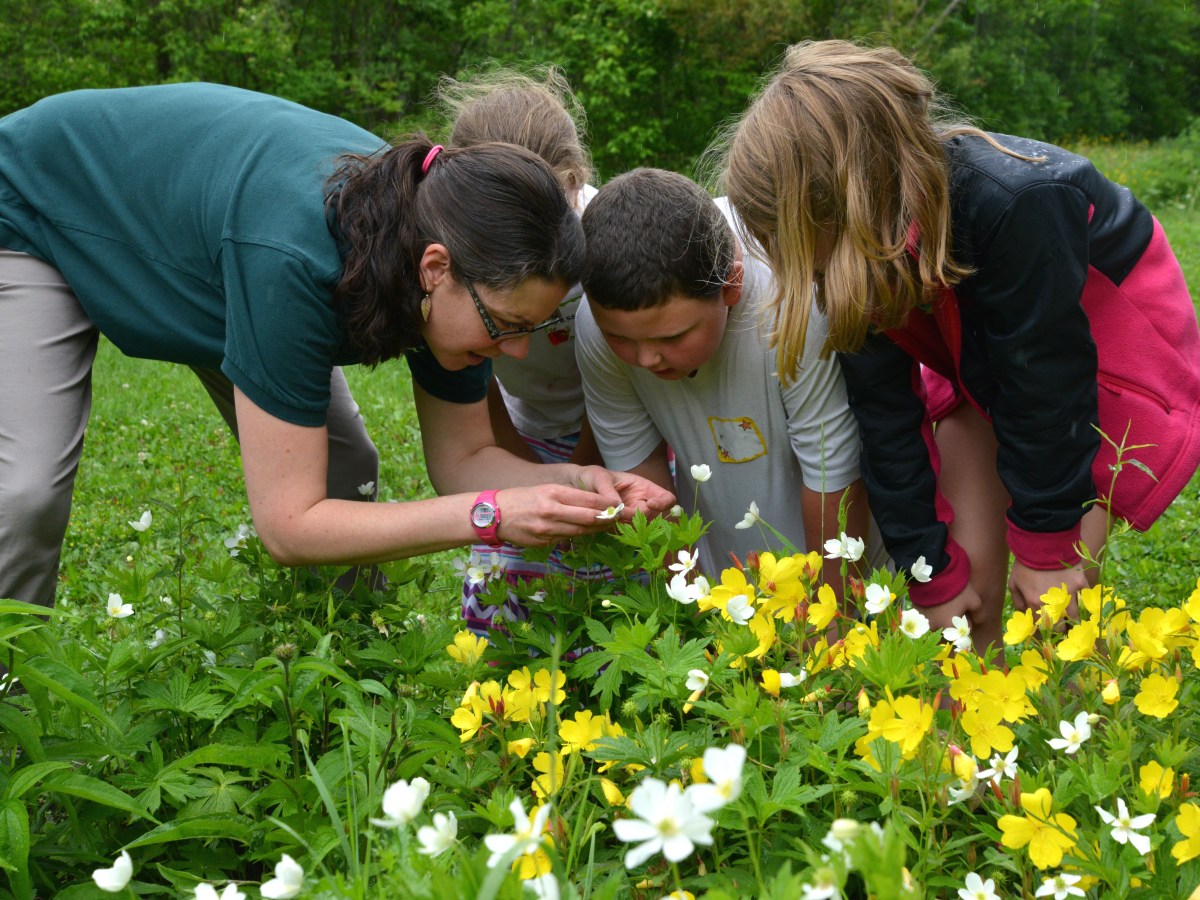
Do you want to help contribute to pollinator survey efforts? The project is accepting photo submissions through September 2021! Photographs can be submitted through the ESNPS iNaturalist project page or through the iNaturalist app after joining the project online. This can be a fun activity to do solo or with friends and family the next time you visit a State Park. Pollinators can be found in a variety of habitats – keep an eye out for wildflowers on warm and sunny days to see what you can find. If you are able to snap some good pictures and upload them to iNaturalist, experts can help you identify the species you have found. It is a great way to learn, too.
What to Look For
Below are some pictures of the target species for this project that have been found in New York State Parks. New York’s pollinators have so much variety! These are just a few examples of what to look for and photograph.
Cuckoo Bee
One of the interesting bumble bees we have in New York is Fernald’s Cuckoo Bumble Bee (Bombus flavidus=fernaldae). Cuckoo bumble bees are a group of parasitic bees that are unable to collect pollen or raise young. These bees will take over the already established nests of other bumble bees by invading and incapacitating or killing the queen. The Cuckoo bumble bee then forces the workers to raise its young.
Fernald’s Cuckoo Bumble Bee (Bombus flavidus=fernaldae) Photo Kevin Hemeon
Bee Mimics
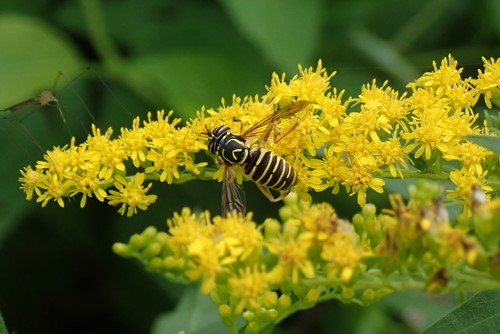
Look closely at the Bare-eyed Bee-mimic Fly (Mallota bautias) and Eastern Hornet Fly (Spilomyia longicornis); these are flies that are called bee mimics. Bee mimics can look very similar to bees, hornets, or wasps. Imitating insects with stingers is a defense mechanism for these harmless flies.
Bare-eyed Bee-mimic Fly (Mallota bautias) Photo Paweł Pieluszyński
Eastern Hornet Fly (Spilomyia longicornis) Photo Laura Shappell
Greater Bee Fly (Bombylius major) Photo Alan Wells
Longhorn Beetles
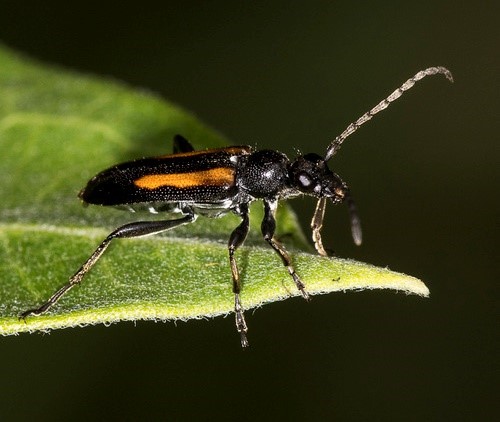
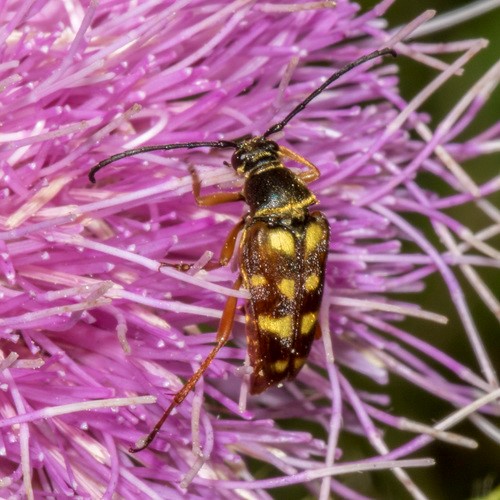
The project is also interested in information on the 100 species of longhorn beetles. These beetles generally have very long antennae and come in a wide variation of colors and patterns. They too are pollinators.
Strangalepta Flower Longhorn Beetle (Strangalepta abbreviata) Photo Alan Wells
Banded Longhorn Beetle (Typocerus velutinus) Photo Alan Wells
Where Should I Look?
You can find native pollinators all over. State Parks have a great variety of natural habitats where you can find interesting pollinators. Sunny days with not too much wind are ideal. Some of the counties that would benefit from additional surveys are Chenango, Cortland, Fulton, Lewis, Montgomery, Orleans, Tioga, and Yates.
Look for flowers along trails through fields, meadows, dunes, forests, or even in marshes and stream sides if you kayak or canoe. Stop and look for a bit to see if any pollinators settle down on the flowers. Photograph from a distance first and then try to move in for some close-ups. The insects are often so intent on feeding that they don’t fly away.
If you can help, sign up for the Empire Pollinator Survey ESNPS iNaturalist project page and submit your photos on that project page or the APP before Sept. 30, 2021. The results from the project are anticipated to be available in spring 2022.
Post by Ashley Ballou, Zoologist, NY Natural Heritage Program www.nynhp.org
Resources
Read more about State Parks and our efforts with pollinators in previous posts in the NYS Parks Blog.
It is Pollinator Week, the week we celebrate pollinators small and tiny. Our native pollinators, including bumble bees, mining bees, bee flies, longhorn beetles, and flower moths, play an important role in supporting the diversity of plant life in New York. Since 2016, State Parks staff has been working hard to help protect our native…
Across New York, State Parks staff is working hard to help support the diverse populations of pollinators from bees to butterflies, beetles, wasps, and more. Here’s a sample of the pollinator protection projects going on this year in State Parks. Rockefeller State Park Preserve Wild Bees Photo Exhibit Working from their photographs from both Rockefeller…
New York State Parks is abuzz with excitement for pollinators. From June 20-26, we celebrate both National Pollinator Week and New York State Pollinator Awareness Week. Our local bees, butterflies, moths, birds and other pollinators are to thank for most of the food we eat, as well as for many of the trees and flowers…
A century ago this week, thousands of people flocked by car and even horse carriage to remote, wild and forested hills in southwestern New York’s Cattaraugus County, near the border with Pennsylvania, to celebrate the opening of a new State Park.
According to a contemporary account in the local Salamanca Republican-Press newspaper, the visitors to the new Allegany State Park used a roadway that had been quickly built over the bed of a former lumbering railway in the region, which also had been part of the state’s 19th century gas and petroleum industry. With people coming in from as far as Buffalo, parking was quickly filled and some people walked a great distance to reach the dedication site, located near an old lumber camp.
Enjoying a picnic of sandwiches, doughnuts, cookies, coffee, iced tea and “milk in unlimited quantities” as reported by the newspaper, the crowd listened as Albert T. Fancher, a former state senator from the region and chairman of the new park’s commission, vowed that Allegany was poised to quickly grow, with areas nearby suitable for creation of a man-made lake and game preserve.
Another speaker, Franklin Moon, dean of the state college of forestry, said the creation of public parks like Allegany were the best remedy for “national irritability,” as he reflected some of the trepidation in the U.S. over the then-recent rise of Bolshevism in Russia.
Some of the Opening Day crowd at Allegany State Park on July 30, 1921.
Today, Allegany State Park welcomes more than 1,500,000 visitors a year to explore western New York’s premier wilderness playground, created thanks to the vision of Fancher, a petroleum industry executive who was a political force in Cattaraugus County for several decades, as well as Hamilton Ward, a Spanish-American War veteran who later founded the Erie County Park Commission and became New York State Attorney General, and Chauncey Hamlin, president of the American Association of Museums and founder of the Buffalo Museum of Science.
Fancher became the park’s first director until his death nine years later in 1930. Fancher’s original cabin, where he stayed at the park with his wife, is still there. Hamlin supported the creation of a science camp at the park.
Starting out in 1921 with about 7,100 acres purchased for $35,800 (equivalent to about a half-million dollars today, or about $70 an acre), Allegany State Park has grown over the years to encompass more than 64,800 acres and includes rare remaining portions of old growth forest with trees more than 100 years old that were left undisturbed during the area’s lumbering and petroleum boom that ran from the early 19th century to the 1920s. Park naturalists have mapped more than 5,200 acres of old growth forests of hemlocks and hardwoods, with the majority of that in the Big Basin area. Some experts believe this is the state’s largest contiguous track of old growth outside the Adirondacks.
Given the uncertainty of planning during the pandemic, the park is not holding a mass gathering like was done in 1921, but is hosting a virtual celebration on July 30th 2021 that will include a library of digital content. The park is also offering a summer series of interpretive programs highlighting the park’s history.
The virtual celebration and other digital content can be viewed HERE starting noon on July 30, 2021.
Additionally, a set of four self-guided interpretive booklets are for sale at the park which guide visitors to 100 points of interest within the park, and includes topics of interest such as early European settlement, the petroleum and lumbering industries, early ski facilities in the state, and the work of Civilian Conservation Corps crews during the Great Depression.
Now New York’s largest State Park, Allegany has a wide variety of recreational resources certain to foster tranquility and soothe any irritability. Due to its size, this sprawling park is divided into two distinct areas – Red House and Quaker Run. Red House has 133 campsites, 130 cabins, 16 full-service cottages, two group camps, five miles of paved bike paths, many miles of hiking and horse trails, and swimming at man-made Red House Lake, with boat rentals. Its historic Tudor-style administration building, completed in 1928, includes a museum of park natural history
A canoeist paddles past the park’s historic Administration Building.
One of the new cabins at Allegany State Park.
The Quaker Run Area has two lakes, 189 campsites, 230 cabins, 37 full-service cottages, two group camps, many miles of hiking trails and horse trails, swimming at Quaker Lake, a boat launch at the Allegheny Reservoir, which has 91 miles of shoreline and is popular for boating, fishing, kayaking and waterskiing. Named for Quaker missionaries and settlers who came to the area in 1798 at the invitation of Seneca Chief Cornplanter to assist with agriculture and education.
The new bathhouse at Quaker Lake.
A fishing pier on Quaker Lake.
Hikers have a wide variety of trails to choose from, with some highlights including:
Located on the park’s Quaker Run side, the Blacksnake Mountain Trail is one of the oldest trails in the park with a unique history. Parts of the trail follow the 1888 section of A&K Railroad (Allegheny & Kinzua), which is evident in the gentle slope on the north side of the three-mile loop. In 1933, the professors of the Allegany School of Natural History, also known as “the School in the Forest”, (located near Science Lake) mapped out a hiking trail they officially named the “Nature Hiking Trail” to conduct their field studies with their students. It was later renamed “Blacksnake Mountain Hiking Trail” in 1980 after Governor Blacksnake, an Iroquois Indian chief for the Seneca Nation of Indians, who allied with the United States in the War of 1812. The trail crosses several streams with new bridges, and a short steep climb leads to mature black cherry trees estimated to be between 100 and 130 years old. Cucumber magnolia, tulip trees and hemlock are other trees of interest along the way. This is a favorite trail for spring wildflower lovers. Trillium, Dutchmen’s breeches, squirrel corn, and spring beauties are just a few of the ephemerals that announce the changing of the seasons. Near the top of the trail, look for a granite milestone marker which represents the border of New York and Pennsylvania, where you can put a foot in each state.
Bear Paw Hiking Trail is named after a style of snowshoe used by Native Americans and was originally designed as an interpretive snowshoe trail in 2015 by park naturalists. The 2.4-mile trail starts at the rear of the Summit Area parking lot. Look for brown numbered markers which highlight unique flora such as ground cedar, various hardwoods, and lowbush blueberries. Halfway along Bear Paw, at the end of the loop, hikers will be treated to the masterfully built Stone Tower, an Allegany State Park landmark, constructed by the Civilian Conservation Corps in 1934. The tower offers beautiful views of large open valleys, the city of Salamanca and Red House Lake. The second half of the trail traverses the south side of the ridge, through beech and maple forests and into a meadow. Depending on the time of the year, hikers may get to sample low bush blueberries or wintergreen growing in this area. The last section has a short, steep incline that adds a bit of challenge. Bear Paw ends at the Summit Warming hut.
The 5.2-mile Robert C. Hoag Bicycle Path is named after the former Seneca Nation President and was dedicated in June 1990. Starting at the Red House entrance of the park, the path passes old apple trees and large stands of spruce and Scotch pine, along with many varieties of hardwoods, shrubs and wildflowers. The most used part of the path is around Red House Lake, where a 3.4-mile trail offers the potential to spot such wildlife as beaver, muskrat, great blue heron, and many species of waterfowl. Spurs off the trail lead to the Red House Wetland Interpretive Complex, Beehunter Cabin Trail and Camp Allegany. Several benches are located along the way to relax and enjoy the surrounding beauty.
Work on the new Quaker Multi Use Trail began in the summer of 2020 between the Taft cabin and the Quaker General Store. The second phase is in the final design stages and will continue the trail to Quaker Lake Beach. Once complete, the trail will offer five miles of accessible paths winding though woodlands and fields along ASP Route 3 and Quaker Lake, including several scenic crossings of Quaker Run.
For birdwatchers, Allegany State Park contains a Bird Conservation Area, which provides breeding and migratory stopover habitat for forest-interior species such as Swainson’s Thrush, Blackburnian Warbler, and Scarlet Tanager. Of the 75 neotropical migratory songbird species that breed in New York, 64 have been observed within the park. The park supports a large breeding population of Osprey and one of the largest breeding concentrations of Cerulean Warblers found in New York, both of which are state species of special concern. The BCA also provides habitat for other state-listed species, including Bald Eagle (threatened), Northern Goshawk, Red-shouldered Hawk, Cooper’s Hawk, and Sharp-shinned Hawk (all species of special concern). Find a map of the BCA here.
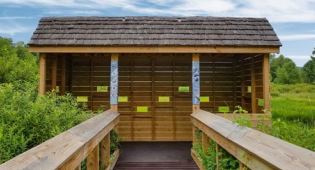
A birdwatching blind in one of the park’s wetland areas.
During the winter, the Art Roscoe Cross Country Ski Area boasts 26 miles of groomed cross-country ski trails. The area is named for an early park forester and ski advocate who later became assistant park manager and worked there from 1928 to 1968, earning the nickname “Father of Skiing” in western New York. For other winter sports enthusiasts, the Quaker Run and Red House areas also have a combined 90 miles of snowmobile trails.
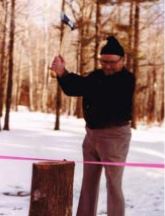
Art Roscoe uses an axe to cut the ribbon to open up the new cross country ski trail network in 1972.
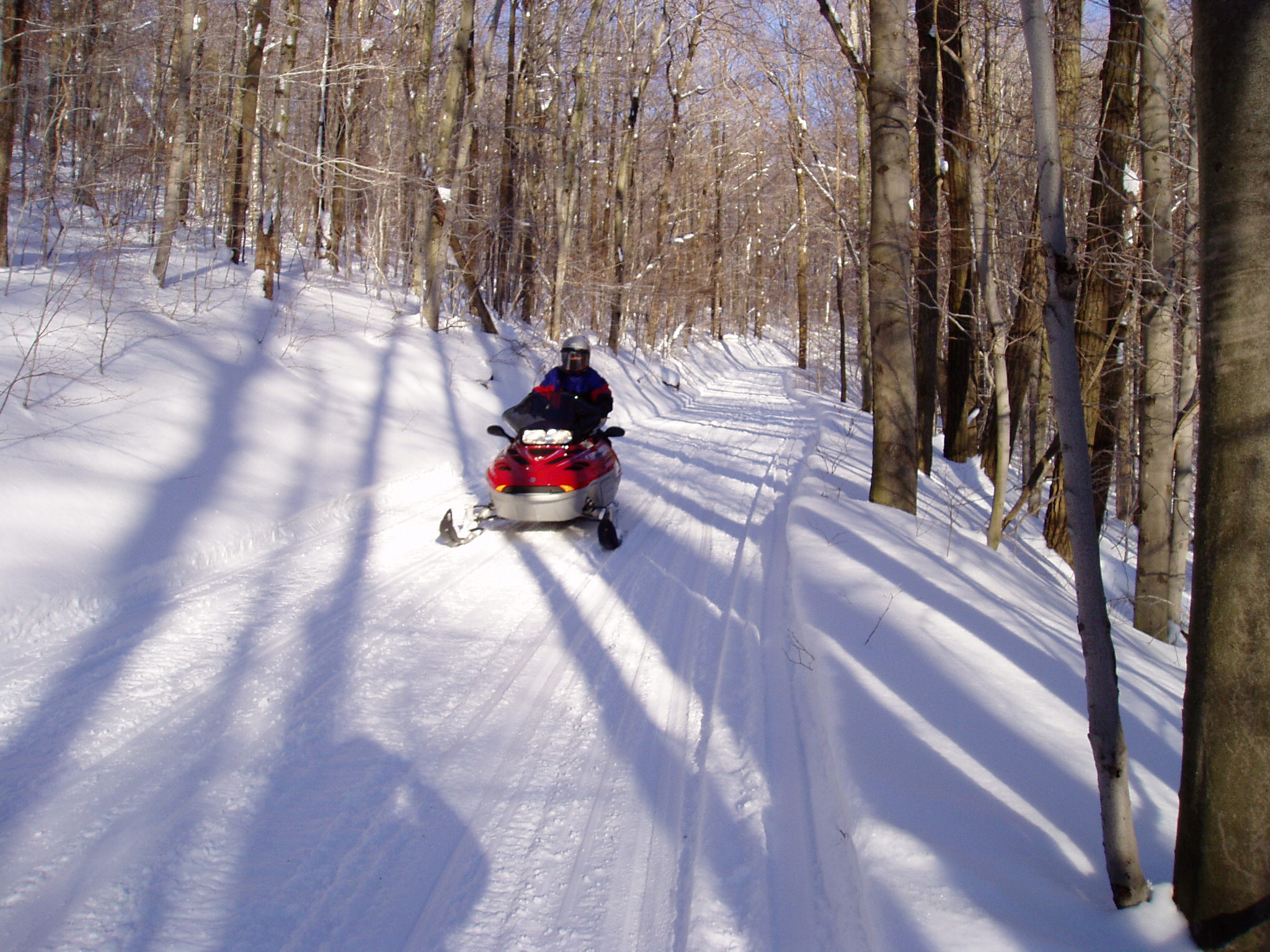
With 90 miles of snowmobile trails, Allegany State Park is popular with sledders.
Allegany also was the site of numerous fire towers, where observers would watch for signs of wildfires in the forests. One of those 60-foot towers, built in 1926 at the 2,365-foot summit of South Mountain, was restored and reopened to the public in 2006, and now offers a spectacular view of Red House Lake and the surrounding area.
The fire tower at the South Mountain summit offers panoramic views of the region.
For another gorgeous view, the Stone Tower, built between 1933-1934 by crews from the Civilian Conservation Corps, stands at 2,250 feet and overlooks the city of Salamanca. On a clear day, the view can stretch for up to 20 miles.
CCC crews also helped establish the park as a regional center for skiing, building a downhill ski center and two ski jumps, which allowed for competitions that would draw thousands of spectators through the 1970s, when the jumps were closed.
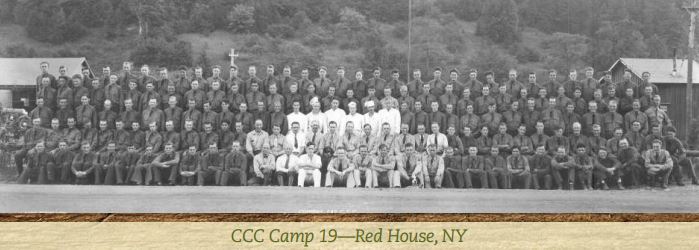
Top, one of the Civilian Conservation Corps crews stationed at Allegany State Park. Below, the Stone Tower that was among the projects built by CCC members.
Allegany also has a unique geological and natural history compared to elsewhere in the state. The park is part of a geological region called the Salamanca Re-entrant, which is the only area in New York that was never reached by glaciers during the last Ice Age some 12,000 years ago. This gives the region its distinctive soils, topography, surficial geology, and flora and fauna.
The well-known “Thunder Rocks” in the park’s Red House area may appear to casual observers to be some of the massive boulders scattered throughout much of the state by Ice Age glaciers but this unusual “rock city” is actually bits of ancient inland seabed created some 400 million years ago, and revealed through geological uplift and erosion.
Thunder Rocks are sections of an ancient inland seabed that has been exposed through geological uplift and erosion.
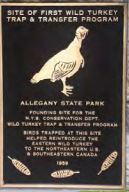
Wild turkeys, now widespread throughout New York, owe that comeback to Allegany State Park, the Regional Park Commission, and the Conservation Department. These birds were largely absent from the state by the beginning of the 20th century, due to overhunting and habitat loss, but in the 1940s, a small population of birds had come into the park, likely from Pennsylvania to the south. From the 1950s to the mid-70s, wild turkeys in the park were live trapped by wildlife officials, who used net-firing cannons to safely capture the birds, which were then taken to the Catskills, Adirondacks and elsewhere in New York state to reestablish the birds in the wild. Some turkeys were even sent to other states in the Northeast and to Canada as part of wildlife restoration efforts there.
All this only begins to scratch the surface of the park’s fascinating history and what it has to offer. So, in honor of the venerable park’s centennial and its next century to come, plan a visit to explore. Interactive maps of Allegany State Park can be found here and here.
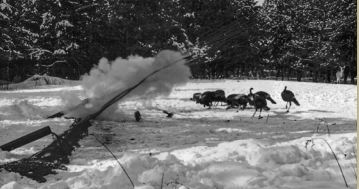
Above, wildlife managers fire a net from a cannon to trap wild turkeys as part of restoration efforts in New York and throughout the Northeast. A plaque now marks the location of the first efforts.
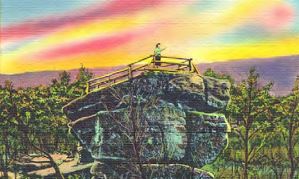
Cover Shot – A colorized historic postcard of Thunder Rocks in Allegany State Park. All photos by NYS Parks.
Post by Brian Nearing, Deputy Public Information Officer, NYS Parks
One of the most popular hikes in the Hudson Valley, the Breakneck Ridge Trail at Hudson Highlands State Park Preserve offers spectacular views of the historic river valley from its 1,200-foot summit. The trail is often listed among the best hikes in the region.
But this 4.4-mile trail, boulder-strewn, narrow, and steep, is also physically demanding for even the most experienced hikers. Not advised for the inexperienced or those used to flat trails, this challenging terrain has occasionally led to injured or lost hikers in areas where rescue can be difficult.
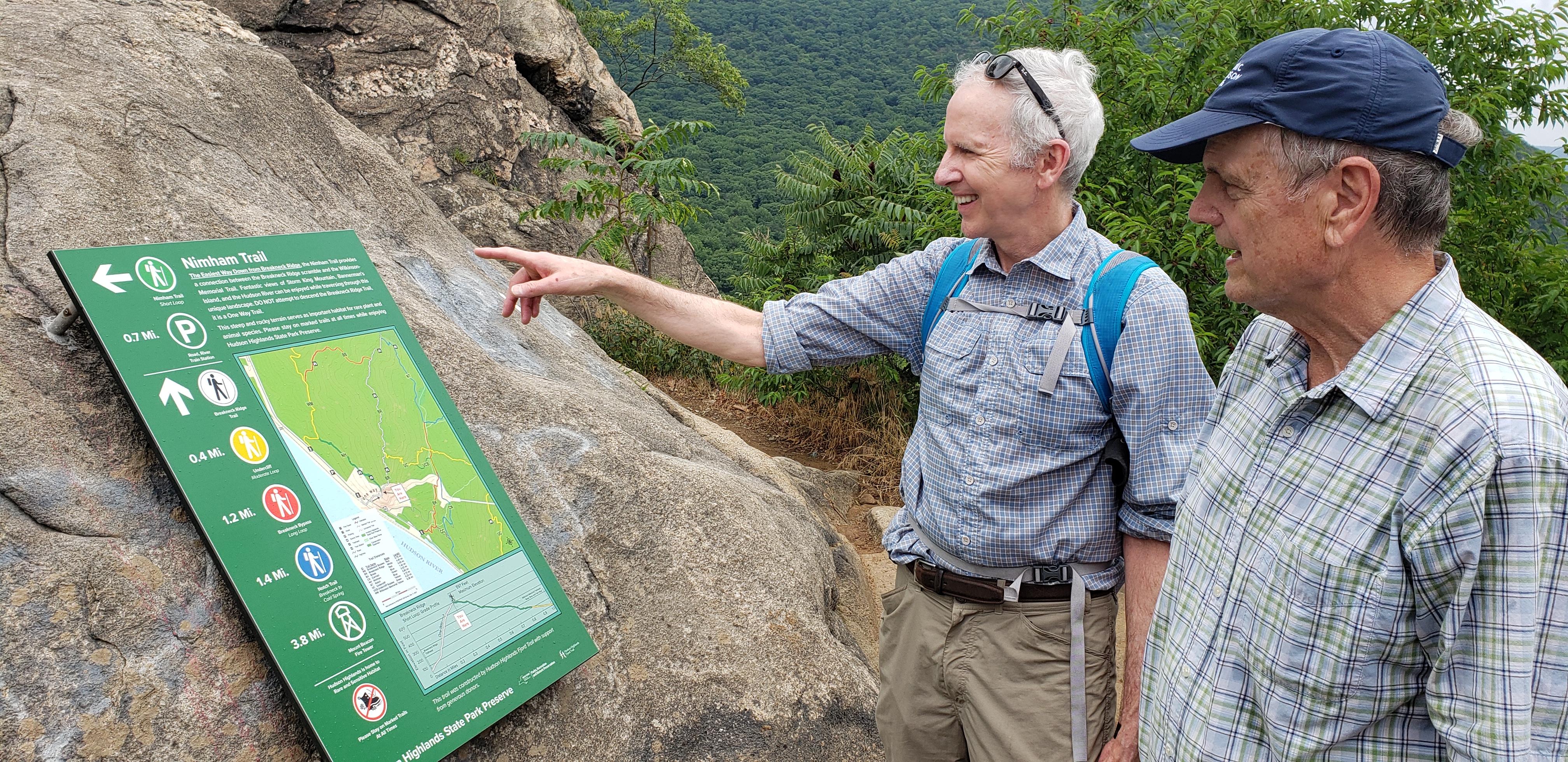
In July 2021, a new trail connecting to Breakneck was opened to provide an alternative, allowing hikers unwilling or unable to continue the arduous ascent to instead make a shorter, gentler, and safer return loop down to Route 9D.
A trail guide on the new Ninham Trail at the intersection of Breakneck Ridge Trail. (Photo Credit- NYS Parks)
Formed with hundreds of hand-set stone steps, the new half-mile Ninham Trail was made possible by Hudson Highlands Fjord Trail Inc., a new not-for-profit affiliate of the environmental group Scenic Hudson, which raised the funds to pay for it. The Fjord team includes Hudson Highlands Land Trust, NY-NJ Trail Conference, Open Space Institute, The Lenape Center, and Riverkeeper; four state agencies: Office of Parks Recreation and Historic Preservation, Department of Transportation, Department of Environmental Conservation, and Department of State; four municipalities: Village of Cold Spring, Town of Philipstown, Town of Fishkill and City of Beacon; two New York metro-area agencies: Metro-North Railroad and New York City Department of Environmental Protection; and three community-based non-profits: Friends of Fahnestock and Hudson Highlands State Parks, Little Stony Point Citizens’ Association, and the Philipstown Greenway Committee.
Hudson Highlands Park Preserve Manager Evan Thompson said the Ninham trail will make hiking Breakneck safer for everyone, since hikers who want a short return no longer will go against the flow of hikers coming up. The new trail also provides hikers a slightly less vertical way to reach Breakneck Ridge. And just as importantly, the trail will also make it easier and quicker for rescue crews to respond to emergencies further up the trail.
Breakneck Ridge as seen from the south at Little Stony Point on the Hudson River.
Ninham Trail is a source of two compelling tales – first, the story of its rugged construction along the face of the ridge, including more than 540 stone steps handcrafted from the mountain’s own stone, and second, the history behind its namesake Daniel Ninham, who was the last chief of the Wappinger tribe that once lived in the rocky Hudson Highlands of Westchester, Dutchess, and Putnam counties. (His last name has also been spelled Nimham, based on the historical record, but the preferred spelling is Ninham.) Ninham and other Wappingers lost their lives fighting on the patriot side during the American Revolution, but despite that the tribe was ultimately pressured several decades later to relocate out of New York and eventually wound up halfway across the continent.
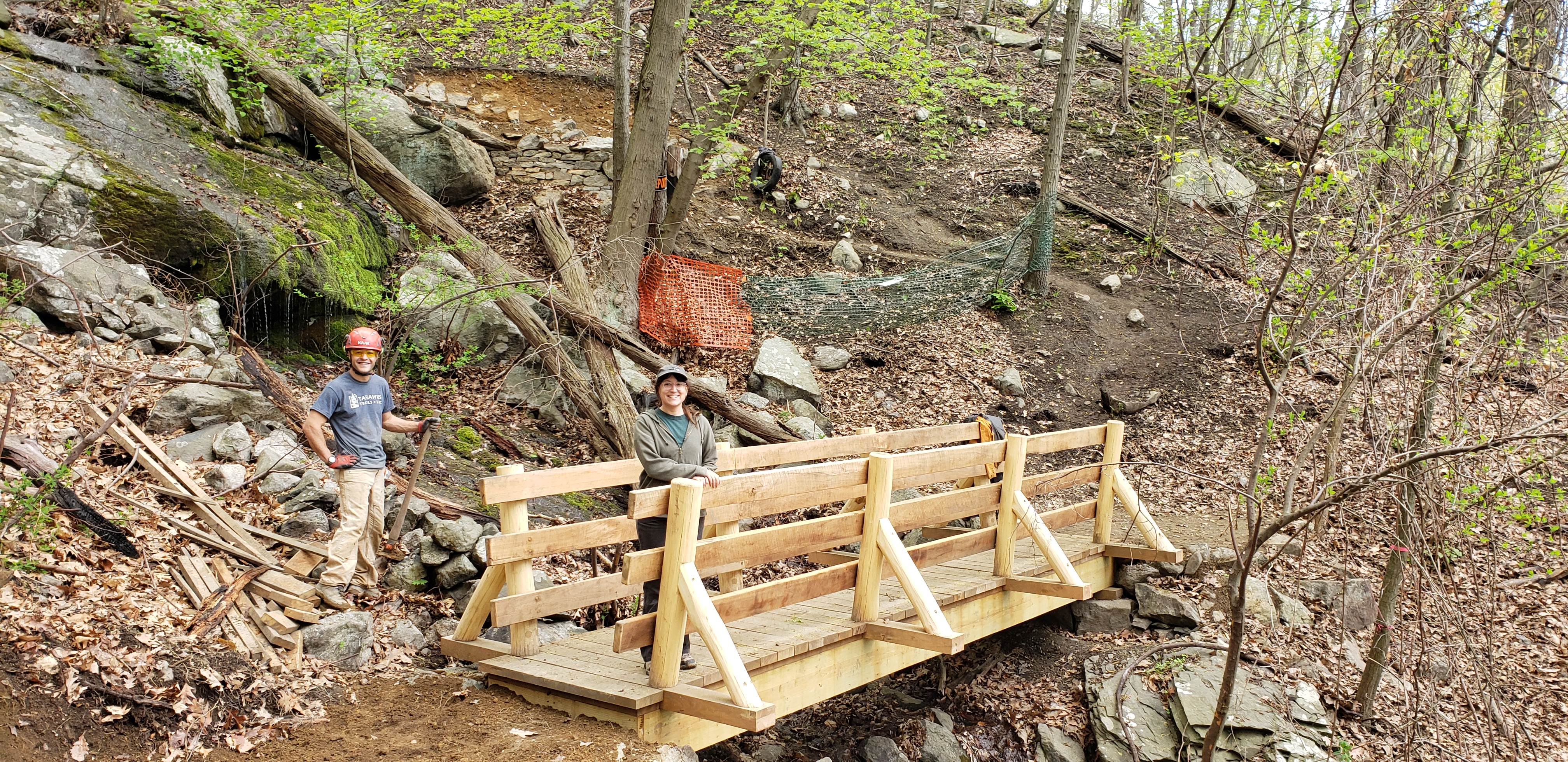
The native granite of the Hudson Highlands where Ninham once roamed forms the spine of the Ninham Trail, which traverses the face of a ridge to connect Breakneck Trail with the Wilkinson Memorial Trail originating on a Route 9D trailhead. Starting in summer 2020 and continuing to completion in June 2021, crews from the firm Tahawus Trails LLC, of Accord, Ulster County, and the volunteer group Jolly Rovers Trail Crew, of Poughkeepsie, worked to carve out the trail and lay in stone steps and bridges where needed.
With each stone step weighing an average of about 500 pounds, that’s more than a quarter-million pounds of stone, cut in place from boulders near the trail, and moved through muscle power aided by block and tackle, come-alongs and highlines, and set into place, with much of the work done by hand. The steps are a legacy as durable as the mountain itself.
Above, a new bridge on the Ninham Trail, constructed by Tahawus Trails LLC. Below, members of the Jolly Rovers crew work on stone steps, with a crew banner marking the volunteer group’s work site.
State Parks Commissioner Erik Kulleseid, left, examines completed stone steps with a member of the Jolly Rovers trail crew.
The rugged trail honors the enduring legacy of Daniel Ninham, who was born in the Hudson Valley near Fishkill in the mid-1720s as Dutch and later English colonists were extending their control over Wappinger and other native lands. By the 1740s, Ninham’s Wappingers and a patchwork of members of other dispossessed tribes in that region had gathered in western Massachusetts, in what today is Stockbridge, Berkshire County. Forming a European-style town named after a place in England, the native inhabitants converted to Christianity and were known then as “Stockbridge Indians.”
The Stockbridge community, which also included English settlers, was mixture of Wappingers, Mahicans/Mohicans, and Munsee (also known as the Lenape or the Delaware), such as the Esopus and Catskills, as well as other Native peoples.
The areas outlined in white, spanning the Hudson Valley in New York, as well portions of New Jersey and Pennsylvania, were the original territory of the Mohican people, which inclueded the Wappinger tribe. (Courtesy of Stockbridge-Munsee Band of Mohican Indians)
As Stockbridge chief (known as a “sachem”), Ninham was fluent in English and tried unsuccessfully to use Colonial courts to regain massive tracts of the lost Hudson Valley lands, claiming deeds had been fraudulently obtained. He later traveled to London in 1766 to make an unsuccessful appeal of the case to British royal officials, who asked the Colonial government to reexamine the case, which was upheld despite disputed and contrary evidence
During the Revolution, Ninham and his warriors, known as the Stockbridge Militia, angered by what they considered these earlier British betrayals after having supported Britain in the French and Indian War and other conflicts, sided with George Washington and the Continental Army, believing that fairer treatment might be obtained from a new government. Militia members served with patriot forces at battles including Bunker Hill, Ticonderoga, Valcour Bay, Saratoga, and Valley Forge.
A drawing of a Stockbridge Militia soldier from the diary of Revolutionary War Hessian soldier Johann Von Ewald (Photo Credit- Wikipedia Commons)
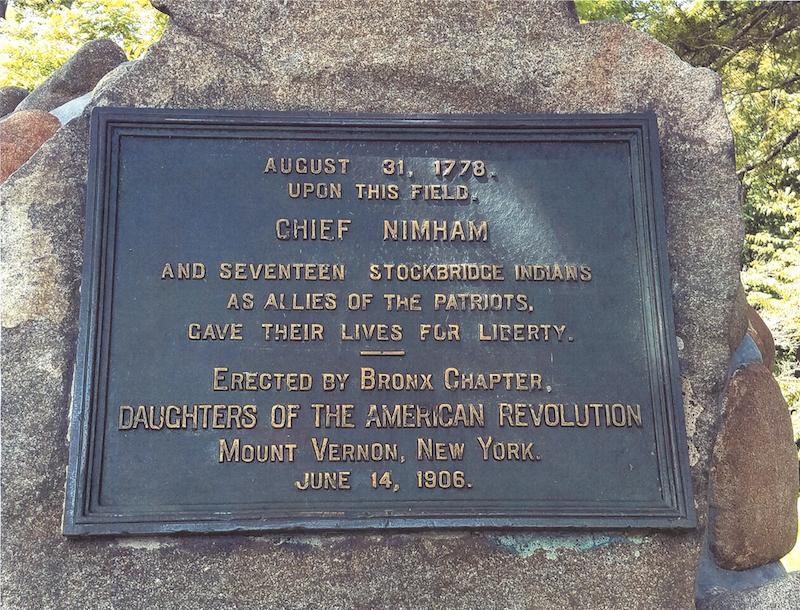
In August 1778 during fighting around New York City, Daniel Ninham, his son, Abraham, and more than a dozen soldiers of the Stockbridge Militia were killed by British and Hessian forces during a battle in what is now Van Cortlandt Park in The Bronx. A stone monument to the Battle of Kingsbridge by the Daughters of the American marks the spot today as one of the reminders of Ninham in New York State.
In the town of Fishkill, at the intersection of routes 52 and 82, the state installed a monument to Ninham in 1937. A memorial to Ninham is in Putnam County Veterans Memorial Park in Kent. Also found in Putnam County is the 1,054-acre Nimham Mountain Multiple Use Area, operated by the state Department of Environmental Conservation.
An oil painting entitled “Ninham’s Last Stand,” by military artist Don Troiani.
However, the Stockbridge Militia’s sacrifice did little to stop encroachment on their Berkshire County land even during the war, and the tribe, weakened by its manpower losses and pressured by former colonists who had taken some of the land and wanted the rest, moved westward to Oneida County south of what is now Syracuse. As part of that move in 1783 as the war ended, the tribe received a personal letter from George Washington thanking them for their service during the Revolution, calling them “friends and brothers” who “fought and bled by our side.” Washington urged that the Stockbridge “not be molested in any manner” during their journey west. As a gesture to his allies, according to some accounts, Washington also paid for the tribe to have an ox roast at Stockbridge before they left, something that current tribal officials conducted an archeological investigation into in 2019
After moving onto lands provided by the Oneida tribe, the Stockbridge again faced pressure in coming years to move, as land speculators and squatters desired that property as well. Some members attempted to move to Indiana in 1818, but were blocked when the Delaware and Miami tribes, which had agreed to take in the Stockbridge, lost control of the land to approaching colonists. In 1822 after reaching a sales agreement with New York State, the remaining Stockbridge left the state entirely, and moved to Wisconsin, where members currently have recognition as the Stockbridge-Munsee Band of Mohican Indians.
Numbering about 1,600 members, the group has a 24,000-acre reservation in Shawano County, west of the city of Green Bay. According to the tribal website, there are only “seven or eight” people alive who can still speak the native Mohican language, a consequence of colonization. Tribal efforts are ongoing to keep the language alive by introducing it to this generation.
So, the story of Ninham is a hard tale befitting a hard path for his people, but also a story of a people who have endured despite such extreme hardship. On its website, the Stockbridge-Munsee Band describes itself as a “long suffering proud and determined people (who) … were pushed from the eastern seaboard across half a continent, forced to uproot and move many times to our present land.” As a modern logo, the band uses a stylized representation of “many trails” to symbolize the many trails the people took to reach this present day.
When walking the Ninham Trail, imagine the muscle and sweat it took to build, and also recall its namesake, a man who once walked those hills, lost his homeland as he tried to navigate a perilous path among powerful forces, and who ultimately lost his life and that of his son as his community gave its support to the cause of founding the United States, believing it could give his people just treatment.
The monument to Ninham and his Stockbridge warriors at Van Cortlandt Park in The Bronx. (Photo Credit – Wikipedia Commons)
Cover shot – The roadside marker to Ninham and the Wappinger in the town of Fishkill, Dutchess County, at the intersection of routes 52 and 82 . (Photo credit – Wikipedia Commons) All photos NYS Parks unless otherwise noted.
Post by Brian Nearing, Deputy Public Information Officer, New York State Parks.
Hiking Hudson Highlands and the Ninham Trail
We strongly recommend following proper hiking safety guidelines and having knowledge of the conditions you will be facing before your planned hike. For best practice:
● Please stay on marked trails. Walking off trail damages the surrounding ecosystem and is the main cause of lost hikers and injuries. ● Wear proper footwear (such as hiking boots or sturdy shoes) and clothing to match the weather forecast. ● Bring enough water with you, carry a paper or digital trail map, and make sure to leave enough time to complete your hike. The park is open from sunrise to sunset. ● Please note that overnight camping and fires are prohibited throughout the park.
● Find maps of hiking trails in Hudson Highlands State Park Preserve here and here (this second map link shows the Ninham trail, which is designated by the letters NH). Learn about other staff-recommended hikes here.
Scenic Hudson President Ned Sullivan, left, points out aspects of the Ninham Trail guide while on a recent hike. (Photo credit- NYS Parks)
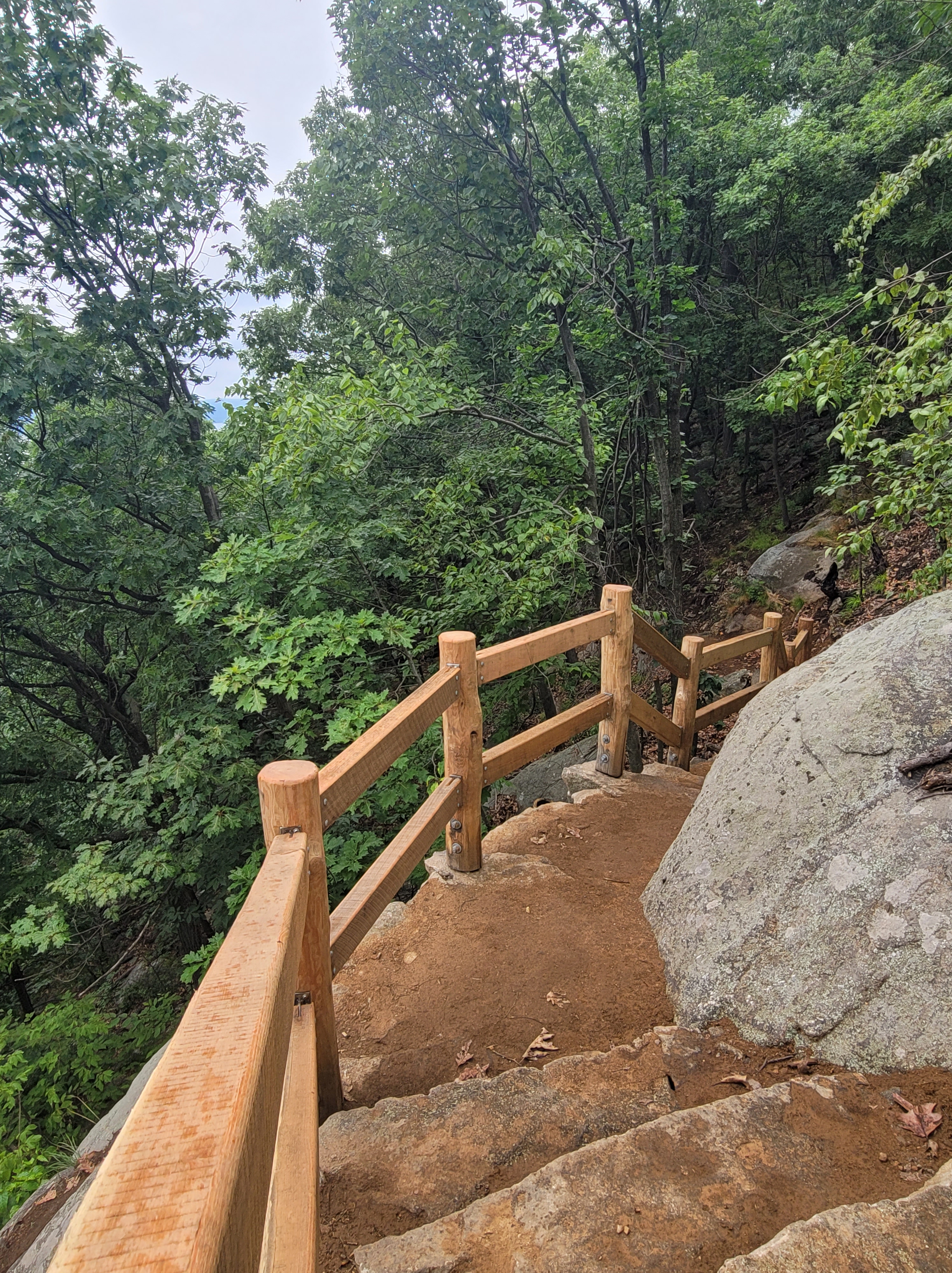
Some of the stone steps along the Ninham Trail, with a wooden fence for added safety due to the steepness of the terrain.
Resources
Learn more about today’s Stockbridge-Munsee by clicking here.
Just upriver in Erie County from Niagara Falls State Park lies New York State’s third largest island. Home to more than 20,000 people and split by Interstate-190, Grand Island is 28 square miles and divides the Niagara River into east and west branches.
Industry and commerce dominated this river and its shoreline for more than a century, leaving a legacy of water pollution, fish unsafe to eat, and loss of wildlife habitat so extreme that in 1987 the U.S. Environmental Protection Agency (EPA) declared the entire 36-mile river an Area of Concern.
That federal listing set the stage for years of remediation efforts by New York State to clean up the river and shoreline. And now, it has led to State Parks, working with several partners, to begin the next chapter in healing the river – the restoration of several wetland areas of habitat along Grand Island critical for many fish and bird species that rely on the river for survival.
Grand Island is in the Niagara River between Buffalo and Niagara Falls.
These projects focus on two State Parks on the island – the 895-acre Buckhorn Island State Park on the northern tip, a nature preserve which has some of the island’s best remaining marshland wildlife habitat, and the more-developed, 950-acre Beaver Island State Park on the southern tip.
With funding support from the EPA under a plan finalized in 2018, Parks staff have finished two habitat restoration projects at Grand Island and two more are under way this season.
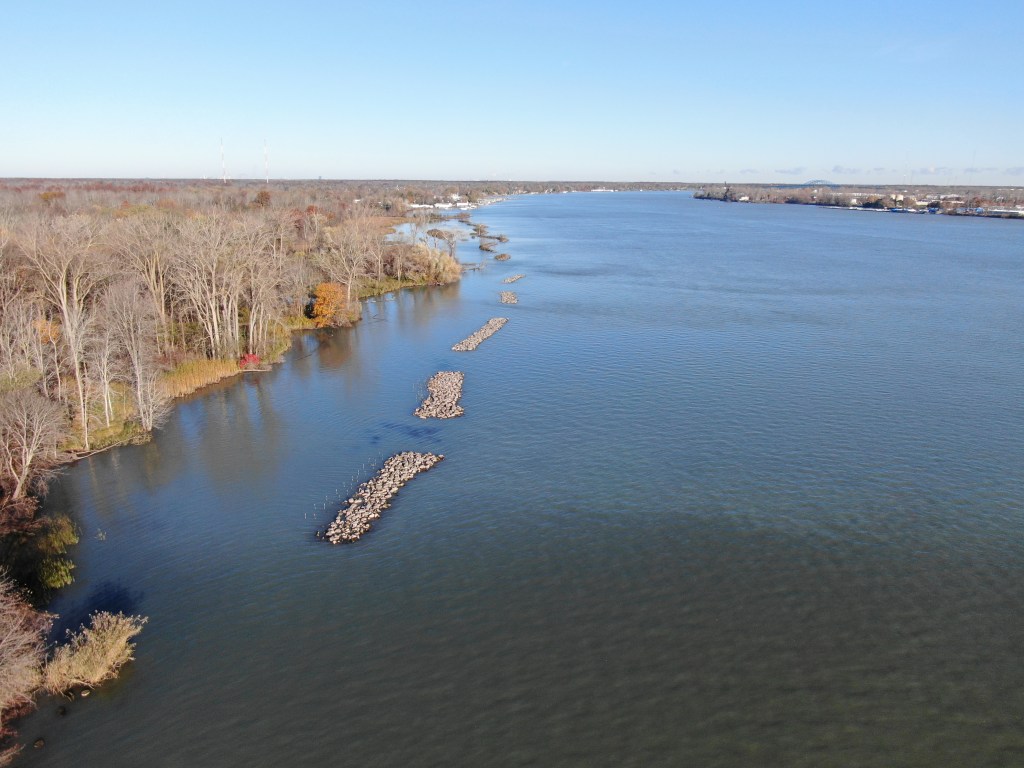
At Beaver Island in the south, offshore rocky reefs have been added in the river to an area called East River Marsh to protect the shoreline from further erosion caused by boat wakes and wind. Thousands of native plants have been planted by hand to provide important habitat for fish and other wildlife.
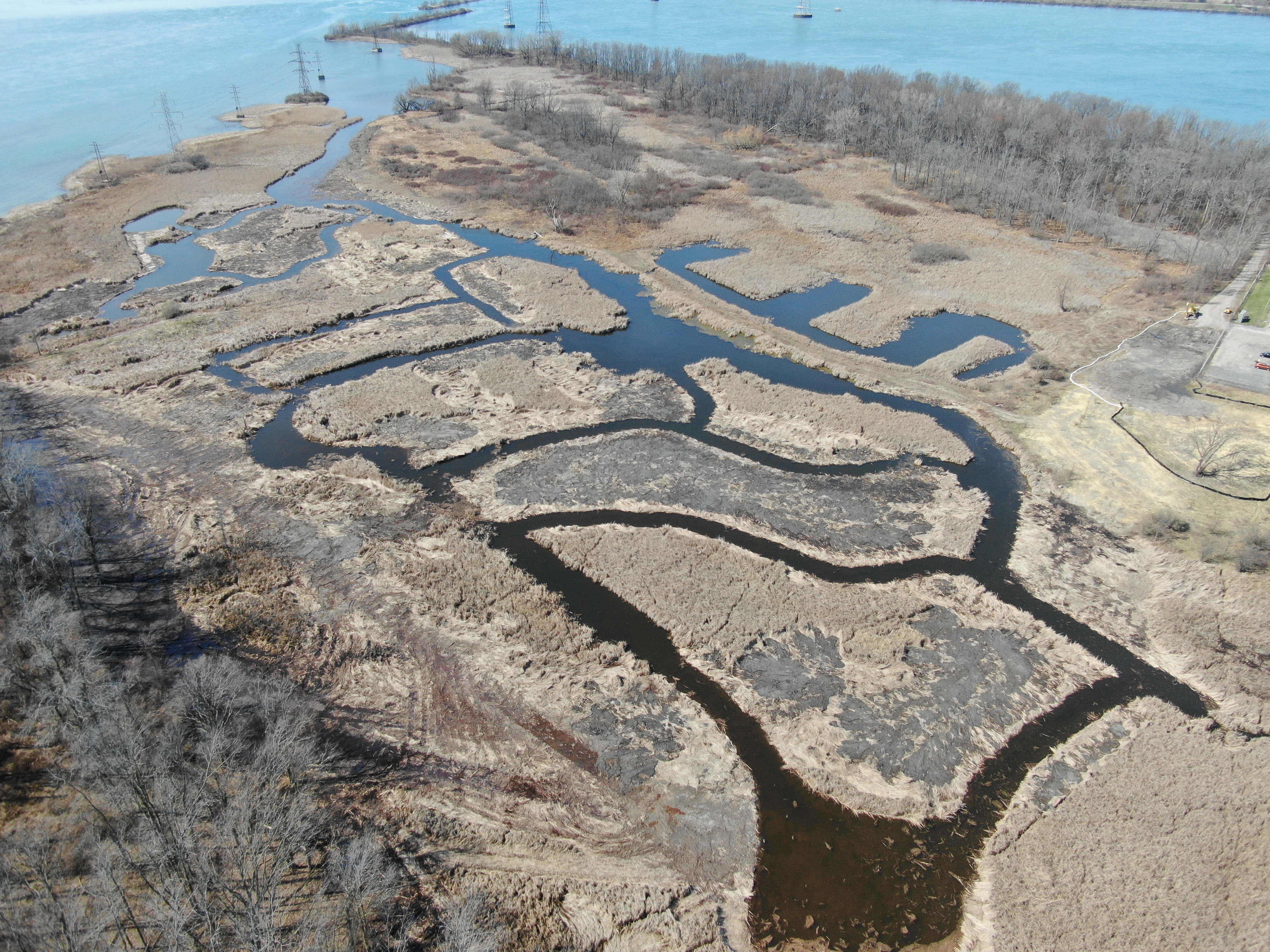
In the north, Buckhorn Island has one of the largest remaining cattail marshes on the Niagara River. At a place called Burnt Ship Creek, contractors hired by Parks have created open water channels and “potholes” in the marsh to provide pathways needed for fish such as Northern Pike to feed and spawn. The new open spaces also allow sheltered nesting sites for such secretive marsh birds as the threatened Least Bittern, which prompted the conservation group Ducks Unlimited to partner with State Parks for this restoration project.
Habitat restoration projects on Grand Island by New York State Parks and other entities are shown on this map. Buckhorn Island State Park is at the northern tip of the island, and Beaver Island State Park is at the southern tip.
Completed habitat restoration project at Burnt Ship Creek at the northern tip of Grand island near Buckhorn Island State Park.
Completed habitat restoration project at East River Marsh at the southern tip of Grand Islandnear Beaver Island State Park.
This season, parks crews are working at a place called Grass Island, which is not actually an island at all, but rather an area of shallow water filled with cattails and other aquatic plants, both above the water and submerged. Sometimes also called Sunken Island, Grass Island is just east of Buckhorn Island State Park across from the city of Niagara Falls.
In addition to cattails and other plants visible above the water, Grass Island is also made up of many acres of submerged plants, predominantly a species known as water celery or American eel grass. This plant provides food and cover for several types of fish, including the Muskellunge, the state’s largest freshwater sportfish, which spawns among the eel grass each spring. The Upper Niagara River is one of state’s most important habitats for this fish.
Above the water, many species of waterfowl and marsh birds use the island for nesting, feeding and nighttime cover. Pied-billed Grebes, a threatened species in New York, nest and raise chicks there in the summer. During the fall migration of Purple Martins, the birds will roost in the cattails by the thousands.
Grass island, as seen in a drone photograph. On the above map, Grass Island is at the top right of Grand Island.
Together, Grass Island forms a 20-acre ecosystem designated as a protected wetland by the state Department of Environmental Conservation (DEC). While Grass Island provides some of the most important habitat in the Niagara River above the falls, this area has been steadily shrinking in recent decades due to wave erosion caused by boat wakes or wind. Between 2007 to 2018, Grass Island shrank by more than a third, losing an estimated 1.5 acres of its above-water vegetation.
Use the slider bar to show the decreasing size of Grass Island. The left image is from September 2018, while the right image was taken in August 2007.
This season at Grass Island, Parks contractors are constructing underwater rock reefs similar to those successfully constructed at East River Marsh. Once the reefs are finished, crews will add submerged tree trunks with the roots still attached (called rootwads) to provide underwater structure needed for good fish habitat. Also, large numbers of native wetland plants will be planted behind the protective rock reefs to expand the area with dense vegetation.
Also this summer, similar rock reefs, rootwads, woody material, and native plantings will be installed along the shoreline at Buckhorn Island State Park to restore and protect coastal wetlands. And finally, another similar project is in the works for the shoreline along the new West River Shoreline Trail at Buckhorn.
These projects join other ongoing conservation efforts at Grand Island being done by DEC, and the Buffalo-Niagara Waterkeeper, a not-for-profit conservation group. Find a FAQ on the projects here.
Buckhorn Island State Park is also a listed Bird Conservation Area, with its marsh providing important nesting habitat for threatened species such as Least Bittern, Northern Harrier and Sedge Wren. The marsh serves as a feeding, resting and breeding area for ducks, coots, moorhens, and rails. Common Tern find suitable habitat for foraging here. Additional birds of interest include a variety of species of ducks, herons, coots, moorhens, and rails. Spring and fall migrations along the Niagara River corridor can bring large numbers of gulls to this site.
Some of the birds of Grand Island known to be in the Bird Conservation Area.
The Niagara River is well-known as an international destination for its tremendous waterfalls, which form spectacular ice formations during the winter. Perhaps a lesser known fact, however, is that the river is also a critical haven for migrating birds during this time of the year. Gulls, in particular, are a common sight along the Niagara,…
Together, these wetland restoration projects at Grand Island aim to maintain and strengthen this urban island ecosystem in a river that fuels the spectacular waterfalls only a few miles away that draw millions of visitors each year.
If a visit to Niagara Falls is in the works, consider also making a trip to Buckhorn Island State Park and Beaver Island State Park, both of which have car-top boat launch sites, to see this part of Niagara River and witness some of the efforts to help restore it. Please remember that these are sensitive ecological areas and habitats for secretive wildlife, so be respectful and take care when visiting these special places.
As always, whenever hiking, or in this instance, more likely paddling, consider “Leave No Trace” principles to minimize your impact on the environment. Learn more on how to practice “Leave No Trace” by clicking on this previous post in the NYS Parks Blog.
Beaver Island State Park: This park has a half-mile sandy beach for swimming, adjacent 80-slip marina with both seasonal and transient boat slips, fishing access, car-top boat launch, multiple canoe/kayak launches, about four miles of bike and nature trails, nature center, playgrounds, picnic areas, athletic fields, horseshoe pits, an 18 hole championship disc golf course, an 18-hole championship golf course. In winter, visitors can snowmobile by permit, cross-country ski, snowshoe, sled or ice fish. Waterfowl hunting is allowed in-season by permit.
Also located in the park is the River Lea house and museum, home to the Grand Island Historical Society and built by William Cleveland Allen, cousin to Grover Cleveland who visited the family farm on several occasions.
Buckhorn Island State Park: For a wilder experience, try this less visited park, which is a nature preserve of marsh, meadows and woods that mark the last vestige of once vast marshlands and meadows that bordered the Niagara River. There are nearly two miles of nature trails for hiking, biking, and cross-country skiing. The preserve includes two launches for kayaks and canoes. There is ongoing restoration to re-establish wetland cover and water levels and increase the diversity of native flora and fauna. This effort aims to increase public access with more non-intrusive trails, overlooks and bird watching blinds.
Cover shot: A work barge involved in habitat restoration at Grass Island. All photos courtesy of NYS Parks.
Post by David Spiering, Great Lakes Habitat Restoration Coordinator, NYS Parks
The New York State Office of Parks, Recreation and Historic Preservation offers the opportunity for environmental volunteers to get to work! Stewardship Saturdays are a great way to come together with a community of people that care about the environment and want to give back to nature.
For example, this spring at the Bayard Cutting Arboretum State Park along the Connetquot River on the southern shore of Long Island, volunteers guided by Parks employees kicked off the season by trimming the historic Rhododendron bushes that line the paths. Rhododendron bushes can grow as tall as small trees if they are not trimmed once a year, but thanks to volunteers, the trails were ready for summer.
The original bushes were planted by the Bayard family during the turn of the 20th century. Gilded Age financier and philanthropist William Bayard Cutting wanted people to “Think of us as a museum of trees, not a park.” The family donated the 691-acre estate in Great River to New York ” to provide an oasis of beauty and quiet for the pleasure, rest and refreshment of those who delight in outdoor beauty; and to bring about a greater appreciation and understanding of the value and importance of informal planting.”
The arboretum has many miles of trails to explore the grounds. Find a trail map by clicking HERE.
Our volunteers have a range of reasons for wanting to help on Stewardship Saturdays. They also come with different levels of knowledge about plant life, so people who are not experts can still contribute by learning from others.
Volunteers this spring take a break from cutting back Rhododendron bushes at Bayard Cutting Arboretum State Park.Below, evidence of their efforts to reopen a pathway for visitors.
One such volunteer, named Laura, said, “We volunteer as a family because we care about conservation and we are always looking for opportunities to give back to the community. George (also a volunteer) invited us to Stewardship Saturdays and we are glad to be here.”
Another volunteer, James, who was there with his wife Jeanette, said, “I am retired so I have a lot of time and like to keep busy. We are involved with Island Harvest, Long Island Cares and help with the flower garden at Planting Fields Arboretum in Nassau County. I volunteer about three days per week. I don’t know about the plants but I’m here to help with anything the park needs.”
Joe has a lot experience volunteering with New York State Parks with his family. He found out about Stewardship Saturdays through the State Parks’ web site: “We went to a meeting and it sounded like a great opportunity to give back to the community and get out into nature for a change. After the first time, we were hooked and we now show up for about 95 percent of Stewardship Saturdays. My family has been to around six different state parks so far and it’s fun. I have lived on Long Island for 45 years and had no idea that this beautiful park existed. When I was in college I worked for Habitat for Humanity and my job was to build houses for people in need. When there is an opportunity to get away from electronics, I jump on it. It’s easy to pick up your phone, but here at Bayard, we are giving back and having some downtime which is nice. I volunteer all year.”
According to research, Rhododendron, meaning “red tree,” refers to the red flowers and woody growth of some species, but Rhododendrons range from evergreen to deciduous and from low-growing ground covers to tall trees. Flowers may be scented or not and are usually tubular to funnel-shaped and occur in a wide range of colors—white, yellow, pink, scarlet, purple, and blue.
The collection of “Taurus Red Rhododendron” plants were named in honor of former Bayard Cutting Board of Trustees member Doris Royce.
One Stewardship Saturday volunteers, Jenna, has some knowledge about the history and how to care for these plants “The Rhododendron plants are from the 1800s brought by boat from England. They started planting them when Frederick Law Olmsted designed the park. These specific ones grow very tall so we have to cut them back when they start to get too big and before they push buds, which helps with next year’s growth. You can cut them but they will grow right back and very fast.”
Two other volunteers contributed to the conversation. Josh said, “I have no knowledge of plants. I am here so that I can help to maintain the historic park which is important to people who live on Long Island”. And another man named Joe who was volunteering said “I love nature. I have my own garden at home. When you volunteer, it is a way to meet like-minded people.”



















 New York State Parks and Historic Sites Blog