This Saturday is National Nature Photography Day. So, grab your phone, head out to your favorite state park and take some pictures.
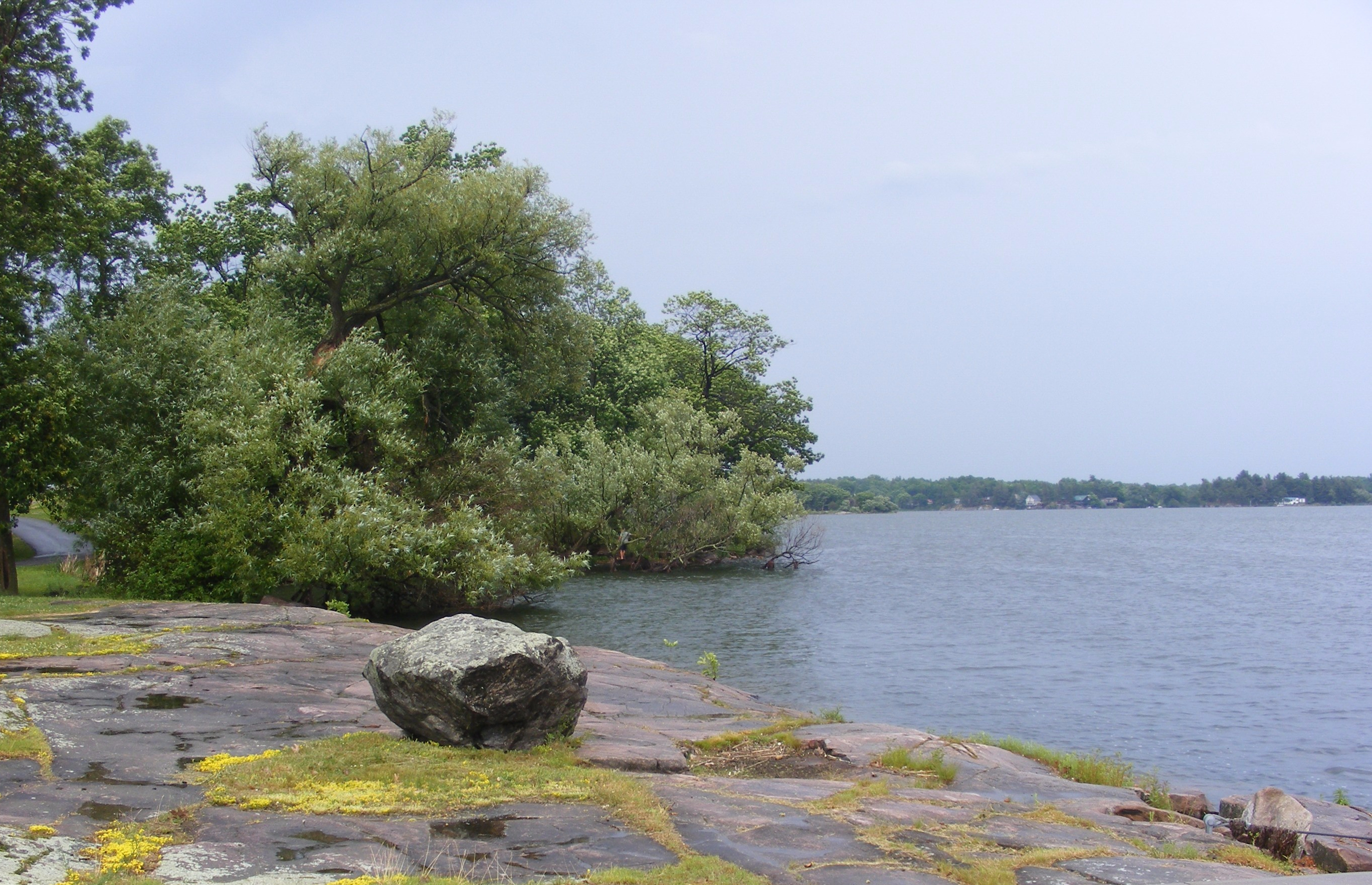
Along Morgan Island shoreline in Kring Point State Park.
Here are a few tips to help you take great photos with your phone:
Get to know the different photo settings your phone offers.
Burst Mode is great for capturing fast moving images like birds or insects in flight or chipmunks scurrying along the trail.
HDR, or High Dynamic Range, helps to improve landscape photos that have contrasting levels of light between the sky and land. HDR evens out the light and shadows between the bright and dark areas.
Practice changing the focus by tapping the screen in the spot where you want the camera to focus.
Practice changing the exposure (image brightness) in case you want to take pictures of something that is in a dark spot or a bright spot.
Before you start taking pictures, clean the lens. With all the use our phones get, the lens can get dirty with finger prints and more. Use a soft lens cloth or 100% cotton cloth dipped in distilled water to clean your lens.
When you are out taking photos:
Be sure you have plenty of memory or storage available for your photos.
The Rule of Thirds guideline will help with composing the photo. The Rule of Thirds is based on dividing the image into nine equal parts and placing points of interest along the lines. In the example below, the image on the right takes advantage of the Rule of Thirds by placing the rock spire on the left vertical line and the distant horizon centered on the lower horizontal line, making the image feel balanced. The image on the left centers the rock spire, not the whole scene, and the image feels unbalanced. Research has shown that our eyes naturally go to the intersections of the lines rather than the middle of the photo. Use the grid setting on your camera to help with the composition.
Rule of Thirds guideline, image by Tadrart01- Pir6monderivative work Teeks99
Take multiple pictures of the same image,trying some from a different angle or perspective, such as looking up to take pictures of trees or kneeling to take photos through the meadow.
This slideshow requires JavaScript.
Crouching down gives you a better angle for photos like this one of a tree hollow in Allegany State Park.
Keep your camera steady as you take your photos, especially for photos of fast-moving things. Place your phone on a rock or a wall to take your pictures or bring a tripod with a smartphone mount.
Cellphone tripod, accessed from Thingverse.com
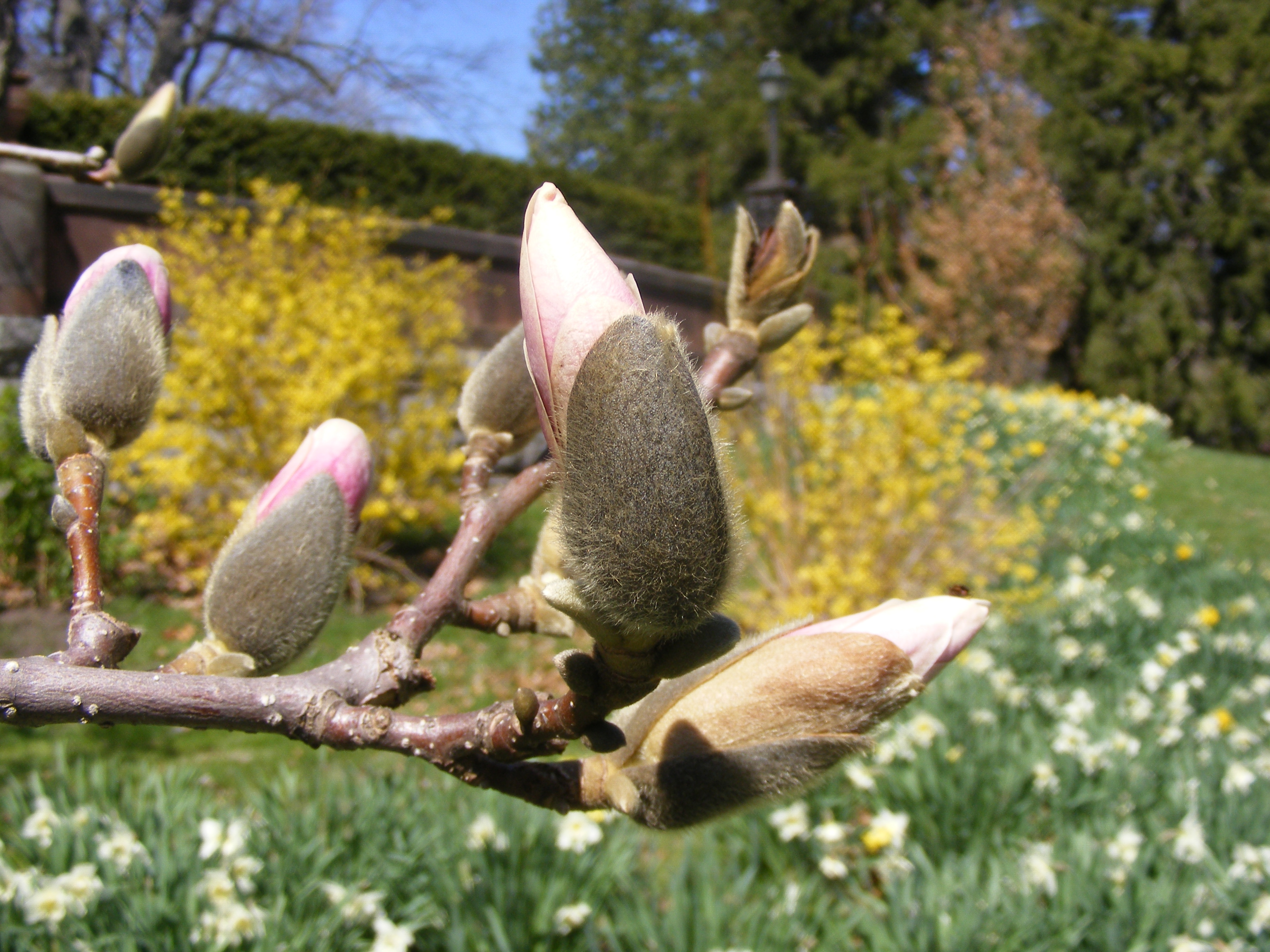
If your phone has macro mode, use it to take photos of flowers or bees in flowers. Just be really careful that you keep your camera steady as you take photos in macro mode, any tiny movement can ruin your shot. If you do move, you can try to take the photo again.
Magnolia bud at Sonnenberg Gardens and Mansion State Historic Park. Used macro mode to capture the image.
Knox Farm State Park (Knox), located in East Aurora, is the former country estate of the celebrated Knox family. Seymour H. Knox, founding partner of the F.W. Woolworth Company, purchased the property in the 1890’s to train Standardbred and carriage horses. The Knox family made significant contributions to the business, educational, and cultural legacy of Western New York and owned the property until 2000 when it was sold to the state. Today the park consists of 633 acres, roughly 400 of which are grasslands and 100 acres of woodlots and wetland areas.
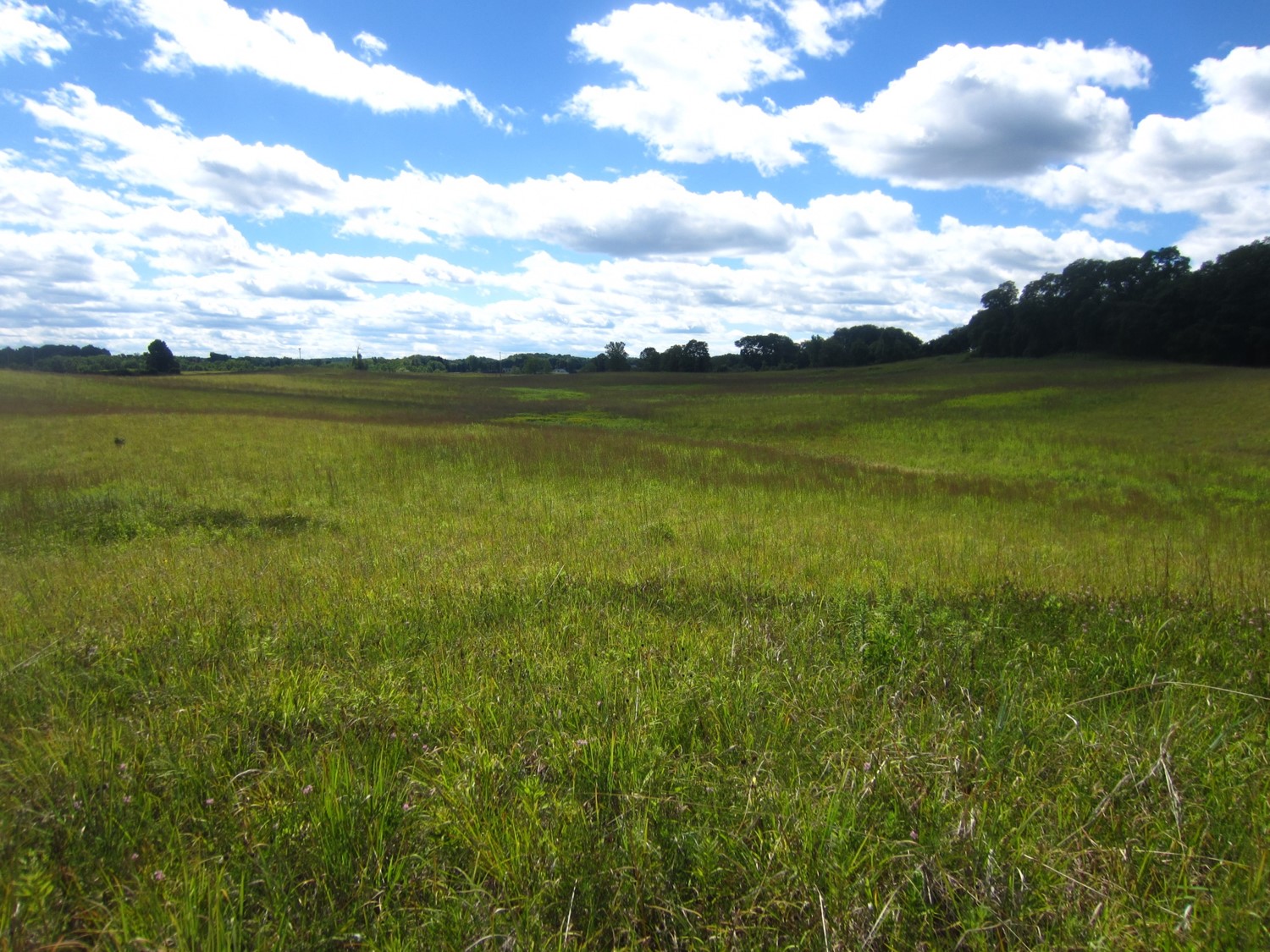
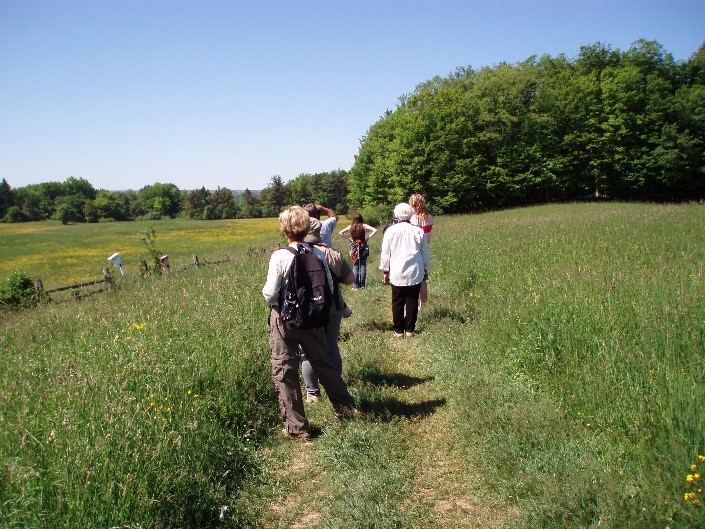
Enjoying one of the many vistas in the park, photo by Claudia Rosen.
The grasslands provide a unique opportunity to enjoy a diversity of life that cannot be found in many other places in Western New York. Visitors can hike, ride horseback, cross-country ski, or snowshoe through the scenic trails. No matter the season, Knox always provides a memorable experience.
Birding along the grassland trails, photo by Niagara Programs Office.
After the winter thaw, some of the most anticipated yearly arrivals to the park are the boisterous bobolinks and eastern meadowlarks. Both bird species only nest in grasslands and can be found in large numbers throughout the park. Bobolinks breeding in Knox may have migrated from as far away as Argentina, making them the longest migrator of any of the New World passerines, or perching birds! Males perform a captivating display flight making a series of buzzes and whistles that sound like R2-D2 from Star Wars.
Female bobolink, photo by Paul Bigelow
Male bobolink, photo by Paul Bigelow
Another grassland representative of the park, the eastern meadowlark, is usually heard before it is seen. They can be found along the trails singing their sweet, lazy whistles from atop a fence post or stalk of high grass. Like bobolinks, female eastern meadowlarks build their nests in a small depression on the ground, hidden amongst the tall grasses. Other grassland birds you may encounter are savannah sparrows, field sparrows, and eastern bluebirds.
Eastern meadowlark, photo by Paul Bigelow
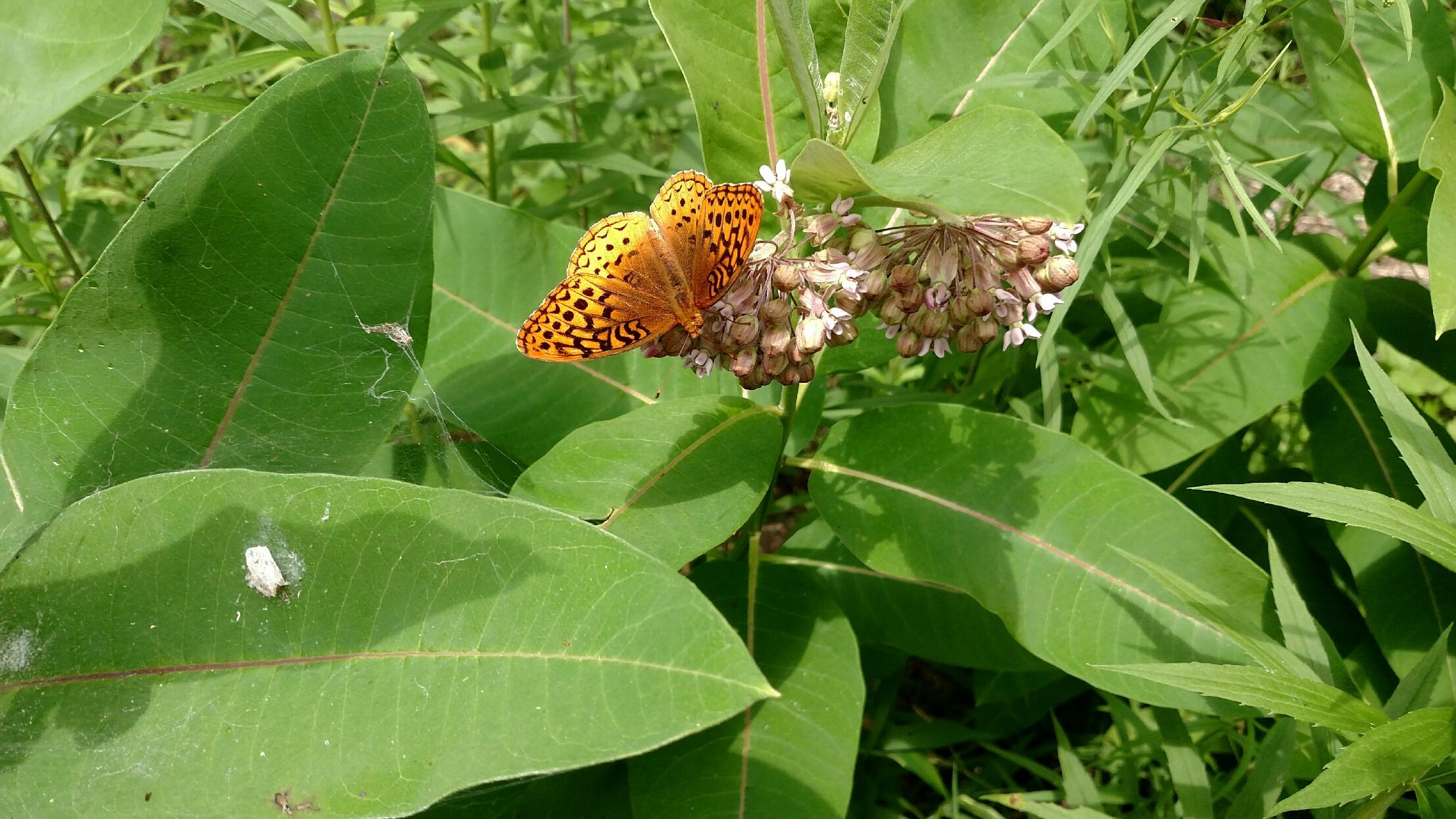
While walking the trails you may also encounter a striking resident of the park, the Baltimore checkerspot butterfly (Euphydryas phaeton), named for the orange and black colors of George Calvert, the first Lord of Baltimore. The caterpillars of these beautifully marked butterflies can be found in wet areas of the park where they feed on white turtlehead (Chelone glabra). However, they are more frequently encountered along the grassland trails where they make use of English plantain (Plantago lanceolate). Adults can be found nectaring on common milkweed (Asclepias syriaca) and other flowers in the designated butterfly meadow.
Baltimore checkerspot caterpillar, photo by Niagara Programs Office
Baltimore checkerspot adult, photo by Niagara Programs Office
A walk through the grasslands of Knox will always yield an exciting surprise. From incredible vistas to the theatrical display flights of male bobolinks, you’re guaranteed to walk away with a feeling of bliss. All trails in the park are easy to walk and some paths are even paved, making them accessible to all. If you haven’t made a trip to Knox Farm yet, be sure to mark it on your list and enjoy this unique and diverse park.
Memorial Day and the unofficial kickoff to summer is nearly here. Many of us will be headed to our favorite state park for a weekend of camping fun or a relaxing afternoon picnic.
If you are looking for some easy recipe ideas for your trip, may we suggest…
MaryAnn’s breakfast sandwich, photo by van-Amos Public Domain
Maryann’s Easy Skillet Breakfast Sandwiches
Ingredients
Bagel or English muffin, 1 per person
Bacon, 2 slices per person
Eggs, 1 per person
American cheese, 1 slice per person
Equipment
Cast iron skillet
Fork
Spatula
Directions
Cook the bacon in the skillet and remove
Remove some of the bacon fat and grill the bagel or muffin
Remove the bagel or muffin and add the eggs
Cook easy over eggs adding cheese went egg is flipped.
Place the egg/cheese on one half bagel or muffin, place two slices of bacon, and top with the other bagel or muffin half.
Season to taste with salt, pepper, hot sauce or other seasoning.
Jackson’s pita pizza, photo by Jeffrey, accessed from Wikicommons
Pita Pizza, one of Jackson’s favorites:
Ingredients
Pitas
Tomato sauce (stored in a sealable plastic jar, plastic bags are a no-go)
Shredded cheese
Other toppings optional
Equipment
Spoon for spreading sauce
Tinfoil is optional but does make a more evenly cooked pizza
Cooking grate optional – you can also use a Y-shaped stick
Directions
Gather all ingredients: pitas, pizza sauce, pizza meat, and toppings and assemble your pizza
Get your campfire hot with low flames
Assemble the pita pizzas and lay them on the grill or Y-shaped stick over the campfire (your Y-shaped stick will not catch on fire as long as it is thick and you are cooking over coals and low flames- do not let the flames touch the stick or pita too much)
Cover the pizzas by tenting some tinfoil
Remove from the fire when the cheese is melted
Stefanie’s skillet nachos, photo by twopeasandtheirpod
Skillet Nachos are one of Stefanie’s favorites:
Ingredients
1 bag corn tortilla chips
1/4 cup onion ; diced
1/4 cup black olives; sliced
1/2 cup pepperoni; chopped
1 cup cheddar cheese; shredded
1/4 cup tomatoes; diced
2 tablespoons vegetable oil
1/4 cup sour cream
1/4 cup salsa
Equipment
10” cast iron skillet
Directions
Heat oil in a cast iron skillet. Spread evenly in layers the chips, onions, olives, pepperoni, tomatoes then the cheese. Cover and heat until the cheese melts.
If you have a hankering for macaroni and cheese, Maryann suggests:
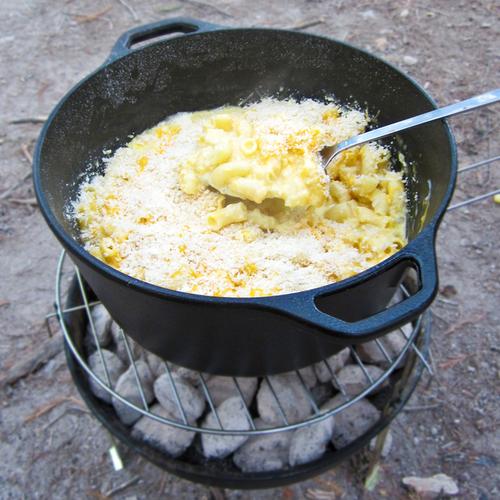
Skillet Mac N Cheese
For camping, measure out the ingredients before the trip and pack in smaller containers or Ziploc bags to save time and space.
Ingredients
2 cups uncooked elbow macaroni (about 8 ounces)
1-1/2 cups half-and-half cream
2 tablespoons butter
3/4 pound cheese (cheddar and smoked cheddar), shredded
2 tablespoons all-purpose flour
Optional toppings: cherry tomatoes
Equipment
10” cast iron skillet
Wooden spoon
1-1/2 qt. pot with lid
Directions
Cook macaroni according to package directions; drain.
Meanwhile, in a large cast-iron or other heavy skillet, melt butter over medium heat. Stir in flour until smooth; gradually whisk in cream. Bring to a boil, stirring constantly. Cook and stir until thickened, about 2 minutes. Reduce heat; stir in cheese until melted.
Add macaroni; cook and stir until heated through. Top as desired.
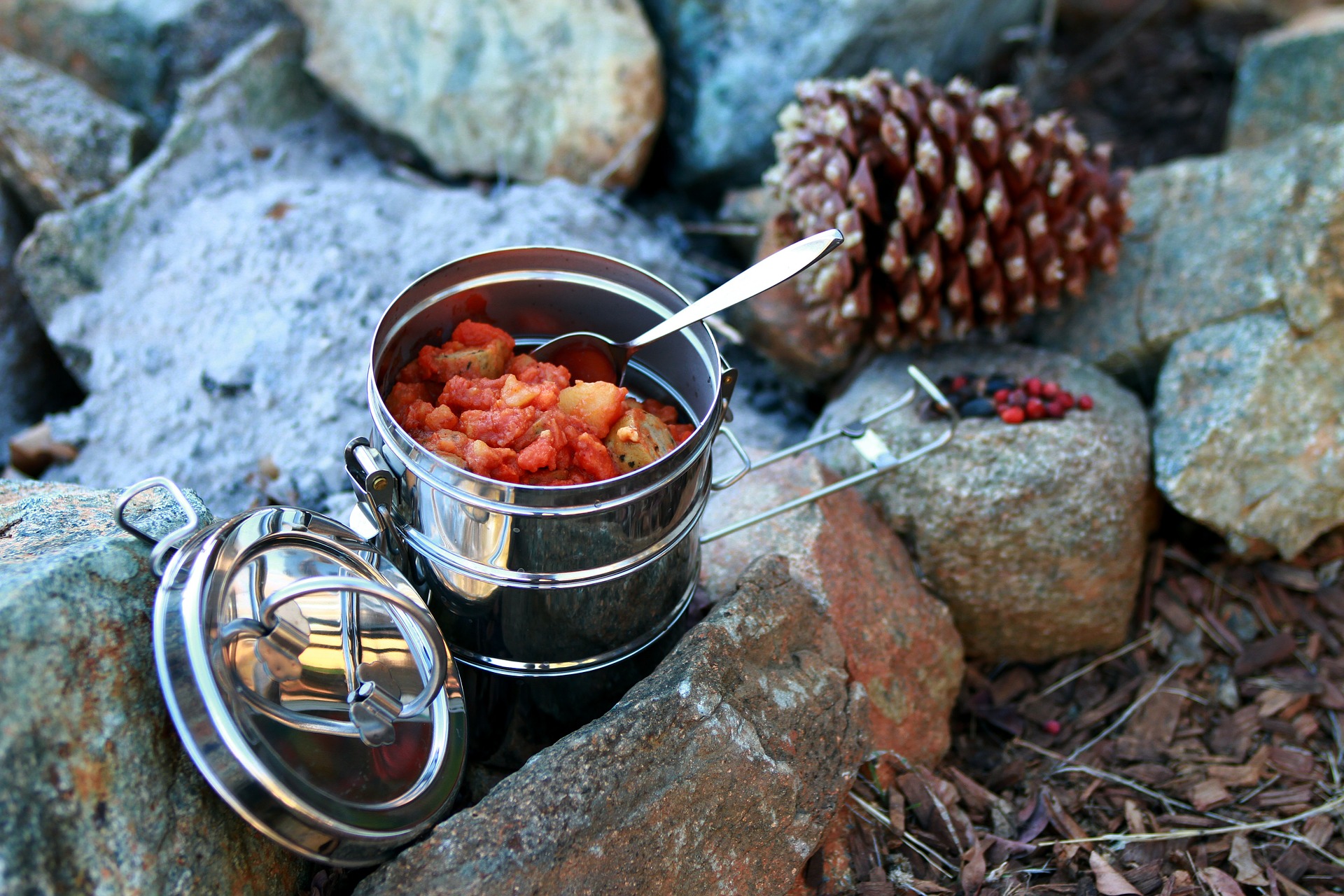
Ro’s one-pot stew, photo by PXHERE
Ro recommends this one pot meal:
Campfire Stew
Serves 12 people
Ingredients
3 lbs. 90% ground beef
3 10 oz. cans of concentrated alphabet vegetable soup
1 large onion, peeled and diced
Salt and pepper
Equipment
2-qt. pot with lid
Knife
Cutting board
Wooden spoon
Directions
Brown ground beef
Add onions and fry until soft
Add vegetable soup and just enough water to keep from sticking.
Cover and heat until hot.
Who can forget dessert?
Sarah’s peach cobbler, photo by Okie Boys, accessed from Flicker
Lazy Peach Cobbler from Sarah:
Ingredients
2 (30 ounce) cans sliced peaches, in syrup
½ stick (1/4 cup) butter
1 package white or yellow cake mix
1 can whipped cream, optional
Ground cinnamon to taste
Equipment
12” camp Dutch oven (the ones with feet and a flat top)
Directions
Place a 12-inch camp Dutch oven over 15 hot charcoal briquettes.
Pour contents of peach cans into oven. Spread dry cake mix evenly over peaches. Sprinkle cinnamon over all to taste. Cut butter into equal slices and arrange on top.
Put lid on top of oven and place 10 hot charcoal briquettes in a checkerboard pattern on top. Bake for about 45 minutes or until done.
Spoon into bowls and add cream, ice cream or whipped cream, if desired.
Dip the bread into the milk and then roll in coconut
Toast on a stick over embers, or cook in a pie iron or a reflector oven.
From Cooking Out of Door compiled by Alice Sanderson Rivoire published by Girl Scout of USA, 1960
Allison’s helpful hint for making refrigerated items last: fill 1-gallon jugs or large yogurt containers with water and freezing them to put in your cooler. They will last longer than a bag of ice and your food won’t be swimming in water as the ice melts.
Need more ideas? Check out these books and websites.
Books
Bell, Annie, The Camping Cookbook, Kyle Books, 2010.
Hansel, Marie, The Campout Cookbook: Inspired Recipes for Cooking Around the Fire and Under the Stars, Workman Publishing, 2018
Time Books, The Outdoor Adventure Cookbook: The Official Cookbook From The Ultimate Camping Authority, Oxmoor House, 2017
White, Linda, Cooking on a Stick: Campfire Recipes for Kids, Gibbs Smith, 1996
If I were to ask you to name the best state parks in New York just off the top of your head, parks like Letchworth or Watkins Glen are probably what leap to mind. However, there are an abundance of parks that have a lot to offer but never make the list. That’s not to downplay parks like Letchworth, by any means – they stand out for a reason. Still, there are other great parks in New York State, but they don’t make it onto people’s radar because they are overshadowed by these larger or more publicized parks. Chenango Valley is just one of these beautiful but unjustifiably underrated parks.
Outstanding Camping
New York State Parks offer visitors some of the best camping in the state. Our family has camped in many of the parks but have found few campgrounds that can compare with Chenango Valley. Chenango Valley has 182 campsites spread throughout three camping loops – Chipmunk Bluff, Sunrise, and Pine Bluff. We found some incredible wooded and private campsites that really gave the impression of being away from it all. This park is surprisingly uncrowded; we were able to get a great campsite without even having to make a reservation at the peak of summer. However, making a reservation in advance is still the best bet to insuring that you will get the site you want.
The author’s campsite, photo by Kimberly Crawford.
People often shy away from wooded camping sites because they don’t want to deal with the mosquitoes that usually accompany the shaded sites. That isn’t usually a problem in Chenango Valley State Park. Why you might ask? This park has a large population of brown bats – but don’t let the idea of bats scare you. These little critters are actually quite helpful, eating between 600-1000 mosquitoes per hour which can help make your camping experience that much more comfortable.
Wildlife and Nature at Chenango Valley
My favorite part of getting out into nature is the opportunity to see animals, or at least evidence of their presence. This park is home to a large variety of animals. One night, as we sat around our campfire, we had the spine-tingling experience of hearing a pack of coyotes howling in the distance. Everything from the rarely seen black bears to more common white-tail deer roam the woods, in and around the park. Visitors might catch a glimpse of animals such as flying squirrels, gray squirrel, rabbits, chipmunks, skunks, red fox, beaver, raccoon, rabbits, and woodchucks. Although we didn’t see many animals during our time in the park, we did see evidence of beavers and met one spunky chipmunk who wanted to pose for a picture for us. Chenango Valley is also known for being an excellent park to bird watch as the trails run through a variety of habitats from woods, lakes, marsh and the river.
A curious chipmunk, photo by Kimberly Crawford
On of Chenango Valley’ American sycamore, photo by NY Natural Heritage Program
Things to do at Chenango Valley
Chenango Valley has a unique geological feature within the park, in the form of two kettle lakes. These lakes were formed by chunks of ice that broke away from a receding glacier. The chunks of ice sat in one place for a long time creating depressions in the earth, thus creating these small lakes. Lily Lake and Chenango Lake are both really quite lovely, with crystal clear water that is excellent for kayaking, canoeing, and fishing. Visitors can rent canoes and kayaks or bring their own and really enjoy the peacefulness of these pristine lakes.
Kayaks and boats ready for a ride, photo by Kimberly Crawford.
Chenango Valley has one of the nicest swimming areas that I have found among the New York State Parks. Although the park calls it a beach, I’m not sure that title is really applicable. It is more like a pool cut into the end of the lake. The “pool” is divided into 4 sections of varying depth. This is excellent because there is a significant separation between the wading pool, perfect for the little ones, and the deep water of the diving area.
Swimming area, photo by Kimberly Crawford
The park is full of hiking trails too. Our favorites are the trails that circumnavigate the lakes as well as a truly unique section of the park, the bog. If you camp in the Sunrise Loop, you can very easily hike to this area. When I heard bog, I immediately thought of some dark, uninviting place, but this wetland area was spectacular. I’m quite serious when I say that the bog looks like you have stepped back in time to the Jurassic period and at any moment a brachiosaur is going to come walking past. This unusual natural community seemed completely out of place, but my kids loved it and had fun “dinosaur hunting.” Of course, for your own safety and for the protection of the bog environment, you will want to make sure to stay on the trail and not go wandering off into the bog.
Lily bog, photo by NY Natural Heritage Program
Chenango Valley also has a world-class golf course for those looking to play a round within the beautiful and idyllic scenery of the park. Some of the hiking trails do take hikers pretty close to the golf course, so beware of flying golf balls.
Chenango Valley State Park Golf Course, photo by Kimberly Crawford
The New York State Parks offer visitors the chance to experience the most breathtaking and beautiful parts of our state. This gorgeous park is one of New York State’s hidden gems. Chenango Valley is a place where you can truly get away from it all and appreciate all the beauty that nature has to offer. A trip to this tranquil retreat is something everyone should experience.
‘Jack’ is the spike flower cluster (or spadix) of the early spring wildflower known as bog onion, wild turnip, brown dragon, and most commonly jack-in-the-pulpit. Jack’s pulpit is a modified leaf (known as a bract) that wraps around and drapes over the top of the flower like a hood.
Jack-in-the-pulpits (Arisaema triphyllum) are perennial plants that are found in moist woodlands throughout New York. They can grow from 12”-26” inches tall, with the leaves in clusters of three on a separate stalk.
The flowers, Jacks, that we see are either female or male. Smaller, younger jack-in-the-pulpits make male flowers and older, larger plants produce female flowers. It takes three years for the plants to start to produce the green flowers.
The plant relies upon flies including fungal gnats and lake flies to pollinate the flowers. They are attracted to the flower’s fungal, mushroom, smell. Gnats and flies can escape from the male flowers through a small hole in the side of the flower, but they get stuck inside the female flowers because there is no escape route.
Once the flower is fertilized, plants produce a green fruit/seed stalk in summer, which turns a bright red in fall.
Jack-in-the-pulpit seed stalk in the fall, Rob Routledge, Sault College, Bugwood.org