Invasive Species Spotlight – Hydrilla

Hydrilla is one of the highest priority invasive plants in New York State.  It outcompetes native plants and causes destruction in our aquatic habitats. It can invade the deeper waters where many of our natives cannot and can aggressively grow up to an inch per day. This allows hydrilla to form thick mats at the top of the surface blocking sunlight for the native plants below.  Oxygen is then depleted leading to a decrease in the amount of oxygen in the water and potential fish kills. Sportfish weight and size can decrease due to the loss of open water and natural vegetation and their spawning habitats can be eliminated by hydrilla. The species also causes obstructions for boating, swimming, and fishing. The large dense mats of vegetation can cause property value to decrease, creating problems for homeowners and communities. Hydrilla not only affects our native habitat but also our local communities and businesses.

Hydrilla is a perennial plant. It grows in springs, marshes, lakes, canals, and rivers. This plant can tolerate low and high nutrient conditions and up to 7% salinity. There are two kinds of hydrilla; a southern population which is comprised of mostly dioecious females (meaning the plants only have female flowers), and northern populations which are monoecious (meaning the plants have both male and female flowers).  The dioecious females overwinter as perennials. The monoecious plants set fertile seed and depend on their tubers for overwintering. Hydrilla can reproduce four different ways, including fragmentation, tubers, turions, and seeds. Fragmented pieces with one node are able to sprout into a whole new plant. Tubers are formed on the rhizome of the plant and each one can produce up to 6,000 new tubers! These tubers can lay dormant for over four years before sprouting into a new plant. Turions, or dormant buds, form in the leaf axil of the plant and then break off and settle into the sediment to produce a new plant. Seed dispersal is the least important reproductive method for the species and is often facilitated by ingestion and subsequent dropping of migratory birds. These plants can grow in low light conditions, deep depths and can photosynthesize earlier in the morning than their native competitors. At its beginning stages it can grow up to an inch a day until it reaches the surface of the water.

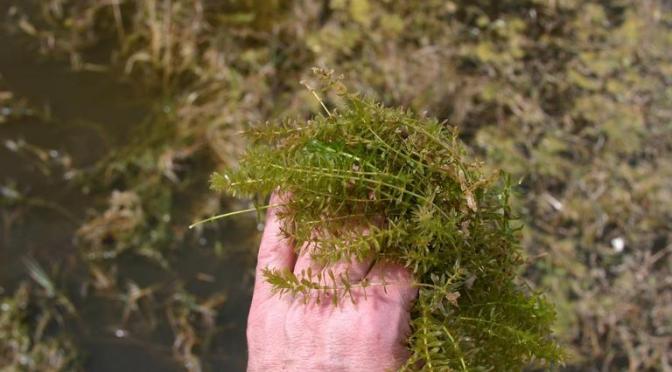
Leaves_Leslie J. Mehrhoff, University of Connecticut, Bugwood.org
Note how small the hydrilla leaves are, photo by Leslie J. Mehrhoff, University of Connecticut, Bugwood.org

Identifying hydrilla can be very tricky at times because it looks similar to a native plant, American elodea, and another invasive plant, Brazilian elodea. There are a few distinguishing characteristics that set hydrilla apart from the other two aforementioned species. The leaves are 5/8 inches long and they grow in whorls of 3-10, 5 leaves per whorl being most common. The leaves have distinct serrated edges. A key feature is the dull-white to yellowish, potato like tuber that grow 2-12 inches below the sediment.

Leslie J. Mehrhoff, University of Connecticut, Bugwood.org
A dense mat of hydrilla, photo by Leslie J. Mehrhoff, University of Connecticut, Bugwood.org

Hydrilla is thought to have originated from the island of Sri Lanka and possibly the southern mainland of India, but it arrived in the United States from Korea as a popular aquarium plant. Colonies were first identified in canals in Miami and Tampa, Florida. Hydrilla fragments made their way up to New York by attaching to boats, their trailers, and live wells. Boat motors, oars, and other equipment break the plant into fragments, facilitating its spread throughout the affected water body and into nearby water bodies that are hydrologically connected. Hydrilla can spread between water bodies that are separated by geographic distance by “hitching a ride” on watercraft trailers and other recreational equipment. The first time hydrilla was discovered in New York was in August 2011, when Jordan Stark found the species in Cayuga Inlet in the Finger Lakes In September of 2012, the species was found in the Erie Canal in North Tonawanda by a U.S. Fish and Wildlife biologist. It has also since been found in Long Island, including Caleb Smith State Park Preserve in Phillips Mill Pond. Since the introduction of hydrilla in New York, a coalition of partners, which includes many state agencies, non-profit organizations, and businesses have taken quick action to help prevent its further spread. After a population of hydrilla is found, partners mobilize resources to conduct a focused education and outreach campaign and survey the area where hydrilla was found to understand the full extent of the population. Once surveying is completed a management plan is implemented, which includes aquatic herbicide application. To learn more about best management practices, please go to http://hydrillacollaborative.com.

Want to help manage this unruly aquatic plant? Learn how to properly identify hydrilla. If you think you found hydrilla take pictures, mark your location, and contact your regional DEC office or submit your observation with pictures on the iMapInvasives mobile app or website. Also, it is important to clean, drain, and dry your boats and any fishing or recreational equipment!
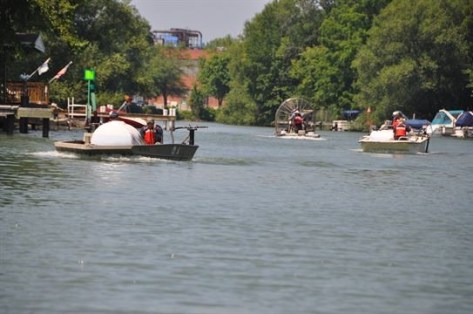
Hydrilla treatment Erie Canal
Treating hydrilla on the Erie Canal.

References

“Cornell Cooperative Extension Tompkins County.” 2011 Hydrilla Eradication Efforts. N.p., n.d. Web. 11 Sept. 2014. http://ccetompkins.org/environment/invasive-species/fighting-hydrilla2011

“Hydrilla (Hydrilla Verticillata (L.f.) Royle).” New York Invasive Species Information. N.p., 3 Oct. 2012. Web. 11 Sept. 2014. http://www.nyis.info/?action=invasive_detail&id=16

“Aquatic Invasive Species.” HYDRILLA (n.d.): n. pag. Web. 11 Sept.2014 www.in.gov/dnr/files/hydrilla.pdf

“Highly Invasive Aquatic Plant Threatens New York’s Waters.” Department of Environmental Concervation. N.p., 21 Sept. 2012. Web. 11 Sept. 2014. http://www.dec.ny.gov/press/85078.html

“Combating Hydrilla.” US Army Corps of Engineers. N.p., 14 Aug. 2014. Web. 11 Sept. 2014. http://www.lrb.usace.army.mil/Media/NewsStories/tabid/6146/Article/494240/combating-hydrilla.aspx
 

Celebrate Independence Day with Our National Bird

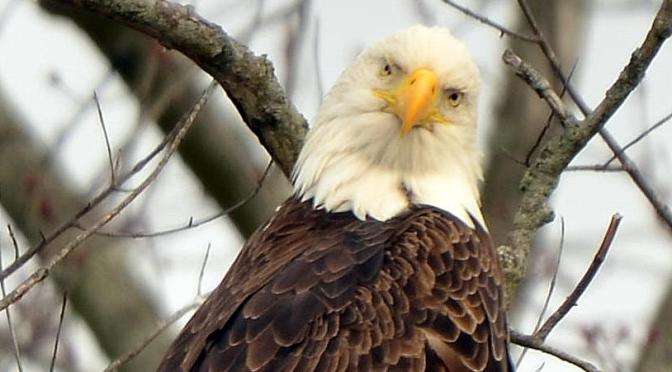
Bald eagles are spectacular birds. With white heads and tails contrasting with their dark brown bodies and their large size, they are the biggest bird in New York State.  Seeing a bald eagle in flight or perched on a tree can be the highlight of any trip to a state park.

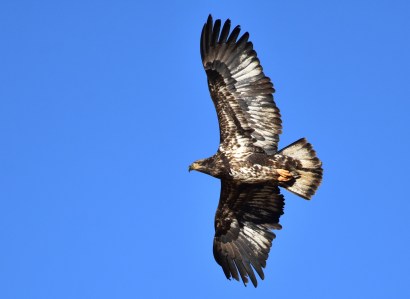
Adult bald eagles are easy to identify, with their white heads and tails while juveniles (any eagle 4 years old or younger) have mottled white and brown wings and a brown body.

Bald_eagle_(subadult)_on_Seedskadee_National_Wildlife_Refuge_(39752849442)
Juvenile bald eagle, photo by USFWS Mountain-Prairie [CC BY 2.0 (https://creativecommons.org/licenses/by/2.0) or Public domain], via Wikimedia Commons
The best places to look for bald eagles are near large bodies of water, such as a lake or river, where you may see them flying overhead or sitting in a tree looking for fish (or getting ready to steal a fish from an osprey).

If you are hoping to see an eagle this Fourth of July, check out one of these parks:

Peebles Island State Park

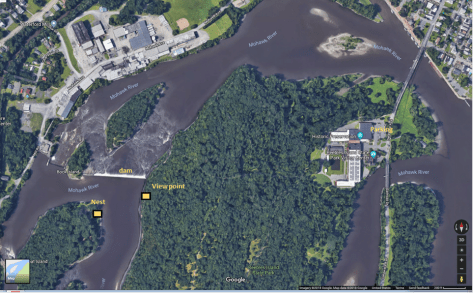
The island the eagles are nesting on is just across the river on another island (Goat Island), so there is no need to worry about disturbing the birds. It is about ½ mile (one way) moderate walk along the Perimeter Trail to the eagles’ nest. When you get to the where the trail splits after the fence, take a right and follow the Perimeter Trail until just after you get past the first dam. Look for the nest in a big oak tree on the island (Goat Island) to the left of the dam.

Our park maps are also on Google Maps, so it is easy to pull them up on a smart phone. If you were to walk the whole Perimeter Trail it is about a 2-mile loop, moderate with some rocks and roots in the trail. Below is a screen shot of Google Maps pointing out the nest location. Additionally, there is a park map at the trail head next to the parking area.

Bring binoculars if you have them to get a better look!

Peebles
Aerial view of eagle’s nest at Peeble’s Island State Park

Robert Moses State Park (northern New York)

Bald eagles can be seen fishing from trees along the trails all the time.

Connetquot River State Park Preserve

Look for eagles flying over the Connetquot Main Pond near the Nature Center.

Bald_Eagle_Fly_By_Andy Morffew
Adult bald eagle in flight, photo by Andy Morffew.

Thacher State Park

At Thacher State Park visitors can view bald eagles at Thompson’s Lake Campground and Thacher Nature Center, both from the lakeshore or from the water. There is an active nest nearby and the eagles are often seen flying over the lake hunting for fish or roosting in trees along the shore.  Eaglets will be fledging soon.

Allegany State Park

Eagles often fish on Quaker Lake and Red House Lake.

BE-8x10
Sammi at Trailside Museums and Zoo, photo courtesy of Palisades Park Commisssion

Bear Mountain State Park

The Trailside Museums and Zoo at Bear Mountain State Park is the home of Sammi the bald eagle.  Sammi (Samantha) was severely injured in 1984 and could not be released back to the wild after her injuries healed. She has been living at Trailside Museums and Zoo since 1985.  Click here to learn more about Sammi’s story.

If you do see an eagle this Independence Day, please let us know!

References

All About Birds, bald eagle

Featured image: By CheepShot (Carpentersville Dam) [CC BY 2.0 (https://creativecommons.org/licenses/by/2.0)%5D, via Wikimedia Commons

Frogs and Pollywogs in NYS Parks

It’s time – hop in the car or on your bike and head to a State Park near you! While you’re there, be sure your ears are open and your eyes are peeled for some awesome amphibian friends! It’s a good opportunity to find out which of the 11 frog species found in New York State are living in our State Parks.

Frogs are amphibians, meaning they live on both land and under water. When females lay eggs, it typically occurs in a nearby pond. The jelly-like egg masses hatch into tadpoles (pollywogs) with round bodies and long finlike tails. Tadpoles develop gills so they can breathe underwater just like fish do! Through a lifecycle process known as metamorphosis, the tadpole begins to develop legs, bulging eyes and air-breathing lungs. All the while the long slender tail starts to shrink and eventually disappears. This frog can now survive on land, breathing in the fresh summer air!

Frogs spend most of their time underground, hanging out in trees, or in the water. On warm summer nights they will emerge from hiding and head to nearby ponds, lakeshores and wetlands. When trying to identify frog species remember to consider the following: coloration, patterns, skin texture (moist or dry), presence or absence of webbing between the toes, and more. If you can’t see your amphibian friends, but you can hear them, take this time to record its unique call and try to identify it when you get home!

Here are just a few of the frog species found in our State Parks:

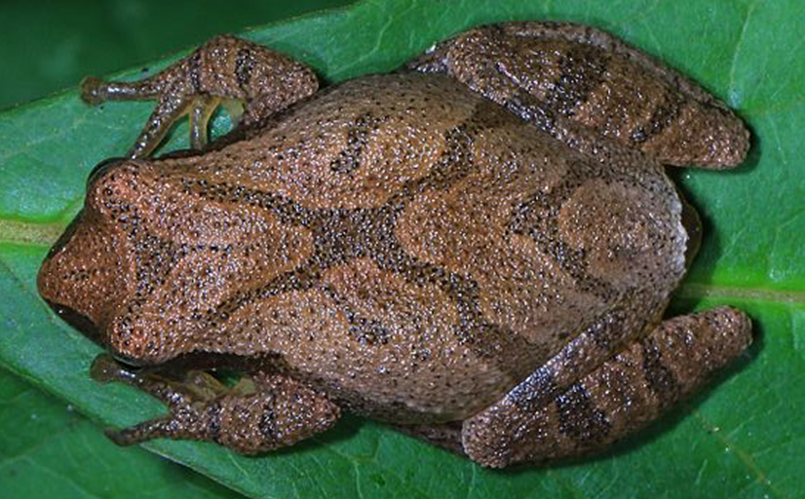
Northern Spring Peeper (Pseudacris c. crucifer)

The tiny spring peeper can range from a rusty brown to a greenish-gray with a distinct dark X or cross on its back. Its skin is smooth and the belly is cream-colored. This species is also known for hanging out in trees, with its unwebbed toes and sticky pads. Spring Peepers breed earlier in the season than other frog species. If you’ve ever spent an evening camping or sitting by the water, you’ve probably heard their infamous “PEEP” or call.

American Bull Frog (Rana catesbeiana)

The bull frog is the largest frog in North America, reaching lengths of 6 to 8 inches. It’s a brownish-green color with dark colored bands or blotches on its hind legs. Unlike the treefrogs, the bull frog has webbed hind feet. They’re often found near permanent waters with lots of vegetation. This species size and carnivorous diet allows it to munch on creatures such as snakes, bats, ducklings and other frogs! Behind the bull frog’s eyes are eardrums known as tympanic membranes. The size of these membranes can be used to determine if the frog is a male (it’s larger than the eye) or a female (the membrane is the same size as the eye). Look for this species between mid-March and mid-July. They may startle you with their really load “croak”.

Green Frog (Rana clamitans)

SeeGreenFrog
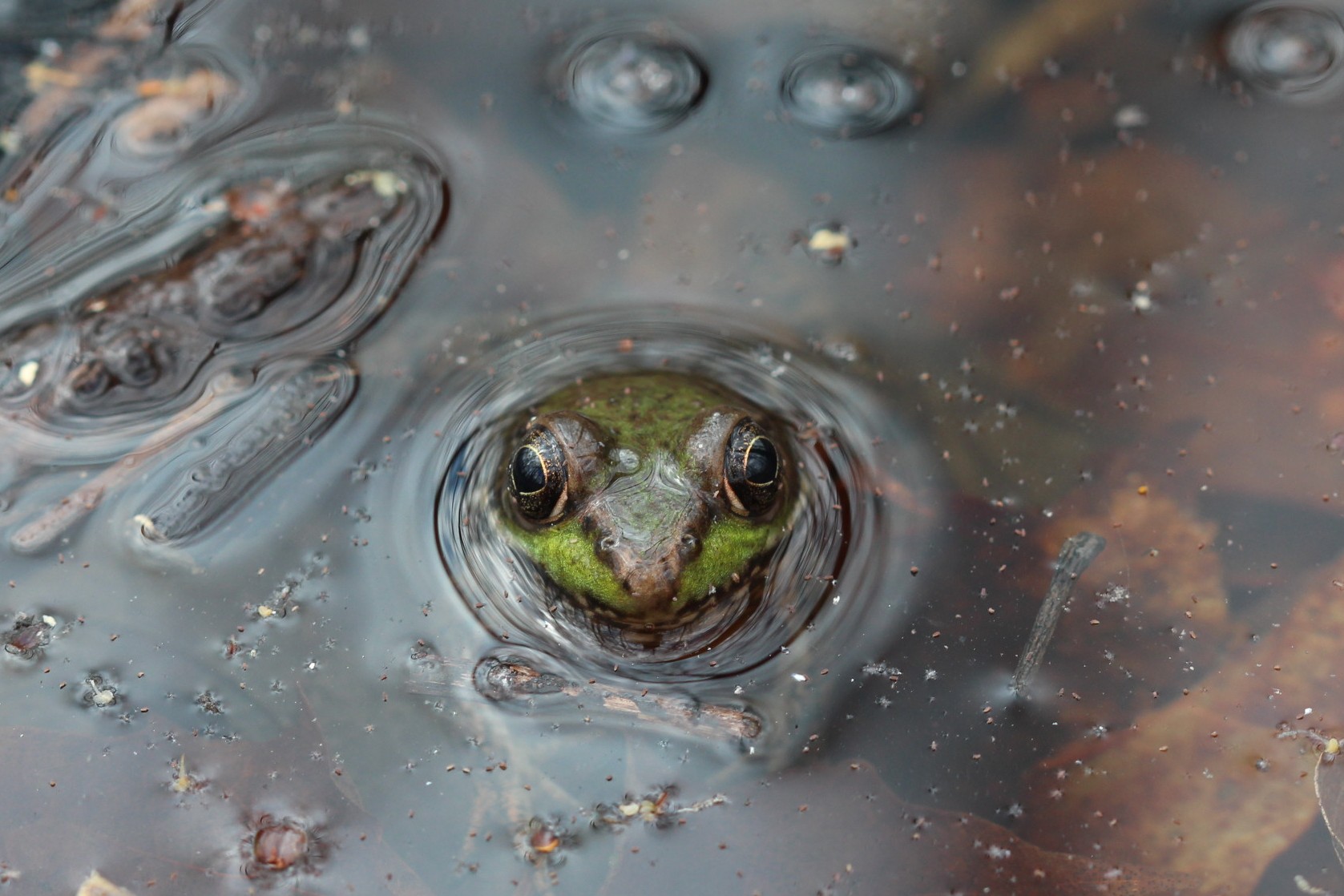
Do you see the Green Frog? Photo by NYNHP.

This is one of the most common frogs across NY State. It is similar to but smaller than a bullfrog. Like the bullfrog, the green frog is brownish-green with bright green on its face and spends most of its time in and near ponds and wetlands. The adults are 3-4 inches long and breed from May to August. Their regular call goes “boing” like the sound of a plucked rubber band or banjo sting. They also have an alarm call, a loud squeak, that you will hear if you scare them into the water. Move slowly towards the edge of the pond to look for these critters and be ready when they squeak and leap into the water!

Green_frog_Rana_clamitans_MatthewScheslingerNYNHP
The green frog’s face is smaller and not as wide and rounded as the Bullfrog. Photo by NYNHP.

Northern Cricket Frog (Acris crepitans)

The northern cricket frog is the smallest and most rare frog species in NY. It is listed as endangered in the State of NY. Adults reach about 1 inch in length, but despite their size, can jump about 5 to 6 feet. Eastern cricket frogs are brown to dull green in coloration with a triangular marking between the eyes. These frogs love shallow ponds with lots of floating vegetation. It has an unusual call, described as two pebbles being clicked together repeatedly. View the northern cricket frog conservation guide created by the New York Natural Heritage Program.

Other awesome frog species found in New York:

Gray Treefrog

Western Chorus Frog

Mink Frog

Wood Frog

Northern Leopard Frog

Southern Leopard Frog

Pickerel Frog

More links with frog/toad calls

NatureBits.org

Calls of Frogs and Toads of the Northeast

Post By Falon Neske- SCA and State Parks

Resources

Bullfrogs

Frogs and Toads of New York State

Featured image, gray tree frog, State Parks

Counting the Bristlesides, Sedgesitters, Leafwalkers

It’s National Pollinator Week! Scientists have been busy looking to see what pollinators live in State Parks. Here’s a first look at some of the early results.

NHP@Bumblefly
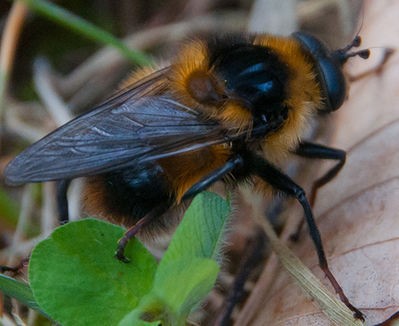
This is actually a fly! The bare-cheeked bumblefly is a very rare Syrphid in NY that mimics bumblebees and lives in old forests.  Photo courtesy of NYNHP.

In 2017 a cadre of NY Natural Heritage Program (NYNHP) biologists working under a long-standing agreement with State Parks began testing out sampling methods for a multi-year statewide Native Pollinator Survey (ESNPS) under the auspices of the Governor’s NYS Pollinator Protection Plan jointly administered by Department of Environmental Conservation and Department of Agriculture and Markets.

NHP_EasternCalligrapher
The eastern calligrapher (Toxomerus geminatus) is a very common species in State Parks all over the state.  Photo by Lindsay Dombroskie, accessed from iNaturalist.

The goal of the ESNPS is to determine the rarity of a wide array of native insect pollinators in non-agricultural habitats. NYNHP Zoologists honed in on the most important and vulnerable pollinating groups in the state, representing a wide variety of native insect pollinators such as bumble bees, mining bees, bee flies, longhorn beetles and flower moths.

NHP_Spider
Captured by a spider, a fate that befalls some flower-visiting flies.  Photo courtesy of NYNHP.

Between June 8 – October 3, 2017 on fair weather days, two biologists used sets of small painted bowls containing soapy water to trap pollinators (the insects mistake the color for a flower) in four different habitat types within each Park (see photo). The biologists also used insect nets to hand- capture pollinators (see photo), spending the better part of one day obtaining a snapshot of the Park’s pollinator community. The collections are the only way to document and identify most of the species.


Over the past winter the biologists then separated out the flies (Dipterans) from the bees and pinned these specimens so that they could be identified by fly specialists at SUNY Cobleskill (see photo). They focused on flies in one notable family, the Syrphidae – or Syrphids, known as the hover flies or flower flies.  Most of the remaining captured pollinators like the bees will be identified by experts at Cornell University as the project continues.


Preliminary results are in for the hover flies or flower flies that SUNY Cobleskill experts helped to identify. There are many different species or types of these flies and not anything like the plain black housefly. Some go by interesting names like Bristlesides, Sedgesitters and Leafwalkers. Many hover flies are mimics of stinging Hymenoptera (see photo) and known to be second only to bees in their pollinating prowess. This is because the adult flies feed on pollen and nectar to power their energy- intensive flight. In doing so, they help to pollinate a wide range of trees, shrubs and wildflowers in every conceivable habitat. At the same time, their larvae (the young stage) are predators of harmful insects such as aphids and adelgids. Many play an important role in aiding decomposition in aquatic and forest environments; in effect breaking down leaves, logs and other debris which then releases nutrients and builds soil.  In other words, Hover flies are very important to the health of our native ecosystems.

NHP@Goosepond
Look closely for the hover fly on a leaf at Goosepond Mountain State Park on September 28, 2017.  Photo courtesy of NYNHP.

A brand new hover fly field guide focusing specifically on northeastern North America will be published later in 2018 by a team of Canadian researchers. This will allow anybody with an interest to pursue these fascinating and colorful insects who will challenge your notions of what a fly is!

A few fun facts we learned about hover flies in State Parks:

  • Total number of Parks sampled: 22 (in all Regions)
  • Total number of different Syrphid (fly) pollinators: 50 species
  • State Parks with the highest diversity of hover flies (at least 7 different species plus more than 15 individual flies): Minnewaska, Thacher, Sunken Meadow, Letchworth, Taconic, and Allegany
  • Number of new species never before seen in the State, or were thought to be no longer in NYS: 5
  • Two out of every three individuals captured (67%) was a calligrapher (Toxomerus), small black and yellow flies whose larvae eat aphids (see photo)
  • Number of Parks with a species that mimic hornets (the rare eastern hornet fly (Spilomyia longicornis)): 3: Allegany, Knox Farm, Sunken Meadow
  • Number of Syrphid species whose larvae eat adelgids (adelgids are a small insect that can cause severe tree damage): 2 (in the genus Heringia) at Gilbert Lake, Grafton, Moreau Lake
  • Number of non-native, introduced species detected: 2. The common compost fly (Syritta pipiens), and common drone fly (Eristalis tenax)
  • Over half of the State Parks had at least one Syrphid species that lives predominantly in older forests.

Authored by Jeff Corser, Zoologist with NY Natural Heritage Program (NYNHP).

NY Natural Heritage Program is affiliated with SUNY College of Environmental Science and Forestry (SUNY ESF) and works in close partnership with NYS Parks and NYS DEC. The Empire State Native Pollinator Project is only one of many kinds of surveys and studies that the program conducts to provide guidance and tools for conservation of native biodiversity across New York State.

All photos by NYNHP for use by permission only

Leapin’ Lizards

A flick of a tail or a blur dash across a rock – was that a lizard? Are there lizards in New York?

Yes, New York is home to three native lizard species.  Lizards are cold-blooded reptiles that spend most of their time on rocks, sunning themselves on flat open spots or hiding in crevices. They also crawl up on logs, stumps and sometimes even up the trunk of the tree. However, male lizards are known for defending their territory from other male lizards by doing push-ups followed by head bobs.  If this does not work, the defending male lizard may attack and bite the intruding lizard.

Lizards are all very well camouflaged, but if you are really lucky you might spot one of these reptiles on one if you hike in the southern Hudson Valley or in Clay Pit Ponds State Park Preserve.

Two of the three New York lizard species are considered rare in the state. Conservation measures are particularly important to maintain the populations of these vulnerable critters. State Parks works to protect habitat and educate park visitors about these seldom seen animals.

Two of these lizard types are called skinks.  Skinks are a type of lizard with no visible neck, a long tail, and short legs. (Some skinks in other parts of the world have no legs at all!)  Skinks have smooth scales, compared to other lizards which have keeled scales (scales that have a ridge down the middle).  Smooth scales give the skink a shining gloss-like appearance whereas lizards with keeled scales have a dull matte-like appearance.  (See below)

Scales

If a skink loses part of its tail to a predator or they release their tail to escape a predator, it will regrow (regenerate) a new tail. The new tail will not have the same shape as the old tail.  Female skinks stay with their eggs after they lay them to guard the eggs until they are hatched.

F15PER51_1_3_skink2
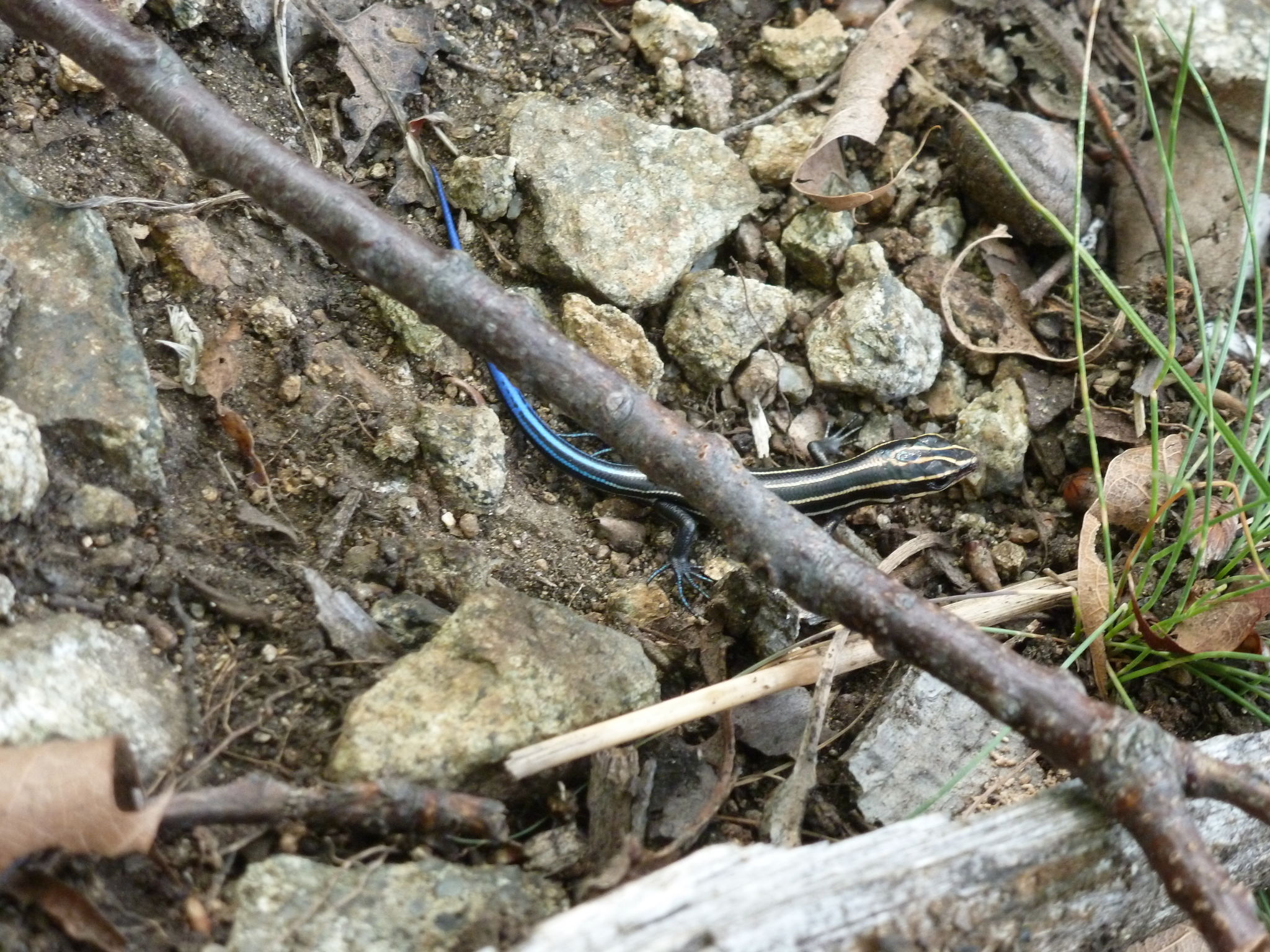
Juvenile five-lined skink, note the blue tail. Photo by State Parks.

The most common lizard in New York is the five-lined skink (Plestiodon fasciatus). Juvenile five-lined skinks are quite striking with their uniform black body, yellow stripes, and bright blue tails.  As these animals approach adult state, the blue color on their tails fades to gray.  Adult females five-lined skinks have faded stripes on their heads, but their body stripes remain strong. Look for these lizards on the ground on rocky summits and sloping hillsides with mixed deciduous trees.  They mostly scurry along the ground, only occasionally climbing shrubs and trees.  On sunny days, you might see one soaking up the sun on a rock or log.

Five-lined skinks are between five and eight inches long, including their tails.  They primarily eat insects and other invertebrates. Larger skinks also eat small shrews and other lizards.  Skinks avoid being eaten by darting as fast as they can from an open area to a hiding spot.  Look for these lizards from April through October in the some of the Hudson Valley State Parks such as Bear Mountain State Park and Hudson Highlands State Park Preserve.

male coal skink Jean Gawalt
Male coal skink. Artwork by Jean Gawalt; courtesy Conservationist magazine

One of our rare lizards is the coal skink (Plestiodon anthracinus) is found in central and western New York.  Coal skinks are identified by the two wide black stripes, bordered by yellow stripes, that run along the length of the body on to the tail.  Like the five-lined skinks, juvenile coal skinks have blue tails.  Some people believe that the blue tail on a juvenile skink is very distasteful and acts as a warning to would-be predators. The main defense of most coal skinks is running quickly away from a threat or predator.

Coal skinks live in forested places, usually near a swamp or other wetland.  You might see one on a rocky hillside near a wetland.  Unlike five-lined skinks, they do not bask in the sun; they are commonly found under the leaf litter, or under loose flat rocks or moss.  Their coloration helps them hid on the forest floor. If they get frightened, they run to water.

Coal skins are the smallest of our native lizards, measuring about seven inches long from nose to tail. Their diet consists of insects, including crickets, millipedes, and spiders.

20170825_Hudson_Highlands_SP_adult_fence_lizard_amc
Adult fence lizard, note the wavy coloration on the side of the body, photo courtesy of NY Natural Heritage Program.

Lastly, the northern fence lizard (Sceloporus undulatus hyacinthinus) is a state threatened lizard that lives in the southeastern park of the state.  Their common name comes from their habit of basking in the sun on fence railings.

Male northern fence lizards have unpatterned grayish-brown back, bluish sides that are boarded by black and blue throats.  Females, on the other hand, have a distinct pattern on their back of irregular wavy cross bands; their bellies are white and there is a patch of either red, yellow, or orange at the base of their tails. Fence lizards measure up to seven and a half inches long.

They prefer to live on dry, rocky hillsides in oak or oak-pine forests where they eat insects and spiders.  They can be active both day and night, depending on the temperature.

If you are lucky, you might come upon a male fence lizard during mating season.  If you do, stop to watch him defend his territory by standing stiff-legged and pushing out his head to show his blue throat.

Remember that these are wild lizards and should never be taken home as pets. Collection has caused the populations of our native lizards to decline in some areas.

2013.05.17 TR and FL Skink Jesse W. Jaycox 01
Two of New York’s native reptiles, five-lined skink in lower right, timber rattlesnake in upper left, photo by State Parks.

Learn more about our New York lizards:

Fence lizards occur in a few locations in eastern NY, including in some of our state parks.

NYS Dept. of Conservation Lizards of New York

NY Falls Lizard Species of New York (Upstate)

Featured image, five-lined skink by Robert Escott

The official blog for the New York State Office of Parks, Recreation & Historic Preservation