The Artist that Didn’t Exist: Glamony, Flameng, and the Portrait of Ruth Livingston Mills

Staatsburgh State Historic Site (Staatsburgh) is the former country estate of Ogden and Ruth Mills, members of the wealthiest and most elite society in the Gilded Age (1870-1900.)  Located directly on the Hudson River in the mid-Hudson Valley, the site includes a 79-room mansion, designed gardens, and a farm with many outbuildings that was a major employer in the area. The Millses were in residence in the fall, when they would entertain high society guests each weekend, assisted by a staff of 24 servants within the house. Modern day visitors to Staatsburgh see the mansion furnished and decorated as it was for these lavish affairs.

One of the most notable objects in the collection is a very large oil portrait of Ruth Livingston Mills, painted in 1909, which formerly hung in the ballroom of her New York City mansion. During the Gilded Age, it was standard for elite society women to have a glamorous portrait made by a fashionable artist. For decades, the portrait of Mrs. Mills was believed to have been painted by an artist named “Glamony” – a conclusion that seems to be drawn from the hard-to-read artist signature. For a long time, no information was found about this artist.

Signature
At first glance, the signature on Mrs Mills’ portrait looks to read: François Glamony New York 1909, photo by State Parks

Recently, a State Parks staff member conducted online research and found a more promising lead on the portrait artist in a database of the Library of Congress, which attributed the portrait to François Flameng.  Googling Flameng immediately locates his biography along with countless examples of his paintings. Some of Flameng’s portraits have signatures very similar to the one at Staatsburgh. They also have clear stylistic similarities to Ruth’s portrait, including a soft and vague background with far more detailed attention to the trappings of wealth and status, including clothing, jewels and hairstyle. The brushwork of Flameng’s portraits also matches that of Ruth’s portrait.

One of Flameng’s most notable portraits was that of Queen Alexandra, wife of England’s King Edward VII.  Painted in 1908, the layers of chiffon and tulle surrounding the queen give her an ethereal quality.

Queen Alexandra_[Public domain], via Wikimedia
Queen Alexandra, Portrait by François Flameng, 1908, access via Wikicommons
Ruth Mills aspired to be the “queen” of American society, so it makes sense that she would have her portrait made by an artist who had just painted the Queen of England the year before.  Ruth’s sister Elizabeth and sister-in-law Elizabeth both had close connections to England’s royal family and the Millses had attended functions with the royal family. Connections to European royalty were highly prized by American elites aspiring to a quasi-aristocratic status. The Millses’ daughter, Beatrice, married the Earl of Granard in the same year that Flameng painted Ruth’s portrait – a social coup for the family.

Identifying the artist of Ruth’s portrait allowed further research, including where the painting had been exhibited. We discovered that in 1913, the painting was in an exhibition that raised money in support of women’s suffrage. This was a revelation, since Mills descendants had told us that Ruth did not support voting rights for women! Now, in the centennial year of suffrage in New York State, we are on the trail of other evidence that Ruth supported women’s right to vote. For more information about Flameng, and Ruth’s portrait and the suffrage connection, see Staatsburgh State Historic Site’s own blog.

Post by Maria Reynolds, State Parks

What’s That? That’s SCAT!

It’s the most wonderful time of the year, the snow is falling, the air is crisp, and the hiking opportunities in State Parks abound. While marveling at the snow-encrusted majesty of the pine and hardwood branches, don’t forget to look down and take a peek at one of the less glamorous and stately aspects of a wintertime hike – wildlife scat! Analyzing who’s who with number two might be the number one way to figure out who is visiting the trails with you, as well as how long ago they were there.

Hunters have long used scat to help with the hunt, determining if animals were around and when, following the scat clues to their quarry. Wildlife watchers and photographers have also used this tool to seek out wildlife. What you can learn from scat can be interesting to anyone, no matter if your intent is to hike, hunt, or just unwind in nature.

Is the scat frozen? The animal could have been around last night. Is the scat desiccated, or dried out and old looking? It could be scat from last season. Can you see if the scat melted snow around it? The animal might not be far away. Are there more than a couple of piles of scat? There could be more than one animal around. Does the scat contain fur? There may be predators hunting.  Scat can be an amazing addition to your toolbox to determine presence and habit of a variety of wildlife around. Here are some photos of common scat piles to help you infer who your wild neighbors are in the woods.

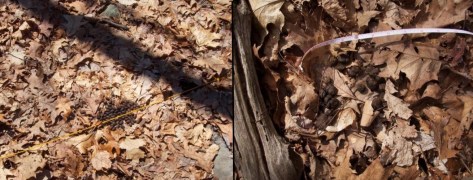
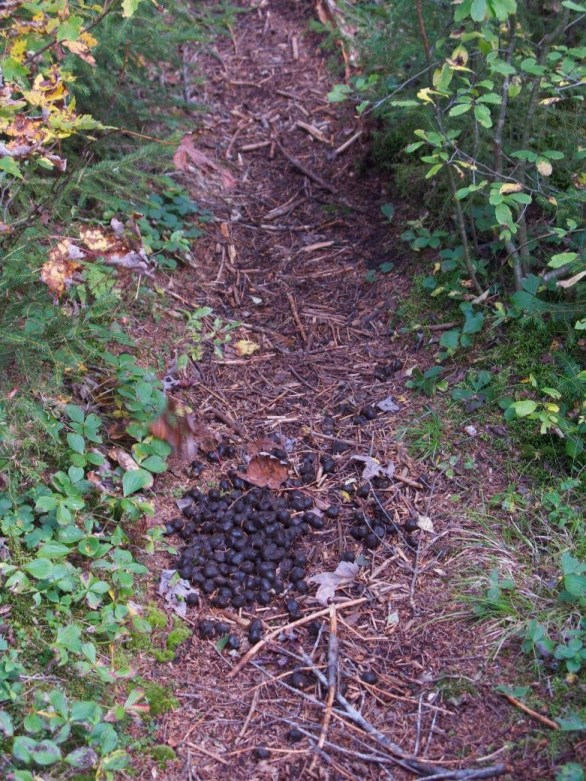
Deer scat might be the most common scat to be found on the trail. Deer scat is usually in pellets and in a pile. If the pile is under leaf litter, or a layer of snow, it is most likely old (see below photo). Deer scat can also be in a more “wet” or “patty” form, but pellets are usually still distinguishable. Shiny or wet scat can indicate a deer is close by!  Deer produce pellets about 13 times a day, a product of their near constant grazing. Bigger bucks can leave bigger poo piles than the does. You can also look further into the scat signs, and see what the deer are preferring to eat. Hunters often organize a hunt around the transition corridors of feeding and bedding areas. Lots of scat in a certain type of feeding area (i.e. clover, grass, apples) would indicate that deer may be accessing this area daily to eat.  Deer beds and poo in cover areas, like scrubby emergent forest, would indicate deer access that area to sleep. A hunt that is set up between those areas, where the deer are apt to travel every day, might have the most chance of being successful.

Deer scat both
Deer scat, fresh (right) and old (left).

Rabbit scat is also very common in brushy areas, and is usually round. Rabbit scat is generally smaller than deer scat and can be more spread out in the feeding area. Look for rabbit scat near low bushes or other available cover. In a strange evolutionary twist, rabbits also produce a second type of scat, called cecotropes, that they eat shortly after depositing. These powerful pellets are full of beneficial gut bacteria.

Cottontail scat_J Jaycox
Cottontail scat.

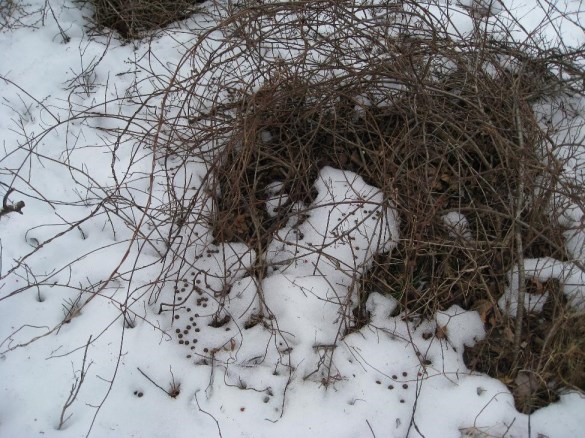
Porcupine scat can contain woody fiber, as they eat twigs and bark. Scat may also be at the entrance to their dens; they don’t seem to need to keep a clean house. Dens can sometimes have mounds of scat around them, if used over multiple seasons. It is theorized that porcupines’ scat piles could provide some warmth in the winter.  Porcupine scat can resemble deer scat, but is somewhat cashew-shaped, as opposed to the rounder deer pellets.

Porcupine den & scat_M Rogers
Porcupine den with scat (broken down) along the entrance.

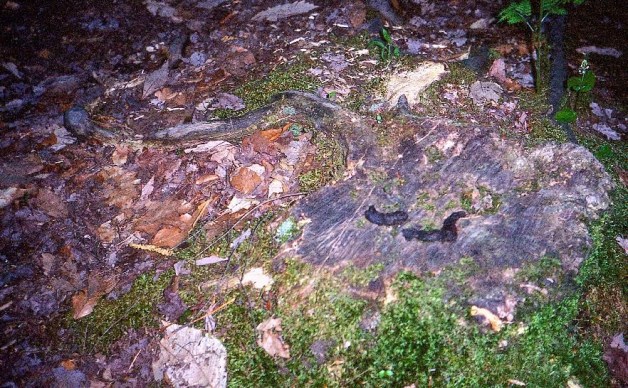
Foxes, and others in the canid family, like to make a point to be sure you see their scat. They often lay their brick and mortar on top of a rock or something high to mark their territory. Fox scat does not smell as foul as your house pet’s deposits; however it does have a distinct musky odor. Fox scat usually contains hair and is very dark with distinct twisted ends, unlike house dog scats, which are tubular with blunt ends.

Fox scat_M Rogers
Fox scat

If you are lucky, you might see bear scat on your next hike! Bear scat is usually characterized as a “plop” instead of pellets. Bear scat can be in enormous piles and can be a variety of colors and consistency depending on their last meal. Bears are omnivores, and so can have nuts, hair, or berries visible in their scat. Bears can also be attracted to food caches in town, like bird feeders, before the long snooze in the winter (see photo below). Bear scat also does not smell as strongly as other scat, and in times where they have a vegetarian diet, can smell quite pleasant (for poo).

Bear Scat both
Bear scat, note the seeds in the right photo

Another very common scat is that of the turkey. Turkey scat, like other birds, contains both urine and feces. The white part of a bird’s scat is the urine.  You can actually tell a male gobbler from a female hen by the shape of the scat. Male turkeys generally balance the budget in a J shape, while females are more in a pile, with a slight spiral to it.  This is because of the anatomy of a female turkey, which has a wider cloaca for eggs to pass through.

Turkey scat both
Turkey Scat (both likely female), note the footprints on left photo.

Another elusive animal you may see by scat rather than seeing in the fur, is the mink. A small furbearer, like the weasel, a mink’s scat is tiny, braided and pointed, with a twisted end. Mink also like to advertise their bathroom breaks on top of logs or stones, like foxes and coyotes. You can tell the difference between mink and weasels easily in the winter, as mink do not change their fur coats out for the camouflage that weasels do. Weasels should be white this time of year.

Mink scat both
Two photos of mink scat, note the twisted ends.

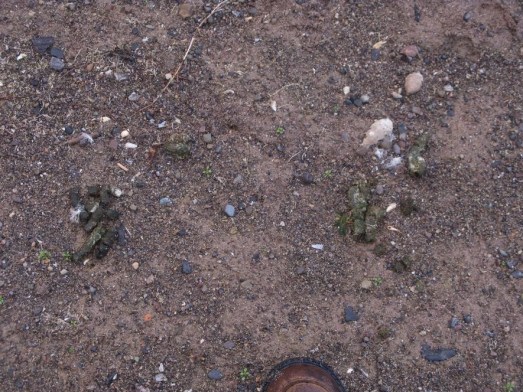
Another avian visitor common to parks is the Canada goose, as well as the snow goose. Both geese, like turkeys, have a distinct white cap on their scat. Goose poop however is more of a long log, and usually found around beaches and other waterbodies in the parks. Geese are normally pretty comfortable around people, and buildings, so you are more likely to see goose scat on the lawns and beaches rather than in the woods on trails.

Goose_M Rogers
Goose scat.

Our final foray into the wonderful world of waste is with one of the largest visitors to the Parks. Moose are more common in the Adirondacks, but have also been seen in the Taconic Highlands.  Moose scat can look like supercharged deer scat. Pelletized, and in piles, moose scat most closely resembles deer scat winter. In the summer months when their diet is more wet, moose scat may resemble cow patties. It can also trick people into thinking it is bear scat. To determine the origin, check out the mode of digestion. Moose are ruminants.  Like cows, they have four compartments in their stomach, so four times the digestion efficiency, and so usually poop fully digested food. Their scat is generally uniformly composed.  Bears are omnivores, with one stomach, and their scat can be more variable in composition, often with undigested berries and hair.

Moose_M Rogers
Moose scat.

Winter hikes are some of the most fun and most unique hiking in NYS Parks, and most Parks do not charge entrance fees in the colder months. Come prepared with extra winter clothing, first aid packs, and always let someone know your plan in case of emergencies. And don’t forget that the feces of many species can be an informative and fun addition to your knowledge of wildlife and outdoors.

Post by Keleigh Reynolds, State Parks

Featured image https://www.flickr.com/photos/bepster/43762108/ .

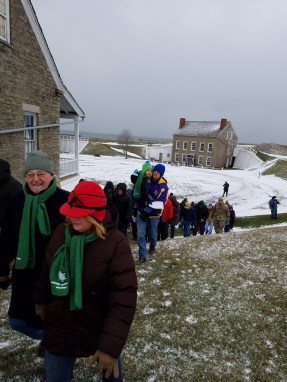
First Day Hike 2018

Fort Ontario 5
Join the “Military Musicology, Walking Tour of Old Fort Ontario”

What better way to kick off 2018 than to join family and friends in the outdoors on New Year’s Day for a First Day Hike. On January 1, New York State Parks and the state Department of Environmental Conservation (DEC) will be hosting a set of guided hikes as part of a nationwide effort to encourage people to get outdoors. Now in its 7th year, New York’s First Day Hike (FDH) program will offer 75 hikes across every region at state parks, historic sites, wildlife areas and trails.

Each year, this enjoyable holiday tradition draws more and more visitors with multiple hiking options from Western New York to the tip of Long Island.  Additionally, since some FDH events are held in the afternoon, there’s no need to get up early for those who like to celebrate New Year’s Eve with gusto!

Hikes are being offered at 59 state parks and historic sites, with some facilities offering multiple hikes for different age groups, skill level and destinations within the park; and at 14 DEC wildlife areas, trails and environmental educations centers.  Staff from State Parks and DEC, along with volunteers will lead these family-friendly walks and hikes, which range from one to five miles in length, depending on location and weather conditions.

“First Day Hikes have become a popular outdoor tradition for families and friends; a healthy way to kick off the New Year amidst the stunning beauty of our state’s most scenic natural backdrops,” said State Parks Commissioner Rose Harvey. “This year’s program includes an expanded variety of winter walks and hikes and is the perfect reminder that New York’s parks are open year-round, offering world-class recreation and enjoyment for people with varying interests and abilities.”

Some host locations welcome dogs on leashes and several have flat, even surfaces for strollers.  Participants are encouraged to contact the park for information and pre-registration where noted.  A sample of this year’s programs feature a seal walk, a walking history tour, a snowshoe waterfall hike, pet-friendly treks, gorge walks, military musicology, canal towpath walk, and more.  New entries for 2018 include a bird survey, full-moon hike, mountain trails, views from a fire tower, and a walk through a maritime forest.

Letchworth 1
Letchworth State Park will offer four different hikes from Letchworth CSI – Who Done It: Journey for young children to a fast-paced hike to the Great Bend Gorge.

The First Day Hikes program originated in neighboring state Massachusetts in 1992 for their state parklands. Since 2012, the program has been held in all 50 states and branded as America’s State Parks First Day Hikes. January 2018 marks the year that First Day Hikes will become an international movement with Ontario Parks in Canada offering these family favorites as well.

If conditions permit, some First Day Hikes may include snowshoeing or cross-country skiing with equipment for rent if available or participants can bring their own.  Many host sites will be offering refreshments and giveaways.  A map and details about hike locations, difficulty and length, terrain, registration requirements and additional information are listed at parks.ny.gov.

Last year’s event featured nearly 4,000 participants, who hiked a total of 7,900 miles amidst New York’s winter beauty. So, start your own tradition, grab some sturdy footwear and a warm jacket, and join in the fun!

Weathering the Storm by Restoring a Native Grass

In October 2012, Superstorm Sandy hit New York, causing severe damage on the Atlantic and Long Island coasts. The strength of the storm highlighted the importance of storm readiness. In one park on Long Island, the storm also brought an opportunity for habitat restoration.

Sunken Meadow State Park is located on the north shore of Long Island, and contains the Sunken Meadow Creek, which flows into the Long Island Sound. The park is over 1,000 acres and includes important coastal habitats including coastal forest, low salt marsh, marine eelgrass, tidal creek, and maritime dunes.

When Sandy struck, it destroyed a berm (a wall made of earth) that State Parks constructed in the 1950s. Ever since it was built, the culverts through the berm were inadequate and greatly reduced tidal flow to Sunken Meadow Creek, decreasing the quality of the habitat upstream. Rather than rebuild the berm, a plan was set in motion to restore the tidal marshland by replacing the berm with a bridge and planting saltmarsh species.

Sunken Meadow Creek after Sandy with photo credits
The remnants of the berm in Sunken Meadow Creek after its destruction by Superstorm Sandy in 2012.

Even before Sandy struck, many partners had joined with State Parks to restore the habitat, including NYS Department of Environmental Conservation (DEC), Connecticut Fund for the Environment, Save the Sound, Long Island Sound Study, National Oceanic and Atmospheric Administration, Restore America’s Estuaries, Sea Grant New York, US Fish and Wildlife Service, The Nature Conservancy, and the Louis Berger Group. The New York Natural Heritage Program provided valuable information to help guide the restoration. The National Fish and Wildlife Foundation provided the funding.

With the removal of the berm came the return of tidal flow (a range of 2-3 feet per tidal cycle), and the gradual natural restoration of 135 acres of tidal creek and salt marsh habitat. Common reed (Phragmites australis) – an invasive plant with low tolerance for salt – had been a problem upstream of the berm, but the return of salty water cleared away much of this undesirable species. Once the common reed was gone, a three-acre area of mudflats was exposed, which the partners identified as an ideal location for marsh restoration work.

Mudflats 2013 with photo credits
xposed mudflats in 2013, one year after Superstorm Sandy, looking toward the pedestrian bridge.

The partners and volunteers teamed up to plant the mudflats with smooth cordgrass (Spartina alterniflora). Thanks to the roots of this native saltmarsh species, this section of the creek is now more resilient in the face of erosion and flooding that storms can bring. (Want to see how plants slow down erosion? Try this fun home experiment!) The restoration will also improve habitat for fish, macro-invertebrates (like fiddler crabs), and birds, providing them with space to forage and reproduce.

Mudflats 2017_with photo credit
View of mudflats looking toward bridge in 2017, two years after restoration planting of smooth cordgrass. You can see the remnants of the fencing put up to protect the young grass plants from being eaten by geese – these posts will be removed in the coming months.

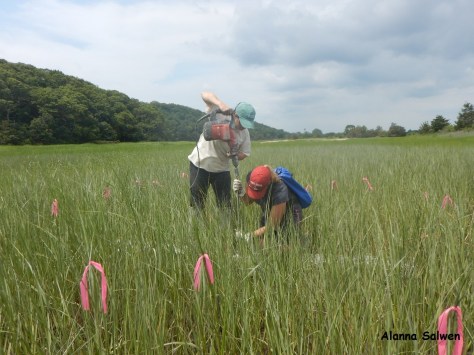
The site continues to be monitored for the success of the plants. State Parks staff will also observe changes in the marsh elevation using Surface Elevation Table monitoring stations (SETs), which were installed in the restoration site and a control site downstream.  The elevation of the marsh surface may change in the future as mud is washed up and sea level rises. To learn more about SETs and how they are used, click here.

DEC staffers with photo credit

To learn more about the tidal creek and salt marsh habitat at Sunken Meadow State Park, check out some of our educational programs! NYS Parks works with local schools to engage students in citizen-scientist projects. A seasonal intern leads nature walks and uses the mobile touch tank to share the tidal world with park patrons. Sunken Meadow also participates in the “A Day in the Life of the Nissequogue River” program, which you can learn more about here.

To find out more about programs available at Sunken Meadow State Park, check the calendar.

Post by Juliana Quant, State Parks

Sources

Connecticut Fund for the Environment, 2013. Sunken Meadow Comprehensive Resilience and Restoration Plan. National Fish and Wildlife Foundation – Hurricane Sandy Coastal Resiliency Competitive Grants. EasyGrantsIS: 42442.

Hurricane Sandy

More details on the Sunken Meadow State Park restoration project from Save the Sound

SCA Service Project at Sam’s Point Preserve

It was a beautiful Monday morning as my fellow Student Conservation Association Hudson Valley AmeriCorps members and I made the trek to the Sam’s Point Area of Minnewaska State Park Preserve. Members were coming from as far north as Moreau Lake State Park (near the Adirondacks) and as far south as Jones Beach State Park on Long Island.  I had come to Sam’s Point before to volunteer with bird surveys, so I was thrilled to return to this spot for our service project.  We had gathered at what would be our home base for the next three days – us in a circle, cars in the background, and a spectacular view of Sam’s Point itself.  We had gathered here for the 9/11 Patriots’ Day of Remembrance and held a moment of silence to reflect on that day 16 years ago, as well as the service we would be providing for the parks.

Before we could get started, some orientation was in order, as there was a lot of information to cover.  Sam’s Point has a rare population of ridgetop dwarf pitch pine barrens, supporting wildlife such as birds, fishers (small mammals related to weasels), and porcupines.  In April 2016, a wildfire broke out in the area, and efforts are underway to study the resilience of this ecosystem.  We were able to see more of the area by hiking up to the scenic overlook as well as to the super cool ice caves!

Invasive plant removal crew_EN
Some of the invasive species removal crew

There were multiple projects being done in our three days of service.  Two crews worked on erosion control devices on the Verkeerderkill Falls Footpath. One crew worked on making water bars, trail structures that take the water off the trail. Another crew worked on building bog bridges, low wooden bridge structures that raise the trail out of the water or other sensitive area. The third crew was constructing invasive plant boot brush stations at various entrances around the park preserve.  I was part of the invasive species crew for the service project.  Our main focus was removing spotted knapweed, a purple flower that grew on the edge of the Loop Road. We had been out in the sun working hard on knapweed removal, and towards the end of the day, decided to move in the shade to work on stilt grass.

Invasives crew on the trail_EN
On the trail in Sam’s Point Area.


While pulling knapweed for many hours at a time, SCA members were able to have some fun.  We had started to play the game Murder on the Trail, which is where the “killer” would stick out their tongue at a person, and five minutes, later the “victim” had to die dramatically. Aaron (one of the program managers) came to check in on us and did not know we were playing this game –   he wasn’t sure what was happening when someone dropped to the ground.  Other fun things included exploring Lake Maratanza and finding baby snakes!  From the beginning of the trail at the bottom of the ridge, all the way to the top, past Sam’s Point towards Lake Maratanza, we pulled almost half a mile of knapweed. That’s a lot of knapweed!

The other teams worked hard and played hard too! The bog bridging crew installed over 170 feet of new bog bridges and the water bar crew improved almost a quarter mile of trail on one of the park preserve’s most popular trails. The boot brush crew installed three new boot brush stations to educate the public about invasive species and help stop the spread of invasive plant seeds.’

Three project photos

After three days of hard work and camping out at Sam’s Point, it was time for all of us to return to our homes in the Hudson valley.  We had done great work for the park and I was happy to be a part of it.

Thank you to the SCA, SCA members, State Parks, and the staff of Sam’s Point. Until next time!

Post by Emily Enoch, SCA Hudson Valley AmeriCorps Member

The official blog for the New York State Office of Parks, Recreation & Historic Preservation