Here at State Parks, leashed dogs are commonly observed with their owners on hiking trails, in approved camping areas and enjoying lazy summer days. However, there is also an elite group of highly trained dogs , K9’s, paired with their State Park Police handlers, in a specialized program that began over 15 years ago.
Since 2002, the New York State Park Police have used Police Canines and Handlers as specialized teams to keep State Parks, our visitors, and our neighboring communities safe. This is a short history documenting their incredible work and highlighting the achievements of “Man’s best friend” in State Parks.
Initially, two K9s trained in explosive detection were selected and stationed in Long Island. Over the next two years, the State Park Police recruited four more K9 teams and stationed them in the Niagara and Saratoga-Capital District Regions and in the Hudson Valley, all trained primarily for finding explosive devices. The last of those specialized canines, K9 Chase, working with Officer Mannocchi in the Palisades, retired in 2014.
The next generation of canines began their deployments after 2014. Officer Mannocchi returned as a canine handler with K9 Sadie, trained for finding people tracking in the wilderness areas of the lower Hudson Valley. Shortly after starting her ‘job’ with State Parks, K9 Sadie, and her handler, Officer Mannocchi were called to assist with a search of a heavily wooded area for a male subject suffering from serious health issues. At 2:00am, K9 Sadie located the man lying in a thicket of woods approximately 1 mile from his home. The man was later reunited with his family without further incident. K9 Sadie and her handler were credited for their rapid response and effective capability.
At the same time that K9 Sadie was training, Officer Cali and K9 Teo came into service in the Niagara Falls area, as part of a homeland security opportunity. Teo is certified in explosive detection and has conducted numerous searches at Niagara Falls attractions and State Park concert venues, as well as a Presidential campaign event and the NCAA Men’s March Madness Tournament.
From the success that the K9 program gained, State Park Police Chief David Herrick expanded the K9 program to address the need for large venue protection. With the support of Commissioner Rose Harvey, Chief Herrick was able to recruit five more K9 teams, who were trained and deployed in 2016.
The New York State Park Police K9 teams are deployed from Western New York to Long Island and prepared to serve the state parks and their millions of visitors.
Yes its true, boaters can expect to be offered free boat washes from stations at select boat launches throughout the state, especially in places like the Adirondacks. The purpose of these stations are to provide free boat washes while also helping to prevent the spread of certain invasive species.
Everyone takes the time to give their cars a good wash periodically, but have you ever thought about how often you should be cleaning your boat? Boats can be carriers of invasive plants and animals. Most of the time, you can see these plants hanging off your propeller, bunks, and trailer and you can simply pick them off. However, some invasive species, like the young of zebra mussels and Asian Clams (called veligers) are so small they cannot be seen with the naked eye. Yet just adding a few of these into a lake or other waterbody is enough to start an invasion.
When we wash our boats, also known as decontaminating, it reduces the chances of transporting harmful invasive species, such as zebra and quagga mussels, spiny waterfleas, or Asian clams, to additional waterbodies.
How do boat wash stations work?
Boat washing begins with a general boat and trailer inspection. A trained professional, typically a boat or watercraft steward, first checks over your boat to see if it needs to be cleaned. If a boat is noticeably dirty and has visible plant matter on it, or if the boat was previously in a different waterbody, there is a good chance the boat steward will offer to decontaminate your boat for free. After a visual inspection of the boat and trailer, the boat steward will ask you to lower your propeller, just low enough to check if there is any water in the engine. If water comes out, the engine will need to be flushed of that foreign water with 120o F water from the boat wash station.
State Parks staff working with Lake George Park Commission stewards to determine if this boat needs to be decontaminated, photo by Matt Brincka, State Parks
At pristine waterbodies like Lake George, boat stewards are more concerned with boats going into the lake that were previously elsewhere. In other lakes where many invasive species are already present, boat stewards may focus their decontamination efforts on boats exiting the water, to prevent furthering the spread of those species.
Lake George Parks Commission Stewards using specialty “muffs” to run the engine while also flushing it clean of any water that could be carrying invasives, photo by Matt Brincka, State Parks
Afterwards, if the boat steward determines that you also should have a full decontamination, they will begin cleaning your boat. The water in the boat wash station is heated up to 140oF with pressure as high as 1,400 PSI. This temperature and pressure has been shown to kill most animals and plants trying to hitchhike on your boat. For specific areas where electronics and engine components are exposed, lower pressure is used to prevent damage to the boats. Boat trailers with felt bunks will be soaked in 140 o F using a low pressure attachment to kill any invasive species that may be hitchhiking on this material.
Jake Barney, a State Parks Boat Steward, demonstrates using a Boat Washing Station.. The handle in the boat steward’s left hand is used to control the amount of pressure coming out of the hose, photo by Matt Brincka, State Parks
During the washing, it is important to wash the outside of the boat and trailer, including the propeller, hull, trailer hitch, and underneath the trailer. It is also important to flush the engine and drain the bilge to ensure the boat is properly decontaminated. Boat wash stations can recycle contaminated water and heat it again, ensuring that its runoff will not contaminate the waterbody. Boat stewards take special care to be sure that no damage happens to the boats during cleaning.
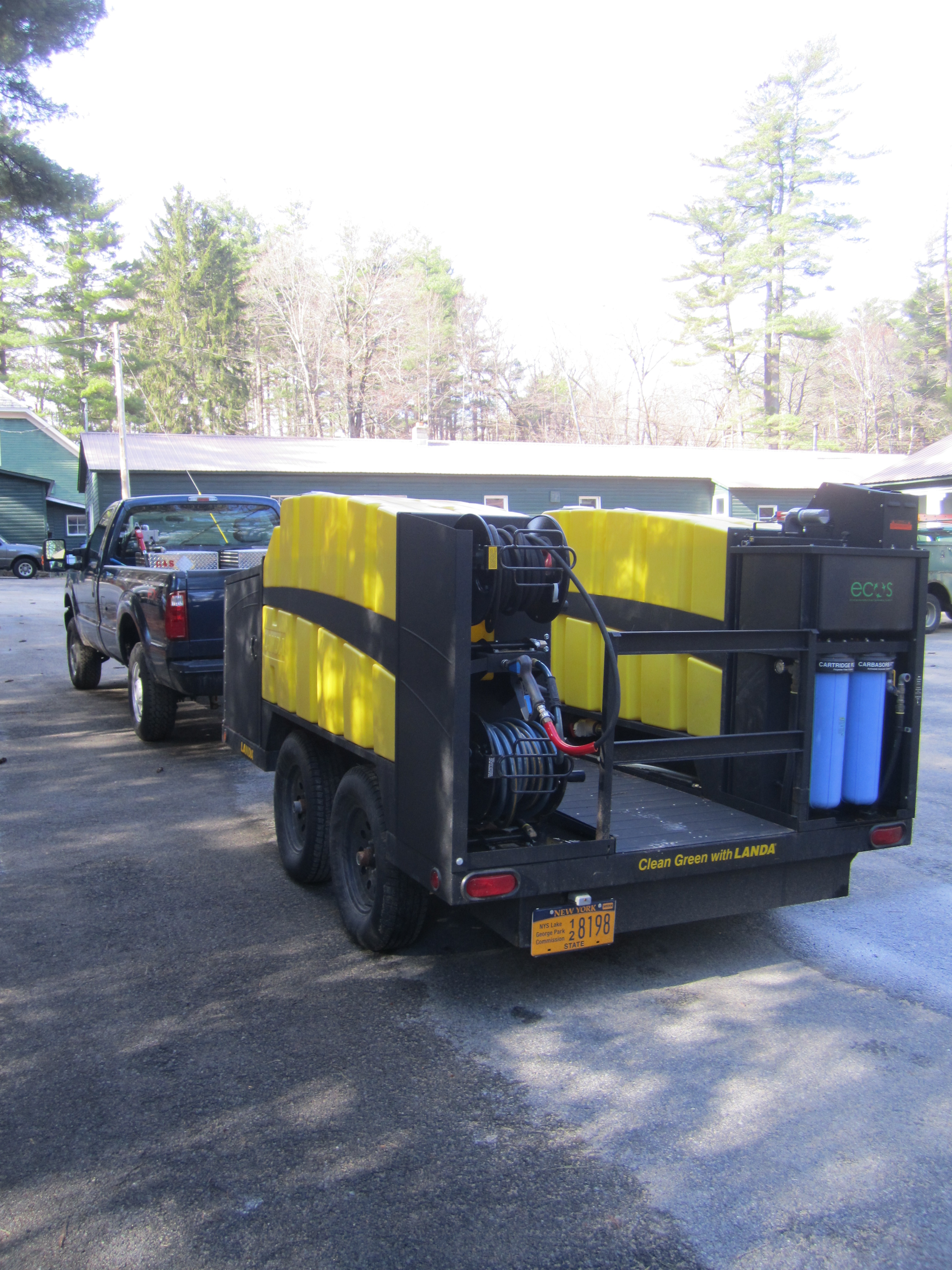
What your average portable boat washing station looks like. The yellow tanks on each side hold water used for decontamination. The machine has a gas engine but uses a diesel burner to heat the water to 140o F, photo by Matt Brincka, State Parks
Boat wash stations are an effective way to clean your boat of all invasives, including those that may be too small to see. Using the boat washing station is the most efficient and effective way to stop the spread of aquatic invasive species, while also providing a free cleaning of your boat and trailer!
Thanks for helping keep New York’s pristine lakes and rivers clean, so we can continue to enjoy them for generations to come!
Kayaking at Fair Haven Beach State Park, photo by Tina Spencer, State Parks
Additional information:
Click here for more information on boat decontamination procedures:
Decontaminating your boat with a boat wash station is always suggested, but be aware that some lakes, such as Lake George, require you to get a decontamination before launching.
Heading to the Adirondacks or Lake George? Find a boat wash station here.
Across New York, State Parks staff is working hard to help support the diverse populations of pollinators from bees to butterflies, beetles, wasps, and more. Here’s a sample of the pollinator protection projects going on this year in State Parks.
Working from their photographs from both Rockefeller State Park Preserve and Stone Barns Center for Food and Agriculture, photographers Paula Sharp and Ross Eatman created the website “Guide to Wild Bees of New York.” This stunning website features extensive photographic documentation, scientific classification, identification guides, and behavior and habitat information on over 80 species of bees in the Hudson Valley. In addition, Sharp and Eatman curated the Wild Bees exhibit which is on display on the concourse at the Empire State Plaza in Albany, NY now until June 25, the end of Pollinator Week 2017. One visitor noted that the photos “…helped me to see bees in a new light.”
A sample of the photos of native pollinators from Rockefeller State Park Preserve and Stone Barns Center on display at the Wild Bees exhibit in Albany or viewable online. Photo by Susan Antenen, State Parks
Staff is developing educational materials about the native pollinators who live in the recently restored sedge meadow. This wet meadow (with grass-like sedges) is habitat for several uncommon butterflies, including northern pearly eye (Enodia anthedon), Appalachian brown (Satyrodes appalachia), mulberry wing (Poanes massasoit) and black dash (Euphyes vestris). However, the size of the habitat at the John Jay State Historic site has declined because woody plants and non-native invasives such as multiflora rose and Oriental bittersweet started growing in the meadow. Woody shrubs have been removed to set back succession and restore the sedge meadow habitat. The outreach materials will explain the restoration and highlight some of the flora and pollinators that visitors may see at the park.
The northern pearly eye (Enodia anthedon) is one of the many butterflies that occurs in the sedge meadow habitat at John Jay State Historic Site. Photo credit: Matt Schlesinger, NYNHP.
Long Island State Parks
Bring Back the Pollinators Project
State Parks biologists and environmental educators are establishing and enhancing native plantings and habitat in seven state parks throughout Long Island. Look for these pollinator projects in Orient Beach State Park, Heckscher State Park, Bethpage State Park, Robert Moses State Park, Caleb Smith State Park, Connetquot State Park Preserve, and Belmont Lake State Park. The Bring Back the Pollinators project is focused on gardens in order to give visitors a close-up view and to learn about the native plants and pollinators. This work goes hand-in-hand with efforts by NY Natural Heritage Program (NYNHP) scientists to identify and protect the natural areas in parks which are key to supporting native fauna, including pollinators. Parks staff have also installed tall fencing around several gardens at Robert Moses State Park, Caleb Smith State Park, Heckscher State Park, and Orient Beach State Park to keep the deer from eating the showcase of flora and pollinator fauna.
Educational signs that include the graphics above are being installed at Long Island’s pollinator project sites. Photo by Annie McIntyre
At Ganondagan State Historic Site, three projects will enhance habitat for native pollinators and other fauna. Staff has worked with NYNHP to identify plant species that are native to the area and that reflect similar natural communities known in the vicinity. Just as important is that the projects restore the cultural landscape of the Seneca town that was on the site over 330 years ago.
The Oak Opening Habitat project is restoring a 60-acre old field to native grasslands to provide habitat for grassland birds, mammals, and pollinators as well as opportunities for historical interpretation. This spring, the grass seeds were sown and invasive species control efforts will continue through 2018. The restoration is based on the NYNHP rare Oak Opening community, which is known from a few places in nearby Monroe County.
Ganondagan State Historic Site’s Oak Opening grassland restoration area. Photo credit: Kyle Webster, State Parks.
The Green Plants Trail is the second project. It includes removing invasive species and replanting native plants to improve pollinator habitat and to feature a variety of plants that had and have cultural value to the Seneca people.
A native bee pollinating a nodding onion plant along Ganondagan State Historic Site’s Green Plants Trail. Photo credit: Brigitte Wierzbicki, State Parks.
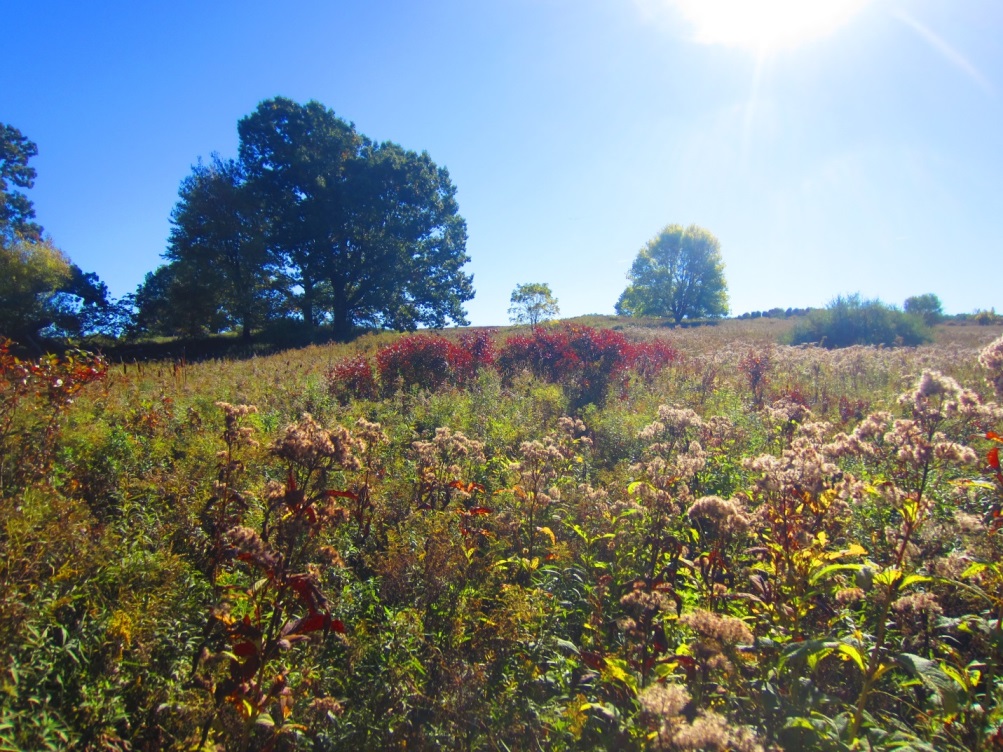
The third project at Ganondagan, Pollinator Grassland, transformed a weedy 13-acre grassland into a tallgrass prairie by planting native grasses (such as big bluestem and Indian grass) and wildflowers (including common milkweed). These plants benefit pollinators and other native fauna.
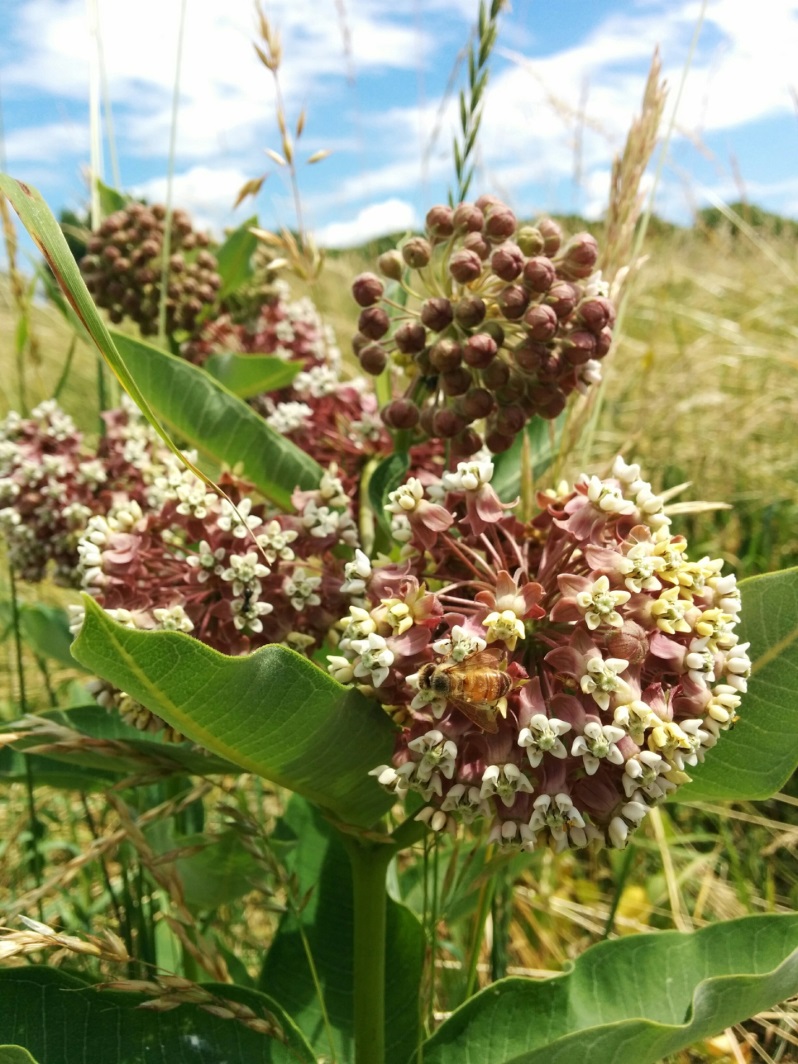
Native bee pollinating the milkweed plant at Ganondagan State Historic Site’s Pollinator Grassland. Photo by Brigitte Wierzbicki, State Parks.
State Parks Partnership Educational Banners and Posters on Native Pollinators and Habitats in State Parks
NYNHP staff is developing high quality banners and signage to promote the importance of native plants and habitats in State Parks and their role in supporting native pollinators. These materials will feature the partnership between NY Natural Heritage Program and State Parks and will be available for use at events, education centers, and other venues. In 2016, NYNHP displayed some draft posters to accompany activities at the New York State Fair, which stimulated many questions and compliments. Messaging, photo selection and design of banners and signage is under way using other funding sources and the professional fabrication of signage will be completed in 2017.
This photo of a clearwing moth was posted at the 2016 NY State Fair to accompany activities on pollinators. Photo credit: Matt Schlesinger, NYNHP.
Pollinators use a variety of plants and habitats from field to forest. Photo credit: Greg Edinger, NYNHP.
The banners will describe how NY Natural Heritage Program is partnering with State Parks to protect habitat and learn more about what pollinators are present in NY – like this rusty patched bumblebee (Bombus affinis). Photo credit: LW Macior.
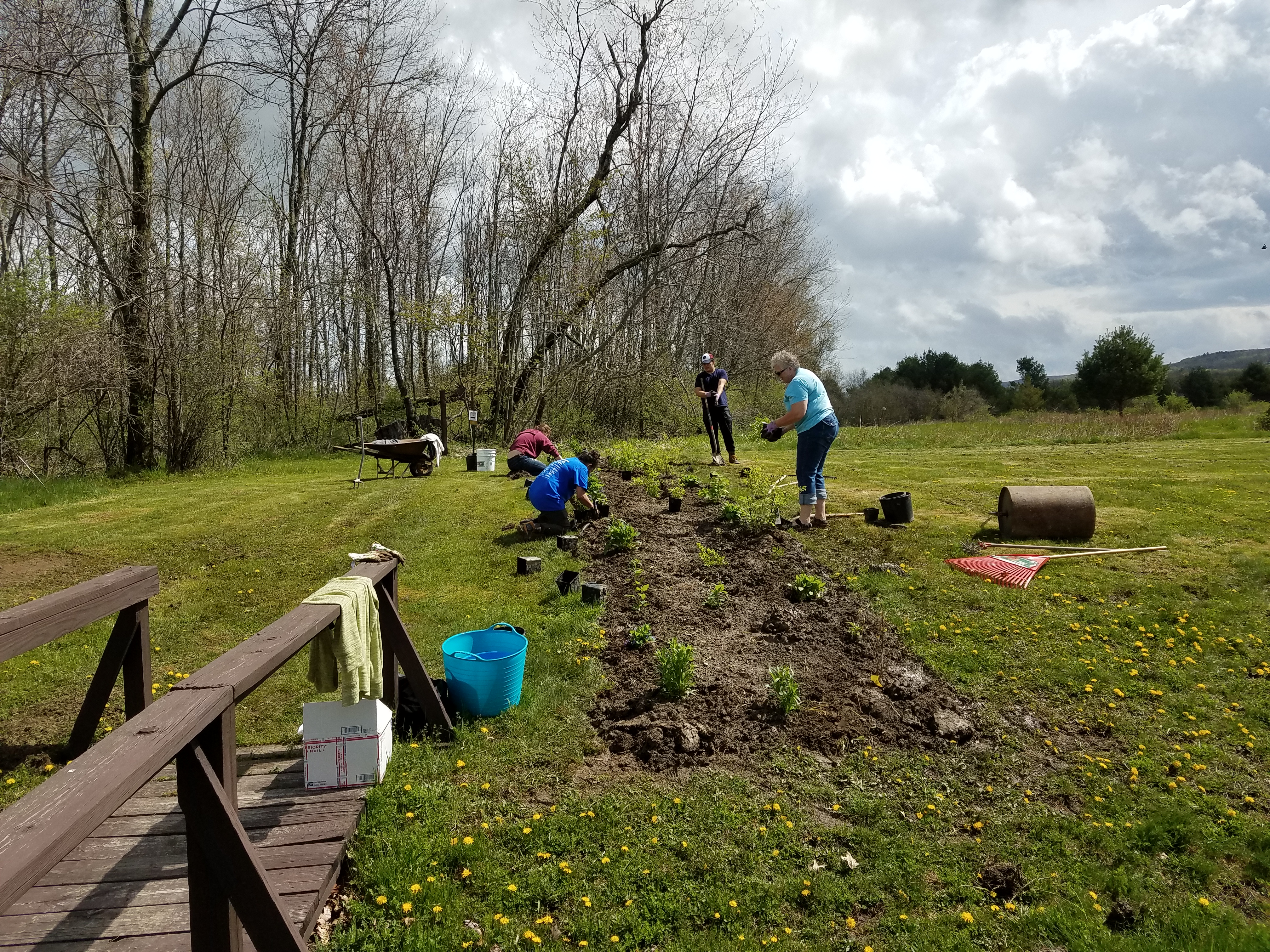
The Council of Park Friends and a local garden club teamed up to plant a native pollinator garden along the side of the nature center at Clark Reservation. The project includes interpretive signs about the native plants, invasive species control, and how State Parks is helping to support native pollinators.
Newly installed pathway through the pollinator garden, photo by Katie Mulverhill, State Parks
Staff and volunteers at this park are creating a Sensory Awareness Trail. Along the trail, staff added NY native plants to attract native pollinators and to interpret the role these plants and pollinators play in our environment. The accessible trail includes tactile elements such as sculptures of insects/animals that rely on our native plant species.
Volunteers plant native plants at Glimmerglass State Park during I Love My Park Day. Photo credit: State Parks.
Local school students planted native plants at Saratoga Spa State Park to help provide food for both the federally endangered Karner blue butterfly (Plebejus melissa samuelis) and the state threatened frosted elfin butterfly (Callophrys irus). And at the Creekside Classroom, a new environmental learning center at Saratoga Spa State Park, a diverse mix of native plantings for landscaping and raingardens were installed.
Lupines in flower, Saratoga Spa State Park Spring 2017, photo by Casey Holzworth
Waldorf School students spreading wild lupine (Lupinus perennis) seed in a cleared field in 2016 , photo by John Rozell, State Parks
The underside of the Karner blue seen perched on the host plant, wild lupine (Lupinus perennis). Photo by Paul Labus, The Nature Conservancy, Indiana.
Male Karner blue butterfly. Photo by Paul Labus, The Nature Conservancy, Indiana.
Creekside Classroom entrance garden, photo by Casey Holzworth, State Parks
Creekside Classroom raingarden will attract native pollinators and serve as a teaching tool for State Parks staff, photo by Casey Holzworth, State Parks.
This summer, staff will convert four small lawns to wildflower meadows at Grafton Lakes State Park. The restoration will include planting native plants to attract native pollinators. Look for the work near the main entrance and near the new visitor’s center.
This lawn along the main entrance road of Grafton Lakes State Park is being converted into a wildflower pollinator meadow, photo by Casey Holzworth, State Parks.
Bennington Battlefield
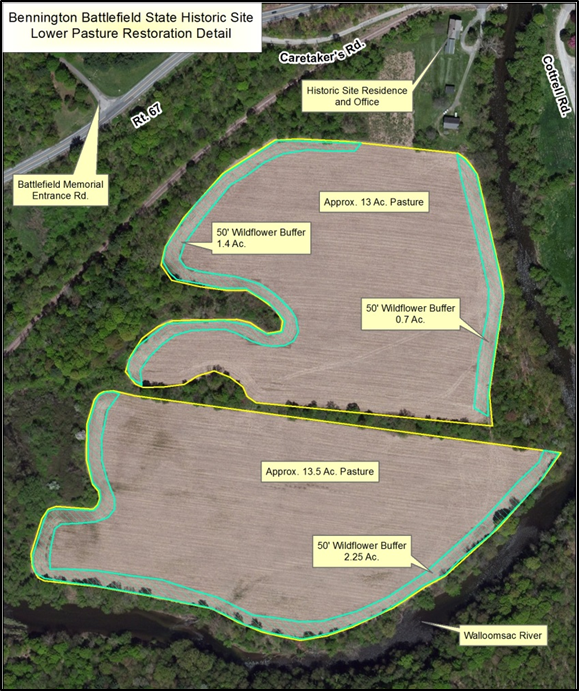
State Parks’ staff worked with Renssalaer County Soil and Water Conservation District, National Resources Conservation Service, and Cornell Cooperative Extension to convert two cornfields at Bennington Battlefield to grazing pasture and a wildflower meadow. Work on this 26-acre project included tilling and seeding the area with non-invasive grasses and planting native pollinator meadows along the edges of the field and nearby wetlands. The pollinator meadows will be fenced off to keep grazing livestock out of those areas.
You’re walking through the woods on a late spring day and a loud bird song bursts from forest. It sounds as if the bird is repeatedly saying ‘tea-cher,’ getting louder with each note. You pause to look for the bird, thinking it may be the size of a robin, a blue jay, or maybe something bigger because it is so loud, but you don’t see anything.
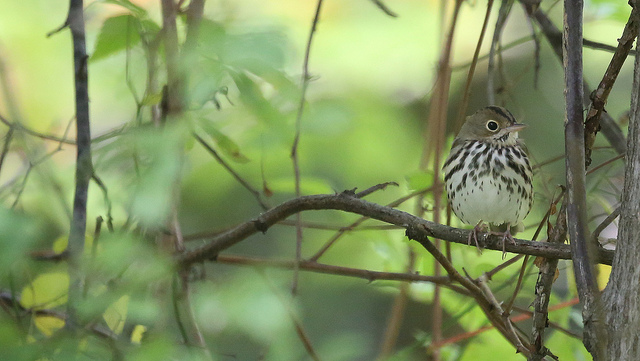
The song starts again, and there on the forest floor, you see a small light brown bird with dark brown streaking on its breast singing ‘tea-cher, teacher’. That bird is only about half the size of a robin. It’s an ovenbird, a bird known for an over-sized voice and a unique nest that looks like an old-fashioned outdoor oven, after which the bird is named.
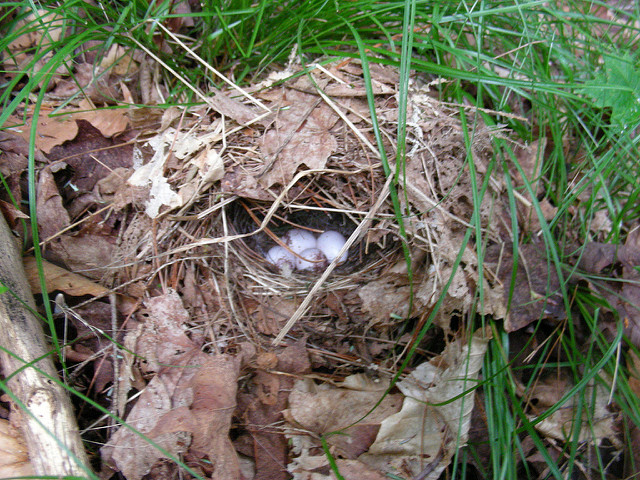
Ovenbird, by Cephas (Own work) [GFDL (httpwww.gnu.orgcopyleftfdl.html) or CC BY-SA 3.0 (httpcreativecommons.orglicensesby-sa3.0)], via Wikimedia CommonsThe female ovenbird builds her domed shaped nest on the forest floor. She builds it from the inside out using pieces of bark, small twigs, grasses, dead leaves and even hair. She leaves a side entrance so she and her mate can care for the young birds once they hatch. After she has finished weaving the nest, the female ovenbird drops small twigs and sticks on top of the nest to hide it from predators such as garter snakes, eastern chipmunks, and raccoons.
Ovenbird nest, photo by Kent McFarland
The next time you walk through the forest, listen for these birds. If you do spot one or see a bird quickly fly off of the forest floor, be careful where you step. Look closely to see if you can find that unique dome-shaped nest on the ground. If you are lucky enough to spot one, view from a distance for just a minute and then move on so the parent can get back to the nest.
Featured image by Tim Lenz, US Fish and Wildlife Service
Did you know that Niagara Falls State Park is the oldest state park in the United States? Established in 1885 as Niagara Reservation, the breath-taking waterfalls at this park are considered some of America’s greatest natural wonders. Did you also know that the American Falls at Niagara Falls State Park, at around 100 feet tall, is not the tallest waterfall in New York? To find this peak waterfall, we must actually go to another New York State Park! From high plunges to rocky cascades, waterfalls are all over New York State Parks. In fact, there are 15 parks that have sizeable waterfalls. Few can deny the mesmerizing power and beauty of a waterfall, so why not try to add some of these destinations to a road trip this summer?
Niagara Falls State Park
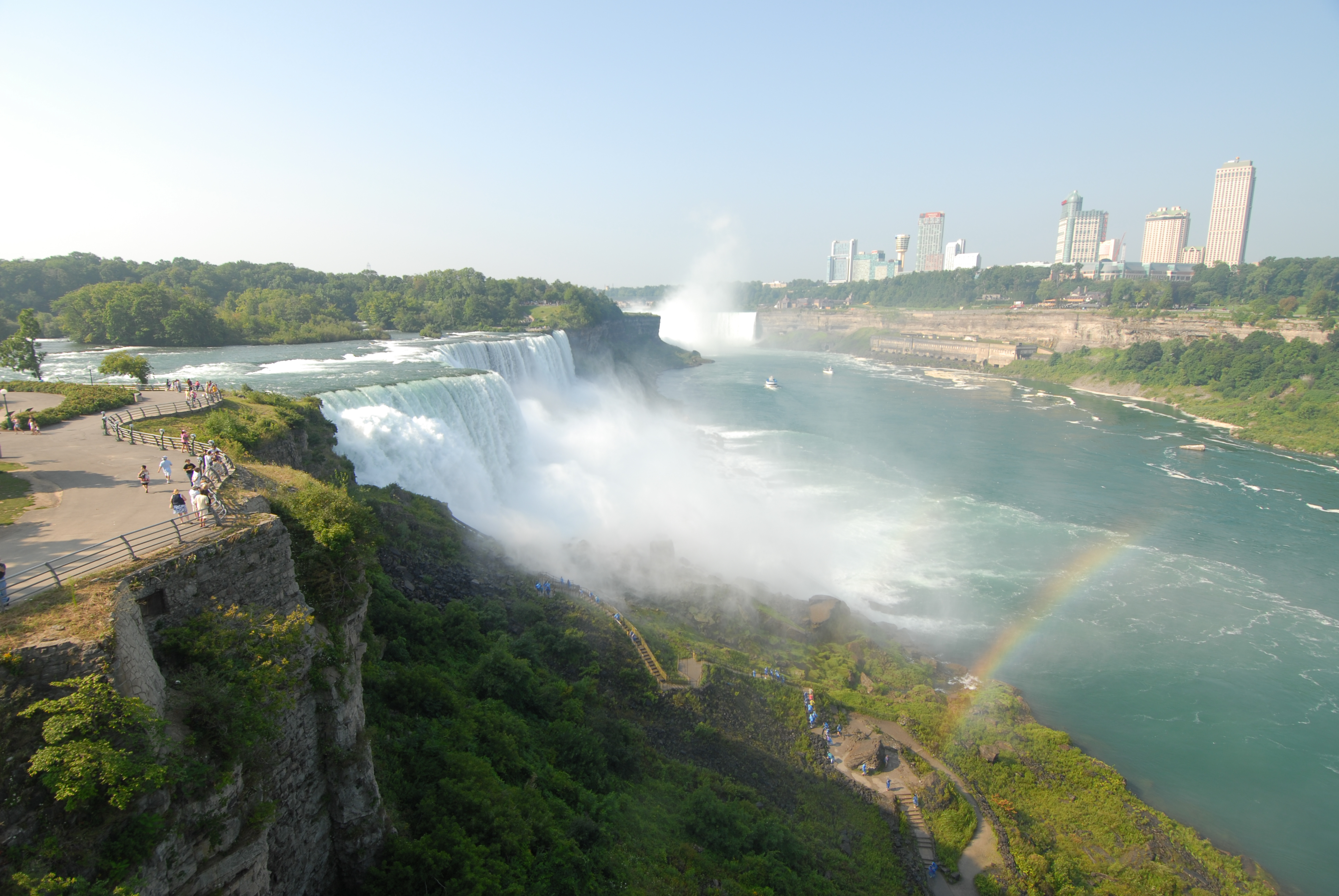
All three waterfalls at Niagara Falls State Park, photo by State Parks
Easily the most well-known of New York’s waterfalls, Niagara Falls is actually composed of three distinct waterfalls. The smallest is Bridal Veil Falls (the middle falls in the picture), which measures around 50 feet wide and 80 feet down to the rocky cascade below. Luna Island separates Bridal Veil Falls from the American Falls, both of which are on the American side of the Niagara River. American Falls (located on the far left of the picture) is around 100 feet tall (measured from the top to the rocky piles below) and around 830 feet wide. Horseshoe Falls (on the right in the picture), which runs between New York and Canada, averages 188 feet tall and 2,200 feet wide.
Letchworth State Park
Hiking near the Lower Falls at Letchworth State Park, photo by State Parks
Considered the “Grand Canyon of the East,” Letchworth State Park southwest of Rochester has three major cascading waterfalls – Upper, Middle, and Lower Falls – which range from 70 to 100 feet tall. There are also numerous smaller waterfalls as the Genesee River cuts through the gorge.
3. Stony Brook State Park
Pausing next to the Lower Falls at Stony Brook State Park, photo by State Parks
Stony Brook State Park, near Dansville, contains a large, rocky gorge common in the Finger Lakes. Visitors can hike along the Gorge Trail to see two of Stony Brooks’ three main waterfalls, as well as several smaller ones in between. Lower Falls, the largest of the three, cascades about 40 feet down to Stony Brook below.
4. Buttermilk Falls State Park
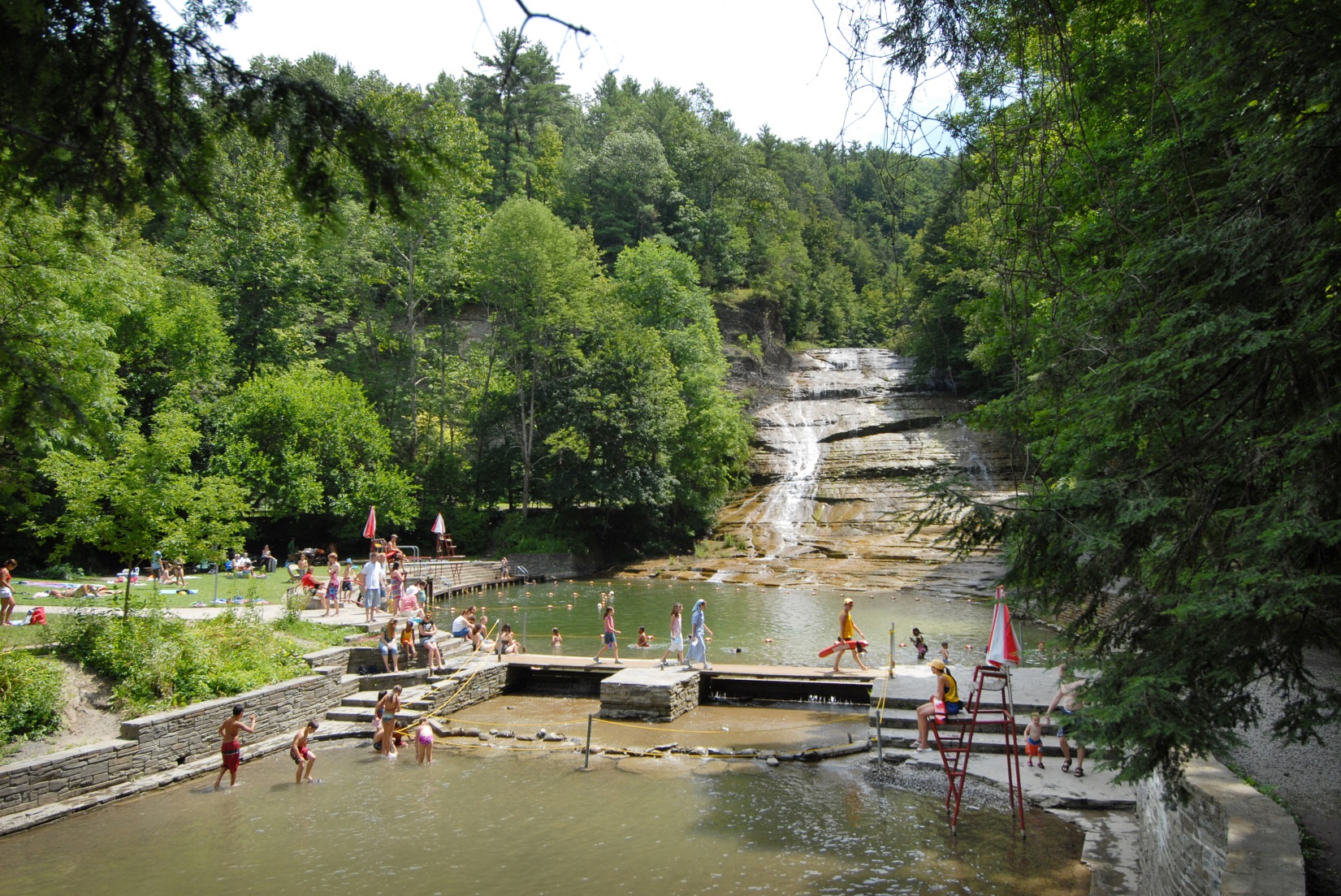
Enjoying a day of swimming by Buttermilk Falls at Buttermilk Falls State Park, photo by State Parks
Buttermilk Falls State Park, near Ithaca in the Finger Lakes, contains a large cascading waterfall, 165 ft, right near the entrance to the park. If you hike up the Gorge Trail, you will find several other minor falls along Buttermilk Creek. There is even a natural swimming area at the base of these falls.
5. Watkins Glen State Park
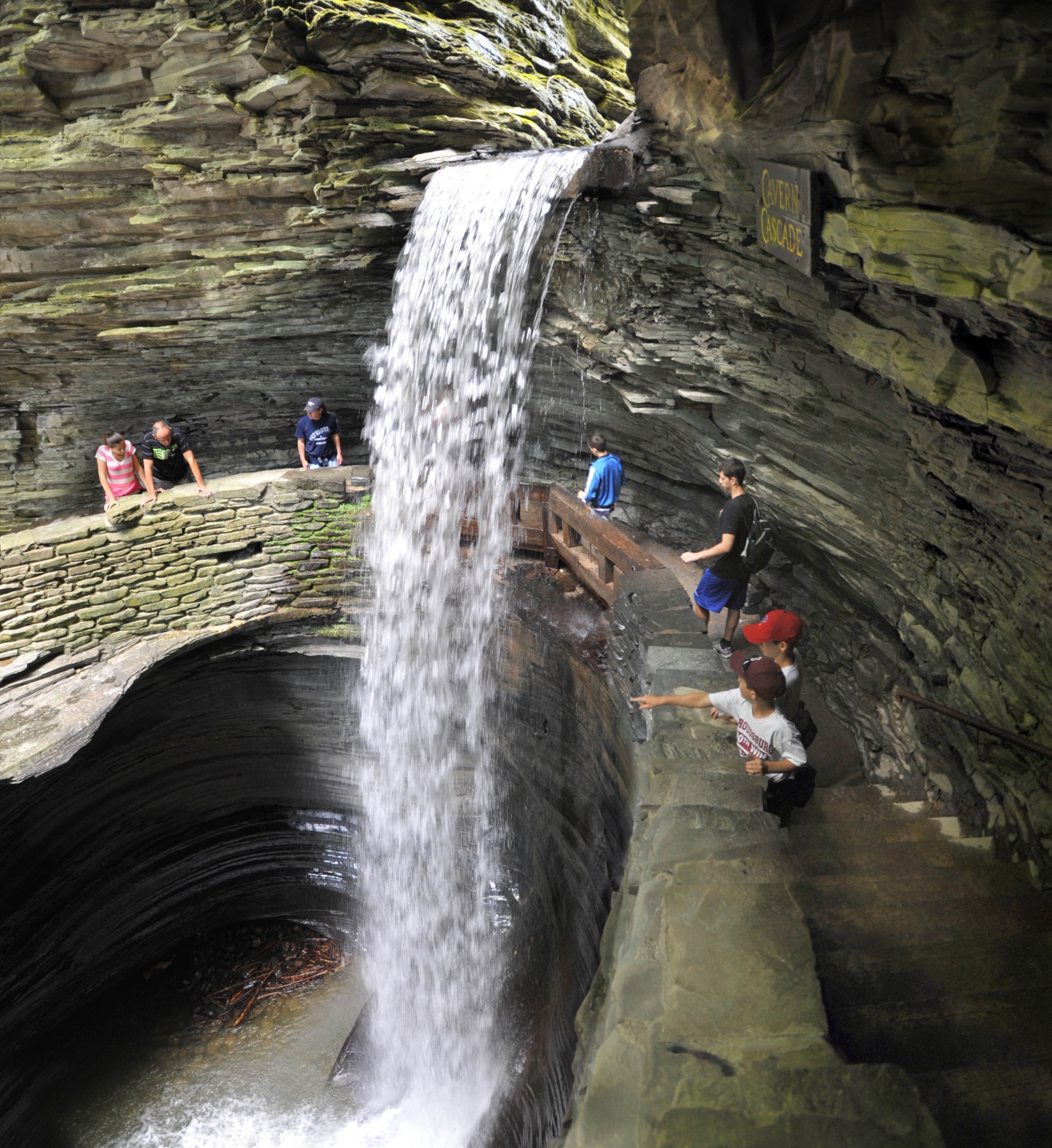
Walking underneath Cavern Cascade at Watkins Glen State Park, photo by State Parks
At Watkins Glen State Park, located at the southern tip of Seneca Lake in the Finger Lakes, you can walk through the gorge along the scenic Glen Creek. Within the two-mile glen there are 19 waterfalls that you are able to walk past, two of which you can even walk behind! Central Cascade is the park’s largest waterfall, plunging more than 60 feet.
6. Robert H. Treman State Park
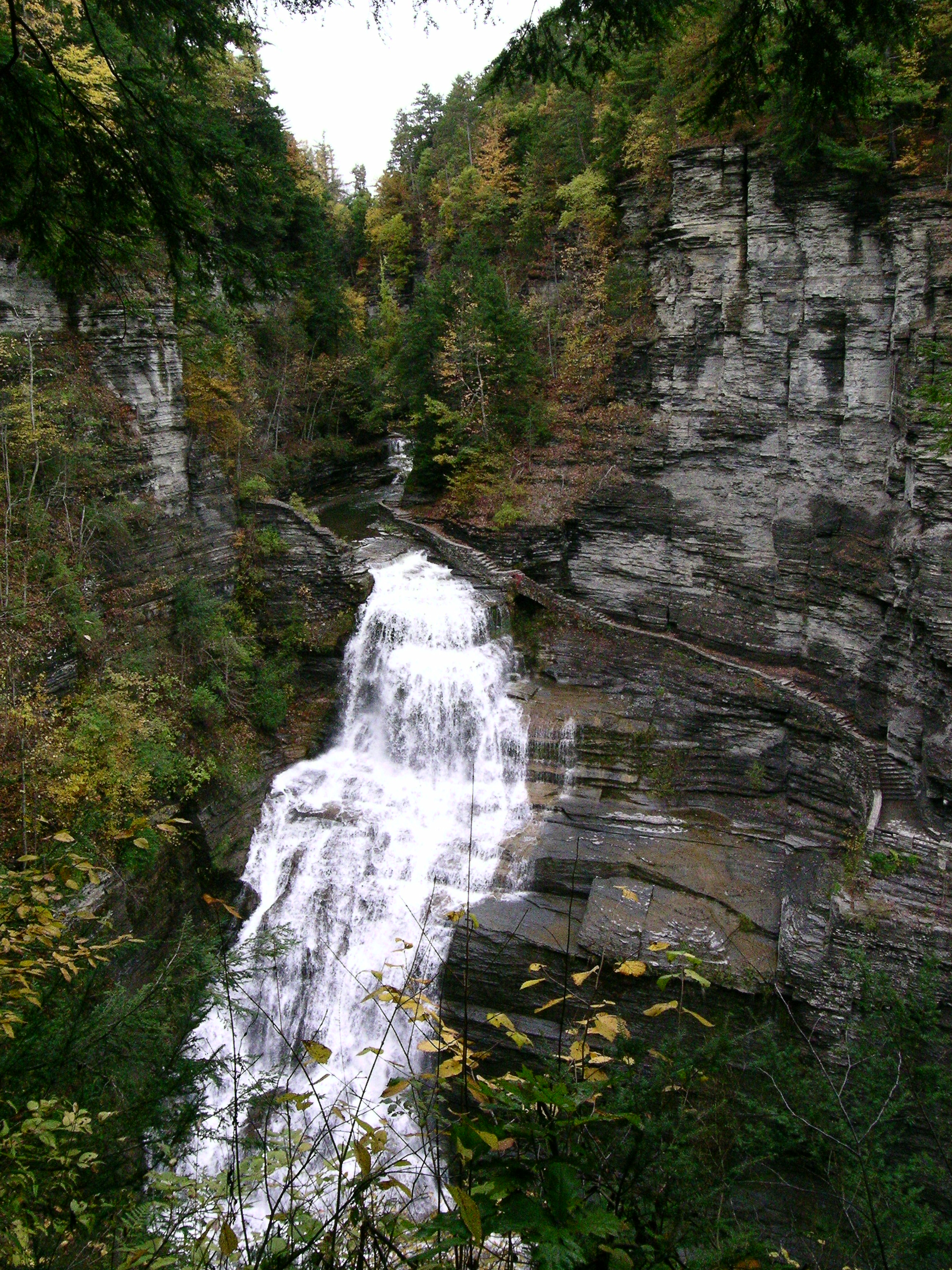
Trail along the top of Lucifer Falls, Robert H. Treman State Parks, photo by Josh Teeter
Home to ten smaller and two major waterfalls, Robert H. Treman State Park is located in Ithaca in the Finger Lakes. In the Upper Gorge you can hike to Lucifer Falls, a 115-foot cascading waterfall. Another park highlight is the stream-fed pool right at the base of the cascading Lower Falls.
Swimming at the base of Enfield Falls at Robert H. Treman State Park, photo by Josh Teeter
7. Taughannock Falls State Park
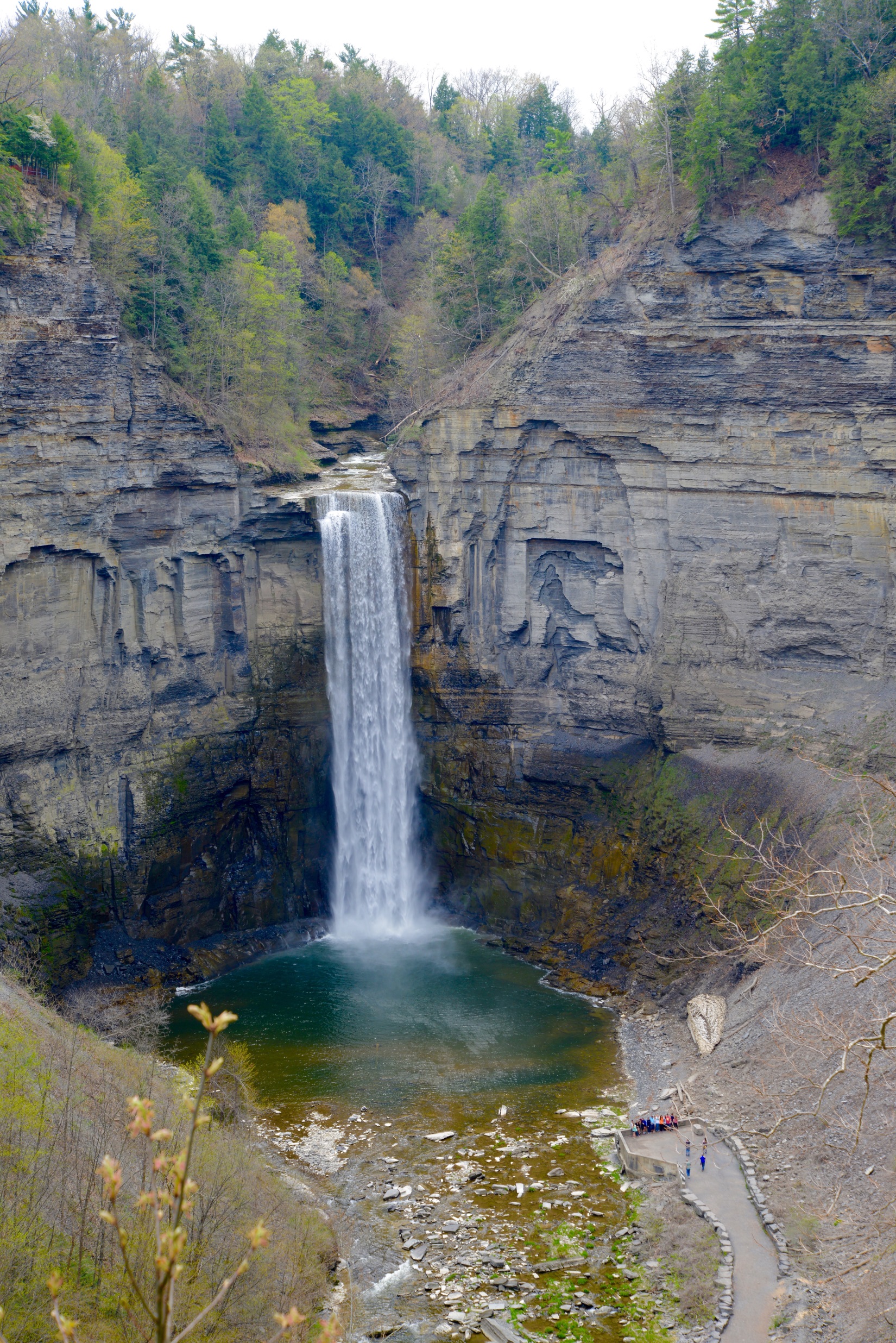
Taughannock Falls, Taughannock State Park, photo by State Parks
Taughannock Falls State Park, located in the Finger Lakes north of Ithaca, is home to the highest vertical single-drop waterfall in the eastern United States. Carved into 400-foot cliffs, water from Taughannock Creek plunges 215 feet over Taughannock Falls. Two smaller waterfalls, Upper and Lower Falls, can also be found at this park.
8. Fillmore Glen State Park
Cowshed Falls at Filmore Glen State Parks, photo by State Parks
Another classic gorge of the Finger Lakes, Fillmore Glen State Park (about 20 miles northeast of Ithaca) is home to five waterfalls. These range from 5 feet in height to the largest in the park, Dalibarda Falls, which is around 85 feet tall. Dry Creek, which runs the length of the park, helps create a stream-fed swimming pool in the Lower Park area.
9. Chittenango Falls State Park
A view of Chittenango Falls at Chittenango Falls State Parks, photo by State Parks
Chittenango Falls, a beautiful 167-foot staircase cascade, is the highlight of Chittenango Falls State Park, located in Central New York southeast of Syracuse. Enjoy the view from the picnic area above or from a wooden bridge over Chittenango Creek below. Chittenango Falls is also home to the world’s only population of the federally threatened Chittenango ovate amber snail!
10. Pixley Falls State Park
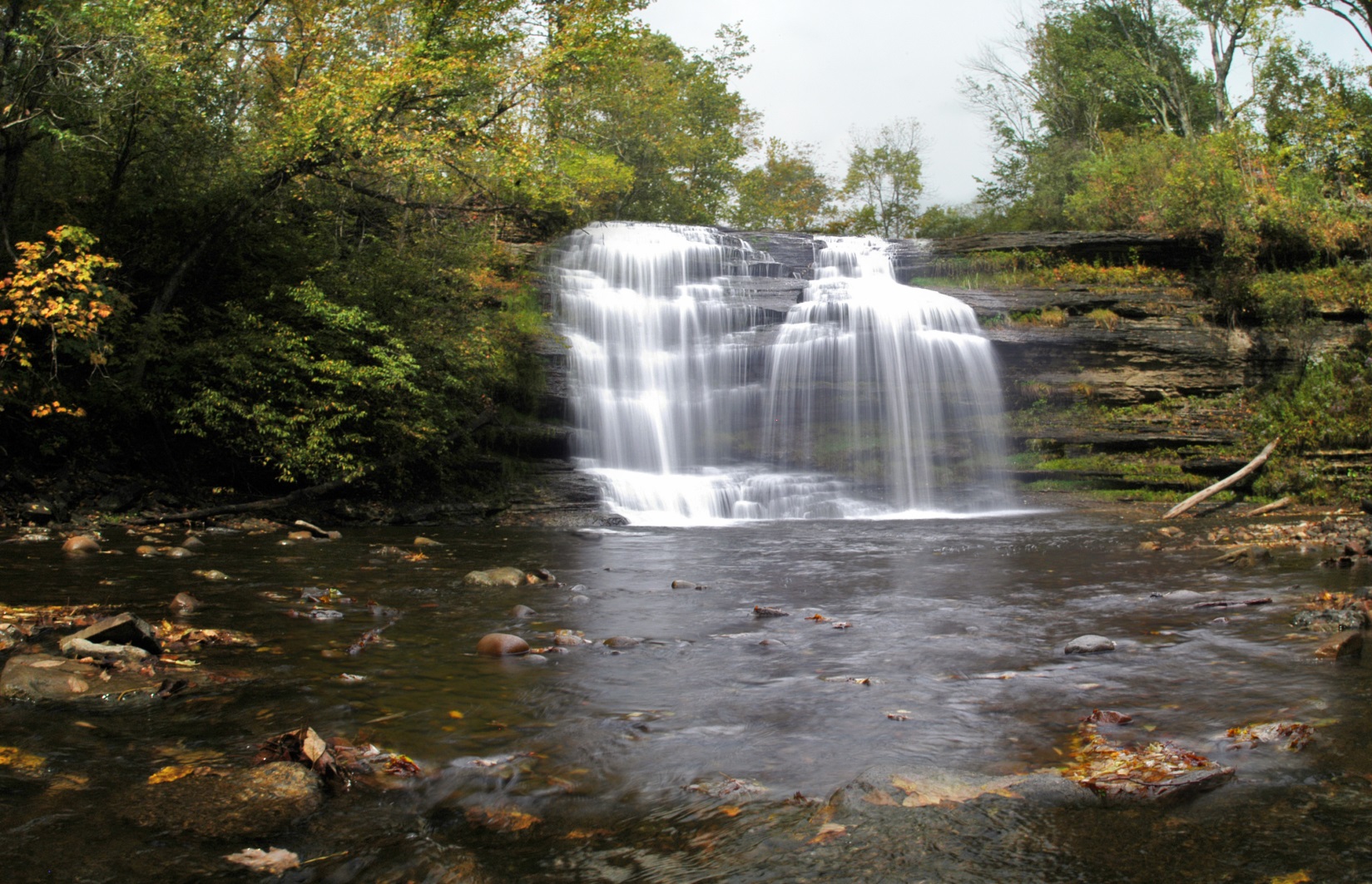
Pixley Falls, Pixley Falls State Park, Photo by State Parks
Pixley Falls State Park is named after its main attraction, the 50-foot waterfall on the Lansing Kill. There are also a few smaller falls in nearby streams. This park is in Central New York, about 20 miles north of Utica.
11. Mine Kill State Park
Lower Falls at Mine Kill State Park, photo by State Parks
Located southwest of Albany, Mine Kill State Park features an 80-foot cascading waterfall that cuts through a narrow gorge. Hike down to the base or check out the separate parking area (1/4 mile south of the park’s main entrance) that provides access to the overlook viewing platform.
12. John Boyd Thacher State Park
Minelot Falls at John Boyd Thacher State Parks, photo by Michelle Johnston, State Parks
John Boyd Thacher State Park, just west of Albany, contains numerous waterfalls which range from 5 feet to over 100 feet. Indian Ladder Falls (also called Minelot Falls) and Outlet Falls are two of the larger falls at this park, each plunging around 100 feet.
Peebles Island State Park is just north of Albany, located at the merging of the Mohawk River into the Hudson River. There is a waterfall here, about 15 feet high, in the Mohawk River near the southern end of the park.
Kayakers enjoy views of the waterfalls at Peebles Island State Parks, photo by John Rozell, State Parks
14. Taconic State Park
Standing at the base of Bish Bash Falls, Taconic State Park, photo by State Parks
Taconic State Park shares borders with Massachusetts and Connecticut. Many people flock to this park to see Bash Bish Falls, which is actually just a short hike across the New York border into Massachusetts. After a long cascade and a 60-foot drop, it is Massachusetts’ tallest single-drop waterfall.
15. Minnewaska State Park Preserve
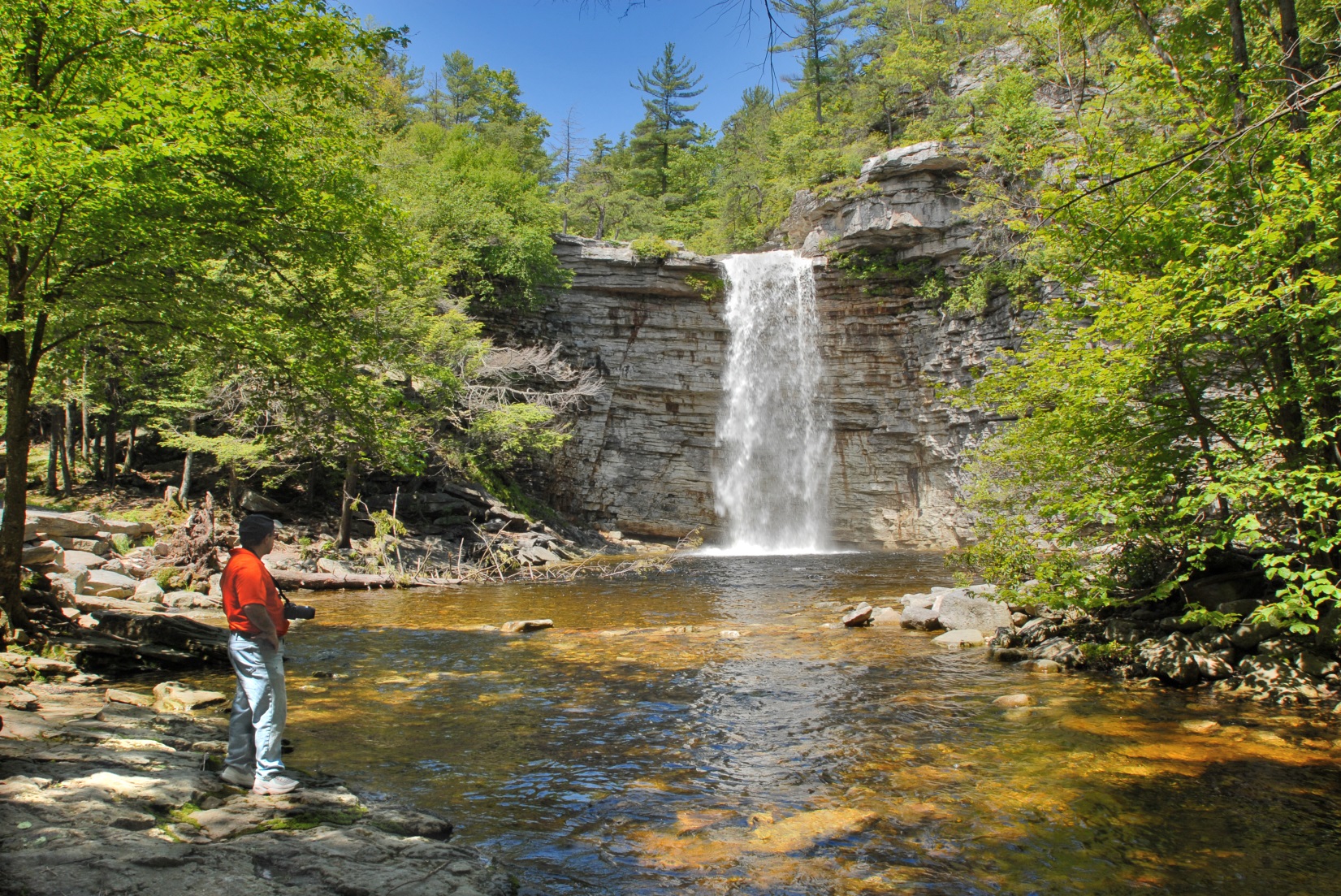
Photographing Awosting Falls, Minnewaska State Park Preserve, photo by State Parks
Minnewaska State Park Preserve, located in the Hudson Valley near New Paltz, contains many waterfalls. Near the gate house, the Peters Kill plunges around 70 feet at Awosting Falls. Stony Kill is another plunging waterfall, reaching about 90 feet in height. Some other well-known falls include Rainbow Falls, Bogerman Falls, Peterskill Falls, Sheldon Falls, and Verkeerderkill Falls near the Sam’s Point Preserve area.
Please remember that waterfall conditions are dynamic, changing with weather and seasons. Stay on the trail and be cautious of your surroundings, like slippery or rocky terrain, fast moving water, or steep drops.
For more information, check out some of these great waterfall resources:

















![By Cephas (Own work) [GFDL (httpwww.gnu.orgcopyleftfdl.html) or CC BY-SA 3.0 (httpcreativecommons.orglicensesby-sa3.0)], via Wikimedia Commons](https://nystateparks.blog/wp-content/uploads/2017/06/by-cephas-own-work-gfdl-httpwww-gnu-orgcopyleftfdl-html-or-cc-by-sa-3-0-httpcreativecommons-orglicensesby-sa3-0-via-wikimedia-commons.jpg)









 New York State Parks and Historic Sites Blog