Early Spring Migrants

Signs of spring are beginning to show in the great northeast. The days are getting longer, skunk cabbage is beginning to erupt from the cold ground and birds that have been afar for the winter months are beginning to return to New York State. One may think “What birds? The birds have been here all winter.” True, not all of our native bird species in New York migrate south for the winter months. Birds such as chickadees, northern cardinals, and red tailed hawks tough out the winter, anticipating the spring breeding season (see prior blog post on overwintering birds).  But far more birds winter in South America, Central America, and the southern USA and make the long journey back to NY in the spring. It is an exhausting flight; the birds must make short stops to fuel up on available food and take a quick rest, then up to the sky to continue their journey. Upon arrival at their breeding/nesting grounds, whether in New York State or farther north, there is little time for rest or replenishment of their lost fat reserves from the long journey. The birds must stake out nesting territory, defend it, find a mate and start building the nest that they will care for, around the clock, in the weeks to come.

Keep your ears and eyes out for the early returning migrants, the birds that are first to arrive in the months of March and April. Before describing some of the species one may encounter while bird watching, lets discover the difference between bird calls and songs, primarily applying to passerines or “song birds”. A call is a brief simple sound like a chip note, peep, or chatter. A song is a longer sound segment, usually with distinctive melody such as a series of notes strung together. Calls can be heard all winter from our resident bird population, but in spring the songs begin. Songs are typically related to courtship and establishing territory. Bird sounds (song, hoot, chatter…etc.) are also very useful in assisting bird watchers with identification, as bird vocals are distinct to individual species.

Additional tips that help with bird identification are size, coloration or plumage, and habitat use. Pick a bird you are familiar with, say the American Crow, and think about the size of the bird you are trying to identify. Having an idea of what size the bird is can help you narrow down what the species is from one that may look similar but is larger or smaller than the bird you are trying to identify. Plumage (feather pattern) is very important when identifying birds and can also be very frustrating! However, the more you bird watch, the better you will get at noticing the differences between species.  Habitat type can also help narrow down what species a bird is. For example, if you are observing a bird in a wetland and you think you know what the bird is, but you’re bird guide says that bird is primarily found in dry open fields – you will have to continue looking. All of these factors combined; sound, size, plumage, and habitat use are useful tools in assisting the observer with identifying a bird.

Early Returning Migrants: Meet the Birds!

Passerines or Song Birds

Red-winged Blackbird

These birds often travel in large flocks and can be found nesting in wet marshy or shrubby habitat. A medium sized bird; the male has a distinctive red patch on the upper wing. The female looks very different in color, being a light brownish hue with darker streaking.

Length: 8.75 inches      Wing Span: 13 inches     Weight: 52 grams

Listen to a red-winged blackbird sing –

Martin St-Michel, XC137984. Accessible at http://www.xeno-canto.org/137984.

House Wren

The House Wren is smaller in size than the Red-winged Black Bird, weighing about 41 grams less. Both female and male House Wrens have similar plumage (meaning they look the same). Wrens in general are noted for the characteristic pose seen in the picture, with their tail feathers and head up in the air. The House Wren nests in dense brushy habitat, usually within woods. They will also take to bird boxes.

House_Wren_-_Colombia_S4E0879_(16980757130)
House Wren, By Francesco Veronesi from Italy (House Wren – Colombia_S4E0879) [CC BY-SA 2.0 (http://creativecommons.org/licenses/by-sa/2.0)%5D, via Wikimedia Commons

Length: 4.75 inches      Wing Span: 6 inches    Weight: 11 grams

Listen to the song of a male house wren: 

Antonio Xeira, XC305012. Accessible at http://www.xeno-canto.org/305012

Common Yellowthroat

The Common Yellowthroat is a warbler and one of the first warblers to arrive in New York. The Common Yellowthroat is a small bird, similar in size to the House Wren. The male has a distinctive black mask, outlined in white – which the female lacks. Warblers in general are very colorful and eye catching. The Common Yellowthroat nests in wet marshy and brushy habitats.

Length: 5 inches      Wing Span: 6.75 inches     Weight: 10 grams

Listen to a male common yelllowthroat sing: 

Jorge de Leon Cardozo and Susan Hochgraf, XC181589. Accessible at http://www.xeno-canto.org/181589

Plovers

Killdeer

The Killdeer is an interesting bird, in that it has the unique behavior of displaying a broken-wing act to draw predators away from their nest. So if you see the act, consider yourself lucky, but do not approach! Killdeer are in the plover family, which primarily are a shore bird. However, the Killdeer can be found nesting on open ground in many habitat types, such as agricultural fields, parking lots, and sandy/bare ground areas. Their vocals sound similar to “Killdeer” and they have two distinctive black rings on their chest. Killdeer are larger than the song birds previously discussed, but smaller then a crow.

Length: 10.5 inches     Wing Span: 24 inches    Weight: 95 grams

Listen to a killdeer call: 

James Bradley, XC302258. Accessible at http://www.xeno-canto.org/302258.

Herons

Great Blue Heron

Great Blue Herons have long legs for wading in water and can be over three feet tall! These birds have a diet composed of fish, frogs, and invertebrates (organisms lacking a spine, such as bugs and insects). Therefore they rely on open water to forage and find food and can be found anywhere from marshy wetlands, rivers, lakes and flooded areas to the shores of the ocean. Look for Herons as the waterbodies began to thaw in spring. These birds nest in rookeries with dozens of nests built of large sticks in a single tree or group of trees, usually within a wetland.

Great Blue Heron
Great Blue Heron, OPRHP

Length: 46 inches     Wing Span: 72 inches    Weight: 2,400 grams/ 5.3 pounds

Listen to a great blue heron call: 

Ian Cruickshank, XC210126. Accessible at http://www.xeno-canto.org/210126.

Raptors

Osprey

Ospreys are a large raptor – meaning they are carnivores. Primarily eating fish, they hover high in the air over water and then dive, talons first, at their prey. They can be found along the shores of river, lakes, and the sea and build huge nests compiled of sticks. The nests can be built on the crotch of a tree, utility poles, or platforms specifically installed for osprey nesting. Typically these birds mate for life, meaning once a pair bond is formed; it lasts until one of the birds dies. Ospreys will return to the same nesting site year after year, adding more to their nest as they see fit. Look for these birds as the water bodies begin to thaw, and their characteristic hovering behavior.

Length: 23 inches     Wing Span: 63 inches    Weight: 1,600 grams/ 3.5 pounds

Listen to an osprey call: 

Paul Marvin, XC145834. Accessible at http://www.xeno-canto.org/145834

Now that you have learned about some of the early returning migrants, grab a good bird field guide, a pair of binoculars and a birding buddy and head to your local State or Town Park! Remember that these birds are under physical stress from their long migration, so avoid flushing or pushing them with your presence (don’t chase them). View with binoculars from a comfortable distance and maybe you will observe courtship behavior or the gathering of nesting material.

*Bird length, wingspan , weight and habitat preference obtained from The Sibley Field Guide to Birds of Eastern North America by David Sibley.

Post by Lilly Schelling, OPRHP, Wildlife Specialist
A Squirrel In Every Color

Most everyone has seen a gray, and glimpsed or at least heard of a red, but have you ever seen a black squirrel?!

Image 1
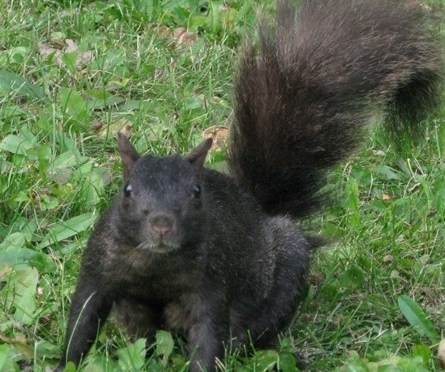
An eye-catching squirrel at Whirlpool State Park with all black fur; Photo by M. Drahms OPRHP

Chances are if you have ever visited Niagara Falls State Park or any of the neighboring parks in the region you’ve seen what at first glance appears to be the shadow of a gray squirrel. That is, until it moves and starts chattering. Of the many types of squirrels in New York State, the black squirrel is not mentioned in most field guides but it most closely resembles the size and shape of the gray squirrel. It also eats the same diet of seeds and nuts with some fruits, fungi, and the occasional insect mixed in.

Image 2
A bounty of nuts and acorns are found by squirrels at State Parks along the Niagara Gorge. Photo by M. Drahms OPRHP

There is a good reason for the similarities in appearance and habits as they are, in fact, the same species. The black squirrel is a color phase of the Eastern Gray Squirrel (Sciurus carolinensis), also known as a melanistic variant. Unlike species that change color seasonally, like the long-tailed weasel, these rodents retain the dark coloration their entire lives. The black fur is caused by a genetic mutation that is passed from generation to generation.

Image_Many Squirrels
Both colors of Gray Squirrel can be seen throughout the year in parks along the Niagara Gorge. Photos by A. Weibel & M. Drahms OPRHP

During winters in Western New York the ground is normally covered in a layer of snow and ice that would make the darker black squirrel easier prey for predators such as coyote, owl and domestic cats. However, a darker coat means more absorption of heat energy from the sun and so less energy used by the animal itself. In the end, the two seem to cancel each other out and gray and black squirrels hold equal dominance around the Falls.

These adorable acorn gatherers garner much attention from the visitors who come to see the beauty of Niagara Falls, hike the Gorge Trail at Whirlpool and Devils Hole State Parks, or ice skate at DeVeaux Woods State Park.

Image4
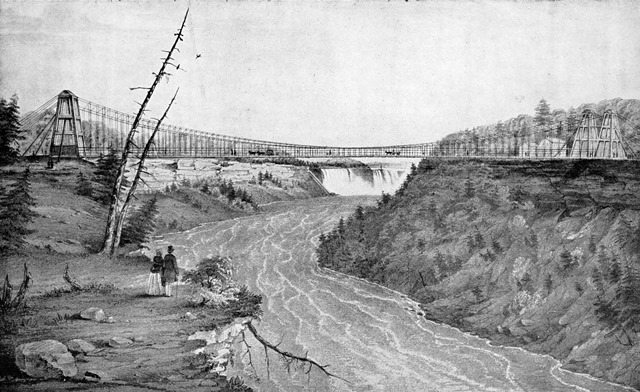
A lithograph created by Charles Parsons of Charles Ellet’s footbridge (completed 1848) commons.wikimedia.org/wiki/File:Charles_Parson_-_Niagara_Falls_Suspension_Bridge.jpg

As to when the variation first appeared in the area around the falls, it is largely unknown. Though there are historic records of black squirrels in the new world, there are none specifically referencing our area. And so, we are left with the urban legends. So the story goes, as the locals tell it, there were no black squirrels in Niagara Falls USA in the early 1800s, but there were across the river in Canada. When the first suspension bridge was built across the Niagara River, with the help of a young boy and his kite, the avenue was open and the black squirrels crossed the river to the USA. Whether the story is true, or whether it was simply over time that the genetic variation showed up in Niagara Falls too, we may never know. But when next you visit, make sure to keep an eye out for this not so common creature.

Post by Angelina Weibel, OPRHP, Environmental Educator, Niagara Region

Does Parks do Invasive Species Work in the Winter?

One might think State Parks’ Invasive Species Staff are sitting around with their feet up, taking a break from the relentless tasks of the summer field season. That’s not at all the case. Winter months are filled to the brim with “To-Do” Lists. The seasonal break in the field season allows for more office related tasks, such as wrapping up the previous field season, checking data for quality control, working with volunteers, and prioritizing, planning, and preparing projects for the upcoming field season. These tasks require significant collaboration with other Park staff, NY Natural Heritage Program (who provides data and advice on protecting rare species and natural communities) and other agencies involved in invasive species management. But putting in the effort and office time early in the season truly pays off to make for a successful field season.

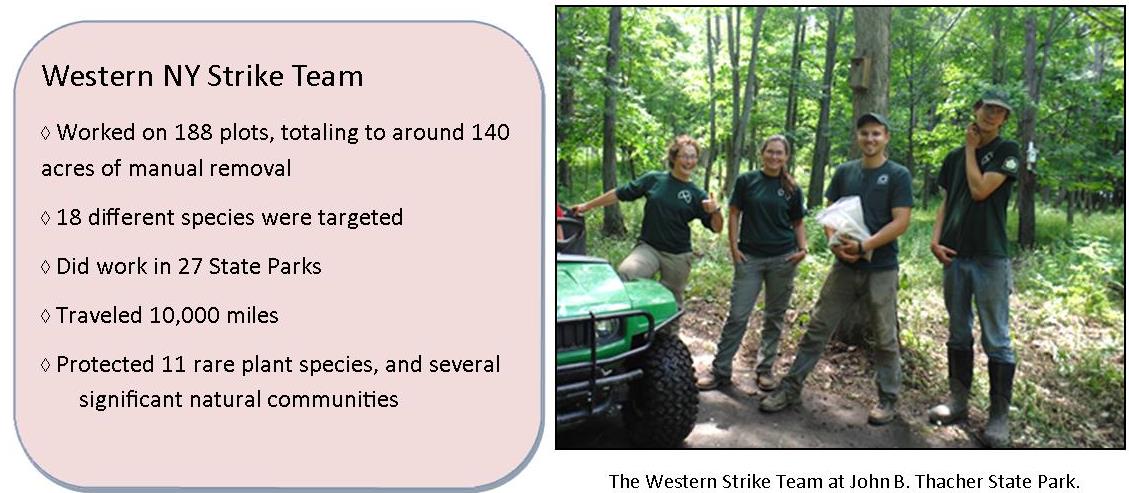
For the summer of 2015, we had two Invasive Species Strike Teams and one Forest Health Specialist Team working on State Park lands. The two strike teams each covered half the state, the Eastern Team covering from Long Island to Lake Champlain. The Western Team covered the State Parks west of the Binghamton-Syracuse line. The Forest Health Specialists also focused on Western NY, coming as far east as the Finger Lakes Region.

Check out what we accomplished this past year!

Western Strike Team
Photo by Alyssa Reid

Eastern Stike Team
Photo by Alyssa Reid

Forest Health
Photo by Alyssa Reid

That is a lot of effort, both on the planning end, and by our hardy crew members! Without the hard work and commitment to excellence of our seasonal staff, the program would accomplish only a tiny fraction of our goals. Their eyes on the ground keep us informed of the details of each treatment area and provide us with feedback on the success or any recommendations for further actions. We listen closely to feedback from the crews and other Parks staff and partners to continue to improve and strengthen the Invasive Species Program each year.

So even though there is snow on the ground and temperatures are cold, we are still working on invasives issues and preparing for what we hope to accomplish in the upcoming field season.

For more information on the State Parks Invasive Species Strike Teams, see this blog post.

For more information on the State Parks Forest Health Specialists, see this blog post.

Post and photos by Alyssa Reid, State Parks Invasive Species Field Project Specialist

Sweet Days Are Coming

In the northeast, winter days can seem to drag on after the holiday season. Snowstorms seen to occur every three days and a constantly blowing wind chills the air to -10oF. It’s the type of weather that makes you wonder why humans don’t hibernate. While we can’t control the seasons; winter will always bring shorter days, the moon will revolve around the earth and the earth will revolve around the sun, we can change our mindset and that is what maple sugaring is about.

The maple sugaring season is almost a spiritual experience that lifts you through the last doldrums of winter. It ignites every sense. Imagine hearing the taps of sap into a metal bucket hung on a tree, the sweet steam lifting off the evaporator immersing your nose in warmth, the crackling fire fueling the evaporator, and of course the sweet taste of liquid gold. The whole experience does not occur unless the right weather conditions are present.

The release of sap in the spring is a sign that the trees are finally waking up from their winter rest. The ideal sap running conditions are warm days and cold nights. This temperature fluctuation causes the sap to run up and down the tree each day. The maple season may only last for as little as ten days, but they are an intense ten days.   Intense because of the time needed to collect and boil down the sap, and it is the boiling down of the sap that takes the most time.

Inserting_the_tap
Tapping a maple tree, https://commons.wikimedia.org/wiki/Category:Maple_syrup_production#/media/File:Inserting_the_tap.jpg

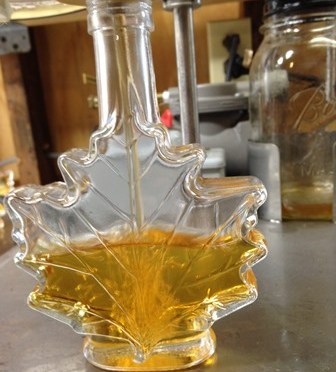
Do you ever wonder why pure maple syrup tends to cost five times more than pancake syrup? It because it takes 40 gallons of sap to make one gallon of pure maple syrup! There is a lot of energy involved to boil down the sap that contains 2% sugar to the sticky syrup containing 66% sugar content. Everyone around helps collect sap, tend to the evaporator, and bottle syrup. Tremendous effort goes into each gallon of syrup and it is all worth it in the end. There is no better feeling than creating something from start to finish and enjoying your success with the ones you cherish.

There are signs in nature that tell you when the maple season is over. The temperature stays above freezing during the night ceasing the sap to run up and down the tree. The buds on the trees start to burst open and the sap turns cloudy and is less sweet. A natural siren goes off-spring peepers serenade the woods as they emerge from their winter hibernation. It’s a bittersweet ending for the sugaring season. The transformation of sap to syrup is over for the year, but now the forest has come back to life and it is time for spring.

Learn more about maple sugaring by attending a program at a state park near you!

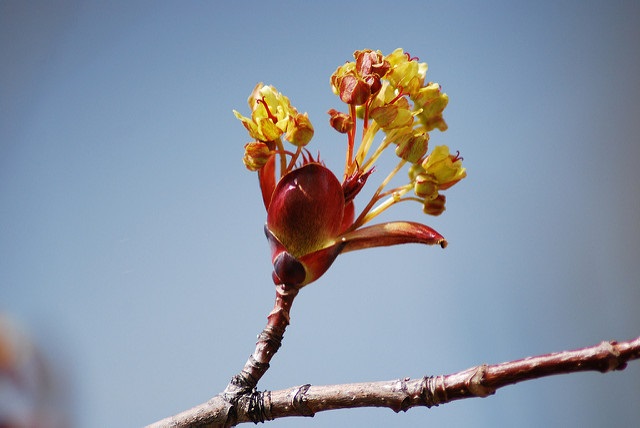
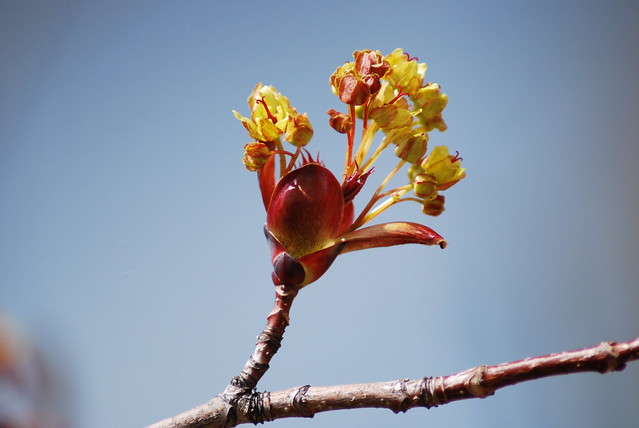
Flower
Sugar maple flower, http://farm4.staticflickr.com/3380/3497922622_2de9730b02_z.jpg

Post by Marlena Vera-Schockner, SCA Member served at Taconic Outdoor Education Center at Fahnestock State Park, 2015

Celebrating 150 Followers!

Today, we celebrate 150 followers of the New York State Parks Nature Times Blog!

Fireworks at Niagara Falls State Park. Photo courtesy of OPRHP.

To date, the blog has featured more than 110 posts than span a myriad of topics including park history, endemic and endangered species, special studies, quizzes, scavenger hunts and more. More than 30,000 visitors from 40 different countries around the world have visited the blog.

To become a follower, visit the blog homepage and click on the button in the upper left hand corner, just under the logo.  Tell your friends and family to “follow” the Nature Times Blog, and they’ll never miss a post!


The official blog for the New York State Office of Parks, Recreation & Historic Preservation