Nature in Autumn: What to Look out for in the Ecological World

The days start getting shorter, the nights are cooler, and the leaves start to turn vibrant colors. Fall is a time of change and when plants and animals start to prepare for the long winter months ahead. It is a great time to get outdoors and observe nature’s seasonal changes.
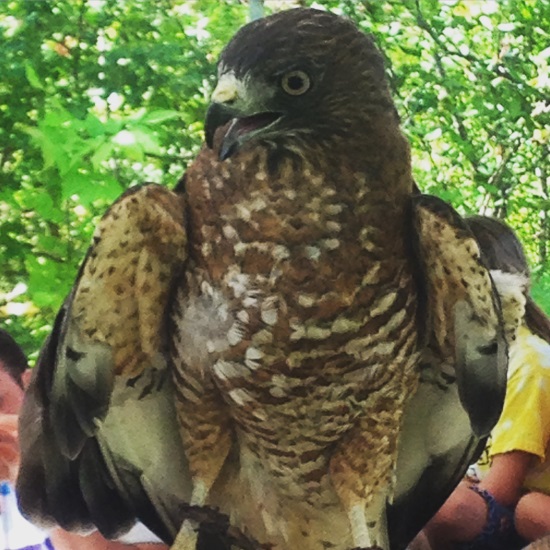
Broad Winged Hawk. Photo by April Thibaudeau, Thacher Park.

One of the Northeast’s finest wildlife spectacles happens in fall, the autumn migration of hawks. Beginning in early September until the end of November, broad-winged hawks, falcons, eagles, kestrels, harriers, and more travel from their northern breeding grounds south due to scarcity of food during the winter. The birds soar on thermal updrafts, minimizing energy expenditure. A group of birds in a thermal is termed a “kettle” and may resemble a spiral of ascending birds. The migrators utilize these updrafts to glide over ridges and down the coast to regions as far as Central and South America where food is plentiful. Thacher Park hosts an annual Hawk Migration Watch at the escarpment overlook where visitors can help count passing birds and learn more about the species they see.

Burr Oak nut showing the cupule of the acorn, which protects the fruit while it grows and matures. Photo by Ben VanderWeide, Oakland

Plants start dispersing their seeds in the fall by way of wind, water, animals, and even explosion or ballistic seed dispersal. It all starts at the end of August when blackberries, mulberries, and other fleshy fruits start to ripen and fall to the ground. These fruits contain small hard seeds and are dispersed after passing through the digestive system of animals, but make a yummy treat for us!  Acorns are theseeds of oak trees and sprout rapidly after falling to the ground. Squirrels can be seen scurrying around this time of year, storing nuts to eat later in the winter. Luckily for trees, squirrels only find about 30% of the nuts they hide – allowing more seedlings to sprout in the spring.
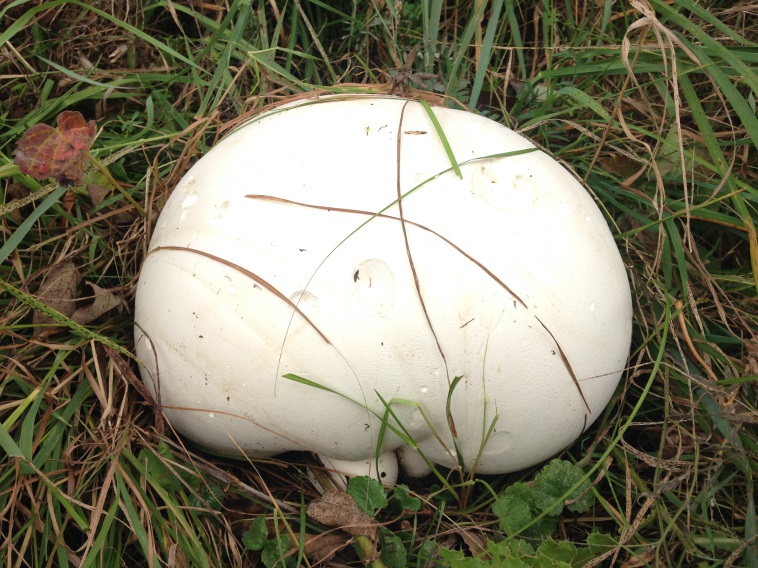
Puff ball mushroom. Photo by April Thibaudeau, Thacher Park.

A warm summer leading to damp September days is the perfect combination for mushrooms to sprout throughout the forest floor.  Fungi are made up of a vast underground network called mycelia, which helps decompose leaf litter, dead animals, and rotting wood. The mushrooms we see above- ground are the fruiting bodies of the mycelium and are composed of spores that disperse in the fall to continue the growth of their kingdom. Puff balls, hen of the woods, oyster mushrooms, and fly agaric are just a few of the mushrooms to look for on a forest hike. It is important to have a great deal of knowledge on mushrooms before picking any to eat, as some can be fatally poisonous.

For fall hikes happening at Thacher State Park check out our Program Calendar.

 Post by April Thibaudeau, Student Conservation Association Intern, Thacher State Park

For further information about these topics please consult:

Hawk Migration

http://www.hawkmountain.org/raptorpedia/migration-path/page.aspx?id=352

Seeds and Nuts

http://bioimages.vanderbilt.edu/pages/fruit-seed-dispersal.htm

Fungi
http://www.countrysideinfo.co.uk/fungi/struct.htm

http://www.fs.fed.us/nrs/pubs/gtr/gtr_nrs79.pdf

Things That Go Squawk In The Night

Ooo Halloween is just around the corner. Soon you may be venturing outdoors at night for trick-or-treating or a cool evening stroll. While you are outdoors you just might hear an eerie squawk, squeak, or snort coming from the woods. What is making that sound? In the darkness it is impossible to see, but if you pause for a moment and listen, you might be able to figure out what animal made the sound.

Some familiar autumn night sounds include:

Field Cricket, By Cody Hough (Own work) [CC BY-SA 3.0 (http://creativecommons.org/licenses/by-sa/3.0) or GFDL (http://www.gnu.org/copyleft/fdl.html)], via Wikimedia Commons
Field Cricket, By Cody Hough (Own work) [CC BY-SA 3.0 (http://creativecommons.org/licenses/by-sa/3.0) or GFDL (http://www.gnu.org/copyleft/fdl.html)%5D, via Wikimedia Commons
The male Field Cricket song is a series of short chirps, 2-3 per second. Each chirp consists of 3-5 pulses, which are made when he closes his forewing (front wing). Male crickets call from burrows or cracks in the soil. If Halloween is a warm evening, crickets may be calling in fields and other grasslands. Listen to field crickets.


Spring Peeper, Lilly Schelling, NYS OPRHP

Male Spring Peeper frogs normally sing their sleigh bell like mating call in spring, but a few will also sing in the fall in woodlands near small ponds or wetlands. Listen to spring peepers.

More unfamiliar sounds include:

Eastern Screech Owl, By Greg Hume (Own work) [CC BY-SA 3.0 (http://creativecommons.org/licenses/by-sa/3.0)], via Wikimedia Commons
Eastern Screech Owl, By Greg Hume (Own work) [CC BY-SA 3.0 (http://creativecommons.org/licenses/by-sa/3.0)%5D, via Wikimedia Commons
Screech Owls are little owls (about 8” long) that pack a loud call! In 1845 Henry David Thoreau described the call of the screech owl as “A most solemn graveyard ditty, the mutual consolation of suicide lovers remembering the pangs and delights of the supernal love in the infernal groves, …… Oh-o-o-o, had I never been bor-r-r-n.”
Our only small owl with ear tufts, both males and females screech owls sing. A common sound is “an even-pitched trill, often called a “bounce song” or tremolo; and a shrill, descending whinny.” (All About Birds, Screech Owl). Occasionally mated pairs will sing to each other. Listen to a screech owl.

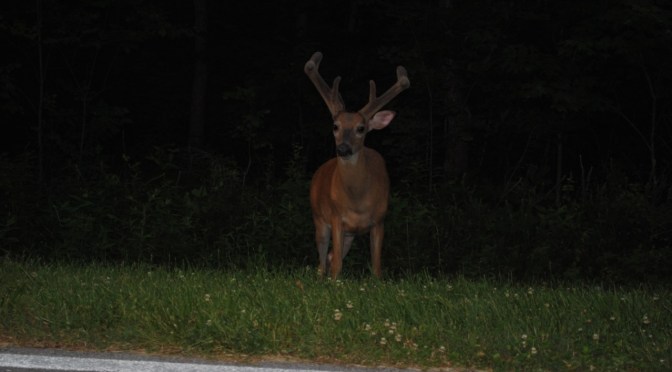
White-Tailed Deer, Lilly Schelling, NYS OPRHP

The otherwise mute White-Tailed Deer will snort when startled. Listen to a white-tailed deer snort. This is one of the few sounds that deer make. Bucks use a series of wheeze-grunt-snort to assert dominance during the breeding season and does and fawns communicate through bleats and grunts.

Raccoon, By D. Gordon E. Robertson (Own work) [CC BY-SA 3.0 (http://creativecommons.org/licenses/by-sa/3.0) or GFDL (http://www.gnu.org/copyleft/fdl.html)], via Wikimedia Commons
Raccoon, By D. Gordon E. Robertson (Own work) [CC BY-SA 3.0 (http://creativecommons.org/licenses/by-sa/3.0) or GFDL (http://www.gnu.org/copyleft/fdl.html)%5D, via Wikimedia Commons
Raccoons, those masked, ring-tailed animals, produce a Variety of vocalizations including screams, growls, and whistles. One sound is similar to a screech owl’s call. Listen to a raccoon.


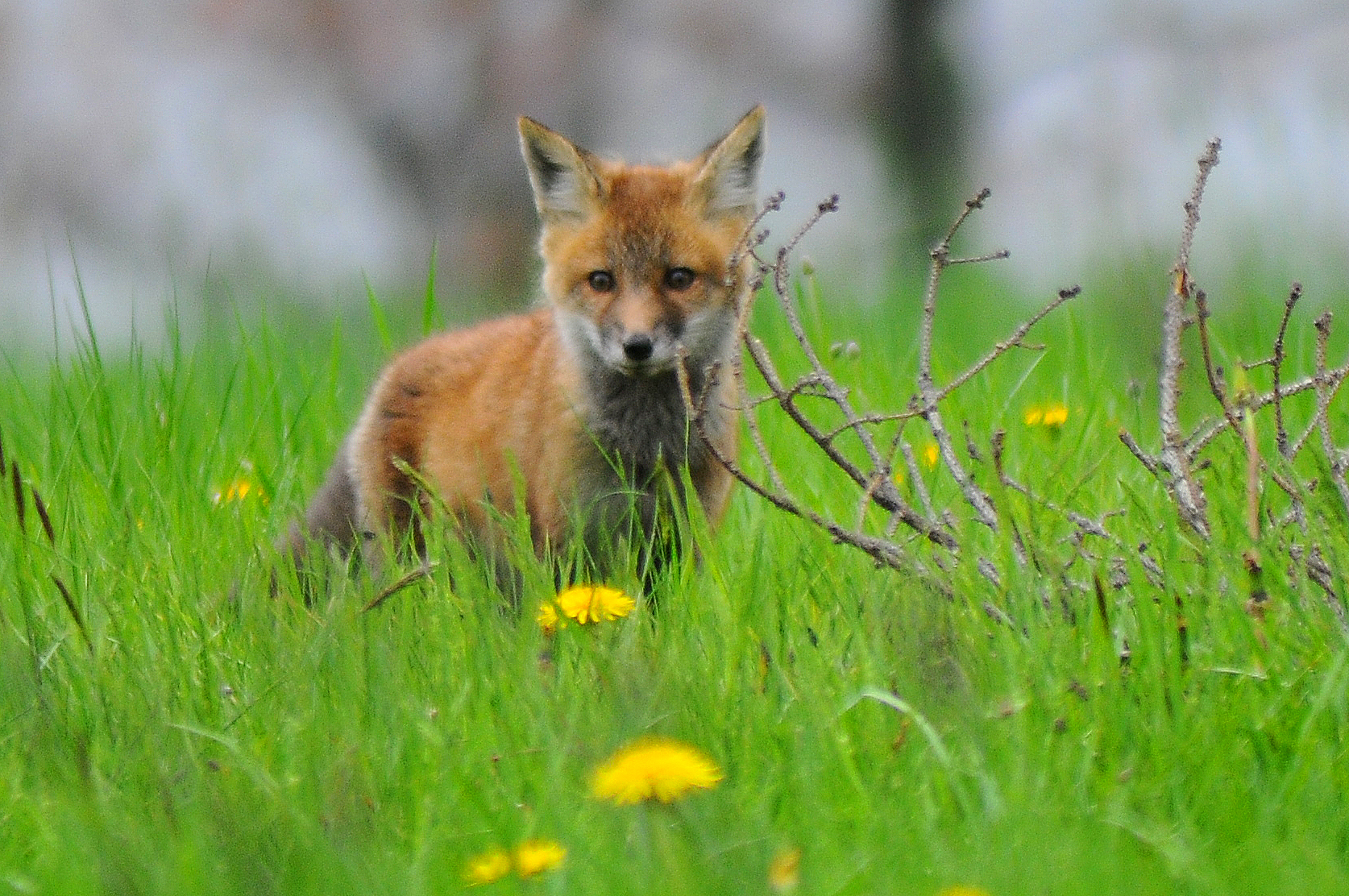
Red Fox Kit, NYS OPRHP

Adult Red Foxes make 12 different sounds; kits, baby foxes, make eight different sounds. These sounds span five octaves and are divided into contact calls and greeting calls. Contact calls, sounds made when foxes are at a distance from one another; start off as a “wow wow wow.” As the foxes get closer, the call changes to a three-syllable call that sounds similar to clucking chickens.
A submissive fox will produce a shriek or high-pitched whine when it greets a dominant fox. And during breeding season males and females may emit a rejection call – a rattling throaty sound termed “gekkering.” Listen to a red fox.

Sources:

Cornell Lab of Ornithology All About Birds http://www.allaboutbirds.org/
Cornell Lab of Ornithology Macaulay Library, http://macaulaylibrary.org/
New York State Department of Conservation, http://www.dec.ny.gov/animals/263.html
Wikipedia, https://en.wikipedia.org/wiki/Main_Page

Post by Susan A Carver, OPRHP.

Painted Turtles of Point Au Roche State Park in Clinton County, New York

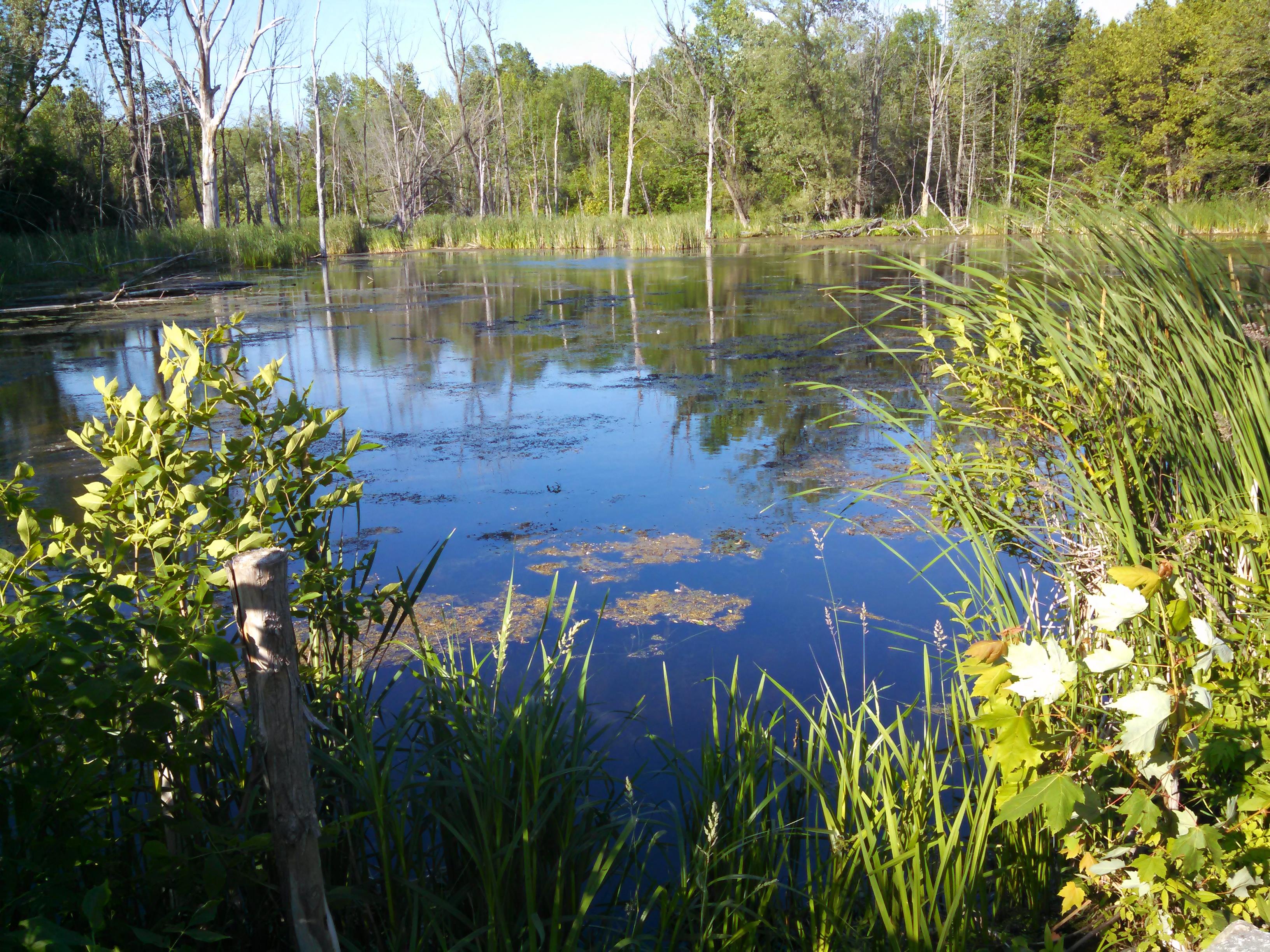
Lower pond site at Point au Roche Park where all 4 turtle hoop traps are set. (Danielle Garneau)

Point Au Roche State Park is a beautiful and diverse park with a lot to offer visitors. By visitors we’re talking both the reptile and human kinds.  Not only does the park offer spectacular views of Lake Champlain for park visitors, it also provides great habitat for painted turtles!

Beginning in September 2012, two SUNY Plattsburgh students and Professor Danielle Garneau began their first field experience handling painted turtles. The goal of the project was to compare sex ratio and age structure of turtle populations in both urban, as well as rural ponds in Clinton County, New York. This research is part of the Ecological Research as Education Network’s (EREN) on-going TurtlePop project that is a collaboration among numerous colleges across the country.

Participants perform the same experimental protocol to determine if a greater number of adult males exist within urban turtle populations, and if this is a nationwide trend. The decline in young females is thought to result from their high rate of road kill when laying eggs at roadsides. An additional cause of death for urban painted turtles is an increase in the abundance of mesopredators (e.g., skunks, raccoons, opossum, foxes) who raid nests for eggs. Since starting, the TurtlePop project has offered field research experiences to many SUNY Plattsburgh students.

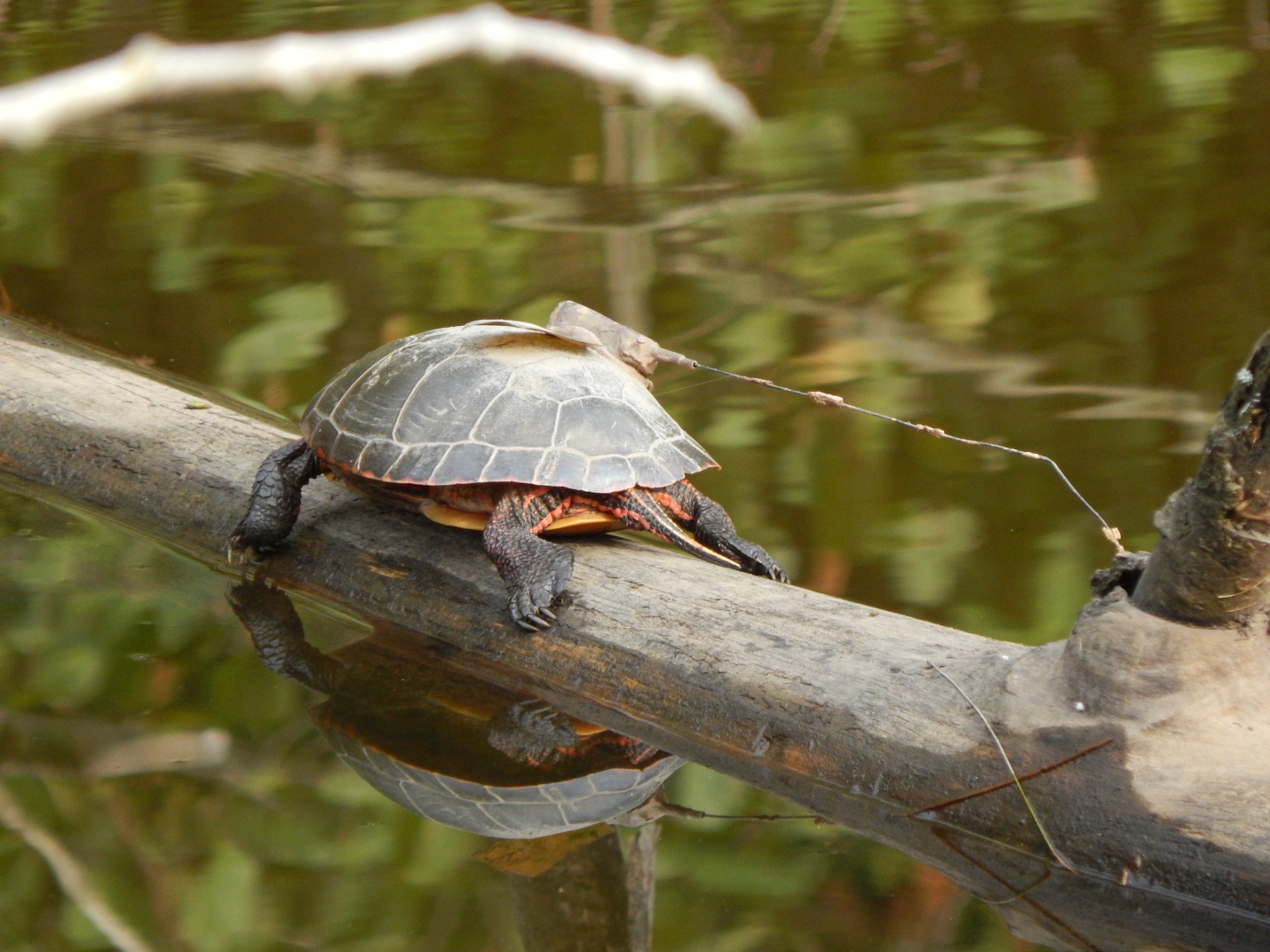
Painted turtle basking on a log with VHF transmitter glued to carapace (top of shell) at the golf course site (urban). Transmitters are used to track animal locations and note movement behavior, nest site selection, and overwintering spots. Note the shedding of scutes (keratin layers) on the top of the turtle shell, which occurs in the middle of summer as turtles grow. Days later this transmitter device fell off the turtle and was relocated along the pond shore. (Danielle Garneau)

About a year into the project, as participants grew ever more curious, a radio-telemetry dimension was added by placing a VHF transmitter on the top of turtle’s shells in order to monitor their movement around a gold course pond complex (urban site) in the city of Plattsburgh. Findings suggest that city turtles do not tend to wander far from the shores of their pond and commonly used basking sites (e.g., downed trees, rocks).

In the summer of 2015, with the help of Point Au Roche State Park Naturalist and SUNY Plattsburgh Ecology alumnus Gillian Dreier-Lawrence, park visitors and college students had the opportunity to participate in and contribute to this growing collaborative research effort at Point Au Roche State Park. We are learning that Point Au Roche State Park has high turtle abundance; approximately 33 individuals were caught over three months of trapping in the lower ponds. Plans to further investigate the turtle population at Point Au Roche are in the works, as the  large number of turtles found indicate that  the population size at the park is likely quite large, only 11 marked turtles have been recaptured so far!

Post by Danielle Garneau, Associate Professor at SUNY Plattsburgh

Useful websites:

http://www.nysparks.com/parks/30/details.aspx

https://www.facebook.com/Friends-of-Point-au-Roche-State-Park-116729181851239/timeline/

http://erenweb.org/new-page/turtle-pop-project/

https://www.facebook.com/#!/ErenTurtlePop?fref=ts

Note: All photos were taken by Danielle Garneau and permissions are granted to use in press.

FORCES : College Students Support Stewardship in New York State Parks

As the summer months wind down, the FORCES Program staff of the Central and Finger Lakes Regions are busy both reflecting on the last few months and making plans for the next academic year.

FORCES stands for “Friends of Recreation, Conservation and Environmental Stewardship”, and the FORCES Program specifically focuses on building long-term, mutually beneficial partnerships between local state parks and colleges. Currently this includes one-day volunteer events, FORCES clubs at six colleges, dozens of stewards between the two regions, partnerships with faculty members and college administration, projects in over twenty parks and historic sites, and involvement with fourteen colleges and universities within the Finger Lakes and Central Regions.

This summer has been an exciting one, with the “FORCES family” including 37 stewards and seasonal employees! The FORCES interns and seasonal employees started together in June with the first annual “Trainapalooza,” which was held this year at Robert H. Treman State Park in the Finger Lakes Region. The stewards gathered for a two day training on invasive species identification and removals, iMap Invasives training, an overview of the geologic and human histories of the area, interesting features of some of the parks, and strategies for outreach and interpretation. The group also camped overnight at the park, and got to know each other while playing Frisbee, solving riddles, and enjoying s’mores.

After they were trained, the stewards separated again to begin projects throughout the two regions. Many projects focused on invasive species removal; stewards worked to remove water chestnut, pale swallowwort, slender false brome, and many other species of invasive plants. Other projects included the creation of a video about the FORCES program, historical research, assistance with the ongoing surveys for the Chittenango Ovate Amber Snail at Chittenango Falls State Park, water quality monitoring at Selkirk Shores State Park, and trail blazing at Two Rivers State Park… the list goes on and on!

The upcoming academic year will bring more excitement as FORCES welcomes new and returning stewards and club members. The semester started with the New York State Fair, where FORCES annually engages the public in building bluebird boxes- they assembled 1,250 boxes just this year! To date, FORCES at the State Fair has hosted over 180 students and involved 8 colleges. Plans are also in motion for the first annual FORCES Membership Gathering, which will take place in October and combine trainings with celebrations for club members, stewards, seasonal staff, and ambassadors- all members of the “FORCES family”.

In the spring, FORCES will hold its second annual Leadership Summit, which assembles club officers and FORCES “Ambassadors” from all FORCES schools to plan and strategize for the growth of the FORCES Program. The event was a huge success last April, with the FORCES staff being (again) blown away and inspired by the passion and dedication of the students.

Keep an eye out for FORCES stewards as you visit the parks, and chat with them about the projects they are working on. They’re accomplishing big things!

For more information visit our new web page.

Post by Becky Sibner, FORCES Program Specialist for the Finger Lakes Region.


The Mysteries of Fall Foliage Revealed

Have you ever wondered what makes the leaves change color in the fall? Or why some years are more vibrant than others? It is quite a fascinating phenomenon, and it all starts with the seasonal temperature and day light hour change. In the fall, the days become shorter and the evenings become cooler. This is what triggers deciduous trees (trees that lose their leaves in the winter) to begin their process of preparation for the winter months to come. This is also why the foliage changes color around the same time every year.

abcission layer
Photo of abscission layer and leaf detachment. Photo by Lilly Schelling.

It starts with the expansion of the abscission layer between the stem and leaf, which slowly blocks the movement of water and sugar back and forth between the leaf and stem. This causes the leaf to lose the ability or resources to replenish chlorophyll, which gives leaves their green coloration. The chlorophyll rapidly breaks down and we are left with xanthophylls and carotenoids, which are responsible for the yellow and orange pigments you see on trees like aspen and birch. These pigments are usually present in the leaf throughout the growing season but are masked by the green pigment of the chlorophyll.  Anthocyanins are responsible for red and purple coloration and are created by the buildup of sugars trapped in the leaf. As fall progresses into winter all of the other pigments break down, as the chlorophyll did, and the only pigment that remains are the tannins, which are responsible for the brown color of the fallen leaves – though some trees retain their brown leaves throughout the winter, such as oak and beech.

Factors that affect the color and duration of fall foliage are temperature, sunlight and moisture. Ideal conditions for colorful fall foliage are a good growing season followed by dry, warm, sunny days and cool nights. If there was stress in the growing season, such as a drought or flood, the abscission layer may form early and the leaves will fall off before changing color. Additionally, too low of temperatures (freezing) in the beginning of fall will rapidly break down the products responsible for bright colors and the only pigment left will be brown. Other factors that can affect colorful fall foliage are heavy rain and windy storms, as these conditions will cause the leaves to fall.

When you are out admiring the fall colors this year, try to identify which pigment products are responsible for the colors you are seeing on the trees. A great way to view the fall foliage is from a canoe or kayak, but remember to wear your personal floatation device as the water will be chilly! The New York Fall Foliage Report is a great tool for tracking the color changes across the state: http://www.iloveny.com/seasons/fall/foliage-report/#.VgQGwstVhBd.

References:

The United States National Arboretum

Post by Lilly Schelling, OPRHP.


The official blog for the New York State Office of Parks, Recreation & Historic Preservation