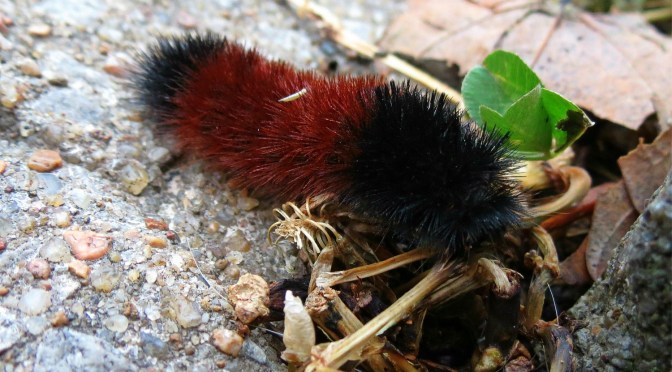
Finding a banded woolly bear caterpillar during a walk in the woods leaves no doubt that autumn is upon us. These familiar black and reddish-brown caterpillars are larval Isabella moths.
By Broly0 (Own work) [CC0], via Wikimedia Commons.
The woolly bears that we see in the fall are the second generation of woolly bears for the year; the first generation hatched out in May. This second generation of woolly bears emerged back in August. Since then , they have eaten leaves from a variety of plants from grasses to clover to trees and sunflowers. Once the cold weather hits, the woolly bear finds a sheltered spot like rotted log, or under a rock, or in a pile of leaves, to overwinter. When the temperatures drop below freezing, woolly bears also freeze. Fortunately woolly bears have a cryoprotectant, a natural sugar-based antifreeze which protects the caterpillar’s tissues from being damaged when it freezes. In spring, woolly bears emerge from their sheltered spot, eat a few more leaves then make their cocoons and undergo metamorphosis to become an Isabella moth.
By Andy Reago & Chrissy McClarren [CC BY 2.0 (http://creativecommons.org/licenses/by/2.0)%5D, via Wikimedia Commons.Folklore has it that woolly bears predict the severity of the upcoming winter based on the proportion of black and reddish brown banding on the caterpillar’s body. A thin reddish brown band means we are in for a tough winter.
But is this folklore true? Dr. C. H. Curran, curator of insects at the American Museum of Natural History in New York City (1928-1960) traveled to Bear Mountain State Park in 1948 to find out. On a single day, he gathered as many woolly bears as he could find, compared the reddish brown segment to the black segment, then reported his findings and a winter weather prediction to a reporter at the New York Herald Tribune. Dr. Curran continued his study for eight more years and was never able to conclude whether the woolly bear was able to predict the winter.
More recently scientists have found that the size of the reddish-brown band increases as caterpillar matures and that wet weather increases the size of the black bands.
While woolly bears may not be an accurate forecaster of the upcoming winter, they are still a delight to see during a visit to a park. Perhaps you’ll see one curled in a ball or looking for the next leaf to eat.
The Ganondagan State Historic Site located in Victor, NY boasts a historically accurate 17th century longhouse and will be opening a new Seneca Art and Culture Center this fall. However, there is a hidden gem at this historic site that not many realize exists! It is the Grassland Management Area at the corner of Boughton Hill Road and School Road which covers around 80 acres (over 60 football fields!) and is one of the most intriguing interpretive areas at the site!
South facing panoramic view of one halve of the grassland management area. Warm season grasses dominate and give off the blue/red hue, while goldenrod provides a yellow color in the lower height range. Line of goldenrod helps to indicate one of the areas not originally seeded for the project, this area is overrun with beautiful purple lupine blooms in the spring and early summer! Photo by Whitney Carleton.
Southwest facing photo of eye-level view of the grassland management area. Big bluestem grass showing dominance in this area, reaching heights of 7 feet or more. Photo by Whitney Carleton.
In 2009 OPRHP restored 67.4 acres of the Grassland Management Area to represent oak opening communities in both plant composition and spatial arrangement. The Grassland Management Area has since spread to fill around 80 acres with the native plants seeded back in 2009.
The idea behind creating an oak opening came from Ganondagan’s past. Journal entries from French and English visitors to the site in the mid to late 1600’s described the landscape they saw when visiting the flourishing Seneca town of Ganondagan. Their descriptions of oak openings were used to create a scene that can transport the viewer back in time to when the Seneca were living at Ganondagan 400 years ago!
Oak openings are fire-dependent savannahs (grasslands) dominated by oak trees and are rare ecological areas, especially in upstate New York. The oak opening created at Ganondagan consists of warm-season grasses (grasses that thrive in the heat of the summer), wildflowers and large oak trees along the surrounding wood edge. Spring fire management promotes lush growth of warm-season grasses and oak trees. Controlled fires also suppress grassland succession (gradual changes in plant species in an ecosystem), provide fertilizer in the form of plant ash, reducing plant height to allow sunlight to reach new (young) plants and hinder the development of invasive species. The fire management of oak openings such as the Grassland Management Area have historically maintained their species composition mainly due to wildfires, to utilize this historic management technique OPRHP will be conducting a prescribed burn. A prescribed burn is a well-planned fire managed by trained firefighting professionals with specific plans in place to keep smoke high and away from the public.
Proper permits and permissions have been received for OPRHP staff to conduct a prescribed burn at the Grassland Management Area in spring of 2016. The burn will cover 20 acres in the first year and help maintain the plant communities of the Grassland Management Area that are representative of the Town of Ganondagan in the 17th century.
When you visit Ganondagan’s oak opening, look for native plants include big bluestem (Andropogon gerardii), little bluestem (Schizachyrium scoparium), Indian grass (Sorghastrum nutans), black-eyed Susan (Rudbeckia hirta), tall white beardtongue (Penstemon digitalis), smooth blue aster (Aster laevis), New England aster (Aster novae-angliae), zigzag aster (Aster prenanthoides), and Indian hemp (Apocynum cannabinum).
Seed heads of Indian grass (left) and big bluestem grass (right). It is easy to tell the different species apart in these tall warm-season grasses! Photo by Whitney Carleton.
Throughout the year, the grassland at Ganondagan are a delight to visit. In spring, it is a lush open area of low, green grasses where chirps and buzzes can be heard above anything else. In the late summer it transforms itself into a beautiful 8-foot tall wonderland of wildflowers and golden brown grasses with different seed head patterns, where you can watch even the slightest of breezes wave through all 80 acres!
Post by Whitney Carleton, OPRHP. Photos by Whitney Carleton and Alexis Van Winkle, OPRHP.
Forest Health Specialists are an important part of New York State Park’s Invasive Species Management Team. Their work helps protect native plants, wildlife and forests that are currently being threatened by two non-native invasive species: Hemlock Woolly Adelgid (HWA) and Emerald Ash Borer (EAB). Although these insects are very different from each other in appearance and behavior, they both cause significant destruction and mortality to their host trees.
Hemlock Woolly Adelgid on hemlock stems. Look for small, white, cotton-like blobs on the underside of hemlock branches, right at the base of the needles.
An adult Emerald Ash Borer emerging from an ash tree. Note the “D” shaped hole the insect has created, which is a sure sign you’ve found EAB.
What do Forest Health Specialists Actually Do?
The Forest Health Specialists are seasonal employees that travel throughout New York State conducting invasive species surveys and monitoring infestations in various Parks. They have training in field biology, forestry, and tree climbing. The team of two camps at the park of interest while completing their work. Surveys involve lots of hiking and investigating trees that look to be in poor health, taking photos, and recording information on location and observations made at each site.
Although hiking in the woods isn’t a bad way to spend a work day, monitoring infestations of HWA is where the job really gets interesting. Specialists need to collect canopy samples from hemlock trees in order to see if insect numbers are declining or increasing. So, using a giant 8-foot slingshot, a line is shot high into the tree to a branch anywhere between 50 to 90 feet above the ground. Then a climbing rope is attached and pulled into the canopy and the fun begins! The Specialist, equipped with a harness and two ascenders (the name for special clips), climbs the rope upwards into the treetop. Climbing can be highly physical but is always rewarding.
A Forest Health Specialist working their way up to the canopy using a climbing harness that is attached to the rope. Climbs typically take about an hour.A bird’s eye view looking down from the top of a hemlock. The tiny speck at in the bottom (in the green shirt and white cap) is the other team member!
So What’s the Goal?
The goal of this program is to get a better grasp of where these invasive species are spreading, assessing their impact on the forests, and ultimately taking action to slow their spread and keep their numbers under control. It also allows biologists and managers to anticipate other impacts to wildlife or rare species; to plan for potential avoidance or removal of hazard trees along trails; and to help others understand changes they see in the forest and landscape around us.
Of course a key component to the program’s success is you! By offering educational programs and volunteer opportunities, Forest Health Specialists also help people all over the state learn about invasive insects. The more people participating in and understanding invasive species in New York; the better chance we have of making a difference in our parks and our communities.
Remember, the best way to stop the spread of Emerald Ash Borer and Hemlock Woolly Adelgid is to avoid introducing them in the first place. Don’t move firewood, take caution in moving landscaping debris around, and clean equipment and vehicles if moving from a site with these pests to somewhere else!
For more information go to NYS DEC website: www.dec.ny.gov/animals/265.html
Post by Kelly Blood (OPRHP). Photos by Kelly Blood and Alyssa Reid (OPRHP).
It’s a summer day on the eastern shores of Lake Ontario. As a visitor walks down the beach they observe the sparkling of the water, the crashing of the waves, and the laughter of people as they enjoy the beach. Parallel to the water runs a series of fencing and signs that mark the perimeter of the remarkable dune ecosystem that lies just behind. This seventeen mile stretch of Lake Ontario is home to the most expansive dune ecosystem in the state of New York. The dunes are large sand hills that are held together by extensive plant root systems. They not only serve as habitat for a variety of species, but as a vital buffer between the power of Lake Ontario and the intricate system of ponds, marshes, and waterways that reside on the other side of the dunes.
The Dune Steward Program was established in the mid 1990’s to help protect this fragile dune system by maintaining the fencing and signs, removing litter, working with wildlife biologists and technicians on a variety of projects, and most importantly interacting and educating the public on the importance of the dunes. The stewards patrol the 17 mile stretch of coastline that includes El Dorado Nature Preserve, Black Pond Wildlife Management Area (WMA), Lakeview WMA, Sandy Pond Beach, Southwick Beach State Park, and Deer Creek WMA. Every summer the Department of Environmental Conservation (DEC) in conjunction with New York State Office of Parks, Recreation and Historic Preservation, The Nature Conservancy, and The Student Conservation Association (SCA), places three interns from across the country to work as dune stewards. Dune stewards are current students or recent graduates who have a background in environmental conservation.
Beach and dunes at Black Pond WMA. Photo by Jennifer Brady.
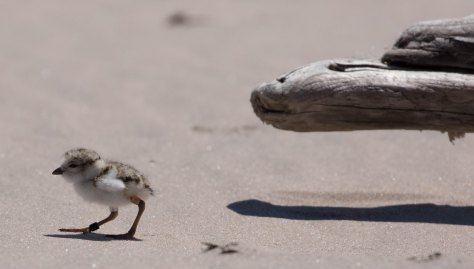
Along with the duties described above, this program allows the stewards the opportunity to be involved in other conservation efforts. Some of these projects include placing identification bands on birds, identifying and monitoring invasive and endangered species, bird surveys, educational events, and a variety of environmental training opportunities. This year the stewards were able to assist in the successful protection of the piping plover, a federally threatened shorebird species. This small bird lays its eggs in shallow scrapes on grassless beaches or dredged soil areas. This summer was the first time in over 30 years that the piping plover has nested on Lake Ontario. Stewards talked to visitors about the plovers and what they can do to assist in the protection of the bird and its chicks. They advised that visitors maintain a respectful distance and keep dogs on a leash when walking through areas where the plovers were nesting.
An adult piping plover and its day old chick. Photo by Elizabeth Truskowski, DEC.
One of the most important aspects of this program was public interaction and education. Each day visitors see the work that the stewards are doing and often approach the stewards to ask questions, express concerns, or even just to thank them for the work they are doing. “It is extremely rewarding to be able to share what we know about the dune environment and its inhabitants to hopefully be able to protect this area for the considerable future,” said Jennifer Brady, DEC dune steward.
Post by Jennifer Brady, DEC Dune Steward, Student Conservation Association (SCA).
Ah, Labor Day Weekend, a perfect weekend to take a hike through your favorite state park. If you do take a hike, try the Symbols of New York State Scavenger Hunt – let us know how you did.
Red-Spotted Admiral or White Admiral butterflies are one our newest state symbol, they were designated as the state butterfly in 2008. These butterflies are polytypic – meaning that there are different coloration patterns for this butterfly depending on where it lives. The white admiral variation has blackish blue wings with wide white band.
White Admiral. Plismo (Own work) [CC BY 3.0 (http://creativecommons.org/licenses/by/3.0)%5D, via Wikimedia Commons.The red-spotted admiral lacks the wide white bands and sometimes has a row of red spots along the top of the wing. Overall the wings are a dark blue color with a light blue dusting on the hindwing.
If you are hiking in northern New York, you will only see the white admiral. If you are hiking in any other part of the state, you will see either the red-spotted or white admiral.
Red Spotted Admiral, note the red spots on the top wings. FrigidNinja (Own work) [CC BY-SA 3.0 (http://creativecommons.org/licenses/by-sa/3.0)%5D, via Wikimedia Commons.Look for Eastern Bluebirds in Park grasslands and on utility wires. These birds are primarily cavity nesters, utilizing hollowed out holes in trees and man-made nest boxes to lay their eggs. Bright blue males are easy to spot while females are a bit more challenging with blueish grey plumage. Both have rust-colored chests and white bellies. Eastern bluebirds have been our state bird since 1970.
New York’s largest rodent, the Beaver, can be found in wooded streams, marshes, and along the edge of ponds and lakes. When you are walking near these wetlands, tree cuttings and chewed trees or shrubs near the shore is a great indicator that beavers are live nearby. If you hear a slap on a pond or marsh, the beaver has spotted you and has slapped its tail on the water to warn other beavers that you are around. If you can find a spot to hide and have time to wait, you might get a glimpse of these shy animals. Beavers have been our state mammal since 1975.
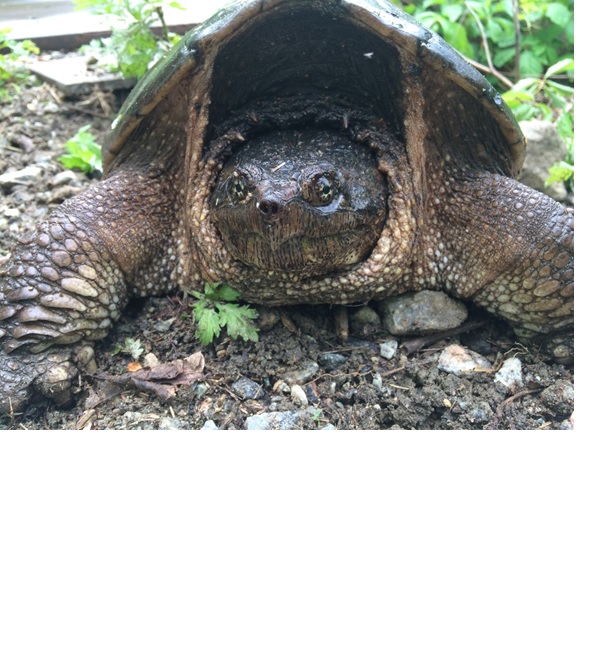
Snapping Turtles can be found in marshes, rivers, streams, lakes, and even in urban waterways. Our largest turtle, their shells can be upwards of 20” long and they can weigh up to 35 lbs. The upper part of the snapping turtle shell or carapace has three keels or ridges. The turtle’s shell can vary in color from tan, brown, olive gray or black. They have a long tail with saw-toothed ridges. Interestingly, snapping turtles have the smallest plastron (or bottom part of their shell) in proportion to their body of any turtle in New York State. Most of their defense strategy is their large size. Look for these turtles swimming slowly through the water with their head poking out of the surface or perched on rocks near the water’s edge. Remember to keep your distance from these turtles; their jaws have a powerful snap! Snapping turtles became our state reptile in 2006.
The rare Nine-Spotted Ladybug has been our state insect since 1989. Slightly bigger than a dime, these oval-shaped insects typically have nine-spots on their backs. If you think you found one, please take a photo, record where you found it and send all the information to The Lost Ladybug Project.
The Sugar Maple was designated as our state tree in 1956. The bark of a young sugar maple is smooth and dark gray; as the tree ages the bark becomes furrowed in uneven long plates. Sugar maples have easily recognized leaves that are between 3”-5” long and 3”-5” wide, usually with 5 shallow ‘u-shaped” lobes. Perhaps you will see the leaves a few of these beautiful trees turning red or yellow during your walk.
And remember to stop and smell the Roses during your hike. If you do, perhaps you will see some late flowers on some of our native roses such as this Common Wild Rose. The flowers can be observed either individually or in small bunches. Look for the common wild rose along roadsides, fields, and salt marshes. Roses were designed our state flower in 1955; they are our oldest state symbol.
Common Wild Rose. magnolia1000 from Canada (Rosa virginiana) [CC BY 2.0 (http://creativecommons.org/licenses/by/2.0)%5D, via Wikimedia Commons.When you are done, why not enjoy some New York state goodies: milk, the state beverage (designated 1981); apple muffin, the state muffin (designated 1987); apple, the state fruit (designated 1976); or yogurt, the state snack (designated 2014.).

![By Sillyputtyenemies (Own work) [CC BY-SA 3.0 (http://creativecommons.org/licenses/by-sa/3.0) or GFDL (http://www.gnu.org/copyleft/fdl.html)], via Wikimedia Commons.](https://i0.wp.com/nystateparks.blog/wp-content/uploads/2015/09/woolly-bear-stairs.jpg?w=284&h=262&ssl=1 "Woolly Bear Stairs")
![By IronChris (Own work) [GFDL (http://www.gnu.org/copyleft/fdl.html), CC-BY-SA-3.0 (http://creativecommons.org/licenses/by-sa/3.0/) or CC BY-SA 2.5-2.0-1.0 (http://creativecommons.org/licenses/by-sa/2.5-2.0-1.0)], via Wikimedia Commons.](https://i0.wp.com/nystateparks.blog/wp-content/uploads/2015/09/woolly-bear-leaf.jpg?w=182&h=122&ssl=1 "Woolly Bear Leaf")
![By Broly0 (Own work) [CC0], via Wikimedia Commons.](https://i0.wp.com/nystateparks.blog/wp-content/uploads/2015/09/woolly-bear-circle.jpg?w=182&h=136&ssl=1 "Woolly Bear Circle")




![Female Eastern Bluebird. Sandysphotos2009 (20100410_16 Uploaded by Snowmanradio) [CC BY 2.0 (http://creativecommons.org/licenses/by/2.0)], via Wikimedia Commons.](https://i0.wp.com/nystateparks.blog/wp-content/uploads/2015/08/bluebird-female-e1441040406568.jpg?w=233&h=233&crop=1&ssl=1 "Bluebird Female")



![Sugar Maple leaves. Superior National Forest (Acer saccharum 2-jgreenlee) [CC BY 2.0 (http://creativecommons.org/licenses/by/2.0)], via Wikimedia Commons.](https://i0.wp.com/nystateparks.blog/wp-content/uploads/2015/08/maple_leaves-e1441040951626.jpg?w=233&h=233&crop=1&ssl=1 "Maple_Leaves")


 New York State Parks and Historic Sites Blog


