Everyone knows that honey bees are great pollinators, but there are so many more insects and animals that are also pollinators. In recognition of Pollinator Week (June 15 – 21), we introduce some of our native pollinators. Each day from April to mid-October, millions of bees, butterflies, moths, wasps, ants, beetles and a few other animals pollinate New York’s trees, shrubs, wild flowers, and agricultural crops while they are feeding on the plant’s pollen or nectar. By transferring the pollen from one flower to another flower, the plant can produce seeds and fruits (fruit in botanical terms includes most of what we call fruits, nuts, and vegetables). Food for us and food for all the animals in the wild depends on this. In fact, pollinators help to maintain healthy and diverse flora, fauna, and ecosystems across New York State and around the world.
Bees, like this Small Black Bee, are our premier pollinators. New York State is home to over 475 bee species. Bees like brightly colored blue or yellow flowers that are full of nectar and have a sweet or minty fragrance.
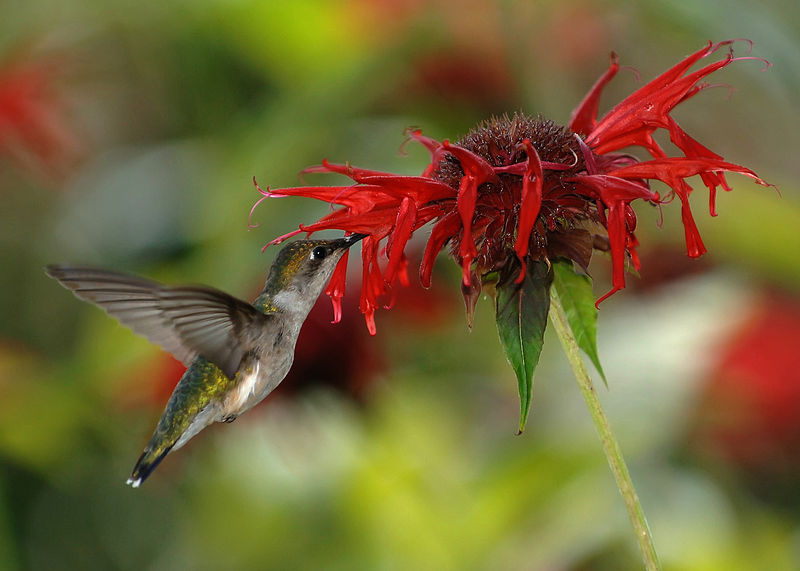
By Sam Droege [CC BY 2.0 (http://creativecommons.org/licenses/by/2.0)%5D, via Wikimedia Commons.Ruby-Throated Hummingbirds like tube or funnel shaped red, yellow or orange flowers that produce a lot of nectar.
By Joe Schneid, Louisville, Kentucky (Own work) [CC BY 3.0 (http://creativecommons.org/licenses/by/3.0)%5D, via Wikimedia Commons.Look for moths like this Snowberry Clearwing Moth on white or pale flowers that open in the late afternoon or night or on dense flower heads like goldenrod. These large moths are often mistaken for hummingbirds. Both seek out plants that produce a lot of nectar deep within the flower.
By Andy Reago & Chrissy McClarren [CC BY 2.0 (http://creativecommons.org/licenses/by/2.0)%5D, via Wikimedia Commons.Like the Snowberry Clearwing Moth, this Question Mark Butterfly can also be found on flower clusters like goldenrod and yarrow (shown), and flowers that produce a lot of nectar deep in the flower.
By Henry Hartley (Own work) [CC BY 3.0 (http://creativecommons.org/licenses/by/3.0)%5D, via Wikimedia Commons.Although you might be a little wary of this insect, this Paper Wasp pollinates a variety of plants including milkweed (shown here), goldenrod, and fall asters. Many different kinds of wasps, including a group called the pollen wasps, are important pollinators.
By Bruce Marlin [CC BY-SA 2.5 (http://creativecommons.org/licenses/by-sa/2.5)%5D, via Wikimedia Commons.Look for these pollinators and more during your next visit to a New York State Park!
Chimney Bluffs looking east from the shoreline. Photo by Brett Smith.
Some people are drawn to water and some are drawn to dramatic landscapes, Chimney Bluffs State Park on the shore of Lake Ontario has both. Located in Wolcott, New York the park’s namesake bluffs stretch for ½ a mile revealing its ever-changing ancient past.
Chimney Bluffs looking east. Photo by Brett Smith.
During the last ice age from 2 million years ago until about 10,000 years ago there were a series of glacial advances and retreats that formed the Great Lakes that changed the landscape of the north-central part of the United States in many ways. One of the clues that glaciers leave behind are called drumlins. We see drumlins as elliptical hills. These hills are blunt on the upglacier end and taper into and elongated tail on the downglacier end, similar in shape to a teardrop. Drumlins form parallel the direction the movement of the ice. These hills usually form in clusters; the exposed upglacier end of the drumlin at Chimney Bluffs State Park is one of roughly 10,000 drumlins located south and east of Lake Ontario.
Click on map to enlarge.
The term drumlin refers to the hill’s shape, not its composition. Some drumlins are solid rock and some are composed of glacial till. Till is a mixture of different sized rock fragments and sediment deposited as glacial ice melts. The drumlin at Chimney Bluffs State Park formed when one glacier melted and deposited the till, later a south moving glacier reshaped the material into its present shape.
The north end of the drumlins has been eroded by thousands of year of wave action, wind, rain and snow. As the north end erodes the exposed material is carved into magnificent and ever changing formations. The bluffs are constantly changing source of beauty and danger.
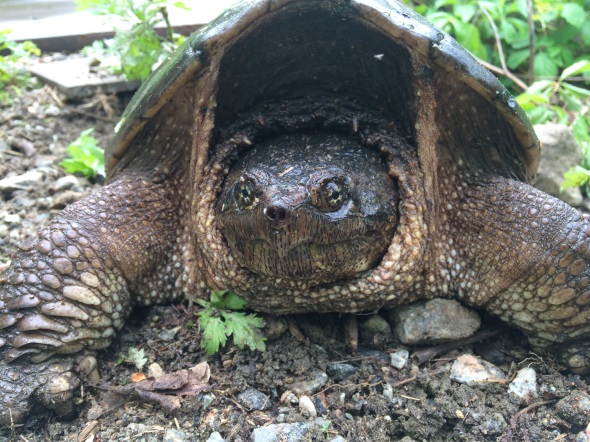
While conducting field work in Clarence Fahnestock State Park the Environment Management Bureau’s Wildlife Unit came across this large female snapping turtle in early June. This female snapping turtle was observed digging a hole in the sandy soil to lay her eggs. This time of the year a variety of wildlife are giving birth or nesting to produce this year’s offspring. Turtles, as you may know, do not move very fast on land and tend to get hit by vehicles while attempting to cross the road. Please watch out for them on the roadways! Snapping turtles and turtles in general look for sandy soils that are easy to dig in to create their nest and lay their eggs. Nesting can take place quite a far distance from water. This is okay! Once hatched, the baby turtles will find their way back to a water source nearby. Get out in nature, experience our beautiful wilderness and all it holds, but please remember to not disturb these natural processes and give wildlife some space to be wild.
Post by Kelly Starkweather, OPRHP Wildlife Unit.
Photos taken at Clarence Fahnestock State Park by Lilly Schelling, OPRHP Wildlife Unit.
Have you ever been to a greenhouse and observed a carnivorous plant, such as a Venus fly trap or a pitcher plant and thought…where do these come from? Well not only can you find carnivorous plants growing native in New York State, we have four different types and 19 different species (New York State Flora Altas)! Carnivorous plants are plants that have adapted to depend on catching insects to supply the nutrients they need for survival, thereby allowing them to live in nutrient poor habitats. NYS is home to pitcher plants (Sarracenia), bladderworts (Utricularia), butterworts (Pinguicula), and sundews (Drosera); each having different methods for catching insects. All of these species thrive in wet, sunny conditions. Some of the best viewing opportunities for these fascinating plants are boardwalks over bogs or from a canoe/ kayak.
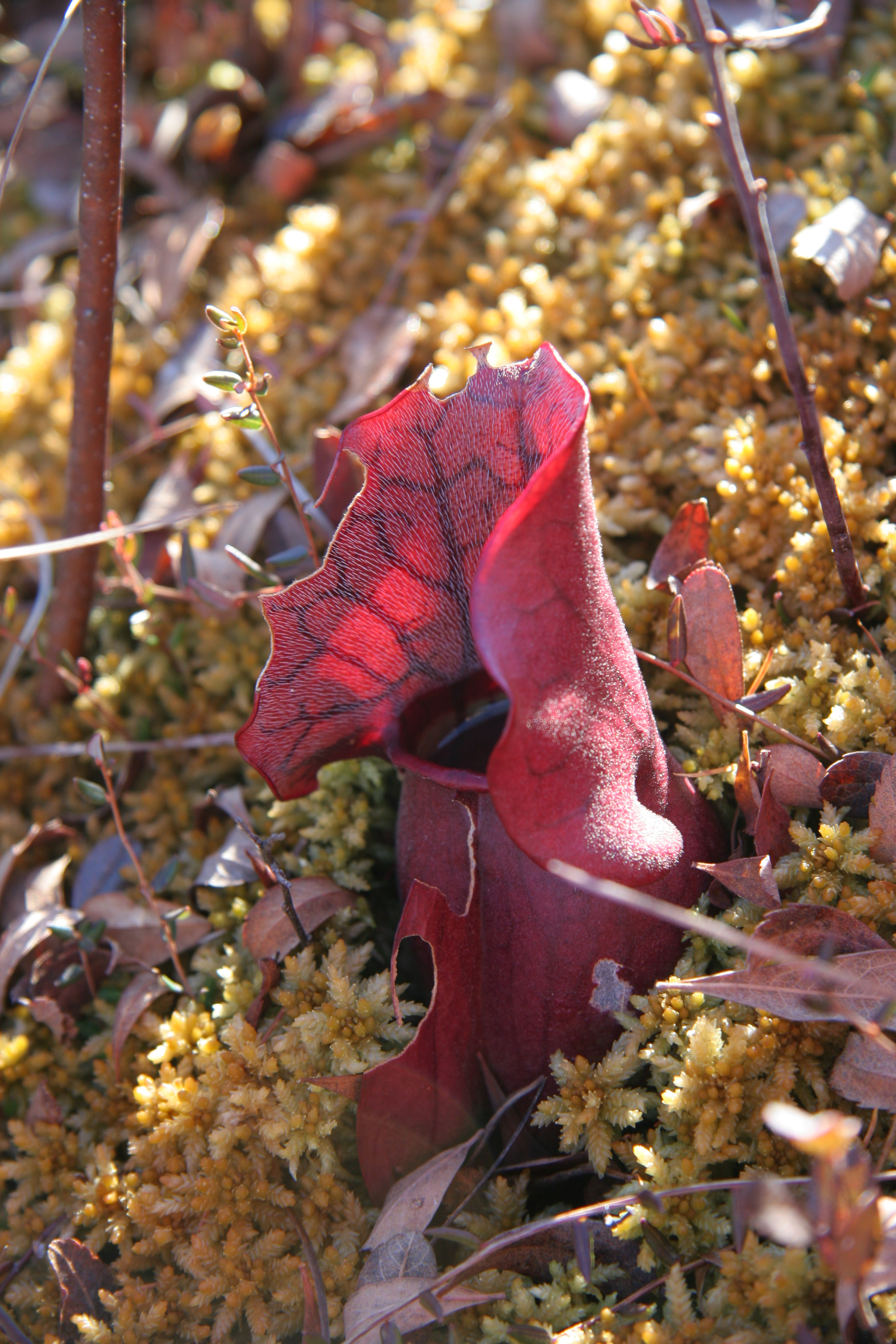
We will investigate the pitcher plant first. We have one species in New York, being the purple pitcher plant (Sarracenia purpurea). These plants are sometimes called ‘trumpet plants’ because of their shape. The pitcher is actually a modified leaf. In some species, the coloration of the pitcher is a mottling of red, green, and white to resemble raw meat – attracting flies and wasps. The mouth of the pitcher secretes a sugary nectar to draw insects to it, making the lip surface slippery, and downward pointing hairs on the lid make insects fall easily off the lid into the pitcher. Once an insect falls inside it cannot get out due to the slippery waxy surface on the inside of the pitcher. The insect is then digested in the juices that reside inside the pitcher, thereby nourishing the plant. The plant has a single flower on a long tall stalk. This is to keep the flower high away from the pitchers to protect the pollinators from becoming prey to the plant! These plants primarily grow in bog/fen habitats in sphagnum moss. Look for pitcher plants in these habitats throughout parks across the state.
Purple pitcher plant. Photo by Lilly Schelling, OPRHP.
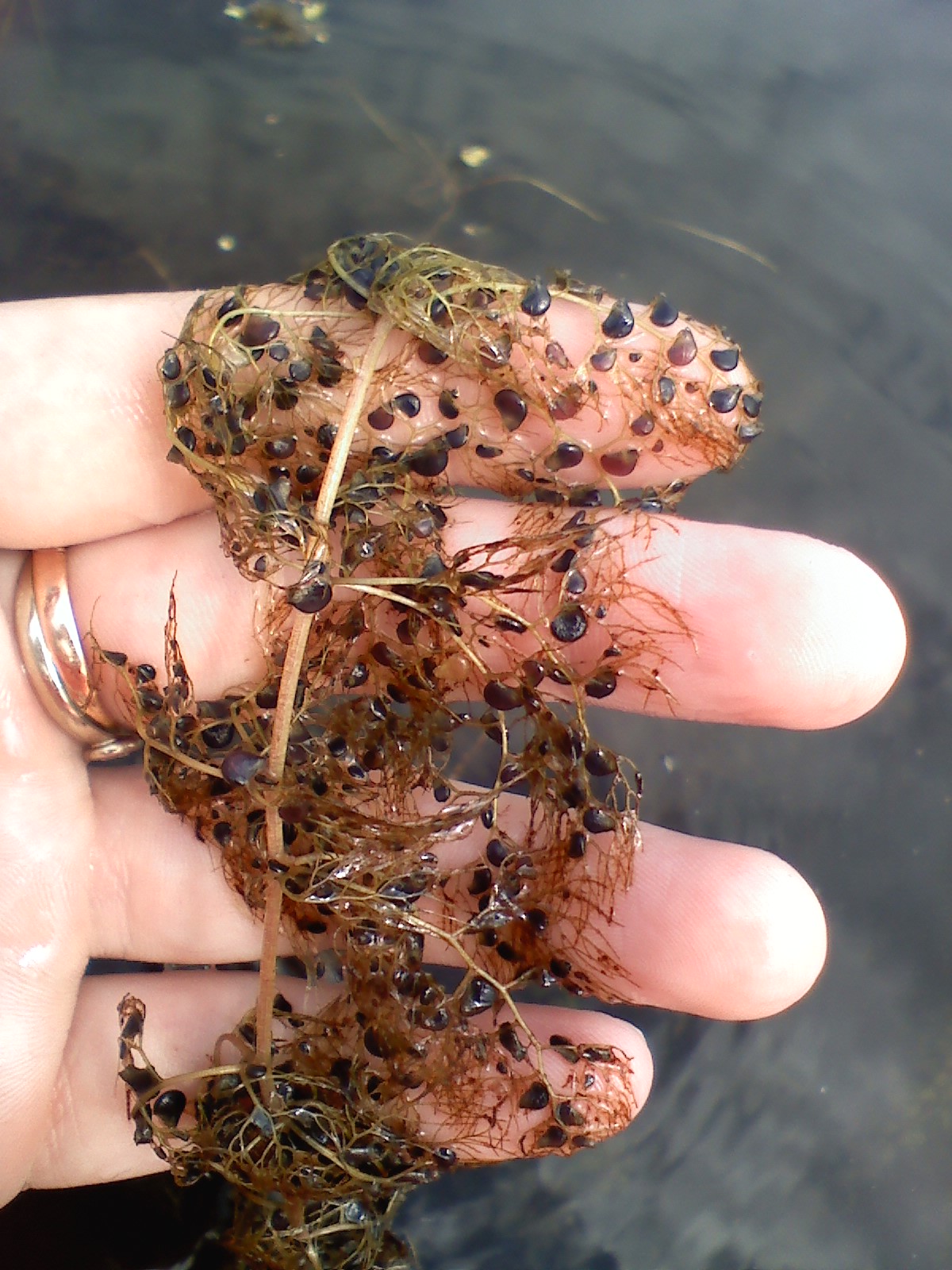
Purple pitcher plants have tall stalked flowers, keeping pollinators away from the hungry mouths of the pitchers. Photo by Andrew Nelson, SUNY Oswego.There are 14 species of bladderworts in the state, all of which are aquatic (living in water). Most of them have yellow flowers with one species having a purple flower. Primarily these plants grow in areas of very slow moving water or in pockets of still water off of rivers and brooks. They have a small bladder shaped trap. The plant has ‘trigger hairs’ at the mouth of the trap, that once touched by prey, opens the mouth and sucks the prey inside – where it is slowly digested by the plant. Bladderworts can be found across the state.
Bladderworts primarily have one flower per stalk. Most species in NY have yellow flowers. Photo by Andrew Nelson, SUNY Oswego.Bladderwort get their name form the bladder of the shaped traps they catch prey with. Photo by Lilly Schelling, OPRHP.
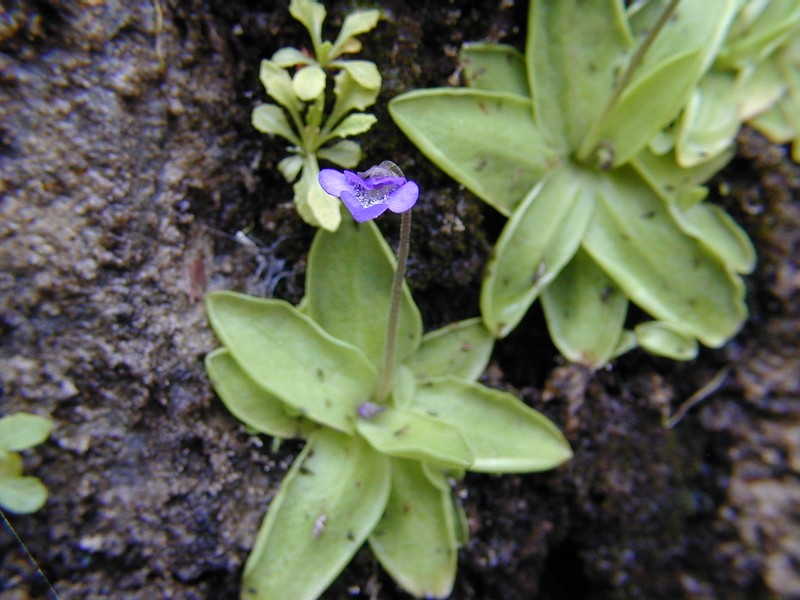
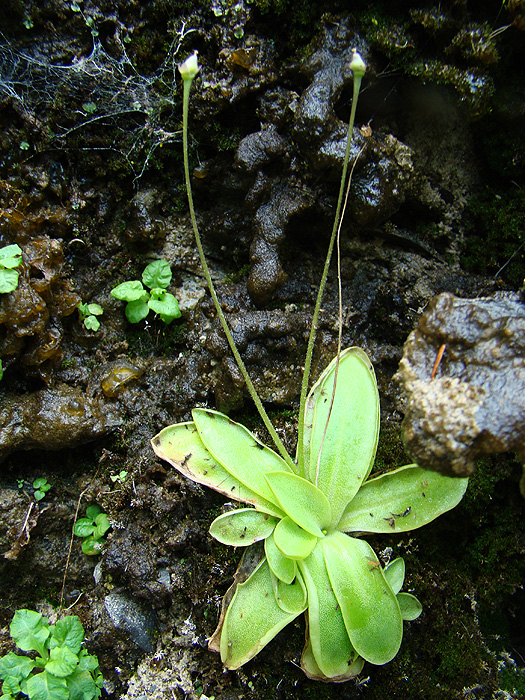
New York State has one species of butterwort (Pinguicula vulgaris). Though they do not look alike, bladderworts and butterworts are in the same family (Lentibulariaceae) because both have similar flower structure; though the method of insect catching for these plants is more akin to the sundew. The leaves have a greasy look and feel to them because they are covered in a sticky glue substance. Once an insect lands on the leaf, it is stuck and the more it thrashes around in an attempt to escape, the more it comes in contact with the sticky digestive juices of the leaf. The butterwort species we have in New York grows on permanently wet cliffs and can only be found in the central and western parts of the state.
The species we have in NY has purple flowers. Photo by Troy Weldy, The Nature Conservancy.Insects are caught and digested on the sticky leaves of the butterwort. Photo by Kim Smith, NYNHP.
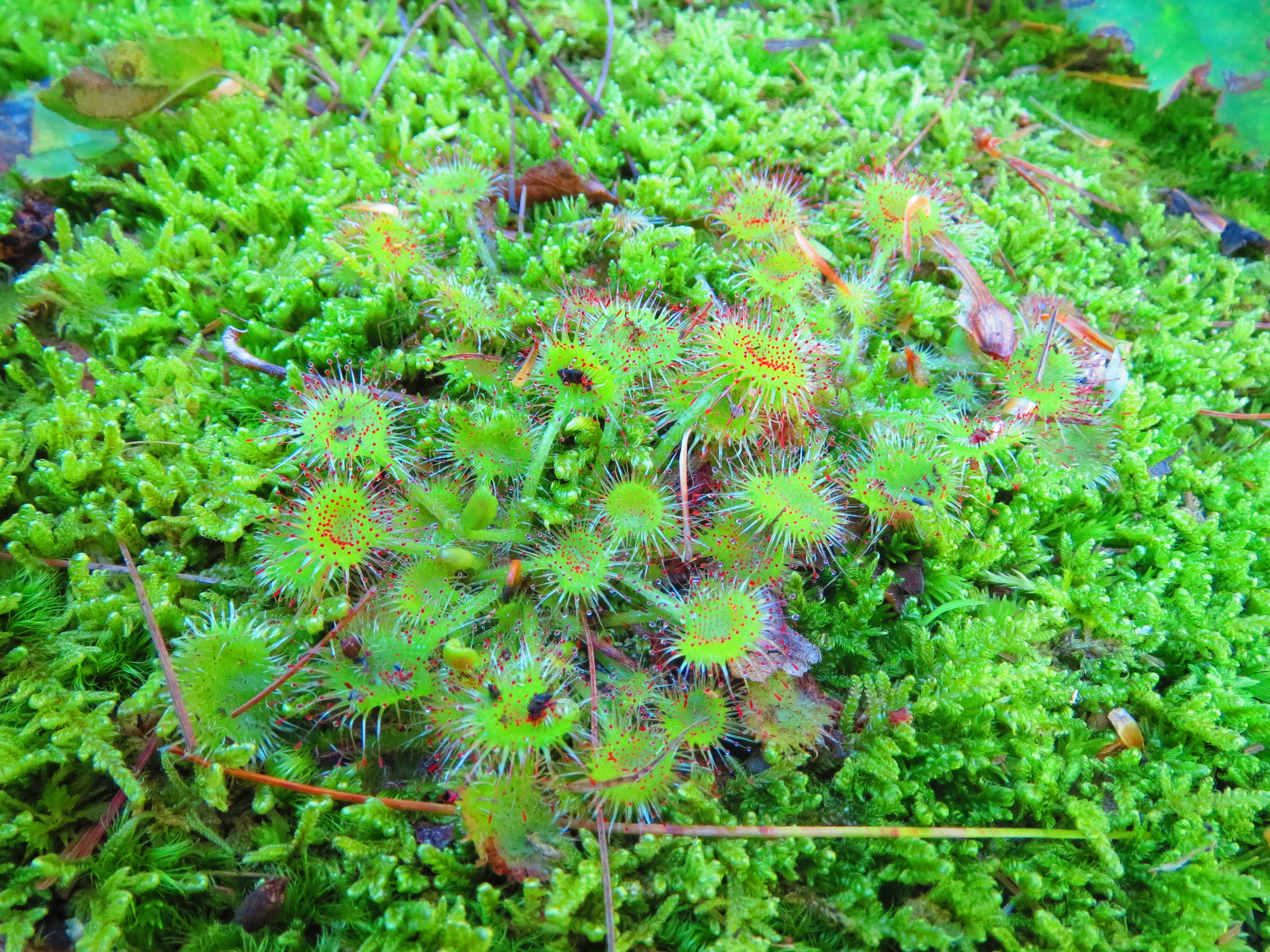
There are 3 species of sundews in New York, the round-leaved sundew (Drosera rotundifolia), thread-leaved sundew (Drosera filiformis) and the spatulate-leaved sundew (Drosera intermedia). Sundews get their name because their leaves look like they are covered in morning dew, however on closer inspection, this “dew” is actually tiny globs of digestive juices created by the plant. An insect will mistake the dew for water and upon landing, become ensnared in the sticky digestive juices of the plant. Large insects may leave legs and wings behind and smaller insects fall prey to the plant. Some species of sundew will curl their leaves around the insect to further trap their prey. Sundews can be found state wide in swampy/bog habitat, often growing alongside pitcher plants and bladderworts.
This is the round-leaved sundew. Notice the many fine hairs with droplets of shiny – glue like digestive juices that insects mistake for water. Photo by Lilly Schelling, OPRHP.
Conserving bog habitat is important for the survival of the various unique plant and animal species that have adapted over time to live there. This type of habitat faces many threats such as development and road and agricultural run-off. Run-off rich in fertilizer from road sides or farming can be disastrous for these habitats and the species that have adapted for living in nutrient poor conditions. Additionally, always remember to leave nature as it is. Though carnivorous plants are marvelously beautiful and fascinating, leave them where they are! If you wish to cultivate these plants in your own home try your local green house or the vast array of stores on the internet.
Post by Lilly Schelling (OPRHP Wildlife Unit).
Photos by OPRHP and NY Flora Atlas (see citation below).
In August 2011, Hurricane Irene and Tropical Storm Lee devastated the Catskill Mountains and Schoharie Valley with a torrent of wind and rain. Several bridges were washed out, including the historic Blenheim Covered Bridge located just north of Mine Kill State Park. A culvert over a tributary of the Mine Kill on the Long Path was subsequently destroyed. On June 6th, the Student Conservation Association (SCA), Long Path North Hiking Club and New York State Parks will join together to construct a new bridge spanning 40 feet over the drainage to once again allow safe passage over this creek for hikers.
SCA Hudson Valley AmeriCorps members remove invasive species in the Habitat Garden at Hudson River Park in Manhattan.
SCA Hudson Valley AmeriCorps members working to replace interpretive signage along the trail at Esopus Meadows Preserve.
SCA Hudson Valley AmeriCorps members are all smiles after completing a new section of trail including split rail fencing at Saratoga Spa State Park.
Every year, on the first Saturday in June all across the country, people celebrate National Trails Day by getting out and going hiking, biking, geocaching and more. National Trails Day is not only about getting out and recreating, but is a great day to give back and volunteer on projects helping to build and maintain trails that we all love and enjoy. This year, three Trails Day projects will be organized and led by SCA AmeriCorps members at Mine Kill State Park in North Blenheim, John Boyd Thacher State Park in Voorheesville, and Hudson River Park in Manhattan. These projects not only accomplish vital work on trails in the region, but also provide SCA members with valuable experience in project management and peer leadership.
For many years, the SCA Hudson Valley AmeriCorps program has been partnering with New York State Parks, Recreation and Historic Preservation as well as New York State Department of Environmental Conservation and several non-profit organizations providing internships across the Hudson Valley region. Currently, 46 SCA members serve for up to ten months at sites from Saratoga Springs to New York City. To learn more about the SCA and Trails Day projects you could get involved in, visit www.thesca.org/events.
Post by Nick Marcet, Student Conservation Association (SCA). Photos by SCA.






![Purple pitcher plants have tall stalked flowers, keeping pollinators away from the hungry mouths of the pitchers. Weldy, Troy, David Werier, and Andrew Nelson. 2015 New York Flora Atlas. [S. M. Landry and K. N. Campbell (original application development), USF Water Institute. University of South Florida]. New York Flora Association, Albany, New York.](https://nystateparks.blog/wp-content/uploads/2015/06/flower-sarracenia_purpurea_andrew-nelson_58.jpg)
![Bladderworts primarily have one flower per stalk. Most species in NY have yellow flowers. Weldy, Troy, David Werier, and Andrew Nelson. 2015 New York Flora Atlas. [S. M. Landry and K. N. Campbell (original application development), USF Water Institute. University of South Florida]. New York Flora Association, Albany, New York.](https://nystateparks.blog/wp-content/uploads/2015/06/bladderwort-flower-utricularia_gibba_andrew-nelson_020919_02.jpg)


 New York State Parks and Historic Sites Blog