From New York City through the Hudson River and Champlain Valley up to Canada, and from Albany to Buffalo along the Erie Canal, New York State’s 750-mile Empire State Trail is the longest single-state multi-use trail in the United States. Weaving in and out of village main streets, urban centers, and rural communities across the state, the Empire State Trail provides a safe and scenic pathway for residents and tourists to experience New York’s varied iconic landscapes, rich history and diverse recreational offerings one mile at a time.
The Empire State Trail (EST) is open year-round, including winter, welcoming bicyclists, walkers, cross-county skiers and snowshoers of all ages and abilities. This jewel of the New York State Parks system connects 20 regional trails to create a continuous statewide signed route –75 percent of which is off-road on a mix of gravel and paved paths.
In this second installment of our Empire State Trail itineraries series, we invite you to explore the Finger Lakes, Northern New York, and New York City. We’ll see you out there!
On Saturday, June 8, New York State Parks and New York State Department of Environmental Conservation celebrated Get Outdoors & Get Together Day at 22 locations across the state. This annual event coincides with National Get Outdoors Day and encourages people of all abilities to connect with public lands through outdoor recreation activities such as fishing, nature walks and hikes, birding, archery, camping, and paddling.
This year, more than 2,000 participants enjoyed the day at a New York State park or historic site! Activities included a magic show, a raptors and reptiles show, dancing, singing, spin art, yard games, and more! Let’s take a look at some of the action.
This was just one of the 4,400 field trips for students across the state funded through the State Parks grant program since it started in 2016.
During their visit in July, the 11- and 12-year-olds learned from Riverbank about the former president who led America’s defeat of fascism, and his famous 1941 speech in which he described his vision for a post-war world.
The campers participated in a lesson focused on Roosevelt’s message that people must stand up when freedom is threatened and not expect others to defend it. To better understand that, the children created their own buttons with slogans and images as an exercise in free speech, which FDR cited as the first freedom.
Campers at FDR Four Freedoms State Park.
“Their
day began with members of Four Freedoms Park Conservancy’s education team
leading an inquiry-based investigation into Franklin Roosevelt’s presidency and
his vision of a world order founded upon four freedoms: freedom of speech and
expression, freedom of worship, freedom from want, and freedom from fear,” said
Ryan Lockwood, Manager of Education at Four Freedoms State Park.
The campers also explored the Park, marveling at renowned architect Louis Kahn’s final project, while also examining primary sources from the FDR era to about what it was like to be a child during the Great Depression. To do this, campers used Depression-era photos by famous photographer Dorothea Lange and an excerpt from FDR’s 1941 State of the Union Address in which he outlined the Four Freedoms.
A portrait of a migrant mother, taken by Dorothea Lange during the Depression in 1936, is one of her most iconic photographs. (Photo Credit: U.S. Library of Congress)
At FDR Four Freedoms Park, the words of the president’s 1941 inaugural speech outline the four freedoms he envisioned for a post-war world.
Following
a lunch break, staffers encouraged the young visitors to see themselves as
activists capable of making the world a better place, just like FDR. After
identifying current issues that mattered to them, the campers created
“Activist Buttons” to persuade others to join them in creating the
kind of world they would like to see in the future.
Many campers made buttons that demonstrated how the four freedoms are not static, said Lockwood. For instance, while in Roosevelt’s time freedom from fear from fear likely involved war, for today’s campers, freedom from fear meant not having to be afraid of another school shooting.
Once
they had their photo taken with their new buttons, the kids finished their
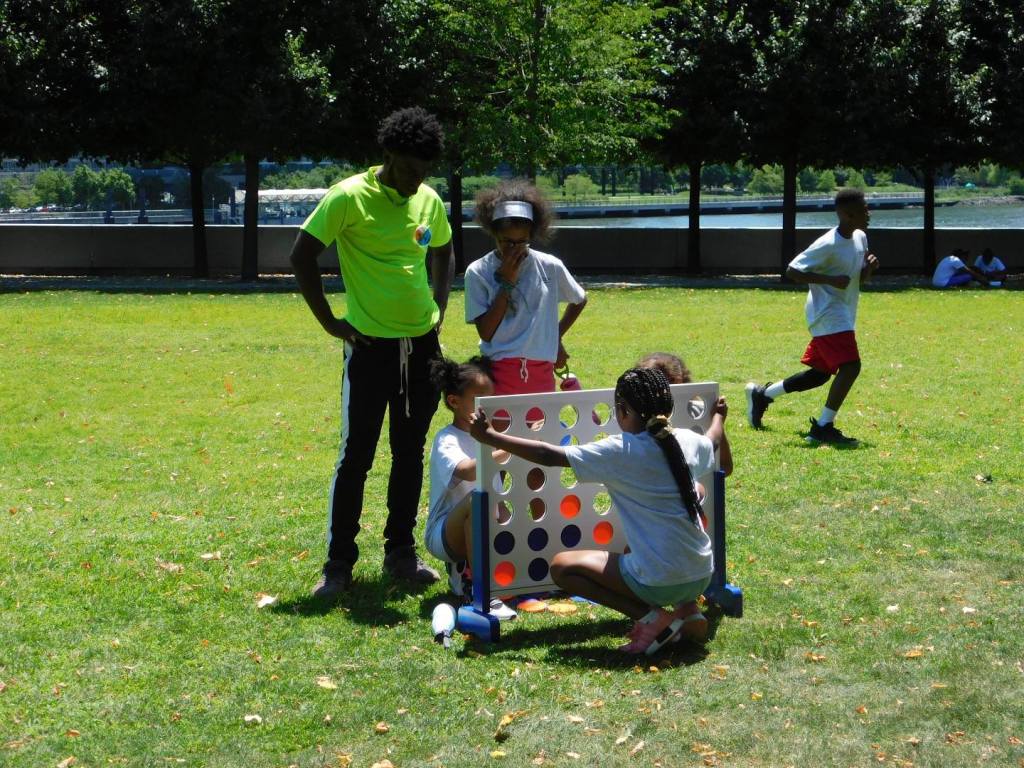
visit playing fun games on the Park’s lawn like Jenga, Connect 4, Checkers and
more.
Four Freedoms Park is among several hundred state parks, nature centers, historic sites, or Department of Environmental Conservation nature centers or fish hatcheries, that more than 200,000 schoolchildren have visited during the three previous school years under the Connect Kids to Parks program.
Since inception, the Connect Kids to Parks Field Trip Grant Program has grown from providing 777 field trips for 30,202 students in 2016-2017 to its current level of about 2,100 field trips for 101,000 students in 2018-2019.
Funding comes from the state Environmental Protection Fund’s enhanced Environmental Justice programming approved in the 2019-20 State Budget. Information for school districts and other eligible organizations on how to apply for the grant is available here and here.
All photographs courtesy of Four Freedoms Park unless otherwise credited.






 New York State Parks and Historic Sites Blog