Ganondagan’s Indigenous Music & Arts Festival is a vibrant celebration of Indigenous cultures, held annually at Ganondagan State Historic Site in Victor, southeast of Rochester near Canandaigua. The festival began in 1989, just one year after Ganondagan was officially established as a New York State Historic Site. Originally named The Anniversary of the Dedication of the Site of Ganondagan, the event was later renamed The Native American Dance & Music Festival. In 2019, it adopted its current name: Ganondagan’s Indigenous Music & Arts Festival.
The two-day festival draws thousands of visitors from an array of cultures. Festival organizers view the event as an opportunity for cultural exchange.
In its early years, the festival was a one-day event, drawing just 200–300 attendees, with only one 40×40 tent and no volunteers. Today, it has grown into a two-day celebration that welcomes over 3,000 visitors and relies on the support of more than 125 volunteers. The festival now features multiple tents, including a large performance tent, and includes 25–30 Native vendors, Indigenous and non-Native food vendors, art demonstrations, Haudenosaunee (Six Nations) dancers, contemporary Indigenous performers, storytellers, a Native Arts Market and children’s activities.
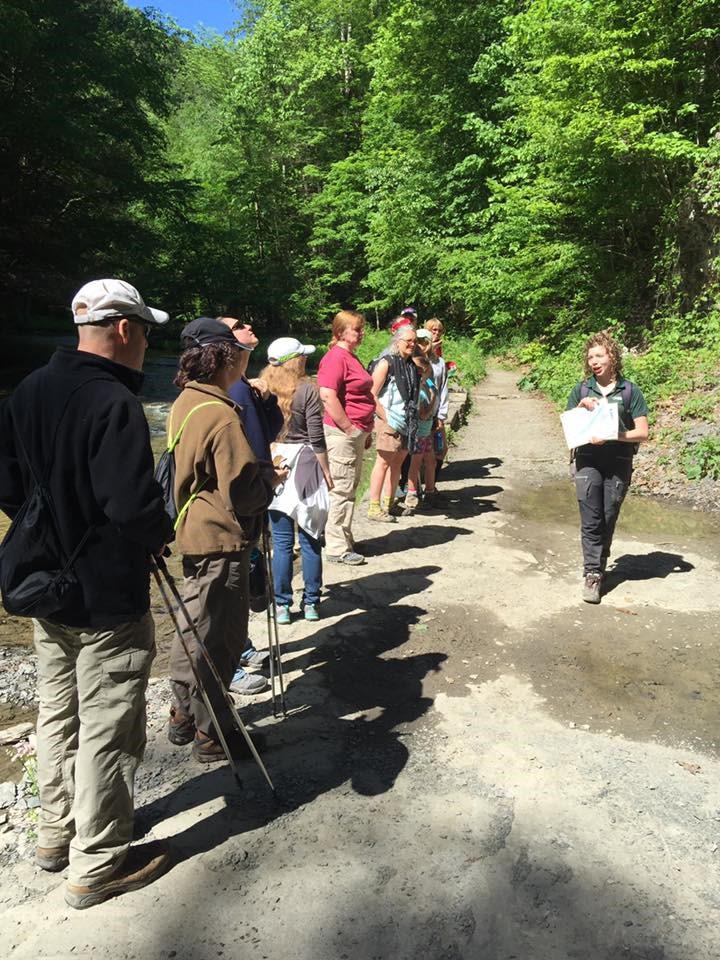
Each year in the Finger Lakes ten hikes are offered throughout the region on the first Saturday of each month. Hikes are led by Parks staff or Parks interns and are offered at different locations each month and vary in length (3-5 miles) and difficulty. As leaders, we try to keep everyone together during the hikes as much as possible but with group size ranging from 2-50, variable terrain and different fitness levels we sometimes get spread out until we take a rest and regroup. We encourage everyone to attend, including but not limited to families, seasoned hikers, visitors to the region, locals, groups, clubs, well behaved dogs and anyone else you can think of. There is no First Saturday hike in January because of the January 1st First Day Hike on offered at Taughannock Falls State Park and no hike in May due to I Love My Park Day always falling on the first Saturday of May.
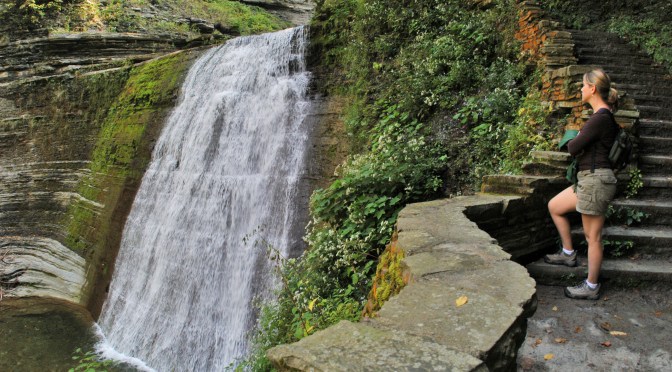
Jane Suhey from the 2017 First Saturday Educational Hike at Robert H. Treman State Park, photo courtesy of Gary Cremeens
The idea behind these hikes is to get people out exploring new parks and learning more about hiking parks while getting a little exercise. Each hike is unique because there are sometimes different leaders and the mix of people who attend is always varied. Both of factors shape how the hike unfolds. We routinely discuss park history, geology, natural history, hiking basics and anything else that is relevant or sometimes topics that come from left field! Last month the temperature was in the low 40’s and there was a steady rain so we began with a discussion on hypothermia and how to tell if someone might be hypothermic.
October 6th hike along the compact stone-dust Catherine Valley Trail (quick side trip to see Montour Falls)
The origin of this offering of hikes is linked to the 2014 First Day Hike when I first met Gary and Wendy Cremeens. After hiking five miles with me they said that they had such a good time that we should do it every month. Their positive energy and willingness to help and support everyone around them sold me on the idea. We offered our inaugural First Saturday Hike at Buttermilk Falls State Park in February of 2015. Gary is in the Cubs outfit in the photo below; he is usually wearing something fluorescent, almost always in shorts and when he attends, he runs around distributing the hike schedule, offering bug spray or tissues and welcomes everyone who shows up. Wendy is equally supportive and always acts as the hike sweeper so no one gets left behind.
Aug 4th 2018 hike at Buttermilk Falls State Park, photo courtesy of Wendy Cremeens
Hikes are free (certain parks at certain times of year charge a parking fee) and reservations are not required but will be accepted via my email at josh.teeter@parks.ny.gov. If you have questions about the hike location, difficulty or any other related questions, feel free to email me in advance. The calendar of hikes can be found on the New York State Parks calendar or on Facebook by searching First Saturday Educational Hikes.
Here in the Finger Lakes, one of the best ways to access the natural beauty of the area is by taking a hike on one of the many trails that can be found within the region’s state parks. The trails (in parks such as Watkins Glen, Taughannock Falls, Robert H. Treman, and Fillmore Glen) lead hikers through a variety of environments, including mature forests, meadows, lake shores, and wetlands. Of course, hikers can also enjoy the deep gorges, dramatic cascades, and waterfalls the region is famous for! Over the years, hiking has gained popularity nationwide. With thousands of miles of hiking trails, New York State has a lot to offer people looking to get outside. The Finger Lakes region of the State Park system sees several hundred thousand visitors each year, many of whom come to hike the trails. Foot traffic, weather, and time have left some of the trails in Finger Lakes state parks eroded and in need of repair. This erosion not only makes the hiking experience less enjoyable for trail users, it also leads to negative impacts on the surrounding ecosystems. To meet this problem head-on, the Finger Lakes Regional Trail Crew (FLRTC) was developed in the spring of 2017.
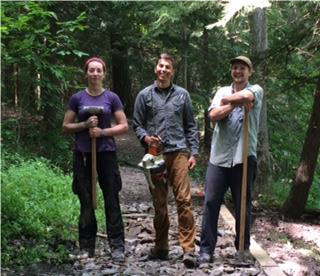
Some of the hard-working members of the Finger Lakes Regional Trail Crew, photo by State Parks
The main goal of the trail crew is to maintain safe and enjoyable hiking trails for park visitors, while protecting the natural and historic resources of the park. Currently the FLRTC consists of three Parks staff members and a diverse group of local volunteers. The Excelsior Conservation Corps (an AmeriCorps program) also helps out with specific projects. In 2018, the trails crew will host two interns from the Student Conservation Association (SCA) Parks Corps devoted to trail stewardship. This team effort has led to a tremendous amount of progress towards the Finger Lakes Park’s trail improvement goals.
Boardwalks protect wet areas or fragile habitat and make for easier walking for visitors, photo by State Parks.
Trail work, as a rule, takes a large amount of physical effort and creative problem solving. The work done by the FLRTC is no exception. Traditional tools and building techniques are often employed. Many of the trails in need of repair are in areas that are not accessible by vehicles or equipment. As a result, many of the materials used in trail construction have to be carried in by hand; it takes a strong crew to lug in lumber, stone, and gravel. Sometimes materials have to be moved down into or across the area’s gorges. The trail crew uses high-strength zip lines to accomplish this task. This is the safest method and protects the fragile slopes and vegetation.
Boardwalks protect wet areas or fragile habitat and make for easier walking for visitors, photo by State Parks.
All of this hard work pays off in the form of functional, safe and visually pleasing staircases, boardwalks, and bridges that blend with the surroundings.
As you get out on the trails this year, take a minute to look down from the beautiful scenery. The trail you are on most likely took a lot of hard work to build and maintain – but chances are the park staff and volunteers behind the work loved every minute of it!
Each June and July, visitors to several gorge parks are rewarded with an unusual treat – the chance to see a “living fossil.”
The term “living fossil” refers to species that have evolved very little over the course of millions of years. Some well-known examples of living fossils include elephant sharks, ginkgo trees, and horseshoe crabs. Although all of these organisms have evolved, these species have stayed so similar that fossils from millions of years ago are still recognizable as ancestors to the modern species.
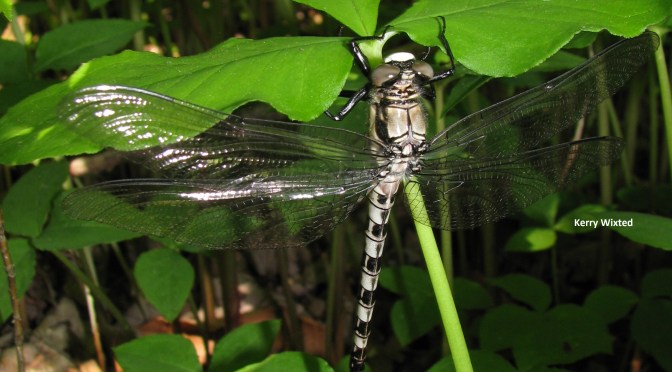
A gray petaltail perches in the sun along a gorge trail, photo by State Parks.
Meet the gray petaltail dragonfly (Tachopteryx thoreyi), a species of dragonfly that closely resembles its ancestors who were around when dinosaurs roamed the earth during the Jurassic Period – almost 200 million years ago! During that time, the petaltail dragonfly was part of very widespread family known as the Petaluridae. Today, however, there are only 11 species of Petaluridae remaining worldwide.
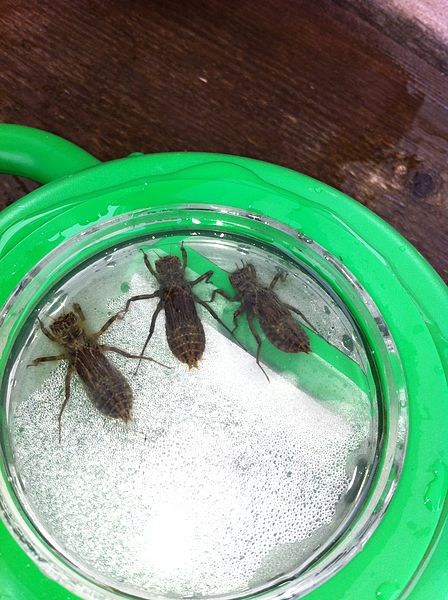
The gray petaltail is found in several of the Finger Lakes gorge parks the gray petaltails love hunting in the gorges, because they can go to the sunny side of the gorge to get warm, which allows them to move much faster. Petaltails are drawn to the gorges to lay their eggs in the soggy seeps on wooded slopes. Most dragonflies lay their eggs in water bodies. The eggs grow into juvenile dragonflies, called nymphs that also typically live in water. That is not the case for the gray petaltail nymphs! The gray petaltail is the only species of dragonfly that does not have fully aquatic nymphs. Instead, the petaltail nymphs live and grow while hidden in the mud, moss and moist leaf litter in the forest seeps. As the nymphs mature, they climb up the trunks of trees to become the adult dragonflies that can fly fast and free all around the gorge.
While they are not nearly as large as their Jurassic ancestors, today’s petaltails are one of the larger species of dragonflies, with a wingspan of up to 5 inches wide. Their distinct black and gray coloring also makes it easy to identify. This species often perches upon rocks and tree trunks, but it is not uncommon for it to perch upon a passerby! Although they are large and ferocious insect predators (eating thousands of mosquitoes), dragonflies are harmless to humans. If you are lucky enough to be chosen as a dragonfly perch, you may be startled, but either brush them away very gently or just enjoy it!
Gray petaltail caught during an odonate (dragonfly) survey, photo by Becky Sibner, State Parks.
The gray petaltail is listed as a species of special concern within New York State, as it is only known in specialized habitat in a small number of locations. NY Natural Heritage Program (NYNHP) continues to survey for them and recently found another new site for them. Luckily, some of those locations are within New York’s state parks, providing habitat protection to this fascinating species – and maybe a chance to see this primitive insect for yourself, especially in June and July.
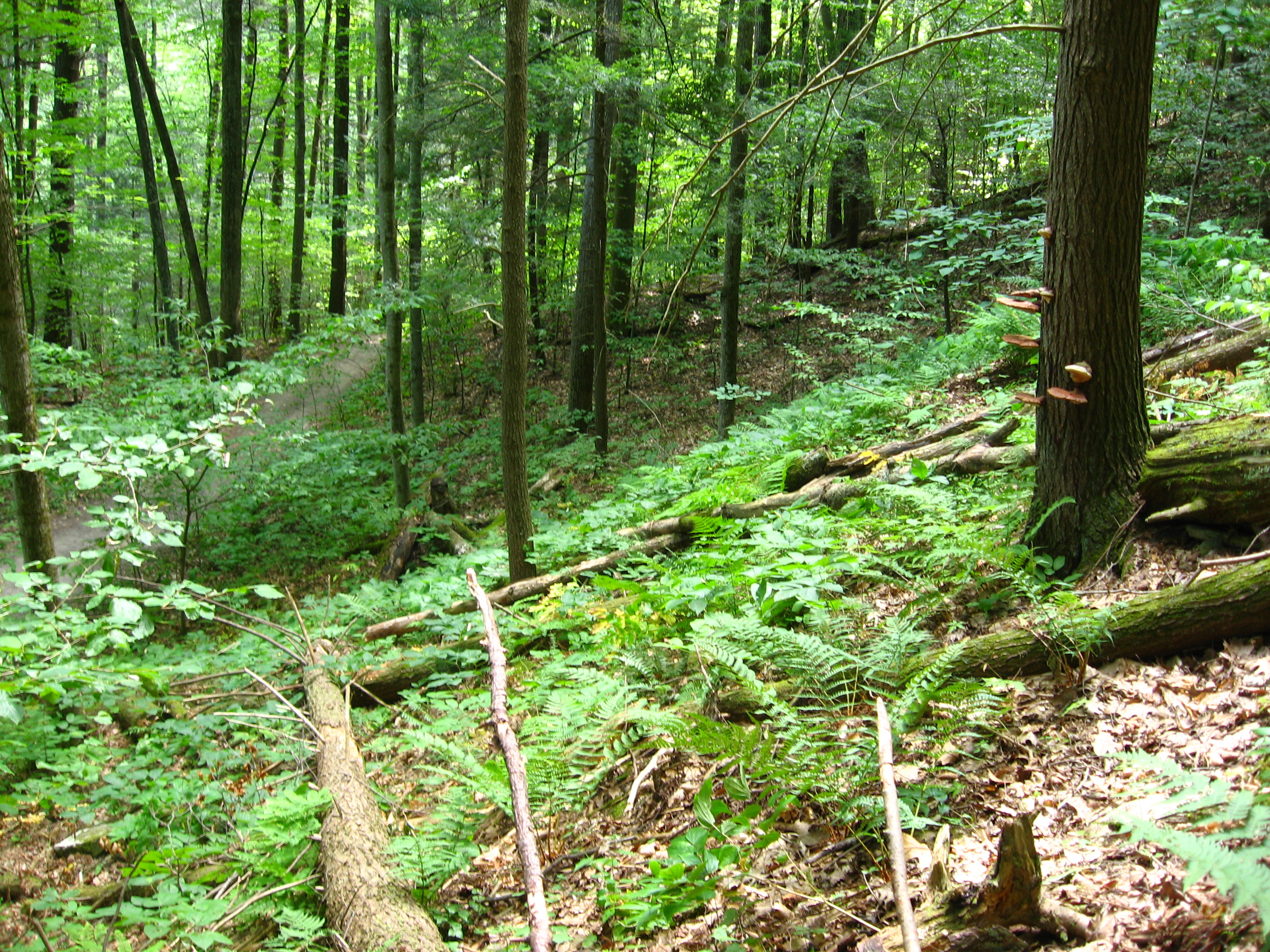
Look for gray petaltails in habitats like this, photo by Julie Lundgren, NY Natural Heritage Program
Post by Laura Young, FORCES Environmental Education Steward & Becky Sibner, Stewardship Project Coordinator, State Parks
Featured image: gray petaltail on a Jack-in-the-pulpit, Kerry Wixted
Sources:
Paulson, D. (2011). Dragonflies and damselflies of the East. Princeton, N.J: Princeton University Press.
Email correspondence with Jason J. Dombroskie, Ph.D. Manager, Cornell University Insect Collection (CUIC) & Coordinator of the Insect Diagnostic Lab (IDL)
Exploring Letchworth State Park geology at the Humphrey Nature Center, photo by Doug Kelly, State Parks
Interpreting might seem like a strange way to describe what the naturalists and historians at Letchworth State Park do. Instead of interpreting one human language to another, they tell the stories of the people who came before and of the beings with no languages; the rocks, trees and animals that make the park such a special place.
This need to educate the public about the park started even before there was a park. William Letchworth (1823 – 1910) assembled the Council Grounds and a museum to engage the strangers who came to his property on railroad excursion trains. He had trails and carriage paths which visitors could walk and enjoy the clean air and shady trees. He brought orphans from Buffalo to enjoy the country and learn vocational skills from his farmhands and household servants.
Following Letchworth, the American Scenic and Historic Preservation Society created the Letchworth Arboretum and built the William Pryor Letchworth Museum. The society intended there to be a research and educational aspect to the work they did. Most of their efforts were directed to building roads and facilities for visitors and transforming the park into a public space.
New York State took over management of the park in 1930. In the 1970s there was a statewide effort to mesh parks with schools and use the parks as educational tools for students. Interpreters were hired and nature and history programs started. By 1974, the National Audubon Society joined in a partnership with the Genesee State Park Region Commission to investigate building nature centers at Letchworth and Hamlin Beach State Parks. Although nothing came of this venture, the idea for a nature center at Letchworth never went away.
Humphrey Nature Center, photo by Elijah Kruger, State Parks
In 2016, the Humphrey Nature Center at Letchworth State Park opened on June 20 and was made possible by a joint fundraising effort of the Letchworth Nature Center Campaign Committee, which includes representatives of the Genesee Regional Parks Commission, the Open Space Institute’s Alliance for New York State Parks, and the Natural Heritage Trust. The campaign raised private funds that were matched 2 to 1 by New York State thanks to Governor Cuomo’s economic development initiatives. The Letchworth Nature Center Campaign Committee was chaired by Peter Humphrey who also, along with his wife, provided an extremely generous donation to kick start the fundraising campaign. The Humphrey Nature Center at Letchworth State Park was named in his honor, recognizing the great role Peter Humphrey played in making the project a reality.
State Park educators lead a tour of the Humphrey Nature Center, photo by Doug Kelly
The goal of the Humphrey Nature Center is to deepen the visitor experience of Letchworth State Park, which was voted the #1 state park in the nation in 2015. The 5,000 square foot, year-round, sustainable facility will help to enhance the exceptional educational and interpretive programming already offered to visitors. Meeting and classroom space, state-of-the-art, hands-on exhibits, a butterfly garden, bird observation area and trails that leave right from the building enrich the visitor’s understanding of the unique history, geology, and environment found in Letchworth State Park.
The next time you are in Letchworth, be sure to visit the Humphrey Nature Center for a program, to explore the exhibits, or just to talk with one of the knowledgeable naturalists. Remember, the Humphrey Nature Center is just your launching point into the fascinating natural history of Letchworth State Park!
Post by Elijah Kruger and Steph Spittal, Letchworth State Park educators
Water explorations, Letchworth State Park, photo by OPHRP
Relaxing after a program at Letchworth State Park, OPRHP photo










 New York State Parks and Historic Sites Blog
