Tag Archives: Finger Lakes Region

FORCES : College Students Support Stewardship in New York State Parks

As the summer months wind down, the FORCES Program staff of the Central and Finger Lakes Regions are busy both reflecting on the last few months and making plans for the next academic year.

FORCES stands for “Friends of Recreation, Conservation and Environmental Stewardship”, and the FORCES Program specifically focuses on building long-term, mutually beneficial partnerships between local state parks and colleges. Currently this includes one-day volunteer events, FORCES clubs at six colleges, dozens of stewards between the two regions, partnerships with faculty members and college administration, projects in over twenty parks and historic sites, and involvement with fourteen colleges and universities within the Finger Lakes and Central Regions.

This summer has been an exciting one, with the “FORCES family” including 37 stewards and seasonal employees! The FORCES interns and seasonal employees started together in June with the first annual “Trainapalooza,” which was held this year at Robert H. Treman State Park in the Finger Lakes Region. The stewards gathered for a two day training on invasive species identification and removals, iMap Invasives training, an overview of the geologic and human histories of the area, interesting features of some of the parks, and strategies for outreach and interpretation. The group also camped overnight at the park, and got to know each other while playing Frisbee, solving riddles, and enjoying s’mores.

After they were trained, the stewards separated again to begin projects throughout the two regions. Many projects focused on invasive species removal; stewards worked to remove water chestnut, pale swallowwort, slender false brome, and many other species of invasive plants. Other projects included the creation of a video about the FORCES program, historical research, assistance with the ongoing surveys for the Chittenango Ovate Amber Snail at Chittenango Falls State Park, water quality monitoring at Selkirk Shores State Park, and trail blazing at Two Rivers State Park… the list goes on and on!

The upcoming academic year will bring more excitement as FORCES welcomes new and returning stewards and club members. The semester started with the New York State Fair, where FORCES annually engages the public in building bluebird boxes- they assembled 1,250 boxes just this year! To date, FORCES at the State Fair has hosted over 180 students and involved 8 colleges. Plans are also in motion for the first annual FORCES Membership Gathering, which will take place in October and combine trainings with celebrations for club members, stewards, seasonal staff, and ambassadors- all members of the “FORCES family”.

In the spring, FORCES will hold its second annual Leadership Summit, which assembles club officers and FORCES “Ambassadors” from all FORCES schools to plan and strategize for the growth of the FORCES Program. The event was a huge success last April, with the FORCES staff being (again) blown away and inspired by the passion and dedication of the students.

Keep an eye out for FORCES stewards as you visit the parks, and chat with them about the projects they are working on. They’re accomplishing big things!

For more information visit our new web page.

Post by Becky Sibner, FORCES Program Specialist for the Finger Lakes Region.


What’s in a Name? – Taughannock Falls

Taughannock Falls State Park, in Ithaca, NY, is part of the historical territory of the Cayuga Nation, one of six nations that form the Iroquois Confederacy. In the period of European colonization of the Americas, the Iroquois controlled an expansive territory that included New York, Pennsylvania, and part of southeastern Canada.

There are two commonly repeated sources for the name of Taughannock Falls, the tallest waterfall in the state of New York

Territory of the 5 Iroquois Nation, approx. 1650
Territory of the 5 Iroquois Nation, approx. 1650. This image is in the public domain.

and a highlight of Taughannock Falls State Park. Both are explained in a travelogue from 1872 by Lewis Halsey, The Falls of Taughannock.

The first is a translation by William H. Bogart, who claims that Taughannock means “the great fall in the woods.” However, Bogart combines his understanding of Iroquoian root words with roots from the Algonquian language, a group with lived south of Iroquois territory.

George Copway, 1850. This image is in the public domain.

Haley also cites George Copway–a well-known Christian-educated Ojibwe man who produced many writings in the late 19th century– as positing his own translation as, “the crevice which rises to the tops of the trees.”

The most exciting, if least plausible, origin story for the falls’ name comes from David Henry Hamilton, a Presbyterian minister born in Canjoharie, NY in 1813. Hamilton wrote that Taughannock was a chief’s title in the Delaware Nation.

The Delaware tribe lived in the region of the Delaware and Susquehanna rivers at the time of European colonization. Being so close to Iroquois territory, the Delaware were frequent victims of Iroquois raids, in which Iroquois warriors captured members of other tribes and adopted them into their own families in order to increase their numbers. According to Hamilton, a young Taughannock–a chief–was captured, but too strong-willed to be adopted into the Cayuga tribe. The chief gathered a group of followers and camped near the falls, only to be defeated in a dramatic last stand. The story ends with his body being tossed over the falls.

We can’t be sure how these writers came to their conclusions, and so we can’t ever be sure how the name Taughannock attached itself to falls or what this word really means. In the end, Taughannock remains as mysterious and beautiful as the falls themselves.

Source: Halsey. 1872. The Falls of Taughannock. New York: Cutter, Tower & Co., Printers and Stationers.

featured image from Taughannock Falls State Park, by Lilly Schelling. Post by Paris Harper.

Bear Tagging

The NY Department of Environmental Conservation maintains about 3-5 radio-collared female bears every year in order to collect long-term data on the reproduction and movement of black bears. As you can imagine, getting collars on bears is not an easy business. This winter, when a rabbit hunter hunter reported a denning black bear with cubs at Pinnacle State Park, the DEC knew that this was an opportunity that couldn’t be missed.

Adult female black bears give birth every other year, with birthing occurring around mid-January. Collars are never put on small cubs because they grow quickly and the collar would pose a strangulation risk. However, DEC felt that the mother bear identified by the hunter would be an ideal target for collaring.

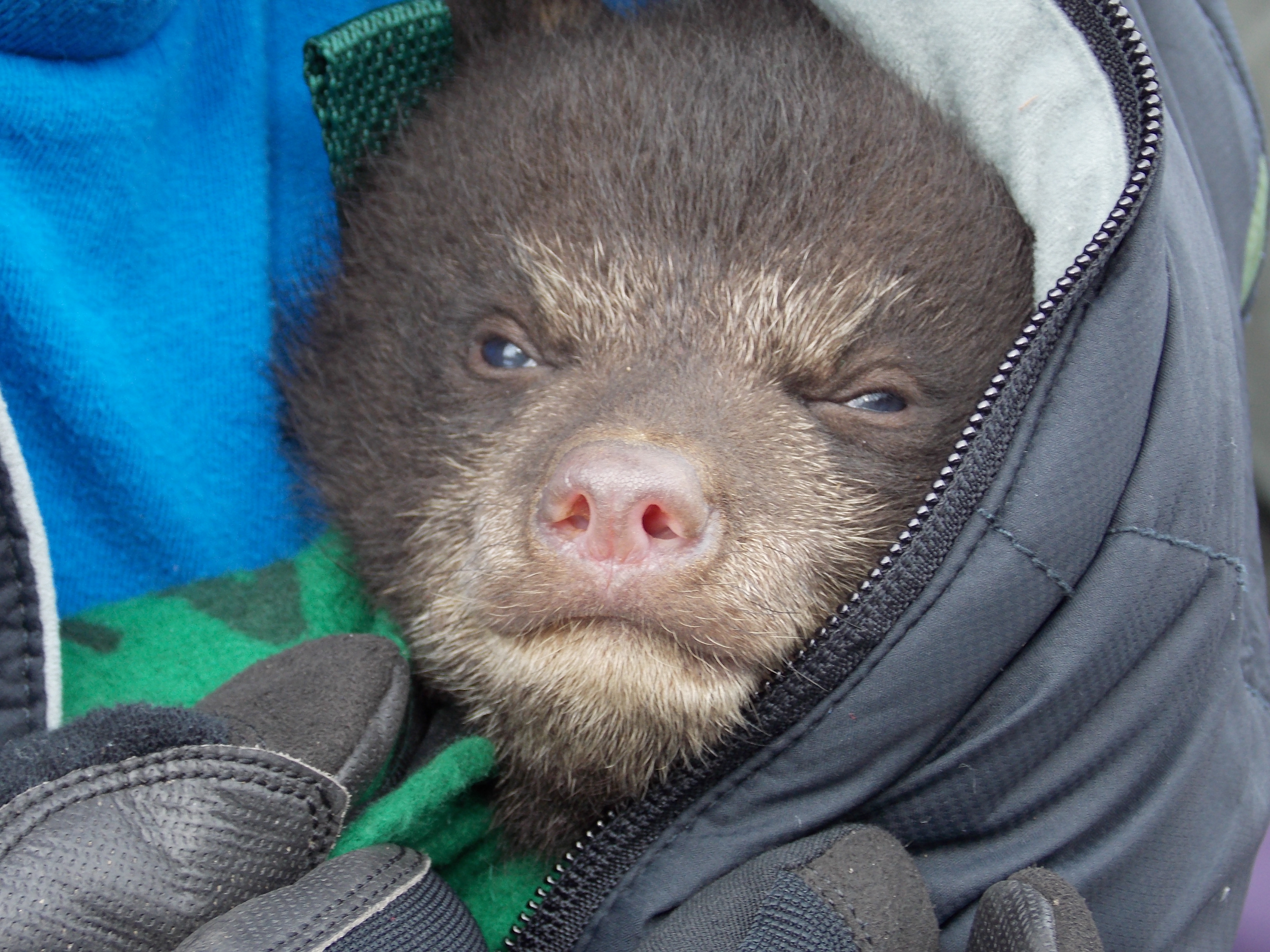
This winter, DEC partnered with State Parks, the Black Bear Management class at Finger Lakes Community College in Canandaigua, and veterinarians and technicians from Seneca Park Zoo in Rochester in order to radio-collar one female black bear.  The process involves tranquilizing the bear while still in her den in order to attach the collar. Because the bear is usually immobilized for half an hour to an hour, the specialists also need to care for the cubs and keep them warm while others are working on their mother.

The following link to a YouTube video will give you a good idea of what a den visit entails,

http://www.youtube.com/watch?v=vJRDpTUIrJI

bear tagging 3

Bear cubs are very cute, but please remember that approaching mother bears and cubs, in their dens or out, is extremely dangerous!

photo by Josh and Jim McGonigal