Tag Archives: Invasive Species

Southern Pine Beetle in New York

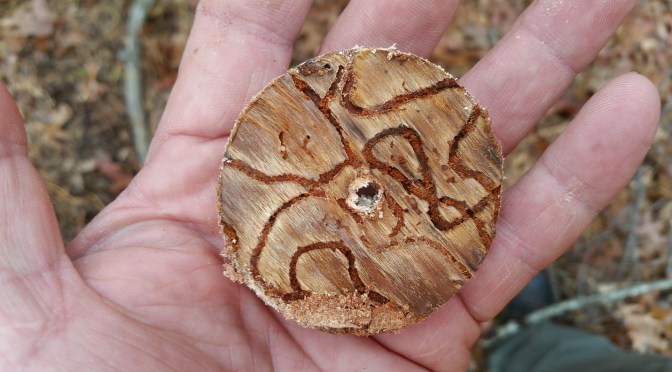
Southern pine beetle has killed thousands of pine trees since it was first found in New York State in 2014. This bark beetle is native to the southern United States, but arrived in New York after working its way northward for many years. Although the beetles are small (2-4 mm; less than 1/8th inch), they are able to kill trees in 2 to 4 months by attacking in large numbers. Once beneath the bark, the thousands of beetles create S-shaped tunnels as they feed on the inner bark, which soon cuts off the nutrients the tree needs to survive and grow.

In New York, pitch pine trees have been attacked by southern pine beetle more than any other species. Pitch pine trees are often a part of unique, globally and statewide rare ecosystems such as Pitch Pine-Scrub Oak Barrens, Pitch pine-oak heath woodlands, Pitch pine-heath barrens, Pitch pine-oak-heath rocky summits, Dwarf pine plains, and Dwarf pine ridges. In New York, southern pine beetle has been found in trees across Long Island and in traps as far north as Minnewaska State Park Preserve in the Shawangunk Ridge. Large forested and unique areas such as the Long Island Central Pine Barrens Preserve and the Shawangunk Ridge are of the highest priority to protect. Maps of the pitch pine communities of statewide significance created by NY Natural Heritage Program provide further guidance on priorities. Although there are no known means to eradicate southern pine beetle, there are measures to reduce the beetles’ impacts and save some of the susceptible pines.

Southern Pine Beetle Map, Tom Schmeelk, NYS DEC
Map of confirmed southern pine beetle infestations from ground surveys and traps as well as suspected infestations from aerial surveys. Photo credit: Scott McDonnell, NYS DEC

To help fight against southern pine beetle, the NY State Department of Environmental Conservation’s (DEC) Forest Health team has conducted trapping, aerial surveys, and ground surveys to monitor for the beetle and cut infested trees (suppression) to manage the beetle. Currently, suppression efforts are focused in the Central Pine Barrens of Long Island. In some cases, pines are replanted along trails or in areas where impacts have been high. The beetles do not attack small, young trees, so the hope is that some trees will survive and produce seed to maintain pine in these ecosystems.

In areas that the beetles were captured in traps, but were not found in trees, such as at Bear Mountain and Minnewaska State Parks, the focus continues to be on early detection and surveying for infested trees. DEC conducts aerial surveys over Bear Mountain and Minnewaska State Parks to map out areas potentially infested with the beetle. These aerial surveys are quickly followed up by ground surveys by DEC, State Parks, NYNJ Trail Conference, and others to verify if the trees are infested. So far, no ground surveys have found infested trees in either of these parks.

Efforts at Connetquot River State Park Preserve on Long Island, one of the hardest-hit areas, are focused on removal of dead trees. State Parks, with help from the Excelsior Conservation Corps (an AmeriCorps program) has been cutting down dead trees killed by southern pine beetle along trails to keep the trails safe and open to visitors. State Parks is also chipping up some of these dead trees to help speed up decomposition.

DEC, Parks and Trails New York, and State Parks co-sponsored tree planting as part of I Love My Park Day in Connetquot River State Park Preserve on May 7th, 2016. DEC’s Tree for Tributaries trained volunteers to plant the 600 pitch pine that were donated from New York State’s Saratoga Tree Nursery. The pitch pine trees were raised from seed originating from Long Island and will help maintain the local pitch pine genetics that is adapted to the conditions of Long Island. Through hazard tree mitigation, chipping, suppression, and re-planting pine trees in areas attacked by southern pine beetle such as Connetquot, hopes are that forests will remain safe for public use and maintain their pitch pine components in the wake of southern pine beetle.

Minnewaskafire_May2008_Lundgren27
Wildfires are nature’s way of thinning the pitch pine forests and woodlands and keeping these ecosystems healthy. Without fire the pines get too dense and are more susceptible to pests like the southern pine beetle. Mechanical thinning (cutting) can mimic some of the ecological processes of fire to benefit the communities of rare species and reduce SPB infestations. Photo credit: J. Lundgren, NYNHP.

For more information see NYS DEC’s website on Southern Pine Beetle.

For more information on The Southern Pine Beetle Response efforts, see The Southern Pine Beetle Management Plan.

For more information on pitch pine communities see the NYNHP Conservation Guides.  A few of these types are listed below:

Pitch Pine-Oak-Heath Woodland

Pitch Pine-Oak Forest

Pitch Pine-Scrub Oak Barrens  (globally rare)

Pitch Pine-Oak-Heath Rocky Summit

For other pitch pine community types or to see what occurs in your county, go to guide.nynhp.org and type “pitch pine” into the advanced search box and check off the community category box.

Post by Molly Hassett, NY State Department of Environmental Conservation and Julie Lundgren, NY Natural Heritage Program

Does Parks do Invasive Species Work in the Winter?

One might think State Parks’ Invasive Species Staff are sitting around with their feet up, taking a break from the relentless tasks of the summer field season. That’s not at all the case. Winter months are filled to the brim with “To-Do” Lists. The seasonal break in the field season allows for more office related tasks, such as wrapping up the previous field season, checking data for quality control, working with volunteers, and prioritizing, planning, and preparing projects for the upcoming field season. These tasks require significant collaboration with other Park staff, NY Natural Heritage Program (who provides data and advice on protecting rare species and natural communities) and other agencies involved in invasive species management. But putting in the effort and office time early in the season truly pays off to make for a successful field season.

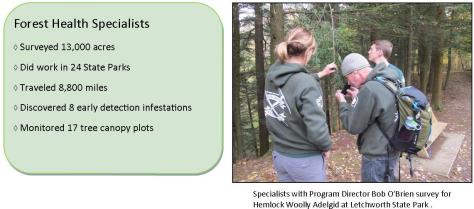
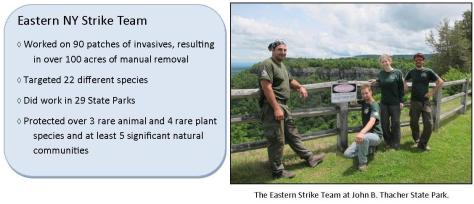
For the summer of 2015, we had two Invasive Species Strike Teams and one Forest Health Specialist Team working on State Park lands. The two strike teams each covered half the state, the Eastern Team covering from Long Island to Lake Champlain. The Western Team covered the State Parks west of the Binghamton-Syracuse line. The Forest Health Specialists also focused on Western NY, coming as far east as the Finger Lakes Region.

Check out what we accomplished this past year!

Western Strike Team
Photo by Alyssa Reid
Eastern Stike Team
Photo by Alyssa Reid
Forest Health
Photo by Alyssa Reid

That is a lot of effort, both on the planning end, and by our hardy crew members! Without the hard work and commitment to excellence of our seasonal staff, the program would accomplish only a tiny fraction of our goals. Their eyes on the ground keep us informed of the details of each treatment area and provide us with feedback on the success or any recommendations for further actions. We listen closely to feedback from the crews and other Parks staff and partners to continue to improve and strengthen the Invasive Species Program each year.

So even though there is snow on the ground and temperatures are cold, we are still working on invasives issues and preparing for what we hope to accomplish in the upcoming field season.

For more information on the State Parks Invasive Species Strike Teams, see this blog post.

For more information on the State Parks Forest Health Specialists, see this blog post.

Post and photos by Alyssa Reid, State Parks Invasive Species Field Project Specialist

FORCES : College Students Support Stewardship in New York State Parks

As the summer months wind down, the FORCES Program staff of the Central and Finger Lakes Regions are busy both reflecting on the last few months and making plans for the next academic year.

FORCES stands for “Friends of Recreation, Conservation and Environmental Stewardship”, and the FORCES Program specifically focuses on building long-term, mutually beneficial partnerships between local state parks and colleges. Currently this includes one-day volunteer events, FORCES clubs at six colleges, dozens of stewards between the two regions, partnerships with faculty members and college administration, projects in over twenty parks and historic sites, and involvement with fourteen colleges and universities within the Finger Lakes and Central Regions.

This summer has been an exciting one, with the “FORCES family” including 37 stewards and seasonal employees! The FORCES interns and seasonal employees started together in June with the first annual “Trainapalooza,” which was held this year at Robert H. Treman State Park in the Finger Lakes Region. The stewards gathered for a two day training on invasive species identification and removals, iMap Invasives training, an overview of the geologic and human histories of the area, interesting features of some of the parks, and strategies for outreach and interpretation. The group also camped overnight at the park, and got to know each other while playing Frisbee, solving riddles, and enjoying s’mores.

After they were trained, the stewards separated again to begin projects throughout the two regions. Many projects focused on invasive species removal; stewards worked to remove water chestnut, pale swallowwort, slender false brome, and many other species of invasive plants. Other projects included the creation of a video about the FORCES program, historical research, assistance with the ongoing surveys for the Chittenango Ovate Amber Snail at Chittenango Falls State Park, water quality monitoring at Selkirk Shores State Park, and trail blazing at Two Rivers State Park… the list goes on and on!

The upcoming academic year will bring more excitement as FORCES welcomes new and returning stewards and club members. The semester started with the New York State Fair, where FORCES annually engages the public in building bluebird boxes- they assembled 1,250 boxes just this year! To date, FORCES at the State Fair has hosted over 180 students and involved 8 colleges. Plans are also in motion for the first annual FORCES Membership Gathering, which will take place in October and combine trainings with celebrations for club members, stewards, seasonal staff, and ambassadors- all members of the “FORCES family”.

In the spring, FORCES will hold its second annual Leadership Summit, which assembles club officers and FORCES “Ambassadors” from all FORCES schools to plan and strategize for the growth of the FORCES Program. The event was a huge success last April, with the FORCES staff being (again) blown away and inspired by the passion and dedication of the students.

Keep an eye out for FORCES stewards as you visit the parks, and chat with them about the projects they are working on. They’re accomplishing big things!

For more information visit our new web page.

Post by Becky Sibner, FORCES Program Specialist for the Finger Lakes Region.


Forest Health Specialists: Climbing in Pursuit of Invasive Insects

Forest Health Specialists are an important part of New York State Park’s Invasive Species Management Team. Their work helps protect native plants, wildlife  and forests that are currently being threatened by two non-native invasive species: Hemlock Woolly Adelgid (HWA) and Emerald Ash Borer (EAB). Although these insects are very different from each other in appearance and behavior, they both cause significant destruction and mortality to their host trees.

What do Forest Health Specialists Actually Do?

The Forest Health Specialists are seasonal employees that travel throughout New York State conducting invasive species surveys and monitoring infestations in various Parks. They have training in field biology, forestry, and tree climbing. The team of two camps at the park of interest while completing their work. Surveys involve lots of hiking and investigating trees that look to be in poor health, taking photos, and recording information on location and observations made at each site.

Although hiking in the woods isn’t a bad way to spend a work day, monitoring infestations of HWA is where the job really gets interesting. Specialists need to collect canopy samples from hemlock trees in order to see if insect numbers are declining or increasing. So, using a giant 8-foot slingshot, a line is shot high into the tree to a branch anywhere between 50 to 90 feet above the ground. Then a climbing rope is attached and pulled into the canopy and the fun begins! The Specialist, equipped with a harness and two ascenders (the name for special clips), climbs the rope upwards into the treetop. Climbing can be highly physical but is always rewarding.

3
A Forest Health Specialist working their way up to the canopy using a climbing harness that is attached to the rope. Climbs typically take about an hour.
4
A bird’s eye view looking down from the top of a hemlock. The tiny speck at in the bottom (in the green shirt and white cap) is the other team member!

So What’s the Goal?

The goal of this program is to get a better grasp of where these invasive species are spreading, assessing their impact on the forests, and ultimately taking action to slow their spread and keep their numbers under control. It also allows biologists and managers to anticipate other impacts to wildlife or rare species; to plan for potential avoidance or removal of hazard trees along trails; and to help others understand changes they see in the forest and landscape around us.

Of course a key component to the program’s success is you! By offering educational programs and volunteer opportunities, Forest Health Specialists also help people all over the state learn about invasive insects. The more people participating in and understanding invasive species in New York; the better chance we have of making a difference in our parks and our communities.

Remember, the best way to stop the spread of Emerald Ash Borer and Hemlock Woolly Adelgid is to avoid introducing them in the first place. Don’t move firewood, take caution in moving landscaping debris around, and clean equipment and vehicles if moving from a site with these pests to somewhere else!

For more information go to NYS DEC website:  www.dec.ny.gov/animals/265.html

Post by Kelly Blood (OPRHP). Photos by Kelly Blood and Alyssa Reid (OPRHP).


Four-Legged Grounds Crew

One hundred Southdown sheep once mowed the expansive lawn of William Rockefeller’s estate, Rockwood Hall, in North Tarrytown, NY.  A century later sheep and goats are grazing once again, but now the property is part of Rockefeller State Park Preserve (Preserve) in the renamed community of Sleepy Hollow.

sheep1
Sheep grazing at Rockefeller State Park Preserve.

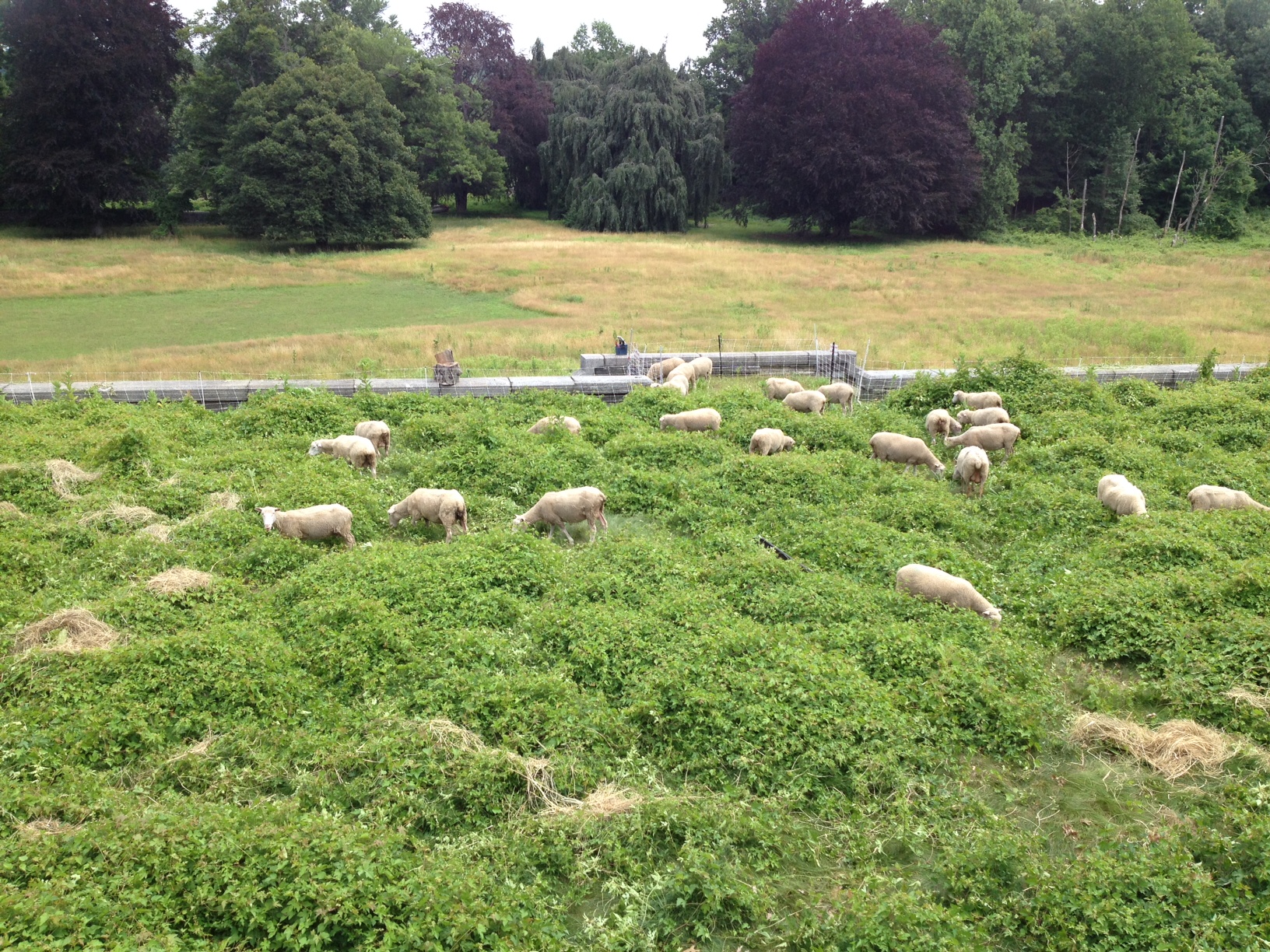
Over recent years, the steep slopes and historic stone foundation overlooking the Hudson River became overrun by the highly invasive akebia vine (Akebia quinata), porcelainberry vine (Ampelopis brevipedunculata) and other invasive species.  To control the vines and manage the grassy hillsides, the Preserve has partnered with Stone Barns Center for Food & Agriculture, a neighboring non-profit working farm and education center, to rotate sheep and goats around the foundation.  Stone Barns gets more grass and forage for their sheep, while public lands get invasive species more under control in an ecofriendly way.

The project was begun in mid-summer of 2014 with 50 sheep augmented by 7 goats over four months.  This year Rockwood Hall will host 10 Boer goats, 30 Tunis sheep and 50 Finn Dorset sheep. They are rotated every 4-6 days through small paddocks enclosed with temporary electric netting and peripheral fencing.   Chris O’Blenness, a farmer employed by Stone Barns Center, is managing the flock and stays on-site at night in a travel trailer.

This is the first joint Rockefeller State Park Preserve-Stone Barns Center experiment aimed at improving landscape health and ecosystem function.  It is also a potential strategy for increasing access to land for beginning farmers.  Chris O’Blenness is representative of beginning farmers and ranchers who are searching for land to work. This type of symbiotic grazing arrangement on public lands is a potential model for other public lands that can offer beginning farmers affordable opportunities for land access—all while performing a vital public service and delighting Preserve visitors.

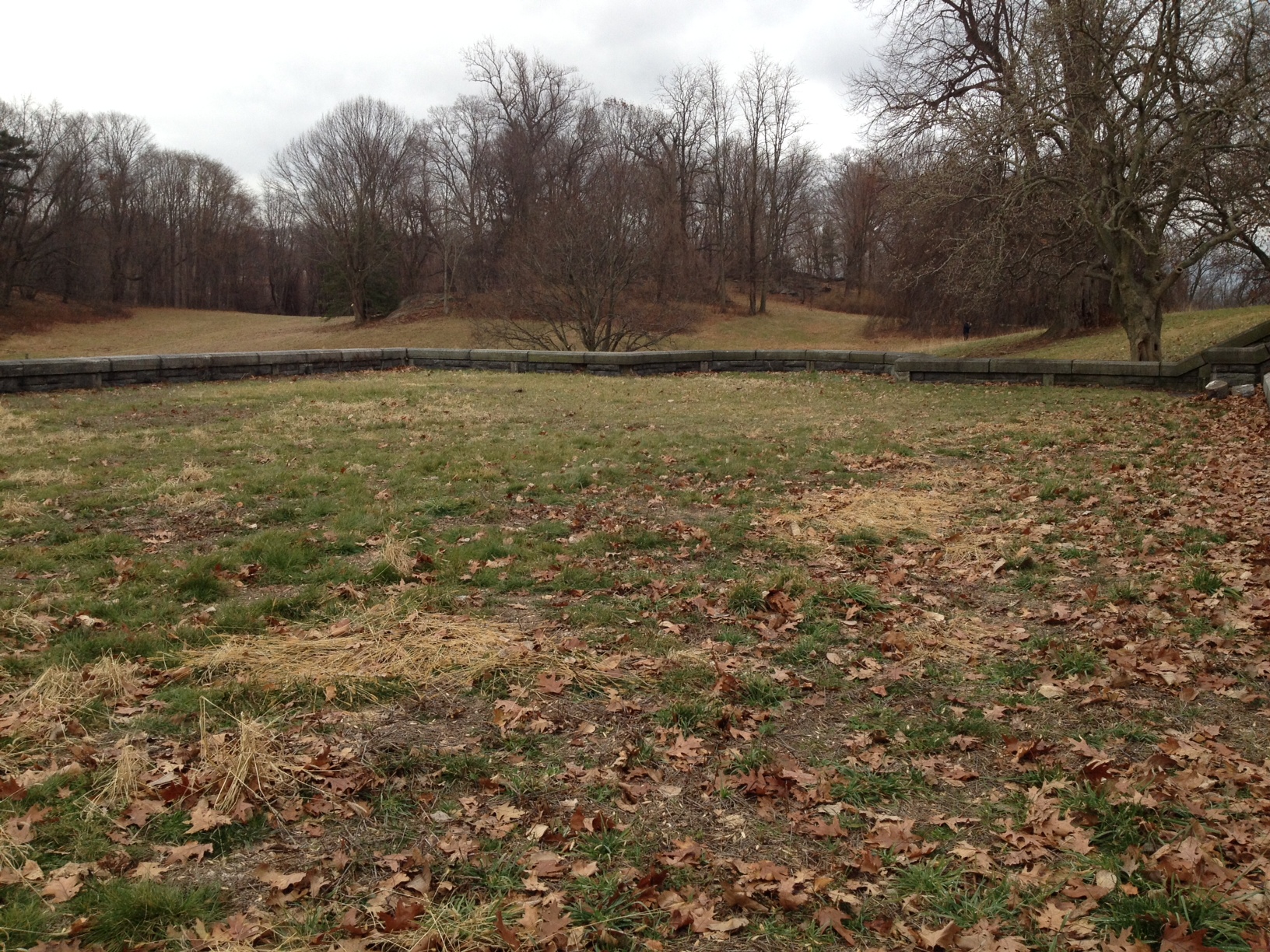
Envisioned as a multi-year initiative, this on-going land management is needed to make headway against the fast-growing spread of invasive species.   So far grazing is making a difference, but progress would be lost if grazing were stopped.  Although 90 grazing animals sounds like a lot, it’s not on a large landscape.  We have also added weedwacking and mowing to the rotation.  Since the grazing started, one terrace, once engulfed in a 3 foot tangle of thick porcelainberry vine, is now able to be mowed weekly and visitors are able to spread blankets on grass and picnic where no one dared before.

sheep2
Terrace with porcelainberry in the summer of 2014.
sheep3
The same terrace in December of 2014 after grazing and mowing.

As the Preserve and Stone Barns gain experience and increase numbers of animals, we’re hoping to fine-tune the grazing to achieve ecological and foraging goals.  Meanwhile, the baas of the sheep and goat greet visitors, many of whom now stop and look and think about invasive species and land management challenges.

Post and photos by Susan Antenen, Rockefeller State Park Preserve Manager.