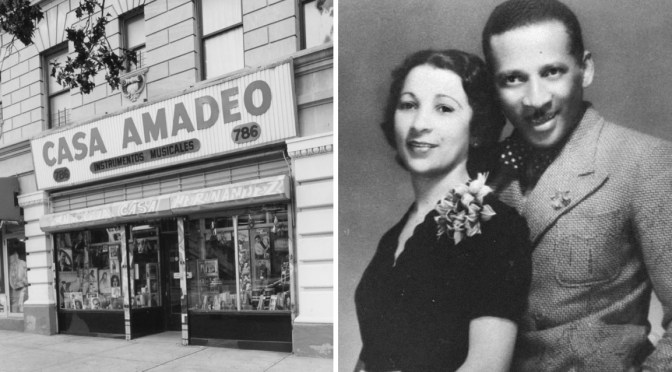
Added to the National Register of Historic Places in 2001, Casa Amadeo, antigua Casa Hernández is best known as the Bronx’s longest continually run music establishment and the oldest Latin music store in New York City. The store’s founder, Victoria Hernández, is one of the earliest female Puerto Rican entrepreneurs in the city. The National Register listing highlights her story and the lasting impact she had on the city’s Latin music scene.
Looming on a corner along Prospect Avenue in the Bronx, this 1905 Neo-Renaissance style apartment building is home to a cornerstone of New York City’s Latin music history.
The Manhanset, home to Casa Amadeo, antigua Casa Hernández, in operation since 1941. Casa Amadeo National Register nomination | Photographer: Martha Cooper (September 2000)
There’s more to nature in New York City than rats and pigeons! From wriggly eels to soaring falcons, there are plenty of species that thrive in and around the concrete jungle. Prehistoric creatures roam our shorelines. Ancient trees line our streets. Read on to learn more about some of the species that make up the hidden nature of NYC.
Each year, New York State Parks’ New York City region collaborates with partners BlackAFinSTEM, NYC Audubon, Latino Outdoors, Feminist Bird Club, and Outdoor Afro to convene Black Birders Week events. Together, these local organizations have created a network of support for historically marginalized people in communities that call this diverse and populated metropolis home, and our state parks are proud to serve as venues for some of the week’s activities.
Black Birders Week is just one example of how an injustice can inspire a community of people to come together to advocate and inspire change. On May 25, 2020, Christian Cooper – a Black man – was birding in Central Park when he encountered a white woman with her dog in the Ramble and politely asked her to put her dog on a leash so as not to disturb nesting birds. In response, the woman called 911 and asserted that a Black man was threatening her and her dog.
The video of this encounter went viral, making national news and demonstrating the challenges Black people face when engaging in outdoor activities. The incident, and others like it, led to the creation of Black Birders Week, now in its fourth year. The week itself aims to celebrate and uplift budding Black birders, expert Black birders, and all birders in between.
In 1836 Balthasar Kreischer emigrated from Bavaria to New York City with plans to help rebuild the city after the devastating fire the previous year. The Great Fire of 1835 burned across 50 acres and destroyed 674 buildings. Kreischer and his partner, Charles Mumpeton established the Kreischer Brick Manufactory, a firebrick businesses with locations in Manhattan, Staten Island, and New Jersey. In the neighborhood now known as Charleston on Staten Island, he began mining for clay that would then be shipped to brickwork factories in Manhattan. The business flourished until Kreischer’s death in 1886. A few years after his death, the factory burned down, and although it was rebuilt, the business never recovered.
The remnants of the clay mining are still visible today from the hiking trails of the park. Some of the clay pits have filled with water and provided habitat to new flora and fauna, while others remain dry and are home to flourishing skunk cabbage. There are areas along the trails where you can still find signs of the former inhabitants of the area, untouched glimpses into the lives of those who once lived in this beautiful area. Outside of the Interpretation Center are some of the historic Kreischer bricks in the walkway, guiding you away from the rush of city life and into the quiet serene that is Clay Pit Ponds State Park Preserve.
Balthasar Kreischer. Image courtesy of the Staten Island Museum Collection.
Kreischer bricks at Clay Pit Ponds State Park Preserve.
Post by Clare Carney, OPRHP, Clay Pit Ponds State Park Preserve.
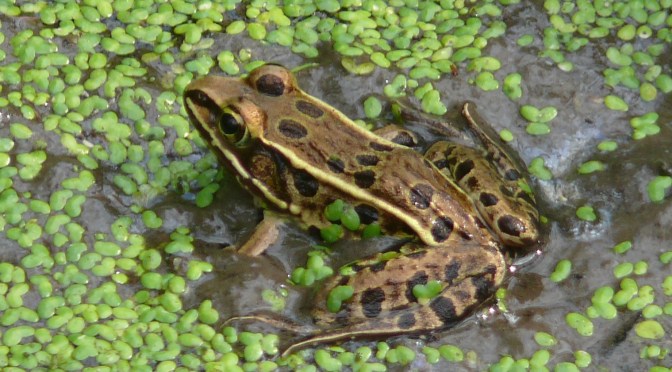
The discovery of a new species is always a big deal, especially when it’s been living right under the noses of over 8 million residents of New York City and the surrounding counties. A new species of leopard frog, still unnamed, was first identified by Jeremy A. Fienberg of Rutgers University in 2009 on Staten Island, and DNA tests confirmed his discovery in 2012.
The deceptively similar northern leopard frog (Rana pipiens), by M. Schlesinger
It’s no mystery how this mystery frog escaped our notice for so long. There are over a dozen leopard frog species that range between Canada and Central America, and until Fienberg recognized their distinctly different vocalizations, all the leopard frogs of NY were presumed to be either northern leopard frogs (Rana pipiens), or southern leopard frogs (R. sphenocephala).
New York State Parks is collaborating with the NY Natural Heritage Program on a regional study aimed at defining the range of the newly described species in comparison to the northern and southern leopard frog. The study’s objectives are to define the distribution, habitat use, and conservation status of the three species from Rhode Island through Virginia by matching calling surveys with follow-up surveys to catch, photograph, and get tissue samples from frogs. In New York, efforts are focusing on the Hudson Valley and Long Island, where State Parks contain some large wetlands that may be suitable as leopard frog habitat.
As part of this project, Natural Heritage biologists Kelly Perkins, Rich Ring, and Matt Schlesinger, and Parks biologist Jesse Jaycox, conducted surveys and habitat assessments for leopard frogs at wetlands in state parks. These surveys were conducted at Goose Pond Mountain, Tallman Mountain, Franklin D. Roosevelt, and Taconic State Parks. Despite spending long evenings in the parks at night, when frogs are most active, no leopard frogs were found. However, these wetlands are home to many other types of frogs, including Green Frogs (R. clamitans), spring peepers (Pseudacris crucifer), wood frogs (R. sylvatica), and pickerel frogs (R. Palustris).
For now, this new species remains a cryptic member of New York’s natural wildlife. Hopefully, we’ll get to know it better in the future.
A swamp in Orange County where the new species makes its home. By M. Schlesinger
The featured image is the unnamed species of leopard frog, by Matt Schlesinger. Post by Matt Schlesinger and Paris Harper.
Update: The newly discovered leopard frog species has been named the Atlantic coast leopard frog, Rana kauffeldi.





 New York State Parks and Historic Sites Blog