

Crisp air. Crunchy leaves. Fall is a magical season. Temperatures are just right for hiking, biking and outdoor adventure. There’s vibrant color everywhere and honking geese overhead. It’s the season of apple cider donuts, pumpkin spice, and of course, Halloween! Maybe that’s why fall has eclipsed summer as the busiest time of year at our parks and historic sites? For your consideration and enjoyment, our seasonal outdoor fun experts have returned to help you squeeze every last drop out of this delightful season!
Continue reading Your Guide To Fall At New York State Parks And Historic SitesTag Archives: New York State History
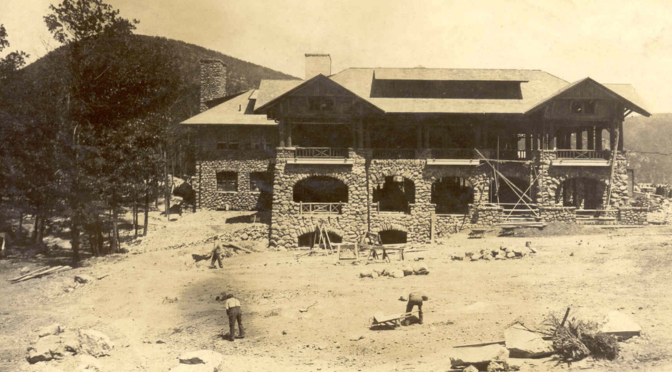
From A to T: A Look at Rustic Park Architecture in New York State
On a trip to a New York State park, you are likely to encounter distinct—and historic—architecture that feels, well, like it belongs in a park. And that’s because many of the historic buildings and structures in our system were originally part of a movement to create a distinct architectural style for park infrastructure. How did that develop? Read on to learn more about park architecture from the 1920s and 1930s…from administration buildings to trail shelters!
Planning and Building for Public Use
The development of the state park system, which began with the adoption of a unified state park plan in 1924, necessitated the construction of buildings and structures that could accommodate increased public usage in the pre-World War II era. These included bathhouses, erected for the use of patrons at parks with swimming facilities; picnic pavilions and smaller trail shelters, which provided shelter to park visitors during inclement weather or for special events; cabins, built to accommodate overnight visitors that did not wish to camp; and other specialized buildings, including park offices, golf clubhouses, and public restrooms.
Rustic Design
The architectural program of the New York State Park system between the late 1920s and early 1940s was decidedly rustic. This meant that projects usually used locally available natural materials, had a natural color palette, exhibited straightforward but skilled craftsmanship, and were designed to be integrated with their natural surroundings.
READ MORE
Congratulations To The 2024 New York State Historic Preservation Awards Recipients
Preserving our history is no small task. Whether someone is restoring a historic home, breathing new life into a warehouse through adaptive reuse, documenting and researching a building for a nomination to the State and National Registers of Historic Places, or restoring cemetery stones, a lot of time, money and creativity goes into preservation and documentation projects.
The Division of Historic Preservation recently recognized eleven outstanding projects with the New York State Historic Preservation Awards. This year saw the addition of the Joan K. Davidson Award. Joan was Parks Commissioner from 1993-1995; Chair of the New York State Council on the Arts from 1974 to 1977, and President of the J. M. Kaplan Fund from 1977 to 1993. She was a strong believer in historic preservation and an advocate for grassroots, collaborative efforts to preserve our shared history.
Without further ado, we proudly present this year’s 2024 New York State Historic Preservation Awards recipients!
Continue reading Congratulations To The 2024 New York State Historic Preservation Awards Recipients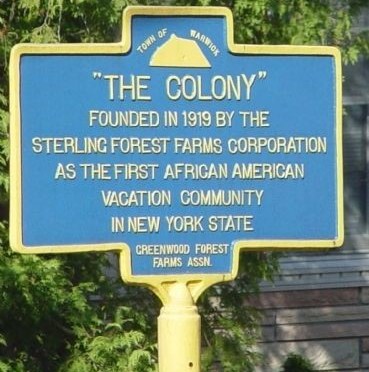
All are Welcome Where They Once Were Not: New York’s First African American Vacation Resort
Vacationing in New York has not always been easy for African Americans. For most of the 20th century, cultural segregation was the norm. While Jim Crow laws in Southern states were explicit, here in New York there also were known rules of discriminatory racial separation in accommodations that could make finding a cool place on hot summer days challenging.
About an hour’s drive north of New York City, the popular mountain resort area of Greenwood Lake in Orange County near the border with New Jersey dated to the 1870s and for years had been off-limits to Blacks, Jews, and Italians. But in 1919, a change happened. Wanting to relax in this beautiful mountain setting and enjoy themselves without racial hassles, a group of prominent African American families, spearheaded by nine members of the Carlton Street YMCA in Brooklyn joined together to create the first African American vacation resort in New York State.
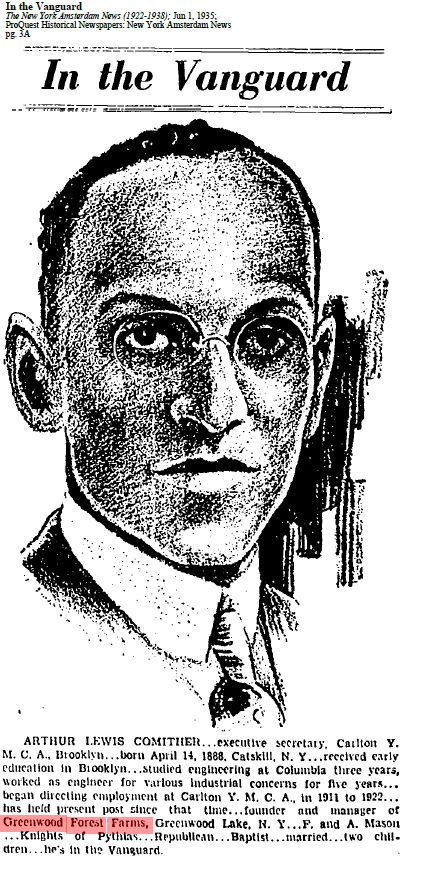
Sterling Forest Farms Incorporated purchased 143 acres of land high in the mountains surrounding Greenwood Lake and named it Greenwood Forest Farms. The ‘Colony’ as it came to be known was to become the summer place to be for African Americans well into the 1960s.
By the mid-1930s, Greenwood Forest Farms was well on its way to becoming the place to be seen during the summer months. A July 1938 headline in the Black-owned New York Amsterdam News boasted “Greenwood Lake May Become East’s Most Fashionable Summer Colony.” A full-page story covered details of the site’s founding, and reporter Thelma Berlack-Boozer was given tours of several cottages, gardens, and all the amenities. At the time there were twenty-eight cottages set in beautifully landscaped gardens with thirty-five other lots in development. The writer described the wonderful natural forest surrounding the location, the luxurious summer furnishings on expansive porches and lovely interiors, the corporation’s plans, and how those who happened to not own cottages still could enjoy time there.
The corporation built a club house called the ‘Farm House’ where vacationers could enjoy live music, dancing, and a restaurant. For those who did not own a cottage, the Farm House was one of three locations where vacationists could rent rooms. The other two were private cottages which rented bedrooms during the summer, with one of those, the Justice House, opened during the winter for those interested in hunting. An August 1941 ad offered lodging at the Farm House for $15 per week or $4 for the weekend, with a car shuttle leaving from Harlem on Tuesdays, Thursdays, and Saturdays to make traveling upstate easy. The plan was completely upscale, to the point that in the 1940s the colony generated its own electricity. When completed, the Colony had a man-made lake, tennis, and hand-ball courts, and a nursey school for everyone’s use.
New York’s Black elite both owned the properties and visited their friends. Luminaries like Cecil McPherson (Cecil Mack) the famous lyricist and music publishing magnate, and his wife Dr. Gertrude Curtis, New York’s first African American woman dentist owned a cottage there. The poet Langston Hughes was among several literary figures who summered there with friends. Civil rights giants James Farmer, Harold W. Cruse, and Robert J. Elzy, the head of Brooklyn’s Urban League were among the property owners and guests.
If people wanted to know where to find the cream of the crop during the warmer months, society columns in the New York Amsterdam News kept people up to date. In 1933 the paper’s Brooklyn Society column informed all that the Elzys could be found at their cottage ‘Rob-Lou,’ and that Mr. and Mrs. Jesse Webster, and their weekend guests from Baltimore motored up to the Greenwood Forest Farm House on Sunday. Mrs. Willard J. Price and her daughters spent the week as guests of Mrs. Walter Taylor of Greenwood. The Jamaica News and Social Briefs shared that Mrs. Gordon Jones and her daughter, were at Sterling Forest Farm for the summer but had returned to Jamaica.
By the late 1960s as the older generation died, and options for vacation locations expanded for African Americans with the passage of the Civil Rights Act and the opening up of public accommodations, fewer people ventured up to Greenwood Forest Farms. In the 1970s the famous Farm House was lost to a mysterious fire, but many families continued to vacation and live there year-round.

In 2007, the Greenwood Forest Farms Association, Inc was created by descendants of original property owners to preserve the legacy of the colony. Although diminished, Greenwood Forest Farms today remains a proud hamlet of the Town of Warwick and has a few multi-generational residents.
Today, New York State Paths through History signs can be found along Nelson Road in the Town of Warwick commemorating Greenwood Forest Farm’s amazing story of resilience and joy. And this historic place is now preserved for the people of New York.
On January 11, 2022, Governor Kathy Hochul announced a 130-acre expansion of Sterling Forest State Park, with a portion of the land belonging to Greenwood Forest Farms. Now with the designation of this land as a State Park, awareness of the legacy of the area will grow.
As State Parks celebrates Black History Month, we are reminded that this property tells the story of a time when racial segregation in the North was found around Greenwood Lake. It reflects part of a long journey to today, when State Parks is committed to the message that “All Are Welcome Here.”

Cover Shot – Historic marker for Greenwood Forest Farms (Photo credit – Woodham, Rebecca. “”The Colony” Historical Marker (Greenwood Forest Farms).” Clio: Your Guide to History. December 27, 2017. Accessed Jan. 20, 2022. https://theclio.com/entry/53333)
Post by Lavada Nahon, Interpreter of African American History, Bureau of Historic Sites, NYS Office of Parks, Recreation and Historic Preservation.
Learn More About Greenwood Forest Farms
Read this 2019 article and 2005 article from the Times Herald-Record newspaper.
Watch this accompanying video by the Times Herald-Record.
Read this 2005 article from the Warwick Historical Papers newsletter.
Learn more about Black history in New York State in previous posts on the the NYS Parks Blog:
Juneteenth — Coming to terms with Freedom
“Grand Old Fort: But Alas Manned by Colored Troops…” Buffalo Soldiers at Fort Ontario
Reviving a Dutch Holiday with African Flavor
A Legacy of Strength: Civilian Conservation Corps
John Brown Farm: Growing Freedom in Adirondack Wilderness
About Sterling Forest State Park
Established in 1998, Sterling Forest State Park covers nearly 22,000 acres of nearly pristine natural refuge amidst of one of the nation’s most densely populated areas, a remarkable piece of woodland, a watershed for millions, and a tremendous outdoor recreation area. This unbroken deep-forest habitat is important for the survival of many resident and migratory species, including black bear, a variety of hawks and songbirds and many rare invertebrates and plants. Hunting, fishing and hiking opportunities are available.
The park’s Senator Frank R. Lautenberg Visitor Center overlooks the nine-mile long Sterling Lake and features exhibits about the local environment as well as an auditorium for related presentations.
The park has more than 80 miles of hiking trails, including a portion of the Appalachian Trail. It offers opportunities for horseback riding (permit required), hunting (permit required), fishing, biking, snowshoeing, cross-country skiing and ice fishing.
The park also is part of the Sterling Forest Bird Conservation Area, and includes such species as Peregrine Falcon (endangered), Pied-billed Grebe (threatened), Least Bittern (threatened), American Bittern (special concern), Osprey (special concern), Sharp-shinned Hawk (special concern), Cooper’s Hawk (special concern) Northern Goshawk (special concern), Red-shouldered Hawk (special concern), Common Nighthawk (special concern), Whip-poor-will (special concern), Red-headed Woodpecker (special concern), Horned Lark (special concern), Golden-winged Warbler (special concern), Cerulean Warbler (special concern), and Yellow-breasted Chat (special concern). Numerous other species contribute to the diversity of birds within the BCA including Broad-winged Hawk, Acadian Flycatcher, Least Flycatcher, Yellow-throated Vireo, Brown Creeper, Winter Wren, Hermit Thrush, Worm-eating Warbler, Blue-winged Warbler, Black-throated Blue Warbler, Pine Warbler, Ovenbird, Louisiana Waterthrush, Hooded Warbler, Canada Warbler, Scarlet Tanager, Rose-breasted Grosbeak, Orchard Oriole, and Purple Finch.
Sources
Greenwood Lake May Become East’s Most Fashionable Summer Colony, Thelma Berlack-Boozer, The New York Amsterdam News, July 23, 1938, ProQuest Historical Newspapers: New York Amsterdam News, pg. 10.
Brooklyn Society, Elzys ‘Rob-Lou,’ The New York Amsterdam News, September 6, 1933; ProQuest Historical Newspapers: New York Amsterdam News, page 11.
Brooklyn Society, Mr. & Mrs. Webster, The New York Amsterdam News, July 12, 1933; ProQuest Historical Newspapers: New York Amsterdam News, page 11.
Jamaica News and Social Briefs, The New York Amsterdam News, July 23, 1928; ProQuest Historical Newspapers: New York Amsterdam News, page 9.
Kinderhook Home A Revolutionary War Story of War, Loss, and Exile
On Route 9, just south of the village of Kinderhook in Columbia County, a sign proudly proclaims it as the birthplace and home of Martin Van Buren, the eighth U.S. President. Next to that is a purple-and-gold sign for the local Elks lodge.
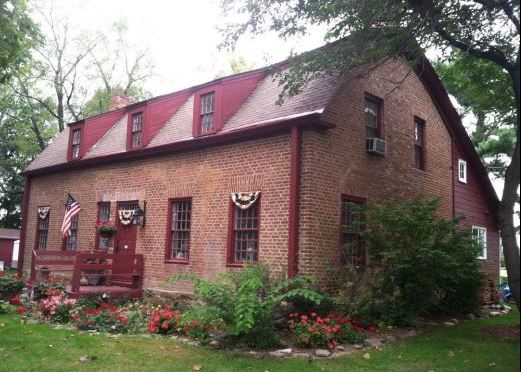
Right across the street sits an unassuming two-story red brick house with dormer windows. While locals know it as the Tory House, there isn’t a sign. But this house has its own story to tell about early New York, one of a family among many thousands that picked the losing side in the Revolutionary War and ended up years later losing that home to the victors in a practice that was to be banned in the U.S. Constitution.
That family was named van Alstyne, one of the many families with Dutch roots that settled in the region during the 18th century to farm. The family had three sons _ Abraham, the oldest; Peter, the middle son; and John, the youngest. By the time that the Revolutionary War broke out in 1775, Peter had built his family the red brick house in Kinderhook on land that he and his brothers had inherited as teenagers two decades earlier when their father died.
Earlier this summer, that house – still used as a residence more than two centuries later – was named to the State and National Registers of Historic Places because of the story of Peter Sander van Alstyne and his family. The narrative of this post is based on research for that nomination submitted on behalf of State Parks by the late Ruth Piwonka, a former member of the Historic Preservation Division at State Parks, and a later Parks consultant and historian for Kinderhook.
Peter Sander Van Alstyne was 32 years old in 1775, already a successful farmer, married and with a young family. A local judge appointed by the Colonial government, he found himself caught up in the conflict the following year when a group of town members come to his home to forcefully tell him that his office, resting on royal authority, no longer had authority to settle disputes over debts. That same year, the beleaguered judge was chosen to be a member of the Albany Committee on Correspondence, a kind of shadow authority created by patriot supporters. But as a supporter of British authority (known as Tory, or a Loyalist), van Alstyne was not to last long on the committee, and he and more than a dozen other suspected Loyalists in that body were soon ordered arrested and imprisoned in 1776.
Many New Yorkers felt as van Alstyne did about their loyalty to England. Some studies estimate that about half of the state’s 200,000 residents held Loyalist sentiments, giving New York the highest percentage of Loyalists among the 13 colonies. Like van Alstyne, many New Yorkers took up arms to oppose what they saw as an an “unnatural” rebellion against the legitimate government.
Van Alstyne was released from jail in early 1777, but after being forced by threats to leave his home, he headed north to join British forces in Canada, and by summer was marching with British General John Burgoyne’s army from Lake Champlain in a bid to capture Albany as part of a strategic plan to split the rebellious colonies in two. His Kinderhook home was being used as a staging point for Loyalists and military supplies in the event that Albany fell.
But that moment was not to come, and van Alstyne was there when Burgoyne’s forces were defeated at the Battle of Saratoga that September, a battle that marked a turning point in the American Revolution and convinced the French to support the rebels.
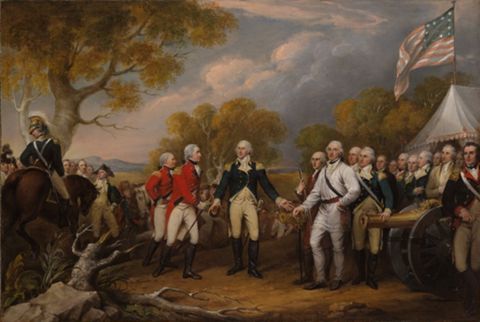
By 1778, van Alstyne had gone to New York City and Long Island, which were under British control, to command sailors who fought in small boats called bateaux. His armed opposition to the Revolution by this point had put his life at risk. Continental troops stationed near his Kinderhook home were trying to catch him, and had captured some of his associates, some of whom were put to death as traitors. By October 1779, van Alstyne had been formally indicted as an “enemy of the state” by New York authorities under what was called the Forfeiture Act. As the war neared an end, New York officials in early 1783 ordered him stripped of his lands, his livestock, and his home, where his brother John’s family was living.
On Sept. 8, 1783, only five days after the Treaty of Paris ended the Revolutionary War, van Alstyne and his family, along with many other displaced Loyalists from Columbia, Rockland, Orange, Ulster, Westchester, and Dutchess counties, as well as some of the troops from Major Robert Rogers, of the famed Rogers’ Rangers backcountry unit, set sail for British-controlled Canada, according to a 1901 account published by Columbia University.
Settling on the northern shore of Lake Ontario near Quinte Bay, van Alstyne received a government land grant of 1,200 acres and became a prominent member of the community, being appointed a judge and later winning election to the Legislative Assembly of Upper Canada. He died in 1800, at age 57.
The former Kinderhook resident was among thousands of New York Loyalists, perhaps as many as 35,000 people, who left the state during and after the Revolutionary War for refuge in British dominions including Canada, according to the 1901 Columbia University account. That came from a total state population of about 200,000, so the forced migration represented about one in every six New Yorkers.
The 1901 account from Columbia University estimated that during the war, there were “at least 15,000 New York Loyalists serving in the Brish army and navy, and at least 8,500 Loyalist militia, making a total in that state of 23,500 Loyalist troops. This was more than any other colony furnished, and perhaps as many as were raised by all others combined.”
The legacy of these Loyalists who left New York can be found in the historic structures along the St. Lawrence and Lake Ontario. Said State Parks historic researcher William Krattinger, “I focus quite a bit on the built and architectural environment and have seen examples of Dutch-framed barns and houses erected in Ontario, undoubtedly erected by builders from the Hudson, Mohawk and Schoharie valleys who were banished to the north after the Revolution. These New Yorkers brought their material culture with them.”
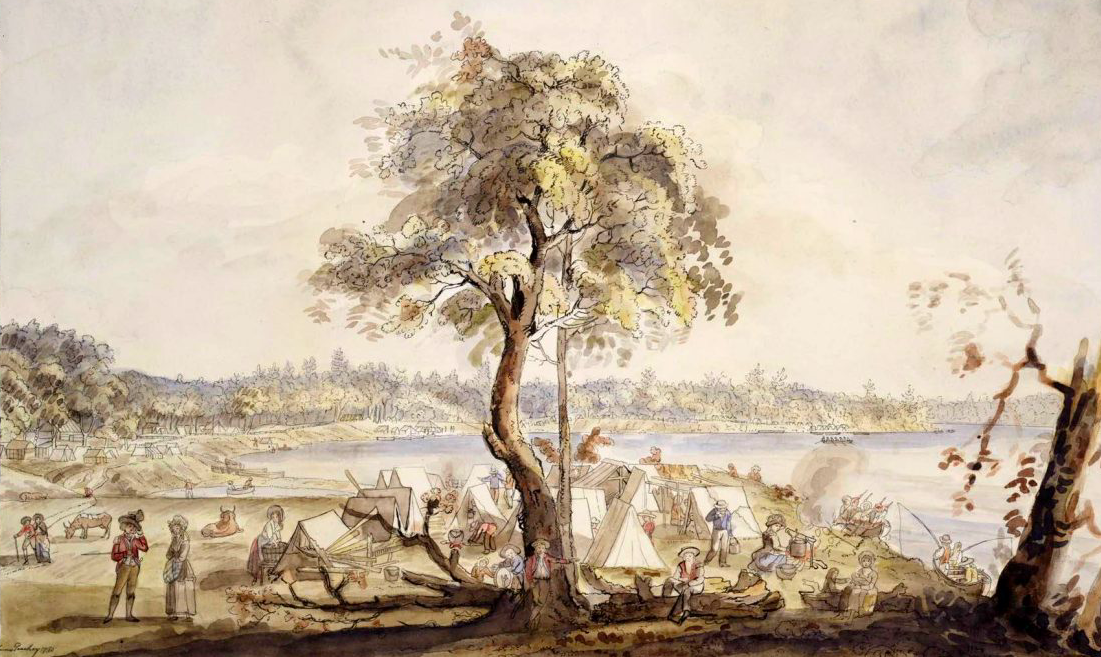
Two years after van Alstyne’s death, New York State officials passed a law in 1802 to renew its still incomplete efforts to confiscate a list of Loyalist properties – a list that included van Alstyne’s Kinderhook home. Offering a bonus to anyone who pointed out forfeited property that had still not been seized, the law described those who had forfeited that property for opposing the Revolution as “attainted.” This concept originates from English criminal law, in which those condemned for a serious capital crime against the state lost not only their life, but also their property, the ability to bequeath property to their descendants, and any hereditary titles.
New York’s bid to seize and sell off remaining Loyalist property two decades after the end of the war came even though the U.S. Constitution, ratified in 1789, specifically prohibits “bills of attainder” passed by legislatures to condemn those deemed state enemies and seize their property.
Here the trail of what happened to van Alstyne’s red brick house grows cold. A clear title to prove who owned the home after van Alstyne lost ownership appears in the public record only starting in the 1850s, although records of forfeiture and sale for other Loyalist properties in Columbia County do exist.
The fate of this home represents just one family’s part of the larger story of how the end of the Revolutionary War meant exile and loss for thousands of New Yorkers who had sided with England, and how the fallout of that time continued for years until the Revolution could truly considered to be ended.
Cover Shot _ Peter Sander Van Alstyne house, Kinderhook. All photos NYS Parks unless otherwise credited.
Post by Brian Nearing, Deputy Public Information Officer, New York State Parks
Resources
Learn more about the Loyalist experience in New York State, using these sources:
A New York Public Library blog post on the 1802 list of Loyalist property to be confiscated in New York State.
A 1901 study into Loyalism in New York State by Alexander Clarence Flick, published by Columbia University Press.
An account by the National Library of Scotland into the lives of two New York Loyalists.
A NYS Parks Blog post about Hudson Valley Loyalist Frederick Philipse III, one of the richest men in Colonial New York whose home is now Philipse Manor Hall State Historic Site in Yonkers, Westchester County.
 New York State Parks and Historic Sites Blog