If you’re visiting a New York State park or historic site in the Hudson Valley this year, you might have a poetic encounter!
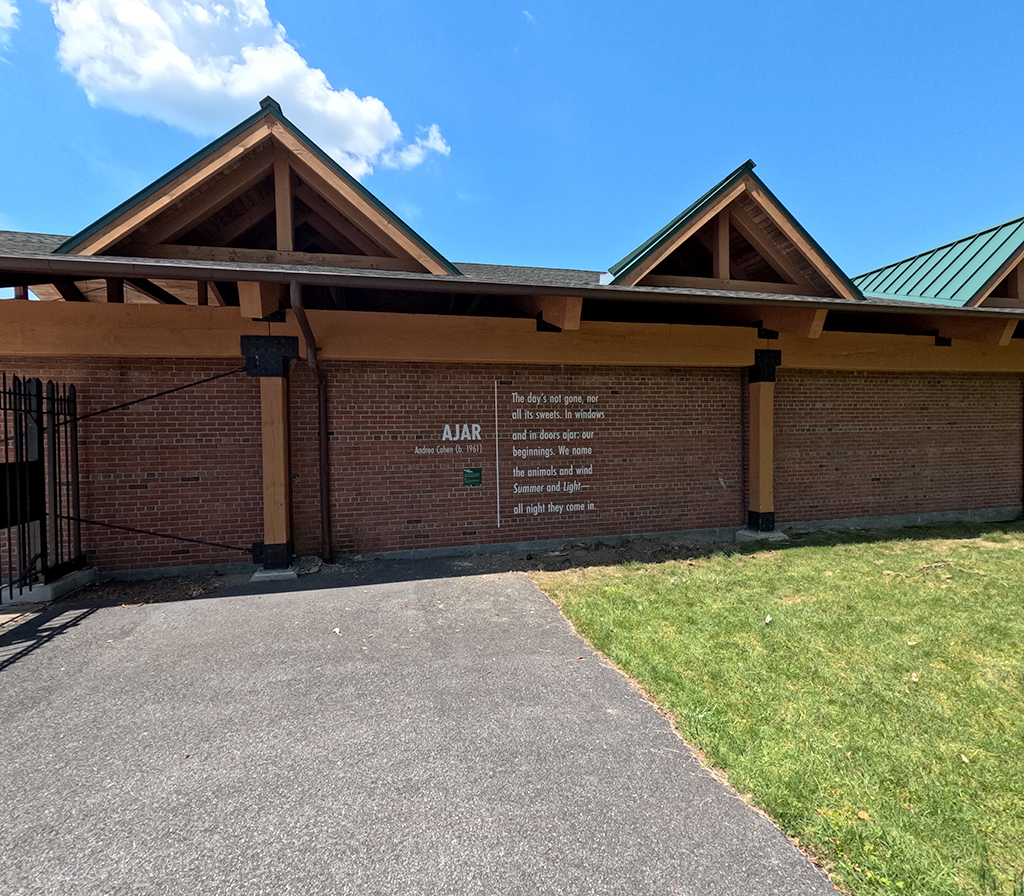
New York State Parks, Recreation and Historic Preservation (OPRHP) is presenting a new temporary public art project, Poetry in the Parks, to celebrate the Parks Centennial. Poems selected by the Poetry Society of America (PSA) and OPRHP are installed in three New York State parks and one historic site stretching from Westchester to Columbia County.
ClermontFDR State ParkLake TaghkanicWalkway Over The HudsonWalkway Over The HudsonThe five poems of the inaugural Poetry in the Parks installation.
This inaugural installation of Poetry in the Parks includes works by Andrea Cohen at FDR State Park in Yorktown Heights; U.S. Poet Laureate Ada Limón and New York Poet Laureate Patricia Spears Jones at Walkway Over the Hudson State Park in Highland and Poughkeepsie; Robert Hass at Lake Taghkanic State Park in Ancram; and Ishion Hutchinson at Clermont State Historic Site in Germantown. Integrated with the architecture found in the parks, the selected poems are meant to be discovered by visitors to help them reflect on the beauty of their natural surroundings.
Poetry and literature have long been used to explore the natural world in ways that can circumvent the pitfalls of scientific and technological determinism. Similarly, in the history of architecture and landscape architecture, new modes of drawing and rendering can add contour and depth to insights from the environmental and biological sciences.
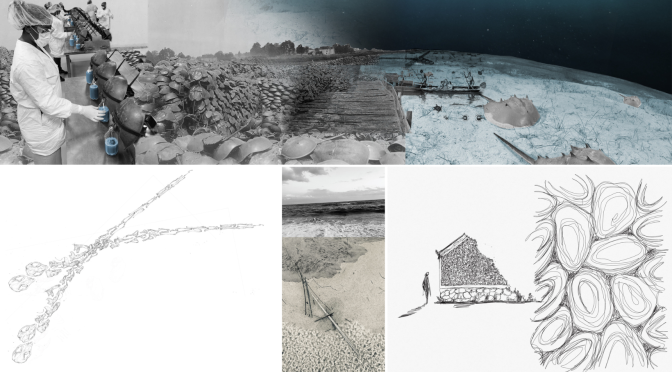
In Spring 2023, Jeanne Haffner, Special Assistant and Director/Chief Curator of the Jones Beach Energy & Nature Center and S.E. Eisterer, Assistant Professor for Architectural History and Theory at Princeton University, collaborated on a seminar for Masters and Ph.D. students called “Histories of Embodied Energy: From Turtles to the Grid.” The course followed the mission of the Jones Beach Energy & Nature Center, investigating “the relationships between human beings, energy systems, and environmental stewardship.” Students toured the Center and surrounding site, and then chose an artifact from Jones Beach to work with for the semester.
Having chosen an artifact, students wrote poems and created a drawing about it. But instead of producing abstract scientific diagrams or architectural renderings, they instead reflected upon alternative ways of representing the environment—ways that prioritize artistic, rather than strictly scientific, approaches. Maryam Popoola, for instance, sees an owl pellet not simply as an object for dissection but as a metaphor for the ever-changing nature of form. Valen Zhang’s poem and drawing considers oysters’ dynamic interactions with the ocean, beach, and built environment. For Marcos Garcia, beach grass on a sandy dune becomes a nexus between humans, lifestyles, and ecological impact. Masa Crilley depicts a horseshoe crab not in isolation, but in a long history that connects underwater worlds, Native American fishing practices, and industrialization.
This selection of poems and visuals reminds us of the continuing connection between art and environmental science, as well as the complex entanglements between environmental, social, and technical systems.
–Introduction written by Jeanne Haffner, Ph.D., Special Assistant and Director/Chief Curator, Jones Beach Energy & Nature Center (NYS Parks) and S.E. Eisterer, Assistant Professor of Architectural History and Theory, Princeton University
–Poems and visuals below created by Maryam Popoola, Valen Zhang, Marcos Garcia, and Masa Crilley
100 years ago this summer, a little girl received a lovely present from her grandmother.
A leather-bound notebook, perfectly sized for small hands. The paper was heavy, to thwart ink from pooling and bleeding through. The pages were lined, to keep unsteady handwriting neat. The gilded edges indicate the importance and timeless elegance of its owner, a daughter of one of New York’s first families. Her name was emblazoned on the cover— Honoria Alice Livingston.
Honoria was the eldest daughter of John Henry Livingston and Alice Delafield Clarkson Livingston. Her great-great grandfather was Chancellor Robert R Livingston, one of the 5 drafters of the Declaration of Independence, the Minster to France under Jefferson, and the co-inventor of the first practical steamboat, just to name a few accomplishments. The Livingston mansion, Clermont, was decorated in 7 generations of familiar excellence. Honoria grew up at Clermont surrounded by her family’s achievements and with the love her parents, her younger sister Janet, their beloved nurse Ollie, a dozen or so servants, and a menagerie of pets.
Honoria and her family
Her maternal grandparents, Howard and Alice Clarkson, lived just up the road and visited often. Grannie Alice and Mom Alice were both prolific poets and journal writers in their own right, so it’s no surprise that young Honoria was showing an interest and a talent for creative writing herself. Grannie christened the notebook with a special poem for her young granddaughter.
To Honoria.
When Grannie was a little girl
She made a little book,
And many times with joy and pride,
Did in its pages look.
And here she wrote her little tales,
And sometimes verses too;
For airy fondness came to her
Just as they come to you.
And now you write such pretty tales,
And little verses too;
So Grannie thought perhaps this book
To hold them all, would do.
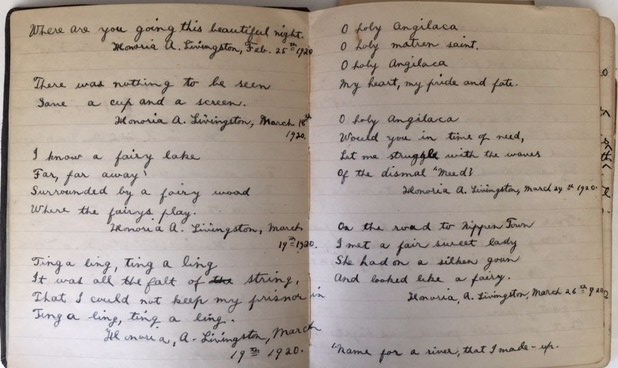
The very day she received the book, Honoria took to work. On the next page, in her very best 10-year-old handwriting, she titled the contents “The Poetry I Made My-Self.” She wrote three poems that day and several more throughout the week.
Comb and brush
I hear a thrush.
Comb and brush
I want to wash.
Brush and comb
Gobi is home
Brush and comb
Away I rome.
Honoria A. Livingston. Aug 3rd 1919
Early poems reference her family, her beloved dog Gobi, and strict rhyming schemes, even if she had to bend the rules a bit to make it work. The following year, the little notebook traveled with the Livingston family as they moved abroad to continue their daughters’ education. Honoria’s repertoire of subject matter grew beyond family life at Clermont and started to include the French countryside, German soldiers, English fairies, and Italian friends.
A sample of Honoria’s poetry including O Holy Angelica.
The Livingstons lived in Europe for the next 6 years. Honoria became a teenager and her subjects became more mature and dramatic:
There’s a road that leads to nowhere good,
There’s a road that leads to Hell;
But there’s also a road to Paradise,
and on that road I dwell.
-Honoria A. Livingston Oct. 5th 1924
Guicciardini, Florence.
Her structures became more experimental and modern:
Of the Universe!
Tell us, I pray thee
Where do the sunsets go when dead?
-Honoria A. Livingston December 2nd 1924
Guicciardini, Florence.
But even so, more than half of her poems are about her beloved pets and many about the comings and goings of her family and friends. Some of her poems are even in French and Italian! She loved to write about the moon and sunsets over Florence, where the family called home for her teenage years.
A week before her 17th birthday in 1926, she wrote a poem to herself, remarking on the occasion and how much she had grown since starting the notebook:
Almost Seventeen!
From a very little child
Into a stately maiden dark,
she has grown.
Guicciardini, Florence. January 25th 1926
The rest of her poems in 1926 play out as her previous years in Italy had— pets, family, and beautiful evenings at the family’s Villa. But in November, something happens. The family suddenly rushes back to the States, leaving precious friends and belongings behind. Honoria’s handwriting becomes rushed, the ink is half washed away in big drips, and pages are torn out. The end of 1926 and the beginning of 1927 do not exist.
Ripped pages from Honoria’s book.
This is when Honoria’s father, John Henry, passed away.
After JH’s passing, the family settled back in at Clermont. Honoria writes in the notebook for another year and then sets it aside— a memento of her childhood and teenage years. She grew up, had her debut in New York City, and married a charming Irishman named Rex McVitty.
Honoria and Rex
They spent their lives at Clermont in Sylvan cottage, even after the mansion and grounds were deeded to The People of the State of New York. They enjoyed meeting park visitors and actively took part in site events. Honoria lived in the cottage until her passing in 2000— her tin mailbox and Poughkeepsie Journal newspaper box were only recently removed from the driveway.
Honoria on Sylvan Cottage’s porch
But even as Honoria grew up, from a 10-year-old girl with her first important grown-up possession, to a beautiful debutant, to an accomplished writer, golfer, gardener, and the Lady of the Estate, she never forgot about her notebook. She came back to it “many times with joy and pride,” just as her Grandmother had before her. As an adult, she even edited and typed some of her early work.
The typed version of Fairies
From a historian’s perspective, Honoria’s poetry journal is a fascinating artifact. Not just a chronical of a young girl growing up, but a chronical of life for an American family and a window into post WWI Europe. Not just flights of fancy, but a collection of popular culture influences of the time. Not just cute pets, but little family moments that tell us so much about the last generation of Livingstons of Clermont. It’s a lovely little book, a scrapbook of experiences, and we are lucky to have it.
As spring returns to New York, so does the eastern phoebe. This charming bird begins its courtship and nest-building in March and April. Since April is also National Poetry Month, it seems fitting to pay tribute to this little bird. The following ode to the phoebe was written by John Burroughs (1837-1921), the beloved New York naturalist who was born on April 3.
When buckets shine ‘gainst maple trees
And dropp by dropp the sap doth flow,
When days are warm, but still nights freeze,
And deep in woods lie drifts of snow,
When cattle low and fret in stall,
Then morning brings the phoebe’s call,
‘phoebe,
phoebe, phoebe,’ a cheery note,
While cackling hens make such a rout.
When snowbanks run, and hills are bare,
And early bees hum round the hive,
When woodchucks creep from out their lair
Right glad to find themselves alive,
When sheep go nibbling through the fields,
Then phoebe oft her name reveals,
‘phoebe,
phoebe, phoebe,’ a plaintive cry,
While jack-snipes call in morning sky.
When wild ducks quack in creek and pond
And bluebirds perch on mullein-stalks,
When spring has burst her icy bond
And in brown fields the sleek crow walks,
When chipmunks court in roadside walls,
Then phoebe from the ridgeboard calls,
‘phoebe,
phoebe, phoebe,’ and lifts her cap,
While smoking Dick doth boil the sap.
Listen to the phoebe sing:
Call recorded by Ian Davies
From John Burroughs Boy and Man by Clara BarrusSources:
Barrus, Clara, John Borroughs Boy and Man, Doubleday, Page & Company, 1920.
We salute National Poetry Month with a poem by Walt Whitman, the 19th century poet whose birthplace is a New York State Historic Site.
UNSEEN BUDS
Unseen buds, infinite, hidden well,
Under the snow and ice, under the darkness, in every square or
cubic inch,
Germinal, exquisite, in delicate lace, microscopic, unborn,
Like babes in wombs, latent, folded, compact, sleeping;
Billions of billions, and trillions of trillions of them waiting,
(On earth and in the sea – the universe – the stars there in the
heavens,)
Urging slowly, surely forward, forming endless,
And waiting ever more, forever more behind.
Walt Whitman, Leaves of grass, 1891-1892
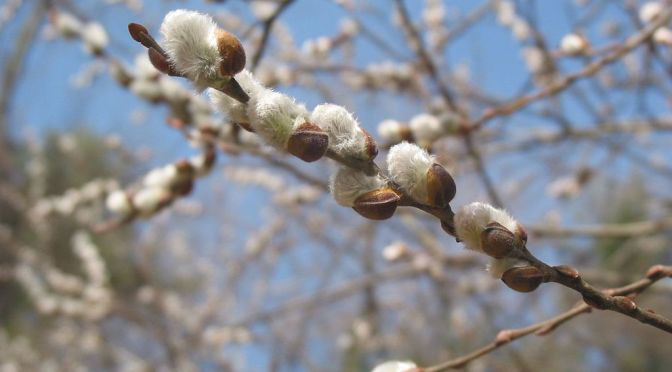
Take some time this month to see the poetry in the unseen buds and early spring flowers in a state park or historic site near you.
Black walnut buds, Photo by S. Carver, State Parks
Birch buds, photo by S. Carver, State Parks
This shrub is found is found in cool forests with sugar maple, beech and birch. The buds of hobblebush are large and lack protective bud scales so they look like praying hands. The buds open as the leaves expand, and some contain a cluster of flower buds in the center as you see here. You can learn more about this plant at the NY Plant Atlas. http://newyork.plantatlas.usf.edu/Plant.aspx?id=726 This shrub is one of the favorite nesting spots for black-throated blue warblers. Photo by J. Lundgren, NYSNHP








![John Burroughs Boy and Man By Internet Archive Book Images [No restrictions], via Wikimedia Commons](https://nystateparks.blog/wp-content/uploads/2018/03/john-burroughs-boy-and-man-by-internet-archive-book-images-no-restrictions-via-wikimedia-commons.jpg)


 New York State Parks and Historic Sites Blog