Busy Beavers and Awesome Osprey; a Canoeing Adventure on Canopus Lake

It is a lovely day in the early summertime, 80o and sunny, with a gentle breeze.  Outdoor educators Daniel Marshall and Ursula Svoboda from the Taconic Outdoor Education Center are preparing to guide weekend canoe tours on beautiful Canopus Lake located in sprawling Clarence Fahnestock Memorial State Park in Putnam County.

“What a gorgeous day to be out on the water!” proclaims a very eager Marshall.

“I hope we see a bald eagle like last time!” replies Svoboda.

No matter the canoe tour guide, a visitor is in for a treat, as all of the educators (guides) from the nearby Taconic Outdoor Education Center.  These guides are friendly, knowledgeable, and bring their own unique perspective on the natural history and ecology of the region.  The hour and a half tour circles the shoreline of the 65-acre lower portion of the man-made lake, weaving in and out of numerous small islands.

The lake, built by the Civilian Conservation Corps (CCC) in the 1930s, is both a recreational and ecological jewel in the park.  In summer, you can find people swimming and sunbathing, paddling in kayaks, and fishing for largemouth bass and yellow perch along the shoreline.  Chain pickerel, brown bullhead catfish, and black crappie also lurk through the aquatic plants below the surface.  A lake such as Canopus, although made by humans, provides a very rich ecosystem.  Other critters that spend most of their time in the water include painted turtles and water snakes such as northern water snake and black rat snake.  There are even predacious water beetles in the lake; beetles are large enough to eat small fish!

Predaceous Diving Beetle_by cotinis
Predaceous Diving Beetle, photo by cotinis

Canopus Lake also attracts animals from the forest ecosystem that may be looking for a drink of water or a place to hunt along the water’s edge.  Beaver activity is evident with toppled trees along the shoreline and a large wood/mud dam near the CCC dam.  Osprey (state special concern species), bald eagles (state threatened) and other birds of prey soar overhead.  Osprey are excellent at fishing, plunging into the water and, more often than not, emerge with a fish in their talons. What makes this canoe trip so exciting is that one really never knows what they might be lucky enough to observe when out on the water!
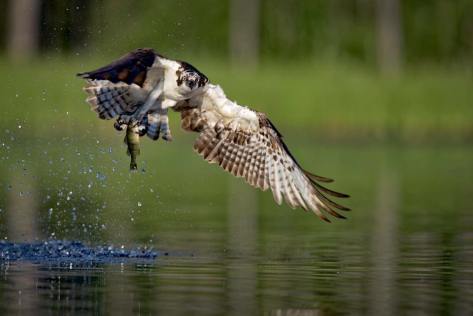
Osprey
North osprey grabs a yellow perch

Canoe tours cost $5 per person and leave from the park’s boat launch along Route 301 just south of the park office.  Some of the boats can accommodate four people (two paddlers and two passengers.)  Reservations are encouraged by calling (845) 265-3773.  Come experience this fun summertime activity for yourself!

Post by Aaron Donato, State Parks
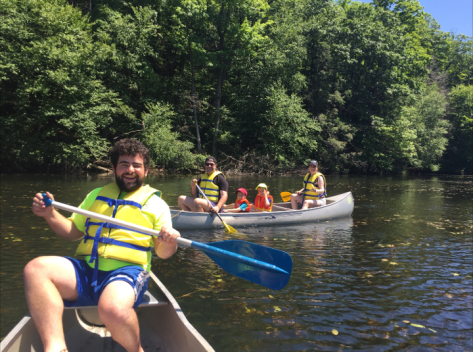
Aaron Donato and canoeing group
Fun times canoeing on Canopus Lake, photo by Aaron Donato

The Petaltail’s Tale

Each June and July, visitors to several gorge parks are rewarded with an unusual treat – the chance to see a “living fossil.”

The term “living fossil” refers to species that have evolved very little over the course of millions of years. Some well-known examples of living fossils include elephant sharks, ginkgo trees, and horseshoe crabs. Although all of these organisms have evolved, these species have stayed so similar that fossils from millions of years ago are still recognizable as ancestors to the modern species.

Petaltail on Rocks, photo by State Parks
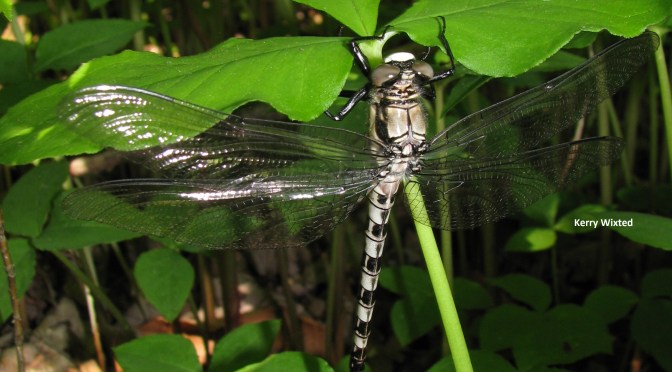
A gray petaltail perches in the sun along a gorge trail, photo by State Parks.

Meet the gray petaltail dragonfly (Tachopteryx thoreyi), a species of dragonfly that closely resembles its ancestors who were around when dinosaurs roamed the earth during the Jurassic Period – almost 200 million years ago!  During that time, the petaltail dragonfly was part of very widespread family known as the Petaluridae. Today, however, there are only 11 species of Petaluridae remaining worldwide.

The gray petaltail is found in several of the Finger Lakes gorge parks the gray petaltails love hunting in the gorges, because they can go to the sunny side of the gorge to get warm, which allows them to move much faster.  Petaltails are drawn to the gorges to lay their eggs in the soggy seeps on wooded slopes. Most dragonflies lay their eggs in water bodies. The eggs grow into juvenile dragonflies, called nymphs that also typically live in water.  That is not the case for the gray petaltail nymphs! The gray petaltail is the only species of dragonfly that does not have fully aquatic nymphs. Instead, the petaltail nymphs live and grow while hidden in the mud, moss and moist leaf litter in the forest seeps. As the nymphs mature, they climb up the trunks of trees to become the adult dragonflies that can fly fast and free all around the gorge.

Dragonfly nymphs - Wikimedia
Petaltail nymphs look very similar to these aquatic dragonfly nymphs, photo by 2109tristan https://commons.wikimedia.org/wiki/File:Dragonfly_nymphs_2013-06-20_16-36.jpg

While they are not nearly as large as their Jurassic ancestors, today’s petaltails are one of the larger species of dragonflies, with a wingspan of up to 5 inches wide.  Their distinct black and gray coloring also makes it easy to identify.  This species often perches upon rocks and tree trunks, but it is not uncommon for it to perch upon a passerby! Although they are large and ferocious insect predators (eating thousands of mosquitoes), dragonflies are harmless to humans. If you are lucky enough to be chosen as a dragonfly perch, you may be startled, but either brush them away very gently or just enjoy it!

Petaltail caught during odonate survey, Becky Sibner
Gray petaltail caught during an odonate (dragonfly) survey, photo by Becky Sibner, State Parks.

The gray petaltail is listed as a species of special concern within New York State, as it is only known in specialized habitat in a small number of locations.  NY Natural Heritage Program (NYNHP) continues to survey for them and recently found another new site for them. Luckily, some of those locations are within New York’s state parks, providing habitat protection to this fascinating species – and maybe a chance to see this primitive insect for yourself, especially in June and July.

Petaltail_habitat_Lundgren_NYNHP
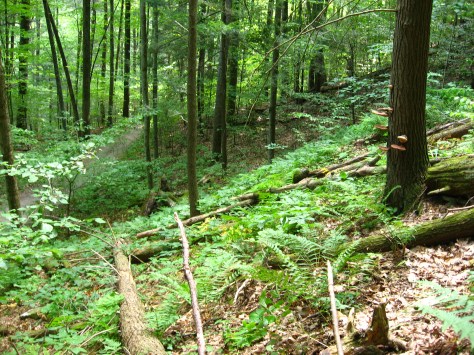
Look for gray petaltails in habitats  like this, photo by Julie Lundgren, NY Natural Heritage Program

Post by Laura Young, FORCES Environmental Education Steward & Becky Sibner, Stewardship Project Coordinator, State Parks

Featured image: gray petaltail on a Jack-in-the-pulpit, Kerry Wixted

Sources:

Paulson, D. (2011). Dragonflies and damselflies of the East. Princeton, N.J: Princeton University Press.

NY Natural Heritage Conservation Guide for gray petaltail

Gray petaltail, IUCN 2017. The IUCN Red List of Threatened Species. Version 2017-1. <http://www.iucnredlist.org>. Downloaded on 12 May 2017.

Dragonflies – living fossils

Email correspondence with Jason J. Dombroskie, Ph.D. Manager, Cornell University Insect Collection (CUIC) & Coordinator of the Insect Diagnostic Lab (IDL)

Help Protect Our Parks – It’s Invasive Species Awareness Week!

July 9th -15th, 2017 marks the fourth annual New York Invasive Species Awareness Week! Each year, New York designates one week to highlight the environmental impacts of invasive species and what we can do to help. This year’s theme, “Invasive Species Reality Check: Where We Are & Where We Need to Go,” focuses on past successes and goals for the future. Invasive species affect all of us, and we could use your help to detect and prevent the further spread of invasive species in New York.

What are invasives? Invasive species are plants, animals (don’t forget about insects!), or other organisms that are accidentally or intentionally introduced from a different region or country (meaning they are non-native), and that cause harm to the environment and the economy. In general, invasive species tend to be adaptable to a variety of environmental conditions. They grow and spread quickly, and because they are non-native, they do not have natural controls like predators or diseases that would normally reduce their numbers. Therefore, invasives are able to displace native plant and animal species and the organisms that depend on those native species.

Keep in mind that not all non-native species become invasive – it is the species that are very successful and have the potential to negatively impact large areas that become a problem. In New York, several especially problematic invasives include: giant hogweed, a huge plant that can cause severe burns and blisters on skin; water chestnut, an aquatic plant that forms dense, impenetrable mats on the water’s surface; and the emerald ash borer, a beetle that has already killed hundreds of millions of ash trees in North America.

One high priority invasive species that we could use your help detecting is called oak wilt, a fungal disease that affects oak trees. It can kill trees in the red oak group (oaks with pointed leaf tips) in as little as 2-6 weeks! Trees in the white oak group (oaks with rounded leaf tips) are less susceptible to the disease, but can still be killed in a matter of years. This July and August, look for oak leaves that are turning brown, starting at the outer edge and progressing into the middle of the leaf. The leaves may fall off of the tree in the spring and summer, often when parts of the leaf are still green. The oak tree’s branches may begin to die off from the top of the tree downward. If you see any of these symptoms, it is crucial that you contact DEC Forest Health via email at foresthealth@dec.ny.gov or call 1-866-640-0652. Read more from the Department of Environmental Conservation about this destructive invasive. Last year, there were only 15 cases of oak wilt reported in New York. Your eyes on the ground could assist in the rapid identification of any new cases and help prevent the spread of this disease.

Take Action!

If you are ready to take action and learn more about invasive species, you’re in luck! This week there will be interpretive hikes and paddling events, presentations, webinars, invasive species removal projects, and more, all across New York State. Check out the Invasive Species Awareness Week (ISAW) calendar or see if your local State Park or nature center is hosting an event. Last year, New York State hosted over 120 ISAW events and had more than 2,000 participants. So whether you just learned about invasive species from reading this blog post or you’re already able to spot the difference between the highly invasive aquatic Hydrilla plant and the common native look-alike Elodea canadensis (learn more about that here!), we need your help. Learn, act, tell your friends. Public awareness and action plays an essential role in halting the spread of invasive species and preventing new introductions.


Here are five easy tips that can make a big difference:

  1. Clean, drain, and dry your watercraft and gear thoroughly to stop the spread of aquatic organisms.
  2. Use local firewood – buy it or gather it where you will be burning it so you don’t transport forest pests.
  3. Plant only non-invasive plants in your garden, or even better, plant native plants. You can use the New York Flora Atlas to check which plants are native to New York.
  4. Clean your boots or your bike tires at the trailhead after hitting the trail – seeds of invasive plants can get stuck on your boots, clothes, or tires. You don’t want invasives in your yard or your other favorite hiking spots.
  5. Get involved – volunteer to help protect your local natural areas, join your local PRISM (Partnership for Regional Invasive Species Management) to stay informed, or become a citizen scientist by using iMapInvasives to report infestations of invasive species right from your smartphone.

New York Invasive Species Awareness Week is coordinated by The New York State Invasive Species Council (ISC), Invasive Species Advisory Committee (ISAC) and Partnerships for Regional Invasive Species Management (PRISMS) in partnership with numerous other agencies, organizations, and groups.

Post by Kelsey Ruffino, Student Conservation Association & State Park

New York State Park Police – K9 Unit History

Here at State Parks, leashed dogs are commonly observed with their owners on hiking trails, in approved camping areas and enjoying lazy summer days.   However, there is also an elite group of highly trained dogs ,  K9’s, paired with their State Park Police handlers, in a specialized program that began over 15 years ago.

Since 2002, the New York State Park Police have used Police Canines and Handlers as specialized teams to keep State Parks, our visitors, and our neighboring communities safe. This is a short history documenting their incredible work and highlighting the achievements of “Man’s best friend” in State Parks.

Initially, two K9s trained in explosive detection were selected and stationed in Long Island.  Over the next two years, the State Park Police  recruited four more K9 teams and stationed them in the Niagara and Saratoga-Capital District Regions and in the Hudson Valley, all trained primarily for finding explosive devices.  The last of those specialized canines, K9 Chase, working with Officer Mannocchi in the Palisades, retired in 2014.

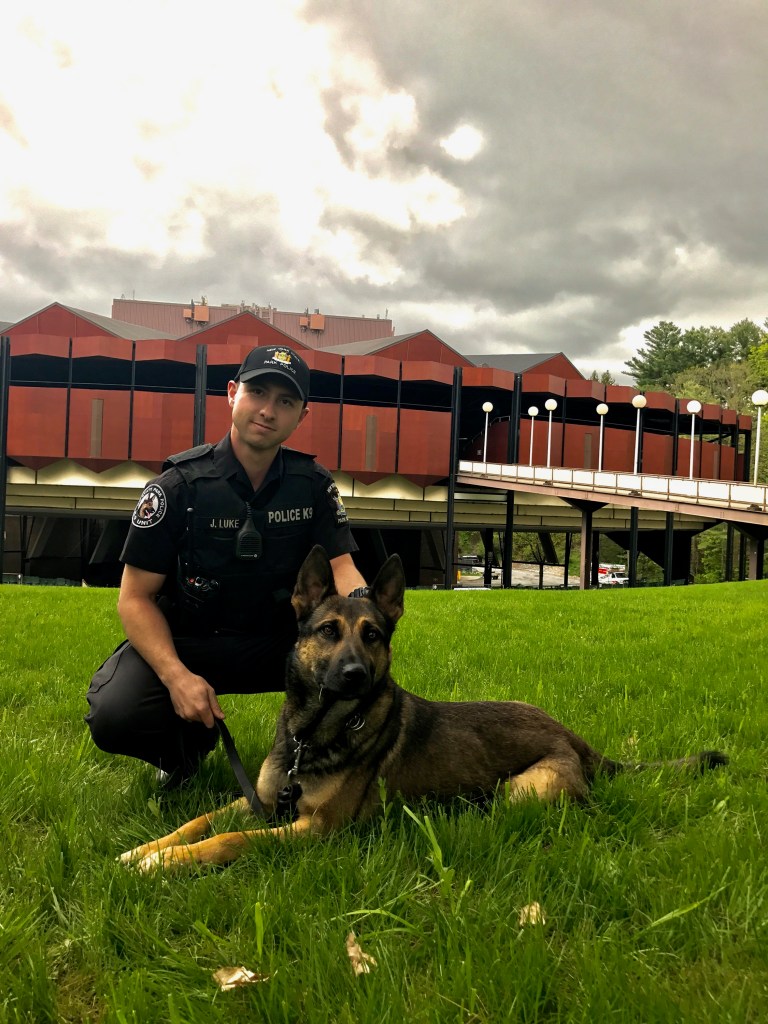
The next generation of canines began their deployments after 2014. Officer Mannocchi returned as a canine handler with K9 Sadie, trained for finding people tracking in the wilderness areas of the lower Hudson Valley. Shortly after starting her ‘job’ with State Parks, K9 Sadie, and her handler, Officer Mannocchi were called to assist with a search of a heavily wooded area for a male subject suffering from serious health issues.  At 2:00am, K9 Sadie located the man lying in a thicket of woods approximately 1 mile from his home.  The man was later reunited with his family without further incident. K9 Sadie and her handler were credited for their rapid response and effective capability.

At the same time that K9 Sadie was training, Officer Cali and K9 Teo came into service in the Niagara Falls area, as part of a homeland security opportunity.   Teo is certified in explosive detection and has conducted numerous searches at Niagara Falls attractions and State Park concert venues, as well as a Presidential campaign event and the NCAA Men’s March Madness Tournament.

From the success that the K9 program gained, State Park Police Chief David Herrick expanded the K9 program to address the need for large venue protection.  With the support of Commissioner Rose Harvey, Chief Herrick was able to recruit five more K9 teams, who were trained and deployed in 2016.

The New York State Park Police K9 teams are deployed from Western New York to Long Island and prepared to serve the state parks and their millions of visitors.