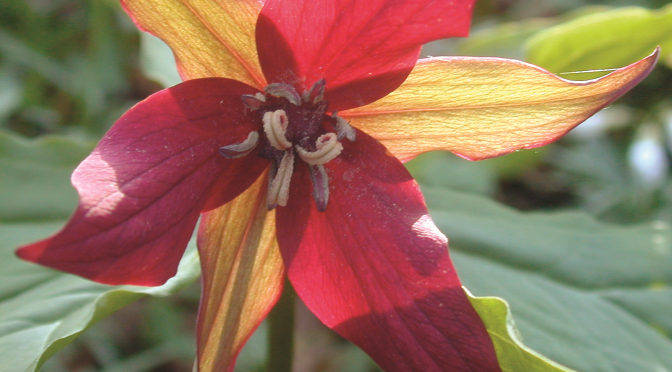
Late Spring Flora

Finally the weather is warming and the flowers are popping out. Time to get outside and look for spring flora! You can find wildflowers in the woods, at the pond or along a stream, in the dunes, or maybe even in your back yard or neighborhood. Here are some native wildflowers in bloom to look out for in May and June.

In the Woods

One of the best places to see an abundance of spring flora is in moist hardwood forests with sugar maple, basswood, ash, and red oak. These are often on slopes and along streams. More acidic forests or drier forests dominated by pines, black or scarlet oak, huckleberries, and blueberries tend to have a less-diverse spring flora. These are common on rocky soils, ridgetops, sandplains (like Long Island or Saratoga). Below are some common wildflowers to look for in either of these types of forests.

Wood anemones (Anemone) are named after the Greek word for “wind”. They have five white petals, divided leaves – shaped kind of like an outstretched hand – and start to bloom before the trees are fully leafed-out. Believe it or not, these are actually related to buttercups!Wood anemone S Young NYNHP1

Bellworts (Uvularia spp.) are common woodland flowers in our parks. They have delicate bell-shaped flowers with six pale yellow petals. There are three common bellwort species in NY state: large-flowered bellwort (Uvularia grandiflora) that likes nutrient-rich or calcareous soils, perfoliate bellwort (Uvularia perfoliata), and sessile-leaved bellwort (Uvularia sessilifolia). The latter is the most common across the state and is also known by the name “wild oats.”
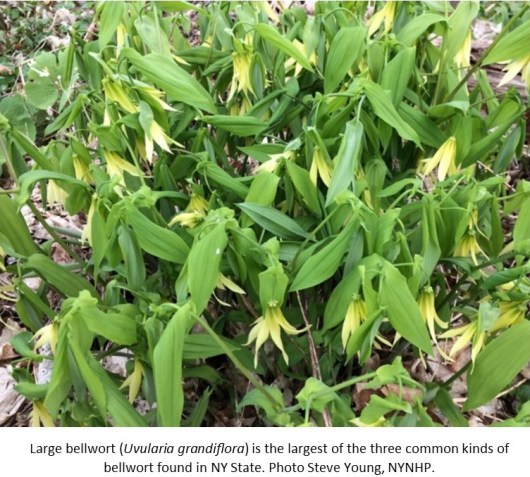
Large bellwort Steve Young NYNHP1

Our native dogwoods (Cornus spp.) have white to pink flowers and include one flowering tree species, several shrubs, and one non-woody (herbaceous) wildflower species. Bunchberry (Cornus canadensis) grows low to the ground, but its flowers look just like those of the flowering dogwood tree (Cornus florida). They may even be blooming at the same time. Dogwoods are identified by the curving veins on the leaves, and flowers with four white or pink bracts that look like petals.

Bunchberry Steve Young NYSNHP1

Shrubby dogwood Gregory Edinger NYNYP1

In Wetlands, Ponds or Streams

Marsh marigold (Caltha palustris) is an easy one to spot because it grows in big clumps or sometimes in large patches. It is always in wet spots, either along slow streams or in open or forested wetlands or seeps. Like the anemones above, this too is in the Buttercup (Ranunculaceae) family.

Marsh marigold Steve Young NYNHP1

Canada lily (Lilium canadense) grows in somewhat open forested wetlands and wet thickets — habitats that are often harder to see from trails and boardwalks. This beautiful lily is widespread across the state, but not nearly so common as marsh marigold.

Canada lily Timothy Howard NYNHP.1jpg

In June, start looking for water lilies in vegetated ponds. We have several native pond lilies, including this stunning White pond lily (Nymphaea odorata) and several yellow pond lilies (Nuphar spp.). Water lilies often serve as landing pads for insects like bees, beetles, damselflies, dragonflies and frogs often hide in the water nearby. You may see some of these critters if you approach slowly and quietly; it’s a good way to keep kids interested too.

White pond lily Kimberly Smith NYNHP1

Sunny Spots from High to Low: Outcrops, Shorelines, and Dunes

Some plants need a lot of sun and can tolerate extremes of heat, wind and/or drought. Here are some of those rugged spring wildflowers to look for:

On rocky trails and summits in the Palisades and Hudson Highlands Parks and elsewhere, look for the pale, yellow flowers of bush honeysuckle (Diervilla lonicera). Bush honeysuckle is one of our native honeysuckles and it attracts many pollinators. It is much less common than the non-native honeysuckles, so a little harder to find and often overlooked.
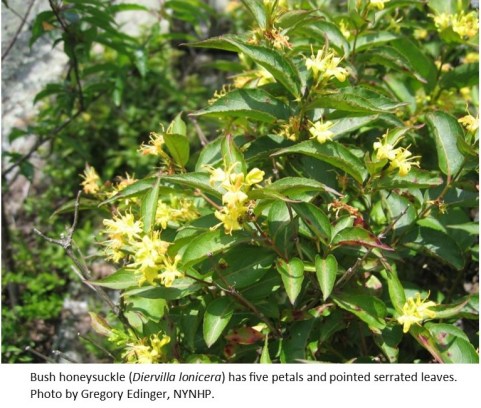
Bush honeysuckle Gregory Edinger NYNYP1

Find a rocky outcrop, rocky lakeshore, or streamside outcrop anywhere in the state and you may find this delicate looking flower: the Bellflower or Harebell (Campanula rotundifolia). You can find it on the rocky shorelines of Lake Ontario in Wehle State Park or other Thousand Islands Parks, on streamside outcrops in the Finger Lakes or Whetstone State Park gorges, or on the rocky summits and slopes of parks like Minnewaska, Hudson Highlands, or Taconic State Parks. This is the bellflower you are most likely to see, but there are native and non-native lookalikes (though usually not in these open rocky spots).
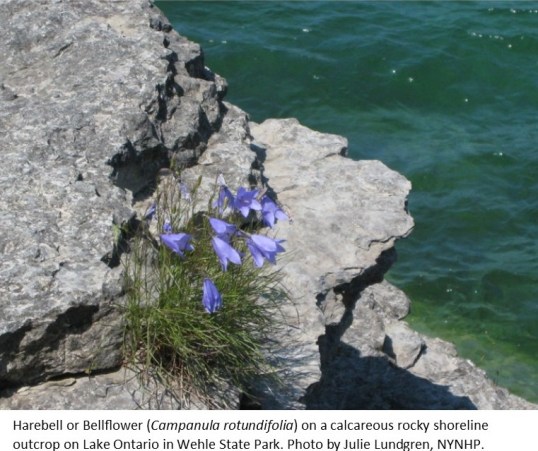
Harebell-bellflower J Lundgren NYNHP1

How about on the sunny dunes of Long Island? Have you ever seen Beach heather (Hudsonia tomentosa) in full bloom? It grows in gray-green mounds on the dunes and sports its tiny but profuse yellow blooms in June. Visit duneside trails at Jones Beach, Hither Hills, Napeague, or Orient Beach State Park. Remember to stay on trails to protect this fragile ecosystem. Local native bees take advantage of this food source.Beach heather Steve Young & Kimberly Smith NYNHP

What’s in a name?

Did you know that every plant (and known organism) is given a unique scientific name? Those are the names in parentheses above. The scientific name consists of a genus followed by a species name like Lilium (genus name) + canadense (species name) = Lilium canadense. While there may be few different plants referred to as Canada lily, or someone might call this plant a meadow lily or wild yellow-lily, the scientific name of Lilium canadense refers to just one kind of plant. So, biologists and landscapers and other people working with plants or animals will use the scientific names when they want to make it clear exactly what species they are referring to. You will see these names in the wildflower guides (books or websites) noted below.

The scientific name also helps to see what species are related — organisms with the same genus name are closely related. So Lilium canadense and Lilium superbum are closely related because they are both in the Lilium genus. Common names are not reliable for this purpose. For example, the white water lily is not a close cousin of the Liliums, as it is in a different genus (Nymphaea). In fact these two kinds of “lilies” are in completely different plant families, the Liliaceae and the Nymphaceae, like distant branches on the family tree.

Both called lilly Timothy Howard and Kimberly Smith, NYNHP

TO LEARN MORE:

Newcomb’s Wildflower Guide by Lawrence Newcomb. Paperback. 1989. The standard field guide for flora in the northeast. Relies on flower structure so takes a little more time to learn, but includes more species than Peterson’s guide.

Peterson Field Guides, Wildflowers – key by color and shape. Great for the casual observer, or if just starting out, try the Peterson First Guide to Wildflowers.

Go Botany – a great online plant key to flora of New England, but includes most of plants you will see in New York.

NY Flora Atlas – the most current taxonomy, atlas, see what is native or not, rare or common, links to other sources.

NY Flora Association – information about field trips, classes, “Learn 10” programs for all levels, calendar of botany field trips and events across the state, links to other information on flora.

NYNHP Conservation Guides – These provide descriptions of the Natural Communities in New York – different kinds of forests, wetlands and other habitats. Use Advanced Search to find what types are in your county. Each Guide gives a few examples of where you can see it and some characteristic plants.

Post by Julie Lundgren, State Parks Ecologist with New York Natural Heritage Program (NYNHP).

Images by NYNHP 2018; may be used with permission only.  http://www.nynhp.org
Harmful Algal Blooms: New York State Takes Action in 2018!

There has been a lot of activity in New York State this spring regarding Harmful Algal Blooms (HABs)!  In an effort to raise awareness regarding HABS, Governor Cuomo called together four HAB Summit Meetings across the State (February 27 in New Paltz, March 6 at SUNY ESF, March 20 in Ticonderoga, and March 26 in Rochester).  Leading experts from the Department of Health (DOH), Department of Environmental Conservation (DEC), Department of Agriculture and Markets (DAM) and other state and national experts convened to discuss and address the causes of algal blooms in 12 priority waterbodies across the state.  The meetings were the first step in the development of action plans to address HAB occurrences in each waterbody.  Of the 12 priority waterbodies chosen as part of the Governor’s initiative to combat HABs, five of them are the home of State Park’s beaches, marinas, or campgrounds (Conesus Lake, Honeoye Lake, Chautauqua Lake, Cayuga Lake and Lake Champlain).  The action plans will be used to implement monitoring and treatment projects related to HABS.

What’s the problem with HABs?

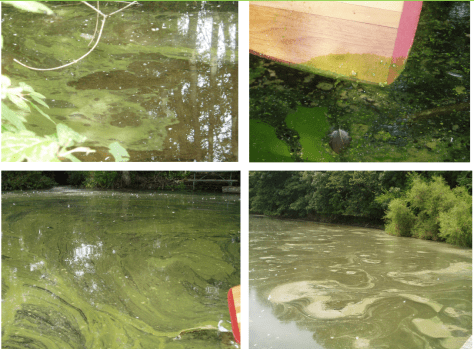
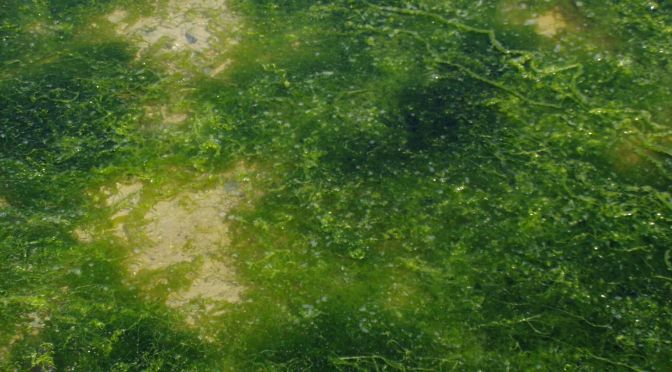
You might see a couple of different terms used in association with HABs, but they mean the same thing: cyanobacteria and blue green algae are used interchangeably.  The term “blue-green algae” is a misnomer; it is not truly algae. It is a type of bacteria called cyanobacteria that is capable of photosynthesis. An algal “bloom” consists of cyanobacteria in great enough numbers of cells to be seen by the naked eye.  Some algal blooms can produce toxins, but not all do.  When an algal bloom produces toxins, it is called a Harmful Algal Bloom.  HABs can thrive when certain conditions are met, including warm weather, stagnant water, and sufficient nutrients in the water body.  The bacteria can form dense mats on the surface of a lake or can be suspended in the water column. The blooms can be brightly colored and look like pea soup, spilled paint, or an oily scum/sheen that coats the lake surface.  The blooms move around the lake in response to wind and currents, tend to accumulate at shorelines, and can move vertically in the water column to find the perfect nutrient and temperature conditions to flourish.  Blooms occur most often in waters high in phosphorous and/or nitrogen, and research is ramping up to determine the exact causes of algal blooms.

Because of the potential for blooms to produce toxins, it is important to keep people and pets out of the water during a bloom.  The toxins can make people and animals sick, and toxin exposure can cause a range of symptoms, including rashes, respiratory irritation, gastrointestinal troubles, and effects on the liver. HABs may also impact drinking water and recreational activities, and can cause unpleasant odors.

It is State Parks Policy to follow the DOH protocol and close bathing beaches when a HAB is present.  To re-open a beach at a State Park, the beach must be free of any signs of a bloom for 24 hours, and a water sample must be submitted for toxin analysis.

The Big Message for the 2018 Beach Season

Know it, Avoid it, Report it.  Learn what a bloom looks like, avoid it, and make sure to report it to the Park Manager if you see a potential bloom at a State Park.  You can also notify the NYS Department of Environmental Conservation, or harmfulalgae@health.ny.gov

HAB Photos from State Parks:

HAB

Below are a few links to learn more about HABs!

NYS Department of Health: Harmful Blue-Green Algae Blooms

Environmental Protection Agency: Cyanobacterial Harmful Algal Blooms in Water

NYS Department of Environmental Conservation: Harmful Algal Blooms

Trails Stewardship in the Finger Lakes

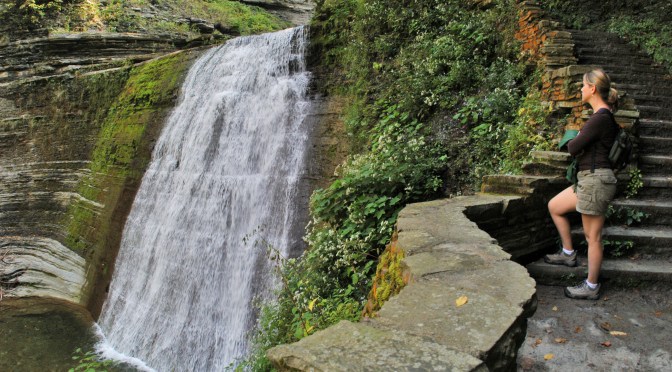
Here in the Finger Lakes, one of the best ways to access the natural beauty of the area is by taking a hike on one of the many trails that can be found within the region’s state parks. The trails (in parks such as Watkins Glen, Taughannock Falls, Robert H. Treman, and Fillmore Glen) lead hikers through a variety of environments, including mature forests, meadows, lake shores, and wetlands. Of course, hikers can also enjoy the deep gorges, dramatic cascades, and waterfalls the region is famous for! Over the years, hiking has gained popularity nationwide. With thousands of miles of hiking trails, New York State has a lot to offer people looking to get outside. The Finger Lakes region of the State Park system sees several hundred thousand visitors each year, many of whom come to hike the trails. Foot traffic, weather, and time have left some of the trails in Finger Lakes state parks eroded and in need of repair. This erosion not only makes the hiking experience less enjoyable for trail users, it also leads to negative impacts on the surrounding ecosystems. To meet this problem head-on, the Finger Lakes Regional Trail Crew (FLRTC) was developed in the spring of 2017.

Crew
Some of the hard-working members of the Finger Lakes Regional Trail Crew, photo by State Parks

The main goal of the trail crew is to maintain safe and enjoyable hiking trails for park visitors, while protecting the natural and historic resources of the park. Currently the FLRTC consists of three Parks staff members and a diverse group of local volunteers. The Excelsior Conservation Corps (an AmeriCorps program) also helps out with specific projects. In 2018, the trails crew will host two interns from the Student Conservation Association (SCA) Parks Corps devoted to trail stewardship. This team effort has led to a tremendous amount of progress towards the Finger Lakes Park’s trail improvement goals.

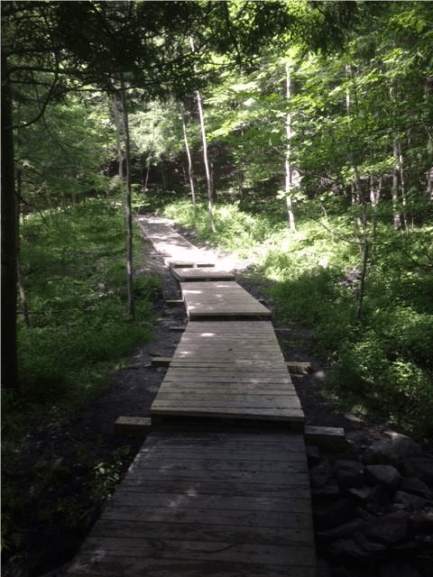
Boardwalk
Boardwalks protect wet areas or fragile habitat and make for easier walking for visitors, photo by State Parks.

Trail work, as a rule, takes a large amount of physical effort and creative problem solving. The work done by the FLRTC is no exception. Traditional tools and building techniques are often employed. Many of the trails in need of repair are in areas that are not accessible by vehicles or equipment. As a result, many of the materials used in trail construction have to be carried in by hand; it takes a strong crew to lug in lumber, stone, and gravel. Sometimes materials have to be moved down into or across the area’s gorges. The trail crew uses high-strength zip lines to accomplish this task. This is the safest method and protects the fragile slopes and vegetation.

Zipline
Boardwalks protect wet areas or fragile habitat and make for easier walking for visitors, photo by State Parks.

All of this hard work pays off in the form of functional, safe and visually pleasing staircases, boardwalks, and bridges that blend with the surroundings.

 As you get out on the trails this year, take a minute to look down from the beautiful scenery. The trail you are on most likely took a lot of hard work to build and maintain – but chances are the park staff and volunteers behind the work loved every minute of it!

 Post by Zachary Ballard, State Parks

Babies Abound! Little Critters in State Parks

Spring is in the air and baby animals abound in our State Parks. Look and listen for some of these young critters in our parks. Remember, it is best to watch them from a distance so you do not scare the young animal or its parent. If you see a young animal that looks like it is abandoned, please leave it be. It is most likely fine on its own or has a parent close by and waiting for you to back away. It is fun to explore and watch, but don’t stay in one spot too long so that the animals can go back to their daily activities.

Box Turtle_E Becker
A class gets a close-up look at a young box turtle at Clay Pit Ponds State Park Preserve. The turtle was handled briefly and then released where it was found. If you find turtles crossing the road or trail, you can move them to safety by putting them on the side where they were headed.
baby raccoon FNSP
A pair of young raccoons peek out from behind a tree at Fort Niagara State Park.
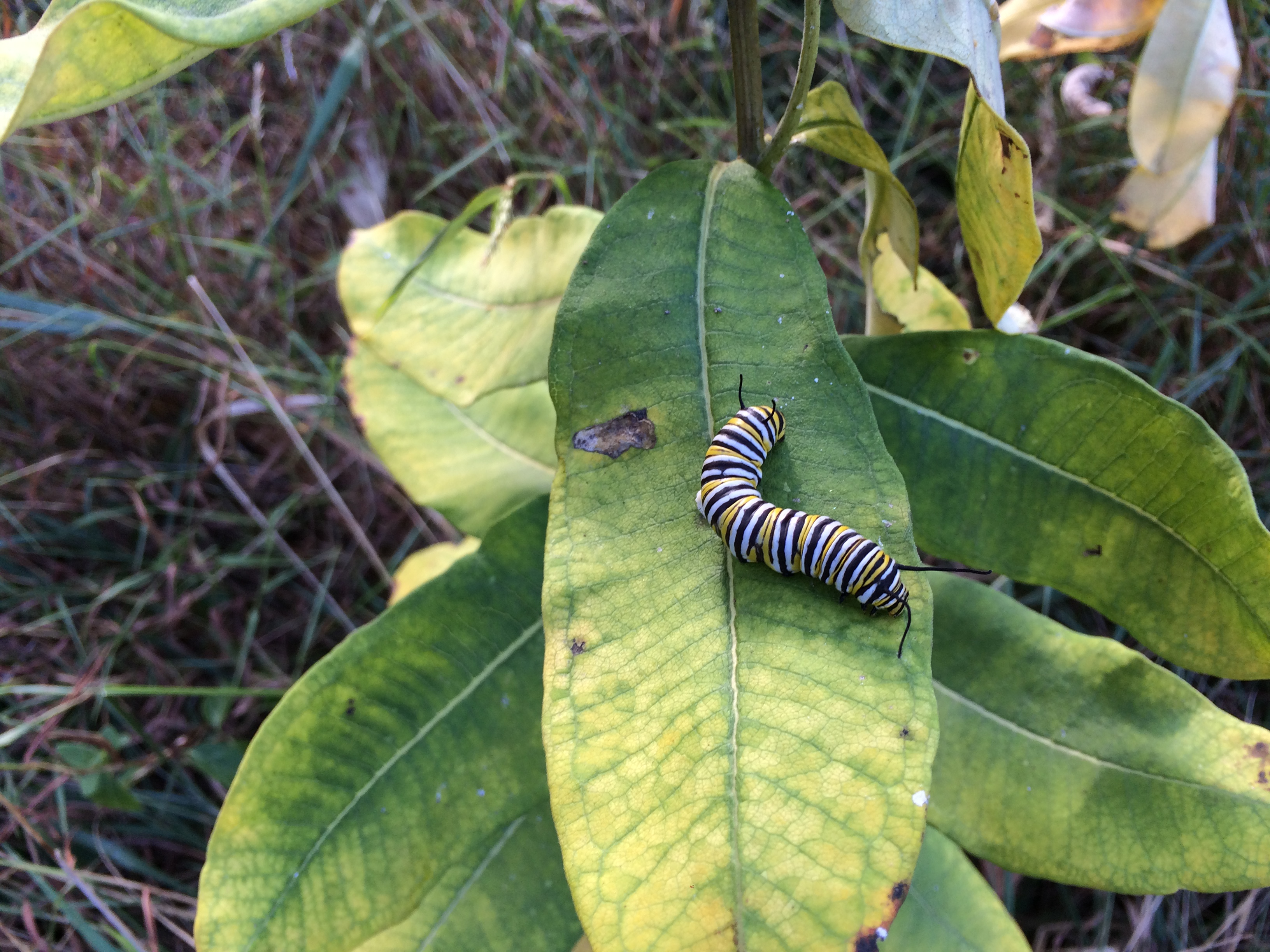
MonarchCaterpillar3_E Becker
Common milkweed (Asclepias syriaca) is one of the monarch caterpillars preferred plants. You can find milkweed in along unmown trail edges and in meadows in many State Parks
MOULTRIE DIGITAL GAME CAMERA
A red fox vixen keeps a watchful eye over a pair of kits at Letchworth State Park.
Drone hatching_Greg Kofsky
Warm weather brings the honey bees back into action. Here, a drone honey bee (at left) is hatching from the hive at the Taconic Outdoor Education Center.
S. Montefinise
Canada geese and goslings at Jones Beach State Park. Adult geese can be pretty aggressive about protecting their babies, so watch quietly from a distance. The goslings can be a lot of fun to watch as they scurry about.
mallard
Mother mallard and her many ducklings.
Fawn_G Lamitina2
A white-tailed deer fawn hiding in the brush at Letchworth State Park. The mother is close by, watching you and waiting for you to move on. You have to look hard and move quietly to get a chance to see these youngsters in the woods.
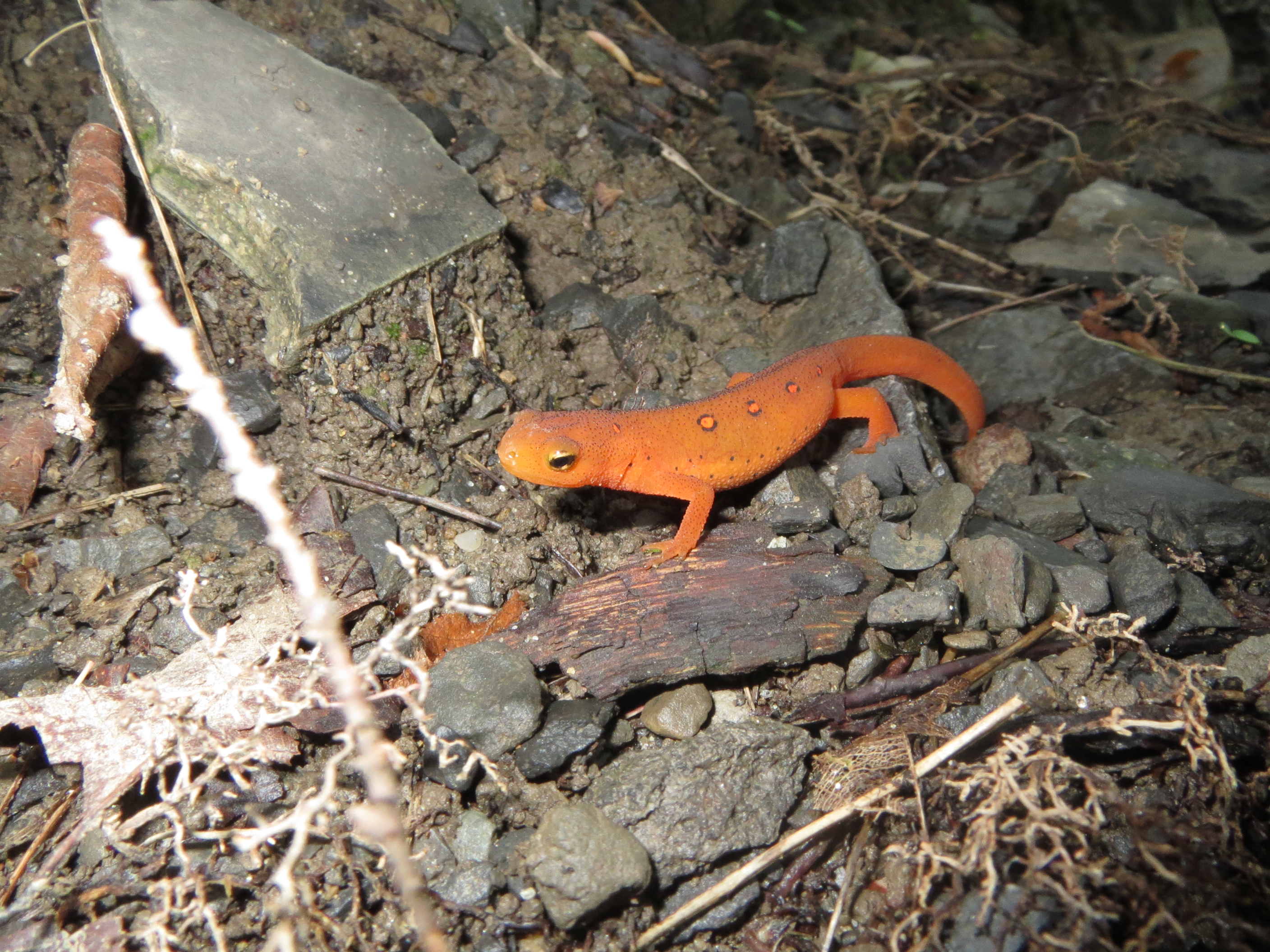
Red Eft at Thacher -Photo by Lilly Schelling
Red efts are the young stage of the aquatic eastern newt (Notophthalmus viridescens). You can hold this one gently, but keep it close to the ground as it will run right out of your hand. This one was seem at John Boyd Thacher State Park.
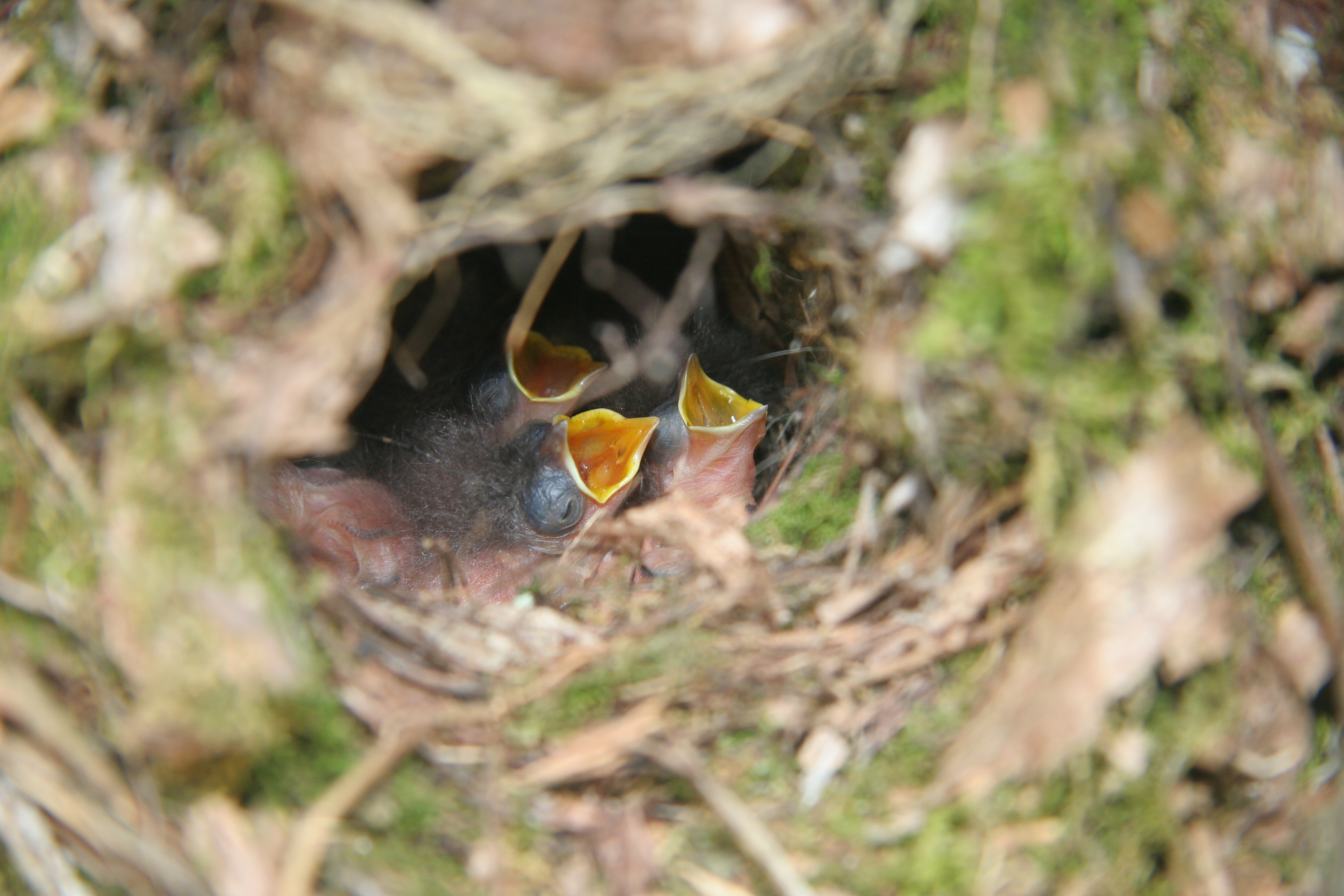
BarnSwallow Chicks-Photo by Lilly Schelling
Red efts are the young stage of the aquatic eastern newt (Notophthalmus viridescens). You can hold this one gently, but keep it close to the ground as it will run right out of your hand. This one was seem at John Boyd Thacher State Park.
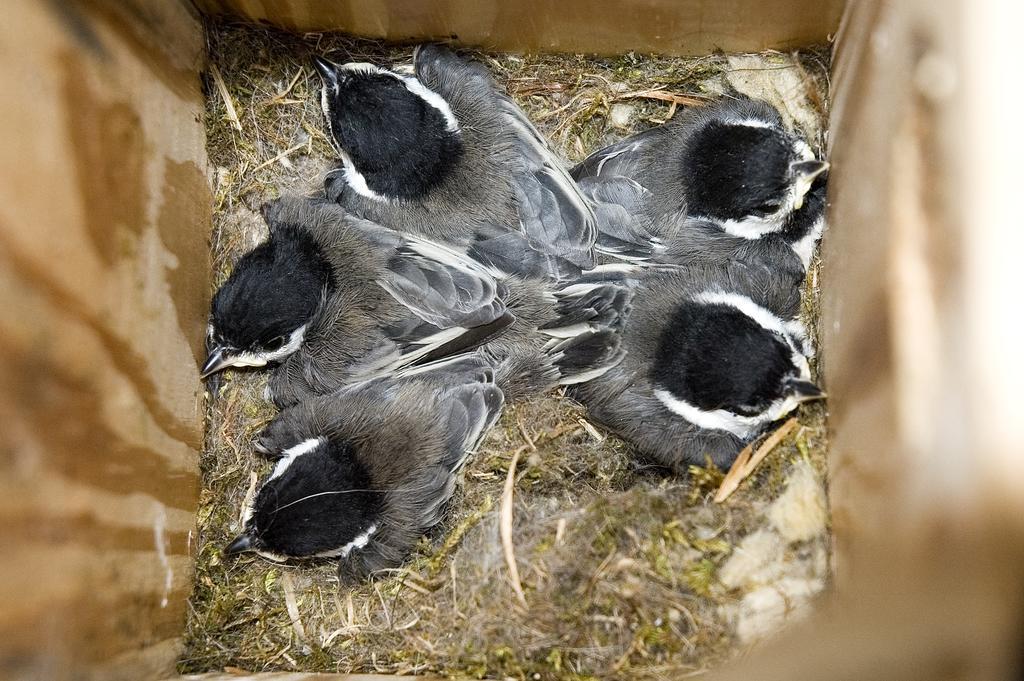
chickadee
Black-capped chickadees nest in tree cavities or will use birdboxes as seen here.
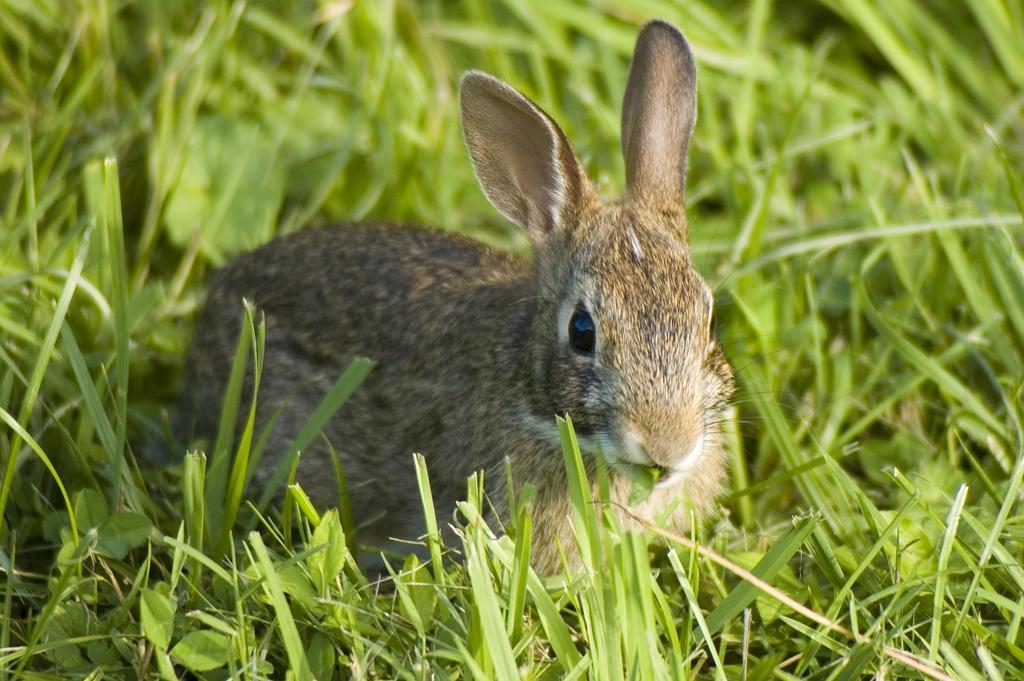
ecottentail
You might see Eastern cottontails in your back yard, local park or in the campground or picnic area in many of the state parks.
Eaglet
Bald eaglet are really big baby birds. This one has been banded by wildlife biologists. The blue and silver leg bands help identify the bird when it is seen elsewhere over the course of its adult life.
killfawn
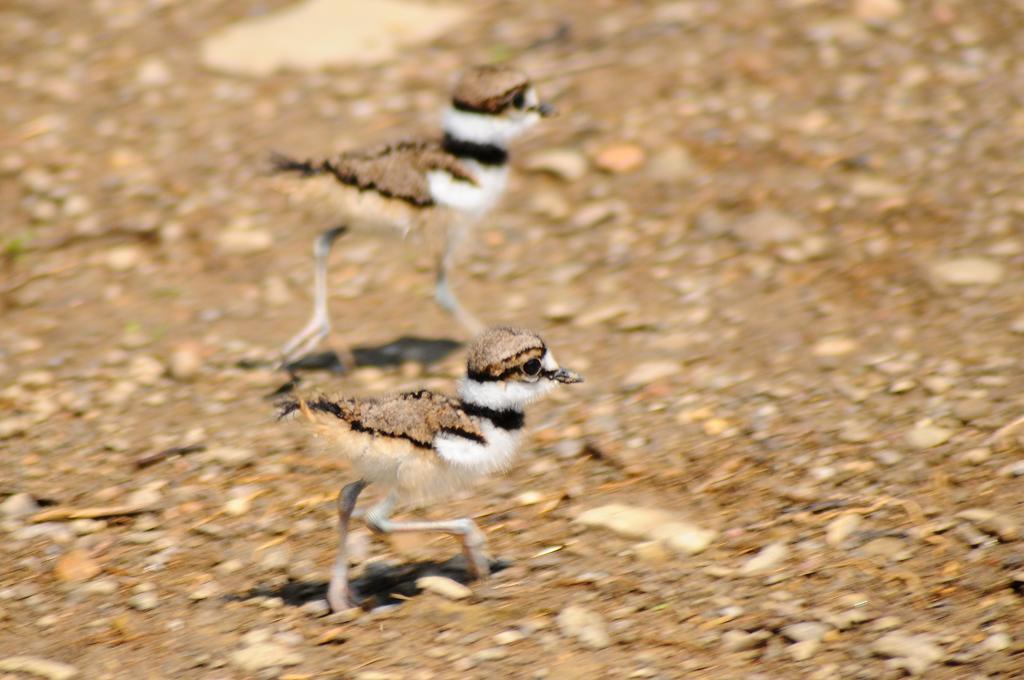
Young killdeer on the run at Allegany State Park. They have a really loud call and may be seen in open areas like lawns and parking lots! Killdeer are precocial birds, meaning they leave the nest shortly after they are hatched.
easternphoebe
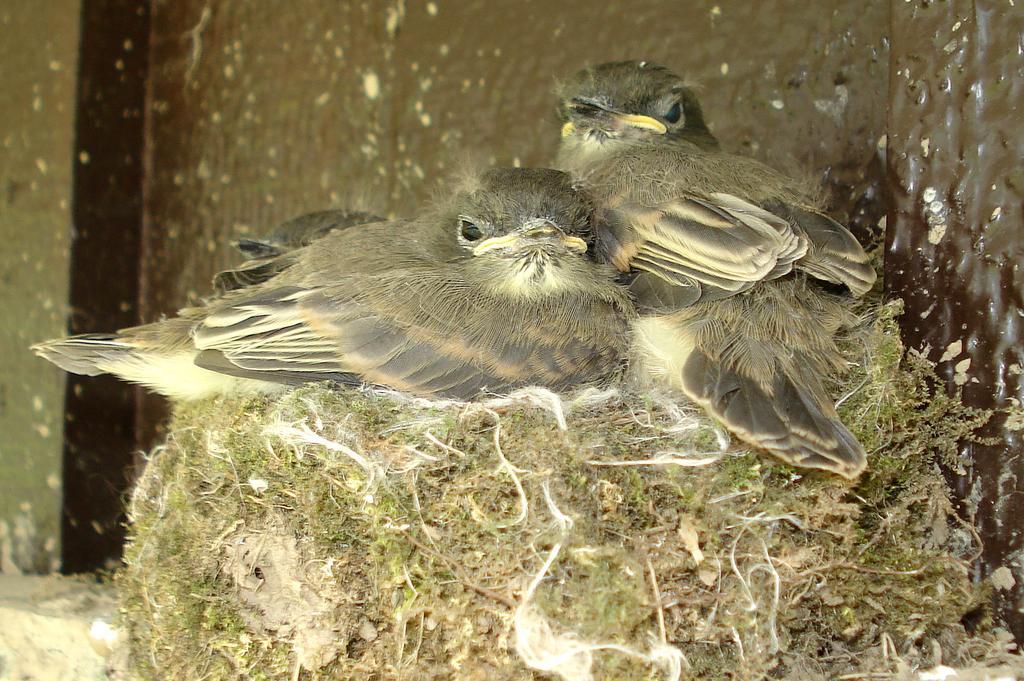
Eastern phoebe nestlings getting a little too big for their nest. Time to try out those wings.
roughwingedswallow
Northern rough-winged swallow fledgling.
snappingTurtlehand
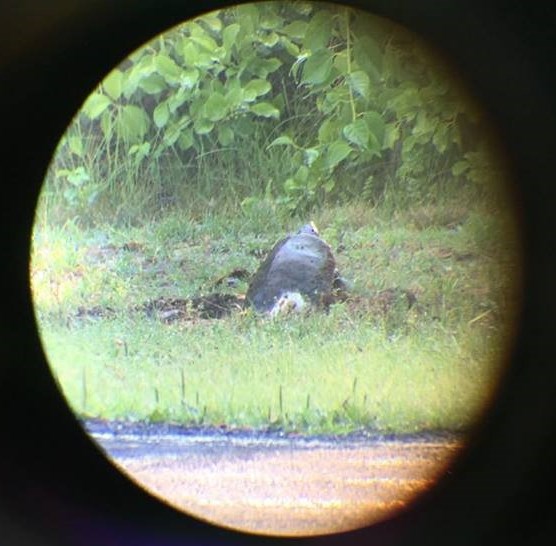
Young snapping turtle covered in duck weed from its pond. Remember that bigger snapping turtles bite, so keep your distance.
woodfrog
A very tiny wood frog, identifiable by the dark mask on its face. It’s ok to hold them gently for a bit, but let them go so they can grow up in their home in the woods.
wooduckwithmarshmellow
Woodchuck mom and her pups in Allegany State Park. The white one was known as “Marshmallow.”
woodcock
A young American woodcock hides in the underbrush, so well camouflaged and thus seldom seen.
tinydusky (002)
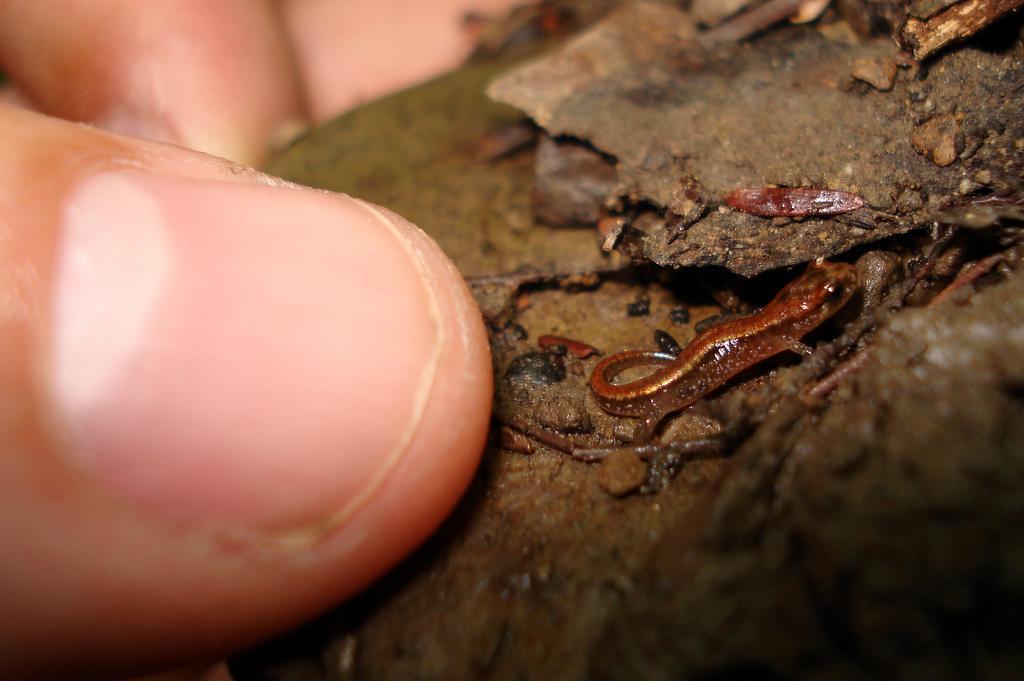
A young dusky salamander found in a wet log at Allegany State Park. It is great to explore and find young animals. Keeping hands off can keep them safe and allow you to observe their behavior in their natural habitat.

Take time this spring to enjoy our State Parks little critters!

Thank you to all staff who contributed to this post.

The Hudson River’s “Tough Turtles”

During the summer months along the Hudson River south of Troy, New York, it’s easy to notice the tides rising and falling, herons wading in the shallow streams, and the giant cargo ships purposefully streaming up and down the river. Difficult to spot, however, are the river’s many turtles. Several varieties call the Hudson home, but the northern (also called common) map turtle is perhaps the most interesting and understudied.

Princess
Northern map turtle “Princess” hanging out while her tracker tag dries before her release. Scientists use these tags to locate the turtles for months after capture.

Northern map turtles (Graptemys geographica) are large river turtles that get their name from the intricate circling pattern on their shells, which resemble the elevation lines on a map. These turtles are relatively secretive. In urban areas they have to work especially hard to find what they need to survive. For one thing, turtles need good basking objects—places where they can come out of the water safely and sun themselves to warm up. Fallen trees or rocks make the best basking habitat, specifically ones that are farther out into the water so they can easily escape from potential predators. Because of the tides, many potentially good basking objects aren’t reachable as they are either too high up the bank or underwater at any given time.

Luna
Scientists quietly observe northern map turtle “Luna” nesting from a safe distance. This nest received protection from predators and likely hatched successfully months later.

Another problem is finding places to lay their eggs. All turtles lay eggs and the northern map turtle is no exception. Most turtles prefer loose, sandy soil with plenty of sunlight for the eggs to develop successfully. Temperature determines the gender of the tiny map turtle babies—eggs toward the cooler, bottom of the nest often become males, while those eggs toward the warmer top (that therefore get more sun and heat) will become females. But in this highly urban area, good places to nest are few and far between. Natural areas, like those found in some of the State Parks along the river, help provide habitat for them. These spots seem perfect for northern map turtles, but they do tend to have a couple of drawbacks: 1) road and foot traffic and 2) predators smelling the eggs and destroying the nests soon after they’ve been laid. In addition, well-meaning people who are simply curious about these turtles (and with good reason!) approach nesting females that may “spook” and stop laying. People should give nesting turtles some space and observe quietly from a distance.

Nest
Probable northern map turtle nest destroyed by a predator. Shells that appear twisted indicate some animal has eaten them, whereas more intact shells mean the nest has likely hatched successfully.

Because good turtle habitat is hard to find in an urbanized section of the river, researchers Dr. James Gibbs and Master of Science candidate Julia Vanaman from the State University of New York College of Environmental Science and Forestry are working to identify what habitats are most important to map turtles. Aquatic plants, basking objects, forest along the river banks, and shoreline development all likely play a role in where these turtles choose to spend their time. Once the researchers understand why a turtle likes an area, they can pass along that information to state and local park managers who can protect habitat and take measures to enhance it (e.g., by creating nesting habitat or increasing the number of available basking objects). With these habitat improvements, hopefully these fascinating turtles will stick around for many years to come.

Note: Northern map turtles (Graptemys geographica) occur across much of eastern North America from the Mississippi River, north to the Great Lakes and St. Lawrence River, and east to small portions of the Susquehanna, Delaware and Hudson river systems. In New York State, the map turtle is considered vulnerable to decline and is recognized as a Species of Greatest Conservation Need (SGCN) in the state’s wildlife action plan. For more information, please check out the following links:

New York State Species of Greatest Conservation Need

Rare Animal Status List

Common Map Turtle Distribution Map

Turtles of New York State

NatureServe northern map turtle

NatureServe Map

Post and photos by Julia Vanaman, Master of Science candidate, SUNY College of Environmental Science and Forestry

Featured image attribution: By Dger [CC BY-SA 3.0 (https://creativecommons.org/licenses/by-sa/3.0)%5D, from Wikimedia Commons