Category Archives: Cool Science

Frogs and Pollywogs in NYS Parks

It’s time – hop in the car or on your bike and head to a State Park near you! While you’re there, be sure your ears are open and your eyes are peeled for some awesome amphibian friends! It’s a good opportunity to find out which of the 11 frog species found in New York State are living in our State Parks.

Frogs are amphibians, meaning they live on both land and under water. When females lay eggs, it typically occurs in a nearby pond. The jelly-like egg masses hatch into tadpoles (pollywogs) with round bodies and long finlike tails. Tadpoles develop gills so they can breathe underwater just like fish do! Through a lifecycle process known as metamorphosis, the tadpole begins to develop legs, bulging eyes and air-breathing lungs. All the while the long slender tail starts to shrink and eventually disappears. This frog can now survive on land, breathing in the fresh summer air!

Frogs spend most of their time underground, hanging out in trees, or in the water. On warm summer nights they will emerge from hiding and head to nearby ponds, lakeshores and wetlands. When trying to identify frog species remember to consider the following: coloration, patterns, skin texture (moist or dry), presence or absence of webbing between the toes, and more. If you can’t see your amphibian friends, but you can hear them, take this time to record its unique call and try to identify it when you get home!

Here are just a few of the frog species found in our State Parks:

Northern Spring Peeper (Pseudacris c. crucifer)
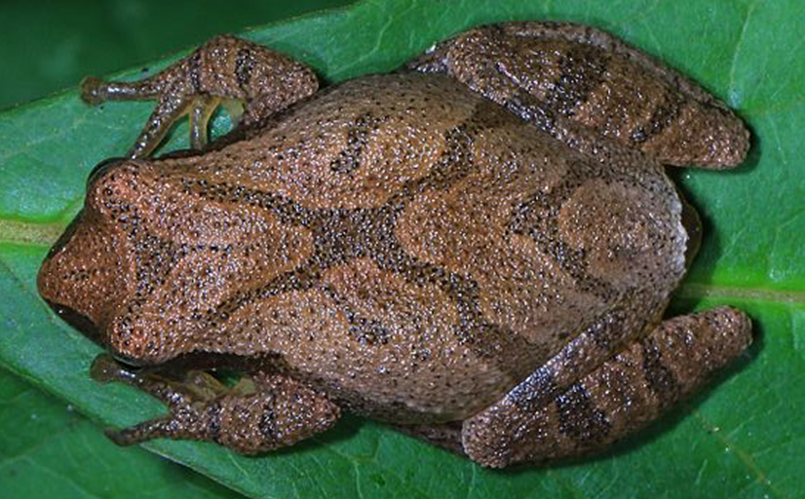
The tiny spring peeper can range from a rusty brown to a greenish-gray with a distinct dark X or cross on its back. Its skin is smooth and the belly is cream-colored. This species is also known for hanging out in trees, with its unwebbed toes and sticky pads. Spring Peepers breed earlier in the season than other frog species. If you’ve ever spent an evening camping or sitting by the water, you’ve probably heard their infamous “PEEP” or call.

American Bull Frog (Rana catesbeiana)

The bull frog is the largest frog in North America, reaching lengths of 6 to 8 inches. It’s a brownish-green color with dark colored bands or blotches on its hind legs. Unlike the treefrogs, the bull frog has webbed hind feet. They’re often found near permanent waters with lots of vegetation. This species size and carnivorous diet allows it to munch on creatures such as snakes, bats, ducklings and other frogs! Behind the bull frog’s eyes are eardrums known as tympanic membranes. The size of these membranes can be used to determine if the frog is a male (it’s larger than the eye) or a female (the membrane is the same size as the eye). Look for this species between mid-March and mid-July. They may startle you with their really load “croak”.

Green Frog (Rana clamitans)

SeeGreenFrog
Do you see the Green Frog? Photo by NYNHP.

This is one of the most common frogs across NY State. It is similar to but smaller than a bullfrog. Like the bullfrog, the green frog is brownish-green with bright green on its face and spends most of its time in and near ponds and wetlands. The adults are 3-4 inches long and breed from May to August. Their regular call goes “boing” like the sound of a plucked rubber band or banjo sting. They also have an alarm call, a loud squeak, that you will hear if you scare them into the water. Move slowly towards the edge of the pond to look for these critters and be ready when they squeak and leap into the water!
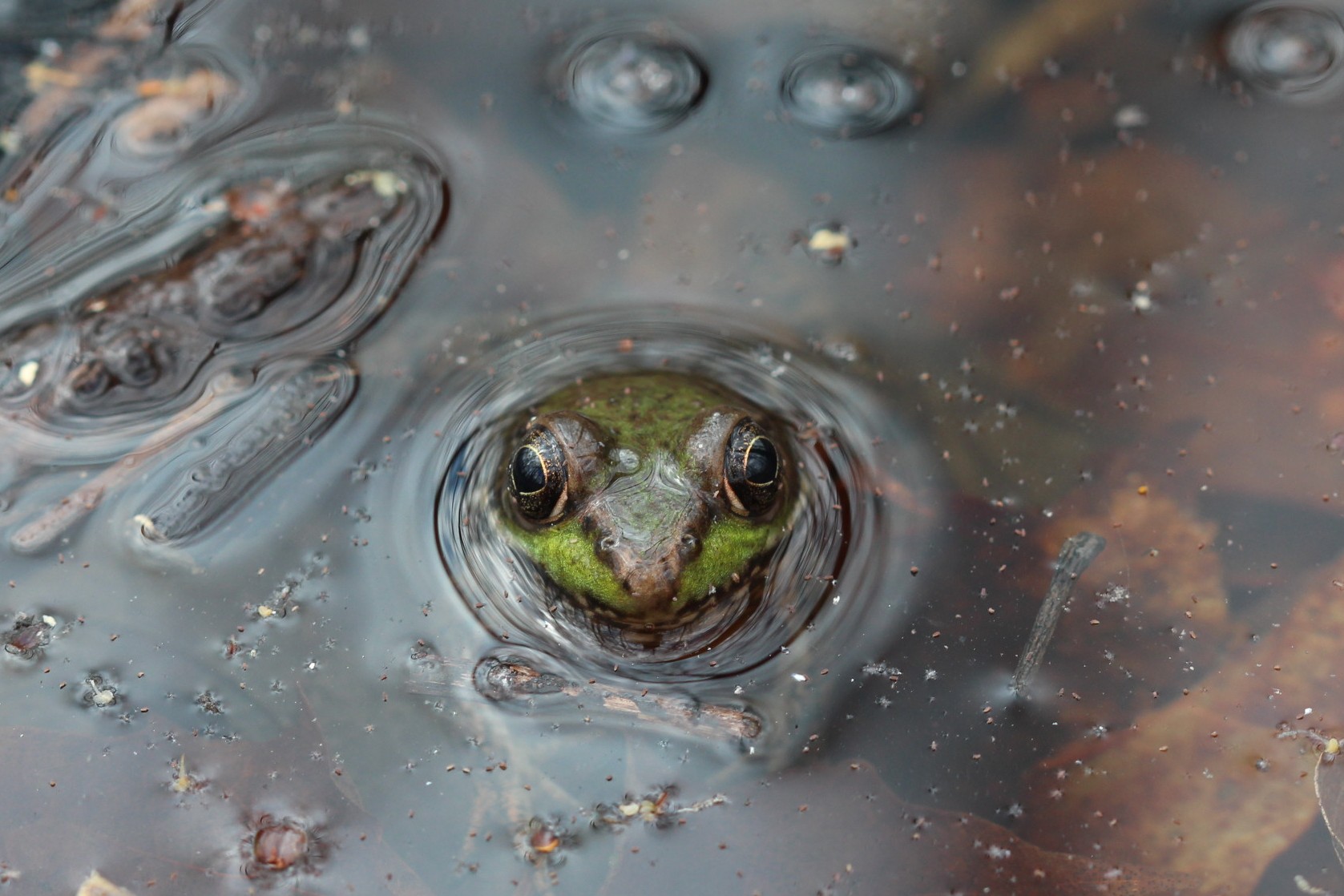
Green_frog_Rana_clamitans_MatthewScheslingerNYNHP
The green frog’s face is smaller and not as wide and rounded as the Bullfrog. Photo by NYNHP.

Northern Cricket Frog (Acris crepitans)

The northern cricket frog is the smallest and most rare frog species in NY. It is listed as endangered in the State of NY. Adults reach about 1 inch in length, but despite their size, can jump about 5 to 6 feet. Eastern cricket frogs are brown to dull green in coloration with a triangular marking between the eyes. These frogs love shallow ponds with lots of floating vegetation. It has an unusual call, described as two pebbles being clicked together repeatedly. View the northern cricket frog conservation guide created by the New York Natural Heritage Program.

Other awesome frog species found in New York:

Gray Treefrog

Western Chorus Frog

Mink Frog

Wood Frog

Northern Leopard Frog

Southern Leopard Frog

Pickerel Frog

More links with frog/toad calls

NatureBits.org

Calls of Frogs and Toads of the Northeast

Post By Falon Neske- SCA and State Parks

Resources

Bullfrogs

Frogs and Toads of New York State

Featured image, gray tree frog, State Parks
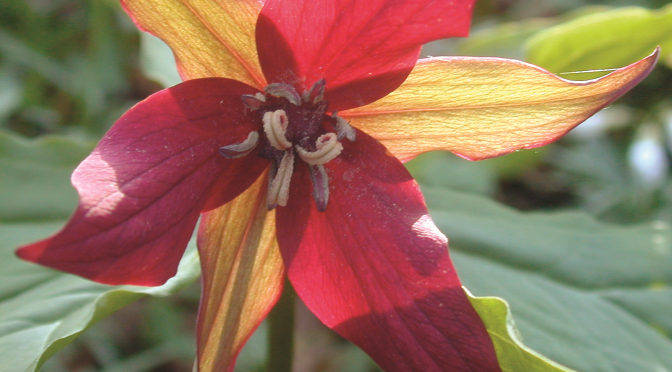
Late Spring Flora

Finally the weather is warming and the flowers are popping out. Time to get outside and look for spring flora! You can find wildflowers in the woods, at the pond or along a stream, in the dunes, or maybe even in your back yard or neighborhood. Here are some native wildflowers in bloom to look out for in May and June.

In the Woods

One of the best places to see an abundance of spring flora is in moist hardwood forests with sugar maple, basswood, ash, and red oak. These are often on slopes and along streams. More acidic forests or drier forests dominated by pines, black or scarlet oak, huckleberries, and blueberries tend to have a less-diverse spring flora. These are common on rocky soils, ridgetops, sandplains (like Long Island or Saratoga). Below are some common wildflowers to look for in either of these types of forests.

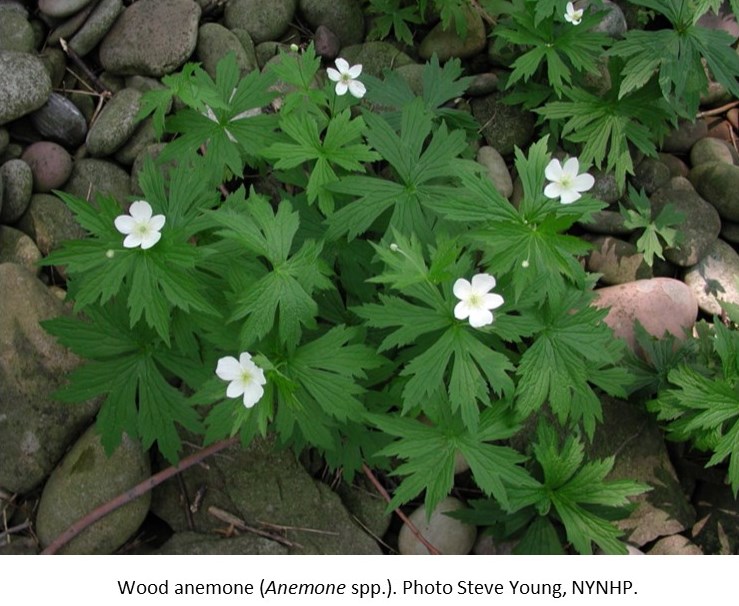
Wood anemones (Anemone) are named after the Greek word for “wind”. They have five white petals, divided leaves – shaped kind of like an outstretched hand – and start to bloom before the trees are fully leafed-out. Believe it or not, these are actually related to buttercups!Wood anemone S Young NYNHP1

Bellworts (Uvularia spp.) are common woodland flowers in our parks. They have delicate bell-shaped flowers with six pale yellow petals. There are three common bellwort species in NY state: large-flowered bellwort (Uvularia grandiflora) that likes nutrient-rich or calcareous soils, perfoliate bellwort (Uvularia perfoliata), and sessile-leaved bellwort (Uvularia sessilifolia). The latter is the most common across the state and is also known by the name “wild oats.”

Large bellwort Steve Young NYNHP1

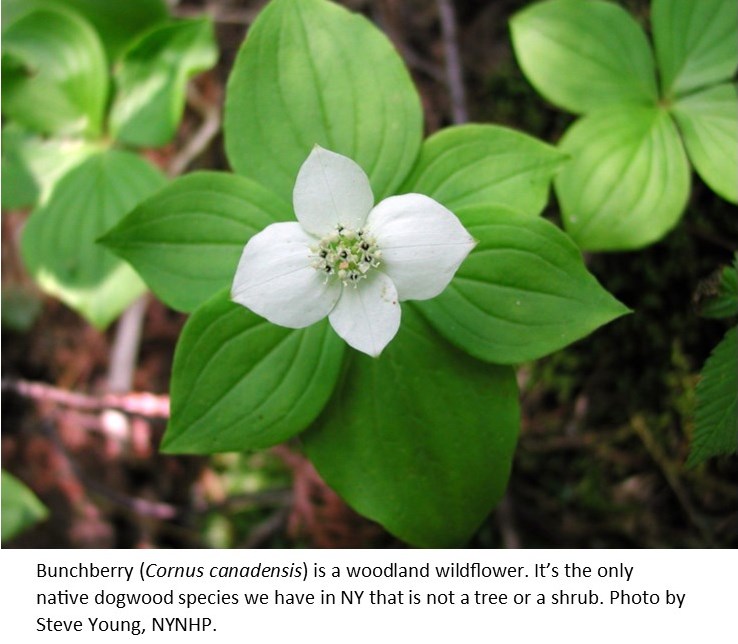
Our native dogwoods (Cornus spp.) have white to pink flowers and include one flowering tree species, several shrubs, and one non-woody (herbaceous) wildflower species. Bunchberry (Cornus canadensis) grows low to the ground, but its flowers look just like those of the flowering dogwood tree (Cornus florida). They may even be blooming at the same time. Dogwoods are identified by the curving veins on the leaves, and flowers with four white or pink bracts that look like petals.

Bunchberry Steve Young NYSNHP1

Shrubby dogwood Gregory Edinger NYNYP1

In Wetlands, Ponds or Streams

Marsh marigold (Caltha palustris) is an easy one to spot because it grows in big clumps or sometimes in large patches. It is always in wet spots, either along slow streams or in open or forested wetlands or seeps. Like the anemones above, this too is in the Buttercup (Ranunculaceae) family.

Marsh marigold Steve Young NYNHP1

Canada lily (Lilium canadense) grows in somewhat open forested wetlands and wet thickets — habitats that are often harder to see from trails and boardwalks. This beautiful lily is widespread across the state, but not nearly so common as marsh marigold.

Canada lily Timothy Howard NYNHP.1jpg

In June, start looking for water lilies in vegetated ponds. We have several native pond lilies, including this stunning White pond lily (Nymphaea odorata) and several yellow pond lilies (Nuphar spp.). Water lilies often serve as landing pads for insects like bees, beetles, damselflies, dragonflies and frogs often hide in the water nearby. You may see some of these critters if you approach slowly and quietly; it’s a good way to keep kids interested too.

White pond lily Kimberly Smith NYNHP1

Sunny Spots from High to Low: Outcrops, Shorelines, and Dunes

Some plants need a lot of sun and can tolerate extremes of heat, wind and/or drought. Here are some of those rugged spring wildflowers to look for:

On rocky trails and summits in the Palisades and Hudson Highlands Parks and elsewhere, look for the pale, yellow flowers of bush honeysuckle (Diervilla lonicera). Bush honeysuckle is one of our native honeysuckles and it attracts many pollinators. It is much less common than the non-native honeysuckles, so a little harder to find and often overlooked.

Bush honeysuckle Gregory Edinger NYNYP1

Find a rocky outcrop, rocky lakeshore, or streamside outcrop anywhere in the state and you may find this delicate looking flower: the Bellflower or Harebell (Campanula rotundifolia). You can find it on the rocky shorelines of Lake Ontario in Wehle State Park or other Thousand Islands Parks, on streamside outcrops in the Finger Lakes or Whetstone State Park gorges, or on the rocky summits and slopes of parks like Minnewaska, Hudson Highlands, or Taconic State Parks. This is the bellflower you are most likely to see, but there are native and non-native lookalikes (though usually not in these open rocky spots).

Harebell-bellflower J Lundgren NYNHP1

How about on the sunny dunes of Long Island? Have you ever seen Beach heather (Hudsonia tomentosa) in full bloom? It grows in gray-green mounds on the dunes and sports its tiny but profuse yellow blooms in June. Visit duneside trails at Jones Beach, Hither Hills, Napeague, or Orient Beach State Park. Remember to stay on trails to protect this fragile ecosystem. Local native bees take advantage of this food source.Beach heather Steve Young & Kimberly Smith NYNHP

What’s in a name?

Did you know that every plant (and known organism) is given a unique scientific name? Those are the names in parentheses above. The scientific name consists of a genus followed by a species name like Lilium (genus name) + canadense (species name) = Lilium canadense. While there may be few different plants referred to as Canada lily, or someone might call this plant a meadow lily or wild yellow-lily, the scientific name of Lilium canadense refers to just one kind of plant. So, biologists and landscapers and other people working with plants or animals will use the scientific names when they want to make it clear exactly what species they are referring to. You will see these names in the wildflower guides (books or websites) noted below.

The scientific name also helps to see what species are related — organisms with the same genus name are closely related. So Lilium canadense and Lilium superbum are closely related because they are both in the Lilium genus. Common names are not reliable for this purpose. For example, the white water lily is not a close cousin of the Liliums, as it is in a different genus (Nymphaea). In fact these two kinds of “lilies” are in completely different plant families, the Liliaceae and the Nymphaceae, like distant branches on the family tree.

Both called lilly Timothy Howard and Kimberly Smith, NYNHP

TO LEARN MORE:

Newcomb’s Wildflower Guide by Lawrence Newcomb. Paperback. 1989. The standard field guide for flora in the northeast. Relies on flower structure so takes a little more time to learn, but includes more species than Peterson’s guide.

Peterson Field Guides, Wildflowers – key by color and shape. Great for the casual observer, or if just starting out, try the Peterson First Guide to Wildflowers.

Go Botany – a great online plant key to flora of New England, but includes most of plants you will see in New York.

NY Flora Atlas – the most current taxonomy, atlas, see what is native or not, rare or common, links to other sources.

NY Flora Association – information about field trips, classes, “Learn 10” programs for all levels, calendar of botany field trips and events across the state, links to other information on flora.

NYNHP Conservation Guides – These provide descriptions of the Natural Communities in New York – different kinds of forests, wetlands and other habitats. Use Advanced Search to find what types are in your county. Each Guide gives a few examples of where you can see it and some characteristic plants.

Post by Julie Lundgren, State Parks Ecologist with New York Natural Heritage Program (NYNHP).

Images by NYNHP 2018; may be used with permission only.  http://www.nynhp.org

A Real Winter Wonderland

It is without question that Niagara Falls State Park is one of the most beautiful places our state and country has to offer, drawing an average of nine million tourists every year. People come from all over the world to experience the power and wonder that is Niagara Falls. Designated as a national historic site and the nation’s very first state park, it comes as no surprise the amount of attention it receives.

However, something most people miss out on is the endless beauty of Niagara Falls in the winter. Watching the cascading water crash through the pure white snow and ice creates a unique and memorable experience only attainable during the winter. Visiting the Falls in the wintertime offers tourists stunning views and the beauty of freezing mist covering the landscape.

Nicole Czarnecki
Overlooking the frozen Cave of the Winds Staircase, photo by Nicole Czarnecki.


Nicole Czarnecki
Impromptu snowball fight, photo by Nicole Czarnecki.

Nicole Czarnecki
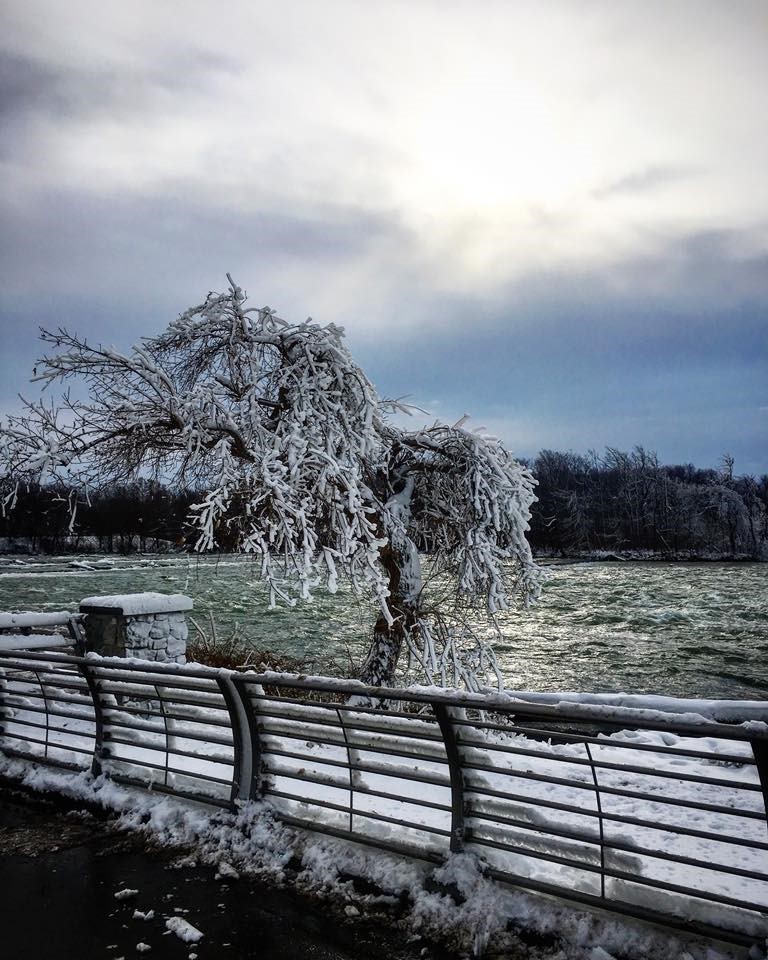
Frozen tree just before the Falls, photo by Nicole Czarnecki.

The newly constructed Cave of the Winds pre-show attraction is now open year-round and offers audiences interactive and virtual exhibits as well as an escape from the chilly temperatures.

Although the Park has received some attention recently pertaining to the beautiful winter wonderland, some articles have mentioned the falls being “iced over” or “freezing over”. It is important to note that the only documented incident of the Falls being frozen completely came in March of 1848 when the Buffalo Express Newspaper stated the cause to be ice damming at the mouth of Lake Erie. The installation of an ice boom at the mouth of the Niagara River has made the likelihood of this event recurring very low if not impossible. Even during the infamous Polar Vortex of 2014 the Falls continued to flow.

Niagara_Falls_Lights_and_Snow_-_panoramio
Light show in January 2014 during the Polar Vortex, photo from Wikimedia Commons.

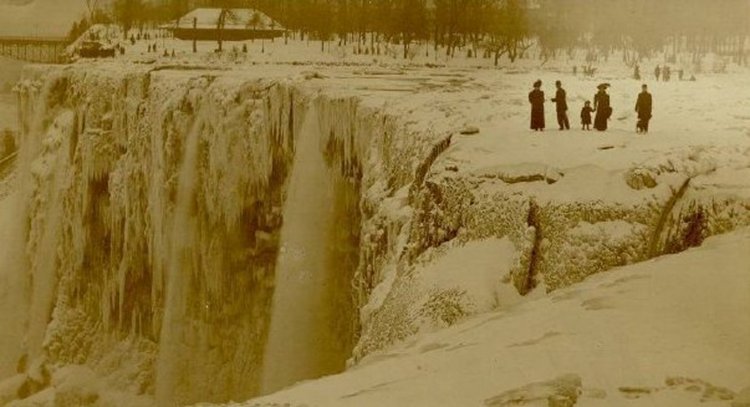
This does not mean that it has not come very close to freezing since then. During the early 1900’s tourists would often walk out onto “ice bridges” forming across the top of the Falls. This activity proved to be very dangerous and was forbidden after February 1914.

260369-545424
People standing on ice above the Falls 1909, photo from Niagara Falls Pubic Library.

2 historic images

All photos provided by State Parks Naturalist Nicole Czarnecki were taken during the Winter Wonder Photography hike. Look for other events at Niagara Falls and surrounding parks this winter on their Facebook page.

Post by Kristin King, State Parks
What’s That? That’s SCAT!

It’s the most wonderful time of the year, the snow is falling, the air is crisp, and the hiking opportunities in State Parks abound. While marveling at the snow-encrusted majesty of the pine and hardwood branches, don’t forget to look down and take a peek at one of the less glamorous and stately aspects of a wintertime hike – wildlife scat! Analyzing who’s who with number two might be the number one way to figure out who is visiting the trails with you, as well as how long ago they were there.

Hunters have long used scat to help with the hunt, determining if animals were around and when, following the scat clues to their quarry. Wildlife watchers and photographers have also used this tool to seek out wildlife. What you can learn from scat can be interesting to anyone, no matter if your intent is to hike, hunt, or just unwind in nature.

Is the scat frozen? The animal could have been around last night. Is the scat desiccated, or dried out and old looking? It could be scat from last season. Can you see if the scat melted snow around it? The animal might not be far away. Are there more than a couple of piles of scat? There could be more than one animal around. Does the scat contain fur? There may be predators hunting.  Scat can be an amazing addition to your toolbox to determine presence and habit of a variety of wildlife around. Here are some photos of common scat piles to help you infer who your wild neighbors are in the woods.

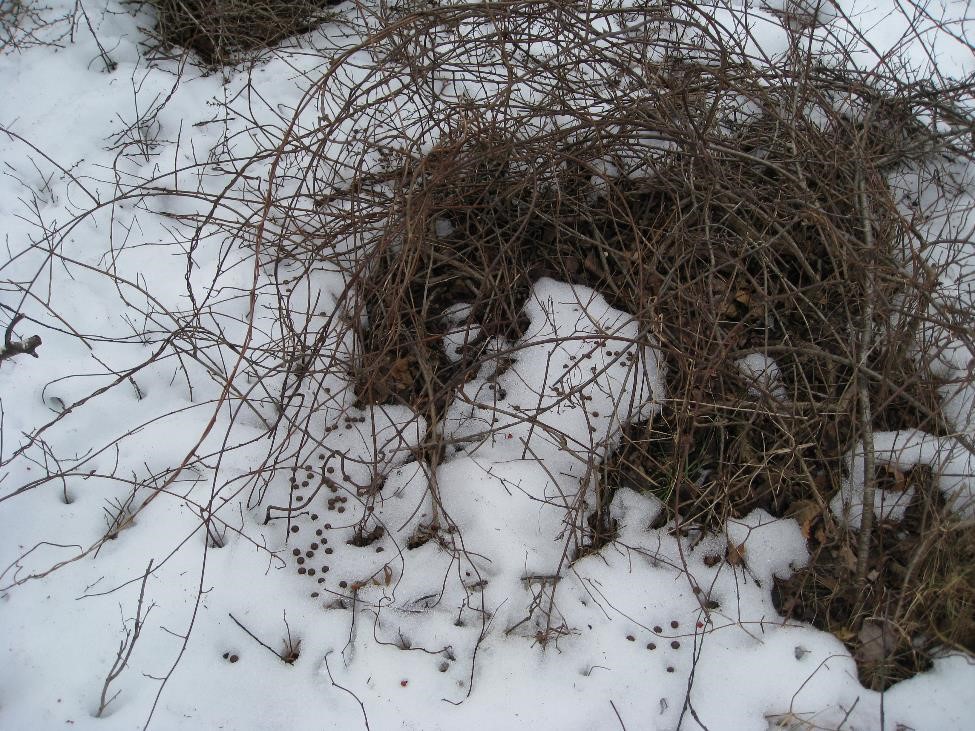
Deer scat might be the most common scat to be found on the trail. Deer scat is usually in pellets and in a pile. If the pile is under leaf litter, or a layer of snow, it is most likely old (see below photo). Deer scat can also be in a more “wet” or “patty” form, but pellets are usually still distinguishable. Shiny or wet scat can indicate a deer is close by!  Deer produce pellets about 13 times a day, a product of their near constant grazing. Bigger bucks can leave bigger poo piles than the does. You can also look further into the scat signs, and see what the deer are preferring to eat. Hunters often organize a hunt around the transition corridors of feeding and bedding areas. Lots of scat in a certain type of feeding area (i.e. clover, grass, apples) would indicate that deer may be accessing this area daily to eat.  Deer beds and poo in cover areas, like scrubby emergent forest, would indicate deer access that area to sleep. A hunt that is set up between those areas, where the deer are apt to travel every day, might have the most chance of being successful.

Deer scat both
Deer scat, fresh (right) and old (left).

Rabbit scat is also very common in brushy areas, and is usually round. Rabbit scat is generally smaller than deer scat and can be more spread out in the feeding area. Look for rabbit scat near low bushes or other available cover. In a strange evolutionary twist, rabbits also produce a second type of scat, called cecotropes, that they eat shortly after depositing. These powerful pellets are full of beneficial gut bacteria.

Cottontail scat_J Jaycox
Cottontail scat.

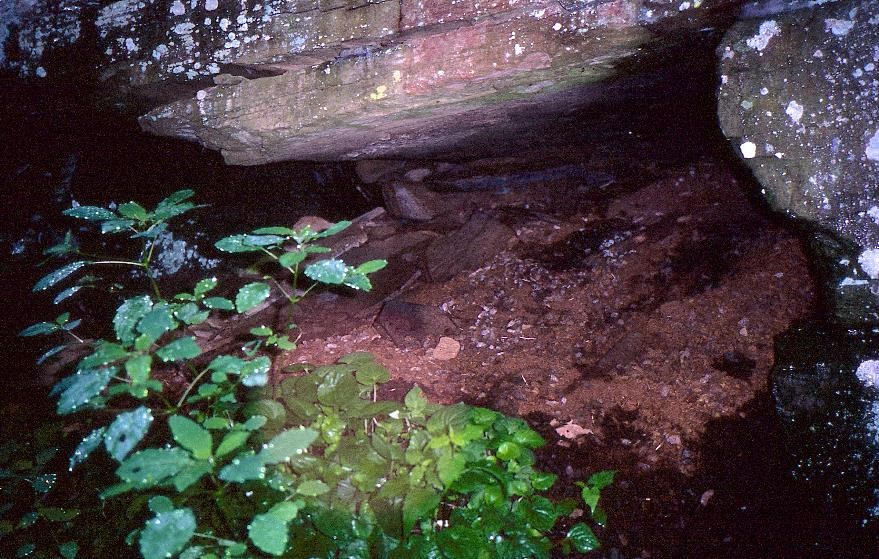
Porcupine scat can contain woody fiber, as they eat twigs and bark. Scat may also be at the entrance to their dens; they don’t seem to need to keep a clean house. Dens can sometimes have mounds of scat around them, if used over multiple seasons. It is theorized that porcupines’ scat piles could provide some warmth in the winter.  Porcupine scat can resemble deer scat, but is somewhat cashew-shaped, as opposed to the rounder deer pellets.

Porcupine den & scat_M Rogers
Porcupine den with scat (broken down) along the entrance.

Foxes, and others in the canid family, like to make a point to be sure you see their scat. They often lay their brick and mortar on top of a rock or something high to mark their territory. Fox scat does not smell as foul as your house pet’s deposits; however it does have a distinct musky odor. Fox scat usually contains hair and is very dark with distinct twisted ends, unlike house dog scats, which are tubular with blunt ends.

Fox scat_M Rogers
Fox scat

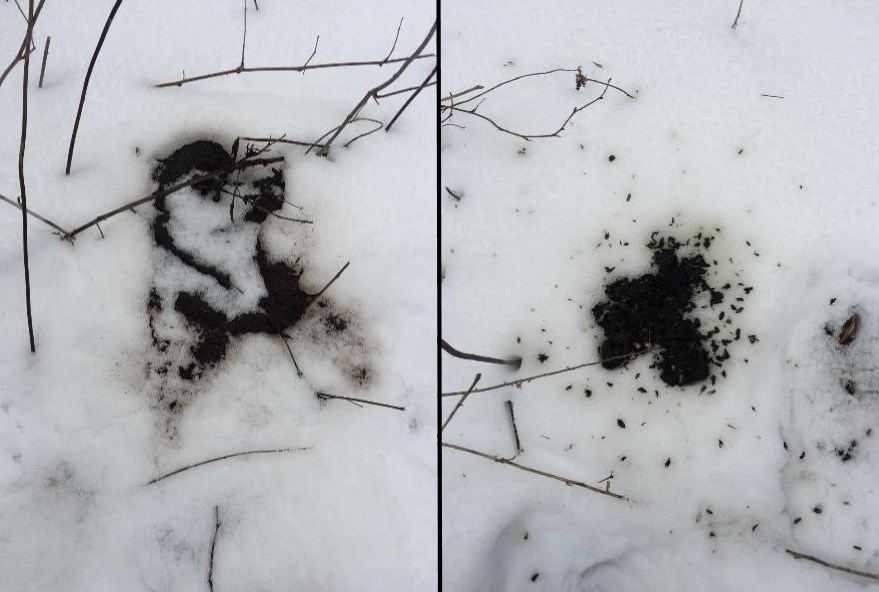
If you are lucky, you might see bear scat on your next hike! Bear scat is usually characterized as a “plop” instead of pellets. Bear scat can be in enormous piles and can be a variety of colors and consistency depending on their last meal. Bears are omnivores, and so can have nuts, hair, or berries visible in their scat. Bears can also be attracted to food caches in town, like bird feeders, before the long snooze in the winter (see photo below). Bear scat also does not smell as strongly as other scat, and in times where they have a vegetarian diet, can smell quite pleasant (for poo).

Bear Scat both
Bear scat, note the seeds in the right photo

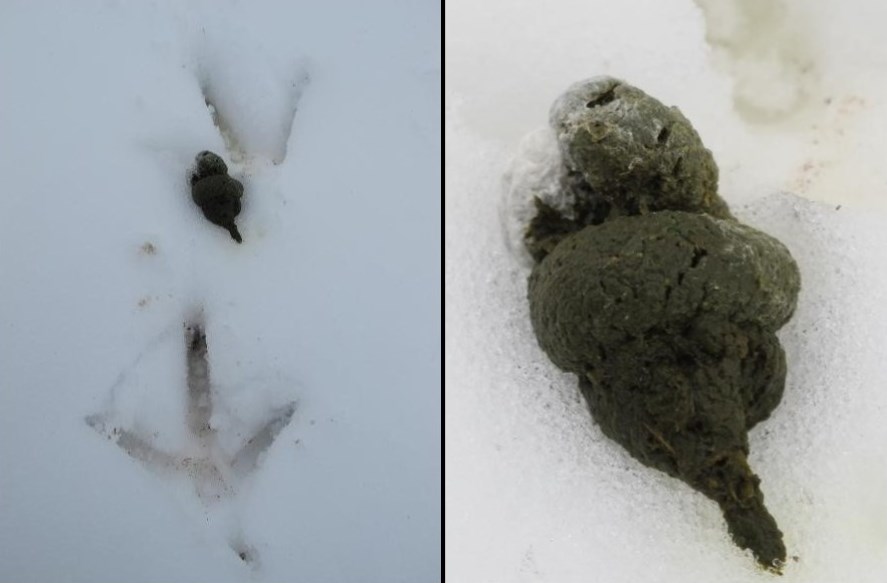
Another very common scat is that of the turkey. Turkey scat, like other birds, contains both urine and feces. The white part of a bird’s scat is the urine.  You can actually tell a male gobbler from a female hen by the shape of the scat. Male turkeys generally balance the budget in a J shape, while females are more in a pile, with a slight spiral to it.  This is because of the anatomy of a female turkey, which has a wider cloaca for eggs to pass through.

Turkey scat both
Turkey Scat (both likely female), note the footprints on left photo.

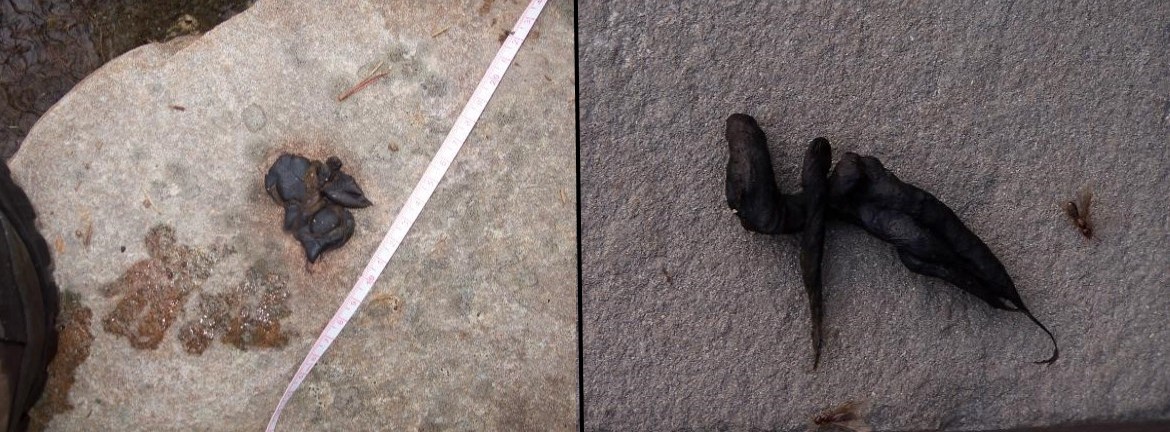
Another elusive animal you may see by scat rather than seeing in the fur, is the mink. A small furbearer, like the weasel, a mink’s scat is tiny, braided and pointed, with a twisted end. Mink also like to advertise their bathroom breaks on top of logs or stones, like foxes and coyotes. You can tell the difference between mink and weasels easily in the winter, as mink do not change their fur coats out for the camouflage that weasels do. Weasels should be white this time of year.

Mink scat both
Two photos of mink scat, note the twisted ends.

Another avian visitor common to parks is the Canada goose, as well as the snow goose. Both geese, like turkeys, have a distinct white cap on their scat. Goose poop however is more of a long log, and usually found around beaches and other waterbodies in the parks. Geese are normally pretty comfortable around people, and buildings, so you are more likely to see goose scat on the lawns and beaches rather than in the woods on trails.

Goose_M Rogers
Goose scat.

Our final foray into the wonderful world of waste is with one of the largest visitors to the Parks. Moose are more common in the Adirondacks, but have also been seen in the Taconic Highlands.  Moose scat can look like supercharged deer scat. Pelletized, and in piles, moose scat most closely resembles deer scat winter. In the summer months when their diet is more wet, moose scat may resemble cow patties. It can also trick people into thinking it is bear scat. To determine the origin, check out the mode of digestion. Moose are ruminants.  Like cows, they have four compartments in their stomach, so four times the digestion efficiency, and so usually poop fully digested food. Their scat is generally uniformly composed.  Bears are omnivores, with one stomach, and their scat can be more variable in composition, often with undigested berries and hair.

Moose_M Rogers
Moose scat.

Winter hikes are some of the most fun and most unique hiking in NYS Parks, and most Parks do not charge entrance fees in the colder months. Come prepared with extra winter clothing, first aid packs, and always let someone know your plan in case of emergencies. And don’t forget that the feces of many species can be an informative and fun addition to your knowledge of wildlife and outdoors.

Post by Keleigh Reynolds, State Parks
Featured image https://www.flickr.com/photos/bepster/43762108/ .

The Niagara Gorge at Low Water

When autumn arrives, what comes to your mind first? Many say the changing foliage or enjoying a hike along a trail, savoring those crisp days given to us during this time of year.

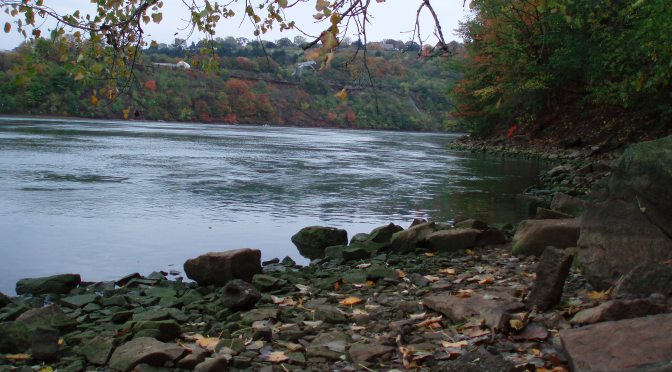
However, here in the Niagara Region of New York, autumn holds an annual event that is well-worth a journey down into the Niagara Gorge! It is the time of year when in addition to viewing the raging rapids, you can also see the river at low water. This is all made possible because of additional water being diverted  for the New York Power Authority and the Ontario Power Company to produce hydroelectricity.

Regulated under The Boundary Waters Treaty of 1909 (revised in 1950), the US and Canada are allowed to divert water for the purpose of power generation as long as they agree to preserve the scenic beauty of the Falls and the Niagara River. Thus, the erosion rate of the falls is reduced significantly. The cliff face is more stable and it makes it easier to maintain the viewing areas at Niagara Falls State Park.

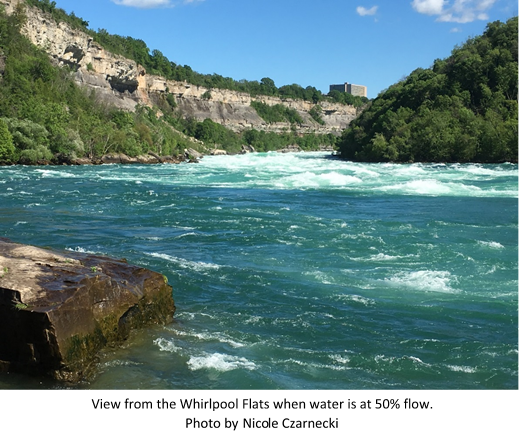
Summer Flow occurs from April 1 until October 31, with 50% of the river water diverted above the Falls during the day and 75% diverted during evening hours to produce electricity.

Photo by Nicole Czarnecki

Winter Flow occurs from November 1-March 31, when 75% of the water above the Falls is diverted, thus we get to see only a quarter of the water flow over the falls.

Gorge at Low Water

This offers opportunities to explore part of the exposed Whirlpool Sandstone rock layer in the Niagara Gorge during the winter flow. The Whirlpool Sandstone layer is underwater during the summer flow.

NIA gorge low water

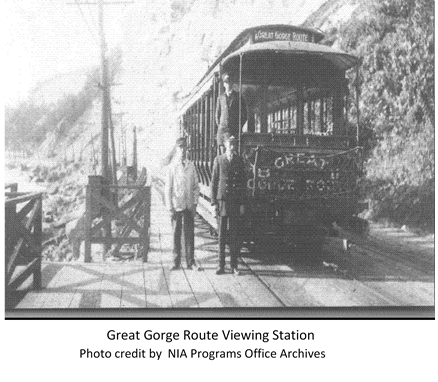
There are guided hikes available with the Niagara Region Park Programs Office in November; in 2017 they are Saturday, November 11 & Saturday, November 18. The hike will take you beyond the Whirlpool to the site of the rapids viewing area. At one time, the exposed rocks were a scenic stop for the Great Gorge Route, an electric trolley line that ran from 1895-1935, running from Niagara Falls to Lewiston, NY. The route also journeyed over to Canada (1899-1932) on what was known as the Niagara Belt Line.

Great Gorge Viewing

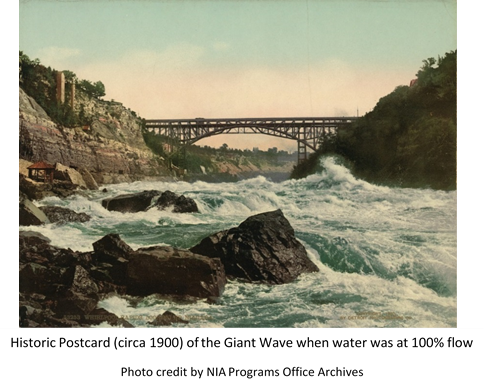
At this trolley stop, passengers were able to walk down the stairs to better view the incredible “giant wave” as seen in the historic postcard below.

Giant Wave Postcard

Post by Carol Rogers, State Parks.

Featured image:  Niagara River Backdrift, accessed from Wikicommons