Category Archives: Flora & Fauna

Rare or noteworthy wildlife spotted in New York State Parks

Plants for Our Pollinators

New York State Parks is abuzz with excitement for pollinators.  From June 20-26, we celebrate both National Pollinator Week and New York State Pollinator Awareness Week.  Our local bees, butterflies, moths, birds and other pollinators are to thank for most of the food we eat, as well as for many of the trees and flowers we enjoy every day.  As these animals go from flower to flower to drink nectar, they accidentally carry sticky pollen from the anthers to the stigma, the male and female parts of flowers.  This fertilizes the eggs, which grow into seeds and fruits that we enjoy.

One of the ways you can show appreciation for these fantastic pollinators is to get out to natural areas in State Parks and enjoy the native flora.  You can also explore native plant gardens and learn more about using native plant species in your own backyard to attract pollinators.  Last year we paid homage to a few of our favorite New York pollinators.  This year, let’s have a closer look at some of the plants and the pollinators that visit them.

Just as pollinators come in all shapes and sizes, so too do the native plants that they enjoy.  Different plants attract different types of pollinators.  Look for all kinds of flowers in the woods, wetlands, meadows, gardens or orchards and you are apt to see some pollinators at work.  Below are some of the native pollinators and flora found in State Parks, with photos from the NY Natural Heritage Program.   NYNHP works in partnership with State Parks (OPRHP) to assess and conduct inventories of natural areas in state parks and helps to protect habitats that support common and rare species alike, including these important pollinators.
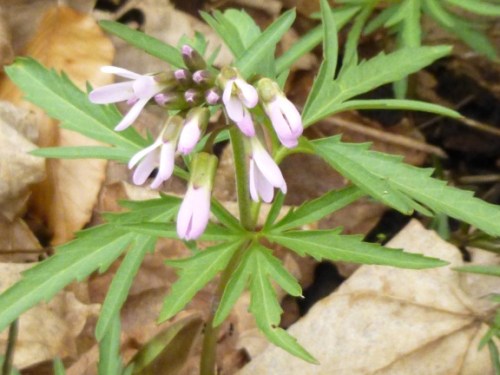
Cutleaf toothwort
Pollinators emerge as soon as there is nectar available for them to feed on. This native wildflower, cutleaf toothwort (Cardamine concatenata), was blooming the first week of April. Photo by J. Lundgren, NYNHP.
Pink Lady Slipper
Pink lady’s slippers (Cypripedium acaule) bloom in June and are pollinated by various kinds of bees. Photo by T. Howard, NYNHP.
wild geranium
A Juvenal’s duskywing (Erynnis juvenalis) feeds on wild geranium (Geranium maculatum), a common native wildflower of woods and openings. Photo by K. Perkins, NYNHP.
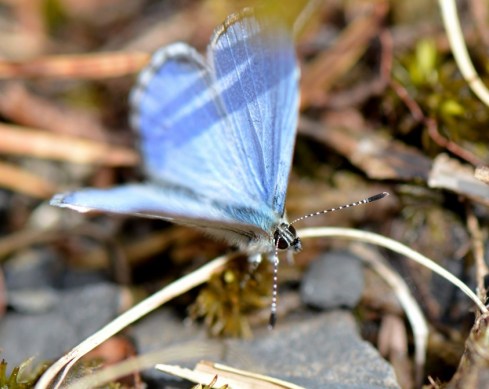
Azure Butterfly
The more showy spring azure butterfly emerges early in the spring and can be seen flitting about sunny trails and open areas. Photo by M. Adamovic for NYNHP.
Goldenrod
Bumblebees (Bombus spp.) are one of the most effective pollinators. You can see how the pollen sticks to its fuzzy body as this bee feeds on the nectar of this native goldenrod. Photo by J. Lundgren, NYNHP.
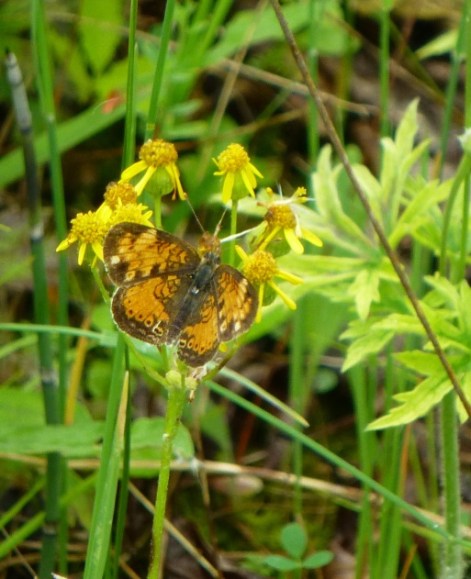
Ragwort
A Pearl crescent butterfly (Phyciodes tharos) feeds on ragwort (Packera aurea) that grows along river shores and wet areas. Photo by J. Lundgren, NYNHP.
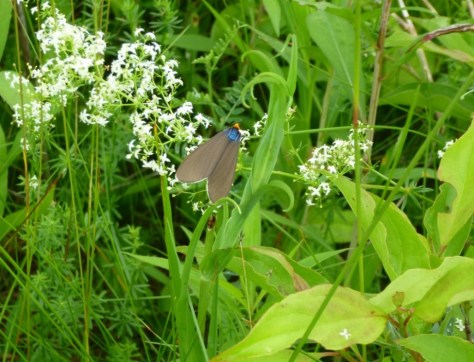
Bedstraw
Moths help pollinate too. Though most moths prefer night, this one is a daytime moth, seen here feeding on bedstraw (this one is non-native, but we have some native bedstraws too) and moving the pollen around in the process. Look for this native moth, the Virginia Ctenucha (Ctenucha virginica) in meadows with flowers from May to July. The caterpillars feed on grasses, so unmown meadows can provide everything this moth species needs year-round. Photo by J. Lundgren, NYNHP.
NE Aster
In late summer and fall, the bright colors of asters and goldenrods are especially attractive to bees and many other insects. The native New England Aster (Symphyotrichum novae-angliae) blooms from August to September. This one is being visited by the Common Eastern Bumble Bee (Bombus impatiens). There are many species of bumblebees, but this one is by far the most common in the state, so the one you are most likely to see. Photo by J. Lundgren, NYNHP

Whether you are a hiker, gardener, farmer, or food-lover you can enjoy and support our local pollinators!  Maintaining natural areas, meadows or gardens with a variety of plants can help to sustain all the life stages of a wide range of insects from bees to butterflies.

If you are interested in creating a backyard oasis for native pollinators, look for plants that are native to your area of the state and, if possible, grown near where you live.  Consider planting different types of flowers; gardens with an array of flowers blooming at different times provide food for a variety of pollinators throughout the season.  Look for white, yellow or blue flowers to attract bees.  Red tubular flowers attract hummingbirds (bees don’t even see red).  Butterflies prefer bright flowers, particularly reds, oranges, and purple (like fall asters).  Moths are attracted to white, purple, or pink flowers with strong, sweet scents, especially those emitting a scent at night.  See resources below on pollinators and native plants in your area.

State Parks is celebrating pollinators at these events across the state:

Clay Pit Ponds State Park – Time Tuesdays, June 21 @ 10am

Learn about our native pollinators by making crafts, playing games, and socializing with other toddlers! Parent or care giver is required to stay. Ages 1-3 (flexible).  Please call (718) 605-3970 ext 201 for more information.

Saratoga Spa State Park – Butterfly Walk Friday, June 24 @2:00pm

Did you know restoring a habitat is like building a neighborhood?  Come enjoy a light hike at the Karner Blue site and learn what butterflies live in the same neighborhood as the Karner Blue butterfly.  Please wear hats and sunscreen.  You may want to bring binoculars or a magnifying glass to see butterflies up close.  This program is appropriate for ages 7 and up.  Registration is required.  Please call 518-584-2000 ext. 122. This program is free.

Thacher Nature Center – Honeybees Are Buzzin’, June 25 @ 2pm

Summertime brings flowers and a hive packed with activity! Come and learn all about honeybees as you view the colony in our indoor observation hive. See the busy workers, the specialized drones and the ever-important queen bee in action! Learn how to dance like a bee, and view the world from a bee’s perspective. Afterwards, take a walk to observe our honeybees at work in the gardens. Please register by calling 518-872-0800.

Letchworth State Park – Butterfly Beauties, June 26 @ 2pm

Study the beauty and composition of hundreds of dried butterfly specimens representing most of the world’s butterfly families. Dozens of local and New York species, as well as those found in the Niagara Parks Butterfly Conservatory, are specially noted. Butterfly structure and local natural history will be featured in two new butterfly videos. This is an excellent primer for the Butterfly Walk on July 9th. (Look for details in the upcoming summer issue of The Genesee Naturalist.) All workshops meet in the Conference Room in the Visitor Center and Regional Administration Building located in Letchworth State Park.  Please call (585) 493-3680 for more information.

Ganondagan State Historic Site – Planting for Ethnobotany Workshop Saturday, August 6, 2016 @9:00am-11:00am

Participants will help plant native plants in the Green Plants Trail and the Pollinator Grassland at Ganondagan.  Ages 8 and up. Registration Required.  Please call (585) 924-5848 for more information.

For more about pollinators and native plantings:

 General Information

Confronting the Plight of  Pollinators

Gardening and pollinator information

— New York’s famous apple orchards would be naught without our beloved pollinators 

New York State Parks Native Plant Policy

 New York State Flora

— Have a plant to identify? Try GoBotany

Native plants for pollinators, by region

Please note, some of the plants listed in this resource are native to the ecoregion but not to NY state. Please check the NY Flora Atlas to confirm which are native to New York before choosing your planting list.

NY Flora Atlas – list of plants known in NY and which are native or not

Pollinator Identification Tools

— Have a bug to identify? Try BugGuide

— Xerces Society for Invertebrate Conservation Northeast Region Pollinator Plants

+++++++++++

Post by Erin Lennon, OPRHP and Julie Lundgren, NYNHP

News Flash! Fireflies Are Flashing In Allegany State Park

On June 1st in Allegany State Park, the first fireflies of the season were spotted, bringing great excitement. Why? Lots of parks have fireflies, but not the Synchronous Firefly – once thought to exist in only a handful of places in the world, but now known in scattered locations from Georgia to southwestern New York.  The (Photinus carolinus), flashes only from late June to mid-July and prefers dark mature forests, over 1200 feet with low vegetation and a water source. Fireflies or lightening bugs are actually a beetle that can produce its own luminescent light.  Each species of firefly (there are over 170 species in the US) has its own unique flash pattern. Colors differ too. The male Synchronous Fireflies flash 8 to 10 times all in unison, then they stop for 10-15 seconds depending on the temperature. They wait for the female to flash back, then they repeat the display again and again into the wee hours of the morning. The best time to see this phenomenon is between 10 pm to 2 am.

Once they find each other, they mate, the females lay eggs, and then the adults die. The larvae hatch in a 3-4 weeks and devour worms and slugs. These small, blackish caterpillar-like predators inject their prey with a fluid which causes numbness, then they suck out the gooey innards. The larvae hibernate in small burrows in the soil and emerge as adults in a few months.

Some people ask, “Why don’t we see as many fireflies as we did as children?” Are we just not noticing? Or not outside as much? Unfortunately, firefly populations have declined, mainly due to light pollution, habitat destruction, and pesticides. How can you help? Check out www.firefly.org to find to more information or take part in a Firefly Watch though the Boston Museum of Science.  To see what the firefly display looks like, check out Radim Schreiber’s website.

Catching fireflies is a fun summer activity, you can put them in a jar to get a close-up look. But then let them go so they can find their mates and contribute to the next generation for us to enjoy next year.

Allegany State Park will be offering special programs to provide visitors with the opportunity to view the Synchronous Fireflies this June. Please check our Facebook page in mid-June for more information. In the event of severe thunderstorms, the event will be cancelled. However, the fireflies do display in rain and you may still observe them on your own if you wish. Displays of the Synchronous firefly are best observed in a dark mature forest in order to experience the full effect. And if you miss these, you can watch for other more common species of fireflies in your back yard, campsite, or parks across the state from June to August.  For information on this and other programs, please check Allegany State Park’s activity schedule on Facebook or call 716-354-9101 ext. 232.

Post by Adele Wellman, OPRHP, Allegany State Park, Lead Naturalist

Fire Dependent Communities

Forest Fire Scorches 3,000 Acres in Ulster Park” was the headline of a story in the New York Times on April 21, 2008.  The park was Minnewaska State Park Preserve in the Hudson Valley. From when it was first reported on April 17 to when it was finally out on April 29, the Outlook Fire burned roughly 2,800 acres in the park. People from 134 state and local agencies came together to control the largest fire to hit the region in 60 years. Recently, another large fire in Minnewaska, the fire at Sam’s Point that burned over 1500 acres in April and May 2016.

These fires were both wildfires, defined as uncontrolled fire in the forest or fields which spreads quickly and is difficult to control.  Historically, wildfires were ignited by lightning strikes. Wildfires are a natural component of many different ecosystems; they have helped to maintain healthy native flora, fauna and systems around the world for thousands of years.

Fires help ecosystems in many ways. They help plants by opening up the tree canopy to allow sunlight to penetrate to the forest floor to enable new seedlings to grow; adding nutrients to the soil and raises the soil pH, giving plants an extra boost of natural fertilizer; reducing the competition for water and soil nutrients by thinning out the underbrush; and decreasing some invasive species and forest pests and diseases. But other invasive species can proliferate after fire, so preventing their spread is an important management strategy.

Some of natural communities in the state — places like Minnewaska, the Shawangunk Ridge, Albany Pine Bush, Long Island Central Pine Barrens and many areas within State Parks are fire-adapted, meaning they can survive wild fires. If fact, the need occasional fires. The plants have special features to survive fires. Pitch pine are one of the best known fire-adapted trees, and they are common in Minnewaska.  If a pitch pine tree is damaged in a wild fire, the roots are not always killed and new growth will sprout from the base or the trunk of what appears to be a dead tree.  Chestnut oak is another tree that is able to withstand fires due to the thick bark. Other plants have seeds that lie safe below the surface, called a “seed bank”, waiting to grow when conditions are right like when there is space and more light following a fire. And perennials like the ferns and trillium and starflower lie dormant underground (like tulip bulbs in your garden), ready to burst upward every spring and summer.

And some plants are fire dependent, meaning that they need fire to thrive or greatly benefit from fire.  Pitch pine is a good example of this. Although some pitch pine cones will open on a hot summer day which drops the seeds to the ground, a fire also exposes the bare soil that helps their seeds to sprout.

Fires can help animals too, including insects, by creating new openings in the forest for the animals to thrive and by leaving snags (dead trees) which provide places for raccoons, squirrels, and woodpeckers and other cavity nesting birds to nest in. Many animals avoid fire by burrowing deeper in to the ground, flying off, or skirting the edge of the fire. Very rarely will an animal be trapped by a fire.  Some species of beetles and birds hunt along the edge of the fire, looking for their prey as it escapes the fire.

This slideshow requires JavaScript.

Life was blooming in Minnewaska just after the Outlook Fire.  In coordination with the New York Natural Heritage Program and State Parks. a team of scientists worked together to study effects of the fire on breeding birds, tree regeneration, and vegetation response. Within a couple of weeks, there were hints of green. Approximately a month after the fire had ended, there was abundant new life in the Pine Barrens, with ferns and Canada mayflower sprouting up, trillium and lady’s slipper flowering, and a wood thrush nest with eggs hidden amongst the charred leaf litter. Pitch pines, chestnut oaks, scrub oak, huckleberry, and other trees and shrubs showed new leaves, bright green against the blackened landscape. Not lost after all, but alive and well.

Susan Carver, State Parks and Julie Lundgren, NYNHP

Hailing More Snails

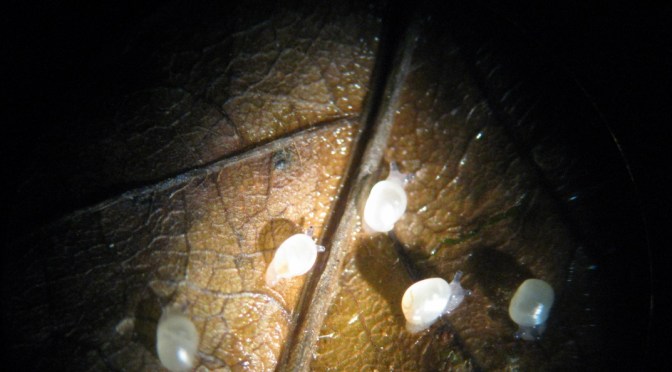
When ten endangered Chittenango Ovate Amber snails (COAS), located in only one known location in the world: Chittenango Falls State Park, were brought into an SUNY College of Environmental Science and Forestry (ESF) lab for captive breeding and did not reproduce over the summer of 2014, graduate student Cody Gilbertson and advisor Rebecca Rundell knew they had to adjust something. Eventually the ten COAS were released, but as luck would have it, during the trial, a stowaway baby COAS came in on vegetation that was offered to COAS adults.  The tiny snail on the plant was placed in an enclosure to monitor closely. This was the beginning of a rapid learning curve for Gilbertson on the food preferences of COAS. New York State Department of Environmental Conservation (in charge of endangered species permitting) granted permission for them to keep the one snail over winter and raise it alone in the lab. From this blessing in disguise, Gilbertson was able to figure out the specific species of leaves this one snail she named “Hatch” preferred to eat – dead cherry leaves! Cherry leaves collected in the spring were consumed regularly and “Hatch” began to grow rapidly. Gilbertson knew it was risky keeping a small hatchling snail because in the past, 80% of hatchlings would die within the first two weeks of life in captivity. She thought it was unlikely “Hatch” would live, but this one snail persisted and survived in the lab showing her what it most preferred to eat, and she watched closely. It turns out this was a very practical way of finding out what COAS needs without harming individuals.

When Gilbertson brought two more COAS in from the wild during summer 2015, adults flourished on the improved diet and reproduction occurred resulting in over 600 baby COAS in just two months! The two snails mated with each other and about seven days after mating, egg masses were laid.  A total of about six egg masses were laid by each snail with about 33 eggs in each egg mass. About 270 of these snails were released back to their wild habitat to help expand the wild population of COAS. The other 300+ snails are still in our lab and are thriving. Over 130 snails have reached maturity (over 14mm in shell length) and over 30 egg masses from the captive born snails have been produced so far.

This research, supported by United States Fish and Wildlife Service, has pushed the recovery of COAS species forward with some very large steps:

1) Researchers have performed a first ever release of captive snails back to the wild

2) Scientists now have information about what COAS eat and what they may need to survive in the wild and in captivity

3) Over 300 snails remain in captivity for assisting in securing this species existence.

However, there is still much to learn about this unique and rare species in our upstate NY backyard. Scientists will need to monitor and care for both the wild and captive populations over time for us to tell if this work is successful long term. But they have certainly put their best foot forward!

Gilbertson with 'Hatch'
Gilbertson with “Hatch,” photo by Cody Gilbertson

Post and photos by Cody Gilbertson, graduate student SUNY College of Environmental Science and Forestry

Happy Second Birthday Nature Times!


This slideshow requires JavaScript.

In this second year of Nature Times we have gotten to know snapping turtles, carnivorous plants, black squirrels, and Sammi, Trailside Museums’ 36 year old bald eagle.  We’ve learned how trails are mapped, how a flock of sheep and goats have become one of State Parks’ 21st century mowing crews, and ways to explore State Parks on foot, in kayaks, on snowmobiles, and on frozen lakes. The stories have featured all kinds of work that State Parks staff and volunteers do throughout the year to help preserve and protect some of New York’s unique and exceptional places. These range from protecting sand dunes on Lake Ontario and old-growth forest at Allegany, to creating native grasslands at Ganondagan State Historic Site, and monitoring invasive species infestations and removing invasive species both on land and water.

This slideshow requires JavaScript.

We mark this second birthday with 61 new followers and over 24,000 page hits!  And we thank the 32 staff, interns, and partner organizations who have shared their passion for State Parks through the blogs that they have written. We also want to recognize our partnership with the New York Natural Heritage Program who helped in initiating this feature and continues to provide support.

We look forward to continuing our celebration of State Parks in the months to come in Nature Times.  Hope to see you soon at one of our Parks or Historic Sites!