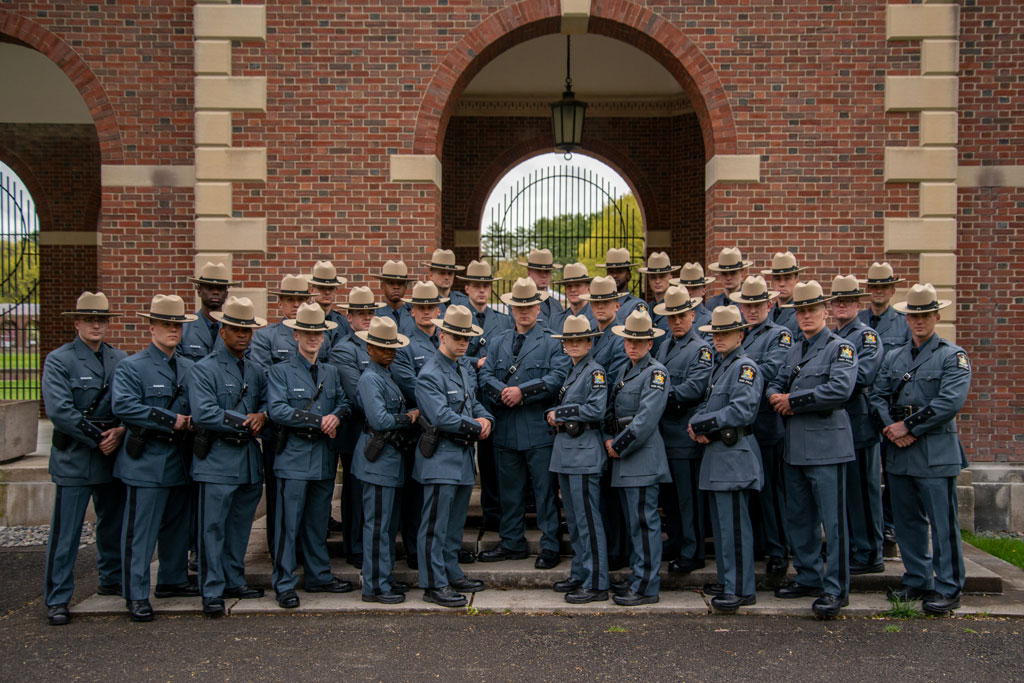
For the first time in four years, New York State’s Office of Parks, Recreation and Historic Preservation’s Park Police have a new graduating class.
That’s right, a group of 32 recruits answered the call, made it through a trying six-month training term, and are now ready to patrol our parks. While we still have a long way to go to get our Park Police numbers in a healthier place, this influx of personnel is a great start to filling depleted ranks, primarily on Long Island and in the Hudson Valley.
Four 17th Academy recruits were honored at the recent Saratoga Spa State Park Hall of Springs graduation ceremony:
Erik Torkildsen – Firearms Proficiency
James Hopkins – Physical Fitness
Matthew Olsen – Academic Achievement
Robert Costanzo – Leadership
For the family and friends gathered on that May 3 morning, the highlight was the recruit recap video that showed the rigors of just what the new officers had to go through. There were written tests, physical fitness activities, pursuit driving drills, snowmobile safety and water rescue lessons, the mental challenges of returning to their barracks to find their living space (purposely) in shambles, plus being tased and pepper sprayed. Some video onlookers laughed, some gasped, some pointed wide-eyed. Most of the new officers didn’t react – they had lived it and earned their badges.
The new class was also offered wisdom and well wishes from leadership at State Parks and Park Police:
“The call to service comes at all hours of the day,” Commissioner Erik Kulleseid reminded them.
“Always make your bed,” suggested Colonel Michael Daddona, Assistant Director of Law Enforcement, referencing making a practice of the first accomplishment of their day, every day.
“Protect precious and beautiful places in New York State,” urged Lieutenant Zachary Voegler, head of the Park Police Academy.
2023’s NY State Park Police graduating officers prior to their May 3 ceremony.
After graduation, PBANYS President and University Police Lieutenants Director James McCarthy underscored the immense benefits of building the Park Police force. “We welcome the addition of these specialized officers who have made a commitment to keeping their neighbors and communities safe,” he said. “At a time when law enforcement agencies face tremendous challenges in recruiting and retaining the best and brightest, the residents of New York state are extremely fortunate that these 32 individuals answered the call to serve and protect.”
Our Park Police graduation, however, was just one of two major events recently hosted at Saratoga Spa State Park. The other event unfolded a few days earlier when Park Police staged an emergency exercise on how to respond to a disaster during a concert at Saratoga Performing Arts Center, commonly known as SPAC, a venue within the park.
When John Boyd Thacher State Park Manager Bill Hein got a call saying that Ron Swanson was going to visit his park, he thought it was a prank. It’s not every day that you get a visit from a celebrity, but that’s just what happened when Parks and Recreation star Nick Offerman visited this State Park in rural Albany County last month to promote his newest book on the network news program CBS Mornings.
The 51-year actor played the deadpan, gruff, libertarian head of small city parks department on the critically acclaimed series, which ran from 2009 to 2015. As fans know, Offerman in real life is a passionate woodworker, making furniture, canoes, and boats, and is the husband of actress Megan Mullally, who is best known for starring on the sitcom Will & Grace. She was filming locally, so CBS producers looking for a picturesque natural Capital Region location for their interview with Offerman chose Thacher Park for its sweeping views from the Helderberg Escarpment.
The Helderberg Escarpment at Thacher State Park at sunrise.
Joining CBS anchor Anthony Mason, Offerman started his morning with sunrise fishing at Thacher’s Thompson’s Lake. While there, the two discussed Offerman’s background. Born and raised in Illinois, Offerman has penned a new book (Where the Deer and the Antelope Play) that reads like a love letter to the outdoors and a reflection on our shared responsibility to act as stewards of our environment. It isn’t his first book but may be his most poignant – set against the backdrop of some of the nation’s most incredible natural sites, including Glacier National Park. His best advice? Get outside!
“In my book, with a sense of humor, I’m trying to remind everybody … to get out. If you don’t know what the poison ivy or poison oak situation is, then you’re not getting deep enough in the woods,” he said.
Read this interview that Offerman gave to the Los Angeles Times about the book and some of his outdoor adventuring that inspired it.
Getting outside is just what he did at Thacher, a flagship park in the eight-county Saratoga-Capital Region. After a morning fishing at the lake (with no catch to show for it), Offerman and Mason enjoyed a hike along Thacher’s famous limestone escarpment. Sitting atop the Indian Ladder Trail, the overlook has a panoramic view that stretches to Albany, down the Hudson Valley, and east into neighboring Vermont.
Punctuating the visual splendor was a roaring waterfall, flowing with gusto from a string of summer rain showers. Offerman couldn’t contain his glee. “We don’t have this in Illinois,” he said.
Nick Offerman chats with Parks staffer Ray Muniz.
Fishing is only one of the activities available at Thompson’s Lake. Featuring 140 campsites, the park also has volleyball court, horseshoe pits, a playing field, swingsets, carry-in boat access, canoes, kayaks, and stand-up paddleboards, fishing areas, and nature trails. The lake is open for ice fishing in the winter.
Settling down on a picnic table to continue the interview, Offerman stopped, pulled out his handy Leatherman multi-tool and tightened up a few screws he thought might be coming loose, much like his Parks and Recreation character, who was really into tools, maintenance, and repair. Offerman reflected on his penchant for woodworking with Mason throughout the interview. It’s a hobby so central to his story – and so unique for an actor – that it was written into his character, who in one episode received a fictional award for woodcraft.
As the crew wrapped up from its morning shoot, Offerman met with some of our real-life Parks and Rec staff, including Regional Director Alane Chinian, Park Manager Bill Hein, and Environmental Educator Savannah Wilson. Hein, an avid fan, even brought copies of Offerman’s previous books. In true Ron Swanson fashion, Offerman was generous with his time, cracking jokes, answering questions, and offering autographs.
Offerman chats with Parks Student Conservation Association members Anna Pirkey and Grace Brennan (l-r).
Saratoga-Capital Regional Director Alane Ball-Chinian, Anna Pirkey, Nick Offerman, Grace Brennan, Thacher Park Manager Bill Hein, and Parks Environmental Educator Analyst Assistant Savannah Wilson.
“I had heard Nick mention Aldo Leopold during part of the taping and that kind of struck a chord with me,” Hein said. “I had read “A Sand County Almanac” in my earlier years and Leopold’s writing on killing wolves in the Southwest helped show me the importance of conservation and the delicate balance that nature lies in. It helped me solidify the career choice I was making out of college.”
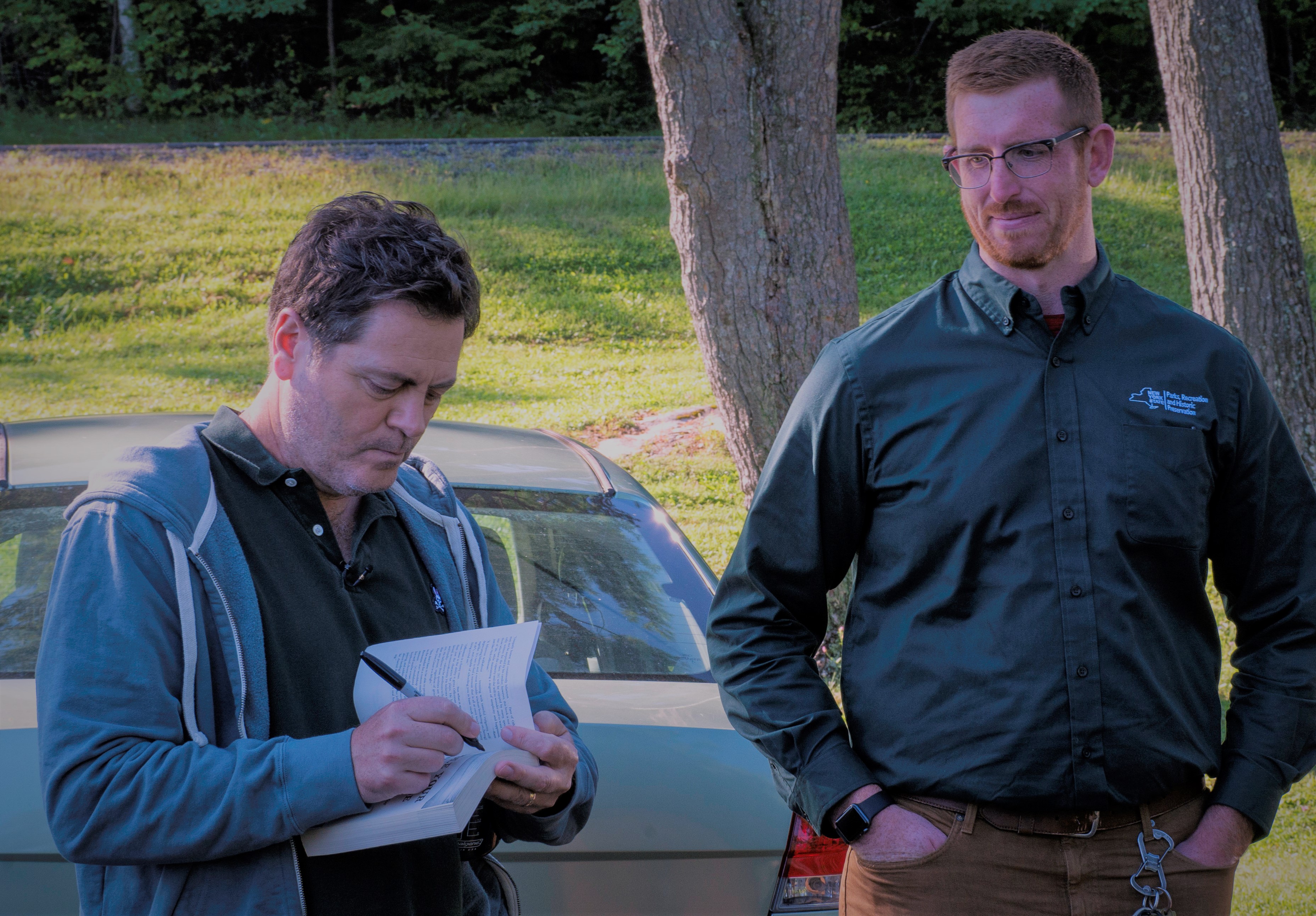
Hein had brought with him a copy of Offerman’s earlier book “Paddle Your Own Canoe” for him to autograph. Beneath his signature, he wrote two words: “To Mirth.”
Offerman signs a book for Thacher Park Manager Bill Hein.
Before leaving Thacher, Offerman had one last compliment to offer Parks staff. “I love your office,” he said, gesturing to the escarpment. “Thank you for the work that you do.”
And thank you, Nick Offerman and CBS Mornings, for helping bring a bit of the beauty of Thacher State Park to a national audience. With its spectacular views and 25 miles of trails spread across some 2,500 acres for hiking, mountain biking, cross-country skiing, snowshoeing, and snowmobiling, it is truly a year-round destination!
Cover Shot- Nick Offerman. All photos by NYS Parks
Post by Rey Muniz, Public Affairs Manager, Saratoga-Capital Region, NYS Parks
Twenty-five years ago, as a young Fish and Wildlife Technician with the state Department of Environmental Conservation, I was recruited for an unusual field outing on State parkland in the Hudson Highlands of southeastern New York: a first of its kind, hands-on training to become a certified nuisance rattlesnake responder.
As a responder, I would be on a short list of people willing to safely and legally relocate timber rattlesnakes that had wandered into compromising situations on private property – a win-win for both the homeowner and snake. No such system was in place in the Hudson Valley and, without it, many homeowners took matters into their own hands, often with a shovel or shotgun.
Randy Stechert, a long-time herpetologist and regional rattlesnake expert who has worked through New York, New Jersey, Connecticut and elsewhere, led our small group to a remote rocky clearing in search of Crotalus horridus, the timber rattlesnake. The largest of New York State’s three venomous snake species (the others being the northern copperhead and massasauga rattlesnake), the timber rattlesnake was in trouble, owing to centuries of habitat loss and direct persecution, including a bounty system lasting into the 1970s.
These depredations were so effective the State declared the species Threatened in 1983, a designation requiring conservation measures to keep it from slipping to Endangered status or worse. Currently under New York State Environmental Conservation Law, it is illegal to capture, kill or possess any native snake at any time without a permit, including rattlesnakes.
The mission of that long-ago outing was to familiarize our ragtag group of would-be responders with this species in the flesh. Randy would show us a wild rattlesnake and how to safely handle it, while imparting his wisdom about all things rattlesnake in his booming baritone voice.
And boy did he deliver.
I will never forget the robust, nearly all-black rattlesnake plucked from a huckleberry patch and deposited on the open bedrock just feet in front of me. Most memorable was how easily we could stand beside this now agitated wild animal with little concern about its intentions. It was in a clearly defensive posture, coiled and ready to repel any further attacks from this presumably malevolent band of primates.
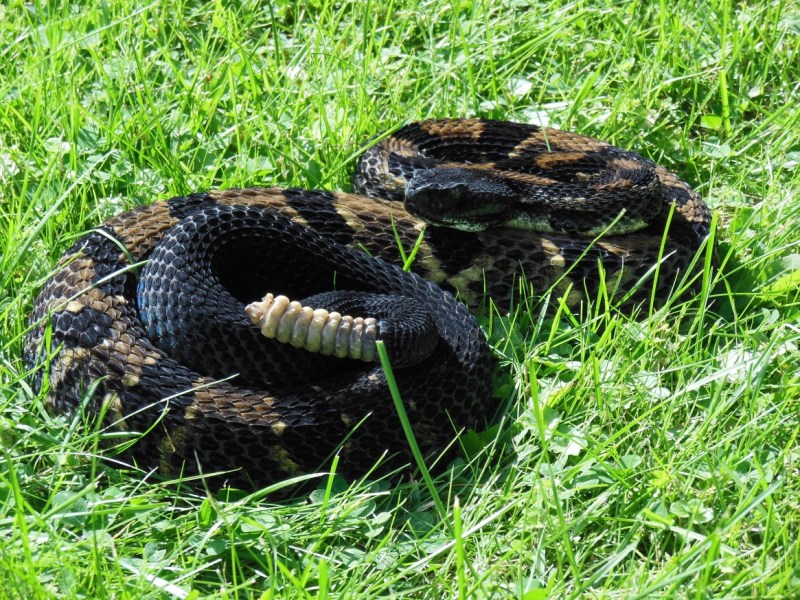
A black morph timber rattlesnake. Colors range from nearly jet black, to browns, to sulfur yellow. (Photo credit – DEC/William Hofman)
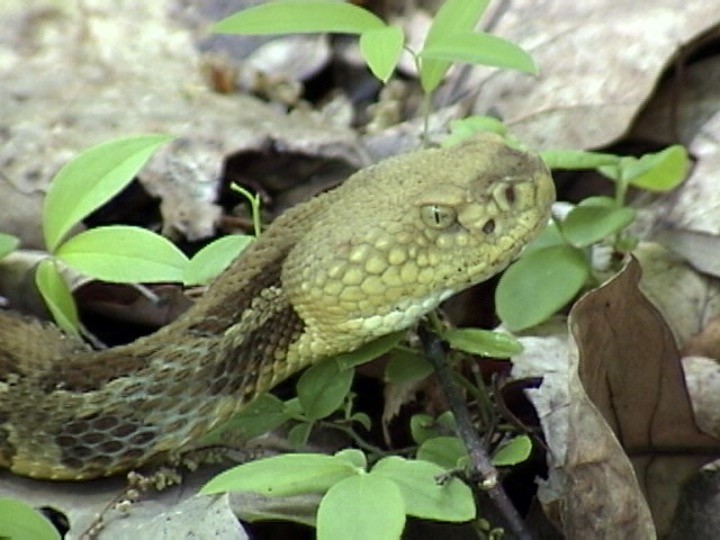
A yellow morph timber rattlesnake.
In the ensuing decades, and after handling dozens of rattlesnakes in my research and as a nuisance responder, I’ve come to understand them as pacifists at heart. Despite their considerable weaponry – two hypodermic needle-like fangs and potent venom – they really just want to be left alone. In fact, their first response to human presence is to remain motionless, and hope their camouflage shields them from detection. If detected and a retreat is available, such as a rock crevice, they will typically make a rapid exit to safety. But if they feel exposed, vulnerable, and without a means for escape, they quickly switch gears in an attempt to intimidate their aggressor. A cornered rattlesnake coils, inflates to look more girthy, and rapidly vibrates its namesake rattle to audibly back up the message. This menacing version is our popular notion of a rattlesnake but, ironically, is merely a response to the perceived threat posed by us.
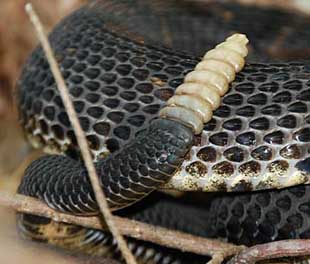
The snake’s rattle is made from rings of keratin – the same hardened protein our fingernails and hair are made of. A new rattle segment is formed every time a snake sheds its skin. When the snake rapidly shakes its tail, the rings vibrate and produce a rattling or buzzing noise used by the snake as a warning to keep away.(Photo credit – New Hampshire Fish and Game Department/Brendan Clifford.)
Hear a rattlesnake rattle…
Since that indelible first encounter with a wild rattlesnake on State Park land, I have become increasingly entwined with this charismatic species. I’ve rescued them from homeowner’s yards, conducted field surveys for their winter dens, and ultimately took a very deep dive into unraveling the timber rattlesnake’s mating system and reproductive ecology as a graduate student.
Still managed by the DEC, the nuisance rattlesnake response program includes most members of that original group recruited in the mid-1990s. While Randy Stechert continues to host trainings (now done with captive snakes, rather than wild ) in recent years, he has passed the torch to another generation of trainers, including myself here at State Parks.
Where I work at Trailside Museums and Zoo at Bear Mountain State Park , natural resource staff, backcountry rangers and our own zookeepers have been trained using our captive rattlesnakes under this program, expanding Parks’ in-house capacity to respond to nuisance situations at all our locations.
Other conservation measures have been installed as well in recent years. For example, all park development projects are “screened” by location to assess their potential for rattlesnake impacts. When possible, projects sited within snake habitat are scheduled for November to March, when the snakes are less likely to be active and in harm’s way. When this can’t be done, the contractor is required to develop a rattlesnake response plan and have an onsite snake monitor to head off conflicts. In some cases, when habitat loss or direct impacts are considered unacceptable, the project is relocated, reconfigured, or even denied.
The timber rattlesnake has been a survivor, persisting in the rocky uplands of the Hudson Valley, Southern Tier and eastern Adirondacks for at least the last six thousand years. Our past concerted efforts to eliminate it from the landscape were unsuccessful, and good thing. As more species disappear and the fabric of nature unravels, thread by thread, the value of having formidable, wild creatures about us only increases.
State parklands are a critical refuge for this imperiled snake in New York and can remain this way with a little foresight, planning, and, frankly, empathy, on our part. If we can successfully accommodate the long-term survival of the timber rattlesnake, it will bode well for biodiversity overall.
Timber rattlesnakes reach the northern limit of their range in New York and New England.(Photo credit – NYS DEC)
A researcher marked this snake’s rattle with red paint to aid future identification.
What To Do If You See a Rattlesnake?
If you are on State parkland or elsewhere in the wild, observe the snake from a safe distance (at least six feet), and take a moment to enjoy this majestic animal. If you snap a picture with your cell phone and want to share it with others over social media, it is best to do this without disclosing exact location information. You can either share a screenshot or make sure location services are disabled on your phone. This will keep the location secret from snake poachers attempting to mine online location data. After briefly observing the snake, back away and make a detour around its location to continue your hike.
In a nuisance situation where the snake’s presence is problematic, such as in or near a dwelling or public space, a certified relocation expert can be obtained by calling 911 or the DEC. Please remember: Do not attempt to disturb or capture the snake yourself. Seeking expert assistance in this instance is one way to help New York preserve its biodiversity.
Cover shot – A yellow morph timber rattlesnake blends into the forest floor. All pictures NYS Parks unless otherwise credited.
Post by Ed McGowan, PhD, Director of Science and Trailside Museums & Zoo, Bear Mountain State Park
Threatened in New York State and often misunderstood, the Timber Rattlesnake is an impressive and unique species that is essential for healthy ecosystems. At an average of 3-4 feet in length and described as “stocky,” timber rattlesnakes are the largest venomous snake species in New York. They are easily identified by their broad triangular-shaped head…
It’s July 1st, 1971. Nelson Rockefeller is governor of New York State, “It’s too Late” by Carole King is number one on the music charts, and gas is 40 cents a gallon. In the eastern part of the state, just shy of the Vermont border, a new state park opens in Rensselaer County, welcoming swimmers onto a monumental 1,000-foot beach.
Michael Hogan is an 18-year-old lifeguard at the new Grafton Lakes State Park, earning $1.76 an hour to keep watch over that beach with two other lifeguards, Sandy Town from Pittstown and Paul R. Jones, who everyone called “Buzz.”
Recalling the day 50 years later for the Grafton Lakes State Park’s new oral history project, Hogan remembers that his team performed a simulated rescue that aired that evening on an Albany television station covering the park opening, which was attended by State Parks Commissioner Dr. Sal J. Prezioso and other dignitaries.
Located in the heart of the Rensselaer Plateau, the new park included five lakes, 1,850 acres, a concession stand, and a park office. Hogan worked at Grafton for seven years, and now is retired and living in Rensselaer County.
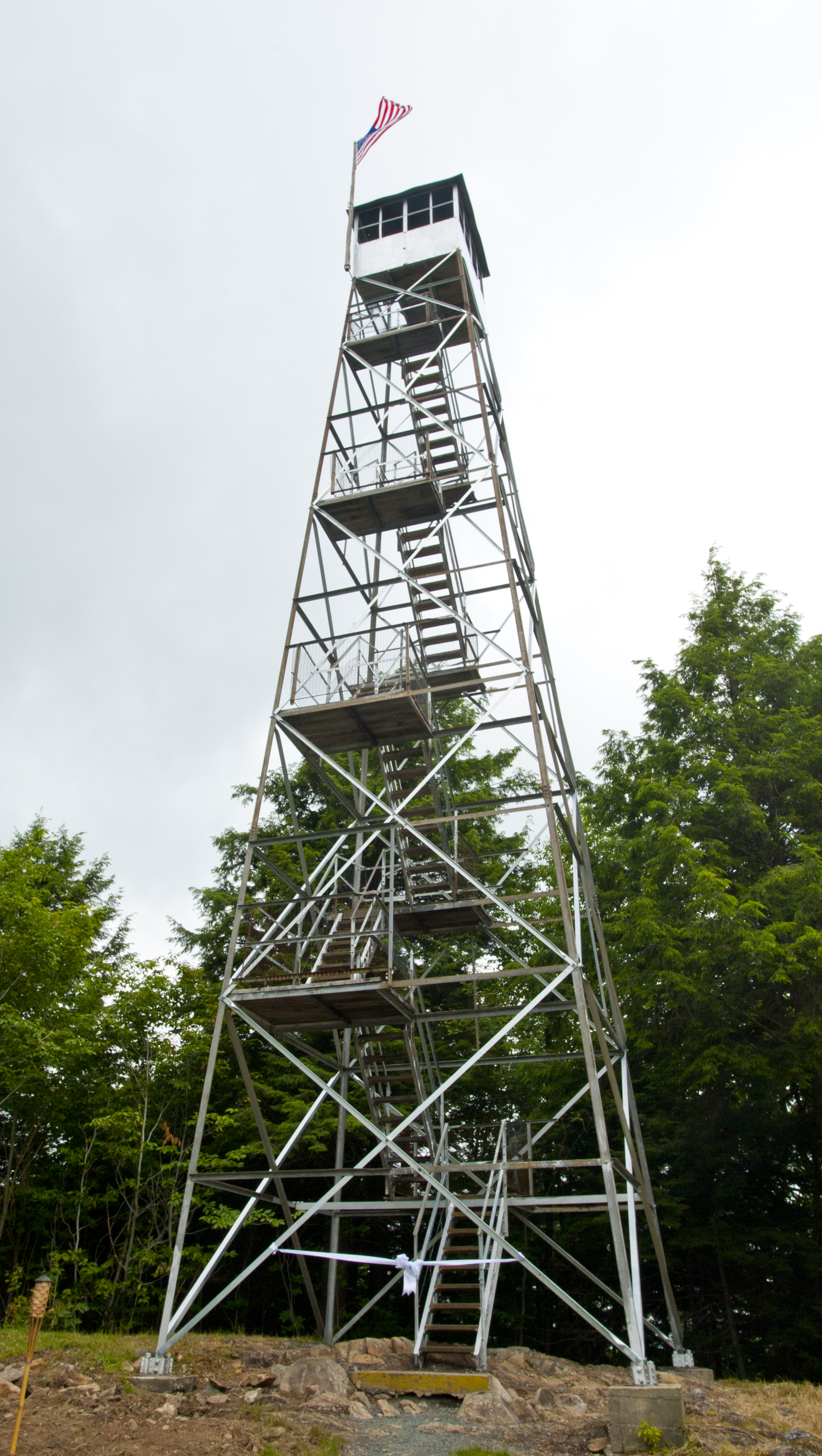
This dawning of a new park was followed shortly by the end of another era at Grafton, when the Dickinson Fire Tower was shut down in 1972 after 48 years in service. One of the tower’s observers, who looked out from atop the 60-foot tower for signs of fire, was Grafton resident Helen Ellett. She was one of a handful of state female fire observers and was assigned to Dickinson from 1943 to 1965 to call in signs of fire in that heavily forested region.
Helen Ellett, top, sight down her orienteering equipment in the cabin atop the Dickinson Fire Tower at Grafton Lakes State Park.
According to Linda Laveway, Ellett’s granddaughter and another participant in Grafton’s oral history project, Ellett was a staunchly independent woman. Long days in the tower were no deterrent for Helen who felt pride every time she raised the American flag, knowing that through her work, she would be helping to save people’s livelihoods and possibly their very lives.
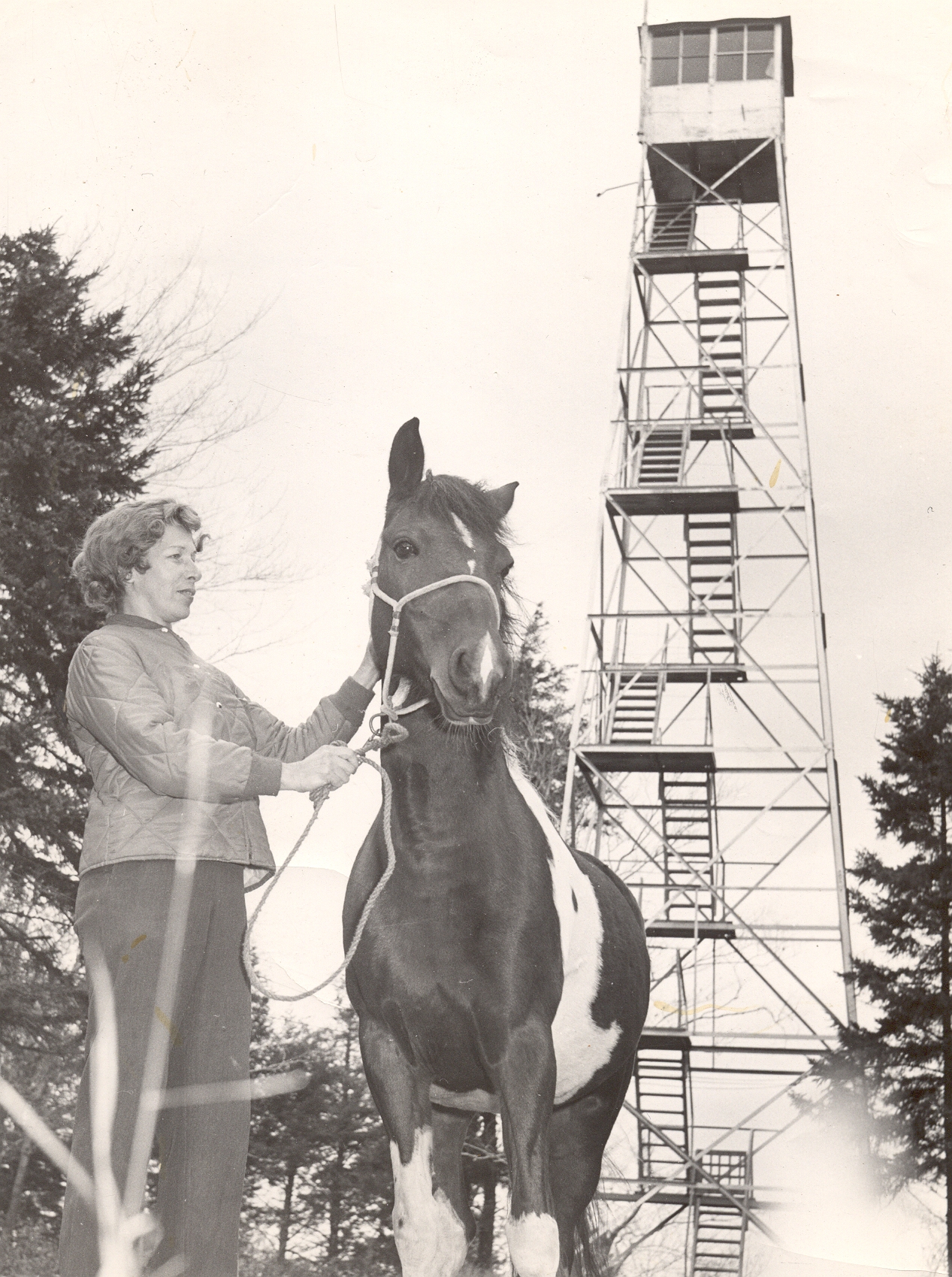
Helen Ellett was one of five women hired to be fire observers at Grafton between 1942 and its closing in 1972. When Ellett was hired in 1943 at age 29, she earned $100 a month, and was a young mother with a daughter. She usually rode one of her horses eight miles to work from where she lived in Grafton. At the tower, she was kept company by her dog, Tippy, and for a short time, her pet raccoon, Soggy.
Tippy and Soggy enjoy a moment.
Helen Ellett and her trusty ride to work.
In 1965, she wrote about her experiences in an article titled “Sitting on Top of the World,” in which she described her initial training by a ranger to use spotting equipment to estimate the location of a potential fire. When she returned to the tower the next day alone and began to climb, she had to “admit the 81 steps seemed like Jacob’s ladder going to heaven … I finally reached the top and tried to open the lock with one hand to hang on with the other; I have never looked but I would not be surprised if my fingers left imprints on the steel railing. That was a long time ago. After a few trips up and down, I didn’t mind at all.”
In her last year of service in the tower in 1965, Ellett reported nine fires and 209 visitors to the towers. At that time, she was earning $122.09 bi-weekly.
After being shuttered for years, the Dickinson Fire Tower was restored by the Friends of Grafton Lakes State Park and reopened in 2012, giving visitors the sweeping vistas that Ellett and other fire observers had. Now a popular hike at the park, the tower was listed on the National Register of Historic Places in 2011 and is the last remaining fire tower in the county.
Helen Ellett, bottom center, helps cut the ribbon at the 2012 reopening of the fire tower to the public.
A visitor takes in the view at the fire tower.
How quickly 50 years have passed since opening day of the beach and park! Grafton Lakes park has now expanded to include more than 2,500 acres, 25 miles of trails, and six lakes, along with a new Welcome Center. The park spans both sides of Route 2 and is a favored place for kayakers, canoeists, and those who like to fish.
Amenities also include biking, boat launches and rentals, equestrian trails, fishing, hunting, pavilions and shelter rentals, playgrounds, and showers, During winter months, there is snowmobiling, snowshoeing and cross-country skiing.
Over the last decade, about a quarter-million people a year annually have visited the park, so over five decades, totaling many millions of visits since 1971.
There is something for everyone at Grafton Lakes, no matter the season. Check out this slideshow below for some ideas…
With so many visitors and so many memories, Parks staff at Grafton is encouraging those who want to participate to come forward and share these tales for posterity in a mini-movie that will debut on the park’s beach the evening July 1st to mark the 50th anniversary. The event that day will also include an art gallery, historical walks, a photo scrapbook, and interpretive panels.
Those who want to visit the Dickinson fire tower will have a chance to meet Linda Laveway, take in the dramatic view, and learn more about her grandmother and the days of the fire observers. Retired, Linda still resides in Grafton and is an active member of the community.
Park staff will hold video interviews for anyone with Grafton memories during April and May. To participate in the oral history project or any 50th anniversary activity, contact the park by email: graftonlakesadmin@parks.ny.gov or phone: 518-279-1155.
You can follow Grafton Lakes State Park on Facebook here. Hope to see you there July 1st as we look back over the last 50 years and make new memories for the years to come!
Cover shot – Kayakers paddle past the beach at Grafton Lakes State Park. All photos by NYS Parks.
Post by Tamara Beal, Environmental Educator, Grafton Lakes State Park
Grafton Lake State Park is holding an event May 1 for I Love My Park Day. Find details here.
Learn more about the history of the Dickinson Fire Tower at Grafton Lakes State Park here..
Bill Bohach often walks the beach as manager of Orient Beach State Park at the wild eastern tip of the North Fork of Long Island, checking for erosion left by powerful ocean storms.
When he saw what had washed up one day in December of this year, along a remote section of beach about a mile from the park’s swimming area, he knew it was special. But there was no way he could have known it was the beginning a Christmas miracle for a family still grieving the loss of a daughter in a drunk-driving accident.
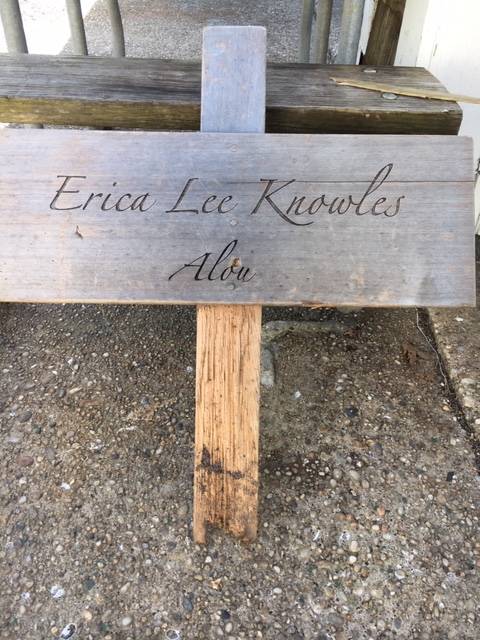
Bohach recognized that the simple wooden sign on a post, which bore the name “Erica Lee Knowles” and the word “Alou” meant something, to someone, somewhere. “The letters had been made with a router, so I knew someone had taken time to make it,” said the 21-year Parks veteran employee.
The weather-beaten memorial sign that Parks Manager Bill Bohach carried off a remote beach at Orient Beach State Park at the eastern tip of Long Island’s North Fork. (Photo Credit- NYS Parks)
So, he picked up the waterlogged sign, carried it the mile back to the park, and took it to the maintenance shop to dry out, placing a note on it warning not to throw it away. Next, came internet sleuthing by Jorge Eusebio, a parks aide, who Googled Erica’s name, and quickly learned of her 2012 death as a passenger in a Rhode Island car crash.
“Once I saw that, it made my mission stronger, to find out whose sign this was,” said Eusebio, who started with Parks in 2017. He located what he thought might be a relative’s name on Facebook, and sent a private message, but got no response. He persisted, locating another name and sending another private message about the sign.
Eusebio had located a cousin to Shiela and John Priore, Erica’s parents, who lived in Georgia, but were heading up to New York for the Christmas holidays in a few days. And Eusebio learned from them that they had placed the sign as a memorial to Erica on Black Point in Narragansett, Rhode Island, a few miles from the accident scene. Black Point is on Block Island Sound about 45 miles east from Orient Beach.
Sometime this year, the memorial had disappeared, apparently the work of vandals who cut the post and discarded it … by throwing it into the sea.
And from there, it had floated, borne by currents and winds, to wash up months later at Orient Beach. The map below shows Orient Beach State Park, on the eastern tip of Long Island’s North Fork (left) and Black Point in Narangansett, Rhode Island (right).
“There are no words to convey how much Bill and Jorge’s act of kindness has meant to us. It was our Christmas miracle,” said Shiela Priore. “Anytime we get to share Erica with this world is a good one. On top of recognizing that the cross meant something but to take the time and effort to search for us leaves me speechless. Our family is forever grateful. We feel as if Bill and Jorge honored her life and her memory.”
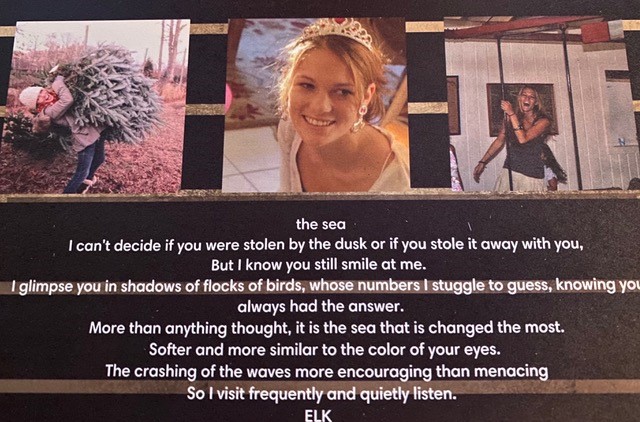
Erica was studying journalism and women’s studies at the University of Rhode Island when she was killed at age 23. The driver in the car she was in was later sentenced to prison time for driving under the influence of alcohol.
Erica L. Knowles (Photo Courtesy of The Priore Family)
Now that the memorial is recovered, Shiela said the family plans to have it placed at a family home on Martha’s Vineyard, a favorite place of their daughter’s where her ashes were spread.
And what of the word “Alou” that is on the sign? “It is how my kids said, `I love you’ when they were small children,” said Shiela.
Both Bill and Jorge recognize their roles in the amazing chain of events against long odds that the memorial would ever again find its way back home to the Priore family. And see the lesson that there is no telling how far a compassionate act might travel.
“I think during these difficult times, this is a message that everyone needs to hear. No matter how it might look, there is still hope,” said Jorge.
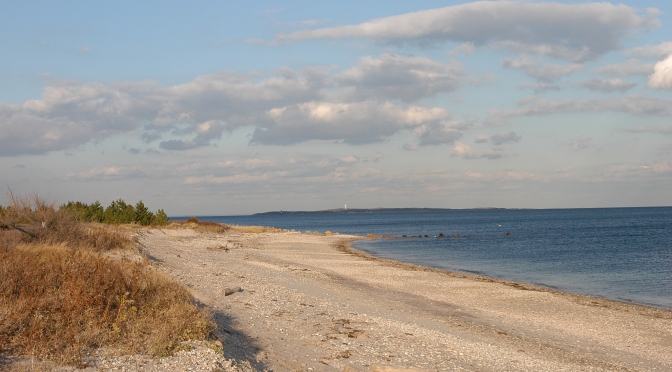
Cover Shot – Beach at Orient Beach State Park (Photo Credit – NYS Parks)
Post by Brian Nearing, Deputy Public Information Officer, NYS Parks.
A poem about the ocean by Erica L. Knowles (Courtesy of The Priore Family)
More About Orient Beach State Park
Orient Beach State Park is a natural wonderland of waterfront with 45,000 feet of frontage on Gardiner’s Bay and a rare maritime forest with red cedar, black-jack oak trees and prickly-pear cactus. Its natural beauty earned designation as a National Natural Landmark in 1980. Other natural attractions in the park include the saltwater marsh and marine wildlife. Great Blue Herons, Egrets, Black Crowned Night Herons, and Osprey are common sights in the park, leading to its recognition as an Audubon Important Bird Area.




















 New York State Parks and Historic Sites Blog