Centuries of holiday traditions to experience. A park that’s only open one season a year. Meteor showers overhead, tracks through the snow, and miles of trails to enjoy in a whole different way.
Winter fun is everywhere at state parks and historic sites! Below are ten activities we suggest you experience this season.
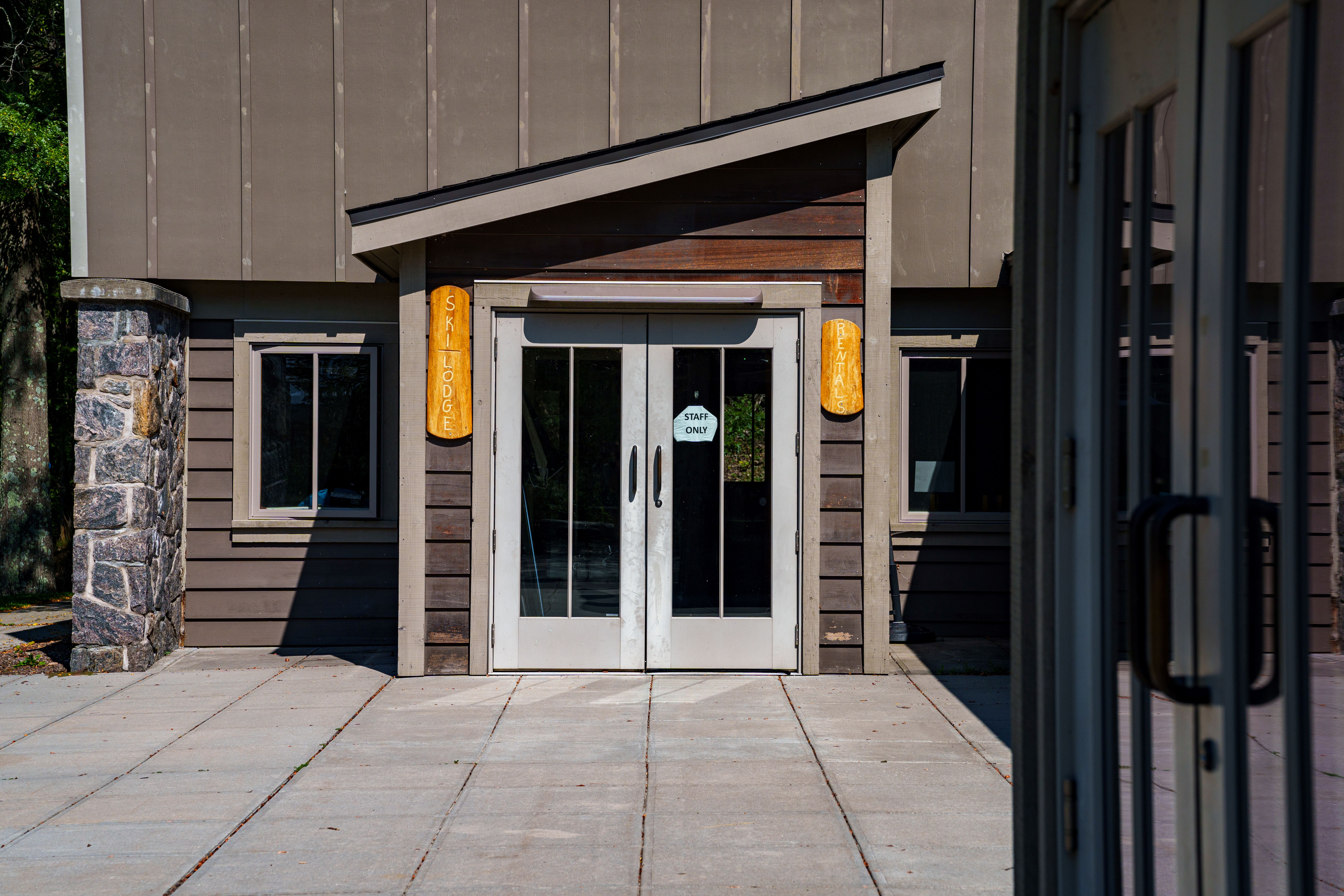
The heart of winter: the ski lodge at Fahnestock Winter Park in the Hudson Valley.
1. Visit Fahnestock Winter Park.Celebrate the spirit of winter at the only park in our system devoted exclusively to the season. At Fahnestock, you’ll discover 20 kilometers of machine-groomed cross-country ski trails, an extensive network of blazed snowshoeing trails, and sledding and tubing. Fuel up at the concession stand and unwind by the fire pit with your fellow winter lovers for the full seasonal experience! No gear? No problem! You can rent equipment for skate and classic skiing, as well as snowshoes, sledding tubes, and tow-behind baby pulks. Check conditions before you go.
Winter doesn’t have to mean being stuck indoors. There’s year-round fun at our parks to help you beat cabin fever, chase away the winter blues, and experience a familiar spot in an entirely new way. Check out these iconic wintertime activities at our parks and sites, but hurry – spring will be here before you know it.
Ice, Ice, Baby
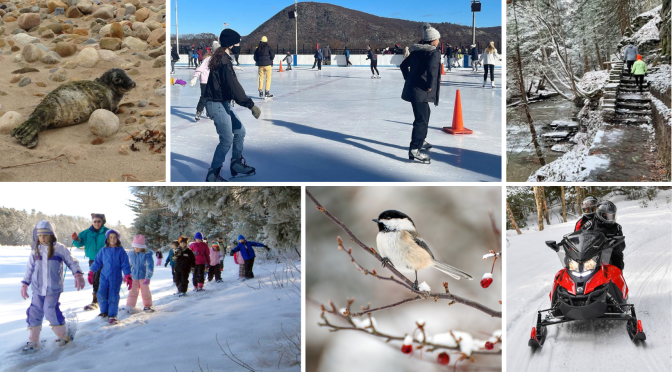
Ice skating is the classic wintertime activity, and our parks offer a safe way to enjoy the ice. From the urban setting of Riverbank State Park to the serenity of Grafton Lakes to the bustling atmosphere and panoramic views at Bear Mountain State Park, ice skating brings joy wherever you do it. This exhilarating experience gets your heart pumping, and is a fantastic winter bonding experience. Twelve of our parks offer skating, and most of them offer skate rentals as well.
New York State is full of incredible trails and activities, and winter is an exciting time to get outside and explore. New views appear when the leaves fall from the trees. The comings and goings of animals are revealed in the snow and mud. Nothing compares to hiking after a snowfall. And the Centennial Challenge winter missions will whet your appetite for an adventure at our parks.
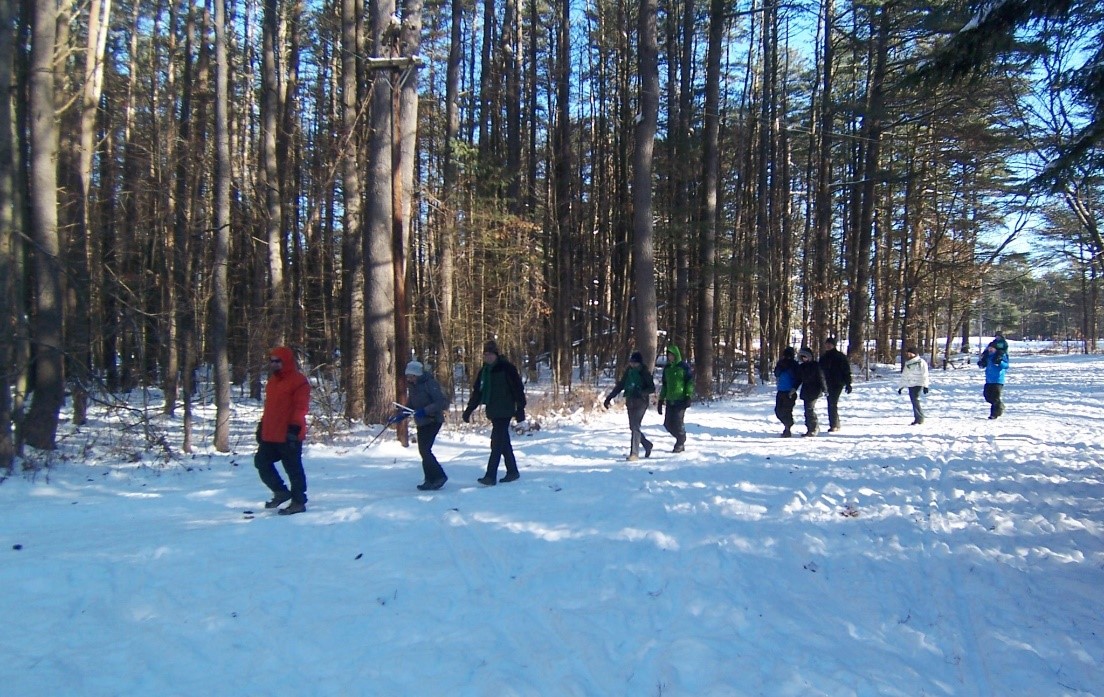
A winter group hike at Saratoga Spa State Park.
Before you discover winter’s grandeur, it’s always important to go out prepared for the season’s conditions. Follow the following tips for a safe time on the trails this winter.
On of my favorite childhood memories was going to an outdoor ice skating rink behind a warehouse in South Glens Falls in Warren County. It was only a field with a large frozen puddle but to me it was amazing. Years later now in my role as manager at Moreau Lake State Park, I wanted to give people near my park the same opportunity.
I started researching ice rinks and how to make them safe but also affordable for the park. While we do have the lake to work with, lake and pond ice usually is bumpy and cracked, thus making stumbles and falls more likely. As I continued researching online, an image of a homemade Zamboni apparatus popped up. Major ice rinks use large Zamboni machines to lay down smooth coats of ice on indoor rinks, but that kind of heavy machinery was not in my budget, so the hand-made model I saw looked like the way to go!
Using a steady flow of warm water to apply a continuous smooth ice surface just like the big machines, a small, human-powered Zamboni was my solution to make lake ice smooth and safe for skaters.
Our two homemade units were created by Aaron Aiken, a staffer at Moreau, who fabricated them after seeing the online photo. It was amazing. Aaron simply gathered all the materials he needed and finished in a day. We had most of the parts needed on hand at the park so there was little to no cost to us.
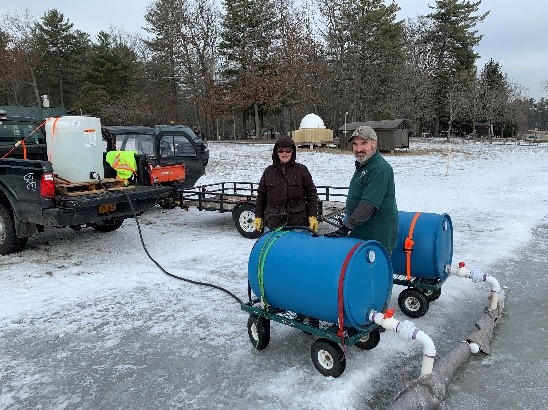
Aaron assembled a 55-gallon poly tank (used to hold the warm water), a 10-foot piece of 2-inch PVC pipe, a 2-inch PVC valve, a 4-foot piece of felt or wool (for trailing the water and flattening it out as smooth ice) and a sturdy wheeled cart. With that and a bit of ingenuity _ presto, a human powered Zamboni machine!
Moreau staffers Donna Fortner (left), and Jay Hauser, load up the Zambonis with warm water before going to lay down ice on the rink.
Zambonis work by slowly drizzling out warm water over the surface of existing ice. The warm water melts all the high spots and fills in all the lows before freezing to create a perfectly smooth surface perfect for skating. The operator judges how fast they want water to come out by adjusting the flow with the valve.
At Moreau, our crew pulls a Zamboni around the rink three times before it runs out of water, and then the other Zamboni takes its place. It is important to have two setups because ridges can form in the ice if you stop putting down warm water even for an instant. To create a smooth rink, it took about 110 gallons of water, applied by two Zambonis over six laps, for a total of about an hour of work.
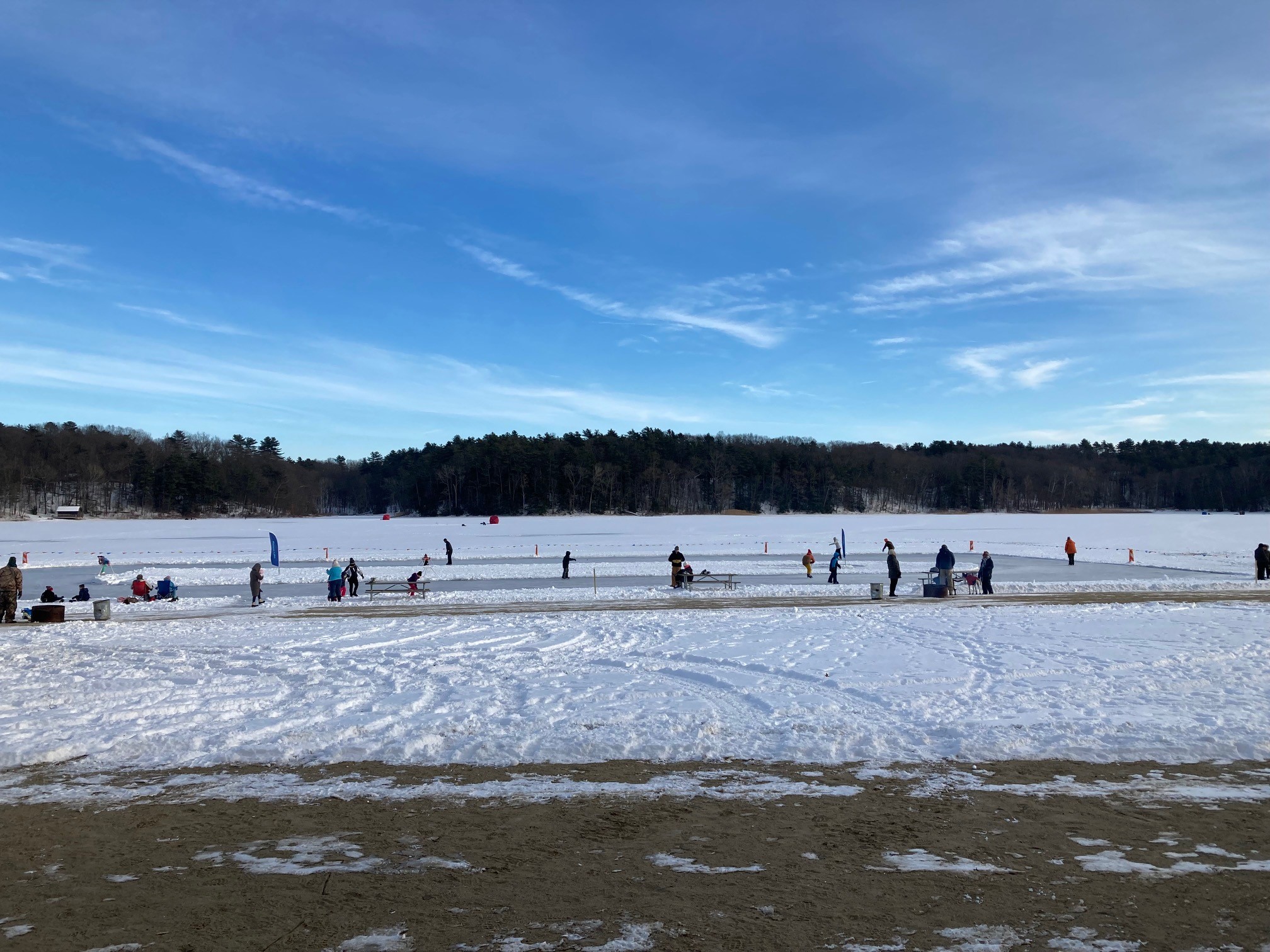
Measuring 250 feet by 100 feet, the outdoor skating rink at Moreau Lake State Park welcomes skaters!The Park has free loaner skates.
Another service that Moreau Lake State Park provides to visitors is the Daily Ice Report. Parks staffers measure the thickness of the ice starting a day after rink ice is laid on, meaning when the ice totally covers the surface of the lake, we wait a day and then start the ice thickness report. Two staff members start at shore with an ice auger and drill through the ice and measure the thickness. If it is under 3 inches they stop at that hole. If it is over 4 inches, they move out 20 feet and drill another hole. They follow the same procedures until it is determined that the average thickness (average readings taken from multiple places on the lake) is at least 6 inches.
When that happens, the lake is opened to skaters, pedestrians and ice fishermen. These ice reports are published over social media every day at 8:00 a.m. until the ice is safe and then these reports are replaced by the open one.
All this comes together to make the lake a safe and enjoyable place to recreate in the winter. At our rink, located just off the beach, a campfire is usually going nearby so skaters can warm themselves. So grab your skates (or borrow ours) and give us a visit!
Cover shot – Moreau staffer Jay Hauser (foreground) pulls a homemade Zamboni around the skating rink at Moreau Lake State Park, as fellow staffer Donna Fortner comes along behind with the second Zamboni . All images NYS Parks unless otherwise noted.
Post by Al LaFountain, Park Manager, Moreau Lake State Park and Grant Cottage State Historic Site
More about Moreau Lake State Park
Covering some 6,250 acres in Saratoga County, Moreau Lake State Park features hardwood forests, pine stands, and rocky ridges. More than 30 miles of hiking trails are available, and can be used for snowshoeing and cross-country skiing in winter. Snowshoe rentals are available.
Last year, Governor Kathy Hochul announced an 860-acre expansion of this park to include spectacular natural habitat along an undeveloped stretch of the Hudson River that will be known as Big Bend Point. This acquisition makes Moreau Lake State Park one of the ten largest parks in the state park system.
Resources
Learn about a Gilded Age ice skater who helped promote figure skating for women from this previous blog post by the curator at Staatsburgh State Historic Site.
Staatsburgh State Historic Site, formerly the Gilded Age estate of the very wealthy and socially-prominent Ruth Livingston Mills and her husband, financier and philanthropist Ogden Mills, sits along the eastern bank of the Hudson River in the mid-Hudson Valley. Commanding a view of the river and the Catskill Mountains, the estate’s Beaux-Arts mansion was once…
A hand-operated Zamboni machine is on display at the Original Hockey Hall of Fame in Museum, in Kingston, Ontario, where it is also described as a “hand flooder.” (Photo credit – Wikipedia Commons)
“Skating is in my heart, not my head.” – Olympic Medalist Michelle Kwan
If you were told there could be volcanoes along the shore of Lake Erie in winter, would you believe it? While it may be hard to imagine, Lake Erie does in fact produce volcanoes and Evangola State Park can be one of the best places to see them!
Unlike traditional volcanoes, the ones found at Evangola State Park are not made of rock and magma, but rather water and ice. Ice volcanoes are a temporary outcome of a partially frozen lake. When ice begins to form on the water’s surface, powerful winds push large waves towards the shore. As they do, the water is sandwiched between the shore and the ice, creating a buildup of pressure.
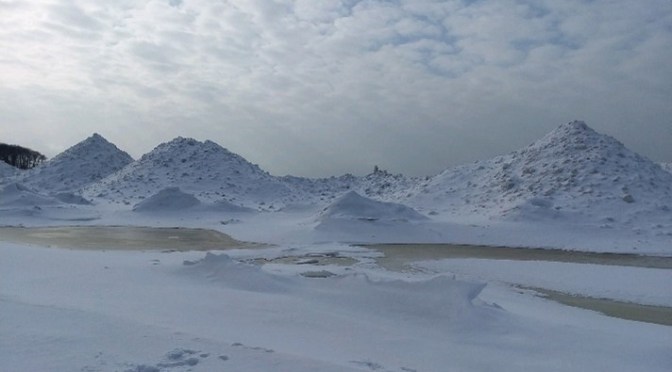
A gap in shelf ice allows for potential formation of an ice volcano.
Eventually with nowhere else to go, this pressure causes the water to burst through cracks in the ice. The resulting spray from this burst, freezes on the ice surface, accumulating in the shape of a cone with an open, unfrozen center. With each successive wave, plumes of water erupt from the newly formed ice volcano, building this winter wonder to potential heights of 20-plus feet! Occasionally the ice may build up in the shape of a cone, but without an open center. These rolling hills of ice become so called ice-dunes.
While Lake Erie is one of the best locations to see ice volcanoes, Lakes Ontario, Michigan, and Superior can also produce these icy cones when conditions are right. For example, such volcanoes have also recently formed during the cold snap at Hamlin Beach State Park in Monroe County and Fair Haven Beach State Park in Cayuga County.
Ice Volcano at Hamlin Beach State Park in February 2022. (Photo Credit – Friends of Hamlin Beach State Park/Denise Bianrosa Duffy)
Further from home but to the excitement of many, in 2021 a 45-foot tall ice volcano formed in southeastern Kazakhstan as water from a hot spring gushed through a thick layer of ice, creating a massive volcano for all to enjoy.
But also, to be clear, the shelf ice on a lake where these structures form can be extremely unsafe and people are strongly advised against venturing out on it to get closer to ice volcanoes.
Confine sightseeing to the shoreline or stick with a guided tour by a trained Parks naturalist. One such hike is scheduled for Feb. 8 at Evangola State Park. Check with the park to learn if the volcanoes have formed.
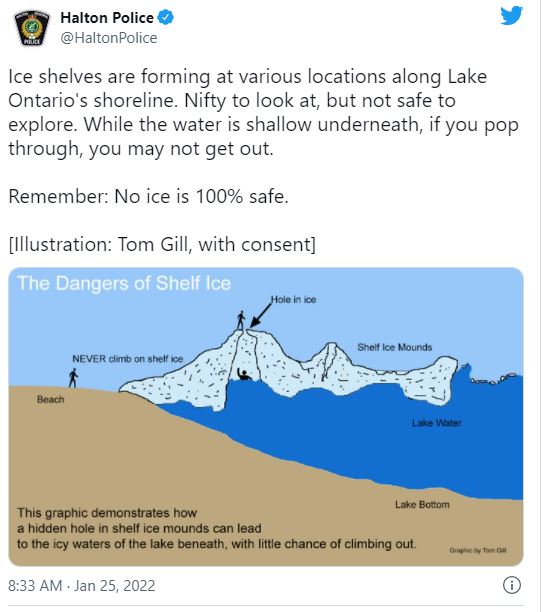
As a recent warning from the police department in Halton, Ontario, describes, if someone falls through shelf ice or down the opening of an ice volcano into the lake water below, it can be nearly impossible to get out even if aid is nearby. Cold lake water can quickly induce hypothermia, which can lead to death.
This graphic below illustrates the danger:
A shoreline guided tour past ice volcanoes at Evangola State Park. Remember, DO NOT venture out on shelf ice or approach an ice volcano. It is EXTREMELY DANGEROUS with the potential for falling into the lake water below with little chance of getting out.
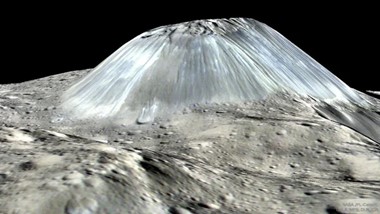
Leaving earthly risk behind for a moment, scientists have even been able to detect ice volcanoes from several planets and moons deep in space. Typically called cryovolcanoes, these are defined as volcanoes that erupt with ice, water, or other materials such as methane and ammonia. In 2010, NASA’s Cassini spacecraft found possible ice volcanoes on Saturn’s moon Titan and in 2016 images from the Dawn space probe revealed dozens of ancient ice volcanoes on the dwarf planet Ceres
Ahuna Mons, an ice volcano on the dwarf planet Ceres, as seen by NASA’s Dawn spacecraft. (Photo Credit – NASA, JPL-Caltech, UCLA, MPS, DLR and IDA
Back on earth, favorable conditions for ice volcano formation here in New York haven’t been consistent in recent years. Warmer winters have resulted in less ice on all the Great Lakes. In 2021, the National Oceanic and Atmospheric Administration reported that only 2.4 percent of the Great Lakes surface was covered by ice in late January, the smallest amount in nearly 50 years. It was also noted that it was ninth-warmest January on record. While strong waves are needed to form ice volcanoes, strong waves with warmer temperatures will result in their destruction or prevent them from forming at all.
Despite our changing climate, ice volcanoes can still be a common occurrence during the winter months. The biggest change is in their longevity. For example, in the past several years, ice volcanoes at Evangola State Park have only lasted a few weeks or even just a few days after forming, as sudden warm spells take hold and break them apart.
For your best chance to experience ice volcanoes, be sure to keep a close watch on your local weather forecast and head towards the lake shore after a push of cold artic air passes through. To add to the adventure of enjoying these frozen phenomena, our team of environmental educators offer guided hikes all winter long, sharing what makes our Great Lakes environment so unique.
An ice volcano “erupts” (on left) at Fair Haven Beach State Park on Lake Ontario. Photo credit – Caroline Lamie, Office Manager/Senior Researcher/Tour & Event Coordinator, Fort Ontario State Historic Site
Cover shot – Ice Volcanoes in 2021 at Evangola State Park. All photos NYS Parks unless otherwise noted.
Post by Matt Nusstein, Environmental Educator, Niagara Region NYS Parks
Along the shores of Lake Erie, Evangola State Park becomes a winter sports mecca as the lake’s famous lake-effect snowstorms blanket the park! Lake-effect snow occurs when cold, Canadian air moves across Lake Erie evaporating its open waters and causing intense, local snow bands which can drop one to two inches of snow per hour.…
Getting cabin fever? Well, bundle up and take a trip to a beach-front state park! Lake Ontario, Lake Erie, Lake Champlain, Long Island parks or the many parks on small lakes: Glimmerglass, Green Lakes, Long Point-Chatauqua Lake, Allegany, or many others. This is the time to explore the many interesting patterns and colors of wintertime…














 New York State Parks and Historic Sites Blog