Solar Power Keeps Growing in State Parks

While there aren’t public events in State Parks this week to mark the 50th anniversary of Earth Day on Wednesday, some of our facilities are still helping the planet every day in the fight against man-made climate change.

Each year, Parks use more than 50 million kilowatt hours (kWh) of electricity to power some 5,000 buildings, including offices, comfort stations, maintenance barns, nature and visitor centers, cabins, historic sites, and other unique facilities like golf courses and pools.

To feed more renewable power into the grid and reduce its demand for fossil fuel-fired electricity, Parks has been installing photovoltaic (PV) solar arrays since 2012. There are now 32 arrays in place, with more expected this year in the Hudson Valley and Long Island regions.

The rooftop solar array at Hallock State Park Preserve on Long Island.

Once the new arrays are completed this year, State Parks will be covering 15 percent of its total statewide energy consumption through solar power, up from the current 4 percent.

These new arrays will offset all the power demand in the Park’s Taconic Region on the eastern side of the Hudson River, which includes 14 parks and eight historic sites in Columbia, Dutchess, Putnam and Westchester counties.

Adding solar power – which unlike natural gas or other fossil fuels does not produce the greenhouse gases that are driving man-made climate change – also saves Parks money on its utility bills. Each year, solar arrays are trimming nearly $340,000 from what Parks would otherwise pay for its electricity!

To perform this work, which both fights climate change and saves money, Parks have trained 100 staff members to design and install our solar arrays.

Parks selects locations for PV arrays that will not disturb natural areas of the park or areas of recreation. They are often installed on rooftops, the back of parking lots, or in other areas that have previously been disturbed.

Parks also applies for financial rebates from the New York State Energy Research and Development Authority (NYERDA) to lower the cost of each project, with savings then reinvested to fund future PV projects. Parks also coordinates with private utility companies to connect its arrays to the grid.

Due to such efforts, three Parks are now electric-energy neutral facilities, and produce enough power for the grid to cover what the consume: Robert Moses State Park, Captree State Park (both on Long Island) and Allan H. Treman State Marine Park in Ithaca in the Finger Lakes. Additionally, Parks has an off-grid PV facility that provides power directly to Bennington Battlefield State Historic Site.

Completed in 2017, Robert Moses State Park made history as being the largest PV installation built by state employees _ its 2,432 American-made panels cover the length of two football fields! This array generates about 950,000 kWh annually, saving more than $100,000 in electricity bills. (For comparison’s sake, the average household in New York State uses about 8,000 kWh annually, according to the U.S. Energy Information Administration).

Solar power made made Robert Moses the first electric energy neutral state park of its size in the country. The array even covers the energy usage of Captree State Park which makes it the second electric energy neutral state park.

Parks also funded, developed, built and managed the first PV installation on the roof of a building listed on the National Historic Register at Peebles Island State Park, headquarters of the Bureau of Historic Sites and Bureau of Historic Preservation Field Service.
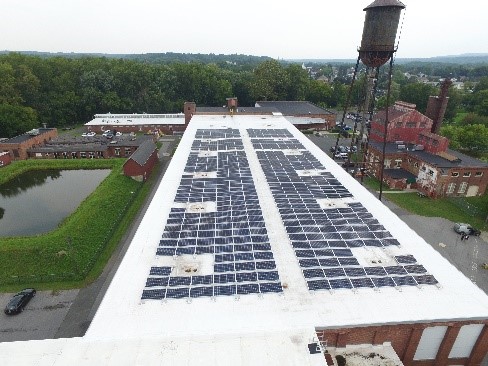
The rooftop array at Peebles Island State Park.

The 450 panels installed on the roof of Peebles’ historic Bleachery Building are projected to generate more than 188,000 kWh and save about $22,500 in utility bills annually. The array covers approximately 30 percent of the building’s energy use. The array at Peebles Island is also used a training location for students from  Hudson Valley Community College and the Glenmont Job Corps.
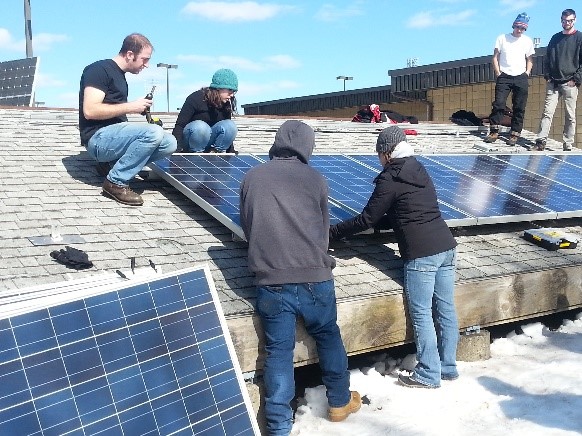
Students from Hudson Valley Community College receive training at the solar array at Peebles Island State Park.

And there will be much more to come. State Parks intends to aggressively increase its solar footprint in order to cover half of its statewide electrical consumption by 2025.

From our smallest arrays to our largest arrays, each PV installation is working to create a greener state parks system every day and for many Earth Days to come!


Cover Photo- Robert Moses State Park solar array. All photos by NYS Parks.

By Caity Tremblay, Parks Energy and Sustainability Bureau

Drawing Today’s History to the Page

For decades, comics have been a gateway into the world of reading for many children. During today’s challenging times, creating personal comics can also help young people chronicle their unique view of the history-making COVID-19 pandemic, according to an artist who also helps students discover history at the Clermont State Historic Site.

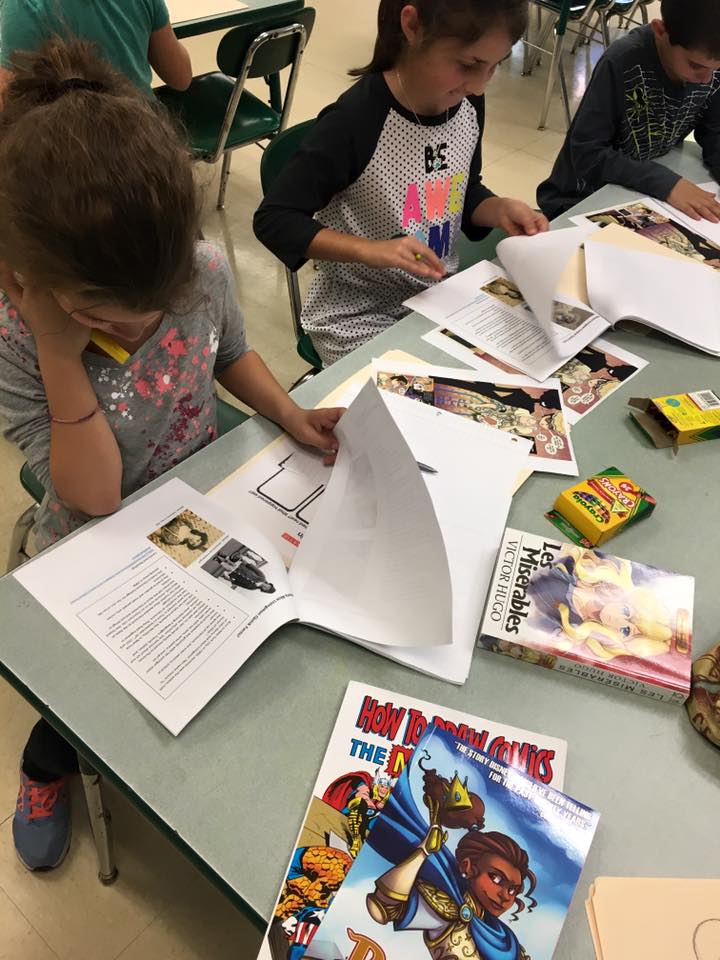
In 2016, Emily Robinson, a professional comic artist and the site’s School Programs Coordinator and Camp Director, founded History Comics Club, a unique program that connects underserved youth with their local history, builds an interest in art and writing, and helps create a sense of place at our historic site for students and their families in the community. Each student learns to draw their own comic while learning about the history of the Livingston Family.

Seven successive generations of the family left their imprint on the site’s architecture, room interiors and landscape. Robert R. Livingston, Jr. was Clermont’s most notable resident. His accomplishments include drafting the Declaration of Independence, serving as first U.S. Minister of Foreign Affairs, administering the oath of office to George Washington, negotiating the Louisiana Purchase and developing steamboat technology with Robert Fulton.

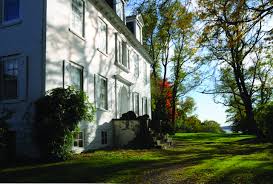
Clermont State Historic Site, which remains closed to the public during the COVID-19 pandemic. (Photo Credit: Friends of Clermont)

Thanks to funding from Friends of Clermont, History Comics Club has provided the program to more than 1,000 students from age 7 to 17, resulting in the program’s publication of five books of their collected comic art and prose.

“Drawing requires the students to look at the history represented at Clermont, from clothing and how homes looked, to pets that lived on the estate,” said Robinson. 

As part of her work to help introduce students to Clermont’s history, she created a series of comics from the point of view of the family dog, Punchy, who gives a “tour” of the mansion in his own inimitable way. View some of it here

Punchy the dog makes an appearance at the Hudson Children’s Book Festival in 2018 to introduce visitors to the history of Clermont.

During the pandemic, families are sheltering at home, and many children might feel anxious over what the future might hold. Art can be a powerful way of processing that anxiety and interpreting ongoing events through their eyes as part of a historical record.

“Art can be a great healer,” said Robinson. “It doesn’t matter how well you draw or write, it’s about being creative and conveying information.”

Emily Robinson’s comic version of herself urging students to consider creating their personal comic or other record of their experiences during the COVID-19 pandemic.

As a child grows older, each piece of art will provide a window into their younger years, said Robinson, who recalled being in fifth grade during the September 11th terrorist attacks.

“I remember the confusion of those early days, and how my own teacher used art as a creative outlet,” she said. “I struggled writing the script for the COVID-19 comic, because I wanted to address kids in a way that wasn’t patronizing but didn’t scare them. They’re already stressed out; art should be a welcome window to self-expression.” Robinson continued, “I hope kids will feel pride that their artwork could help inform future historians’ understanding of life during the pandemic.” 

It does not take many supplies to start creating comics at home, a drawing pad and something to draw with. Robinson suggested that students may start with a basic sketch book, which includes stencils and general information on how to draw expressions and symbols. But almost any kind of white paper, like computer printer paper, will do.

During the last four years, Robinson has taken the program to the Hudson City School District, Germantown Central School District, Rhinebeck Central School District, and the Starr Library in Rhinebeck, as well as the Hudson Valley Writers’ Project in New Paltz. She also has presented on the program at the Hudson Children’s Book Festival and in 2018 hosted a panel at Comic Con in New York City.

Clermont’s Historic Site Manager, Susan Boudreau, is extremely proud of the program and what it offers to area children: “As I’ve seen over the life of the program, the art of making comics can make a great impact on the lives of our students. No student needs to have any artistic experience to participate, and some find that they are quite talented, which is so empowering. The openness of the comic genre encourages students to explore their own identities, fears, hopes, and dreams, which is a wonderful gift in these uncertain times.”

Emily Robinson, under her pen name Emily Ree, is best known for her young adult graphic novels, Anarchy Dreamers and Marshmallow Horns. You can see more of her work on her websites, EmilyRee.com and AnarchyDreamers..com.


Cover Photo: Emily Robinson’s comic representation of herself wearing a protective mask. All photos from New York State Parks.

By Brian Nearing, Deputy Public Information Officer, New York State Parks

Keep Your Nature Break Local at State Parks …

During the COVID-19 pandemic, it is important to keep in mind that we should be recreating locally, meaning as close to home as possible. That does not mean long drives to well-known State Parks that might draw crowds, something that has been happening recently in some popular sites.

Parks facilities are spread across 11 regions that span the state, so many people need not travel far to find a trail. To learn more about your region and its facilities, click here.


And there are also other ways to reduce stress while sheltering in place at home. New York has partnered with Headspace to offer some helpful techniques that can be done at home. Learn more here about this collection of meditation, sleep and movement exercises .

To help keep parks open and safe, consider taking this online pledge from Parks & Trails New York:

I pledge to:

☑ Avoid crowded areas: if a park or trail is crowded, be ready to change plans. Also, steer clear of places people tend to congregate: parking lots, playgrounds, picnic areas, overlooks.

☑ Practice social distancing: stay 6 feet away from individuals outside of immediate household members

☑ Stay local: recreate close to home and keep visits short

And, of course, if you’re not feeling well or have any COVID-19 symptoms, please STAY HOME.

If you must go out, heed this advice from State Parks and the Department of Environmental Conservation :

·       Stay local and keep visits short. Visit in small groups limited to immediate household members;

·       Maintain distance from others while in places where people tend to congregate, such as parking lots, trailheads, and scenic overlooks;

·       Avoid games and activities that require close contact, such as basketball, football, or soccer;

·       Avoid playground equipment like slides and swings and other frequently touched surfaces;

·       Do not share equipment, such as bicycles, helmets, balls, or Frisbees;

·       If you arrive at a park and crowds are forming, choose a different park, a different trail, or return another time/day to visit; and

·       If parking lots are full, please do not park along roadsides or other undesignated areas. To protect your safety and that of others, please choose a different area to visit, or return another time or day when parking is available.

As with all hikes, there are few things to remember beyond carrying a mobile phone. Wear sturdy yet comfortable shoes or boots, bring water and snacks, and perhaps carry a camera, to capture what you see. Be mindful of hikes on steep terrain or that go near cliff tops. Having a small first-aid kit available in case of emergency is never a bad idea.

Hiking poles are useful, and can transfer some of the stress of hiking from your knees and legs to your arms and back. And use a trail map, which is available park website at https://parks.ny.gov/ Check the park’s individual website to see if its maps can be downloaded to your iOS Apple or Android device.

For some facilities, data is available as a Google Earth KML file or a map is available to download to your iOS Apple and Android mobile devices in the free PDF-Maps app. Learn more

It is important to know how long a trail is and how long it ought to take to finish. Since daylight is not an unlimited resource, tossing a flashlight or headlamp into your backpack is a good form of insurance, should you unexpectedly find yourself on the trail as dusk approaches. Parks staffers are stretched thin during the pandemic and this is not an ideal time to be in need of a nighttime rescue.

COVID-19 UPDATE

State Parks encourages New Yorkers to recreate locally, practice social distancing, and use common sense to protect themselves and others. Getting outdoors to walk, jog, hike, ride a bike, or visit a park or state lands is a healthy way to stay active, spend time with your immediate household family members, and reduce stress and anxiety while practicing social distancing. While indoor spaces and restrooms at State Park facilities may be closed to prevent community spread of COVID-19, parks, grounds, forests and trails are open during daylight hours, seven days a week.

For the safety of all visitors, all State Park playgrounds, athletic courts and sport fields are closed. Visitors are asked to #recreatelocal, choose parks that are close to their home and follow CDC/NYSDOH’s guidelines for preventing the spread of colds, flu and COVID-19. We appreciate your support and patience as we navigate this public health crisis together. Learn more about COVID-19 and its impact on NY State Parks. Visit: COVID-19 UPDATE

Parking Limitations in Effect:To encourage physical social distancing at popular parks, trailheads and scenic areas, State Parks may reduce the number of available parking spaces on high visitation days. Have a plan ready to visit a different park or another park area. 

Early Season Camping and Pavilion/Shelters: Due to the global health crisis, all campgrounds, cabins, cottages, and pavilions/shelters are CLOSED to visitation through April 30. All visitors with reservations will be issued a full refund. We ask for your patience as refunds are processed. 

Camping Reservations & Pavilion/Shelter Reservations: New York State has suspended all new camping, cabin and cottage and pavilion/shelter reservations for the 2020 season until further notice. We are assessing campground and pavilion status on a daily basis. If you’ve made a reservation for the season beginning May 1, and we determine your facility is safe to open, your reservation will be honored. However, visitors who wish to cancel an existing reservation may do so and receive a full refund. Thank you for your patience as we work to protect the safety of our visitors and staff.


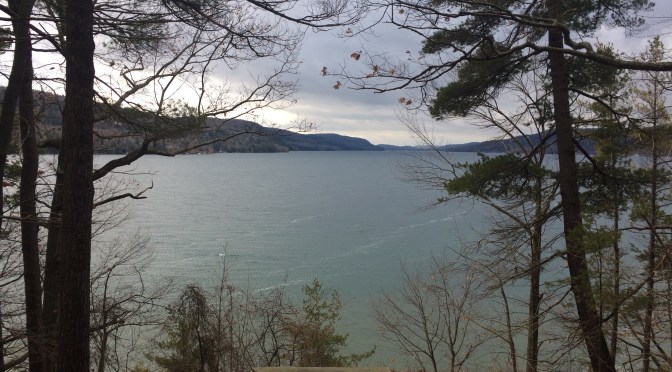
Cover shot: Otsego Lake at Glimmerglass State Park.

By Brian Nearing, Deputy Public Information Officer, NYS Parks

Spotted Turtles on the Move For Spring!

While we must stay put this season to help protect ourselves and those we love, other creatures here in New York are making their seasonal spring migrations.

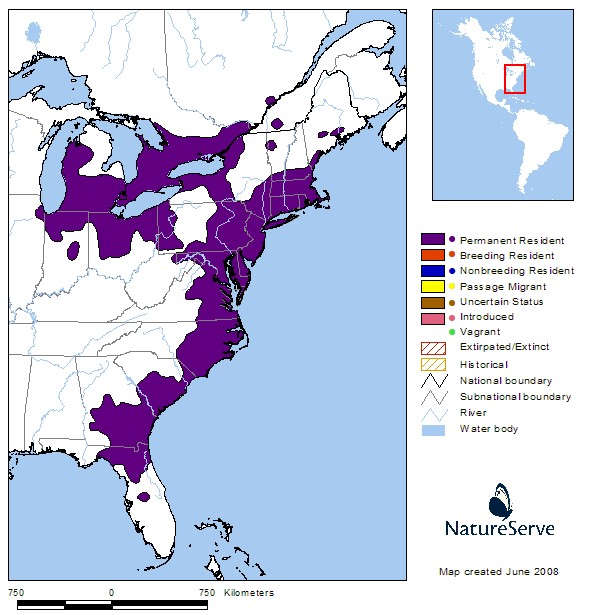
Among those are spotted turtles. These small, attractive reptiles can be found throughout much of New York in the Hudson Valley, on Long Island, and in the plains of western and central New York. They generally emerge from their winter hideaways in March or early April (Gibbs et al. 2007).

Spotted turtles (Clemmys guttata) are more tolerant of cold water and are one of the first aquatic turtles to become active; you might see them basking throughout winter depending on temperatures. Early spring is the best time of the year to spot these turtles. There is ample food with salamanders and frogs laying their eggs in vernal pools (Beaudry et al. 2009). They will also eat aquatic insects and other invertebrates such as slugs, worms, and snails (Gibbs et al. 2007). When looking for turtles, keep an eye out for them basking in small pools, marshes, and other wetlands on rocks, logs, and along the shoreline.

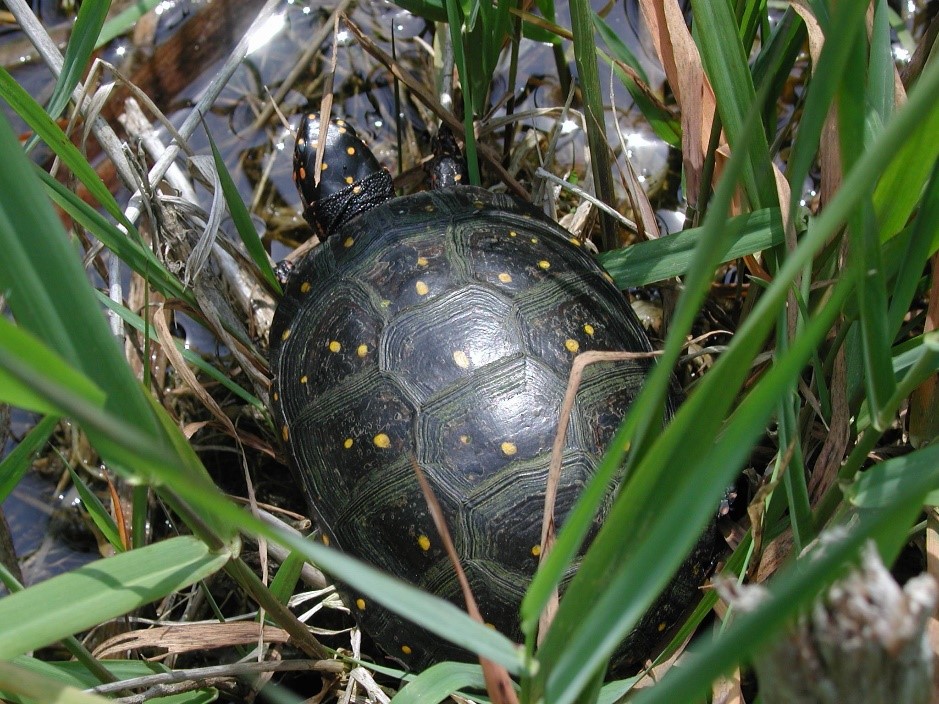
The reason these turtles are called spotted turtles is obvious when you see one – the black carapace (upper shell) and skin are covered in small, round yellow dots. This color pattern could reduce the turtle’s likelihood of capture since it resembles the floating duckweed present in many frequently used habitats. This camouflaging pattern makes it difficult to find spotted turtles when they are in the water.

Spotted turtles are thought to be declining throughout their range, and there are several threats that may be contributing to the decline. These turtles can experience high mortality from crossing roads as they move between wetlands during the spring and in search of nesting and upland summer locations.  (Beaudry et al. 2009, Ernst and Lovich 2009).

Nesting female mortality is especially bad for spotted turtle populations, since it can take 10-15 years before a female is old enough to reproduce.

Spotted turtles can live over 40 years, so once a female reaches reproductive age it has many years of egg laying ahead. Turtle eggs and juveniles have a high mortality rate, so it is important to keep these older females around to keep producing eggs, only a small fraction of which will reach adulthood.

A spotted turtle shows its distinctive yellow markings. (Photo Credit- Jesse W. Jaycox)
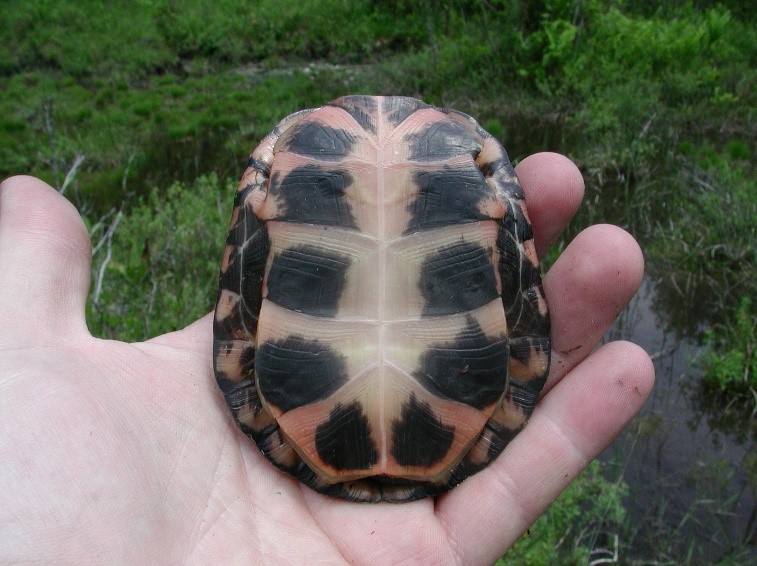
The bottom shell, or plastron, l of a spotted turtle. (Photo Credit- Jesse W. Jaycox)

One important habitat requirement of spotted turtles is relatively shallow, clear, and clean water with a soft, muddy bottom (Gibbs et al. 2007, Ernst and Lovich 2009). They will spend most of the spring within these wetland habitats, until females travel to find a nesting site in early June.

Spotted turtles will practice estivation, a period of dormancy during high temperatures, by retreating into the muck at the bottom of wetlands, into muskrat burrows, or under vegetation in the surrounding uplands during the warm summer months when many wetlands are drying up (Gibbs et al. 2007, Ernst and Lovich 2009, Joyal et al. 2001, Milam and Melvin 2001).

Learn about the distribution of spotted turtles at Nature Serve.

Other threats spotted turtles face are collection for the pet trade, habitat loss and fragmentation, invasive plants, and predators (Ernst and Lovich 2009, NYSDEC 2020). Spotted turtles are a target for the commercial pet trade (CITES 2013) due to their small size and attractive coloring.

Habitat loss and invasive plants encroaching on wetland habitats can reduce the amount of suitable habitat these turtles have available to use throughout the year. They need upland buffers around wetland habitats for nesting, movement between wetlands, and summer estivation (Milam and Melvin 2001), and these habitats are frequently fragmented by development and roads.

What can you do to help protect these cryptic little turtles? If you are lucky enough to catch a glimpse of a spotted turtle in the wild, admire it from afar and leave it undisturbed. All native species of turtles in New York are protected and cannot be collected without a permit.

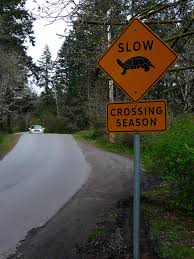
If you happen to see one crossing the road, pull over in a safe place and help it along. Make sure to move the turtle to the side of the road that it was facing, otherwise it will just turn around and cross the road again!

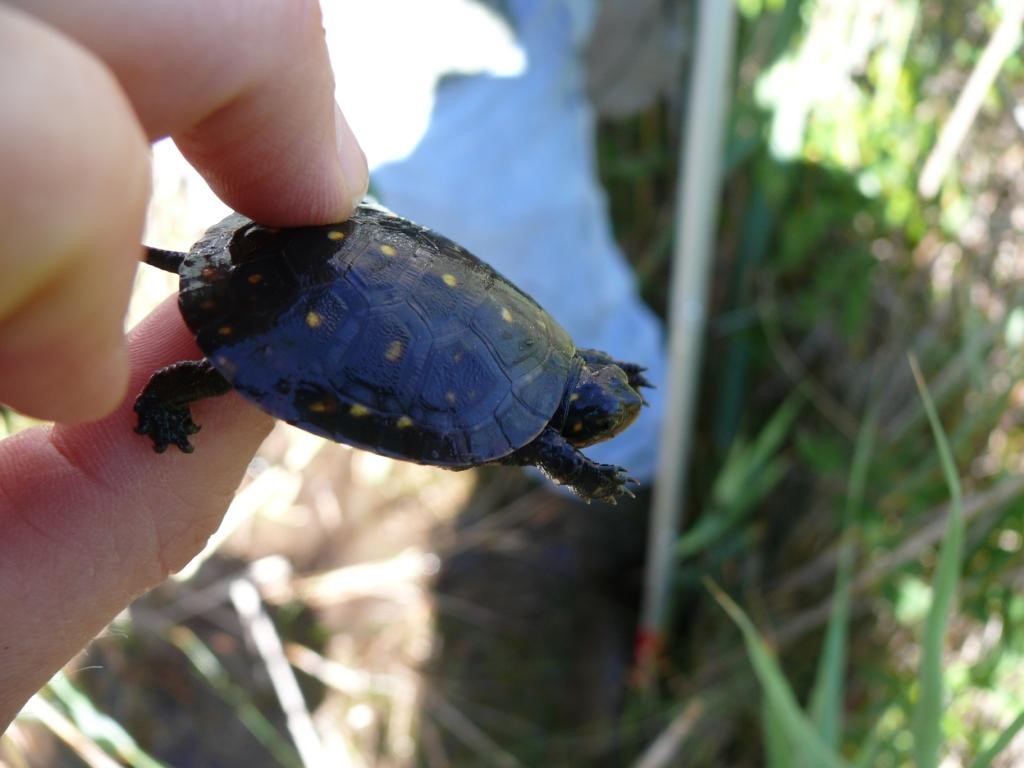
A researcher holds a juvenile spotted turtle. (Photo Credit- Matthew D. Schlesinger)

Cover Photo- Wikipedia Commons

Post by Ashley Ballou, Zoologist, NY Natural Heritage Program

References

https://www.dec.ny.gov/animals/44388.html

https://guides.nynhp.org/spotted-turtle/

Ernst. C. H., and J. E. Lovich. 2009. Turtles of the United States and Canada. Second edition, revised and updated. Johns Hopkins University Press, Baltimore, Maryland. xii + 827 pp.

Beaudry, Frederic, Phillip G. deMaynadier, and Malcolm L. Hunter Jr. 2009. Seasonally dynamic habitat use by spotted (Clemmys guttata) and Blanding’s turtles (Emydoidea blandingii) in Maine. Journal of Herpetology 43:636-645.

Gibbs, J.P., A.R. Breisch, P.K. Ducey, G. Johnson, J.L. Behler, and R.C. Bothner. 2007. The amphibians and reptiles of New York State. Oxford University Press, NY.

Joyal, Lisa A., Mark McCollough, and Malcolm L. Hunter Jr. 2001. Landscape ecology approaches to wetlands species conservation: A case study of two turtle species in souther Maine. Conservation Biology. 15(6): 1755-1762.

Milam, J. C., and S. M. Melvin. 2001. Density, habitat use, movements, and conservation of spotted turtles (Clemmys guttata) in Massachusetts. Journal of Herpetology 35:418-427.

New York State Department of Environmental Conservation. 2020. Spotted turtle fact sheet. Available https://www.dec.ny.gov/animals/7150.html. (Data accessed March 2020).

Waterfalls Herald Spring’s arrival

So much has changed in recent days as all of us in New York deal with the COVID-19 pandemic, But natural cycles are still continuing to mark the arrival of spring.

One of those cycles is the freshet – a term used to describe a thaw from snow and ice melt that then feeds a surge of fresh water into rivers and streams. Too large a freshet can cause spring flooding.

While much of the snow in New York is now gone, there is still snowpack remaining in the high country from the recent storm that will feed the freshet in the coming days. And while that surge is thankfully too small to cause flooding, it does mean that is a great time to see some of the beautiful waterfalls found in New York State Parks.

Use this map to locate a State Park with a waterfall.

In the eastern North America, annual freshets occur from the Canadian Taiga ranging along both sides of the Great Lakes, continuing through the heavily forested Appalachian mountain chain and St. Lawrence valley from northern Maine into barrier ranges in North Carolina and Tennessee.

In the western part of the continent, freshets occur throughout higher elevations of various west coast mountain ranges that extend southward down from Alaska as far as the northern reaches of Arizona and New Mexico.

This previous post from the NYS Parks Blog describes each waterfall in detail:

Fall in Love with New York State Parks’ Waterfalls

Did you know that Niagara Falls State Park is the oldest state park in the United States? Established in 1885 as Niagara Reservation, the breath-taking waterfalls at this park are considered some of America’s greatest natural wonders. Did you also know that the American Falls at Niagara Falls State Park, at around 100 feet tall,…


By Brian Nearing, Deputy Public Information Officer, New York State Parks.

The official blog for the New York State Office of Parks, Recreation & Historic Preservation