One fish, two fish, small fish, big fish: The recent story of fish in Lake Minnewaska

Big fish eat smaller fish, smaller fish eat zooplankton, zooplankton eat phytoplankton, and phytoplankton produce their own food. If smaller fish eat all of the zooplankton, what’s to stop the phytoplankton from multiplying out of control? If the big fish eat all of the smaller fish, will the big fish still be able to sustain their population? Whenever an organism is added to or taken away from an ecosystem, it acts like a pebble thrown into a pond. There’s the initial splash, then there are ripples that radiate outward affecting everything in their path.

In 2008, a “pebble” was thrown into Lake Minnewaska. This pebble was a type of minnow called a Golden Shiner.  Exactly how the Golden Shiners entered the lake is not certain, however they are a common bait fish so it is  possible that they were introduced to Lake Minnewaska by someone who was hoping to hook the catch of the day! If that was the case, the odds would have been against that fisherman.  For several decades prior to the occurrence of the shiners, there were no fish reported in the lake. Lake Minnewaska has been very acidic in the past, making it an unhospitable environment for most fish to live in. Recently, the pH in the lake has begun to rise to a level closer to neutral, making the lake more inhabitable for fish.

snakes in water
Two Northern Water Snakes compete for a Golden Shiner in Lake Minnewaska. Photo taken by Nicholas Martin, Park Educator, Minnewaska State Park Preserve.

The introduction of a predator to the food web in Lake Minnewaska caused a trophic cascade. A trophic cascade is when a top predator is added to or removed from a food chain. The effects of the addition or loss of this predator are experienced all the way down the food chain. The shiners’ predation on the zooplankton drastically decreased their population. The ripple continued spreading outward because the loss of the zooplankton meant the loss of a major plant consumer. The phytoplankton could then grow and multiply without restraint. The result was an algal bloom in 2011 that turned the lake green and decreased the visibility to less than three feet. As a result, the Minnewaska Swimming Beach was closed for a month that summer.
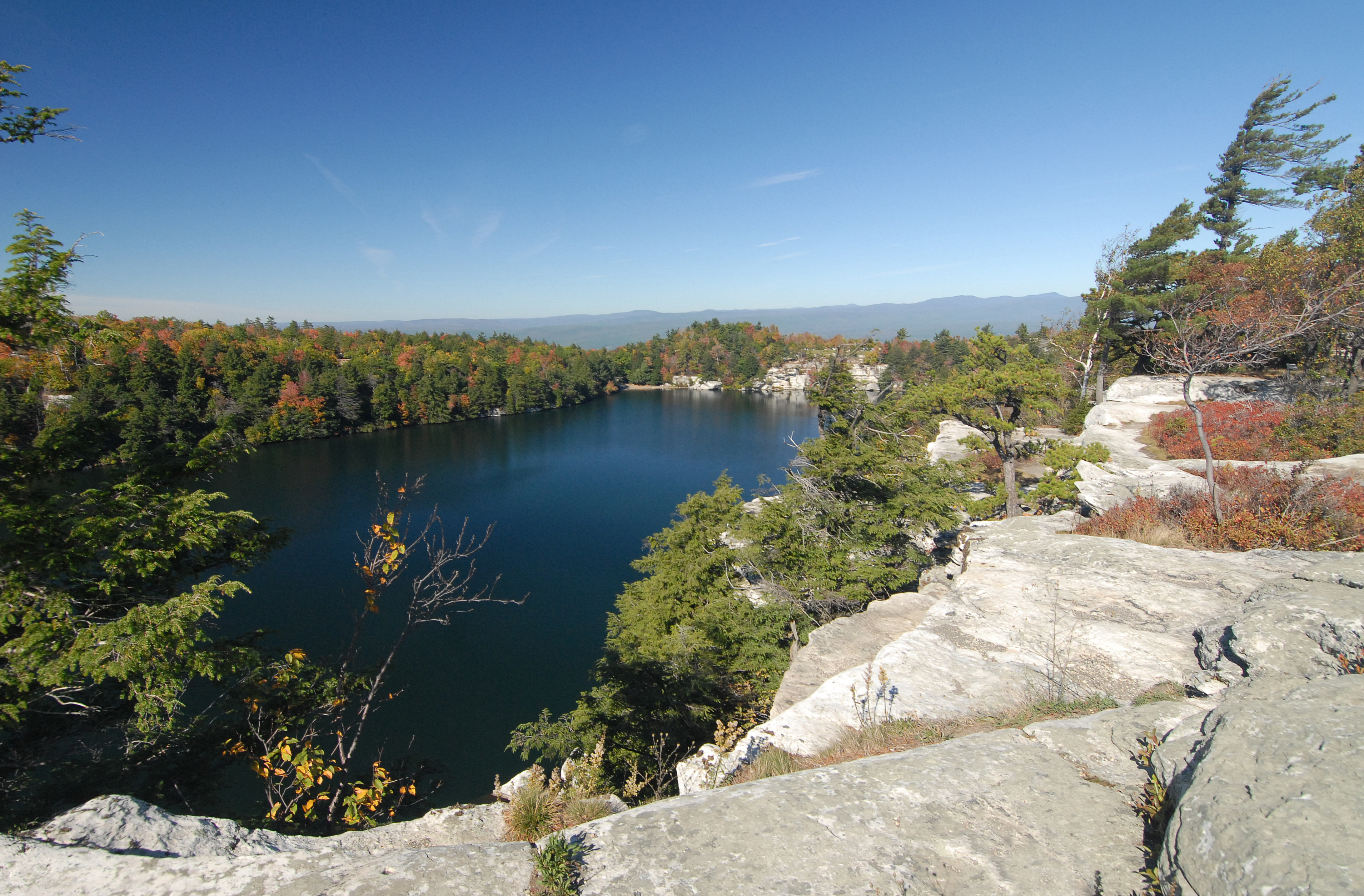
Minnewaska State Park Preserve
A view of Lake Minnewaska with the Catskills in the background from on top of the quartz conglomerate cliffs surrounding the lake. Photo by John Rozell, OPRHP.

The algal bloom showed us that Lake Minnewaska’s ecosystem had been severely altered by the shiner introduction.   Another ‘pebble’ was tossed in 2012; the “big fish on the block” made its appearance. Largemouth bass entered the lake and filled a role at the top of the food chain.  Bass are avid predators, and they began preying on the shiners.  Electrofishing, the use of a weak electrical current in the water to temporarily stun fish, has been used in the lake every year since the shiners appeared in order to monitor the fish populations. In 2013 there was a large population of 10,000 – 15,000 golden shiners and 700 – 800 largemouth bass in Lake Minnewaska. In 2014 no shiners were observed during electrofishing and the number of bass had increased by 60%. Did the bass population increase because they had an ample food source in the shiners? What will happen to the bass population now that they have lost this food source? We can only wait and see.

signage
It is important not to transport plants or animals from one environment to another. Doing so can start a chain of events that can drastically alter the balance of the ecosystem. Sign by Nicholas Martin, Park Educator, Minnewaska State Park Preserve.

Post by Laura Davis, Park Educator, Student Conservation Association/AmeriCorps Intern, Minnewaska State Park Preserve.

Sources:

Dr. Richardson SRBP Lecture at Suny New Paltz February 2015.

“Baitfish Regulations.” General Regulations. DEC, http://www.dec.ny.gov/outdoor/31416.html. 24 June 2015.

Richardson, David C. “Why Is Minnewaska Lake Turning Green: Changes in Acidity and Fish in the Sky Lakes.” Shawangunk Watch 18 (Summer 2013): 1-3. Print.

Lauren Jorgensen, Kristen Husson, and Karen Terbush. Minnewaska State Park Preserve Lake Minnewaska Water Quality Report. Rep. Albany: NYOPRHP, 2012. Print.
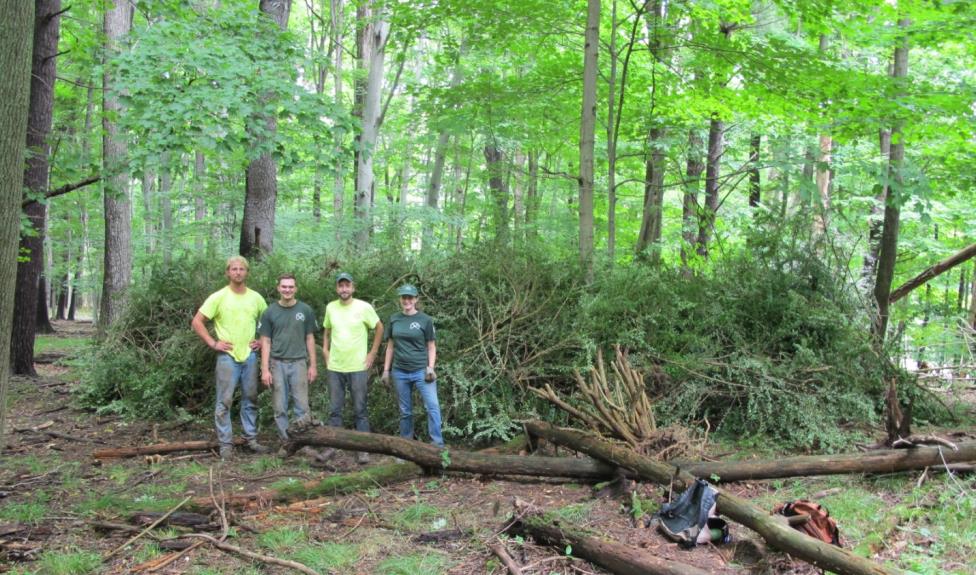
On the Front Lines in the Battle Against Invasive Species: Strike Teams!

Invasive Species Strike Teams are an important part of environmental stewardship; they are the protectors and defenders of our native plants and wildlife! Invasive plants are fast spreading and can create ecological changes that crowd out native plants and alter habitats to make them unsuitable for native insects or animals. The goal of the strike teams is to manually remove these plants in areas of significance to protect our native biological diversity. A diverse landscape is healthier and more robust, better able to fend off threats and adapt smoothly to changes, such as climate change.

1

Above: Our 2014 Western Strike Team in Letchworth State Park, showing off all their hard work removing Japanese Barberry (Berberis thunbergii). Japanese barberry is a commonly planted ornamental which escapes into forest understories and increases incidence of Lyme disease.

What is a Strike Team anyway?

The New York State Parks Invasive Species Strike Teams consist of seasonal employees who travel throughout New York State to remove invasive plants from the most valuable areas of our Parks. These teams of four camp near their project areas to accomplish the goals of the Invasive Species Program. All these removals are done with manual hand tools, such as pick mattocks, shovels, machetes and loppers. Our strike teams are always up for the physical challenge and have made incredible headway against some large opponents.

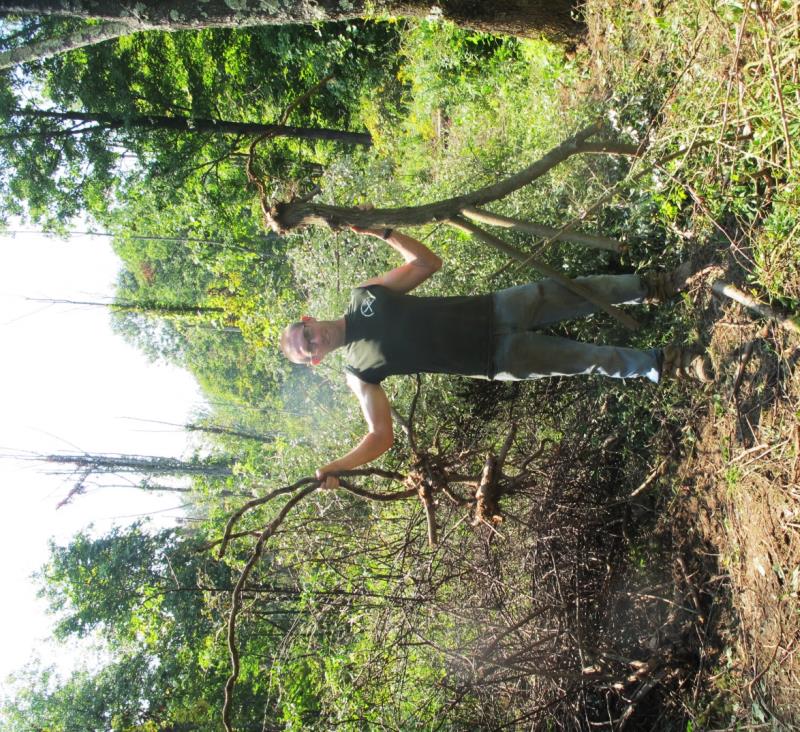
2

Above: A strike team member from 2012 who proudly showcases the large autumn olive (Elaeagnus umbellata) he removed with hand tools, determination and brute strength. Machinery is used to remove large shrubs, but our strike team got there first in this case!

What are the goals?

Invasive Species Program staff has had many successes in controlling invasive species  by carefully selecting projects geared toward terrestrial invasives, which can be controlled manually and through adaptive management.

3

Above: The 2015 Eastern Strike Team wishing everyone well from Grafton Lakes State Park, outside of Albany. You can see some of our most often used tools in this photo (From L-R: the ax mattock, pick mattock and loppers), as you can see, other essential elements in their toolbox include the hard hat and gloves!

Accomplishments

Starting in 2008, six interns and volunteers assisted with invasive species removals state wide. Since 2010, State Parks has employed 46 seasonal staff to remove invasive species. In the past 5 years over 1100 new observation points were entered into the program iMap Invasives, a national database reflecting new sightings of invasives. On average, strike teams remove 19 different species per year at their project sites. Some of the native species which are protected by the invasive species program include: twinleaf, American Hart’s tongue fern, sky blue aster, cardinal flower, Chittenango ovate amber snail, the Karner blue butterfly, several warbler species, mountain mint, bushy cinquefoil, and slender blazing star.

Above: Two examples of native plants which benefit from strike team controls. On the left, the spring flowering twin leaf (Jeffersonia diphylla). On the right, the stunning late summer red of the cardinal flower (Lobelia cardinalis), a plant loved by pollinators.

One of the best ways to reduce invasive species is avoid introducing them in the first place. Please check what is planted ornamentally in your yard and remove plants or shrubs which are invasive and replace them with natives. Learn more information about New York’s invasive species on the NYS DECs Prohibited and Regulated Invasive Species List

For more information regarding Invasive Species Awareness Week (July 12-18) events, check out the New York Invasive Species Information Blog.

Post by Alyssa Reid, Minnewaska State Park Preserve (OPRHP). Photos courtesy of OPRHP.


Explore NYS Parks’ Waterways

Now that the ice is finally gone and the water is warming up, those of us who love paddling are heading out to our favorite spots. Where better than to check out the ponds, lakes, and waterways than in New York State Parks? Whether just for exercise or to enjoy the sun and sky while paddling across the water, getting out in your kayak or canoe is a chance to relax and see a little of the world that can only be experienced from the water.

Grafotn PRK_2664
Kayakers at Grafton Lakes State Park. Photo courtesy of OPRHP.
Dog in Kayak with life vest_Lilly Schelling
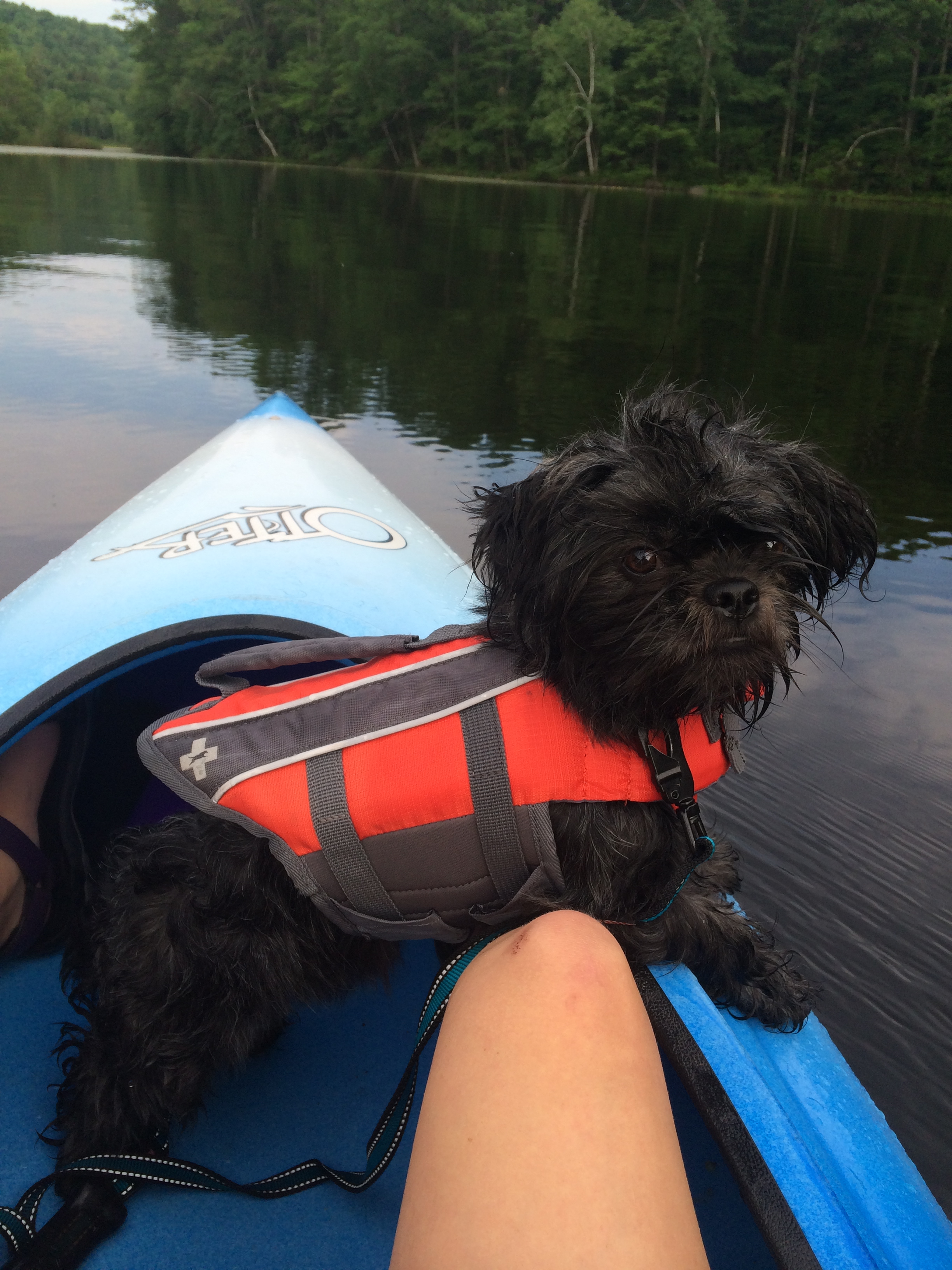
Life vests are also available for pets! Photo by Lilly Schelling, OPRHP.

The Marine Services Bureau of State Parks has just conducted training for Park staff who will be offering American Canoe Association kayaking lessons and tours in parks this summer.  Check out for their kayak program schedules.

Marine Services Bureau is also hosting two paddling events.  W.O.W. (Wear it On the Water) Paddle Fest will be held in two locationson Saturday, July 11 at Gilbert Lake State Park and Saturday, August 15 at Fair Haven Beach State Park.  This free event will feature free kayaking lessons, a Life Jacket Flash Mob, and Sport Fishing Clinics along with other family fun and friendly activities to help you enjoy the water.

Whether exploring for turtles, watching for osprey, fishing, or listening for the slap of a beaver’s tail, we want to remind you to be mindful of the safety of yourself and others who are paddling with you.  Take a free online paddle safety course at www.paddlecourse.com.  Don’t pack it, but wear your life jacket, be boat sober, and leave a float plan letting someone know where you are paddling and when you will return.

Marine Services Bureau encourages all paddlers to obtain an IF FOUND Sticker to identify your boat.  Write your name, cell phone and alternative phone number on the sticker and affix to your boat.  It’s a great way to return a lost boat or help law enforcement rescue a capsized kayaker.  Get your IF FOUND sticker by sending a legal sized self-addressed stamped envelope to NYS Parks, Marine Services Bureau, IF FOUND Sticker, Albany, NY 12238.

If Found
Photo by Ro Woodard, OPRHP.

So grab your life jacket and paddle and head out to the nearest lake or pond to enjoy the serenity and natural surprises that are just a paddle away.

Picture1


Post by Ro Woodard, Marine Services Bureau (OPRHP).

Sand: The Beaches’ Hidden Treasures

Fourth of July is nearly upon us and it is time to hit the beach!  And beaches mean sand – sand to build sand castles, sand that tickles your toes during beach strolls, and sand for beach volleyball and bocce.

But what is beach sand?  According to http://www.merriam-webster.com, sand is “a loose granular material that results from the disintegration of rocks, consists of particles smaller than gravel but coarser than silt.”  These small particles are less than 1/10th of an inch in diameter.  The mineral makeup of individual sand particles depends on local and regional rocks, which are eroded by ice and rain, then carried to the ocean by rivers where they are deposited on gently sloping beaches. The size of individual sand particles is dependent on the slope of the beach, both above and below waterline. The color of beach sand is influenced by nearby landscapes and ocean bottom.

In New York, many beaches have a variety of minerals including quartz, white or clear particles; feldspar, buff-colored particles; and magnetite, black particles.  On beaches around the world you will find lava (black beaches), coral (pink beaches), garnet (purple beaches), olivine crystals (green beaches) and more. Some beaches have unique sand such as the orange Kerala coast beach sand in India.

New York State Parks have over 65 beaches on lakes, ponds, rivers, bays, and the Atlantic Ocean.  Let’s take a closer look at the sands on a few of those beaches …

Along Lake Erie

Evangola Beach Sand

The sand on the beach at Evangola State Park in southern Erie County is principally quartz, feldspar, magnetite, with smaller amounts of garnet, calcite, ilmenite, and hornblende.  All of the particles are approximately the same size.

Along Lake Ontario

Hamlin_Beach Sand

Located northwest of Rochester, Hamlin Beach State Park beach sands are mostly quartz, hypersthene (brown and gray), and augite (greenish).

On Long Island

Jones_Beach Sand A

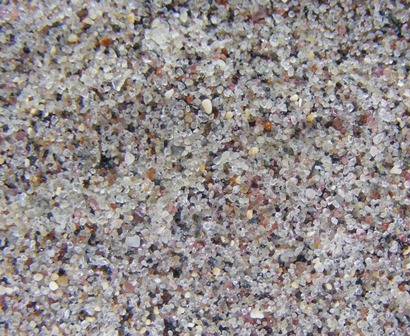
Jones Beach State Park has 6-1/2 miles of Atlantic Ocean shoreline; different sections of beach have slightly different sands.  Some parts of the beach have sand that is mostly comprised of quartz with a little feldspar and tiny shell fragments.  Note that the clear quartz particles have different sizes.

Jones_Beach Sand B


Other sections of beach at Jones Beach State Park have quartz, garnet, and magnetite sand with a few tiny shell fragments. All of the particles are about the same size.

Robert_Moses Sand


The beach at Robert Moses State Park, also on the Atlantic Ocean side, is mixture of quartz, garnet, magnetite, and shells. The shell in the photo is about 1/3” long; larger glass piece is about 1/6” long.

Napeague_Beach Sand

The beaches on the north side of Napeague State Park and Hither Hills State Park are along Napeague Bay. Here the sands contain magnetite and garnet which give the sand a purplish hue.

Bring your magnifying glass the next time you head to a NYS Parks beach.  You might be surprised at what you see when you take an up-close look at the sand.

Thanks for Anne McIntyre, Dave McQuay, and Megan Philips for their help with collecting sand samples for this article.

Post and sand photos by Susan Carver, OPRHP.

Learn more at:

Coastal Care: http://coastalcare.org/2010/10/dream-in-color-on-the-worlds-rainbow-beaches/

International Sand Collector’s Society: http://www.sandcollectors.org/SANDMAN/The_Hobby_of_x.html

Sand Atlas: http://www.sandatlas.org/sand-types/

Pilkey, Orrin H., William J Neal, Joseph T. Kelley, & J. Andrew G. Cooper; The World’s Beaches : A Global Guide to the Science of the Shoreline; University of California Press, Berkeley, 2011.


Staff Spotlight: What it means to be a “Boat Steward”

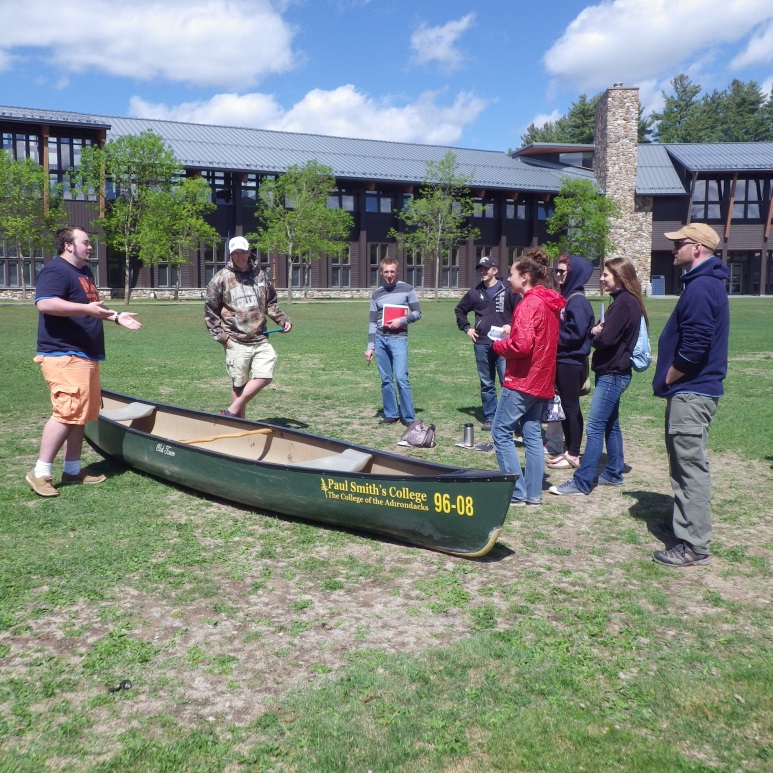
On a Monday in mid-May the 12 members of the 2015 NYS Parks Boat Steward Program piled into two minivans in the parking lot at Hamlin Beach State Park. The vans were packed to the gills with supplies, including snacks for the road, uniforms, plant rakes, 5-gallon buckets, and  folding tables. Strict instructions were given to avoid opening the trunk without someone standing by to catch any overnight bags or coolers that may tumble out. To a bystander, our situation likely seemed akin to a scene from the National Lampoon’s Family Vacation film – only we weren’t leaving for a vacation. We were bound for a multi-day training at Paul Smith’s College, where watercraft inspection began in New York State more than 15 years ago.

Watercraft inspection has become an increasingly popular way to prevent the spread of aquatic invasive species (AIS) via overland transport.  During the training, Boat Stewards learn how to educate the public on AIS, conduct voluntary watercraft inspections remove and dispose of any plant or animal matter, and collect data about the boaters that they interact with.  This data helps us to understand how and where AIS are being transported, which regions of the state require enhanced outreach, and where boat washing stations would be most efficiently utilized.

mock inspect
Stewards conducted mock watercraft inspections for AIS at Paul Smith’s College in the Adirondack Park. Returning stewards from the Paul Smith’s program took on various “boater personalities” to help the new stewards prepare for any type of situation that could arise at the boat launch.
ais hands on
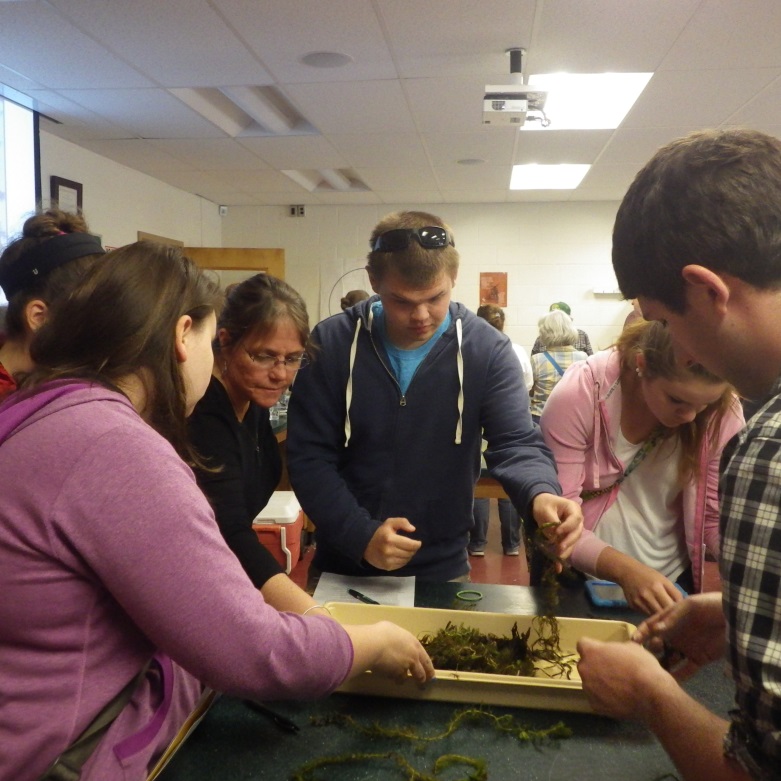
Paul Lord (SUNY Oneonta) held a hands-on invasive plant and animal identification session, which was an invaluable piece of the training for the stewards. After they had time to become familiar with the specimens, stewards were given a quiz!

Fast forward to five weeks later, the stewards are trained and on-site at 21 launches across the Great Lakes and Lake Champlain.

The following images were taken in the field during routine site visits.

Above left: Zebra mussels attached to a stick near the boat launch at Point Au Roche State Park on Lake Champlain. Can you imagine how many of these mussels could cover the bottom of a boat?! Banded mystery snails were also found at this location. Zebra mussels and banded mystery snails are just two of 50 known invasive species in the lake.

Above right: Melyssa Smith (OPRHP Water Quality Unit) and Ariana London (OPRHP Boat Steward) practice throwing the plant rake from a boat launch on the Great Chazy River. It is still a bit early in the season for significant plant growth; however AIS Eurasian watermilfoil and a native Elodea have been collected at this site thus far.

s poweres
“So far, the two main aquatic invasive species that I have found are curly-leaf pondweed and Eurasian watermilfoil. I keep some samples on my table to show to boaters and park visitors who come by to learn about them. I also throw my rake into the water every morning to gather new specimens. I have been learning to identify many different types of aquatic life!” – Sarah Powers, Salmon River and Lake Ontario steward.

Above left: Tara inspects a motor boat that is preparing to launch. “For me, being a Boat Steward is about patience, passion and perseverance.” –Tara Camp, St. Lawrence River steward.

Above right: A curly-leaf pondweed specimen on the boat launch at Westcott Beach State Park. Notice how the leaves resemble lasagna noodles.

If you encounter a Boat Steward this summer, be sure to ask them how you, a New York State Park visitor, can help halt the spread of aquatic invasive species by adopting a few simple practices when launching or retrieving your watercraft.

And always remember to:

  • Drain your bilge, ballast tanks, livewells, and any water-holding compartments
  • Inspect your watercraft and trailer for plant and/or animal matter, and remove and dispose of any material that is found
  • Clean your watercraft between uses or allow it to dry before visiting a new water body

For more information about the NYS Parks Boat Steward Program, please call (518) 402-5587.

Post and photos by Megan Phillips, OPRHP Water Quality Unit.


The official blog for the New York State Office of Parks, Recreation & Historic Preservation