From placid lakes and intimate mountain streams to broad rivers and sea-foamed saltwater coast, the state park system offers limitless fishing possibilities and the enticing prospect of “tight lines.” Striped bass, bluefish, salmon, trout, panfish and freshwater bass are but a few of the many popular fish species that can be fished for at state parks, with angling set amidst the backdrop of some of the state’s most compelling and dramatic natural scenery.
For a reel-y good time: fishing is a whole different way to connect with the outdoors. Photo by Susan Lananger, Allegany State Park.
While some anglers may prefer the fall striped bass bonanza at Montauk Point, with its festive atmosphere and challenging rock-strewn shoreline, others may find flyfishing for brook and brown trout on the remote hemlock-lined streams of Allegany more to their liking. State parks additionally offer numerous options for recreational boat fishing. Launches for motorized boats are located strategically throughout the state on prime angling waters, along with smaller docks and launches providing lake and river access for canoes, kayaks and the like.
State parks offer anglers premier opportunities on two great lakes, the Hudson, St. Lawrence, Niagara and other smaller rivers, numerous streams and brooks, countless lakes of varying size and setting, and the saltwater shores of Long Island Sound and Atlantic Ocean. If there’s a fish to be angled for in New York State, be it fresh or saltwater, chances are good that it can be found in a state park.
Through I Fish NY, the New York State Department of Environmental Conservation helps New Yorkers understand the basics of fishing legally and offers opportunities to try the activity. Our parks often hold fishing programs as well. Read on for our guide to angling at state parks!
Big fish eat smaller fish, smaller fish eat zooplankton, zooplankton eat phytoplankton, and phytoplankton produce their own food. If smaller fish eat all of the zooplankton, what’s to stop the phytoplankton from multiplying out of control? If the big fish eat all of the smaller fish, will the big fish still be able to sustain their population? Whenever an organism is added to or taken away from an ecosystem, it acts like a pebble thrown into a pond. There’s the initial splash, then there are ripples that radiate outward affecting everything in their path.
In 2008, a “pebble” was thrown into Lake Minnewaska. This pebble was a type of minnow called a Golden Shiner. Exactly how the Golden Shiners entered the lake is not certain, however they are a common bait fish so it is possible that they were introduced to Lake Minnewaska by someone who was hoping to hook the catch of the day! If that was the case, the odds would have been against that fisherman. For several decades prior to the occurrence of the shiners, there were no fish reported in the lake. Lake Minnewaska has been very acidic in the past, making it an unhospitable environment for most fish to live in. Recently, the pH in the lake has begun to rise to a level closer to neutral, making the lake more inhabitable for fish.
Two Northern Water Snakes compete for a Golden Shiner in Lake Minnewaska. Photo taken by Nicholas Martin, Park Educator, Minnewaska State Park Preserve.
The introduction of a predator to the food web in Lake Minnewaska caused a trophic cascade. A trophic cascade is when a top predator is added to or removed from a food chain. The effects of the addition or loss of this predator are experienced all the way down the food chain. The shiners’ predation on the zooplankton drastically decreased their population. The ripple continued spreading outward because the loss of the zooplankton meant the loss of a major plant consumer. The phytoplankton could then grow and multiply without restraint. The result was an algal bloom in 2011 that turned the lake green and decreased the visibility to less than three feet. As a result, the Minnewaska Swimming Beach was closed for a month that summer.
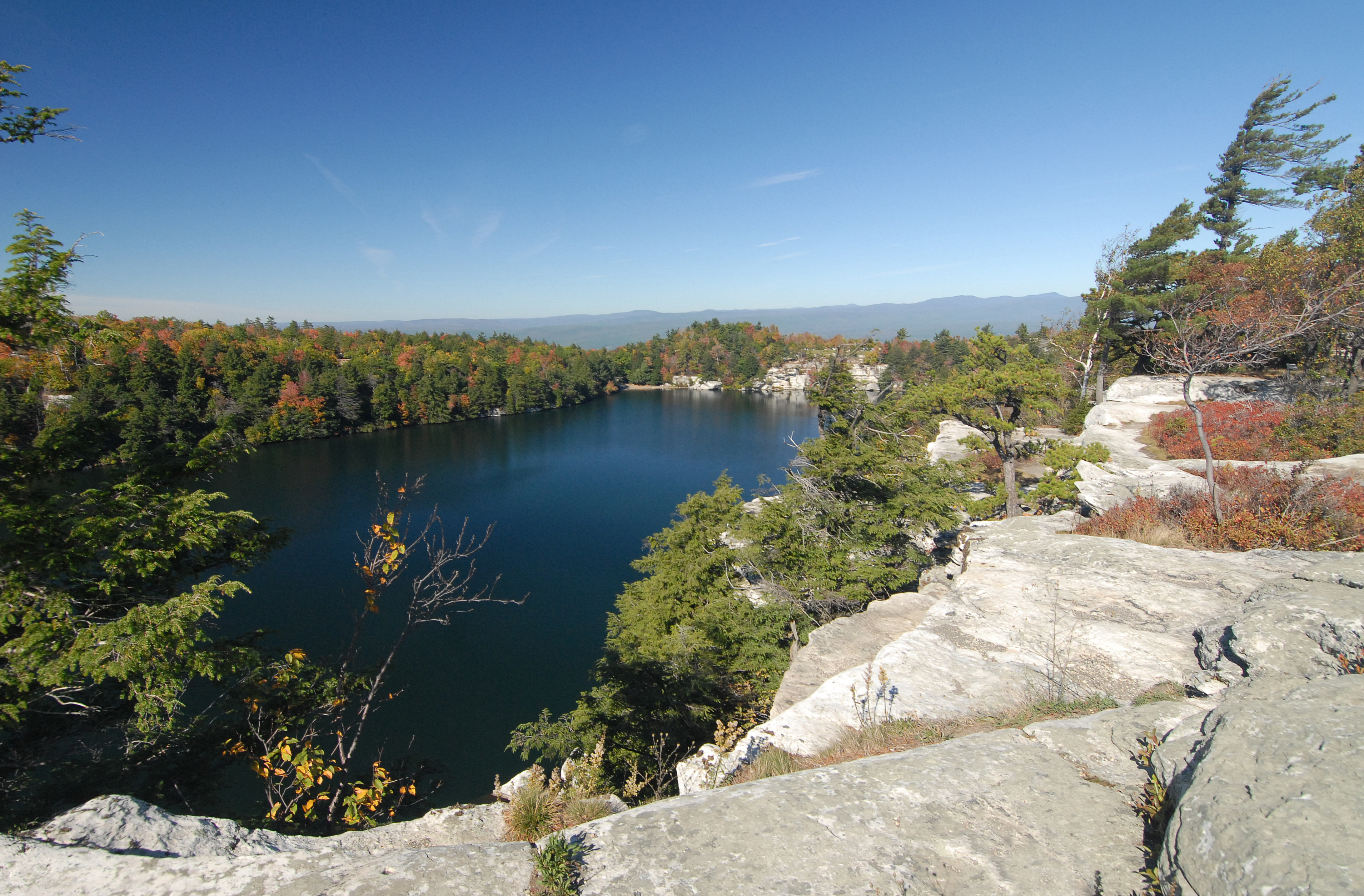
A view of Lake Minnewaska with the Catskills in the background from on top of the quartz conglomerate cliffs surrounding the lake. Photo by John Rozell, OPRHP.
The algal bloom showed us that Lake Minnewaska’s ecosystem had been severely altered by the shiner introduction. Another ‘pebble’ was tossed in 2012; the “big fish on the block” made its appearance. Largemouth bass entered the lake and filled a role at the top of the food chain. Bass are avid predators, and they began preying on the shiners. Electrofishing, the use of a weak electrical current in the water to temporarily stun fish, has been used in the lake every year since the shiners appeared in order to monitor the fish populations. In 2013 there was a large population of 10,000 – 15,000 golden shiners and 700 – 800 largemouth bass in Lake Minnewaska. In 2014 no shiners were observed during electrofishing and the number of bass had increased by 60%. Did the bass population increase because they had an ample food source in the shiners? What will happen to the bass population now that they have lost this food source? We can only wait and see.
It is important not to transport plants or animals from one environment to another. Doing so can start a chain of events that can drastically alter the balance of the ecosystem. Sign by Nicholas Martin, Park Educator, Minnewaska State Park Preserve.
Post by Laura Davis, Park Educator, Student Conservation Association/AmeriCorps Intern, Minnewaska State Park Preserve.
Sources:
Dr. Richardson SRBP Lecture at Suny New Paltz February 2015.
Richardson, David C. “Why Is Minnewaska Lake Turning Green: Changes in Acidity and Fish in the Sky Lakes.” Shawangunk Watch 18 (Summer 2013): 1-3. Print.
Lauren Jorgensen, Kristen Husson, and Karen Terbush. Minnewaska State Park Preserve Lake Minnewaska Water Quality Report. Rep. Albany: NYOPRHP, 2012. Print.



 New York State Parks and Historic Sites Blog