It’s the most sparkly time of the year! It’s the holiday season and the grand finale of the year of wellness at New York State Parks and Historic Sites. All year long, we’ve come together to improve all aspects of our well-being, build community, and connect to nature and history. We celebrated the holiday season the same way, with handcrafted experiences designed to bring people together to make memories without breaking the bank. Our gift to you is a look at the holiday and winter festivities at state parks and historic sites all across New York. Thank you for making us part of your year-end traditions!
As our understanding of history grows, so do the stories we tell about our past. The upcoming commemorations of the 250th anniversary of the American Revolution (2026) and the 400th anniversary of the arrival of the first enslaved Africans in New York and 200th anniversary of the ending of legalized slavery in New York (both in 2027) provide the perfect opportunity for a re-examination of these key events in American history.
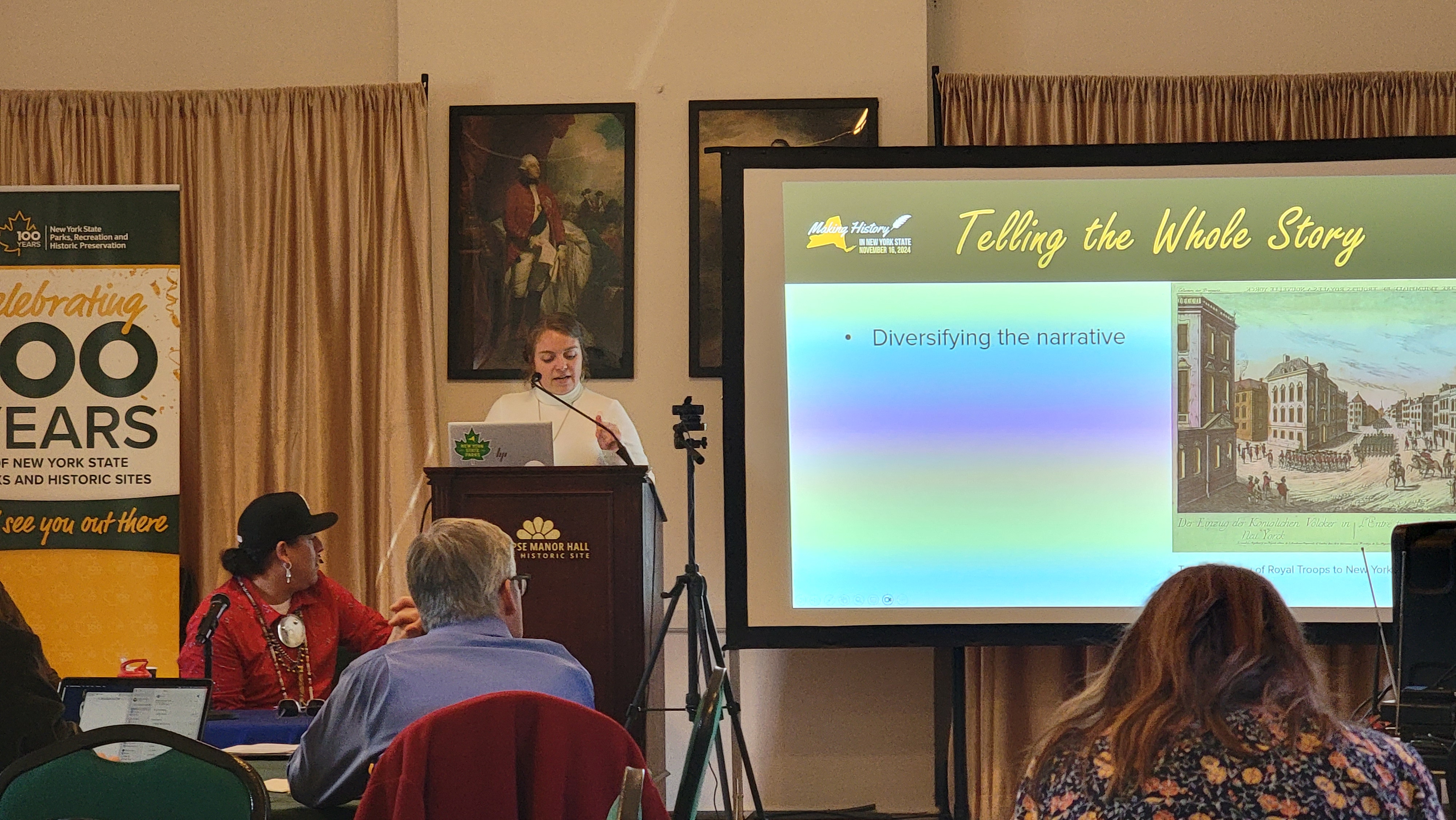
On Saturday, November 16, 2024, the public and staff members from New York State Parks, Recreation and Historic Preservation gathered at Philipse Manor Hall State Historic Site in Yonkers and online for “Making History: Revolution, Abolition, and Preservation in New York State,” a symposium highlighting the agency’s Our Whole History initiative. The initiative starts with acknowledging that our understanding of history is complex and nuanced, and evolves with historical research. Our Whole History actively fills in parts of history that were previously ignored to gain a more complete understanding of the past.
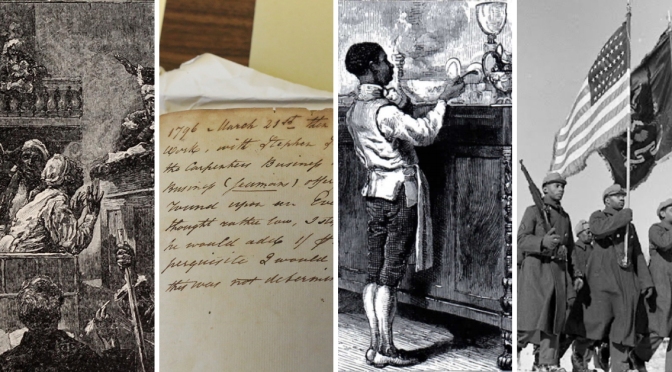
Black History Month is drawing to a close. But at the Office of Parks, Recreation and Historic Preservation, research into New York’s Black history is continuous. From the 1627 arrival of the first 22 enslaved African men to the 1827 abolition of slavery in New York and into the future, Black history is the history of New York and of the United States. This is a cornerstone principle of ‘Our Whole History,’ a Parks initiative launched several years ago to thoroughly research and share the stories of New York State from the points of view of all who lived it.
As research continues, a more complete picture of the past emerges. The stories of the Black New Yorkers who contributed so much to New York’s history are revealed through painstaking, detail-oriented research. Key caretakers, highly skilled laborers, folks who contributed to a smooth-running household become clearer.
To piece together their stories, our dedicated historians conduct archaeology, study physical objects, and delve deep into records of all kinds: account ledgers of both homes and businesses; census data; estate inventories; wills; letters and journals; city directories; diaries, and more.
Several of our historians shared with us the stories of Black figures who shaped the history of their sites.
In settlements along the Hudson River Valley and in Albany on the hill where the New York State Capitol sits today, enslaved and free African descendants once gathered with family and friends to celebrate Pinkster. During the holiday, the Dutch attended religious services but also gathered socially to play games and eat holiday foods. Enslaved Africans had leave to travel and gather during the festivities, which was not allowed during most of the year.
Left: Pinkster event signage outside of Schuyler Mansion State Historic Site. Right: Pinkster coverage from the Albany Morning Express, 1880.
Over the past few decades, the Pinkster celebration has enjoyed a resurgence in New York State. And in recent years, historic sites in New York State Parks, Recreation and Historic Preservation’s care have served as venues to carry on the deeply rooted cultural tradition.
A History of Pinkster
Settlers in New Netherland, a 17th century Dutch colonial province on the east coast, practiced their religious observance of Pentecost (Pinksteren in Dutch) or Whitsunday in the Americas. Pentecost signifies the Holy Spirit being sent to the disciples, roughly fifty days after the resurrection, as described in the New Testament of the Christian bible.
In 1803, a published account of Pinkster in the Albany Centinel newspaper described the scene: “readiness, on Monday morning, blacks and a certain class of whites, together with countries and colours, begin to assemble on Pinkster from every part of the city and from the adjacent country miles around, forming in the whole a motley group of thousands…”
With picnics, barbecues and fireworks, many New Yorkers will celebrate the Fourth of July this weekend, marking the signing of the Declaration of Independence in 1776.
Perhaps not so well known is that several months later, more than 500 other New Yorkers embraced another public declaration – this one pledging loyalty to British King George III against a “most unnatural, unprovoked Rebellion that ever disgraced the annuls of time.”
New York’s so-called “Declaration of Dependence” reflected a split at the start of the Revolutionary War between Patriots and Loyalists (also called Tories) among the state’s 200,000 residents. That divide ultimately claimed the fortunes and property of dozens of Loyalists, including the prominent and wealthy owner of Philipse Manor Hall State Historic Site, in Yonkers, Westchester County.
Born in 1720 in New York City, Frederick Philipse III enjoyed influence and power as one of the largest landowners in the Hudson Valley and possibly the richest man in New York. He was the fabulously wealthy great-grandson of a Dutch carpenter named Frederick Flypsen who arrived in New Holland in 1653 at age 27 and created a fortune based on land, shipping, fur and slave trading.
Flypsen, who Anglicized his name to Philipse after the British took over New York, became a major landholder along the east side of the Hudson River, eventually controlling more than 50,000 acres in what is now Westchester, Putnam and Dutchess counties.
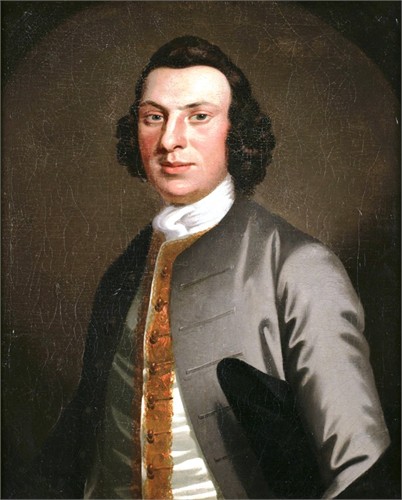
Frederick Philipse III when he was one of the richest men in New York State.
Frederick Philipse III took over his share of family holdings at age 30 in 1752, devoting himself to administering the estate, called Philipsborough, and collecting rents from his many tenant farmers. His residence at the opulent manor hall, which had been started by his grandfather, continued by his father, Frederick II, and erected in stages between 1682 and 1758, was a showcase of English gentility but had brutal underpinnings.
Up to 30 enslaved people and two dozen white indentured servants worked the manor under Frederick III, according to a report from Columbia University based on Philipse family records donated to the university. Frederick III was a founding governor of King’s College in 1754, which later become Columbia University.
It was also during this period that Philipse appropriated a large amount land in what is now Dutchess County from the Wappinger Native American tribe under dubious circumstances, sparking tribal leaders to launch an unsuccessful appeals in the 1760s to Colonial leaders, and later to British authorities.
On the eve of the Revolutionary War, Philipsborough extended for about 24 miles along the east bank of the Hudson, from the Croton River in Westchester County to northern Bronx County. Due to his wealth and prominence, Philipse held a post in the Colonial state Assembly, but his role there were largely ceremonial and uniformly supportive of the royal government that was guarantor of his privileges.
Map of Philipsburg at the time of Frederick Philipse III. (Credit- Wikipedia Creative Commons)
As revolutionary sentiment in the Colonies began to take shape in early 1775, Philipse blocked an effort to send New York delegates to a Continental Congress in Philadelphia, siding with the British Crown. He then had a pro-monarchy notice posted in a New York City Loyalist newspaper, drawing the ire and hostility of Patriot factions in New York and elsewhere. That led to Philipse being put to the top of a Patriot list of Westchester County Loyalists.
With combat later breaking out in Massachusetts and New York, some Loyalists began fleeing to England as others were arrested by Patriot leaders, but nothing happened to Philipse initially. But after he assembled his tenants in early 1776 to urge them to support the British against the uprising, a subpoena was issued that summer for his arrest, which was later ordered by George Washington in August 1776 after the Declaration of Independence was issued. Philipse was held in New Rochelle before being transferred to New Haven, Connecticut. Officials there agreed to let him return to his manor in December under a signed parole agreeing not to undermine the Revolution.
The Declaration of Dependence was issued on November 28, 1776 with Frederick Philipse III among the Loyalist signers who vowed to support the “supremacy of Great Britain over the Colonies.” Philipse’s signature is prominent on the first page of the declaration, which now is at the New York Historical Society in New York City.
The declaration stated that some Loyalists had been “driven from their Habitations, and others sent Prisoners into some of the neighboring Colonies.” The appeal concluded by stating that the Philipse and the other signers _ a mix of civil and military officers, clergy, landowners and wealthy merchants _ were opposed to the Revolution “in every stage of its rise and progress, at the risk of our Lives and Fortunes.”
Many New Yorkers felt as Philipse did. About half of the state’s 200,000 residents held Loyalist sentiments, giving New York the highest percentage of Loyalists among the 13 colonies.
While back at the manor on parole in March 1777, Philipse attempted to pass a message to British forces after he witnessed nearby Patriot troop movements. When the message was intercepted, he panicked and fled with his family downriver to the safety of British-occupied New York City. The lord of Philipsburg was never to see his luxurious estate and home again.
As the tide of war began to turn, New York lawmakers decided to permanently break the power of the pro-British elite by stripping Philipse and 58 other Tories of their property and condemning them to banishment and death under the Confiscation Act of Oct. 22, 1779.
So, for the first time in a century, the Philipse family had no standing in Westchester County. Frederick III remained in New York City until the end of the war in 1783, when British troops evacuated. His estate and most of his wealth gone, and facing penalty of death, he sailed with other Loyalists to Great Britain, a place he had never been. Philipse was a broken man when he died there just two years later at age 65.
His lands and property were auctioned off by New York State in 1784-85 into more than 300 separate parcels, bringing in more than $28 million by today’s standards, making it the largest confiscated estate sold in New York. The money raised was used to pay off war debts.
In 1868, after passing through the hands of many owners, the former manor house became Yonkers Village Hall and, in 1872, the first City Hall. By the 20th century, city growth threatened the manor’s future until it was acquired by New York State in 1908 with the generous help of the Cochran family of Yonkers.
Today, Philipse Manor Hall serves as a museum of history, art and architecture, as well as host to community organizations, meetings, educational programs and special events. Highlights of the Hall include its 18th century, high style Georgian architecture, a 1750s papier mache Rococo ceiling, and an impressive collection of presidential portraits, including the six Presidents from New York State.
Currently, all tours and programs at Philipse Manor Hall State Historic Site are postponed until further notice due to the COVID-19 pandemic. Check back at the website for updates.
Cover Shot- Philipse Manor Hall State Historic Site. All photos by NYS Parks unless otherwise credited.
Post by Brian Nearing, Deputy Public Information Officer for NYS Parks
Resources
An American Loyalist: The Ordeal of Frederick Philipse III, by Stefan Bielinksi, Division of Historical Services, New York State Museum, State Education Department, 1976
To The Right Honorable Richard Viscount Howe, of the Kingdom of Ireland, and His Excellency The Honorable William Howe, Esquire, General of His Majesty’s Forces in America, the King’s Commissioners for restoring Peace in His Majesty’s Colonies and Plantations in North America &c. &c. &c.
May it please your Excellencies.
Impressed with the most grateful sense of the Royal Clemency, manifested I your Proclamation of the 14th. Of July last, whereby His Majesty hath been graciously pleased to declare, “That he is desirous to deliver His American subjects from the calamities of War, and other oppressions, which they now undergo:” and equally affected with sentiments of gratitude for the generous and humane attention to the happiness of these Colonies, which distinguishes your Excellencies subsequent Declaration, evincing your disposition “to confer with His Majesty’s well affected subjects, upon the means of restoring the public Tranquility, and establishing a permanent union with every Colony as a part of the British Empire.”
We whose names are hereunto subscribed, Inhabitants of the City and County of New-York, beg leave to inform your Excellencies: that altho most of us have subscribed a general Representation with many other of the Inhabitants; yet we wish that our conduct, in maintaining inviolate our loyalty to our Sovereign, against the strong tide of oppression and tyranny, which has almost overwhelmed this Land, may be marked by some line of distinction, which cannot well be drawn from the mode of Representation that has been adopted for the Inhabitants in general.
Influenced by this Principle, and from a regard to our peculiar Situation, we have humbly presumed to trouble your Excellencies with the second application; in which, we flatter ourselves, none participate but those who have ever, with unshaken fidelity, borne true Allegiance to His Majesty, and the most warm and affectionate attachment to his Person and Government. That, notwithstanding the tumult of the times, and the extreme difficulties and losses to which many of us have been exposed, we have always expressed, and do now give this Testimony of our Zeal to preserve and support the Constitutional Supremacy of Great Britain over the Colonies; and do most ardently wish for a speedy restoration of that union between them, which, while it subsisted, proved the unfailing source of their mutual happiness and prosperity.
We cannot help lamenting that the number of Subscribers to this Address is necessarily lessened, by the unhappy circumstance that many of our Fellow-Citizens, who have firmly adhered their loyalty, have been driven from their Habitations, and others sent Prisoners into some of the neighbouring Colonies: and tho’ it would have afforded us the highest satisfaction, could they have been present upon this occasion: yet we conceive it to be the duty we owe to ourselves and our prosperity, whilst this testimony of our Allegiance can be supported by known and recent facts, to declare to your Excellencies; that so far from having given the last countenance or encouragement, to the most unnatural, unprovoked Rebellion, that ever disgraced the annuls of Time; we have on the contrary, steadily and uniformly opposed it, in every stage of its rise and progress, at the risque of our Lives and Fortunes.









 New York State Parks and Historic Sites Blog