The Force was with our intrepid volunteers and friends on Saturday, May 4, 2024, as the 13th I Love My Park Day took place across New York. More than 150 state parks, historic sites, and public lands welcomed thousands of volunteers to help rake and plant flower beds, clear trails, paint benches, build birdhouses, clean up beaches and public spaces, clear away invasive species, and get the parks looking fantastic for the busy season ahead.
This week we celebrate Earth Day! The first Earth Day was held in 1970 to draw attention to ongoing environmental issues in the United States, such as water and air pollution. Since then, Earth Day has become a global event held every April 22nd in honor of protecting the environment. With over 350,000 acres of park land and waters, NY State Parks play an important role in the protection and stewardship of New York’s natural ecosystems. If you would like to join in the celebration and participate in hands-on Earth Day activities, check out the list below for a sampling of Earth Day events held in State Parks across the state! If you can’t make any of this week’s Earth Day events, join us for Arbor Day programs next week and I Love My Park Day on Saturday, May 7th!
Long Island
Brookhaven National Lab Climate Van Jones Beach Energy & Nature Center Friday, April 22, 2022 09:00 AM – 04:30 PM This pioneering mobile laboratory consists instruments used in their climate research to measure atmospheric variables. Come explore and get a glimpse into the science of forecasting atmospheric conditions. The talks will be on Zoom as well as in person.
Protect the Pollinators Event Jones Beach Energy & Nature Center Saturday, April 23, 2022 12:00 PM Build your own bee or insect house; Guided tour of our Pollinator Garden; Springtime Storytime; and Pollinator Relay Races
Earth Day Celebration Project Connetquot River State Park Preserve Saturday, April 23, 2022 09:00 AM In celebration of Earth Day, please join Friends of Connetquot to plant native plants and ferns along the main road to the Clubhouse. Meet up by the Kiosk in the main parking lot starting at 9 am. Please dress appropriately and bring gloves. To register, please visit www.friendsofconnetquot.org.
Earth Day Hike Hallock State Park Preserve Saturday, April 23, 2022 09:00 AM – 11:00 AM Celebrate our earth home by taking a 3 mile hike through the trails of the Preserve observing all that nature can share with us! All programs meet in the upper parking lot unless noted. Programs led by MaryLaura Lamont. Call for details, reservations at (631)315-5475. Snow/rain cancels programs!!!
Earth Day Festival Hempstead Lake State Park Saturday, April 23, 2022 11:00 AM – 3:00 PM The event will include alternative energy activities, up-cycling t-shirt into aprons, make native pollinator seed bombs, and more!
Come to Hempstead Lake to up-cycle a t-shirt!
Niagara
Earth Day Walk Buckhorn Island State Park Friday, April 22, 2022 10:00 AM – 11:30 AM Happy Earth Day everyone! Joins us for a relaxing walk through the woods and along with Niagara River. For information and registration call (716) 282-5154
Arbor Day Walk DeVeaux Woods State Park Friday, April 29, 2022 01:00 PM – 02:30 PM Happy Arbor Day! Enjoy a walk through old growth trees. Registration required, please call (716) 282-5154.
Thousand Islands
Celebrate Earth Day! Point Au Roche State Park Saturday, April 30, 2022 10:00 AM – 12:00 PM Celebrate Earth Day with us! Go on a Scavenger Hunt! Play some Earth Day themed games! Plant a seed to take home! Help clean up the Park! Activities available 10am-12pm. All ages welcome!
Earth Day at Zoo New York Minna Anthony Common Nature Center Saturday, April 23, 2022 10:00 AM – 03:00 PM Come join the Earth Day celebration at the Thompson Park Zoo! Learn about the natural world around you and the importance of protecting our natural resources. Discover new places and ways to enjoy the outdoors. There will be numerous family friendly activities and many different organizations at the event, including the Nature Center! For additional information, please call the Thompson Park Zoo at (315) 782-6180. Preregistration recommended. Please call (315) 482-2479 to register. Face covering encouraged when indoors.
Arbor Day at TILT’s Sissy Danforth Rivergate Trail Wellesley Island State Park Saturday, April 30, 2022 10:00 AM – 02:00 PM Celebrate Arbor Day and the Thousand Islands Land Trust’ (TILT) 9th Annual “For the Trees” Celebration by planting trees at the S. Gerald Ingerson Preserve along the Sissy Danforth Rivergate Trail. Bring the whole family to get their hands dirty! There will be numerous family friendly activities, workshops, games, and exhibits from TILT and many different organizations, including the Nature Center! For more information, please visit tilandtrust.org or call (315) 686-5345. Preregistration recommended. Please call (315) 482-2479 to register. Face covering encouraged when indoors.
Trees and Climate Point Au Roche State Park Saturday, April 30, 2022 02:00 PM – 03:00 PM Join the park naturalist to explore trees, their important role in the ecosystem, and what they do for us. How can trees help with climate change? What can we learn by studying tree rings? What threats do trees face? Also, learn about Wangari Maathai, a very inspiring conservationist and activist, and how we can follow her example to help trees! Please note this will be an indoor program.
Finger Lakes
Beach Cleanup Event Sampson State Park Friday, April 22, 12:00 PM – 4:00 PM Looking for a good way to give back to your community this Earth Day? Come out to Samson State Park from 12:00pm to 4:00pm on Friday, April 22nd and help us clean up trash and debris along the beach front and cobble shoreline of Seneca Lake. Did you know that the beautiful and State Threatened grows right here at Sampson? Twinleaf is just one of the unique and important species that call Sampson State Park home. Come help us protect this important ecological community and learn about conservation efforts around the state! Feel free to bring work gloves, or borrow ours! Meet us near the beach and look for the FORCES table!
Saratoga/Capital Region
Earth Day Clean Up Saratoga Spa State Park Friday, April 22nd, 10:30 AM Celebrate Earth Day at Saratoga Spa State Park with our most recent park partner, the Children’s Museum at Saratoga! We will work together to make the park a little more beautiful. At 10:30AM on April 22nd, we will meet at the Lincoln Bathhouse where the Museum’s new Nature Backpack program will be demonstrated. At 11:00AM everyone will head out to help clean up one of the park’s many pathways. Come share in the reward of making a greener, cleaner world! Gloves and bags will be provided. No registration necessary.
Trout Discovery Day Grafton Lakes State Park Thursday April 21, 2022 11:00 AM to 1:30 PM Grafton Lakes State Park is hosting its annual Trout Discovery Day. As the weather gets warmer it is the perfect time to stock long pond with trout. The DEC will be providing trout and Grafton will be providing activities. Come on your own or bring out the whole family, Trout Discovery Day is the perfect event for all ages. Enjoy trout shaped treats, crafts, and educational booths highlighting the wonders of trout! Learn about their habitats, school programs and micro and macro invertebrates. Come help to stock our ponds. The event will be held on April 21 from 11am-1:30 pm, $2 cash per child, ages 6-15. Ages 5 and under and adults are free to enter. DEC will bring trout at 11:30 am. Park at Rabbit Run.
Earth Day Festival Grafton Lakes State Park Friday, April 22, 2022 5:00 PM-8:00 PM Join Grafton Lakes for a family friendly Earth Day festival. Learn about the migration of monarch butterflies, the importance of pollinators, the impacts of invasive species, and much more. Partake in activities, demos, and crafts. This year’s Earth Day theme is to Invest in Our Planet’s Future. Each one of us can make a positive impact from the small to the tall. No registration required. The Festival will be held Friday, April 22nd from 5-8pm. The charge for the festival is $3/person cash, ages 5 and under free.
Earth Day was first celebrated in 1970 as an act of support for environmental protection. Now, more than 50 years later, Earth Day events are attended by over a billion people worldwide. What better way to celebrate this year than to visit your local Preserve!
Immerse yourself in nature and stop by “education stations” along Brother’s Path from 10 am – 1 pm to learn about topics such as clean water initiatives, sustainability, native plants and pollinators, wildlife conservation, and more!
Start your own native plant garden with our seed planting activity, which will take place every half hour from 10:30 am to 12:30 pm beside Swan Lake. (While supplies last.)
Learn about birds of prey and get up-close and personal with a few of them in a LIVE demonstration from 1 – 2 pm on the Overlook trail. (Please note: no dogs or horses will be allowed on Overlook during this time.)
Participate in a “BioBlitz” to learn more about biodiversity within the Preserve and contribute as a citizen scientist by logging your observations using the iNaturalist app. We’ll meet at the Swan Lake kiosk at 2 pm and venture from there.
Cost: FREE! No registration required. You may want to bring cash for raffles and merchandise. Proceeds support the maintenance of our beautiful carriage roads and landscape. Appropriate for all ages. Rain date: April 24
Thanks to a “hands-on” kayak mission against invasive water chestnut this summer at Lake Taghkanic State Park, this popular lake ought to be clearer of these aquatic invaders for next paddling season.
And timing is critical in dealing with water chestnuts, floating plants which can rapidly spread to create dense patches that can clog a lake, damage the native ecosystem and make it hard for canoeists and kayakers to paddle.
Water chestnut (Trapa natans) is one of the several Aquatic Invasive Species (AIS) that are monitored in hopes of reducing abundances in state waterbodies. Widespread in the state, water chestnut is now found in 43 counties.
The aquatic invasive water chestnut can be found in 43 countries across the state. Counties shaded green are known to be infested. (Photo Credit – NYS Department of Environmental Conservation)
Invasive species, like water chestnuts, are organisms that are non-native to an area, typically causing harm to human health, the economy, and the environment. If left unchecked, AIS can spread quickly from one body of water to another, threatening biodiversity and potentially impeding recreational opportunities.
The key to battling the an infestation discovered this season at Lake Taghkanic in Columbia County was to remove hundreds of plants before going to seed. Water chestnuts are annuals, and thus must reseed themselves each year to propagate.
Anyone who has been out along a shoreline and came across a strong, spiny, star-shaped brown nut-like “fruit” or seed pods has found a water chestnut nut. Bearing four sharp spines or points, each nut contains a single seed that can produce 10 to 15 stems.
Anchored to the water bottom, the plants have submerged, feathery brownish leaves on stems that can grow up to 15 feet long. On the water’s surface, these stems come to an end with a floating rosette, or circular arrangement of leaves. The leaves are triangular shaped with toothed edges.
These clusters can float on the surface due to buoyancy bladders connected to the leaf stems, forming dense floating mats that can be nearly impenetrable. Each rosette produces about 20 of the hard nut-like fruits in the late summer and early fall which, after dropping from the plant to the water bottom, lay in sediment over the winter to sprout in the spring
Left: The spiny nut that contains the seed is tough and sharp, and can hurt if stepped on. Another name for this is “water caltrop”, so called for a nasty, pointy Roman-era spiked weapon that was strewn along the ground to pierce the feet of soldiers and hooves of horses. Middle: The rosettes where the nuts form. Right: A rosette floating in the water. (Photo Credit – NYS DEC)
You can imagine the concern when water chestnut showed up in Lake Taghkanic State Park, a park focused on boating, swimming, water sports and beach activities. Controlling water chestnut at the park was vital to support these recreational opportunities as well as the native fauna of the lake, including one rare species known there.
Due to the fast-growing nature of water chestnut, it is important to control newly introduced infestations as soon as possible, also known as “early detection, rapid response” (EDRR). If left unchecked, patches of water chestnuts can spread prolifically.
A map of Lake Taghkanic, showing the area of water chestnut infestation highlighted in green. (Photo Credit – NYS Parks)
Water chestnut is an invasive species of high concern for many waterbodies in New York State, having potential ecological, economic and health impacts. The plant can form dense mats on the water’s surface, greatly impacting the organisms below. These layered mats can block sun and oxygen from submerged plants, resulting in a die back of native species and fish populations. Recreation is also inhibited by dense patches of water chestnuts, making it difficult to swim, boat, kayak, or fish. The spiny nuts often drift to shore, creating an additional hazard for pets and people to step on.
Effective control of water chestnut depends largely on preventing seed formation. By manually removing the plants in mid-summer before mature seeds can drop, managers can halt such potential reproduction.
At Lake Taghkanic, staff from the Office of Parks, Recreation and Historical Preservation, state Department of Environmental Protection, and Capital Region Partnership for Regional Invasive Species Management (PRISM) worked to rapidly respond to the infestation. This team of ten individuals were well-versed in the control of invasive species, and several team members had prior experience manually removing water chestnut.
Held July 16, the pull was led by Matt Brincka (NYS Parks Invasive Biologist), with other participants including Falon Neske (NYS Parks), Lindsey DeLuna (NYS Parks), Lauren Gallagher (NYS Parks), Rebecca Ferry (NYS Parks), Kristopher Williams (Capital Region PRISM), Lauren Mercier (PRISM), Lauren Henderson (PRISM), Steven Pearson (DEC), and Catherine McGlynn (DEC).
The team navigated to the water chestnut infestation in kayaks, maintaining social distancing and wearing face coverings when necessary. When manually pulling water chestnut plants, it’s important to reach as far down the stem as possible to pull the root system from the bottom sediment.
At Lake Taghkanic, water chestnut was mixed in among lily pads, presenting a challenge to pulling by hand from kayaks. (Photo credit – NYS DEC)
In the bag: The rapid response crew has filled plastic bags with about 100 pounds of water chestnuts, each one pulled by hand from the lake bottom. (Photo Credit – NYS DEC)
Once pulled, the water chestnuts were collected in garbage bags, drained, and weighed. Within a day, more than 100 pounds, or from 300 to 400 plants were removed! The information was recorded for upload to iMapInvasives so that the infestation of water chestnuts can be tracked.
You may have heard the name iMapInvasives before, but if you have not been exposed to this magnificent mapping tool, I recommend you check it out! iMapInvasives, New York State’s online invasive species database, could be compared to a modern-day hero. A robust and helpful resource- thanks to its devoted observers. Citizen Scientists, Educators, Students…
Afterward, the team also surveyed the 3.7 mile lakeshore to ensure there were no other visible water chestnuts. Parks staff developed a control plan that will include monitoring and hand-pulling at Lake Taghkanic annually in order to deplete the seed bank (seeds can remain viable for several years at the bottom) and keep the problem at bay.
Over the years, NY State Parks has organized and participated in several invasive species pulls, additionally having a seasonally staffed AIS Strike Team and Boat Steward program. Reader more about these programs in the posts below.
Selkirk Shores State Park has been one focus area for State Parks staff in efforts to control a water chestnut infestation. In 2015, about 240 bags of water chestnut were removed there, visibly reducing the biomass by 40 percent. During the 2016 season, another 12.5 tons were pulled out. This removal resulted in a decrease in abundance of water chestnut during from 2017 through this year, further maintaining the value of this State Park.
Prompt invasive species responses, such as water chestnut pulls, work towards ensuring recreational enjoyment and preserving natural ecosystems in our parks. Early detections of invasive species are often reported by patrons.
The next paddling season may be months away, but remember: If you believe you have found a new population of an invasive species at a State Park, tell a park staff member or reporting it in iMapInvasives will ensure that swift eradication action is taken.
You may have seen them in a park near you, these super heroes and heroines in disguise. Since 2008, New York State Parks have deployed Invasive Species Strike Teams. These Strike Teams conduct invasive species surveys and manually remove non-native invasive plants in areas of significance. The goal is to protect native plant and animal…
Now that summer is here, when you head to the boat launch for a day on the water, you will often run into a friendly face in a blue vest. These are Boat Stewards! Boat Stewards are educators who share their knowledge of invasive species and how to prevent boats from spreading such species into…
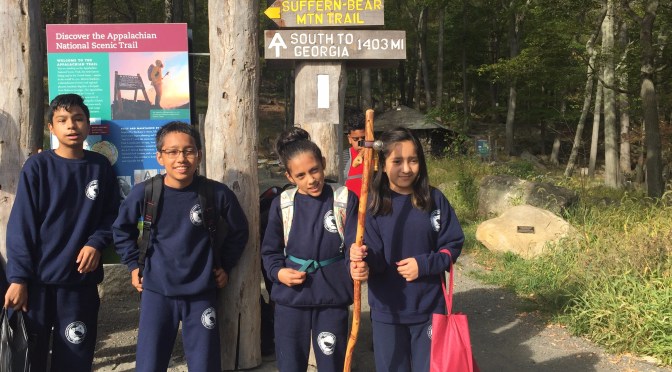
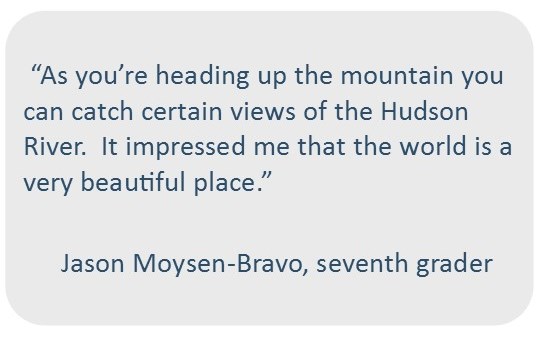
Since the fall of 2016, approximately 300 seventh graders from the P.S./I.S. 218 Rafael Hernandez Dual Language Magnet School in the Bronx have enjoyed an annual field trip to Bear Mountain State Park, thanks to the Connect Kids Field Trip Grant program run by State Parks. The hour-long journey from the school affords views of spectacular autumnal foliage and the Hudson River Valley to our urban students.
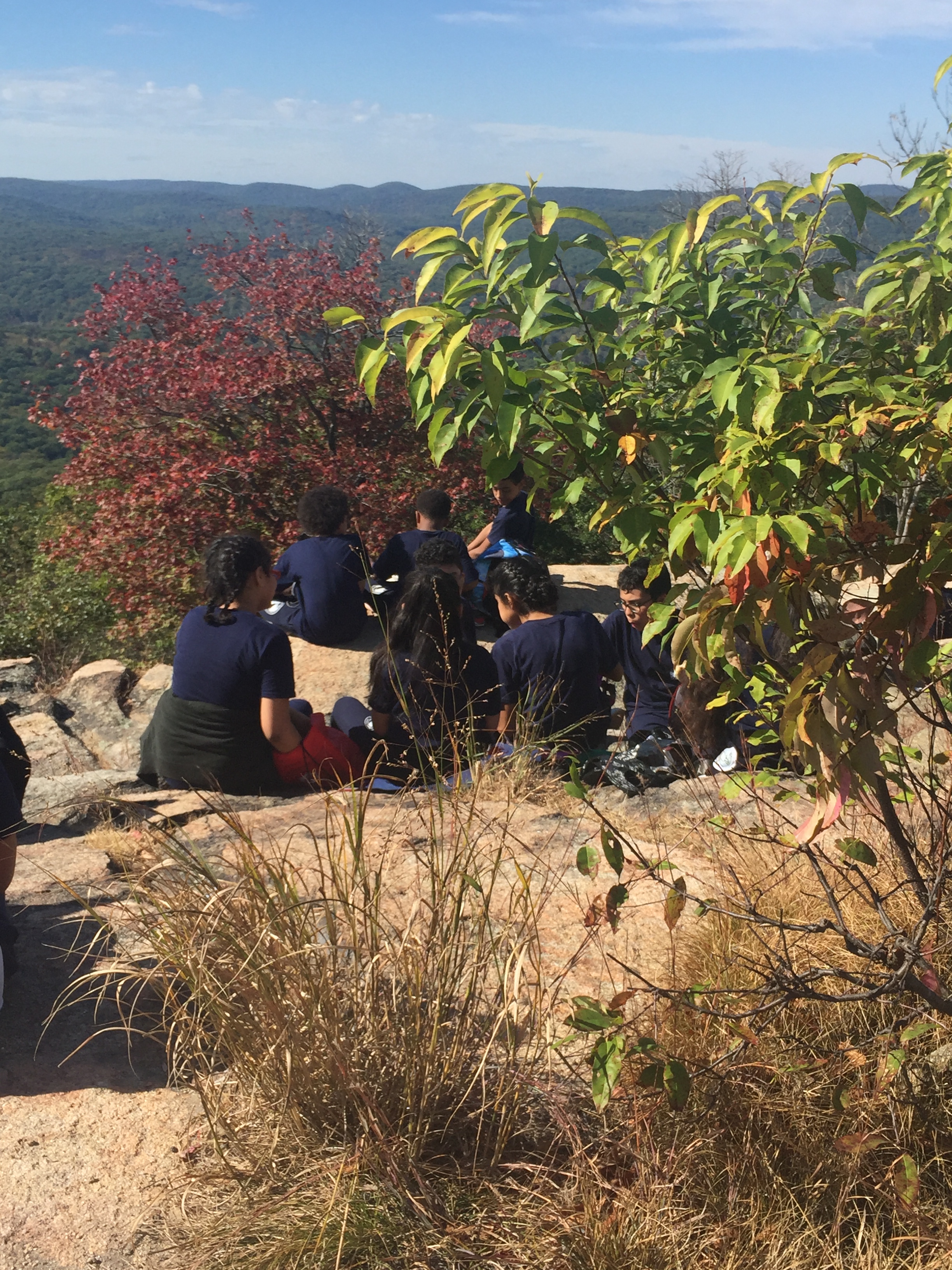
Students pause at the top of Bear Mountain, enjoying the views of the Hudson River
Arriving at the site the students divide into two groups: one group hikes a portion of the Appalachian Trail, while the other visits the animal exhibitions at the Trailside Museum and engages in organized outdoor play outside the Bear Mountain Inn. (Some of our students suffer from asthma and don’t choose the mountain hike.) They return to school thoroughly exercised, full of excitement from their experiences hiking or observing firsthand the animals at the Zoo. The trip coincides with an English Language Arts unit of study focused on memoir, or personal narrative. For many, the hike up the mountain has afforded the first opportunity to hike a woodland trail that our students have ever experienced, and they write about their experience and recall it throughout the year proudly.
Because we teachers applied late in the fall, we traveled to Bear Mountain in early December of 2016. The smell of the pines was intoxicating, but a light snow had just fallen, making the trail slippery and a bit treacherous on the way up. We conceded that the mountain top was beyond our reach that day, and did our best to lead the students back down the trail as carefully as we could. We wished we had foreseen the footwear that the students needed to better negotiate the trail under slippery conditions – some were wearing sneakers with little tread.
PS 218 students on the trail in early December
In our second year, we scheduled our trip in early October, and our mountain hikers encountered a blazing hot Indian summer day. Though we reached the top of Bear Mountain, a few children had inexplicably brought loaded backpacks, which created all kinds of challenges for our teacher crew. Yellow jackets were abundant near the picnic areas below; one student was stung! We realized later how much we needed to bring an abundant supply of water for the return trip home on the buses. Vomiting incidents drove home that there were risks related to the heat, but junk food and dehydration played a part as well.
This year, the buses were very late departing the school, which cut short our time and made it impossible to reach the top of the mountain. NYC morning rush hour traffic can be unpredictable; next year we will be sure to request our buses earlier. At the end of the day, a shortcut on a loosely pebbled trail led to multiple scraped knees.
Each year, we realize how we can plan better for the next! So, for your Kids Connect Trip, be sure you …
Require comfortable and appropriate footwear, depending on time of year; jackets if appropriate
Limit backpack weights. Test as kids leave bus (allow only lunches and a drink)
Outlaw sweet drinks, and chips or sweets for the ride! Students should eat a good breakfast!
Bring first aid kits for bee stings, cuts, bug bites
Stock an abundant supply of water on your buses
Secure contacts of individual bus driver
Remember your bus permit and paperwork to verify your site visit with a signature from Parks administrative staff
Post and photos by Heather Baker Sullivan, PS 218 Rafael Hernandez Dual Language Magnet School teacher
Iona Island, located along an elbow of the Hudson River in Bear Mountain State Park, is technically an archipelago of three islands connected by marshlands. Iona has had many owners in its storied history, prior to being bought by New York State in the 1960s. The Island was host to Native American tribes for thousands of years, who took advantage of the plentiful shellfish along its shores. In the last few hundred years, it has been the site of an unsuccessful vineyard, a hotel and weekend destination for NYC residents, a U.S. Navy arsenal, and a partially built park recreation area. The eastern side of the island past the railroad tracks has been closed to the public since the 1980s, but a small portion of the island consisting of the five remaining Navy buildings is used for storage for the Palisades Interstate Park system. The rest of the island has returned to a more natural state of woods, meadows, and rocky outcroppings and serves as a sanctuary for wintering bald eagles. The island achieved National Natural Landmark status in 1974, and was designated a NYS Bird Conservation Area and Audubon Important Bird Area shortly thereafter.
A key natural feature at Iona is the extensive marshlands, 153 acres in all, flanking its western side. Part of the Hudson River National Estuarine Research Reserve (HRNERR), this brackish tidal marsh (marshes with water that has different concentrations of salt depending on the tides) teams with life including fish, waterfowl, waterbirds, plants, and crustaceans. In recent times, the rich biodiversity of the marsh, including a number of state rare species, has been threatened by Phragmites australis, or as it is more widely known, common reed.
Common reed (Phragmites australis) is a plant that was likely brought to the US from Europe and Asia in the 1800s through ship ballast or the water taken in by ships to allow them to balance on long voyages. Commonly referred to as just Phragmites, this non-native plant is invasive in the U.S., displacing and crowding out native plant species, such as cattails, rushes, asters, and many others. In turn, the presence of this species has undermined the complex web of marsh dependent organisms.
The non-native Phragmites is identifiable by its tall stature, dark blue-green leaves, and tendency to form dense stands, with little to no possibility for native species to grow in the areas that they occupy. A native species of phragmites (Phragmites americanus) occurs in NY as well, but this smaller plant with reddish stems grows with less density so it does not crowd out other flora.
Iona Island Marsh in 2008 before treatment. Phragmites dominate the background.
The phragmites problem at Iona Marsh began in the early 1960s, when the first small colony appeared near a pipe draining into the marsh. Over the next 40 years, phragmites steadily expanded until it covered nearly 80 percent of the marsh area. Researchers tracking these changes noted a concurrent decline in marsh specialist birds and specialized brackish marsh plants, including state rarities. In an effort to reverse these trends, the Palisades Interstate Park Commission, while partnering with Hudson River National Estuarine Research Reserve and the Highlands Environmental Research Institute, started a New York State Department of Environmental Conservation (NYSDEC) funded management program in 2008 focused on a 10-acre test area. The goal was to reduce the invasive phragmites, and make room for native plants to once again occupy the area. If the program was successful in this small area (1/15th of the marsh), it could be expanded to additional marshlands.
A multi-faceted control and monitoring program has been developed and implemented and the results have been dramatic. More than 90% of the phragmites was eliminated within one year and nearly 97% by the third year. Researchers saw the return of huge meadows of annual native marsh plants, including some state-threatened species, followed by perennial cattail stands. Marsh specialist birds such as Virginia rail, least bittern (State-threatened), and marsh wren followed soon thereafter. Based on this success, the project was expanded to an adjacent 32-acre area of the marsh known as Ring Meadow. Both areas now have less than five percent Phragmites cover, an overall success on the journey to reestablish native vegetation.
Map of the Iona Island Marsh Treatment Areas
While complete eradication of the Phragmites may be impossible to achieve, success can be maintained through continued monitoring and spot treating remaining and new patches. Bird and vegetation surveys are conducted annually, as are measurements of sediment build-up on the marsh surface, as it relates to sea level rise. The goal remains to restore the native plant communities in the marsh to promote biodiversity. A healthy, native marsh community will lead to increased productivity and habitats for fish, birds, and mammals – many of them specially adapted to the brackish conditions at Iona. With continued management, the long-term outlook is positive for this Hudson River jewel, one of only four large brackish marshes on the Hudson.
Ring Meadow in 2016. Cattail and blooming Rose Mallow have regrown where phragmites once were.
Interested in seeing Iona Marsh for yourself? While public canoeing and kayaking are not allowed in the marsh itself to protect this unique place, through collaboration with the State Parks, NYS DEC offers free public canoe programs each summer. Not a fan of getting on the water? Iona Island is accessible by road. There is a parking lot approximately ½ mile onto the island, right before the railroad tracks (the boundary of the public accessible areas), where you can park and view the marsh. Lucky visitors may spot waterfowl, muskrats, frogs, turtles, wetland birds, deer, or even bald eagles!
Photo credit: PIPC Archives
Dr. Ed McGowan, 2017 Annual Report Iona Island Marsh




 New York State Parks and Historic Sites Blog