Tag Archives: thousand islands

Cast a Line at State Parks

From placid lakes and intimate mountain streams to broad rivers and sea-foamed saltwater coast, the state park system offers limitless fishing possibilities and the enticing prospect of “tight lines.” Striped bass, bluefish, salmon, trout, panfish and freshwater bass are but a few of the many popular fish species that can be fished for at state parks, with angling set amidst the backdrop of some of the state’s most compelling and dramatic natural scenery. 

For a reel-y good time: fishing is a whole different way to connect with the outdoors. Photo by Susan Lananger, Allegany State Park.

While some anglers may prefer the fall striped bass bonanza at Montauk Point, with its festive atmosphere and challenging rock-strewn shoreline, others may find flyfishing for brook and brown trout on the remote hemlock-lined streams of Allegany more to their liking. State parks additionally offer numerous options for recreational boat fishing. Launches for motorized boats are located strategically throughout the state on prime angling waters, along with smaller docks and launches providing lake and river access for canoes, kayaks and the like.

State parks offer anglers premier opportunities on two great lakes, the Hudson, St. Lawrence, Niagara and other smaller rivers, numerous streams and brooks, countless lakes of varying size and setting, and the saltwater shores of Long Island Sound and Atlantic Ocean. If there’s a fish to be angled for in New York State, be it fresh or saltwater, chances are good that it can be found in a state park.

Through I Fish NY, the New York State Department of Environmental Conservation helps New Yorkers understand the basics of fishing legally and offers opportunities to try the activity. Our parks often hold fishing programs as well. Read on for our guide to angling at state parks!

Continue reading Cast a Line at State Parks
Native Spring Wildflowers

Spring is in the air and with warmer temperatures come the spring flowers everyone hopes to glimpse.  Most of the flowers people have come to associate with spring are not native to North America though.  Crocus, daffodils, hyacinths, and tulips, for example, are all European flowers.  There are, however, many native plants that “spring” up at this time of year.

Native plants are valuable for a variety of reasons.  They contribute to the biodiversity and health of ecosystems and provide habitat for birds, insects, and other wildlife.  Also, as they are acclimated to the local environment, native plants are often hardier and require less care than imported plants.

As you walk through the woods this spring, look for native plants growing beneath the trees.  In 1936, Minna Anthony Common made a list of plants that were native to the Thousand Islands Region in the journal she kept detailing her work on the Rock Ridges Nature Trail in Thousand Island Park.  These three were among the native plants that were already growing along the trail when she began to work on it.

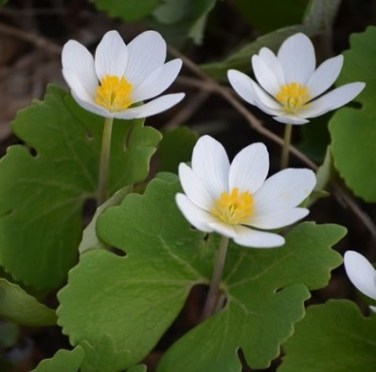
bloodroot

Bloodroot (Sanguinaria canadensis) has white flowers with 8 to 12 petals that are approximately 1¼ inch wide.  The flowers sprout on 3 to 6 inch stems through folded leaves.  The deeply lobed leaves open as the plant grows.  When the root of the plant is cut, it “bleeds” a reddish- orange liquid.  This is what gives the plant its name.  Bloodroot prefers moist soil and partial shade and is often found along the woodland edge.  At the Minna Anthony Common Nature Center, bloodroot can be found in the flower bed along the front of the museum building.

spring beauty

Spring Beauty (Claytonia virginica) has small (½ to ¾ inch) pink or white flowers with darker pink veins.  Each plant has a single pair of long narrow leaves.  These flowers also prefer moist woodland habitats.

roundlobe hepatica

Hepatica (Hepatica nobilis) is a member of the buttercup family.  It has ½ to 1 inch wide blue, pink, or white flowers and three lobed leaves.  Hepatica begins blooming in early spring and will continue to bloom into the summer season.  Hepatica prefers partial shade and is often found in woodland habitats.

If you are interested in learning more about native plants, visit us at the Nature Center.  We have a many books about native plants in our library and gift shop.  We also have a copy of Minna Anthony Common’s journal available for our visitors to read.  Best of all, we have miles of trails where visitors can see these plants in their native habitat.  The best way to learn about nature is to experience it.

Post by Molly Farrell, Nature Center Director at Minna Anthony Common Nature Center (Wellesley Island State Park).

Sources:

Common, Minna.  Rock Ridges Nature Trail: Record of the Trail, journal kept by Common while developing the trail system

Newcomb, Lawrence. Newcomb’s Wildflower Guide. Little, Brown and Company, New York. 1977.

USDA Plants http://plants.usda.gov (accessed 3/10/2015)

Minnesota Wildflowershttp://www.minnesotawildflowers.info/flower/virginia-spring-beauty (accessed 3/10/2015)

Prairie Moon Nursery www.prairiemoon.com  (accessed 3/10/2015)