Tag Archives: Wildlife

Plover Stewards: Guardians of the Endangered Piping Plover

Twenty miles east of New York City, on Long Island, over six million people every year head to Jones Beach State Park for some fun in the sun. This popular beach also happens to be one of the most popular spots in New York State for the endangered Piping plover to nest. The Piping plover is a small, sandy colored shorebird with yellow/orange legs, and a black band strapped across its neck. After they arrive, they chow down on a diet made up of mostly invertebrates (think insects and mollusks), and make their homes at the base of the dunes. Unfortunately, due to extensive hunting in the 19th century for their feathers along with increased beach recreation post-World War II their populations have seen a steep decline. Plover stewards are tasked with reversing this downward trend and protecting these shorebirds from the bevy of visitors. Every summer, the conservation efforts begin with the construction of a “symbolic fence.”
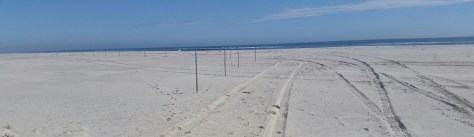
Tire Tracks
Symbolic fencing setup. Photo by Keegan Mobley

Symbolic fence is erected all along the beach in areas where plovers nest and is a simple combination of metal posts, orange string, and orange flagging. Once the fences are built and the plovers arrive, it’s up to the plover stewards to find the nests. Unlike a songbird, piping plovers nest on the ground in round, shallow depressions called “scrapes.” To create a scrape, male plovers walk around the dunes finding locations they would like to nest, then simply scoop out the sand with their feet. They make several scrapes, so females have a variety of spots to choose as a nest. Once they choose a scrape, the plovers will line the pit with shell fragments to reinforce the ground where the eggs will be laid. Plovers will leave and return to their scrape via the same routes forming “Highways.”

Plover stewards use observable highways along with sightings of broken wing displays to determine how close they are to a nest. Plovers feign being injured to draw attention away from their nest and chicks. They lure the predator to follow them by stealthily walking out of the nest and pretending to have a broken wing. As they parade, they tempt the potentially voracious animals away from the nest, only to fly away at the last second before being captured! Even though they use sneaky tactics, the plovers still need some help. So, every year plover stewards build shelters called exclosures around the nests which keep out hungry animals. SUNY College of Environmental Science and Forestry is conducting a study to assess the effectiveness of exclosures.  They do this by comparing predation of exclosed nests versus non- exclosed nests.

Exclosure
Installed piping plover nest exclosure. Photo by Kim Rondinella.

Come June, the exclosures become obsolete as the eggs begin to hatch. Newly hatched chicks can’t fly and are still in danger of being crushed by vehicles driving on the beach. Public vehicles are therefore not allowed on the beach during this time. At State Parks there is still a need for park vehicles to travel the beach for daily tasks, such as trash removal and maintaining the mounds of sand in front of the lifeguard chairs. Plover stewards escort the vehicles to help keep the chicks safe. It takes chicks between 28-35 days to fledge, or to learn how to fly. During this time the chick will transform from looking like a cotton ball on sticks to an almost identical version of its parents.
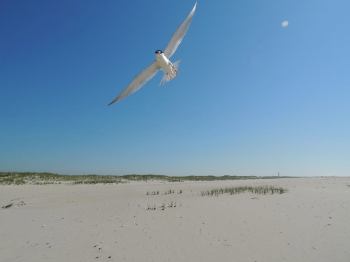
Least Tern
Least tern straight ahead! Photo by Kim Rondinella.

Long walks on the beach watching these plovers grow- up may sound glorious, but there are some occupational hazards to being a plover steward. During a plover survey walk it’s impossible to avoid another shorebird nesting in the dune habitat: the threatened Least tern. Unlike plovers, Least terns guard their nests viciously: dive-bombing, squawking, and even defecating on anything that comes near including a plover steward.  Yet there are strategies that a plover steward can use to happily coexist with the Least terns! These are including but not limited to walking slowly and confidently and placing a long stick in his/her backpack.

By the end of August, the plovers along with the Least terns will fly thousands of miles south for their annual migration. For many plover stewards it is hard to see these tiny shorebirds leave after months of meticulous observation. But they will be back next year!

Learn more about piping plovers in New York:

USFWS (THE REAL) PLOVERS OF NEW YORK

Post by Keegan Mobley and Allison Philpott, Jones Beach State Park Plover Stewards and Student Conservation Association members
Rebirth After Fire

Text and photos by Lindsey Feinberg, Student Conservation Association Intern at Sam’s Point  Please ask permission to use photos.

Located within Minnewaska State Park Preserve is Sam’s Point, an area of unique ecological significance encompassing roughly 5,000 acres in the Shawangunk Mountains of southern New York. Toward the end of April, during a particularly dry and windy week, a fire broke out along the Verkeerderkill Falls Trail and engulfed over 2,000 acres of pitch pine and oak woodlands. While this may seem like a devastating event, one of the factors that make the globally rare dwarf pine ridge ecological community of Sam’s Point so unique is that it is a fire dependent ecosystem.

Since progressing into the deep summer months, Sam’s Point has experienced an explosion of new growth. Toward the end of the fire there was an extended period of cold rainy weather that continued for a week after the fire was out. Soon afterward , bracken fern (Pteridium aquilinum) fiddleheads began springing forth through the burned earth and painted trilliums (Trillium undulatum) flowered near the Ice Caves trail in an area of low intensity burn. A number of pink lady slippers (Cypripedium acaule)  also popped up along the Loop Road and the Verkeerderkill Falls Trail.

Sam’s Point was fully closed until Memorial Day Weekend, when it was reopened to limited capacity with only the Loop Road and Ice Caves Trail available to the public. Park staff members were positioned at the Verkeerderkill Falls Trail with a table of educational materials in order to encourage park patrons to obey the closures and help them understand the importance of staying out of affected areas. The main concern is the potential for rapid spread of non-native invasive plant species by seeds hitchhiking in the boots and backpacks of visitors. Without competition from established plants and with the increased availability of nutrients that follows fire, invasive species have the potential to quickly establish.

Fortunately, the closures seem to be working and few invasive plants and many native species have been seen in those areas. Blueberries (Vaccinium spp.) and huckleberries (Gaylussacia baccata) have been quick to return, along with chokeberries (Photinia melanocarpa), serviceberry (Amelanchier sp.), wild raisin (Viburnum nudum) and sheep laurel (Kalmia angustifolia), which have repopulated the understory in a carpet of vibrant green. Rhodora (Rhododendron canadense), a small, showy rhododendron that is threatened in New York State, has been proliferating in high numbers in some of the wetter areas of Sam’s Point. Even bunchberry (Cornus canadensis), a wildflower more typical of cool, moist woodlands and uncommon in southern New York, is coming back near the Indian Rock Trail.

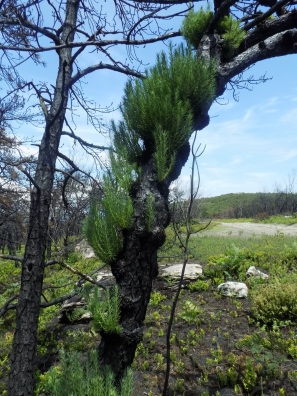
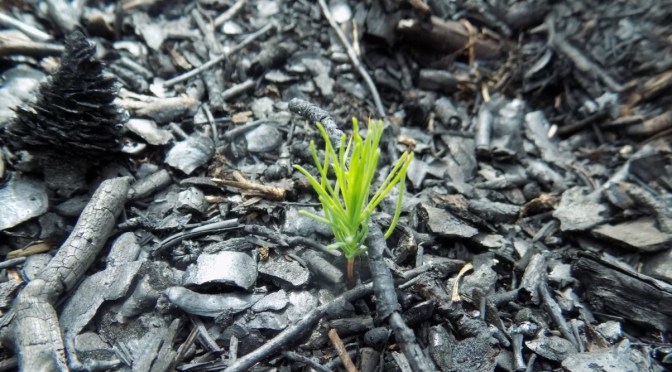
Many of the pitch pine trees that were blackened and scorched, all of which looked ostensibly dead, have exhibited new growth occurring at the base, epicormically (along the trunk), and from the top of the tree. Walking along the loop road, hints of long bristly shoots resembling bright green porcupines are apparent on a number of blackened trees. The majority of pitch pine stumps that were cut for fire control purposes have also begun re-sprouting.

New Shoots on Pitch Pine
Pitch pine is not the only tree sending out new shoots—scrub oaks, birches, red maples, and aspens are also exhibiting basal sprouting on burned trees. Quaking aspen seedlings have shot up in areas along the loop road, exhibiting strange early growth patterns of large, red tinted leaves. Photo by Lindsey Feinberg

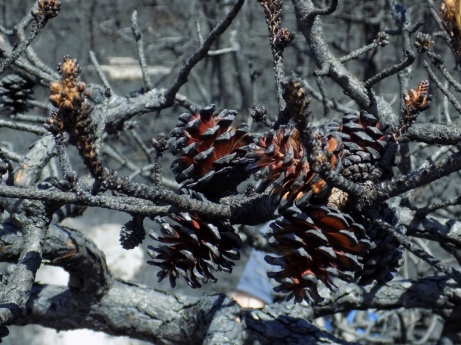
Equally important for the ecology and continuance of the globally rare dwarf pine ridge community  is the successful germination of pine seeds. As pitch pines get older, they lose their ability to re-sprout. Many older pitch pines will experience a wave of mortality even after new shoots appear. Possible reasons for this subsequent mortality of pitch pines is that a burned tree tends to be more stressed, and may not as resilient to any new factors that can further increase stress, such as insect predation and extreme weather events. Additionally, new shoots probably won’t distribute evenly on each tree, and this added weight on a weakened tree can cause branches to break or the entire tree to topple over. But there is still hope. The closed, charred pine cones opened soon after the fire ended, their russet innards contrasting brightly against the blackened landscape. The seeds were dispersed and fell to the ground. In order to germinate, pitch pine seeds need to be exposed to mineral soil. This is usually achieved when a fire burns through the upper duff (dead leaves and other plant material) and organic soil layers, which are more likely to burn when the fire is allowed to continue for long enough and reach a hot enough temperature. Until recently, the park staff at Sam’s Point had been unable to find any seedlings despite nearly half of the acreage on Sam’s Point being burned.

Pitch Pine Cones
Newly opened pitch pine cones along the Indian Rock Trail. Photo by Lindsey Feinberg

But how do you monitor 2000 acres for seedlings? You don’t. Instead, you look at a sample. One of the first post-fire initiatives by Parks’ Sam’s Point research staff was to establish 20 randomly placed research plots in order to document forest regeneration and the recovery of this natural area over time. Returning to the plots and recording information on the plants and soil helps us to understand and learn more about this ecosystem. In addition, we established photopoints in four of the research plots. Since May 7th, we have been photographing four plots from the same location on a biweekly basis. Photopoints are a great supplement to research documenting change over time, as it provides a way to visually understand what changes are taking place.

This slideshow requires JavaScript.

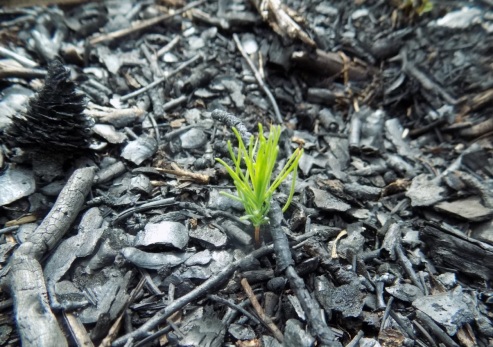
Sampling is scheduled to begin sometime in August, but one of the most exciting aspects of establishing randomly placed plots is discovering unique areas that might otherwise go unnoticed. During our fieldwork we found several areas of pitch pines averaging only 4 feet tall. Upon further examination, we discovered that the soil was extremely shallow in those spots, as little as 2 inches over solid bedrock. In July, none of Sam’s Point staff had seen any new seedlings during their regular duties around the park, but after checking in on the sections with low soil depth we were able to find a good number of seedlings. And soon after, seedlings were found in some of the wetland pockets as well. All good news for the recovery.

Pitch Pine Seedling
A pitch pine (PInus rigida) seedling finally appears, several months after the fire. Photo by Lindsey Feinberg

Sam’s Point has a number of unique, highly acidic wetlands too. While the larger pockets were relatively untouched by the fire, the smaller outflows were more vulnerable, especially in areas of extremely shallow soil. However, the wet areas that were burned along High Point Carriage Road and some other narrow strips of wetland have begun exhibiting their wetland qualities once again. Sphagnum moss, a characteristic moss genus found in bogs, has returned in some of these areas, while tiny sundews (Drosera spp.) can be seen on both the newly grown moss and the saturated but still blackened soil.

Animal activity was apparent almost immediately. The prairie warblers’ ascending trill could be heard throughout the spring in all areas of the preserve. Insect and pollinator activity has been high, especially with the return and subsequent blooms of milkweeds and meadowsweet. Park staff also noticed a number of ruffed grouse, which like forest openings. The remains of chewed up pine cones littering the forest floor are evidence of red squirrels. Eastern towhee activity was also high in the period immediately after the fire. Towhees are a species of bird that feed on pitch pine seeds as they are released from their cones. Amphibians could be spotted burrowing into the moist ground in order to keep cool.

During a fire and the initial period afterward, it is easy to focus on the destruction and negative impacts. However, it’s important to remember that fire is a vital ecological process in many environments, especially for the health and longevity of pine barren communities. The Sam’s Point Fire offers great opportunities for discovery. Researchers from the Shawangunk Ridge Biodiversity Partnership, Mohonk Preserve, The Nature Conservancy and nearby colleges like SUNY New Paltz met to discuss research needs and interests to inform management and increase our knowledge about this exceptional place and ecosystem. It’s exciting to see what the future holds for Sam’s Point.


All About the Brook Trout: New York’s State Fish

Plants for Our Pollinators

New York State Parks is abuzz with excitement for pollinators.  From June 20-26, we celebrate both National Pollinator Week and New York State Pollinator Awareness Week.  Our local bees, butterflies, moths, birds and other pollinators are to thank for most of the food we eat, as well as for many of the trees and flowers we enjoy every day.  As these animals go from flower to flower to drink nectar, they accidentally carry sticky pollen from the anthers to the stigma, the male and female parts of flowers.  This fertilizes the eggs, which grow into seeds and fruits that we enjoy.

One of the ways you can show appreciation for these fantastic pollinators is to get out to natural areas in State Parks and enjoy the native flora.  You can also explore native plant gardens and learn more about using native plant species in your own backyard to attract pollinators.  Last year we paid homage to a few of our favorite New York pollinators.  This year, let’s have a closer look at some of the plants and the pollinators that visit them.

Just as pollinators come in all shapes and sizes, so too do the native plants that they enjoy.  Different plants attract different types of pollinators.  Look for all kinds of flowers in the woods, wetlands, meadows, gardens or orchards and you are apt to see some pollinators at work.  Below are some of the native pollinators and flora found in State Parks, with photos from the NY Natural Heritage Program.   NYNHP works in partnership with State Parks (OPRHP) to assess and conduct inventories of natural areas in state parks and helps to protect habitats that support common and rare species alike, including these important pollinators.

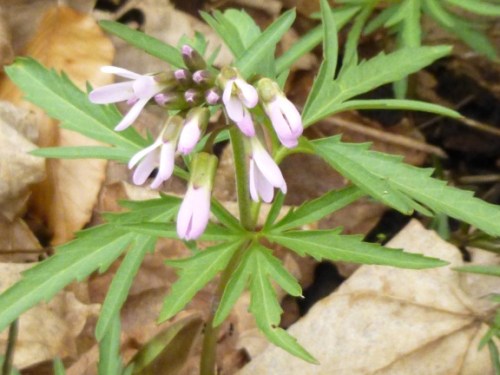
Cutleaf toothwort
Pollinators emerge as soon as there is nectar available for them to feed on. This native wildflower, cutleaf toothwort (Cardamine concatenata), was blooming the first week of April. Photo by J. Lundgren, NYNHP.
Pink Lady Slipper
Pink lady’s slippers (Cypripedium acaule) bloom in June and are pollinated by various kinds of bees. Photo by T. Howard, NYNHP.
wild geranium
A Juvenal’s duskywing (Erynnis juvenalis) feeds on wild geranium (Geranium maculatum), a common native wildflower of woods and openings. Photo by K. Perkins, NYNHP.
Azure Butterfly
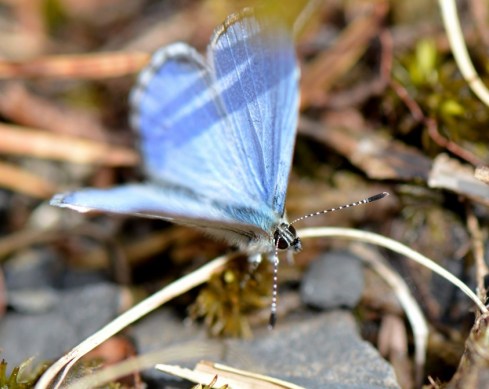
The more showy spring azure butterfly emerges early in the spring and can be seen flitting about sunny trails and open areas. Photo by M. Adamovic for NYNHP.
Goldenrod
Bumblebees (Bombus spp.) are one of the most effective pollinators. You can see how the pollen sticks to its fuzzy body as this bee feeds on the nectar of this native goldenrod. Photo by J. Lundgren, NYNHP.
Ragwort
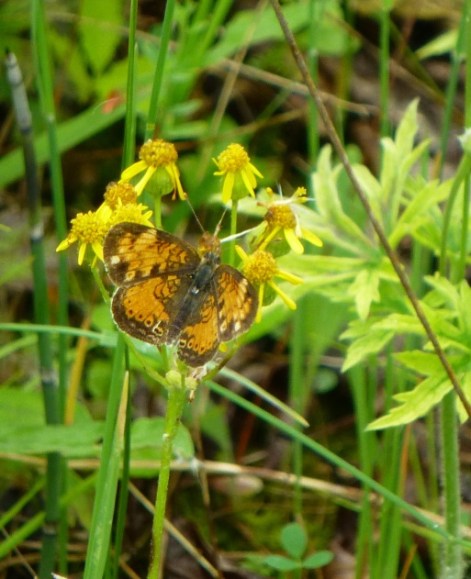
A Pearl crescent butterfly (Phyciodes tharos) feeds on ragwort (Packera aurea) that grows along river shores and wet areas. Photo by J. Lundgren, NYNHP.
Bedstraw
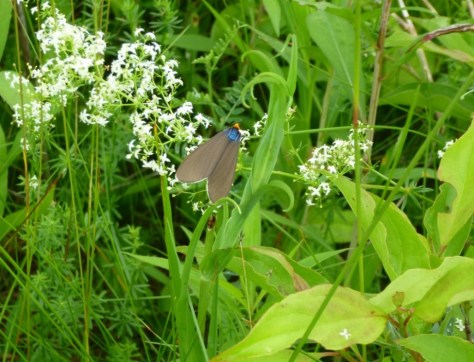
Moths help pollinate too. Though most moths prefer night, this one is a daytime moth, seen here feeding on bedstraw (this one is non-native, but we have some native bedstraws too) and moving the pollen around in the process. Look for this native moth, the Virginia Ctenucha (Ctenucha virginica) in meadows with flowers from May to July. The caterpillars feed on grasses, so unmown meadows can provide everything this moth species needs year-round. Photo by J. Lundgren, NYNHP.
NE Aster
In late summer and fall, the bright colors of asters and goldenrods are especially attractive to bees and many other insects. The native New England Aster (Symphyotrichum novae-angliae) blooms from August to September. This one is being visited by the Common Eastern Bumble Bee (Bombus impatiens). There are many species of bumblebees, but this one is by far the most common in the state, so the one you are most likely to see. Photo by J. Lundgren, NYNHP

Whether you are a hiker, gardener, farmer, or food-lover you can enjoy and support our local pollinators!  Maintaining natural areas, meadows or gardens with a variety of plants can help to sustain all the life stages of a wide range of insects from bees to butterflies.

If you are interested in creating a backyard oasis for native pollinators, look for plants that are native to your area of the state and, if possible, grown near where you live.  Consider planting different types of flowers; gardens with an array of flowers blooming at different times provide food for a variety of pollinators throughout the season.  Look for white, yellow or blue flowers to attract bees.  Red tubular flowers attract hummingbirds (bees don’t even see red).  Butterflies prefer bright flowers, particularly reds, oranges, and purple (like fall asters).  Moths are attracted to white, purple, or pink flowers with strong, sweet scents, especially those emitting a scent at night.  See resources below on pollinators and native plants in your area.

State Parks is celebrating pollinators at these events across the state:

Clay Pit Ponds State Park – Time Tuesdays, June 21 @ 10am

Learn about our native pollinators by making crafts, playing games, and socializing with other toddlers! Parent or care giver is required to stay. Ages 1-3 (flexible).  Please call (718) 605-3970 ext 201 for more information.

Saratoga Spa State Park – Butterfly Walk Friday, June 24 @2:00pm

Did you know restoring a habitat is like building a neighborhood?  Come enjoy a light hike at the Karner Blue site and learn what butterflies live in the same neighborhood as the Karner Blue butterfly.  Please wear hats and sunscreen.  You may want to bring binoculars or a magnifying glass to see butterflies up close.  This program is appropriate for ages 7 and up.  Registration is required.  Please call 518-584-2000 ext. 122. This program is free.

Thacher Nature Center – Honeybees Are Buzzin’, June 25 @ 2pm

Summertime brings flowers and a hive packed with activity! Come and learn all about honeybees as you view the colony in our indoor observation hive. See the busy workers, the specialized drones and the ever-important queen bee in action! Learn how to dance like a bee, and view the world from a bee’s perspective. Afterwards, take a walk to observe our honeybees at work in the gardens. Please register by calling 518-872-0800.

Letchworth State Park – Butterfly Beauties, June 26 @ 2pm

Study the beauty and composition of hundreds of dried butterfly specimens representing most of the world’s butterfly families. Dozens of local and New York species, as well as those found in the Niagara Parks Butterfly Conservatory, are specially noted. Butterfly structure and local natural history will be featured in two new butterfly videos. This is an excellent primer for the Butterfly Walk on July 9th. (Look for details in the upcoming summer issue of The Genesee Naturalist.) All workshops meet in the Conference Room in the Visitor Center and Regional Administration Building located in Letchworth State Park.  Please call (585) 493-3680 for more information.

Ganondagan State Historic Site – Planting for Ethnobotany Workshop Saturday, August 6, 2016 @9:00am-11:00am

Participants will help plant native plants in the Green Plants Trail and the Pollinator Grassland at Ganondagan.  Ages 8 and up. Registration Required.  Please call (585) 924-5848 for more information.

For more about pollinators and native plantings:

 General Information

Confronting the Plight of  Pollinators

Gardening and pollinator information

— New York’s famous apple orchards would be naught without our beloved pollinators 

New York State Parks Native Plant Policy

 New York State Flora

— Have a plant to identify? Try GoBotany

Native plants for pollinators, by region

Please note, some of the plants listed in this resource are native to the ecoregion but not to NY state. Please check the NY Flora Atlas to confirm which are native to New York before choosing your planting list.

NY Flora Atlas – list of plants known in NY and which are native or not

Pollinator Identification Tools

— Have a bug to identify? Try BugGuide

— Xerces Society for Invertebrate Conservation Northeast Region Pollinator Plants

+++++++++++

Post by Erin Lennon, OPRHP and Julie Lundgren, NYNHP

Bird Banding at Crown Point State Historic Site

The small girl skipped ahead of her family on the grassy path toward the bird banding station, a couple of picnic tables covered with a canopy, with two tents pitched nearby.   Five rows of mist netting were strung along alleys in the dense brush, with hopes that birds would fly into them and get caught so that they could be studied, banded, and released.  Master bird bander Gordon Howard sat at one of the tables with a tiny bird in his hand, a book open in front of him.   He gently stretched the wing feathers to look for different color patterns and signs of wear to help him determine the age of the bird.

The girl and her family walked up to Gordon, and he smiled and explained what he was doing.   When he was finished, he asked if she would like to hold and release the brightly colored male yellow-rumped warbler.  She nodded her head, and Gordon showed her how to gently wrap her small fingers around the bird’s neck and body so that it would not be injured.  A broad smile spread across her face as she felt the soft, warm feathers and the rapidly beating heart of the bird.  Her parents took pictures, and then Gordon told her to gently toss the bird into the sky and let go.  The warbler flew from her hand right back into the hawthorn shrubs and began feeding, preparing for its migration further north.   Although the bird had left her hand, the memory never left the child.

Bird banding began at the Crown Point State Historic Site 41 years ago by J.M.C. “Mike” Peterson.  Spring migrant birds have been monitored here every year since for two weeks in early to mid-May.   Over 17,000 individual birds of 106 different species have been banded here, with each bird receiving a small metal band with a unique identifying number that is placed around its leg like a bracelet.  Information on each bird that is banded, such as species, sex, age, and condition, is forwarded to the U.S. Fish and Wildlife Service, which oversees all bird banding in the United States.  If the bird is ever found again, the band number can be reported to the USFWS and much can be learned about the bird’s movements.  The current main banders are Gordon Howard, Gary Lee, and Tom Barber, with help from several other banders and a number of volunteers.  Visitors are welcome from 7 AM to 5 PM every day of the season, which runs this year from the afternoon of May 6 to the morning of May 22.  Educational programs about birds and bird banding are offered to school groups, birding clubs, and civic organizations.  Reservations for these are arranged by contacting Gordon by email at ghoward@clemson.edu.

Bird banding has several values, including education, determining bird longevity, and figuring out migration routes.   The Crown Point peninsula that juts north into Lake Champlain is an excellent place to capture and study migrating birds, because birds concentrate here to feed and rest on their journey northward each spring.  Many of these songbirds wintered in South or Central America, and are migrating to their summer breeding ranges in New York, New England, and Canada.

If you go to visit, the best time of day is early to mid-morning.  Calm, dry days are usually better than windy, wet days.  Park in the lot by the museum, and walk up the blacktop road toward the barns.   Then follow the signs that direct you onto the grassy path to the banding center which is tucked in by the brushy edge.  Wear casual clothes and boots or shoes that can handle mud.  Bring your family, a camera, binoculars, and your sense of wonder.

Post by Ellie George, volunteer with the Crown Point Bird Banding Association

Photos were supplied with one time use permission from the photographers Ellie (Eleanor) George and Thomas Barber.
.