On the second weekend in March with spring in the air at Letchworth State Park, maple sap was being boiled down into tasty syrup in the newly built sugar shack at the park’s Humphrey Nature Center. Maple weekends were coming soon, and many gallons of syrup were needed to treat hundreds of visitors expected for outdoor education programs in one of western New York’s most popular State Parks.
But the next day, the sugar shack at Letchworth went cold. Because of emerging COVID-19 pandemic, Parks workers were told to immediately start working remotely from home. So public events at State Parks like Maple Weekends were cancelled. And a completely booked public field trip season at Letchworth for May and June disappeared as well.
If people could no longer brought to nature by park naturalists, perhaps those naturalists could bring nature to people remotely?
Immediately, newly hired NYS Parks Corps member Conrad Baker tapped prior video production experience to make a weekly video series called ‘Nature Detectives,’ for Letchworth State Park’s Facebook page. The approximately five-minute videos invited viewers, especially kids, to use their senses, or ‘nature tools,’ to make observations, or ‘notice nature clues’ about a mysterious plant, animal, or fungus found outdoors. Then, the video solved the mystery and encouraged viewers to find the same species in their own neighborhoods.
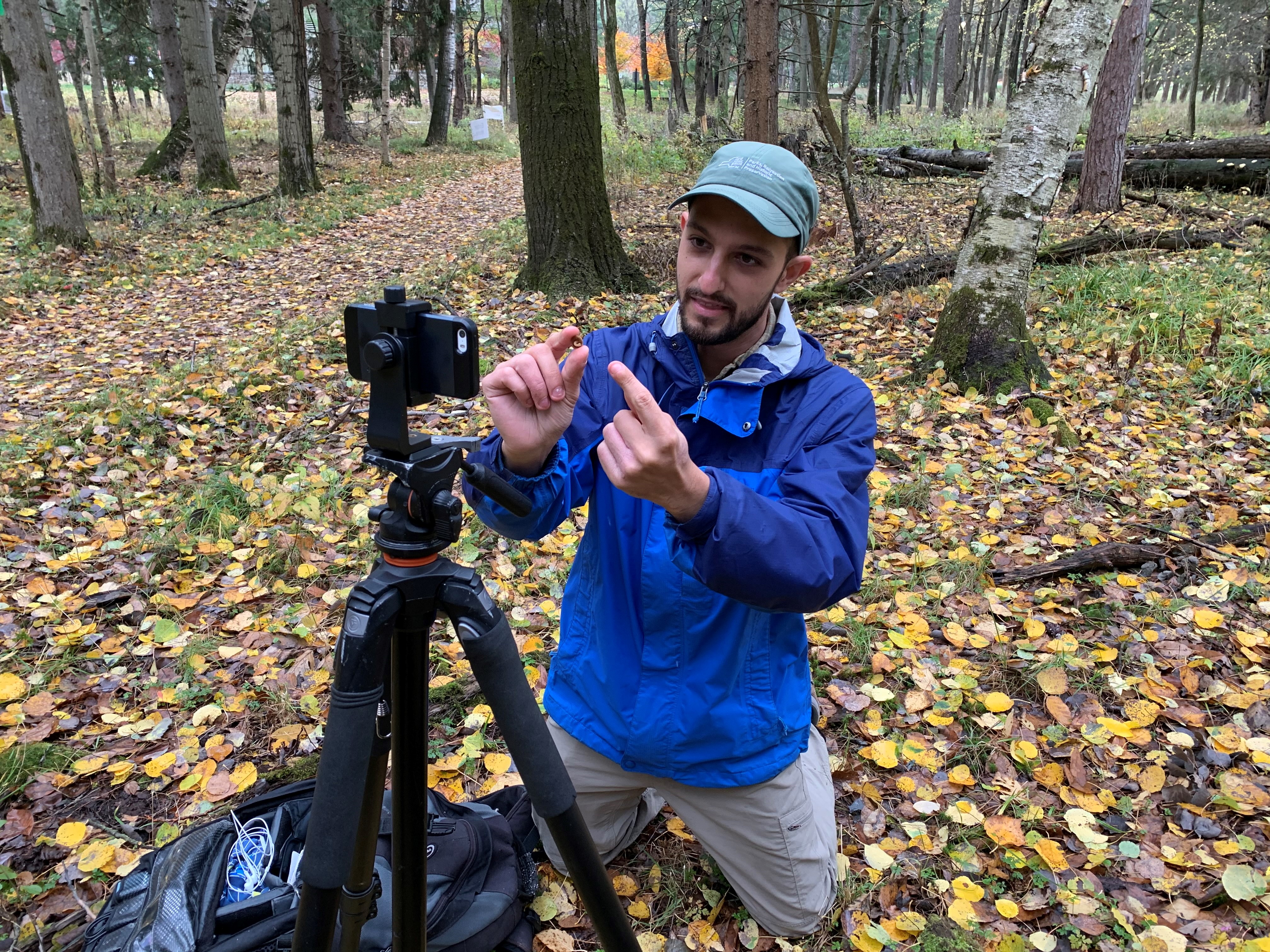
Conrad Baker tees up a video for the Nature Detective series on the NYS Parks Facebook page. (Photo credit – NYS Parks)
While using these videos satisfied the Park’s short-term goal of providing some safe, educational public programs, none of the Nature Center’s field trips were happening for the foreseeable future. But within this challenge lay an unexpected opportunity. Now unable to deliver in-person programs as usual, Environmental Educator Elijah Kruger could use the sudden schedule vacancies to adapt existing field trip lesson plans into safe, immersive, virtual programming. With Baker at the camera, Kruger took to the field.
Letchworth State Park educators and interpretive staff Mike Landowski, Steph Spittal, Karen Russell, Sandy Wallace, Doug Bassett, and Brian Scriven reviewed draft videos and gave crucial program design advice.
There are currently five virtual field trip videos on the NYS Parks YouTube channel. The playlist is accessible here.
Since previous records showed that the topics of Geology, Mammals, and Invasive Species were the most in-demand field trips, those videos were made throughout April and May, and released June 1. Next came more scientifically complex field trips about the natural world and the human relationship with it. A field trip on Forest Ecology was released Sept. 18. Life of the Monarch butterfly is the most recent to go up.
Normally, an in-person Geology field trip group would hike about three quarters of a mile between several gorge overlooks, with the trip taking about 90 minutes. But using video, viewers can move instantly between overlooks and cover the entire field trip in detail in 20 minutes. This work pushed the limits of cell phones, birding cameras, free editing software, and existing office supplies that had to take the place of top-end video gear.
A Mammalogy field trip group is often stationary, sometimes even inside the Nature Center. An educator invites the field trip group to see and feel up-close details of mammal furs and skulls to learn more about their adaptations and roles in the ecosystem. On video, such furs and skulls are presented next to real-world outdoor signs left by these animals. Close-up cutaway shots were key to highlight the animals’ homes, scat, and habitats. Deep detail in teeth, bones, and furs were only visible by building on the right cutaways.
Previously, in-person Invasive Species field trip groups never hiked through the territory now covered by the Invasive Species virtual field trip. This third field trip video was an opportunity to use cutaways and editing to visually capture complex, multi-stage forest succession changes, like deer overbrowsing, in which deer damage the ecosystem by eating away at all the young trees and shrubs.
And some improvisation was needed to get the right shots. By using rubber bands to attach lenses to cell phone cameras, close-ups showed fine details in macro shots, like crawling ticks and the hemlock wooly adelgid, a tiny insect that threatens the health of helmlock trees.
Previously, a Forest Ecology field trip group would walk about a half-mile of forest trail around the Nature Center, noticing content-relevant animals, plants, fungi, and environments along the way. Field trip video now assembles a kind of “best of” experience, with exceptional examples of lichens, woodpecker holes, short-lived fungi and quick glimpses of animals from miles apart and over several weeks into one cohesive experience.
The Life of the Monarch video is the culmination of skills and tools picked up from the four previous videos. The segments are carefully assembled from footage that was shot miles and weeks apart. Close-up cutaways show monarch butterfly handling and tagging. Footage of feeding caterpillars, time lapses of metamorphosis, and slow-motion videos of butterfly releases tie together the story of these creatures’ lives and how they benefit us in unseen ways.
The pandemic encouraged our environmental education staff to do what they do best – adapt and use the tools at their disposal to serve park visitors with safe, enjoyable, educational programs. In-person programming is now resuming with safety precautions. Still, teachers are already starting to request virtual guided field trips, where park educators join classes via video chat to answer questions and match virtual field trip video content to their class lessons.
So, what was born out of necessity and imagination has now become a regular part of Letchworth State Park’s mission to bring education nature programming to anyone, no matter where they might live.
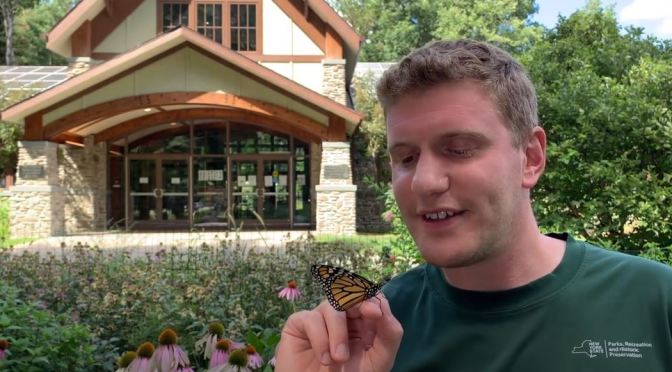
Cover shot – Letchworth State Park Environmental Educator Elijah Kruger with a Monarch butterfly. (Photo credit – NYS Parks)
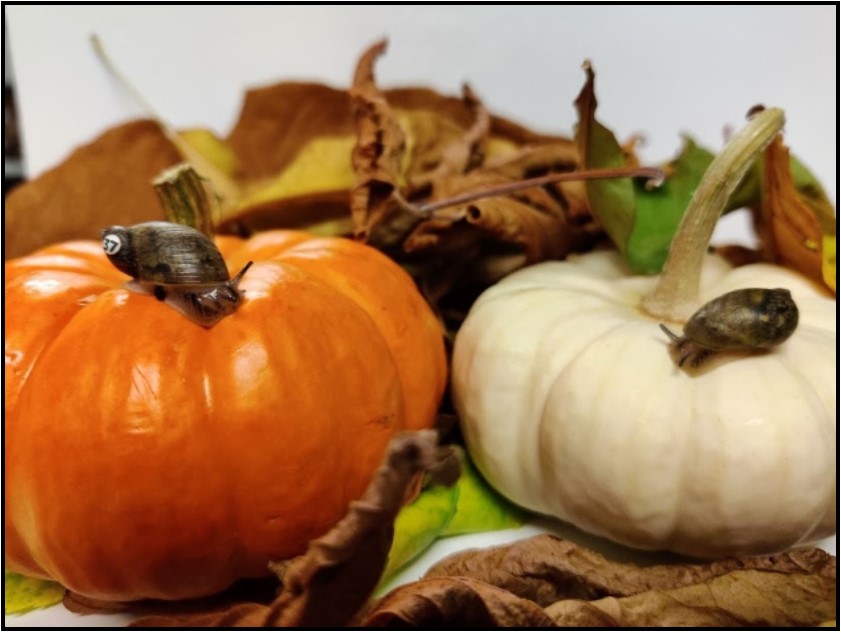
Since Ice Age glaciers retreated from New York nearly 12,000 years ago, a snail slightly larger than a dime has lived in damp, shaded and rocky terrain at the base of a towering waterfall in Madison County.
A moist and mild micro-habitat, the “splash zone” around the namesake 167-foot cascade at Chittenango Falls State Park is the last wild place on earth where the Chittenango Ovate Amber snail is known to exist. The species is named for its home; its ovate, egg-shaped shell; and its amber coloring.
A close-up of the Chittenango Ovate Amber Snail. There are currently about 100 of the tiny mollusks known to exist in Chittenango Falls State Park, the only wild place on earth with a known population. (Photo credit – SUNY-ESF)
The spray from the waterfall at Chittenango Falls State Park creates the moist and mild micro-habitat needed by the snail, which has occupied this place in Madison County since the last Ice Age. (Photo Credit – New York State Parks)
This delicate mollusk leads a precarious existence, as a population now estimated at less than a hundred faces threats from floods, droughts, rockslides, another species of snail, climate change, and even the feet of irresponsible hikers.
The snail was abundant when it was first discovered at the falls in 1905. By the early 1980s, the population was estimated at less than 500 individuals, and the population continued to plummet in the 1990s. The snail is listed as an endangered species by New York State and a threatened species by the federal government. Historically, the species was found in a handful of sites from Tennessee to Ontario, Canada, but now is known to only exist in New York.
To fend off potential extinction of what is affectionately known as the “chitt,” a captive breeding program started five years ago, supported by State Parks, SUNY College of Environmental Science and Forestry (SUNY-ESF), U.S. Fish and Wildlife Service, state Department of Environmental Conservation, and the Rosamond Gifford Zoo in Syracuse. Federal funding to support the program has come from the Great Lake Restoration Initiative.
Banding together on Facebook as the “Snailblazers,” these partners recently added another friend of the chitt – the Critz Farms brewery in Madison County, which has crafted an IPA dedicated to raise funds for the breeding program.
With each leisurely sip of the Endangered Species IPA, described as a “delightfully citrusy, medium-bodied beer,” funds go toward supporting a snail incubator program at SUNY-ESF in Syracuse and the hand collection of a mix of native plant leaves that form the diet of the finicky snail.
Since the program started, nearly 2,000 snails have been propagated in climate-controlled incubators at both SUNY-ESF and the Rosamond Gifford Zoo in Syracuse, said Cody Gilbertson, senior research support specialist at SUNY-ESF. Due to COVID restrictions this year, the zoo incubator program was consolidated into SUNY-ESF.
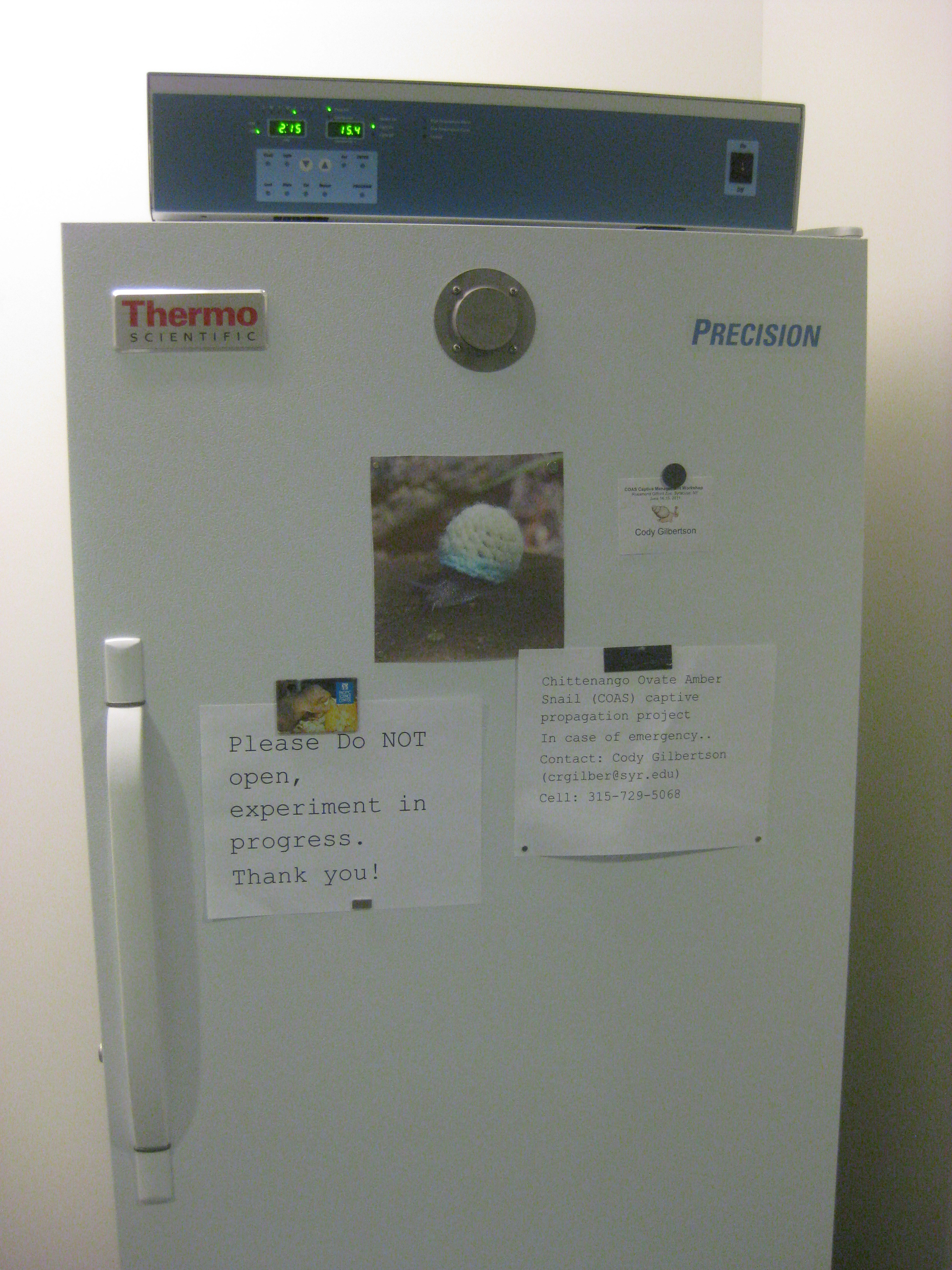
During field research at Chittenango Falls, SUNY-ESF researcher Cody Gilbertson holds an Ovate Amber snail (below). The captive-bred snails reside in a climate controlled unit back at SUNY-ESF in Syracuse. (Photo Credit – SUNY-ESF)
Of the captive-bred chitts, slightly more than 400 have been released into the park during this time, some as hatchlings and the rest as adults capable of reproduction. Even with these efforts, the snails are barely hanging onto their foothold.
About 500 snails reside in the incubators currently, protected as a “backup” population should some dire circumstances extinguish the Chittenango snails. Hundreds of snails have already lived their entire natural life spans – about two years – in the incubators.
In the breeding facility at SUNY – ESF, young snails live on moistened paper towels containing a calcium powder to promote shell growth (left). Leaves are added later to the snails’ plastic storage containers (center), which are kept inside a climate-controlled unit (right). (Photo credit – SUNY-ESF)
When breeding started, there was an estimated population at the falls of about 350 snails, said Gilbertson. The most recent counts are now at about 100.
The habitat zone, a mix of boulders that have fallen from the limestone cliffs, is consistently moist from the mist of the falls. That nurtures water-loving plants, including a number of native wildflowers, including the snail’s favorite, Joe-Pye weed (Eutrochium purpureum), said Delaney Kalsman, project coordinator at State Parks.
Joe Pye weed, a favorite food of the snail. (Photo credit – State Department of Environmental Conservation)
Located along the park’s Gorge Trail, this area is fenced off and marked against trespassing. Anyone entering the area without authorization can be prosecuted under New York State Environmental Conservation Law and the federal Endangered Species Act.
Another count of the snail population is set for the summer of 2021, said Kalsman. The number of snails has been declining in recent years, with possible explanations including competition from a species of invasive snail and climate change.
“The environment is experiencing longer drought periods, reducing the flow and spray of the falls which the snail relies on,” she said. “When it does rain, large flooding events are happening at greater frequencies. In 2017, a major flood washed away large portions of Joe-Pye weed.”
Within such a small home, a potential extinction-level event can show up quickly. Such events like the 2017 flood, along with the other threats, put the chitt as “severe threat of extinction,” Gilbertson said. “This threat is further amplified because the entire wild population exists only at Chittenango Falls State Park.”
To propagate more snails, Gilbertson needed to understand what they ate from the flora and fauna around the falls. She learned the snails preferred the fallen leaves of black cherry trees collected in early spring, as well as leaves from pignut hickory, sugar maple and ash. And snails needed certain species of leaves at certain times, and at certain stages of decomposition. So, SUNY-ESF and Parks staff needed to collect leaves regularly and maintain a kind of “compost” menu for the snails. The leaves are stored dry and then rehydrated as needed.
“This diet for our snails is more natural than a synthetic paste or vegetables that is used in many other captive invertebrate programs. Survival was boosted by this natural diet,” she said.
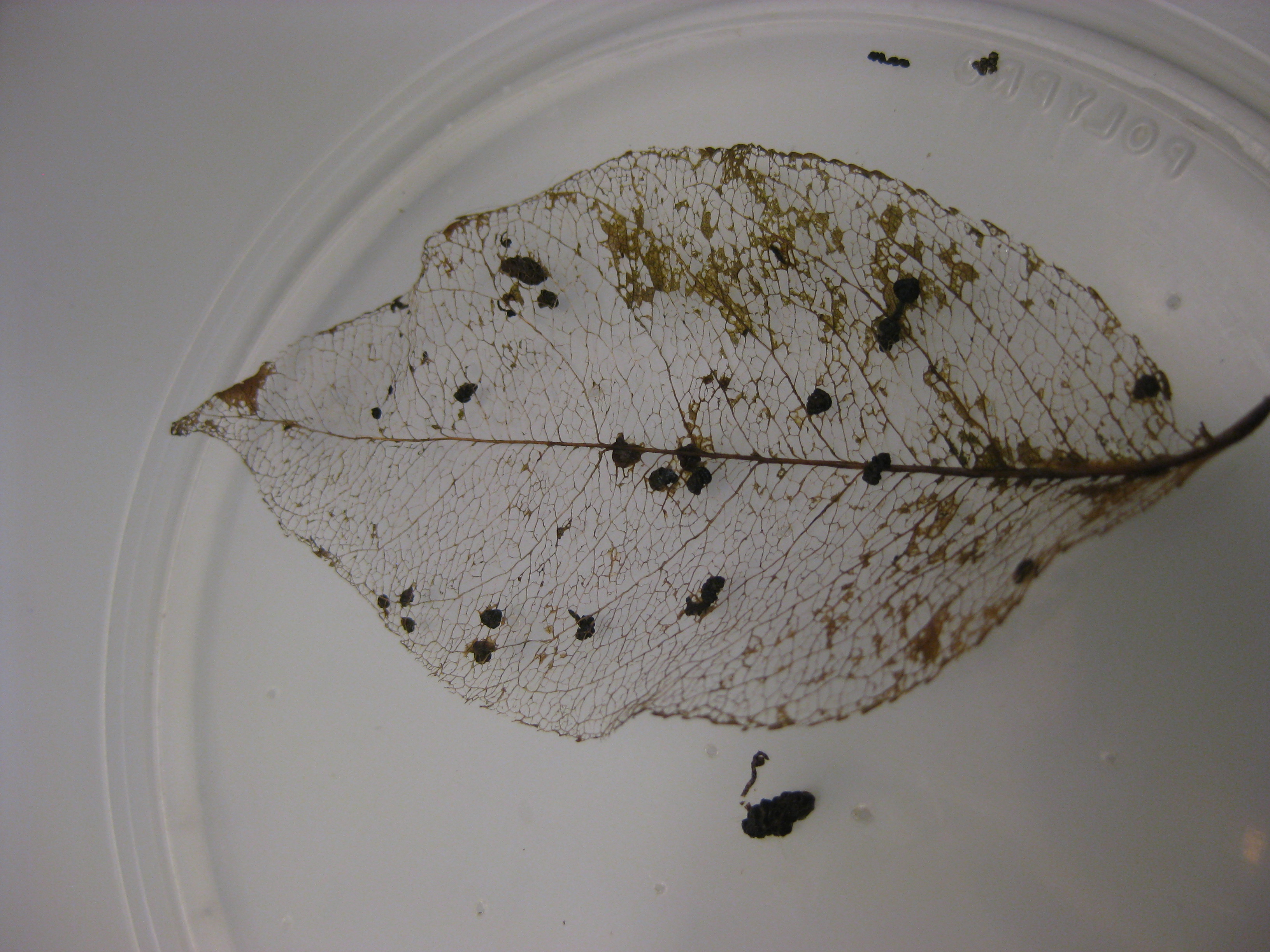
A black cherry leave after being consumed by numerous snails. (Photo credit – SUNY-ESF)
State Parks staff is now designing a “garden” of native trees and plants in the park to supply the optimal forage that can be brought to the snails, as part of the efforts spearheaded by Kalsman, park Operations Manager Shawn Jenkins, and SUNY-ESF FORCES (Friends of Recreation, Conservation and Environmental Stewardship) stewards Jordan Stransky, Sarah Petty, and David Rojek.
(And for the curious: Snails have a form of teeth, called “radula,” which is Latin for “little scraper.” The radula is a tongue-like ribbon with raised rasps, which the snail uses to scrape and tear away at whatever plant they are eating.)
Another issue to consider is that of a potential lack of genetic diversity, which could make the snails vulnerable to disease. To avoid having the captive offspring breeding only with other captive offspring, researchers periodically gather snails from the falls to be brought into the captive program.
Called “pulsing,” this method “brings new founders from the wild to breed and introduce hypothetically new genetic lines into our captive population,” Gilbertson said.
Snails mate between May and July, resulting in the female laying about a dozen tiny eggs. Each summer, about 200 to 300 snails are reared from those eggs. The hatchlings are so tiny that the safest way for researchers to move them around is by using paintbrushes, she said. The tiny creatures use their “foot,” a muscle that contracts to allow the snail to move, to grasp the bristles on the brush.
Each year, researchers bring more captive-bred snails to the falls to live and breed with the snails there. And this tiny population continues for another day, aided by the work of dedicated people at State Parks, other partners and now brewers and patrons of a farm-brewed IPA.
Happy Thanksgiving from the Chittenango Ovate Amber snail and New York State Parks! (Photo credit – NYS Parks)
There are historic figures whose names we sometimes hear but whose story may have grown hazy. Sojourner Truth too often falls into that category.
Her famous “Ain’t I A Woman” speech of 1851 may still be familiar to a few, but unfortunately, the popular version has her speaking in the voice of the Deep South where she doesn’t belong. In fact, she’s a native New Yorker from the Hudson Valley.
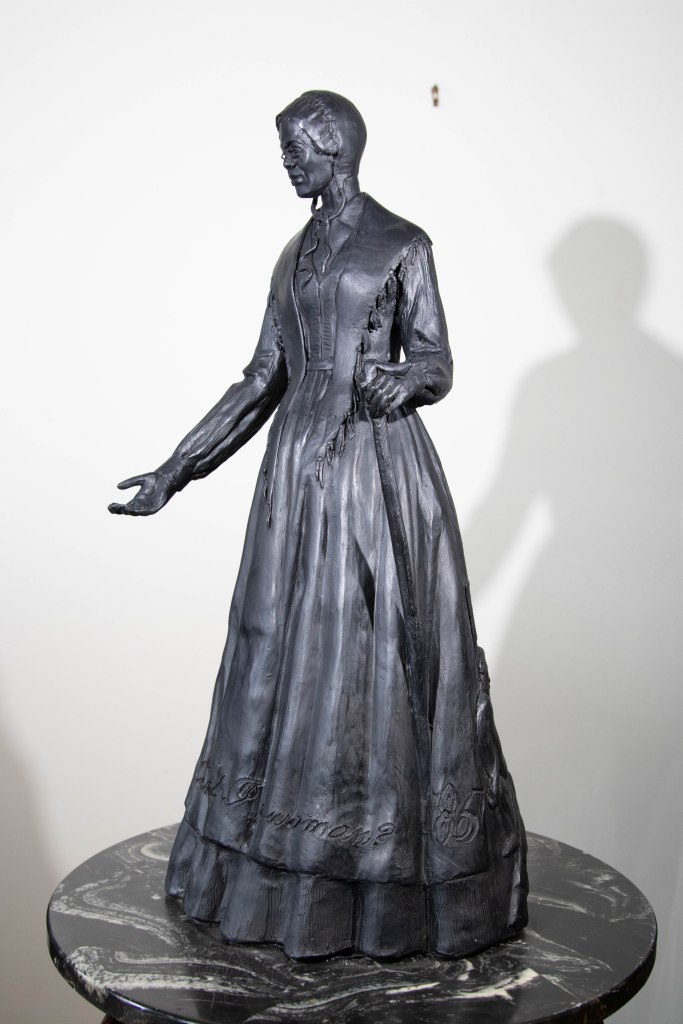
A bronze statue of this famous 19th century African-American abolitionist and women’s rights advocate is being installed this month at the western entrance to the Walkway Over the Hudson State Park in Ulster County, so this is a good opportunity to get to know Sojourner Truth better.
The statue of Sojourner Truth that is being unveiled at Walkway Across the Hudson State Park.
She was born enslaved in 1797 to James Baumfree (alternatively spelled Bomefree) and Elizabeth ‘Mau-Mau Bet’, enslaved parents who were owned by a Dutch family in Esopus, Ulster County. Isabella, as she was named then, grew up speaking Dutch.
Some of the worst treatment she received as an enslaved teen came at the hands of her second owner because she didn’t speak or understand English, and he didn’t speak or understand Dutch. She bore the scars on her lacerated back, the punishment she received as a result of this language barrier, for the rest of her life. Later, she displayed these marks during her talks as a sign of the common mistreatment the enslaved received. Even after becoming fluent in English, contemporaries noted that she spoke with a Dutch accent, not a Southern one as a later popular account of her famous 1851 speech portrays.
I have as much muscle as any man, and can do as much work as any man.
I have plowed and reaped and husked and chopped and mowed, and can any man do more than that?
I have heard much about the sexes being equal; I can carry as much as any man, and can eat as much too, if I can get it.
Portion of Sojourner Truth’s “Ain’t I A Woman?” speech to the Woman’s Rights Convention in Akron, Ohio, as reporter on June 21, 1851, by The Anti-Slavery Bugle, of Salem, Ohio. A version published more than a decade later had her speaking in Southern voice.
Despite her low birth status, Sojourner Truth became one of the leading voices for human rights and universal suffrage in the 19th century. Her life as an itinerant preacher working on behalf of the enslaved, newly freed, and women, especially Black women, left a legacy that has kept her in the public consciousness.
Her birth, two years before New York’s Gradual Emancipation Act took effect on July 4, 1799, would have her remain enslaved well into adulthood. Her owner John Dumont struck a deal with Isabella and agreed to free her in 1826. After receiving a life-threatening injury while working in his fields, she required time to heal. Dumont used the healing time as justification to renege on his promise of freedom. In retaliation, she leaned upon her trust in God, and “…walked away by daylight” to find liberty, taking her youngest daughter Sophia with her.
This map shows where Sojourner Truth began her walk to freedom in Esopus, Ulster County, (pin on the right) westward to Marbletown (pin on the left).
This bold journey by the 29-year-old was the first of several she would make in her life. After walking many miles, she reached a settlement at Marbletown headed by Quakers, who were known anti-slavery abolitionists. A man there directed her to a farm owned by Isaac Van Wagenen, who held no enslaved people and had joined Quakers and Methodists working for the emancipation of all the enslaved. Van Wagenen paid $25 to Dumont for Isabella and her daughter, then freed her, allowing her to work off the cost as a domestic for the household.
While working for the Van Wagenen’s, Isabella faced her second tribulation. The Gradual Manumission laws in New York restricted the sale of enslaved children out of the state, lest they not be freed at the appointed time. Her young son Peter, through a series of twists and turns, was illegally sold and taken to far-off Alabama, from which he might never return. Upon hearing the news, Isabella ran to the wife of her former owner, who had orchestrated the sale, but was firmly rebuked. Isabella reached out to others, all of whom made light of her frantic state over her missing child. Realizing how others perceived her plight, she called upon God and proclaimed calmly that she would have her son back.
Walking the road, she happened upon a man who directed her to some Quakers, assuring her they would help. Not only did they provide lodging for her that night, they provided money to press her complaint in court. In 1828, Isabelle won her son’s return _ marking one of the first legal cases where an African-American woman prevailed in court against a white person.
The judge in the case declared that the “boy be delivered into the hands of the mother—having no other master, no other controller, no other conductor, but his mother.” It was to Isabella’s horror that when alone with her son, she discovered he now bore scars from being physically abused during his distant enslavement.
From Ulster County, Isabelle moved to New York City, where she worked as a domestic for people involved in the anti-slavery movement. It is during this time that she began her training in public speaking. Illiterate throughout her life, during her time in New York City, she increased her knowledge of the Bible, listening intently during Bible study. She believed strongly in the idea of everyone having a direct relationship with God and leaned heavily upon hers. Like many abolitionists she became known for her radical and anti-cleric religious views. More of a spiritualist than a traditional churchgoer, Truth often spoke of being abused by ‘Christians,’ many of whom strongly supported slavery and participated in mob violence against blacks and white members of anti-slavery groups.
During her time in New York City, she worked, saved money and opened a bank account, reunited with a brother and sister who had been sold as children, won a court case for slander, and grew as a preacher, speaking out on the street and at anti-slavery gatherings.
But by 1841, divisions within New York’s abolitionist community, the rise of the pro-slavery Democratic party and her son Peter’s death at sea while working as a sailor, pushed her onward. Heeding inner divine guidance, she changed her name from Isabella Baumfree to Sojourner Truth in 1843 and headed east out of New York City. She traveled the road to Brooklyn, then out to the Long Island, into Connecticut and ultimately reached Massachusetts, speaking ‘truth’ to hundreds along the way about the inhuman practice of enslavement and human rights. Her speeches were well received and comments about her talks appeared repeatedly in newspapers across the region.
Her strong desire to be treated as an equal manifested itself not just in her teachings on tolerance, but her desire to live what she preached. The early 19th century saw waves of religious and social reform movements sweeping through the northern part of the U.S. Many within the anti-slavery movement believed strongly in equality, prompting Abolitionist and other religious reformers to establish utopian communities that foreshadowed the communes of the 1960s. One of the early examples was the Northampton Association in Northampton, Massachusetts, which Sojourner Truth joined in 1844.
The Narrative of Sojourner Truth, the story of her life, was dictated to her friend Olive Gilbert during their time together at Northampton. According to Professor Margaret Washington, a noted scholar on Sojourner Truth, and author of Sojourner Truth’s America, “…embedded in Northampton was a commitment to revolutionize civilization.” Frederick Douglass once commented that “The Northampton air was full of “isms…Grahamism, mesmerism, Fourierism, transcendentalism, Communism and Abolitionism. But it was to be commended because of its deep commitment to emancipation.”
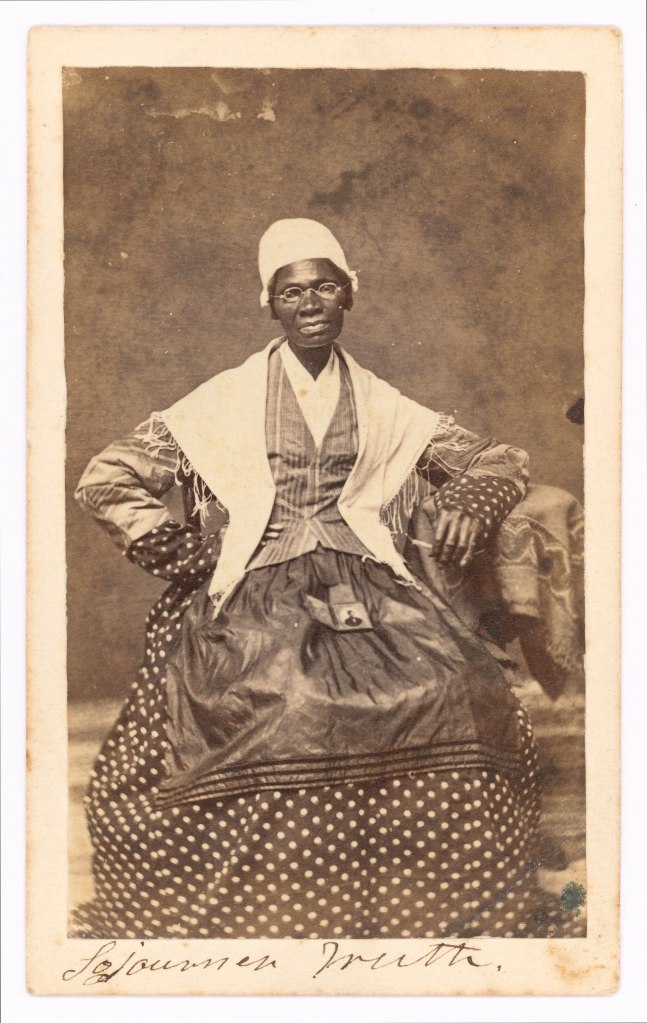
The Northhampton community was home to many involved in the anti-slavery movement. A mix of farmers, artisans, clerks, teachers, ministers, intellectuals, and other professionals, it reflected the equality that Sojourner longed to see in America. While in residence Sojourner worked in the laundry, but otherwise spent her time traveling the region preaching and teaching on civil rights, abolition and suffrage. It was her plan that the Narrative, along with photographs of herself, which she had inscribed with the famous words, “I sell the shadow to support the substance,” would provide an income to support her vision that many women didn’t have.
“I sell the shadow to support the substance.” — Sojourner Truth. Carte de Visite, circa 1864, in the collections of the Library of Congress (http://www.loc.gov/pictures/item/97513239/)
The stirrings of the coming Civil War took her from Massachusetts to Washington, D.C., where during the war she recruited men for the Union Army, and later worked for the Freedmen’s Bureau, helping to feed thousands of newly freed enslaved. Her awareness of their plight, and the endless need for work and sustenance moved her to the realization that without land of their own the freedmen would not prosper. This began her work on petitioning for space within the territory of Kansas. With the end of the war she returned to the road, again focusing on universal suffrage and women’s rights.
But support for all the disenfranchised in the country wasn’t there. It became increasingly clear that a choice had to be made between voting rights for Black men or women, but both would not succeed at once. The ‘race or gender’ struggle created a schism within the suffrage movement that was being led by Elizabeth Stanton and Susan B. Anthony, who wanted to see white women gain suffrage first. Their public comments and involvement with strong pro-slavery Democrats pushed many long active suffrage supporters like Sojourner Truth and Fredrick Douglass to distance themselves.
Following the passage of the 15th Amendment which gave voting rights to Black men (but not women regardless of race) in 1870, Sojourner moved to Battle Creek, Michigan, and returned to the women’s movement. Leaving behind the animosity of the past, she and Douglass again joined forces with Stanton and Anthony to push for voting rights for women until failing health caused her to retire from public life. On November 26, 1883, the 86-year-old Sojourner Truth died at her home in Michigan. The national adoption of women’s suffrage was still four decades away.
Her popularity as a long standing, dynamic public speaker on human rights and suffrage, someone often quoted or referenced in newspapers and other periodicals of the time, brought hundreds to her funeral. Sojourner Truth’s life reflected her deep and abiding belief that justice for all would someday come. The shadow of her legacy is deep and abiding, and reflects a journey toward equality that she knew would continue.
As she wrote, “I don’t expect I will to live to see it, but when this generation has passed away, there will be a grand change.”
Cover picture of Sojourner Truth: Credit Wikipedia Commons; Wood, Norman B., “White Side of a Black Subject,” (1897)
Post by Lavada Nahon, Interpreter of African American History, state Bureau of Historic Sites
Offers critical analysis of Truth’s famous Ain’t I a Woman speech, dispelling the inaccurate use of southern dialect in the later transcription and focusing on the earlier transcription of the speech which was more true to her northern Afro-Dutch roots.
This PBS series highlights the spiritual lives of historic figures and provides details about Sojourner Truth’s religious beliefs, spiritual life and ministry.
This work includes several important texts about Sojourner Truth’s life, including a dictated autobiography and some correspondence. Full text transcript available via PDF.
Selected Books
Grigsby, Darcy G., Enduring Truths: Sojourner’s Shadows and Substance (2015).
Mabee, Carleton and Mabee, Susan Newhouse, Sojourner Truth: Slave, Prophet, Legend (1993).
Mandziuk, Roseann M. and Pullon Fitch, Suzanne Sojourner Truth as Orator: Wit, Story, and Song (1997).
Gilbert, Olive, The Narrative of Sojourner Truth (1850)
Painter, Nell Irvin Sojourner Truth: A Life (1997).
Schmidt, Gary D. (illustrated by Daniel Minter), So Tall Within: Sojourner Truth’s Long Walk Toward Freedom (2018) [children’s book].
Stetson, Erlene and David, Linda, Glorying in Tribulation: The Lifework of Sojourner Truth (1989).
Washington, Margaret, Sojourner Truth’s America (2011)
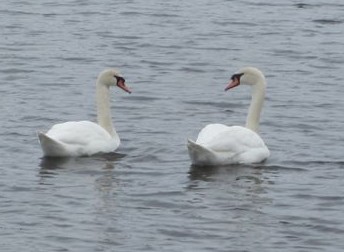
Mute swans are easily discriminated from native tundra and trumpeter swans by their orange beaks. (Photo Credit- State Parks)
Mute swans are large, impressive birds that many people are delighted to see in public water bodies and in New York State Parks.
However, many people are unaware that mute swans are a non-native species which can create negative impacts in our parks. Mute swans (Cygnus olor) were introduced to the U.S. from Europe during the late 1800s and early 1900s as decorative accessories to zoos, parks, and private estates.
In New York State, Mute swans were particularly popular on private estates on Long Island and in the Hudson Valley. Many of these pet swans escaped from captivity or were intentionally released into the wild. Since their introduction, wild mute swans have successfully expanded their habitat to the extent that it is now a source of concern for natural resource managers
Environmental Impacts: What do we have against swans, anyway?
Mute swans are highly territorial and will aggressively defend their large territories against other birds—including native waterfowl. This hurts our native bird populations by limiting their access to feeding areas and potential nesting sites. Mute swans may also act aggressively towards humans who walk, swim, or boat too close to their nesting sites.
Besides being physically threatening, mute swans place a greater strain on the aquatic habitats where they feed. Their long necks reach a greater number of underwater plants than other birds’. Besides eating aquatic plants, mute swans tend to uproot much of the aquatic vegetation where they feed, which would otherwise provide food and shelter for native waterfowl species, fish and other organisms.
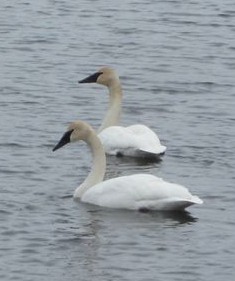
Tundra swans (Photo Credit- Terry Spivey, U.S. Forest Service)
Tundra Swan
The tundra swan is one of two native swan species in New York State (the other is the trumpeter swan, see below). A graceful tundra swan is an incredible sight for bird lovers. The average tundra swan has wingspan stretching just over five feet. While the tundra swan is the smallest swan species observed in New York State, averaging more than 14 pounds, they are still larger than a Canada Goose. While Tundra Swans are similar in size and coloring to trumpeter swans, their voice is distinctly different. Listen for their clear hooting, which sounds like klooo or kwooo.
They typically feed on shellfish, aquatic plants, and occasionally grains. While tundra swans spend most of the breeding season in the Arctic, where nesting and hatching takes place, these strong birds migrate southwards annually and frequently rest, feed, and eat in New York State Parks.
Trumpeter swans (Photo Credit- USFWS)
Trumpeter Swan
Trumpeter swans are the largest of the North American waterfowl, weighing as average 23 pounds. Their call is a gentle nasal honk, lower in tone than the tundra swan. The trumpeter swan was almost rendered extinct by the high demand for swan feathers for use as quill pens throughout the 1600s-1800s. Trumpeter swans have successfully rebounded and they are relatively common in North America today, but they continue to be rare in New York. Providing and protecting suitable nesting habitat could be key to helping New York trumpeter swan populations grow.
Population control
In a few places where the mute swan population is particularly high, State Parks is working with the state Department of Environmental Conservation and Wildlife Services to manage population growth and protect aquatic species and habitats in State Parks. In order to do so most effectively, State Parks is utilizing an integrated, multi-pronged approach:
Public Education: Many people value the presence of mute swans, but are often unaware that they are an invasive species which can negatively impact the ecology of parks. Educating the public is key to managing wildlife and promoting ecosystem health.
No Feeding Policy: All State Parks have a strict no-feeding policy for all wildlife. Feeding wildlife can be harmful to them and set up dangerous situations for people.
Habitat modification: Like Canada geese, mute swans seek out grassy lawns and open areas adjacent to water bodies. By allowing shoreline vegetation to grow taller, or by installing fencing, we can make it more difficult for mute swans to travel from water to land — therefore making park facilities less attractive habitats.
Nest and Egg Treatment: Oil blocks the exchange of oxygen through the shell and prevents young birds from hatching. Following the guidelines set by the Humane Society, parks’ staff always perform a float test before treating eggs. If an egg floats, it means that an air sac has formed and a chick has begun developing. By oiling swan eggs early in the season before chicks have begun developing, State Parks staff and partners are able to prevent halt swan reproduction. This process helps reduce the local population over time. A permit is required to disturb any swan nest or eggs on park or private property.
Population Control: In order to protect endangered or threatened plants as well as significant natural communities in or near State Parks boundaries, lethal methods may be used to manage mute swan populations. As in all cases of animal control, lethal measures are only considered as a last resort.
Now that summer is here, when you head to the boat launch for a day on the water, you will often run into a friendly face in a blue vest. These are Boat Stewards! Boat Stewards are educators who share their knowledge of invasive species and how to prevent boats from spreading such species into other waterbodies.
You can expect to run into stewards across much of New York State, since there are more than 200 Stewards who are part of various programs. Here at the state Office of Parks, Recreation and Historic Preservation, our Boat Steward program is run in collaboration with the SUNY College of Environmental Science and Forestry (ESF).
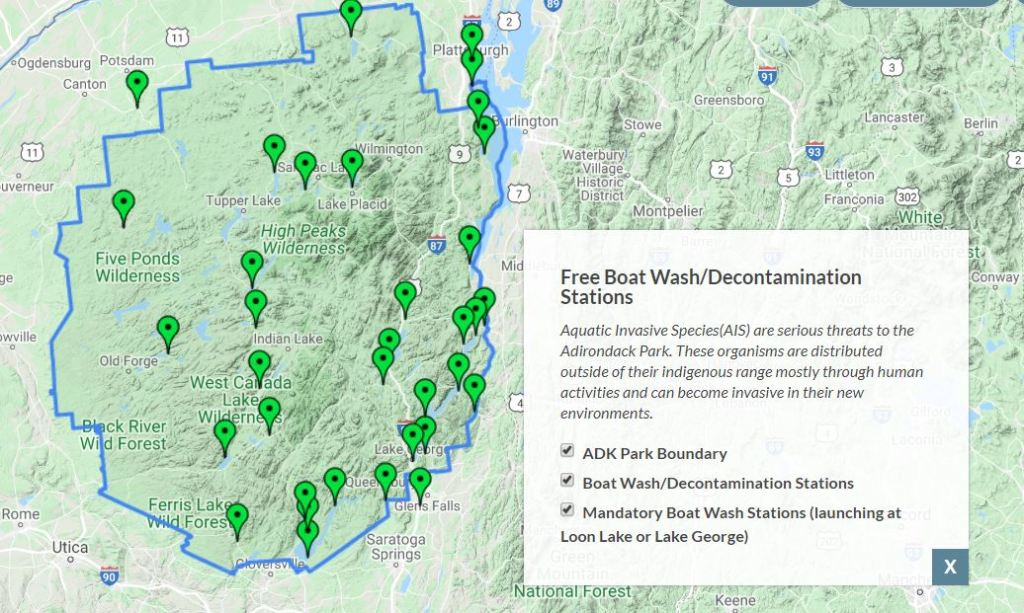
Beginning the Memorial Day weekend, 20 Stewards are stationed at 25 different State Park boat launches. These experts can answer your questions about aquatic invasive species (AIS) within New York State, provide educational information on many species, and will help check that there are no aquatic hitchhikers on your boat or trailer!
All our stewards within the state will be wearing masks and social distancing for your protection and theirs during the COVID-19 pandemic. Please arrive with your boats and equipment already clean, drained, and dried and be willing to help our stewards conduct inspections while maintaining social distance. Please follow the protocols for social distancing and wearing masks in public while at the launches.
When you arrive or leave a boat launch, a Steward will ask to perform a voluntary inspection on your watercraft and encourage you to join them. Remember, please practice social distancing, and stay six feet away from Stewards while they perform their duties.
Inspections apply to both power boats and paddlecraft, like canoes and kayaks.
While completing the inspection, Stewards are on a mission to find all visible plant or animal material attached to the watercraft and trailer and will point out places on the boat where aquatic invasive species often get caught. Stewards also gather information from boaters through a short survey to help understand the movement of AIS across the New York State.
At many locations across the state, Stewards operate Watercraft Decontamination Stations, also known as Boat Wash Stations. Decontamination stations are a free high-temperature, high-pressure wash for your boat.
Phpto 4
A boat steward at Conesus Lake State Boat Launch, Livington County, at the uses a high-pressure wash to remove invasive species from a boat.
Boat Wash Stations are highly effective at eradicating aquatic invasive species we might not be able to see with our naked eye, such as young Zebra Mussels or Spiny Waterfleas. The ESF-NYS OPRHP program operates two such units located at Allan Treman State Marine Park on Cayuga Lake and Conesus Lake State Boat Launch.
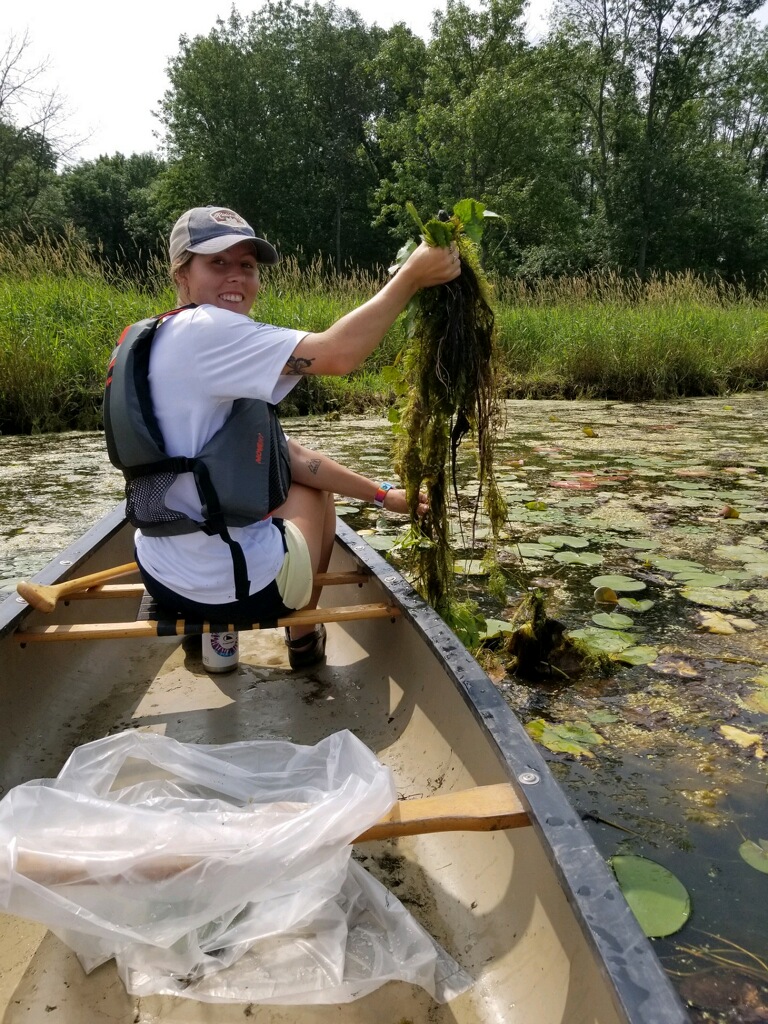
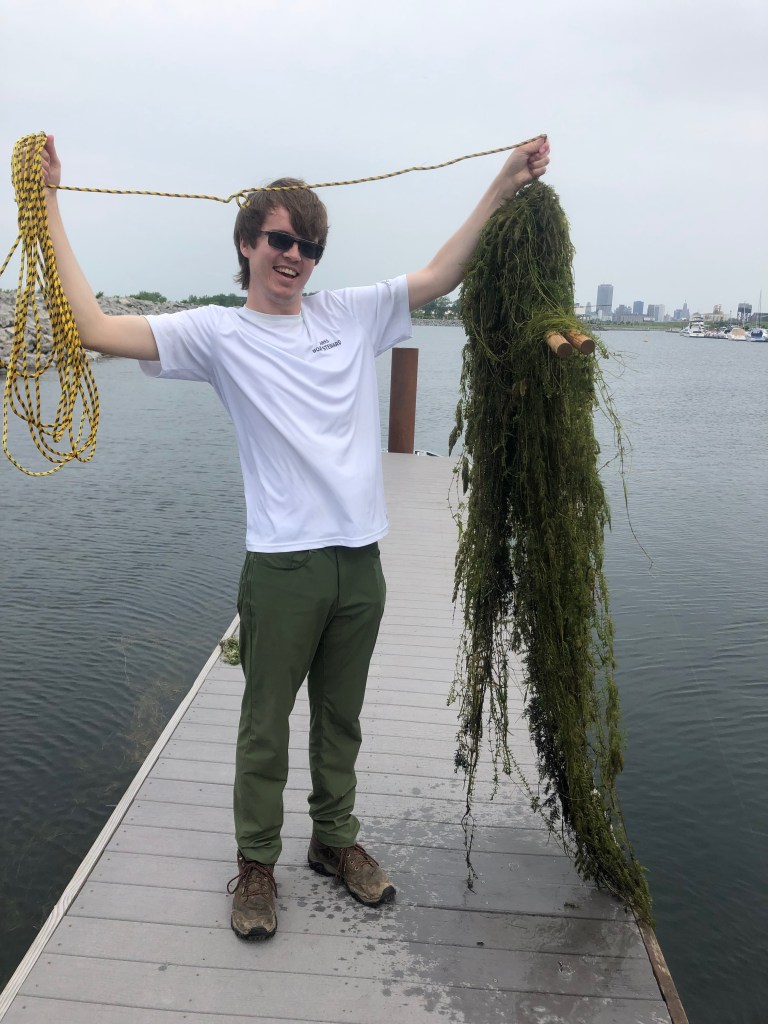
When stewards are not at the launch, they are busy collaborating with many partner organizations to partake in all levels of invasive species management. They participate in sampling for AIS, mapping new infestations, and large-scale removals of invasive species such as Water Chestnut.
Since the program’s inception in 2014, our boat stewards have conducted more than 100,000 inspections and interacted with more than 250,000 boaters. In 2019, stewards intercepted 3,803 boats that were carrying invasive species.
Each of these boats could have led to a new introduction that has potential to cause significant harm to ecological, economic, and human health.
Cover shot- Boat stewards at the start of the 2019 season. (All photographs from NYS Parks and reflect 2019 boating season)
Post by Mallory Broda, Program Coordinator (Program Support Specialist), ESF- NYS OPRHP Boat Steward Program
Help Do Your Part to Protect Our Waterways
* Clean, drain, and dry your watercraft and equipment thoroughly before visiting other waterbodies.
* Inspect and remove debris and mud from boats, trailers, and equipment before and after each use.
* Dispose of all debris and bait in trash cans or above the waterline on dry land.
* Drain all water-holding compartments including live wells, bait wells, and bilge areas. If possible, disinfect with hot water (140°F) for at least 30 seconds.
* Dry boats, trailers, and all equipment before use in another water body. A minimum of 5-7 days in dry, warm conditions is recommended.
* Do not dispose of unwanted aquarium pets or bait fish in waterbodies, ditches, or canals.