What Makes Jones Beach a Classroom

Jones Beach has always had a special relationship to energy. Located on Long Island’s South Shore just 20 miles from New York City, Jones Beach State Park is on a barrier island shaped over hundreds of thousands of years by the energy of advancing and receding glaciers, and later by the energy of the sun currents of ocean water and wind carrying sand along the coast.

Originally called Short Beach, this barrier island was inaccessible to the public. To create the state park almost a century ago, planners and engineers harnessed the energy of machines and human labor, moving sand and plants to expand the island, and building roads, amenities, and the Art Deco tower and buildings so recognizable today.

Today, energy is everywhere on Jones Beach. It’s in the dramatic dive of a predator like the Common Tern, and in the bright sun that drives photosynthesis of the Seaside Goldenrod, Beach Grass or Beach Pea. It’s in water that brings migratory species and the winds that distribute seeds and carry pollinators from plant to plant. But energy is also present in the engines of the cars that bring visitors to the Park, and in the historical construction of the parkways that they follow to get here.

In an era of climate change, and in the context of New York’s growing commitment to developing renewable energy systems, the Jones Beach Energy & Nature Center aims to help New Yorkers understand the fundamental ways human energy consumption and energy infrastructure continue to shape our natural environment.

To further this mission, the Center recently released Energy & Us, a 300-plus page curriculum for high school students that is available to view or download for teachers and school districts at no cost through jonesbeachenc.org/curriculum.

The goal of the program is to inspire young people to think critically about how energy shapes their landscapes and their lives, as well as their own roles in energy systems and ecosystems that surround them. With the beach itself as a classroom, Jones Beach State Park is the perfect place to learn about energy from sunlight, sand, wind, and water.

NATURAL ENERGY AT JONES BEACH


Let’s start by considering the very essence of Jones Beach – a simple grain of sand. A crystal structure composed of millions of molecules, typically of the compound silicate (SiO2), sand is held together with very strong bonds. By comparison, bonds in a drop of spray from the ocean are much weaker. Much less energy needs to be added to water than to sand to trigger what is known as phase shift: A puddle of water will quickly evaporate in the sun, while a similarly sized patch of sand won’t melt. Sand will melt with enough heat, as in done in glass-making, but does sand melt in nature?

Close-up images of grains of sand. (Photo credit – Wikipedia Commons)

Consider when lightning strikes a beach, it creates melted and recrystallized sand formations called fulgurites, also known as “fossil lightning.” Lightning possesses tremendous energy — the core of a lightning strike can reach 53,500 F — but only makes contact with a relatively small surface. The strike quickly heats the sand to a high enough temperature that its chemical bonds are broken. Fulgurite then forms as the energy transfers out of the melted sand into the surrounding ground and air, and the melted matter becomes solid again, forming this unusual form of fused sand.

Have you ever gone swimming in the late summer or early fall, and found the water to be warmer than the air? Solar energy that is absorbed over the course of the summer dissipates in the fall more easily from land and air than from water. This is because water is a relatively poor conductor; energy moves through it with difficulty, so water is slow to heat and slow to cool.

Air is a good insulator and a poor conductor, which is why fur and down help keep animals warm. It’s not the quantity of hairs or feathers that matters, but rather the layer of air trapped within that stops energy from being conducted out of the body into the surrounding air. Birds fluff up during the winter to trap more insulating air in their feathers.

A snowy owl sits among the sand dunes and beach grass at Jones Beach. (Photo credit – Sean Hanley and G. Anthony Svatek/Kulturfolger Productions)

When sunlight hits the beach, radiant energy transforms into the kinetic energy of excited electrons in the sand, which vibrate, producing what we experience as warmth. Maybe even too much warmth on a sunny day, as anyone who has walked barefoot knows! The excited electrons also release new photons, wave particles that carry energy away from the sand and produce what we perceive as glare.

A Monarch butterfly among the seaside Goldenrod in the maritime dunes at Jones Beach, harvesting the energy found in the flowers’ nectar. (Photo Credit – Julie Lundgren/NY Natural Heritage Program)

ENERGY DRIVES ECOSYSTEM CONDITIONS


At Jones Beach, dominant winds flow from the west and the north, pushing sand dunes gradually towards the sea. Meanwhile, ocean currents flow parallel to the mainland, pushing sand from east to west and moving the shoreline westward. A jetty constructed in the 1950s at the West End interrupts these currents, causing sand to accumulate on the eastern side while the western channel remains open.

Winter and storm-season waves typically contain more energy, pulling more sediment off the beach and into the water in a process called erosion. When large waves wash over dunes during high tides and storms — a phenomenon called “overtopping” — dunes can flatten and shift. In summer, ocean currents, waves, and winds typically bring sands back onto the beach and dunes in a everchanging cycle.

Jones Beach shoreline change map. (Photo credit – Ruth Nervig/JBENC)
Fresh sands are deposited by summer waves, wind and storms creating open habitat for piping plovers, terns and some rare plants like Seabeach Knotweed and Seabeach Amaranth. (Photo credit – Julie Lundgren/NYNatural Heritage Program)

Water and winds can also influence how species move through Jones Beach. Birds, winged insects, fish, phytoplankton, and various other organisms travel on currents in the air and water, and currents also distribute seeds, eggs, and nutrients that organisms need to survive. Local examples of this include plankton that float on ocean currents, providing food for larger marine animals; shorebirds that depend on the strong sea breeze; and grass seeds spread by water and wind. Although major storms can decimate local populations of some species, most of the plants and animals of this ecosystem are adapted to these natural processes.

Seabeach knotweed (Polygonum glaucum) is a plant that needs open and untrampled beach and dune areas. (Photo credit – Julie Lundgren/NY Natural Heritage Program)
In the aftermath of a hurricane at Jones Beach, the massive energy of the storm washed up this massive uprooted tree trunk. (Photo credit – Julie Lundgren/NY Natural Heritage Program)

ENERGY SHAPES PUBLIC INFRASTRUCTURE AND PRIVATE LIFE


When planner Robert Moses envisioned Jones Beach State Park in the 1920s, he recognized that the automobile would have an increasing role in daily American life.

The rise of cars was coupled with another innovation by automaker Henry Ford – the assembly line that allowed for costs to be reduced, creating a new class of workers with enough disposable income to purchase the goods they produced, and with more leisure time to allow travel.

Jones Beach State Park was one of the first and most prominent parks to connect this growing urban middle class to the environment.

Automobiles entering Jones Beach on its opening day on Aug. 24, 1929. (Photo credit – New York State Archives)

A map showing the Parks and Parkway envisioned by Robert Moses. (Photo Credit – Long Island State Parks Commission)

In 1924, as the new chairman of the State Parks Commission and President of the Long Island State Parks Commission, Moses began planning a system of “Parks and Parkways” to connect car-owning city residents to beaches and parklands across Long Island. Moses envisioned parkways as an extension of the parks themselves: green spaces that transported urban dwellers to a beautiful natural landscape.

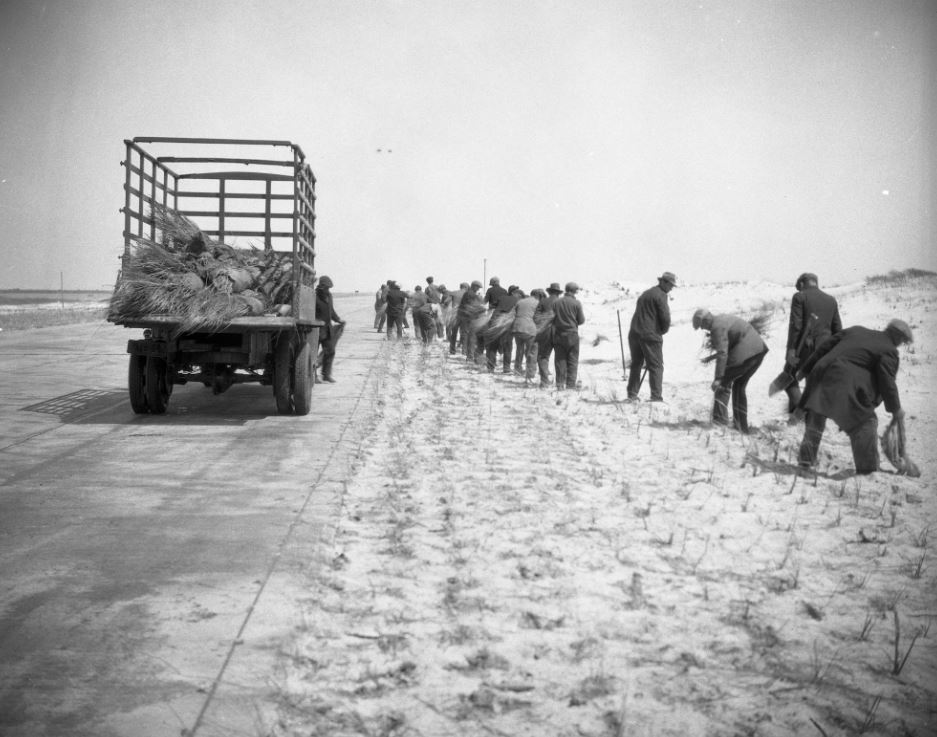
Jones Beach opened in 1929 as a triumph of 20th century engineering. Forty million cubic yards of sand were dredged from the bay to widen the beach and raise its elevation up to 12 feet. Workers hand-planted a million native Beach Grass plants to prevent the taller dunes from blowing away in the wind.

Workers planting Beach Grass during construction at Jones Beach State Park (Photo credit – NYS Parks)
Beach Grass (Ammophila breviligulata), native to Long Island, has long roots which help create and stabilize the maritime dunes at Jones Beach. (Photo credit – Julie Lundgren/NY Natural Heritage Program)

Moses’s plan for parks and roads across Long Island reflected a new approach to “nature,” one of landscapes constructed intentionally for public enjoyment. The parkways also helped spark a new era of Long Island suburbanization, which greatly increased consumption and the demand for energy.

Many different types of energy come together at the Jones Beach Energy & Nature Center. As climate change impacts the globe with rising seas and stronger storms, Jones Beach will model the positive possibilities for access and use of energy. Solar panels that power the Center represent New York’s commitment to expand renewable energy and reduce greenhouse gas emissions that are driving climate change. Resilient design modeled by the building itself will be key as New York’s communities adapt to rising sea levels and changing weather patterns.

There has never been a more important time for New Yorkers to understand the connections between energy, nature, and society. With the Energy & Us curriculum, young people throughout the state can begin to reconsider about how those forces shape their own lives, and how they can engage with them to transform the future.


Cover shot – Jones Beach Energy & Nature Center, Michael Moran/nArchitects


Post by Olivia Schwob, a writer, researcher, and editor interested in human geography, political economy, and public things. Olivia was Developer of the Energy & Us curriculum from 2020-2021, Curatorial Team Writer for the Jones Beach Energy & Nature Center from 2019 – 2020, and Managing Editor of Urban Omnibus, a publication of the Architectural League of New York, from 2016 – 2019. She lives in Brooklyn.

Winter Sowers Bring May Flowers

Native plant gardening is one of the most important ways to take sustainable action, creating habitat for indigenous wildlife while preventing the spread of invasive species. Growing plants from seed has the benefit of higher genetic diversity than planting nursery stock, which is often cloned.

Better yet, locally sourced seeds are part of the local ecotype, or the genetic variety adapted to your area. The more locally your seed was harvested, the better your garden will help preserve your ecosystem in the face of climate change, invasive species, and other threats to our landscape.

That’s why Rockefeller State Park Preserve held a series of gardening workshops this winter. Yes, you read that right—the gardening season starts in winter! Native wildflowers are adapted to the climate of this region, so they’ve evolved to need the cold of winter to break through the outer coating of their seeds. This is called cold stratification. Sowing by mid-February ensures that your seeds have enough time in the cold to germinate by mid-April when the weather warms up.

While the preserve’s Native Wildflower Seed Sowing Workshops are over, here’s a handy guide to follow along at home.

Sourcing native seeds


The best way to get seeds of your local ecotype is through a local seed collecting organization that already has the licenses and permissions to legally and ethically source seed. It’s important not to attempt harvesting seeds yourself without appropriate licensing and training, as this can threaten the natural population of the plant. Healthy Yards is a coalition of public and private landowners in Westchester County working together to provide locally-sourced seed to home gardeners. If you don’t know of such an organization near you, I’ve added some resources at the bottom of this article. Planting the seeds of a New York native plant is better than planting nonnative nursery stock, even if it’s from a different ecotype.

Preparing your materials


You will need a container and soil. Reuse a plastic salad container or milk jug with a lid to maintain humidity, and punch drain holes in the bottom. Label it with the name of the plant, the date sown, and the expected germination date. For soil, sterile seed starting mix can be bought from nurseries and gardening stores. In a shallow plastic container, moisten the soil by mixing it with hot water with your hands. Hot water and steam will penetrate the soil more quickly than cold water, so you won’t need as much to get your soil just slightly moist. Too much water could lead to seed rot.

Scoop the soil into the container until it’s two-thirds full and gently smooth the surface, without compressing it.

Materials needed: soil, a plastic container with a lid and drainage holes, masking tape and marker for labeling, seeds, and spice shaker with sand. (Photo Credit – D. Mishra)

Sow the seeds


Sow seeds at a depth equal to the size of the seed itself. A larger seed should go in a depression in the soil with a light layer of soil on top, while tiny seeds may be sprinkled on the surface. An easy way to surface sow tiny seeds is to mix them with sand in a salt or spice shaker. The sand will show you how much you’ve sown, and is easier for light to penetrate than soil, sometimes a requirement for native seeds.

Seeds sown with sand, with pencil for scale. These seeds have already germinated, but sand helps with visibility before they have emerged. (Photo credit – P. Butter)

Wait


Seal the container and place it outdoors or in an unheated room. Mark your calendar for the expected germination date. Check the moisture level periodically, giving a spritz of water if they’re drying out.

Germination and Beyond


When the weather starts warming and your germination date approaches, check on your seeds every day to see if they sprout. When you see cotyledons, or the first leaves, remove the lids and place them in the sun. These leaves were contained in the embryo and will not look like the representative leaves of the plant.

Now that the lid is off, you’ll have to monitor the moisture more often. You can place a tray under the container to hold some water to prevent drying out. Once the first set of true leaves emerge, transplant each seedling into its own pot with potting soil and compost. At this point, care for each plant according to its individual moisture, soil, and light requirements.

When they’re big enough, plant them in your garden by mid-June and water daily until they begin to put on new growth. If they aren’t ready to be planted by June, then keep them in pots until fall as they are less likely to establish in the heat of summer.  Continue to water and remove any surrounding weeds or competing plants. Don’t worry if all your seedlings don’t survive or if the plants don’t flower the first year. Some plants take a year or two to get established.

Enjoy watching your seedlings grow to attract bees, beetles, butterflies and other interesting insects. In the winter, leave foliage and seed heads to provide shelter and food for overwintering insects and birds. Your native plant garden will help bridge the gap between nature and your neighborhood.

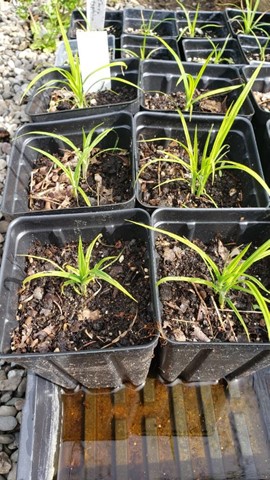
A native sedge showing its true leaves, ready to be potted. (Photo credit – P. Butter)
Native sedge after being potted in 4-inch plug pots, in a tray of water to maintain moisture. (Photo credit – P. Butter)

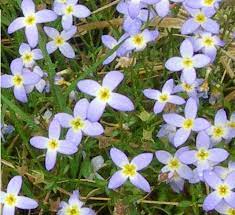
Cover Shot – Bluets (Houstonia caerulea), a native spring wildflower that can form delicate carpets of pale blue on dry sunny sites. A classic rock garden plant and groundcover. Photo Credit – State Department of Environmental Conservation.

Post by Devyani Mishra, Flora Steward, Rockefeller State Park Preserve


Resources


Bringing Nature Home by Doug Tallamy is a call to action for planting native plants in your garden that describes how your yard can help your ecosystem.

This website from the state Department of Environmental Conservation lists native flowers for gardening and landscaping.

The following websites can help you find plants native to your area:

Native Plant Finder (By Zip Code) , Xerces Society Pollinator Conservation Resource Center, Lady Bird Johnson Wildflower Center New York Special Collection

Here are some responsibly sourced seeds that serve the Northeast and the Great Lakes regions. These sources include plants that aren’t native to New York, so be sure to double check with the New York Flora Atlas that the plant you want is native to your area:

Prairie Moon Nursery, Ernst Conservation Seeds, Eco59, WildSeedProject.net, OPN Seeds, Hudson Valley Seed Company

Here are some native plant societies around New York that may know more about locally sourced seed in your area:

Finger Lakes Native Plant Society, Adirondacks Garden Club, Long Island Native Plants Initiative, Torrey Botanical Society, Niagara Frontier Botanical Society


Human Zamboni Machines of Moreau Lake State Park

On of my favorite childhood memories was going to an outdoor ice skating rink behind a warehouse in South Glens Falls in Warren County. It was only a field with a large frozen puddle but to me it was amazing. Years later now in my role as manager at Moreau Lake State Park, I wanted to give people near my park the same opportunity.

I started researching ice rinks and how to make them safe but also affordable for the park. While we do have the lake to work with, lake and pond ice usually is bumpy and cracked, thus making stumbles and falls more likely. As I continued researching online, an image of a homemade Zamboni apparatus popped up. Major ice rinks use large Zamboni machines to lay down smooth coats of ice on indoor rinks, but that kind of heavy machinery was not in my budget, so the hand-made model I saw looked like the way to go!

Using a steady flow of warm water to apply a continuous smooth ice surface just like the big machines, a small, human-powered Zamboni was my solution to make lake ice smooth and safe for skaters.

Our two homemade units were created by Aaron Aiken, a staffer at Moreau, who fabricated them after seeing the online photo. It was amazing. Aaron simply gathered all the materials he needed and finished in a day. We had most of the parts needed on hand at the park so there was little to no cost to us.

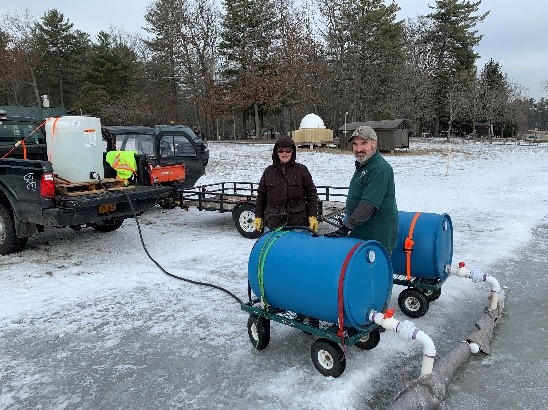
Aaron assembled a 55-gallon poly tank (used to hold the warm water), a 10-foot piece of 2-inch PVC pipe, a 2-inch PVC valve, a 4-foot piece of felt or wool (for trailing the water and flattening it out as smooth ice) and a sturdy wheeled cart. With that and a bit of ingenuity _ presto, a human powered Zamboni machine!

Moreau staffers Donna Fortner (left), and Jay Hauser, load up the Zambonis with warm water before going to lay down ice on the rink.

Zambonis work by slowly drizzling out warm water over the surface of existing ice. The warm water melts all the high spots and fills in all the lows before freezing to create a perfectly smooth surface perfect for skating. The operator judges how fast they want water to come out by adjusting the flow with the valve.

At Moreau, our crew pulls a Zamboni around the rink three times before it runs out of water, and then the other Zamboni takes its place. It is important to have two setups because ridges can form in the ice if you stop putting down warm water even for an instant. To create a smooth rink, it took about 110 gallons of water, applied by two Zambonis over six laps, for a total of about an hour of work.

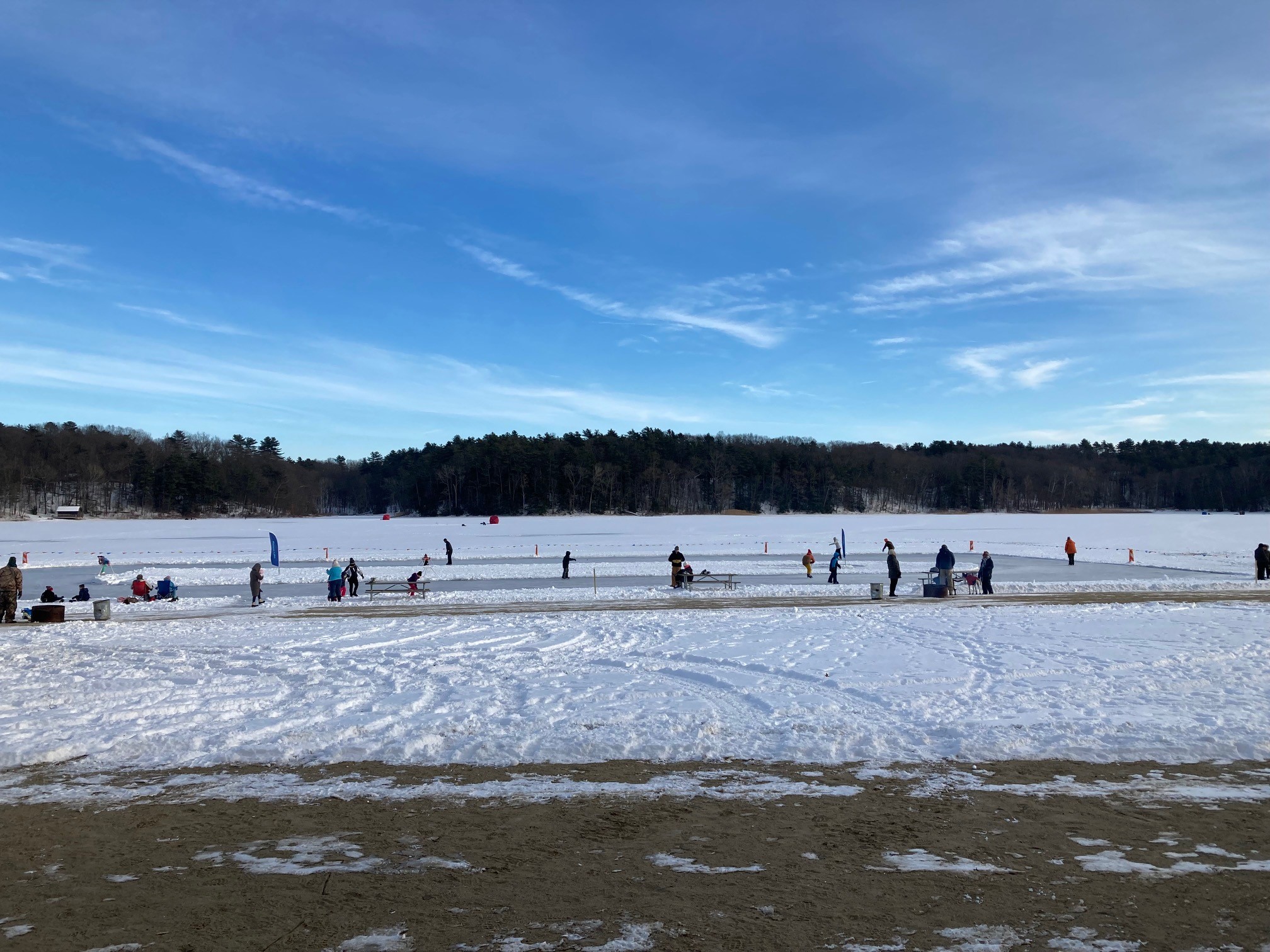
Measuring 250 feet by 100 feet, the outdoor skating rink at Moreau Lake State Park welcomes skaters! The Park has free loaner skates.

Another service that Moreau Lake State Park provides to visitors is the Daily Ice Report. Parks staffers measure the thickness of the ice starting a day after rink ice is laid on, meaning when the ice totally covers the surface of the lake, we wait a day and then start the ice thickness report. Two staff members start at shore with an ice auger and drill through the ice and measure the thickness. If it is under 3 inches they stop at that hole. If it is over 4 inches, they move out 20 feet and drill another hole. They follow the same procedures until it is determined that the average thickness (average readings taken from multiple places on the lake) is at least 6 inches.

When that happens, the lake is opened to skaters, pedestrians and ice fishermen. These ice reports are published over social media every day at 8:00 a.m. until the ice is safe and then these reports are replaced by the open one.

All this comes together to make the lake a safe and enjoyable place to recreate in the winter. At our rink, located just off the beach, a campfire is usually going nearby so skaters can warm themselves. So grab your skates (or borrow ours) and give us a visit!

Cover shot – Moreau staffer Jay Hauser (foreground) pulls a homemade Zamboni around the skating rink at Moreau Lake State Park, as fellow staffer Donna Fortner comes along behind with the second Zamboni . All images NYS Parks unless otherwise noted.

Post by Al LaFountain, Park Manager, Moreau Lake State Park and Grant Cottage State Historic Site

More about Moreau Lake State Park


Covering some 6,250 acres in Saratoga County, Moreau Lake State Park features hardwood forests, pine stands, and rocky ridges. More than 30 miles of hiking trails are available, and can be used for snowshoeing and cross-country skiing in winter. Snowshoe rentals are available.

Last year, Governor Kathy Hochul announced an 860-acre expansion of this park to include spectacular natural habitat along an undeveloped stretch of the Hudson River that will be known as Big Bend Point.  This acquisition makes Moreau Lake State Park one of the ten largest parks in the state park system.


Resources


Learn about a Gilded Age ice skater who helped promote figure skating for women from this previous blog post by the curator at Staatsburgh State Historic Site.

Gilded Age Ice Skater Carved Early Path

Staatsburgh State Historic Site, formerly the Gilded Age estate of the very wealthy and socially-prominent Ruth Livingston Mills and her husband, financier and philanthropist Ogden Mills, sits along the eastern bank of the Hudson River in the mid-Hudson Valley. Commanding a view of the river and the Catskill Mountains, the estate’s Beaux-Arts mansion was once…

A hand-operated Zamboni machine is on display at the Original Hockey Hall of Fame in Museum, in Kingston, Ontario, where it is also described as a “hand flooder.” (Photo credit – Wikipedia Commons)

“Skating is in my heart, not my head.” – Olympic Medalist Michelle Kwan

Volcanoes On A Great Lake

If you were told there could be volcanoes along the shore of Lake Erie in winter, would you believe it? While it may be hard to imagine, Lake Erie does in fact produce volcanoes and Evangola State Park can be one of the best places to see them!

Unlike traditional volcanoes, the ones found at Evangola State Park are not made of rock and magma, but rather water and ice. Ice volcanoes are a temporary outcome of a partially frozen lake. When ice begins to form on the water’s surface, powerful winds push large waves towards the shore. As they do, the water is sandwiched between the shore and the ice, creating a buildup of pressure.

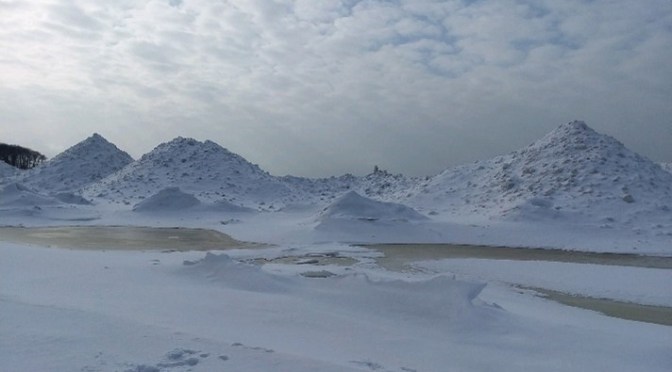
A gap in shelf ice allows for potential formation of an ice volcano.

Eventually with nowhere else to go, this pressure causes the water to burst through cracks in the ice. The resulting spray from this burst, freezes on the ice surface, accumulating in the shape of a cone with an open, unfrozen center. With each successive wave, plumes of water erupt from the newly formed ice volcano, building this winter wonder to potential heights of 20-plus feet! Occasionally the ice may build up in the shape of a cone, but without an open center. These rolling hills of ice become so called ice-dunes.

While Lake Erie is one of the best locations to see ice volcanoes, Lakes Ontario, Michigan, and Superior can also produce these icy cones when conditions are right. For example, such volcanoes have also recently formed during the cold snap at Hamlin Beach State Park in Monroe County and Fair Haven Beach State Park in Cayuga County.

Ice Volcano at Hamlin Beach State Park in February 2022. (Photo Credit – Friends of Hamlin Beach State Park/Denise Bianrosa Duffy)

Further from home but to the excitement of many, in 2021 a 45-foot tall ice volcano formed in southeastern Kazakhstan as water from a hot spring gushed through a thick layer of ice, creating a massive volcano for all to enjoy. 

But also, to be clear, the shelf ice on a lake where these structures form can be extremely unsafe and people are strongly advised against venturing out on it to get closer to ice volcanoes.

Confine sightseeing to the shoreline or stick with a guided tour by a trained Parks naturalist. One such hike is scheduled for Feb. 8 at Evangola State Park. Check with the park to learn if the volcanoes have formed.

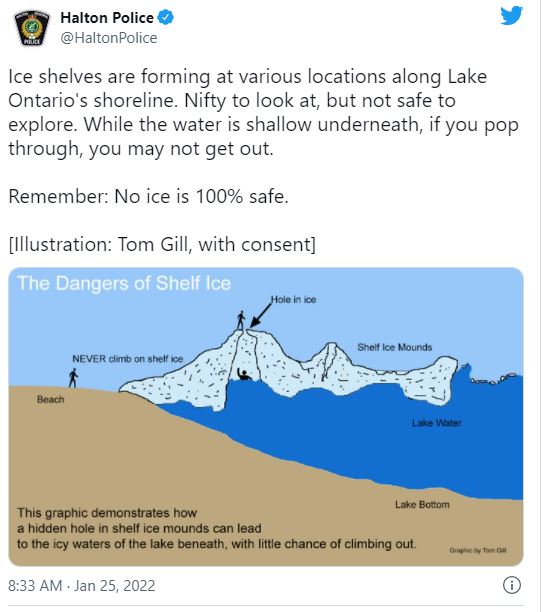
As a recent warning from the police department in Halton, Ontario, describes, if someone falls through shelf ice or down the opening of an ice volcano into the lake water below, it can be nearly impossible to get out even if aid is nearby. Cold lake water can quickly induce hypothermia, which can lead to death.

This graphic below illustrates the danger:


A shoreline guided tour past ice volcanoes at Evangola State Park. Remember, DO NOT venture out on shelf ice or approach an ice volcano. It is EXTREMELY DANGEROUS with the potential for falling into the lake water below with little chance of getting out.

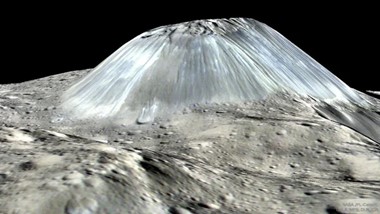
Leaving earthly risk behind for a moment, scientists have even been able to detect ice volcanoes from several planets and moons deep in space. Typically called cryovolcanoes, these are defined as volcanoes that erupt with ice, water, or other materials such as methane and ammonia. In 2010, NASA’s Cassini spacecraft found possible ice volcanoes on Saturn’s moon Titan and in 2016 images from the Dawn space probe revealed dozens of ancient ice volcanoes on the dwarf planet Ceres

Ahuna Mons, an ice volcano on the dwarf planet Ceres, as seen by NASA’s Dawn spacecraft. (Photo Credit – NASA, JPL-Caltech, UCLA, MPS, DLR and IDA

Back on earth, favorable conditions for ice volcano formation here in New York haven’t been consistent in recent years. Warmer winters have resulted in less ice on all the Great Lakes. In 2021, the National Oceanic and Atmospheric Administration reported that only 2.4 percent of the Great Lakes surface was covered by ice in late January, the smallest amount in nearly 50 years. It was also noted that it was ninth-warmest January on record. While strong waves are needed to form ice volcanoes, strong waves with warmer temperatures will result in their destruction or prevent them from forming at all.

Despite our changing climate, ice volcanoes can still be a common occurrence during the winter months. The biggest change is in their longevity. For example, in the past several years, ice volcanoes at Evangola State Park have only lasted a few weeks or even just a few days after forming, as sudden warm spells take hold and break them apart.

For your best chance to experience ice volcanoes, be sure to keep a close watch on your local weather forecast and head towards the lake shore after a push of cold artic air passes through. To add to the adventure of enjoying these frozen phenomena, our team of environmental educators offer guided hikes all winter long, sharing what makes our Great Lakes environment so unique.

For those interested in learning more, look for guided hikes through the Niagara Region Parks Interpretive Programs Office.

An ice volcano “erupts” (on left) at Fair Haven Beach State Park on Lake Ontario. Photo credit – Caroline Lamie, Office Manager/Senior Researcher/Tour & Event Coordinator, Fort Ontario State Historic Site

Cover shot – Ice Volcanoes in 2021 at Evangola State Park. All photos NYS Parks unless otherwise noted.

Post by Matt Nusstein, Environmental Educator, Niagara Region NYS Parks

Resources

Learn about ice volcanoes on the the Keweenaw Peninsula of Lake Superior.

Learn about the presence of Cryovolcanism in the Solar System in this report from the BBC.

Learn about other Great Lakes wonders to look for at NYS Parks in previous Parks Blog posts.

Evangola State Park: Lake Erie’s Winter Playground!

Along the shores of Lake Erie, Evangola State Park becomes a winter sports mecca as the lake’s famous lake-effect snowstorms blanket the park! Lake-effect snow occurs when cold, Canadian air moves across Lake Erie evaporating its open waters and causing intense, local snow bands which can drop one to two inches of snow per hour.…

Wonders of the Winter Beach

Getting cabin fever? Well, bundle up and take a trip to a beach-front state park! Lake Ontario, Lake Erie, Lake Champlain, Long Island parks or the many parks on small lakes: Glimmerglass, Green Lakes, Long Point-Chatauqua Lake, Allegany, or many others. This is the time to explore the many interesting patterns and colors of wintertime…

All are Welcome Where They Once Were Not: New York’s First African American Vacation Resort

Vacationing in New York has not always been easy for African Americans. For most of the 20th century, cultural segregation was the norm. While Jim Crow laws in Southern states were explicit, here in New York there also were known rules of discriminatory racial separation in accommodations that could make finding a cool place on hot summer days challenging.

About an hour’s drive north of New York City, the popular mountain resort area of Greenwood Lake in Orange County near the border with New Jersey dated to the 1870s and for years had been off-limits to Blacks, Jews, and Italians. But in 1919, a change happened. Wanting to relax in this beautiful mountain setting and enjoy themselves without racial hassles, a group of prominent African American families, spearheaded by nine members of the Carlton Street YMCA in Brooklyn joined together to create the first African American vacation resort in New York State.

One of co-founders of Greenwood Forest Farms, Arthur Lewis Comither. (Photo Credit – ProQuest Historical Newspapers)

Sterling Forest Farms Incorporated purchased 143 acres of land high in the mountains surrounding Greenwood Lake and named it Greenwood Forest Farms. The ‘Colony’ as it came to be known was to become the summer place to be for African Americans well into the 1960s. 

By the mid-1930s, Greenwood Forest Farms was well on its way to becoming the place to be seen during the summer months. A July 1938 headline in the Black-owned New York Amsterdam News boasted “Greenwood Lake May Become East’s Most Fashionable Summer Colony.” A full-page story covered details of the site’s founding, and reporter Thelma Berlack-Boozer was given tours of several cottages, gardens, and all the amenities. At the time there were twenty-eight cottages set in beautifully landscaped gardens with thirty-five other lots in development. The writer described the wonderful natural forest surrounding the location, the luxurious summer furnishings on expansive porches and lovely interiors, the corporation’s plans, and how those who happened to not own cottages still could enjoy time there.

The corporation built a club house called the ‘Farm House’ where vacationers could enjoy live music, dancing, and a restaurant. For those who did not own a cottage, the Farm House was one of three locations where vacationists could rent rooms. The other two were private cottages which rented bedrooms during the summer, with one of those, the Justice House, opened during the winter for those interested in hunting. An August 1941 ad offered lodging at the Farm House for $15 per week or $4 for the weekend, with a car shuttle leaving from Harlem on Tuesdays, Thursdays, and Saturdays to make traveling upstate easy. The plan was completely upscale, to the point that in the 1940s the colony generated its own electricity. When completed, the Colony had a man-made lake, tennis, and hand-ball courts, and a nursey school for everyone’s use.

New York’s Black elite both owned the properties and visited their friends. Luminaries like Cecil McPherson (Cecil Mack) the famous lyricist and music publishing magnate, and his wife Dr. Gertrude Curtis, New York’s first African American woman dentist owned a cottage there. The poet Langston Hughes was among several literary figures who summered there with friends. Civil rights giants James Farmer, Harold W. Cruse, and Robert J. Elzy, the head of Brooklyn’s Urban League were among the property owners and guests.

If people wanted to know where to find the cream of the crop during the warmer months, society columns in the New York Amsterdam News kept people up to date. In 1933 the paper’s Brooklyn Society column informed all that the Elzys could be found at their cottage ‘Rob-Lou,’ and that Mr. and Mrs. Jesse Webster, and their weekend guests from Baltimore motored up to the Greenwood Forest Farm House on Sunday. Mrs. Willard J. Price and her daughters spent the week as guests of Mrs. Walter Taylor of Greenwood. The Jamaica News and Social Briefs shared that Mrs. Gordon Jones and her daughter, were at Sterling Forest Farm for the summer but had returned to Jamaica.

By the late 1960s as the older generation died, and options for vacation locations expanded for African Americans with the passage of the Civil Rights Act and the opening up of public accommodations, fewer people ventured up to Greenwood Forest Farms. In the 1970s the famous Farm House was lost to a mysterious fire, but many families continued to vacation and live there year-round. 

An account of the fire that destroyed the Farm House at Greenwood Forest Farm appeared in the New York Amsterdam News on Aug. 14, 1971. (Photo credit – ProQuest Historical Newspapers)

In 2007, the Greenwood Forest Farms Association, Inc was created by descendants of original property owners to preserve the legacy of the colony. Although diminished, Greenwood Forest Farms today remains a proud hamlet of the Town of Warwick and has a few multi-generational residents. 

Today, New York State Paths through History signs can be found along Nelson Road in the Town of Warwick commemorating Greenwood Forest Farm’s amazing story of resilience and joy. And this historic place is now preserved for the people of New York.

On January 11, 2022, Governor Kathy Hochul announced a 130-acre expansion of Sterling Forest State Park, with a portion of the land belonging to Greenwood Forest Farms. Now with the designation of this land as a State Park, awareness of the legacy of the area will grow.

As State Parks celebrates Black History Month, we are reminded that this property tells the story of a time when racial segregation in the North was found around Greenwood Lake. It reflects part of a long journey to today, when State Parks is committed to the message that “All Are Welcome Here.”


Cover Shot – Historic marker for Greenwood Forest Farms (Photo credit – Woodham, Rebecca. “”The Colony” Historical Marker (Greenwood Forest Farms).” Clio: Your Guide to History. December 27, 2017. Accessed Jan. 20, 2022.  https://theclio.com/entry/53333)

Post by Lavada Nahon, Interpreter of African American History, Bureau of Historic Sites, NYS Office of Parks, Recreation and Historic Preservation.

Learn More About Greenwood Forest Farms


Read this 2019 article and 2005 article from the Times Herald-Record newspaper.

Watch this accompanying video by the Times Herald-Record.

Read this 2005 article from the Warwick Historical Papers newsletter.

Learn more about Black history in New York State in previous posts on the the NYS Parks Blog:

Juneteenth — Coming to terms with Freedom

“Grand Old Fort: But Alas Manned by Colored Troops…” Buffalo Soldiers at Fort Ontario 

Do You Know Sojourner Truth?

Reviving a Dutch Holiday with African Flavor 

A Legacy of Strength: Civilian Conservation Corps

John Brown Farm: Growing Freedom in Adirondack Wilderness


About Sterling Forest State Park

Established in 1998, Sterling Forest State Park covers nearly 22,000 acres of nearly pristine natural refuge amidst of one of the nation’s most densely populated areas, a remarkable piece of woodland, a watershed for millions, and a tremendous outdoor recreation area. This unbroken deep-forest habitat is important for the survival of many resident and migratory species, including black bear, a variety of hawks and songbirds and many rare invertebrates and plants. Hunting, fishing and hiking opportunities are available.

The park’s Senator Frank R. Lautenberg Visitor Center overlooks the nine-mile long Sterling Lake and features exhibits about the local environment as well as an auditorium for related presentations.

The park has more than 80 miles of hiking trails, including a portion of the Appalachian Trail. It offers opportunities for horseback riding (permit required), hunting (permit required), fishing, biking, snowshoeing, cross-country skiing and ice fishing.

The park also is part of the Sterling Forest Bird Conservation Area, and includes such species as Peregrine Falcon (endangered), Pied-billed Grebe (threatened), Least Bittern (threatened), American Bittern (special concern), Osprey (special concern), Sharp-shinned Hawk (special concern), Cooper’s Hawk (special concern) Northern Goshawk (special concern), Red-shouldered Hawk (special concern), Common Nighthawk (special concern), Whip-poor-will (special concern), Red-headed Woodpecker (special concern), Horned Lark (special concern), Golden-winged Warbler (special concern), Cerulean Warbler (special concern), and Yellow-breasted Chat (special concern). Numerous other species contribute to the diversity of birds within the BCA including Broad-winged Hawk, Acadian Flycatcher, Least Flycatcher, Yellow-throated Vireo, Brown Creeper, Winter Wren, Hermit Thrush, Worm-eating Warbler, Blue-winged Warbler, Black-throated Blue Warbler, Pine Warbler, Ovenbird, Louisiana Waterthrush, Hooded Warbler, Canada Warbler, Scarlet Tanager, Rose-breasted Grosbeak, Orchard Oriole, and Purple Finch.

Sources

Greenwood Lake May Become East’s Most Fashionable Summer Colony, Thelma Berlack-Boozer, The New York Amsterdam News, July 23, 1938, ProQuest Historical Newspapers: New York Amsterdam News, pg. 10.

Brooklyn Society, Elzys ‘Rob-Lou,’ The New York Amsterdam News, September 6, 1933; ProQuest Historical Newspapers: New York Amsterdam News, page 11.

Brooklyn Society, Mr. & Mrs. Webster, The New York Amsterdam News, July 12, 1933; ProQuest Historical Newspapers: New York Amsterdam News, page 11.

Jamaica News and Social Briefs, The New York Amsterdam News, July 23, 1928; ProQuest Historical Newspapers: New York Amsterdam News, page 9.

The official blog for the New York State Office of Parks, Recreation & Historic Preservation