Human Zamboni Machines of Moreau Lake State Park

On of my favorite childhood memories was going to an outdoor ice skating rink behind a warehouse in South Glens Falls in Warren County. It was only a field with a large frozen puddle but to me it was amazing. Years later now in my role as manager at Moreau Lake State Park, I wanted to give people near my park the same opportunity.

I started researching ice rinks and how to make them safe but also affordable for the park. While we do have the lake to work with, lake and pond ice usually is bumpy and cracked, thus making stumbles and falls more likely. As I continued researching online, an image of a homemade Zamboni apparatus popped up. Major ice rinks use large Zamboni machines to lay down smooth coats of ice on indoor rinks, but that kind of heavy machinery was not in my budget, so the hand-made model I saw looked like the way to go!

Using a steady flow of warm water to apply a continuous smooth ice surface just like the big machines, a small, human-powered Zamboni was my solution to make lake ice smooth and safe for skaters.

Our two homemade units were created by Aaron Aiken, a staffer at Moreau, who fabricated them after seeing the online photo. It was amazing. Aaron simply gathered all the materials he needed and finished in a day. We had most of the parts needed on hand at the park so there was little to no cost to us.

Aaron assembled a 55-gallon poly tank (used to hold the warm water), a 10-foot piece of 2-inch PVC pipe, a 2-inch PVC valve, a 4-foot piece of felt or wool (for trailing the water and flattening it out as smooth ice) and a sturdy wheeled cart. With that and a bit of ingenuity _ presto, a human powered Zamboni machine!
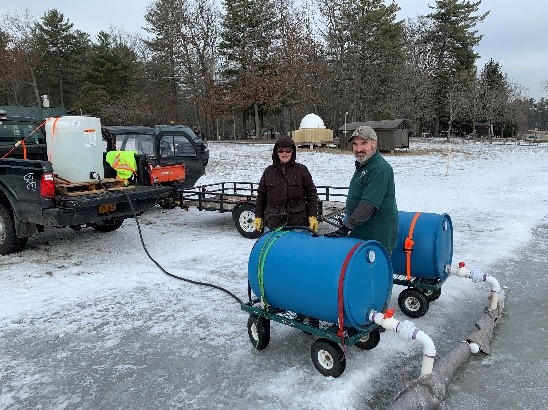
Moreau staffers Donna Fortner (left), and Jay Hauser, load up the Zambonis with warm water before going to lay down ice on the rink.

Zambonis work by slowly drizzling out warm water over the surface of existing ice. The warm water melts all the high spots and fills in all the lows before freezing to create a perfectly smooth surface perfect for skating. The operator judges how fast they want water to come out by adjusting the flow with the valve.

At Moreau, our crew pulls a Zamboni around the rink three times before it runs out of water, and then the other Zamboni takes its place. It is important to have two setups because ridges can form in the ice if you stop putting down warm water even for an instant. To create a smooth rink, it took about 110 gallons of water, applied by two Zambonis over six laps, for a total of about an hour of work.

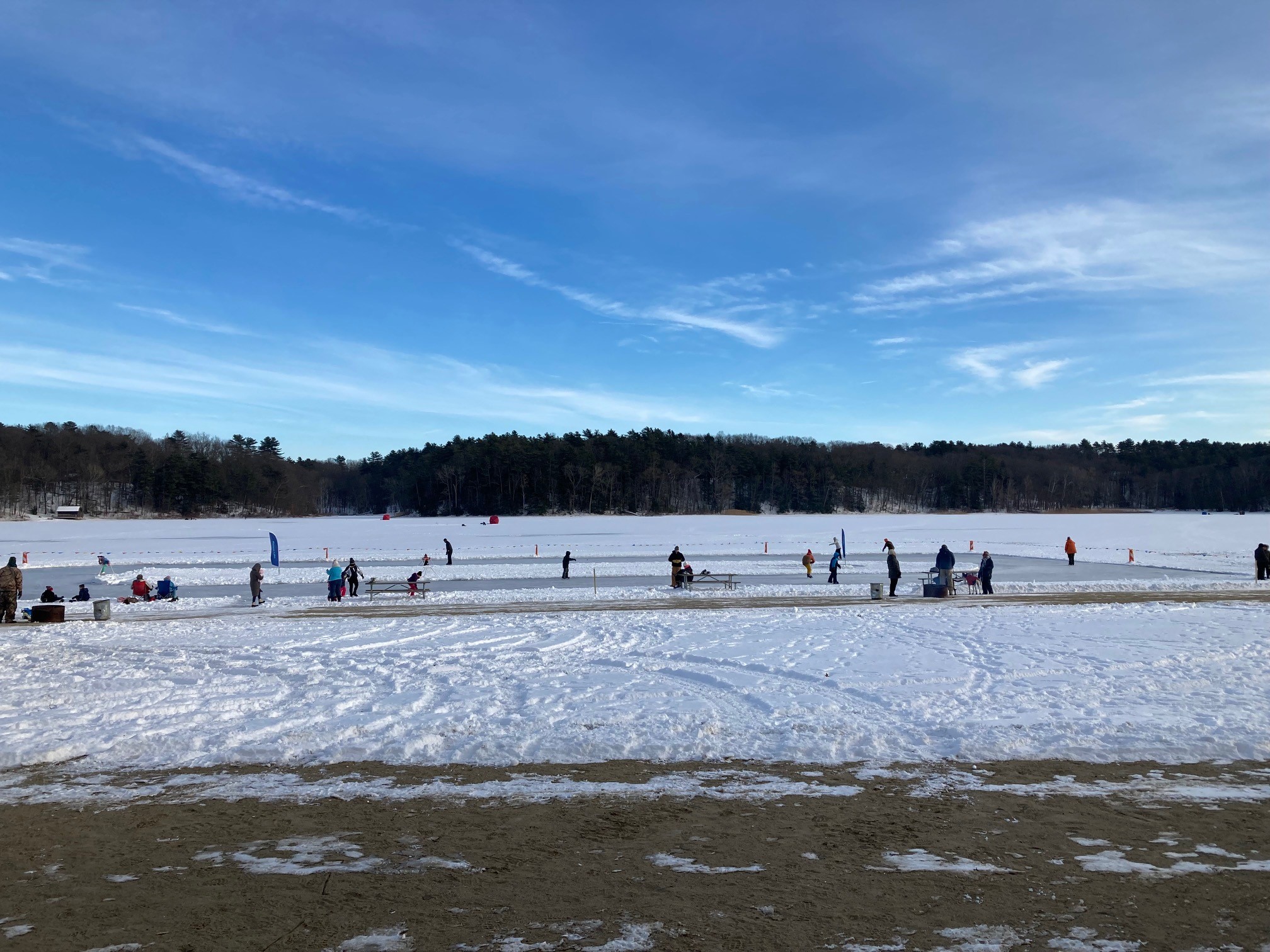
Measuring 250 feet by 100 feet, the outdoor skating rink at Moreau Lake State Park welcomes skaters! The Park has free loaner skates.

Another service that Moreau Lake State Park provides to visitors is the Daily Ice Report. Parks staffers measure the thickness of the ice starting a day after rink ice is laid on, meaning when the ice totally covers the surface of the lake, we wait a day and then start the ice thickness report. Two staff members start at shore with an ice auger and drill through the ice and measure the thickness. If it is under 3 inches they stop at that hole. If it is over 4 inches, they move out 20 feet and drill another hole. They follow the same procedures until it is determined that the average thickness (average readings taken from multiple places on the lake) is at least 6 inches.

When that happens, the lake is opened to skaters, pedestrians and ice fishermen. These ice reports are published over social media every day at 8:00 a.m. until the ice is safe and then these reports are replaced by the open one.

All this comes together to make the lake a safe and enjoyable place to recreate in the winter. At our rink, located just off the beach, a campfire is usually going nearby so skaters can warm themselves. So grab your skates (or borrow ours) and give us a visit!

Cover shot – Moreau staffer Jay Hauser (foreground) pulls a homemade Zamboni around the skating rink at Moreau Lake State Park, as fellow staffer Donna Fortner comes along behind with the second Zamboni . All images NYS Parks unless otherwise noted.

Post by Al LaFountain, Park Manager, Moreau Lake State Park and Grant Cottage State Historic Site

More about Moreau Lake State Park


Covering some 6,250 acres in Saratoga County, Moreau Lake State Park features hardwood forests, pine stands, and rocky ridges. More than 30 miles of hiking trails are available, and can be used for snowshoeing and cross-country skiing in winter. Snowshoe rentals are available.

Last year, Governor Kathy Hochul announced an 860-acre expansion of this park to include spectacular natural habitat along an undeveloped stretch of the Hudson River that will be known as Big Bend Point.  This acquisition makes Moreau Lake State Park one of the ten largest parks in the state park system.


Resources


Learn about a Gilded Age ice skater who helped promote figure skating for women from this previous blog post by the curator at Staatsburgh State Historic Site.

Gilded Age Ice Skater Carved Early Path

Staatsburgh State Historic Site, formerly the Gilded Age estate of the very wealthy and socially-prominent Ruth Livingston Mills and her husband, financier and philanthropist Ogden Mills, sits along the eastern bank of the Hudson River in the mid-Hudson Valley. Commanding a view of the river and the Catskill Mountains, the estate’s Beaux-Arts mansion was once…

A hand-operated Zamboni machine is on display at the Original Hockey Hall of Fame in Museum, in Kingston, Ontario, where it is also described as a “hand flooder.” (Photo credit – Wikipedia Commons)

“Skating is in my heart, not my head.” – Olympic Medalist Michelle Kwan
Volcanoes On A Great Lake

If you were told there could be volcanoes along the shore of Lake Erie in winter, would you believe it? While it may be hard to imagine, Lake Erie does in fact produce volcanoes and Evangola State Park can be one of the best places to see them!

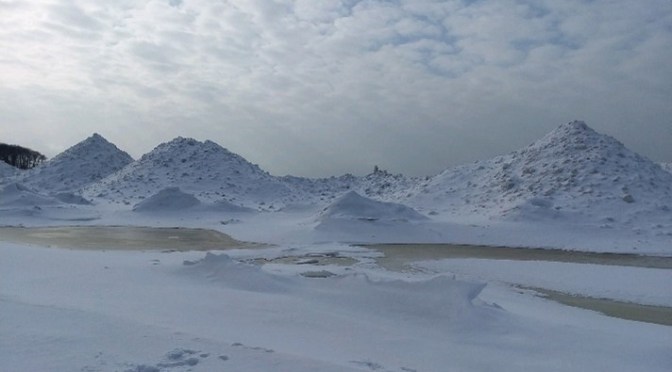
Unlike traditional volcanoes, the ones found at Evangola State Park are not made of rock and magma, but rather water and ice. Ice volcanoes are a temporary outcome of a partially frozen lake. When ice begins to form on the water’s surface, powerful winds push large waves towards the shore. As they do, the water is sandwiched between the shore and the ice, creating a buildup of pressure.

A gap in shelf ice allows for potential formation of an ice volcano.

Eventually with nowhere else to go, this pressure causes the water to burst through cracks in the ice. The resulting spray from this burst, freezes on the ice surface, accumulating in the shape of a cone with an open, unfrozen center. With each successive wave, plumes of water erupt from the newly formed ice volcano, building this winter wonder to potential heights of 20-plus feet! Occasionally the ice may build up in the shape of a cone, but without an open center. These rolling hills of ice become so called ice-dunes.

While Lake Erie is one of the best locations to see ice volcanoes, Lakes Ontario, Michigan, and Superior can also produce these icy cones when conditions are right. For example, such volcanoes have also recently formed during the cold snap at Hamlin Beach State Park in Monroe County and Fair Haven Beach State Park in Cayuga County.

Ice Volcano at Hamlin Beach State Park in February 2022. (Photo Credit – Friends of Hamlin Beach State Park/Denise Bianrosa Duffy)

Further from home but to the excitement of many, in 2021 a 45-foot tall ice volcano formed in southeastern Kazakhstan as water from a hot spring gushed through a thick layer of ice, creating a massive volcano for all to enjoy. 

But also, to be clear, the shelf ice on a lake where these structures form can be extremely unsafe and people are strongly advised against venturing out on it to get closer to ice volcanoes.

Confine sightseeing to the shoreline or stick with a guided tour by a trained Parks naturalist. One such hike is scheduled for Feb. 8 at Evangola State Park. Check with the park to learn if the volcanoes have formed.

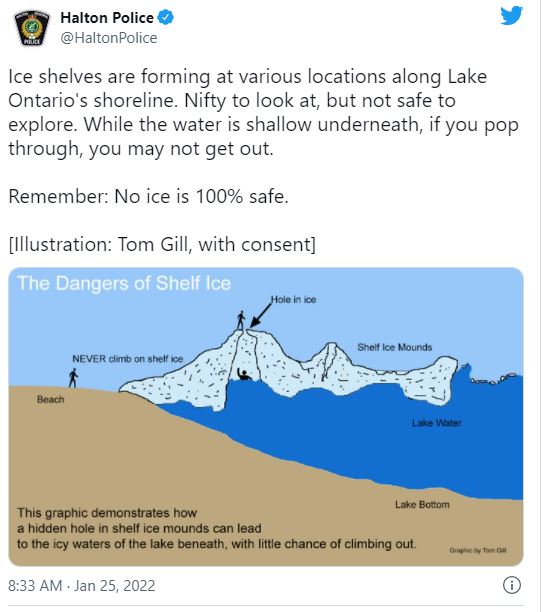
As a recent warning from the police department in Halton, Ontario, describes, if someone falls through shelf ice or down the opening of an ice volcano into the lake water below, it can be nearly impossible to get out even if aid is nearby. Cold lake water can quickly induce hypothermia, which can lead to death.

This graphic below illustrates the danger:


A shoreline guided tour past ice volcanoes at Evangola State Park. Remember, DO NOT venture out on shelf ice or approach an ice volcano. It is EXTREMELY DANGEROUS with the potential for falling into the lake water below with little chance of getting out.

Leaving earthly risk behind for a moment, scientists have even been able to detect ice volcanoes from several planets and moons deep in space. Typically called cryovolcanoes, these are defined as volcanoes that erupt with ice, water, or other materials such as methane and ammonia. In 2010, NASA’s Cassini spacecraft found possible ice volcanoes on Saturn’s moon Titan and in 2016 images from the Dawn space probe revealed dozens of ancient ice volcanoes on the dwarf planet Ceres

Ahuna Mons, an ice volcano on the dwarf planet Ceres, as seen by NASA’s Dawn spacecraft. (Photo Credit – NASA, JPL-Caltech, UCLA, MPS, DLR and IDA

Back on earth, favorable conditions for ice volcano formation here in New York haven’t been consistent in recent years. Warmer winters have resulted in less ice on all the Great Lakes. In 2021, the National Oceanic and Atmospheric Administration reported that only 2.4 percent of the Great Lakes surface was covered by ice in late January, the smallest amount in nearly 50 years. It was also noted that it was ninth-warmest January on record. While strong waves are needed to form ice volcanoes, strong waves with warmer temperatures will result in their destruction or prevent them from forming at all.

Despite our changing climate, ice volcanoes can still be a common occurrence during the winter months. The biggest change is in their longevity. For example, in the past several years, ice volcanoes at Evangola State Park have only lasted a few weeks or even just a few days after forming, as sudden warm spells take hold and break them apart.

For your best chance to experience ice volcanoes, be sure to keep a close watch on your local weather forecast and head towards the lake shore after a push of cold artic air passes through. To add to the adventure of enjoying these frozen phenomena, our team of environmental educators offer guided hikes all winter long, sharing what makes our Great Lakes environment so unique.

For those interested in learning more, look for guided hikes through the Niagara Region Parks Interpretive Programs Office.

An ice volcano “erupts” (on left) at Fair Haven Beach State Park on Lake Ontario. Photo credit – Caroline Lamie, Office Manager/Senior Researcher/Tour & Event Coordinator, Fort Ontario State Historic Site

Cover shot – Ice Volcanoes in 2021 at Evangola State Park. All photos NYS Parks unless otherwise noted.

Post by Matt Nusstein, Environmental Educator, Niagara Region NYS Parks

Resources

Learn about ice volcanoes on the the Keweenaw Peninsula of Lake Superior.

Learn about the presence of Cryovolcanism in the Solar System in this report from the BBC.

Learn about other Great Lakes wonders to look for at NYS Parks in previous Parks Blog posts.

Evangola State Park: Lake Erie’s Winter Playground!

Along the shores of Lake Erie, Evangola State Park becomes a winter sports mecca as the lake’s famous lake-effect snowstorms blanket the park! Lake-effect snow occurs when cold, Canadian air moves across Lake Erie evaporating its open waters and causing intense, local snow bands which can drop one to two inches of snow per hour.…

Wonders of the Winter Beach

Getting cabin fever? Well, bundle up and take a trip to a beach-front state park! Lake Ontario, Lake Erie, Lake Champlain, Long Island parks or the many parks on small lakes: Glimmerglass, Green Lakes, Long Point-Chatauqua Lake, Allegany, or many others. This is the time to explore the many interesting patterns and colors of wintertime…

All are Welcome Where They Once Were Not: New York’s First African American Vacation Resort

Vacationing in New York has not always been easy for African Americans. For most of the 20th century, cultural segregation was the norm. While Jim Crow laws in Southern states were explicit, here in New York there also were known rules of discriminatory racial separation in accommodations that could make finding a cool place on hot summer days challenging.

About an hour’s drive north of New York City, the popular mountain resort area of Greenwood Lake in Orange County near the border with New Jersey dated to the 1870s and for years had been off-limits to Blacks, Jews, and Italians. But in 1919, a change happened. Wanting to relax in this beautiful mountain setting and enjoy themselves without racial hassles, a group of prominent African American families, spearheaded by nine members of the Carlton Street YMCA in Brooklyn joined together to create the first African American vacation resort in New York State.

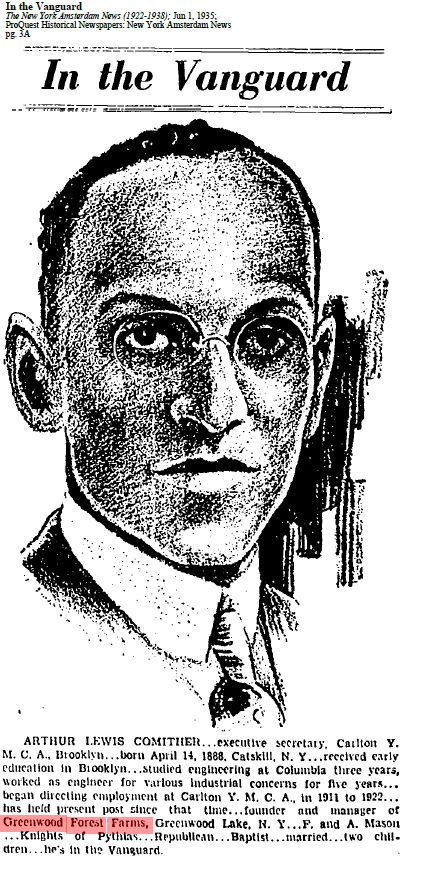
One of co-founders of Greenwood Forest Farms, Arthur Lewis Comither. (Photo Credit – ProQuest Historical Newspapers)

Sterling Forest Farms Incorporated purchased 143 acres of land high in the mountains surrounding Greenwood Lake and named it Greenwood Forest Farms. The ‘Colony’ as it came to be known was to become the summer place to be for African Americans well into the 1960s. 

By the mid-1930s, Greenwood Forest Farms was well on its way to becoming the place to be seen during the summer months. A July 1938 headline in the Black-owned New York Amsterdam News boasted “Greenwood Lake May Become East’s Most Fashionable Summer Colony.” A full-page story covered details of the site’s founding, and reporter Thelma Berlack-Boozer was given tours of several cottages, gardens, and all the amenities. At the time there were twenty-eight cottages set in beautifully landscaped gardens with thirty-five other lots in development. The writer described the wonderful natural forest surrounding the location, the luxurious summer furnishings on expansive porches and lovely interiors, the corporation’s plans, and how those who happened to not own cottages still could enjoy time there.

The corporation built a club house called the ‘Farm House’ where vacationers could enjoy live music, dancing, and a restaurant. For those who did not own a cottage, the Farm House was one of three locations where vacationists could rent rooms. The other two were private cottages which rented bedrooms during the summer, with one of those, the Justice House, opened during the winter for those interested in hunting. An August 1941 ad offered lodging at the Farm House for $15 per week or $4 for the weekend, with a car shuttle leaving from Harlem on Tuesdays, Thursdays, and Saturdays to make traveling upstate easy. The plan was completely upscale, to the point that in the 1940s the colony generated its own electricity. When completed, the Colony had a man-made lake, tennis, and hand-ball courts, and a nursey school for everyone’s use.

New York’s Black elite both owned the properties and visited their friends. Luminaries like Cecil McPherson (Cecil Mack) the famous lyricist and music publishing magnate, and his wife Dr. Gertrude Curtis, New York’s first African American woman dentist owned a cottage there. The poet Langston Hughes was among several literary figures who summered there with friends. Civil rights giants James Farmer, Harold W. Cruse, and Robert J. Elzy, the head of Brooklyn’s Urban League were among the property owners and guests.

If people wanted to know where to find the cream of the crop during the warmer months, society columns in the New York Amsterdam News kept people up to date. In 1933 the paper’s Brooklyn Society column informed all that the Elzys could be found at their cottage ‘Rob-Lou,’ and that Mr. and Mrs. Jesse Webster, and their weekend guests from Baltimore motored up to the Greenwood Forest Farm House on Sunday. Mrs. Willard J. Price and her daughters spent the week as guests of Mrs. Walter Taylor of Greenwood. The Jamaica News and Social Briefs shared that Mrs. Gordon Jones and her daughter, were at Sterling Forest Farm for the summer but had returned to Jamaica.

By the late 1960s as the older generation died, and options for vacation locations expanded for African Americans with the passage of the Civil Rights Act and the opening up of public accommodations, fewer people ventured up to Greenwood Forest Farms. In the 1970s the famous Farm House was lost to a mysterious fire, but many families continued to vacation and live there year-round. 

An account of the fire that destroyed the Farm House at Greenwood Forest Farm appeared in the New York Amsterdam News on Aug. 14, 1971. (Photo credit – ProQuest Historical Newspapers)

In 2007, the Greenwood Forest Farms Association, Inc was created by descendants of original property owners to preserve the legacy of the colony. Although diminished, Greenwood Forest Farms today remains a proud hamlet of the Town of Warwick and has a few multi-generational residents. 

Today, New York State Paths through History signs can be found along Nelson Road in the Town of Warwick commemorating Greenwood Forest Farm’s amazing story of resilience and joy. And this historic place is now preserved for the people of New York.

On January 11, 2022, Governor Kathy Hochul announced a 130-acre expansion of Sterling Forest State Park, with a portion of the land belonging to Greenwood Forest Farms. Now with the designation of this land as a State Park, awareness of the legacy of the area will grow.

As State Parks celebrates Black History Month, we are reminded that this property tells the story of a time when racial segregation in the North was found around Greenwood Lake. It reflects part of a long journey to today, when State Parks is committed to the message that “All Are Welcome Here.”


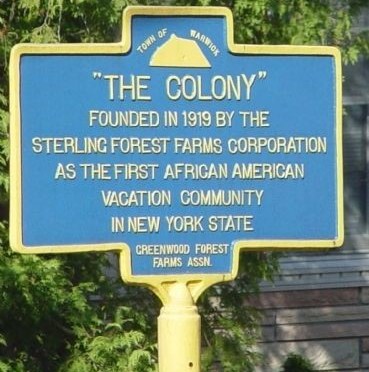
Cover Shot – Historic marker for Greenwood Forest Farms (Photo credit – Woodham, Rebecca. “”The Colony” Historical Marker (Greenwood Forest Farms).” Clio: Your Guide to History. December 27, 2017. Accessed Jan. 20, 2022.  https://theclio.com/entry/53333)

Post by Lavada Nahon, Interpreter of African American History, Bureau of Historic Sites, NYS Office of Parks, Recreation and Historic Preservation.

Learn More About Greenwood Forest Farms


Read this 2019 article and 2005 article from the Times Herald-Record newspaper.

Watch this accompanying video by the Times Herald-Record.

Read this 2005 article from the Warwick Historical Papers newsletter.

Learn more about Black history in New York State in previous posts on the the NYS Parks Blog:

Juneteenth — Coming to terms with Freedom

“Grand Old Fort: But Alas Manned by Colored Troops…” Buffalo Soldiers at Fort Ontario 

Do You Know Sojourner Truth?

Reviving a Dutch Holiday with African Flavor 

A Legacy of Strength: Civilian Conservation Corps

John Brown Farm: Growing Freedom in Adirondack Wilderness


About Sterling Forest State Park

Established in 1998, Sterling Forest State Park covers nearly 22,000 acres of nearly pristine natural refuge amidst of one of the nation’s most densely populated areas, a remarkable piece of woodland, a watershed for millions, and a tremendous outdoor recreation area. This unbroken deep-forest habitat is important for the survival of many resident and migratory species, including black bear, a variety of hawks and songbirds and many rare invertebrates and plants. Hunting, fishing and hiking opportunities are available.

The park’s Senator Frank R. Lautenberg Visitor Center overlooks the nine-mile long Sterling Lake and features exhibits about the local environment as well as an auditorium for related presentations.

The park has more than 80 miles of hiking trails, including a portion of the Appalachian Trail. It offers opportunities for horseback riding (permit required), hunting (permit required), fishing, biking, snowshoeing, cross-country skiing and ice fishing.

The park also is part of the Sterling Forest Bird Conservation Area, and includes such species as Peregrine Falcon (endangered), Pied-billed Grebe (threatened), Least Bittern (threatened), American Bittern (special concern), Osprey (special concern), Sharp-shinned Hawk (special concern), Cooper’s Hawk (special concern) Northern Goshawk (special concern), Red-shouldered Hawk (special concern), Common Nighthawk (special concern), Whip-poor-will (special concern), Red-headed Woodpecker (special concern), Horned Lark (special concern), Golden-winged Warbler (special concern), Cerulean Warbler (special concern), and Yellow-breasted Chat (special concern). Numerous other species contribute to the diversity of birds within the BCA including Broad-winged Hawk, Acadian Flycatcher, Least Flycatcher, Yellow-throated Vireo, Brown Creeper, Winter Wren, Hermit Thrush, Worm-eating Warbler, Blue-winged Warbler, Black-throated Blue Warbler, Pine Warbler, Ovenbird, Louisiana Waterthrush, Hooded Warbler, Canada Warbler, Scarlet Tanager, Rose-breasted Grosbeak, Orchard Oriole, and Purple Finch.

Sources

Greenwood Lake May Become East’s Most Fashionable Summer Colony, Thelma Berlack-Boozer, The New York Amsterdam News, July 23, 1938, ProQuest Historical Newspapers: New York Amsterdam News, pg. 10.

Brooklyn Society, Elzys ‘Rob-Lou,’ The New York Amsterdam News, September 6, 1933; ProQuest Historical Newspapers: New York Amsterdam News, page 11.

Brooklyn Society, Mr. & Mrs. Webster, The New York Amsterdam News, July 12, 1933; ProQuest Historical Newspapers: New York Amsterdam News, page 11.

Jamaica News and Social Briefs, The New York Amsterdam News, July 23, 1928; ProQuest Historical Newspapers: New York Amsterdam News, page 9.

Holiday Points of Light at Grafton Lakes State Park

Lights have long been associated with the holiday season, along with family, holiday cheer, and guiltlessly indulging in your sweet tooth.

At Grafton Lakes State Park in Rensselaer County, staff chose to embrace that season of light by placing dozens of luminaria along trails for the park’s inaugural annual holiday “Luminary Walk” in December. What are luminaria, one might ask? ( Hint: It is not the plural of luminary.)

Originating in the Philippines after it became a Spanish colony at the beginning of the 16th century, luminaria are small paper lanterns with candles used to mark the Christmas season. Originally made then from bamboo and paper coming from China, the Philippine tradition of luminaria was brought eastward by Spanish traders into the southwestern North America and Mexico when that region was still controlled by Spain.

Today, holiday luminaria as a reflection of a holiday contribution of Hispanic culture are a common sight in the southwestern United States, including New Mexico and Arizona, but have become popular in other parts of the country as well.

To bring that festive glow into the northern forests at Grafton, parks staff led by Tamara Beal arranged for more than 125 luminaria for the festival, while also seeing to it that firewood was stacked, marshmallows were prepped on sticks, and hot coco was steaming by the jugful.

Each light was powered by three triple AAA batteries and each white paper bag required a precisely cut wooden block to weigh down the bag. The maintenance staff cut the blocks and strung lights along the boardwalk for the event. All 125 bags with lights and blocks were put together, loaded up into a utility vehicle and spaced out along a half-mile of trail by staffers Rebecca Milanese and Ava Bassallo.

Check out the slideshow of the luminaria trail below…

Under crystal dark skies and the light of a full moon in December, an unprecedented 900 people showed up for the event and to walk the illuminated paths.

With Holiday music wafting from the Welcome Center back patio, there was a general buzz of happiness and joy. Visitors warmed up by the fire with marshmallow and stick in hand, creating a tasty treat. Children sat down inside stimulating their imaginations to create one-of-kind holiday crafts. Behind the scenes, volunteers and staff members were serving the public, refilling the hot chocolate jug, breaking up pieces of chocolate, restocking the crafts, and more.

The magical illuminated journey began on the boardwalk just beyond the back patio. As the Holiday music faded, a serene silence welcomed the wanderer. Each step in the light a reminder of fond Holiday memories. Up the stairs of the replica fire tower, with a bird’s eye view, the forest twinkled in brilliance. Just beyond the forest, romance rolled on the wind by the lake as many couples opted for a moonlit stroll.

What was originally foreseen by event coordinator, Tamara Beal, as being a small quaint event, left hundreds of people renewed in their holiday cheer in a park dotted with dozens of warm points of light. Thank you to all those who came out and to staff members and volunteers who dedicated their time and contributed to the magic.


Cover shot – Replica Fire Tower with luminaria at Grafton Lakes State Park. All photos by NYS Parks unless otherwise noted.

Post by Tamara Beal, Environmental Educator, Grafton Lakes State Park

Check out future events at Grafton Lakes State Parks here.

Moonlight over Long Pond at Grafton Lakes State Park (Photo Credit – Deborah Balcanoff, used with permission)

***UPDATE***

Interested in attending an upcoming luminaria walk? There is one scheduled for 6 p.m. Feb. 24, 2021 at Moreau Lake State Park in Saratoga County. Click here for more details.

Camping in the Round

While State Parks offers more than 8,100 campsites, 825 cabins, and 136 full-service cabins across New York, in the western part of the state, there is another kind of camping option available – yurts.

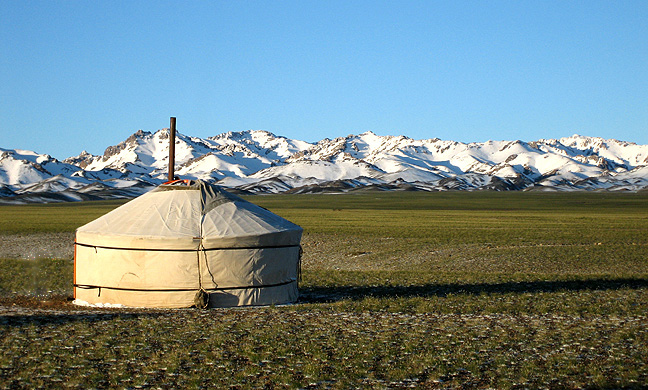
A yurt is a round fabric shelter on a raised platform, with a roof, door, and windows that provides more shelter and room than a ground tent yet is a simpler accommodation than a traditional wood-framed cabin. The history of yurts traces back about 3,000 years to central Asia, where nomadic peoples used these portable homes as they moved around vast treeless grassland plains, known as steppes.

Yurt is a Turkish adaptation of the Mongolian word “ger” (meaning “home”) originally used to describe such residences, which were meant to be easy to assemble and disassemble as their owners moved with their horses and livestock throughout the seasons. Yurts are formed by a circular wooden lattice wall that supports wooden rafters attached to a elevated center ring, with the structure draped in fabric, originally felt, wool or hides. Being round, yurts were perfectly designed to resist high winds common in the region, since the shape has no corners or flat spots to catch wind gusts.

According to historians, the Mongol conqueror Genghis Khan led his vast armies from his command post in a large yurt that moved from battlefield to battlefield.

The historical importance of the yurt to the region is represented in the official flag of the republic of Kyrgyzstan in central Asia. The flag consists of a red field charged with a yellow sun that contains a depiction of a “tunduk,” the opening in the center of the roof of a yurt. This view is what someone might see looking up upon awakening in a yurt

The state flag of Kyrgyzstan, featuring a representation of the center opening in a yurt’s roof. (Photo Credit – Wikipedia)
A Mongolian ger on the steppe at Gobi Gurvansaikhan National Park in southern Mongolia. (Photo Credit- Wikipedia Commons, Uploaded by Adagio at English Wikipedia)

Easy and quick to build, this ancient design arrived in America during the 1970s as part of the simplified “back to the land” movement, slowly developing a following as an inexpensive form of housing that could be assembled in a day. The structures have been gaining popularity in recent years as a camping accommodation that puts its residents close to nature, while offering more comfort and sturdier protection against the elements than a tent. Modern yurts are meant primarily to be kept in place as semi-permanent structures, although they still can be taken apart and moved if necessary.

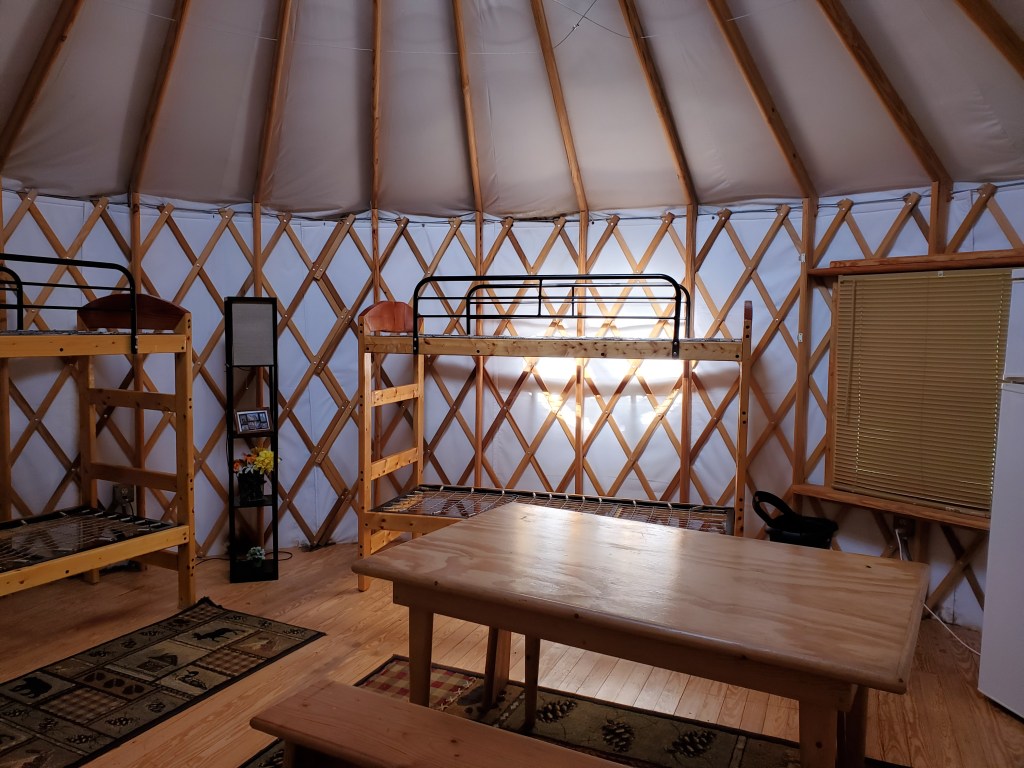
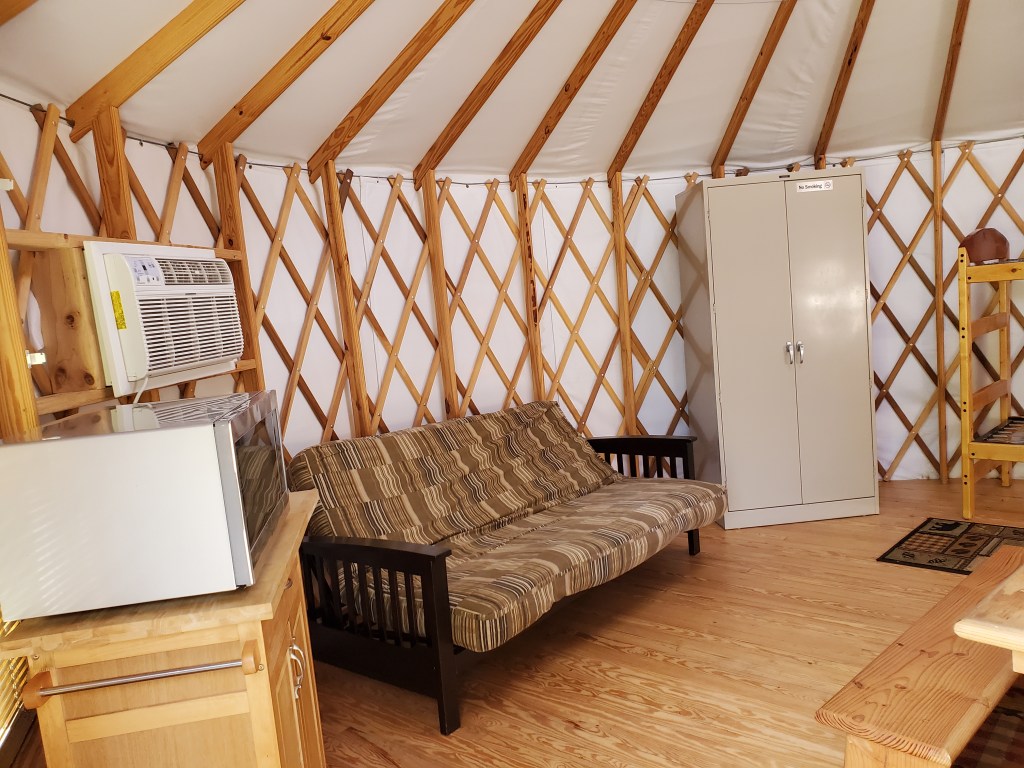
Three state parks in western New York now offer yurts as places to camp _ Four Mile Creek and Golden Hill state parks in Niagara County, and Evangola State Park in Erie County. Made from wooden lattice and rafters covered with heavy-duty fabric and insulation, these yurts feature a domed roof, windows, and bunk beds, as well as a refrigerator, microwave, and heating/AC units.

The yurts at both Four Mile Creek and Golden Hill at located closed to Lake Ontario and offer beautiful views. Golden Hill’s yurts are situated so that the decks provide a view of both sunrises and sunsets with Golden Hill’s Thirty Mile Lighthouse in sight. Take a slideshow tour of the Golden Hill yurts below…

At Evangola, the yurts are located next to a fishing pond, and just a short walk to the park’s Lake Erie shoreline.

Campers who have stayed in the yurts tell State Parks that they like it because it’s “in-between” camping in a tent and a cabin, being particularly useful for those who might not have all the gear needed for tent camping.

When the first yurts went up in 2013 at Four Mile Creek, New York State Parks joined a growing number of state parks across the country embracing this form of shelter as a camping alternative.

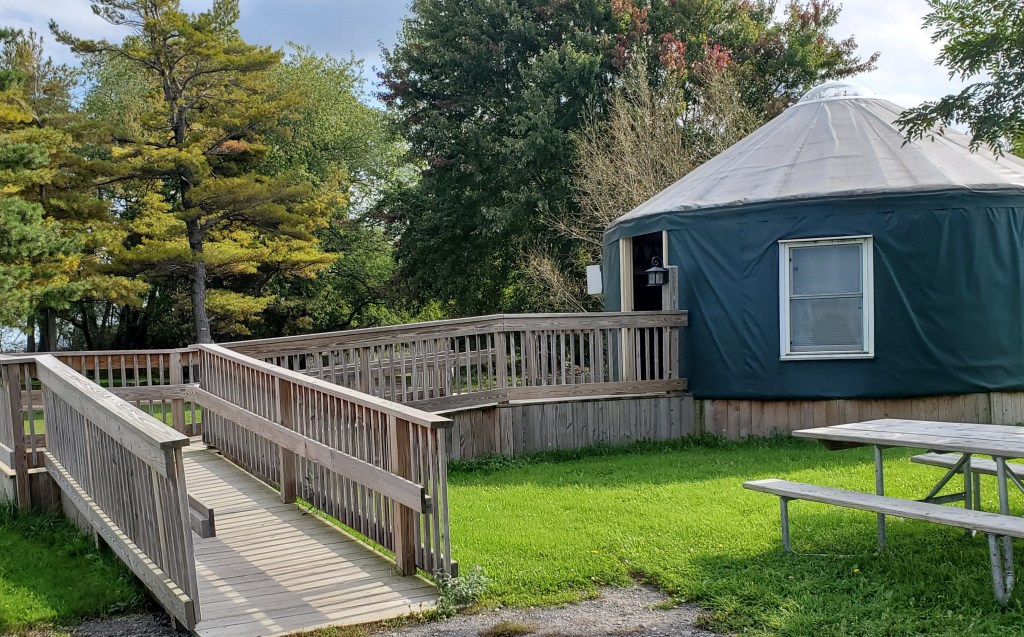
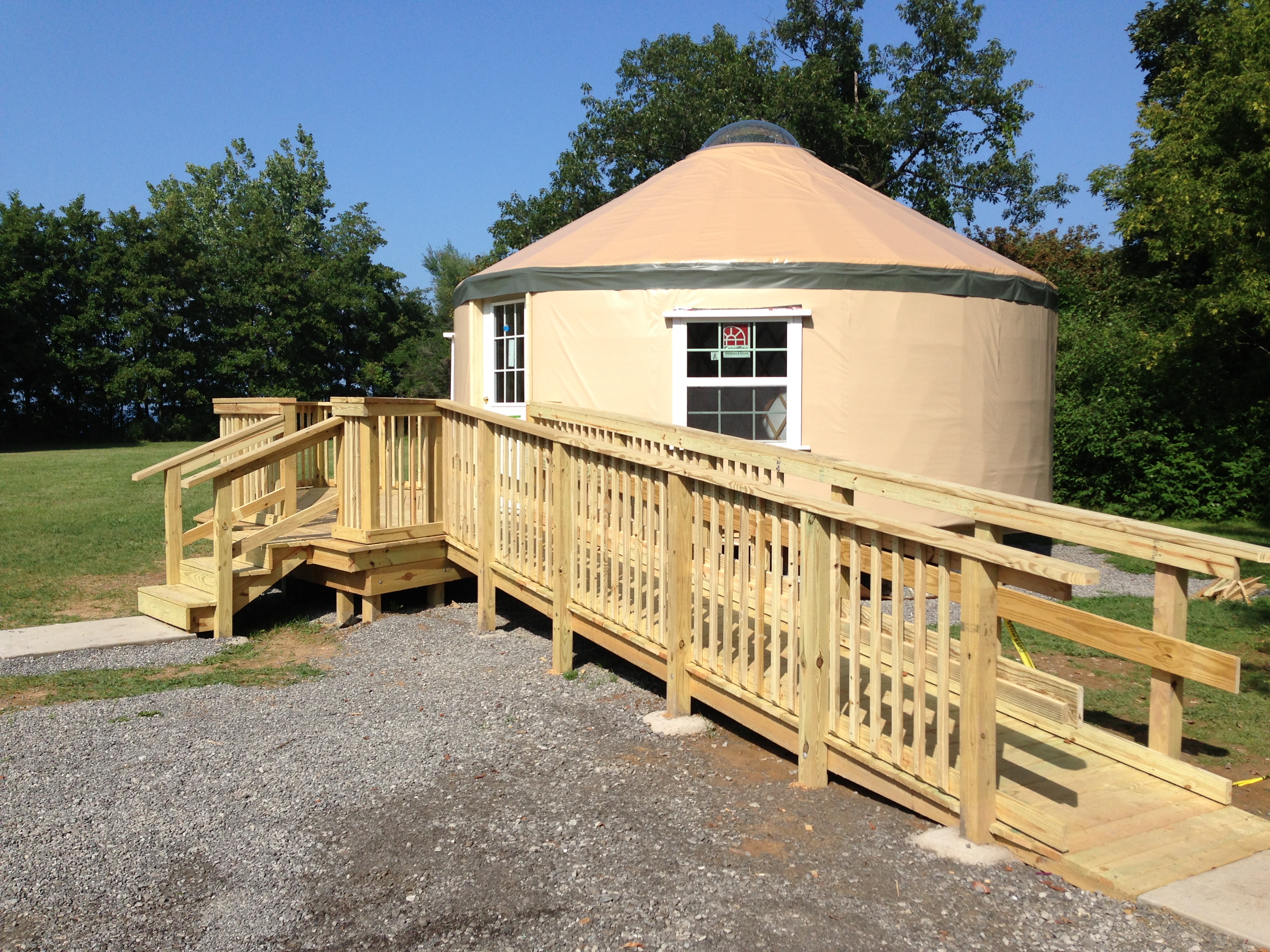
A yurt at Four Mile Creek State Park with an ADA accessible ramp.

According to industry accounts, the first two yurts in a state park in the U.S. went up in Oregon in 1993. Now, some two dozen state park systems across the country have added yurts.

The yurts in New York’s state parks are 20 feet in diameter, which results in about 330 square feet of interior living space and plenty of head room. While that might seem spacious for those used to maneuvering around a tent, that is a far cry from the largest yurt in the world. The so-called “White Building” (Ak Öýi) in the Turkmenistan capital of Ashgabat, dedicated in 2015, is in the form of a yurt more than 200 feet in diameter that stands about 100 feet high, with three separate stories holding a café, offices, apartments and an auditorium with 3,000 seats!

So, when considering camping at State Parks in western New York, think about trying out a yurt. Three thousand years of history can’t be wrong!

A traditional yurt on a cart in contemporary Kazakhstan. (Photo Credit- Wikipedia Commons/Creative Commons)

Cover Shot- A yurt at Four Mile Creek State Park. All shots credited to NYS Parks unless otherwise noted.

Post by Brian Nearing, Deputy Public Information Officer, NYS Parks

Resources

All reservations for New York State Park yurts, campsites, cabins, and full-service cottages are handled through the ReserveAmerica website.

The official blog for the New York State Office of Parks, Recreation & Historic Preservation