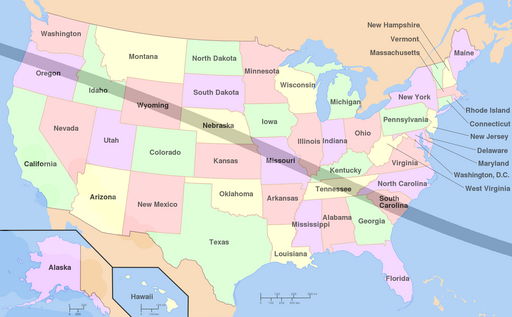
Many of us remember the last total solar eclipse in the United States, known as the Great American Eclipse in August 2017. The news coverage talked of the path of totality which travelled from coast to coast, starting in Oregon and arcing south across the country through South Carolina. Those who remained here in New York were treated to a view of between 59-75 percent obscuration (covering) of the sun as the moon passed between the sun and Earth. While it was definitely a national event, New York didn’t get the front-row seats that being in an eclipse’s path of totality provides.
Path of 2017 eclipse, courtesy of Wikicommons.
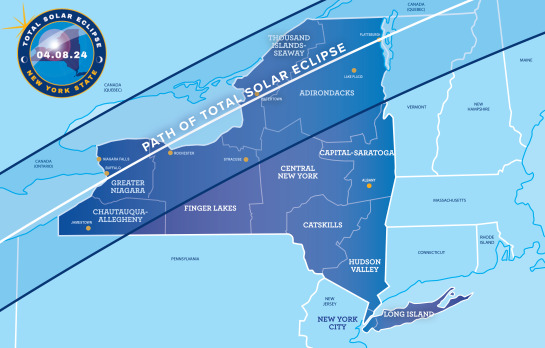
Thankfully, many New Yorkers will soon have the opportunity to see this celestial wonder for themselves from their own backyards or local parks. On April 8, 2024, another total solar eclipse will pass from Mexico through parts of 14 different states and into Canada. This time, New York is in the eclipse’s path.
The 2024 eclipse path in New York State, courtesy of I Love NY. To drill down on the path of totality for April 8, visit our interactive map.
Some people have been looking forward to the 2024 total solar eclipse for years, some for decades! But all of this anticipation has some of us looking backwards to the last total solar eclipse that passed through the skies of New York State in 1925.
Path of 1925 total solar Eclipse, Butler Papers, Archives of American Art, Smithsonian Institute.
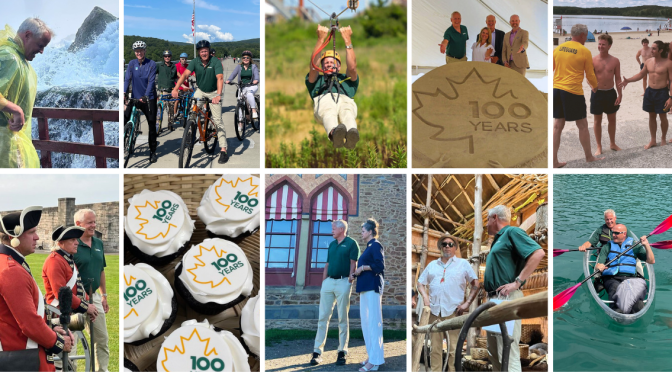
In 2024, New York State Parks and Historic Sites will celebrate our Centennial, commemorating the 100th anniversary of the founding of our parks and sites system. While we have incredible public properties older than the 100-year-old system, the Centennial celebrates the vital legislation that allowed us to build and expand our network of parks and sites, forging the system we know and love today.
As OPRHP Commissioner, I am reminded every day of the immense pride and enjoyment New Yorkers take in our facilities. To prepare New York State residents and visitors from around the world for the exciting year ahead, I recently embarked on a two-day journey to showcase the breadth of our parks and sites system, highlighting various activities and partnerships that make our system so unique.
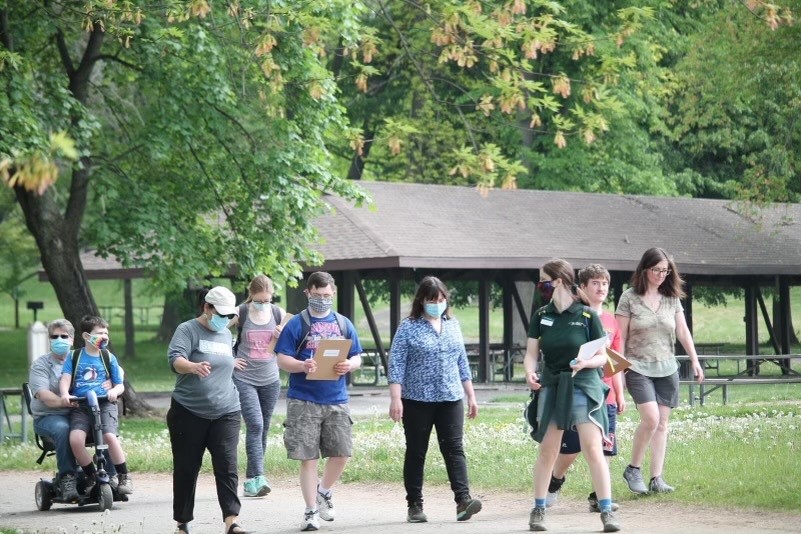
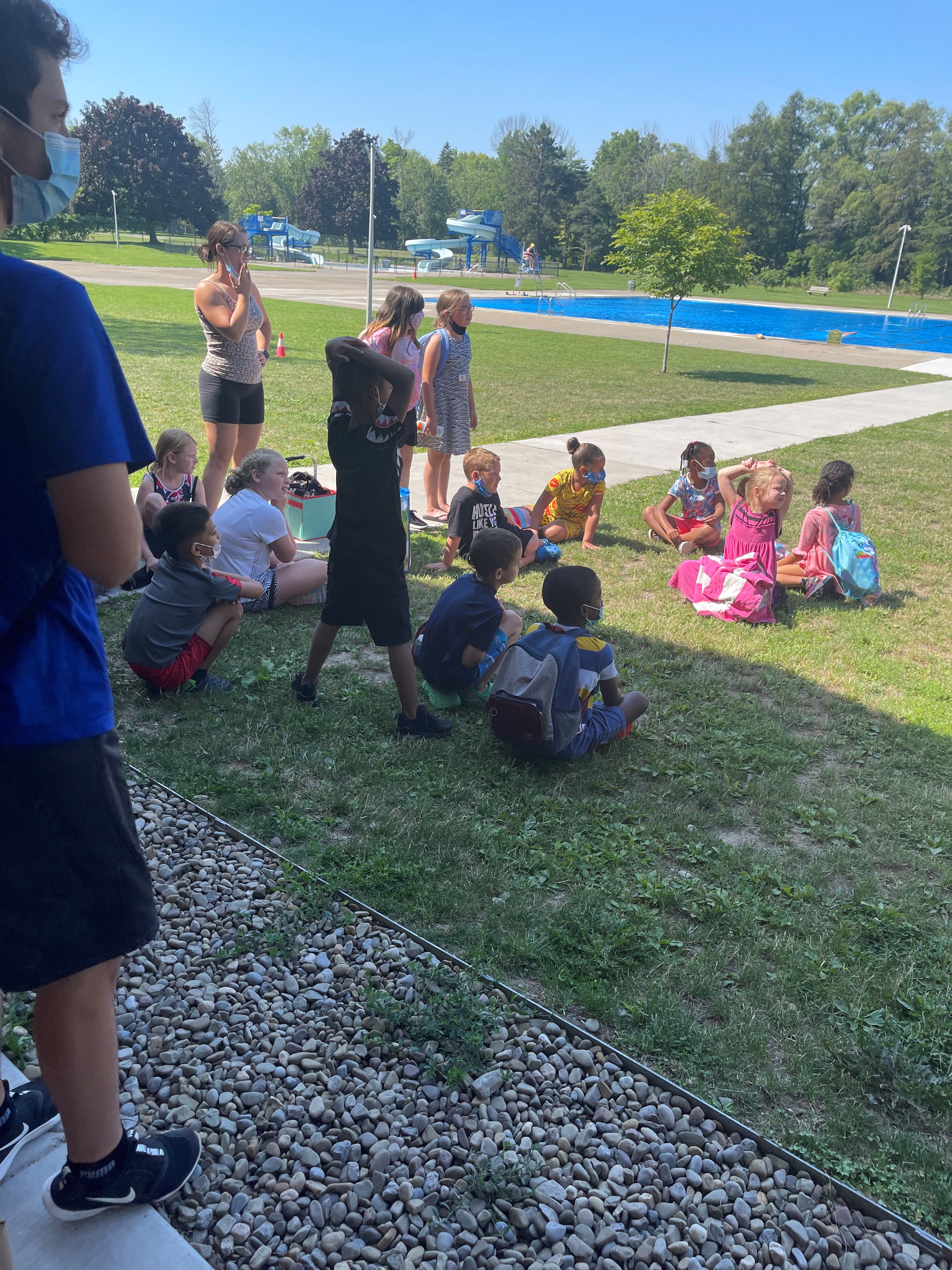
A ladder is used to get to a place otherwise beyond reach. That kind of help is the idea behind the State Parks’ Ladders to the Outdoors program, which provides free recreational programs for youth in underserved communities in Niagara and Erie counties.
The goal of State Parks’ Ladders to the Outdoors program is to remove financial barriers to getting children to play outdoors, try new sports, take a hike or camp in State Parks that they might not have a chance to visit. Since this program started in the summer of 2021, more than 2,000 kids from a variety of school districts, community, church, and youth groups have attended more than 50 different sporting and recreational events, completely free of charge.
Examples of programs that have been provided include guided hikes in the Niagara Gorge, sledding at Buffalo Harbor State Park, snowshoeing at Knox Farm State Park and a hike at Niagara Falls State Park. The offerings are endless and be tailored to any group or season.
When a group attends a Ladders program, activities will be tailored to the park they wish to go to and they will have access to a complete inventory of gear, from soccer balls, baseballs, bats and gloves, and footballs, to snowshoes and sleds. Want to learn disc golf? To bike? Fish? Swim? Kayak? Hike? We have all that equipment and people to help show the way, and it is always free!
It doesn’t stop at providing just the gear. To date, $300,000 has been invested to improve playgrounds and sporting fields, such as the baseball diamond and playground accessibility at DeVeaux Woods State Park in Niagara Falls, and Beaver Island State Park in Grand Island.
A safe and sturdy ladder costs money and Parks is making this program work with the support of a $860,000 grant made to the Natural Heritage Trust by the Ralph C. Wilson Jr. Foundation. Wilson was the former owner of the Buffalo Bills football team and a founding owner of the American Football League, who prior to his death in 2014, created one of the nation’s largest charitable foundations to benefit the people of the Western New York, Buffalo and Detroit areas.
Ladders to the Outdoors is looking to grow this summer, with programs available at the following State Parks: Buffalo Harbor, Beaver Island, DeVeaux Woods, Reservoir, Whirlpool, Fort Niagara, and Wilson-Tuscarora.
If your youth group would like to join in or has an idea for a program, please apply or contact us. An online form can be found here. More information is available through KeJuan.Harmon@parks.ny.gov
Start climbing your ladder and see what’s happening at State Parks in western New York!
Post by KeJuan Harmon, Coordinator, Ladders to the Outdoors Program
More About the WNY State Parks in Ladders to the Outdoors
Buffalo Harbor State Park is the first state park in the city of Buffalo. Boasting beautiful views of Lake Erie, the park is home to a 1,100-slip marina, a restaurant, boat launches, personal watercraft launches, fish cleaning station, restrooms, and a beach for strolling and sunbathing, and a nautical themed playground great for kids of all ages.
Beaver Island State Park is located at the south end of Grand Island in the upper Niagara River. The 950-acre park has a half-mile sandy beach for swimming, adjacent 80 slip marina with both seasonal and transient boat slips, fishing access, car-top boat launch, multiple canoe/kayak launches, bike and nature trails, nature center, playgrounds, picnic areas, athletic fields, horseshoe pits, an 18-hole championship disc golf course, an 18-hole championship golf course.
DeVeaux Woods State Park has a baseball diamond, a signature playground, picnic facilities, nature trails through a meadow and Old Growth Woods, and a path that leads across the Niagara Scenic Parkway to Whirlpool State Park with access to the Niagara Gorge trail system.
Whirlpool State Park has many scenic overlooks with spectacular views of the Whirlpool and rapids. Trailheads lead into the Gorge where challenging trails lead to one of the most spectacular landscapes in the country. There are also picnic facilities and a playground in this park.
Reservoir State Park has two tennis courts, seven softball diamonds, four basketball courts, a roller hockey court, and picnic facilities.
Fort Niagara State Park has two boat launches providing access to the Lower Niagara River and Lake Ontario, woodland hiking trails, a swimming pool, a view of Lake Ontario, picnic grounds, playgrounds and 18 soccer fields.
Wilson-Tuscarora State Park is a well-preserved natural area for many varieties of plants and wildlife, encompassing 476.5 acres of mature woods, open meadows, and marshland. Tuscarora Bay, divided from Lake Ontario by a strip of land called “The Island,” has a boat launch and emergency storm shelter docks. The park’s four-mile nature trail is also used for hiking, snowshoeing and cross-country skiing. Fishing for many varieties of pan fish and game fish, from boats or from shore, is extremely popular.
Did you know that New York State’s public lands and waters have had a charitable partner for more than 50 years? The Natural Heritage Trust (NHT) was established in 1968 as a non-profit, public benefit corporation with the mission to support parks, outdoor recreation, historic preservation and land and water conservation throughout state lands. During…
A custom energy-efficient LED lighting system that produces a rainbow of colors nightly at Niagara Falls State Park is a far cry from the simple technology used at the start of the Civil War when the falls were illuminated for the first time in honor of a visiting English prince.
The evening of Sept. 14, 1860, the falls were lit up for a short time using so-called Bengal lights, which were a centuries-old type of chemical flare that burned with bluish light. While it worked for the prince’s visit, this short-term and cumbersome method of lighting the falls was not to be used again.
A few years later, a new technology developed during the recently concluded Civil War came to the world-famous falls. Spotlights used then were powered by heating up piles of calcium quicklime until it glowed brightly, which is the origin of the phrase of putting something “in the limelight.” Union forces had used such spotlights during the war to illuminate Confederate positions at night.
The emerging technology of electric lights arrived at the falls in 1879 to herald the arrival of an official couple from the government of Canada. More than two decades then passed before Walter D’Arcy Ryan, an innovative lighting engineer with Schenectady-based General Electric Co., designed a massive new searchlight system in 1907 that used colored gelatin films changed by hand to project different colors onto the face of the falls.
For 30 nights in a row in 1907, Ryan used 44 searchlights with colored filters, and powered with steam engines, to illuminate the entirety of Niagara Falls for the first time. Following this acclaimed success, he was named head of GE’s Illuminating Engineering Laboratory, the world’s first institution for research into lighting, created the following year in Schenectady.
According to the New York Tribune of Sept. 5, 1907, Niagara Falls looked far more dramatic lit up at night such that “words fail to describe the magnificence of the spectacle”. Another observer wrote: “It was a riot of glorious beauty, so new, so strange, so marvelous – so like some unearthly and unexplained magic that it held the spectator startled, then spellbound, speechless and delighted.”
Officials pose with the General Electric searchlight system used to illuminate Niagara Falls in these undated photographs. (Photo Credit- NYS Parks)
Ryan’s system was incredibly powerful for its day, producing more than 1 billion candela (a measurement of luminous intensity). That was the equivalent to more 8.3 million standard 110-watt lightbulbs!
By then, the illumination of the falls was proving to be an increasingly popular attraction, and in 1925 a joint U.S.-Canadian group was formed to manage and operate lighting – the Niagara Falls Illumination Board. The five-member board saw to it that new, even more powerful electric lights were installed for a ceremony that year. Lights were upgraded again in 1958, 1974, and 1997.
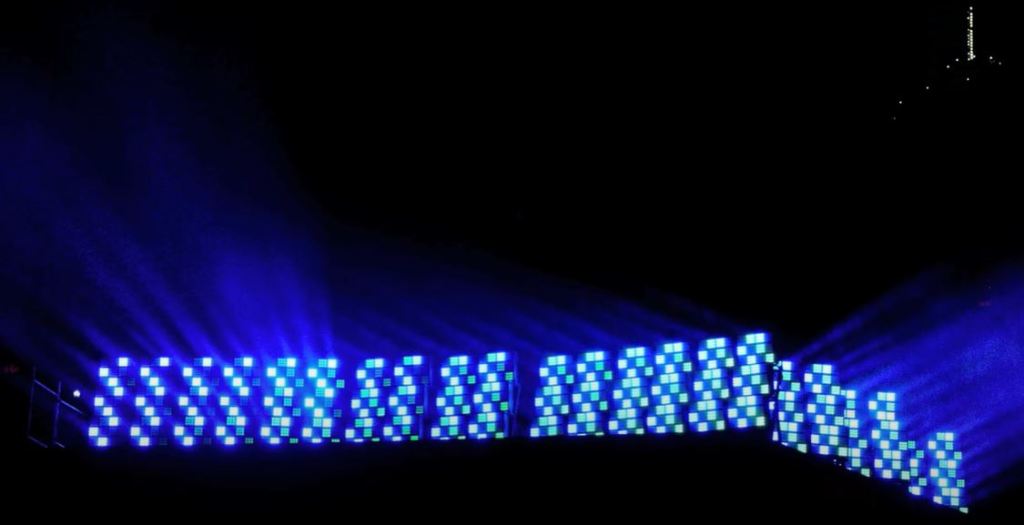
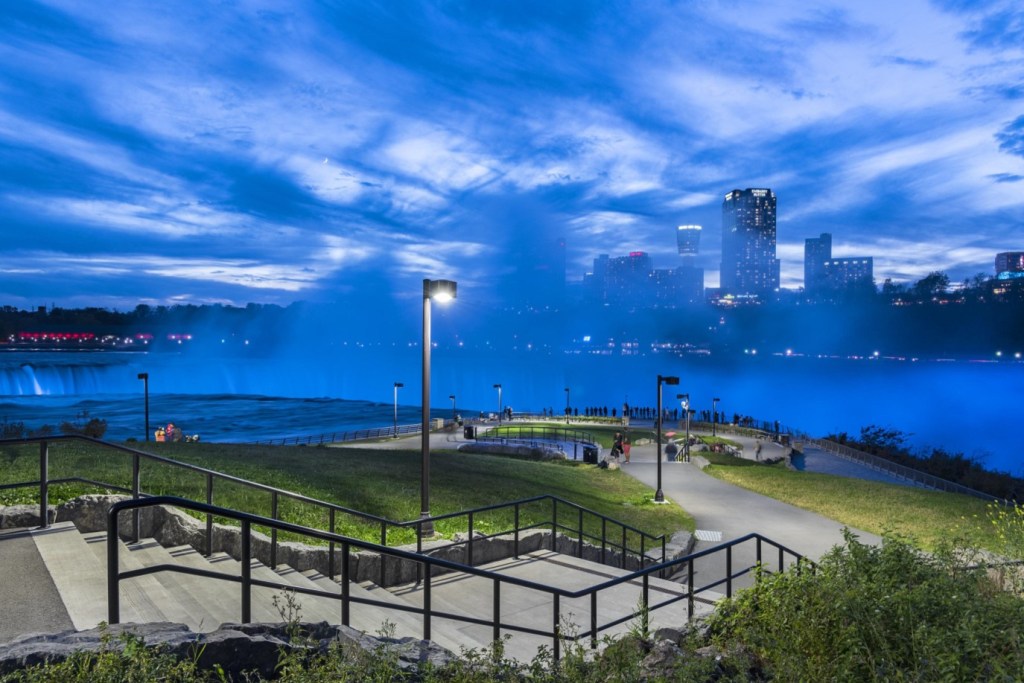
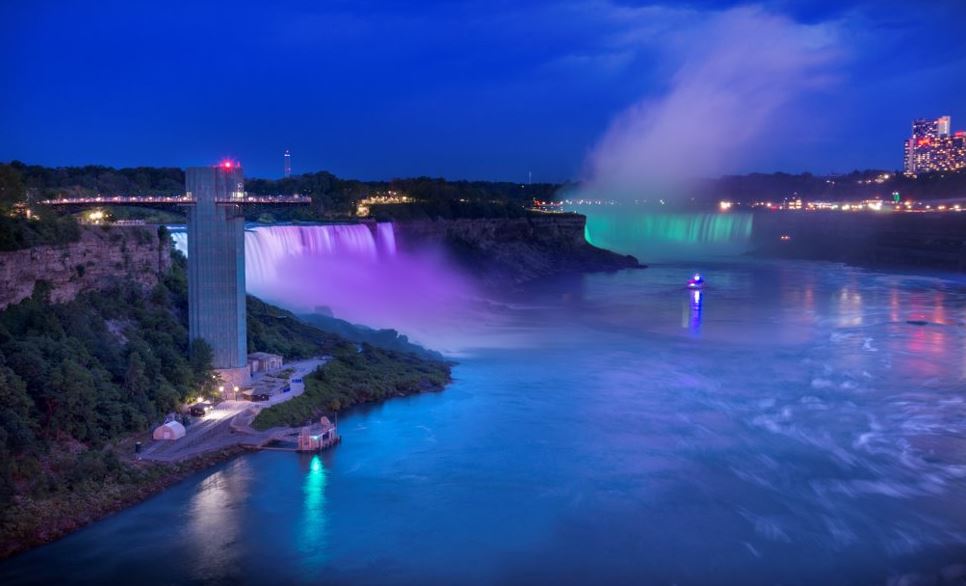
Today, visitors to Niagara Falls State Park are witnessing the work of an array of energy efficient LED lights that was installed in 2016. This $4 million custom system produces any color desired and has twice as much illumination as the previous lights, producing an enormous 8 billion candela. (For the lighting techies, that is more than eight times more powerful that the turn-of-the-century GE system, equivalent to the illumination from 66.6 million standard 110-watt lightbulbs!)
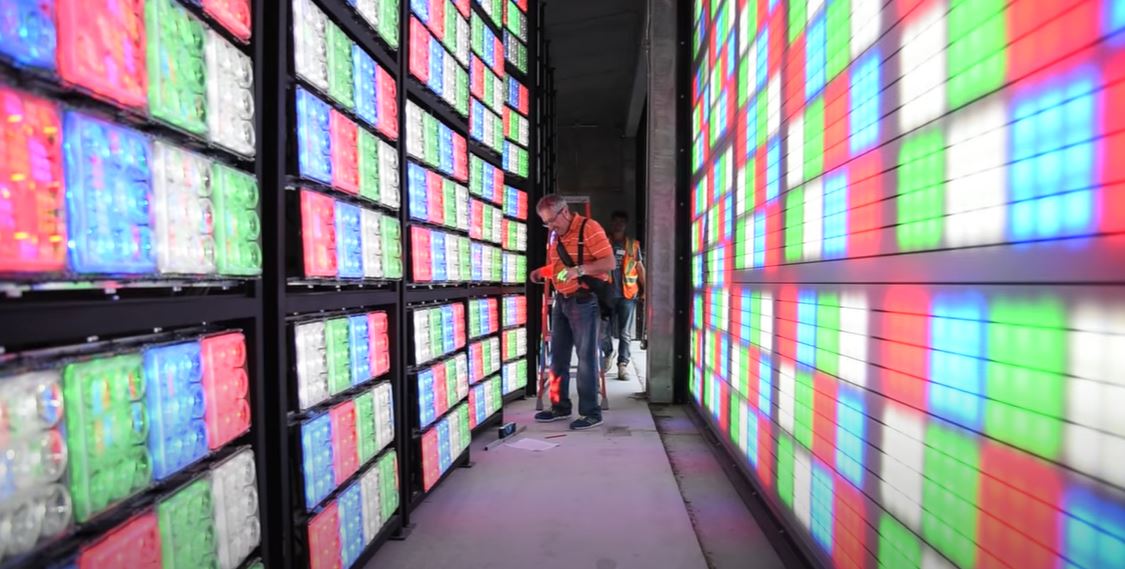
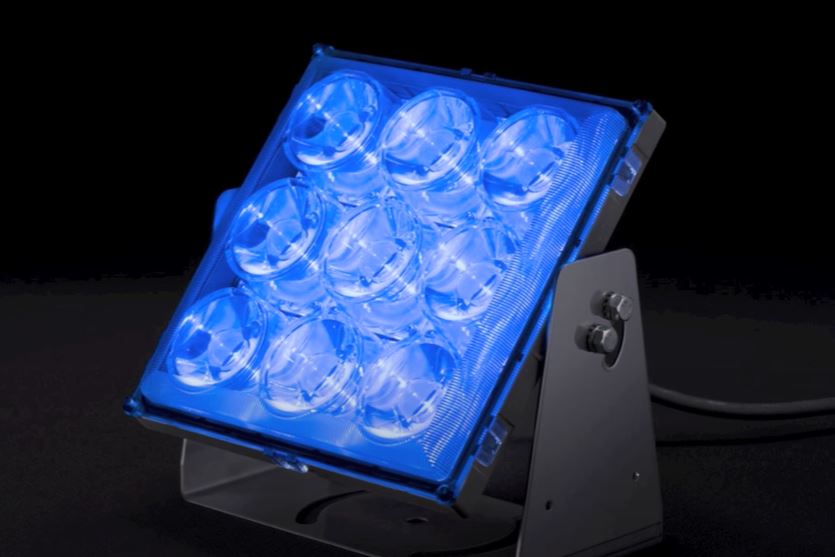
The array contains 12,600 LED lights, evenly divided among red, blue, green, and white. Red, blue, and green are the primary colors of light in physics and adjusting the ratios of each produces the full palette of colors. When all three colors are equally combined, that produces white light. The system at Niagara is powerful enough to span the 1,900 feet needed to reach the both the American and Horseshoe Falls.
A technician tests the new LED lighting system at Niagara Falls. (Photo Credit- Mulvey & Banani Lighting Inc.)
Click this slideshow below to see aspects of the LED array, including a close-up of the lights, their appearance once grouped, and use in action.
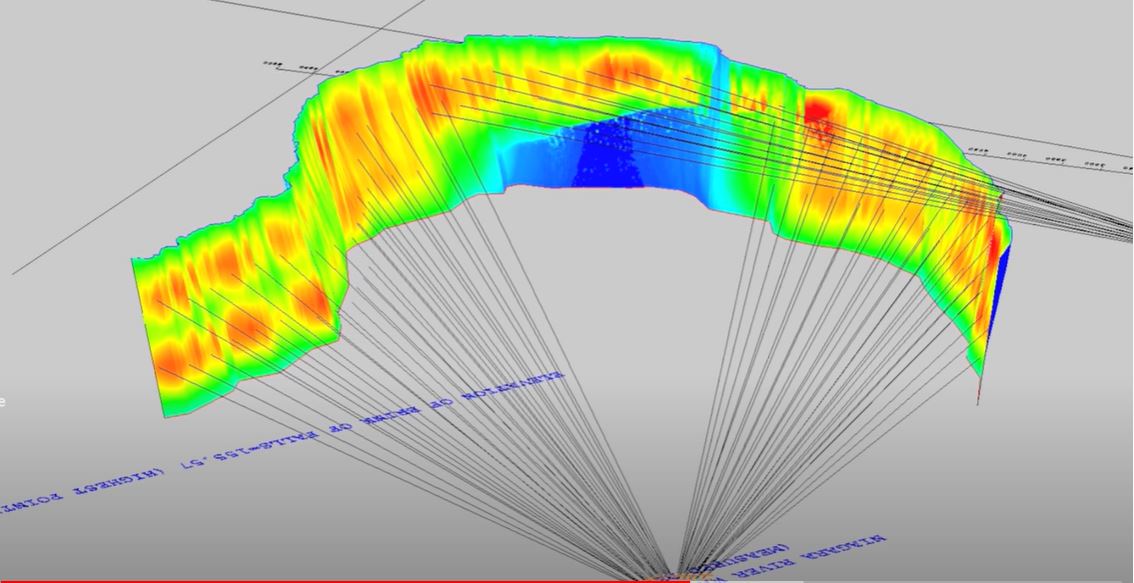
A schematic of how the LED light beams illuminate American Falls and Horseshoe Falls. (Photo Credit- Mulvey & Banani Lighting Inc.)
This unique custom system was designed by a consortium of companies including ECCO Electric Ltd., Salex Inc., Mulvey & Banani Lighting Inc., Sceneworks, and Stanley Electric. To test whether the LEDs could cast beams of light the distance needed, the crew successfully tested mockup systems across a lake in Ontario and along an abandoned aircraft runway!
The lights are operated via computer but can also be operated by two staff members who watch guard over the lights each night. They can even be programmed to perform shows such as “Inspired by Nature” which features colors and movements inspired by nature, including the sunrise, aurora borealis, rainbows and sunset.
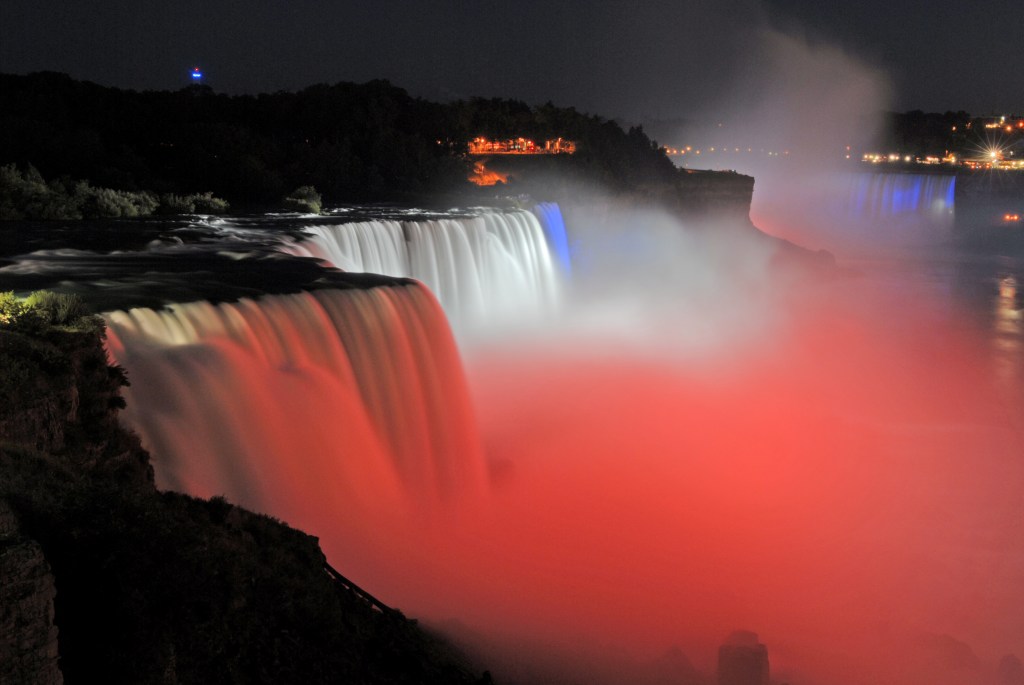
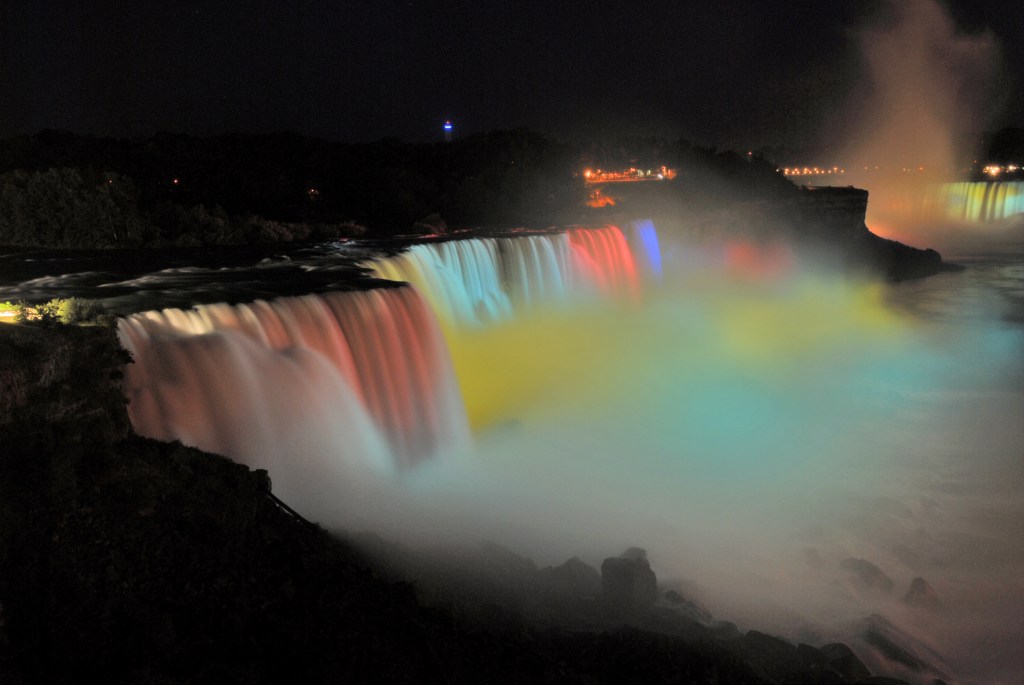
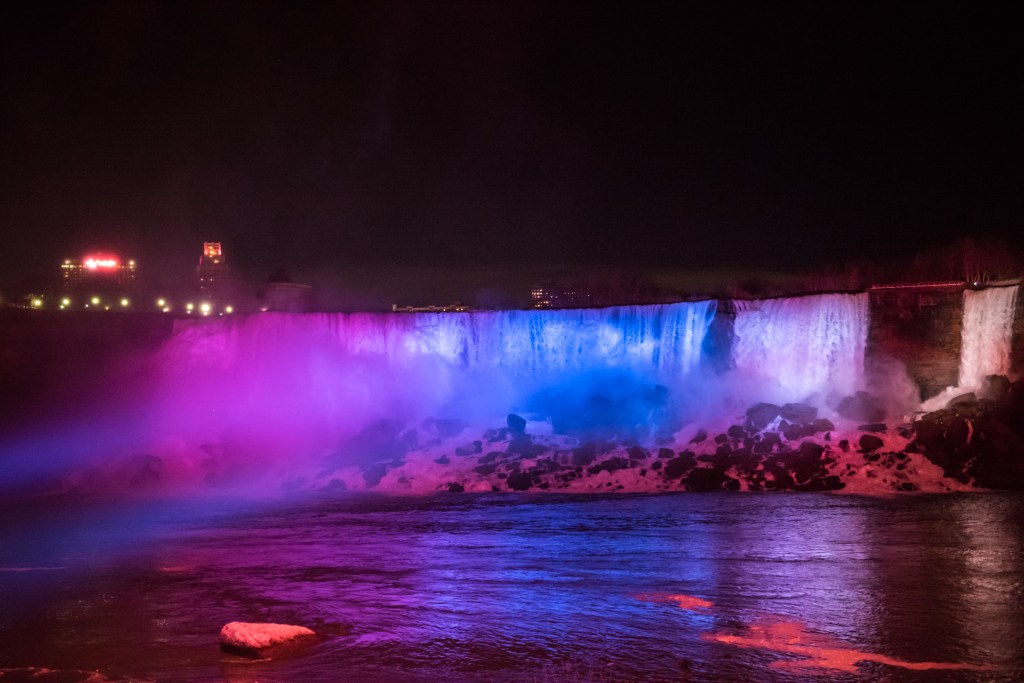
Today the world-famous falls are lit up every night of the year in an ever-changing light show, the colors chosen to reflect a wide variety of causes, events, and people, all of which reviewed and approved by the board.
On June 15th, 2021, for example, the falls were illuminated in the official New York State colors of blue and gold in celebration of reaching 70 percent of New York adults receiving their first dose of COVID-19 vaccine.
In 2016, when Queen Elizabeth turned 90 on April 21, the falls were colored purple in her honor. It did cause a bit of unintended confusion. The musician formerly known as Prince, who was closely associated with purple, died the same day so many people mistakenly thought the lighting was for him!
Other recent illumination highlights might be less well-known, including highlighting of the Republic of Bashkortostan, Wrongful Conviction Day, and Dress Purple Day, Bullying Prevention Month, Latvian Independence Day, and Dysautonomia awareness.
The falls have been illuminated blue to mark playoff appearances of the NFL Buffalo Bills, purple and gold to mark the tragic death of NBA star Kobe Bryant, a combination of red, white, and gold to honor the Canada’s gold-medal Olympic women’s soccer team, and blue and green for the Canadian professional basketball team Niagara River Lions.
The falls also have been lighted green for St. Patrick’s Day, rainbow colors for Pride Month, blue to mark the 70th anniversary of the North Atlantic Treaty Organization (NATO), and red to welcome Chinese New Year.
One night a year, March 26, the falls go dark for an hour in honor of Earth Hour, a global initiative aimed at drawing attending to ongoing human-induced climate change. Click on the slideshow below to see some of Niagara Fall’s amazing colors!
With the ability to shine light through mist and flood both the American Falls and Horseshoe Falls with every color under the sky, the nightly illumination is the highlight of any visit to Niagara.
Hours of illumination vary by seasonal timing of nightfall, starting between 4:30 and 8:30 p.m., and wrapping up from 1 to 2 a.m. With the earlier nightfall in winter, the falls are illuminated earlier in the evening. When the falls freeze in the winter, creating massive ice formations, the lights take on another beautiful dimension.
The Illumination Board is an example of international cooperation between the U.S. and Canada, with its membership consisting of New York State Parks, Niagara Parks (Canada), the New York Power Authority, Ontario Hydro (Canada) and the cities of Niagara Falls in both the U.S. and Canada, which pay annual dues to cover the expenses associated with this special attraction.
The group is also charged with fulfilling requests for lighting for charitable organizations, special causes, global events, and other special occasions. As the Falls is such a global icon, hundreds of requests are received each year.
Under board rules, requests cannot be considered for commercial purposes, personal occasions like birthdays or marriage proposals, religious or political events, and institutions, such as hospitals and schools.
Be sure to include an overnight on your next visit to Niagara Falls to catch the illumination. Pro tip: The best viewing from the American side is from Terrapin Point or Prospect Point.
Check out the schedule of lightings and learn more about the nightly illumination here.
Post by Angela Berti, Marketing and Public Affairs Coordinator, Niagara Region, NYS Parks
Watch this Youtube video below by Mulvey & Banani Lighting to learn more about how the Niagara Falls are illuminated…
Learn more about the color of light from the American Museum of Natural History.
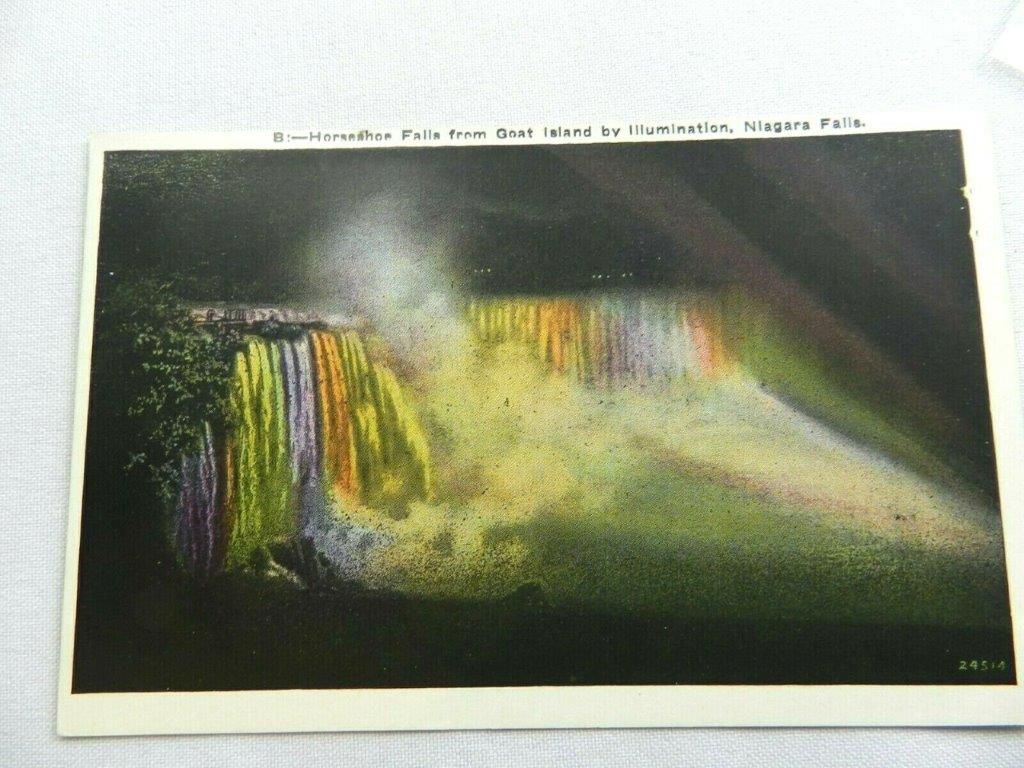
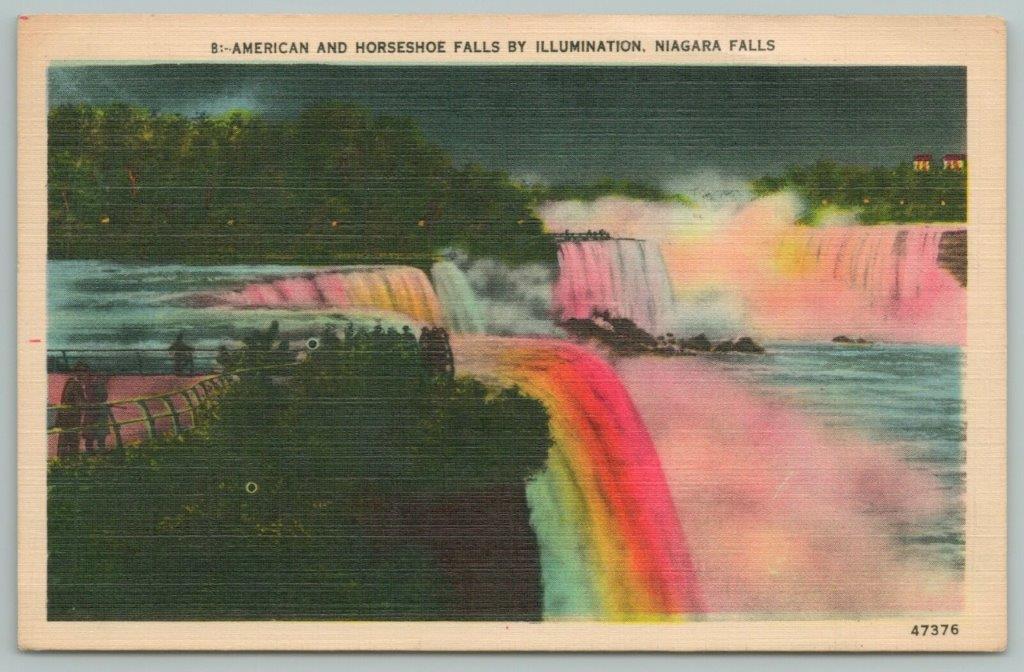
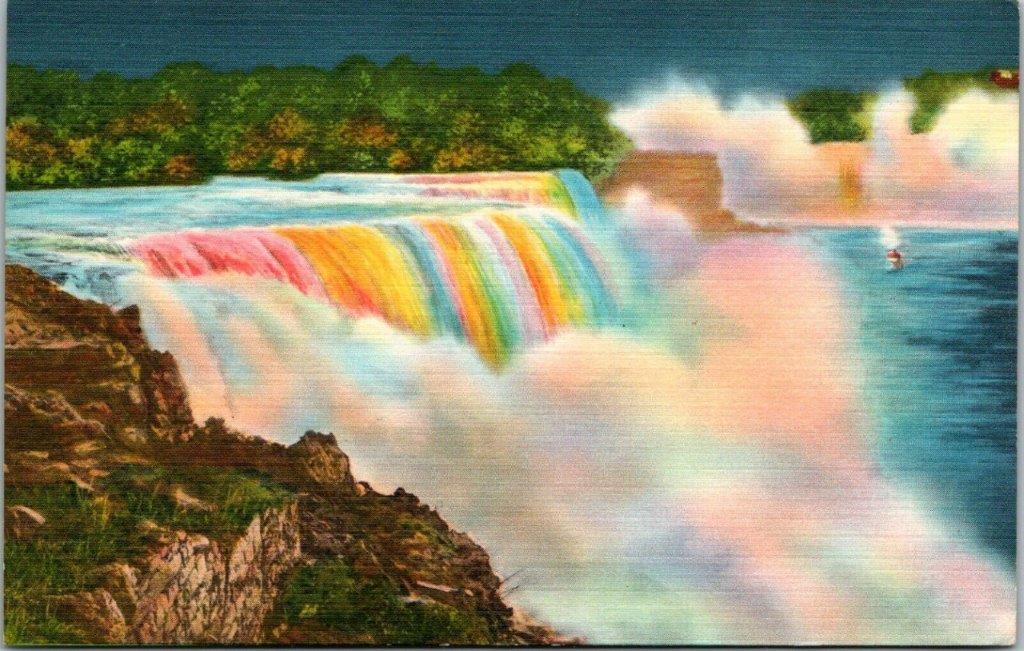
Click below for a slideshow of historic Niagara Falls’ postcards showing its illumination…
If it sounds like the plot of a Hollywood adventure movie, these engineering obstacles surmounted during the rebuilding of the nation’s oldest state park at Niagara Falls fit the bill.
***UPDATE*** The project won the top award in October 2021. Read more about it here.***
Established in 1960, this prestigious award honors the project that best illustrates superior civil engineering skills and represents a significant contribution to civil engineering progress and society. Honoring an overall project rather than an individual, the award recognizes the contributions of many engineers.
Other past winners and nominees have included the new World Trade Center, Cowboys Stadium and seismic protection upgrades to the Golden Gate Bridge in San Francisco.
This nomination for Niagara Falls recognized the complex and dangerous challenges in working in a place where 45 million of gallons of water a minute cascade over the 167-foot waterfalls and where freezing temperatures turn water into thick coats of ice. And that this work had to be done while the park remained open year-round to millions of visitors who come from all over the world.
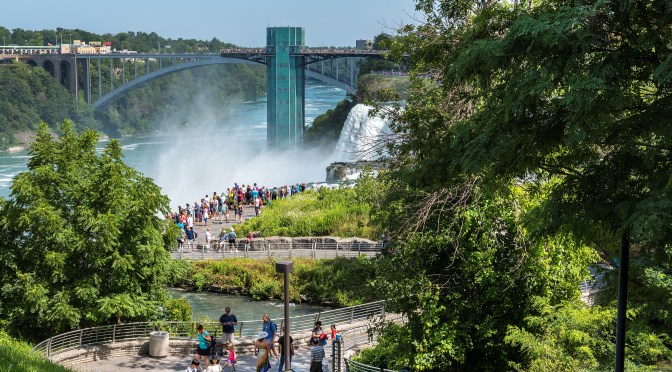
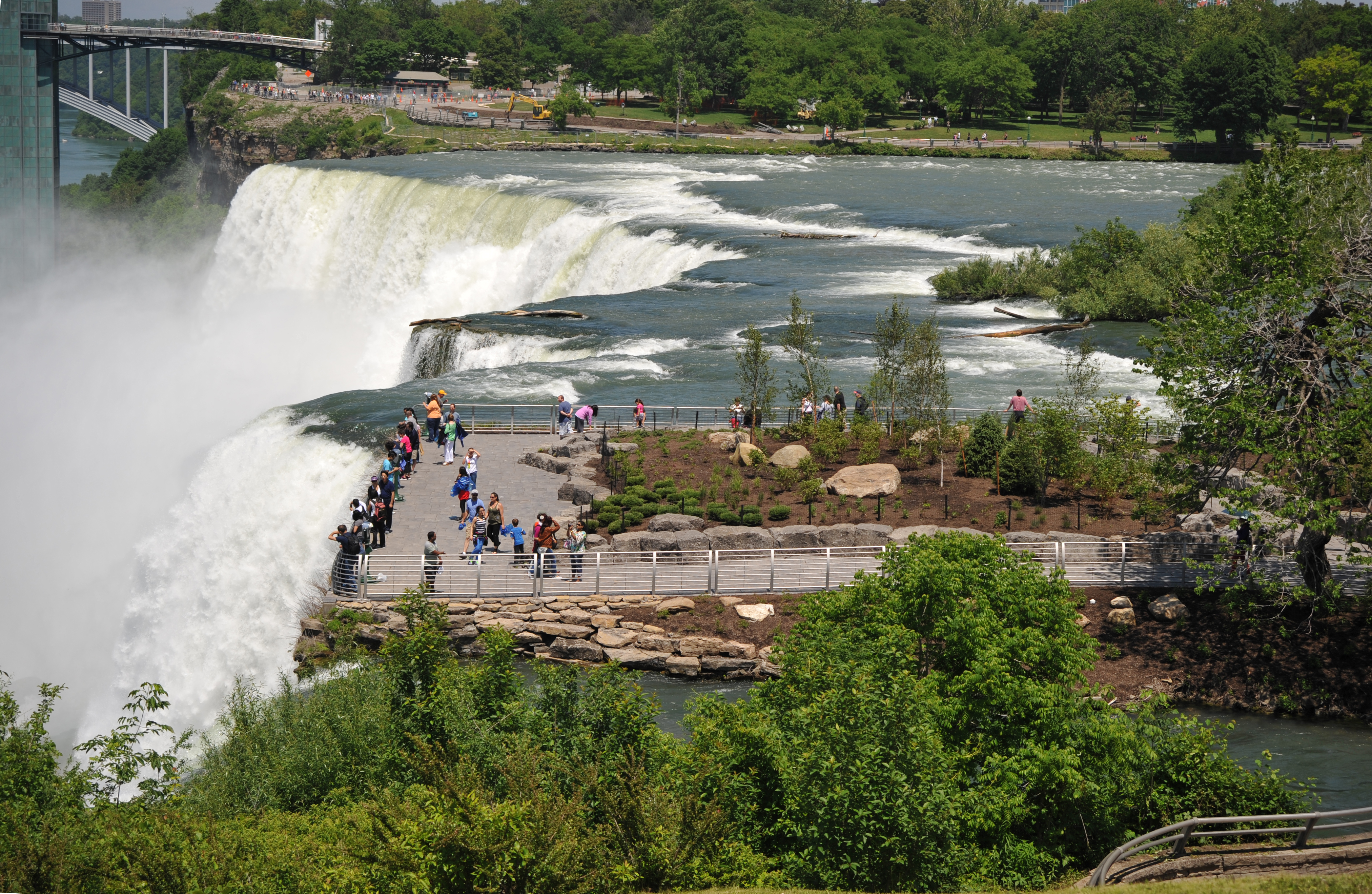
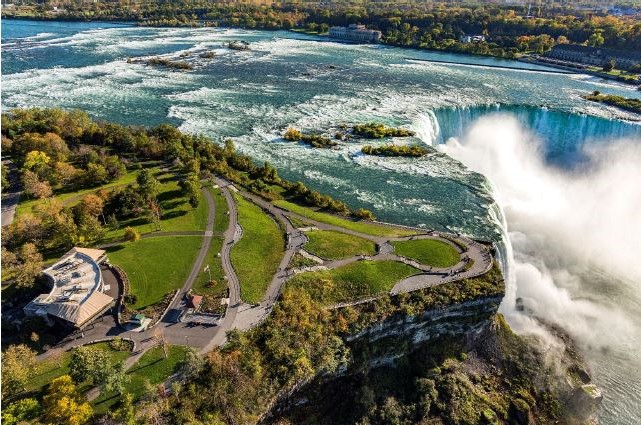
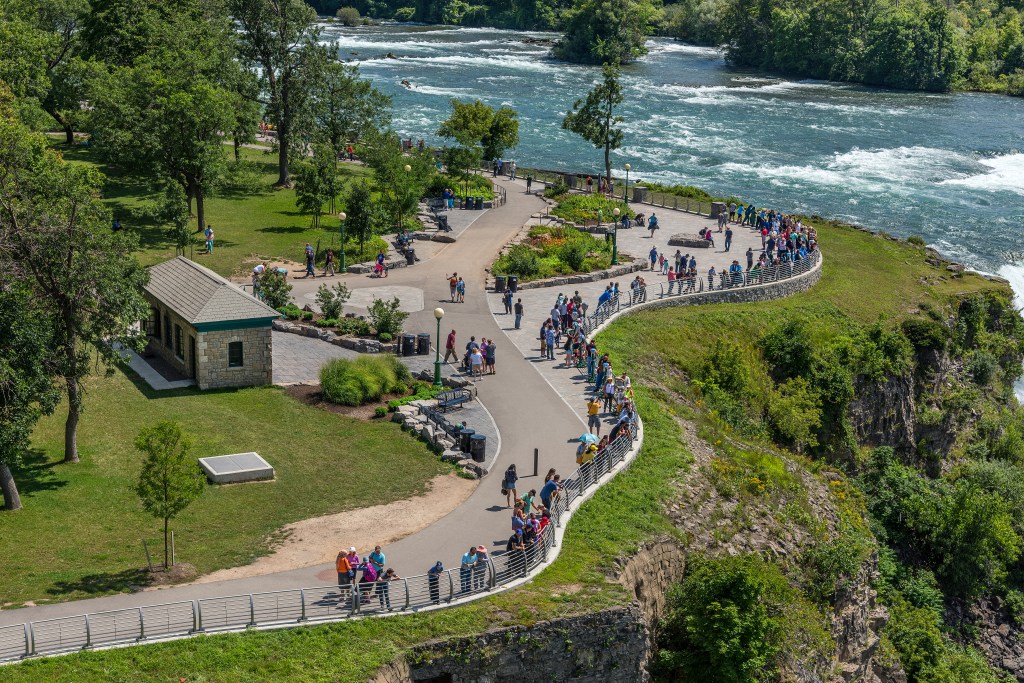
A portion of the viewing area of the American Falls. In the distance (upper center), are the viewing areas at Luna Island and Goat Island. Horseshoe Falls is in the upper distance. (Photo Credit – NYS Parks)
Overseen by the global engineering firm of T.Y. Lin International, work at the park involved 21 separate projects, including bridges, roads, parking, pathways, observation areas, railings, landscaping, electrical, mechanical and drainage systems all spread across the 400-acre facility, its three waterfalls – American, Bridal Veil, and Horseshoe – and its five islands – Luna, Goat and Three Sisters. The entire park is now ADA-compliant, and accessible to all.
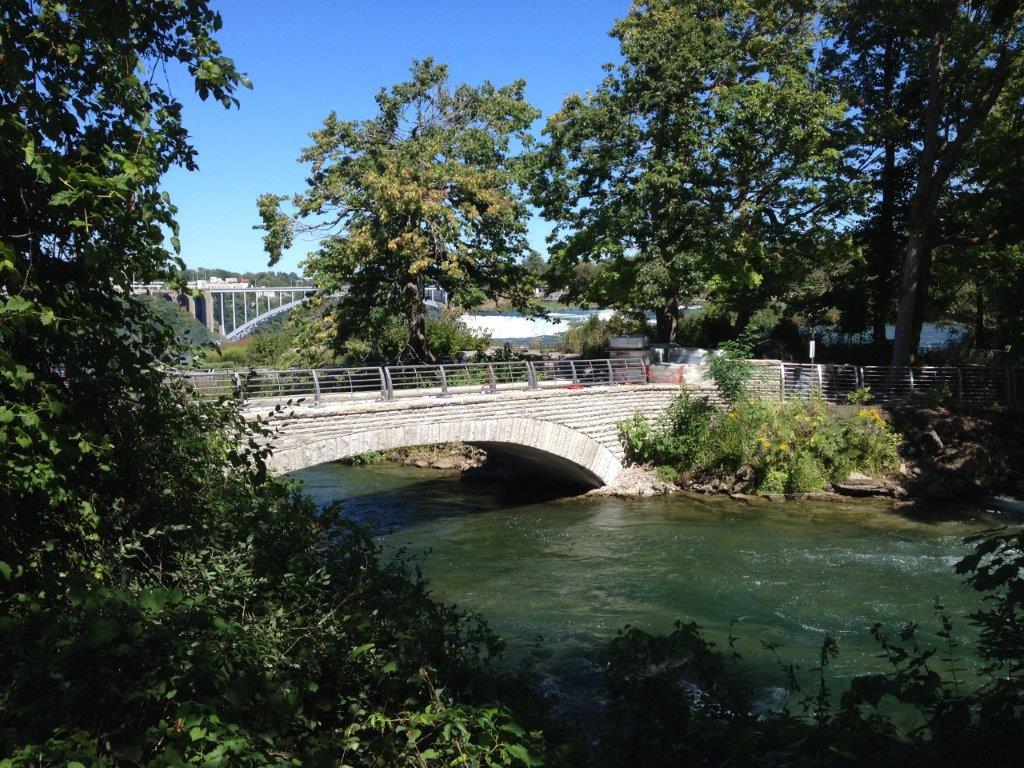
To start, engineers initially had to inspect the condition of the existing infrastructure at America’s oldest state park, established in 1885 and inspired by the landscape design principles of Frederick Law Olmsted and architect Calvert Vaux, who had overseen the design of Central Park in New York City. These inspections included assessing Luna Island’s pedestrian bridge, which spans the Niagara River a mere 80 feet from the roaring precipice of Bridal Veil Falls.
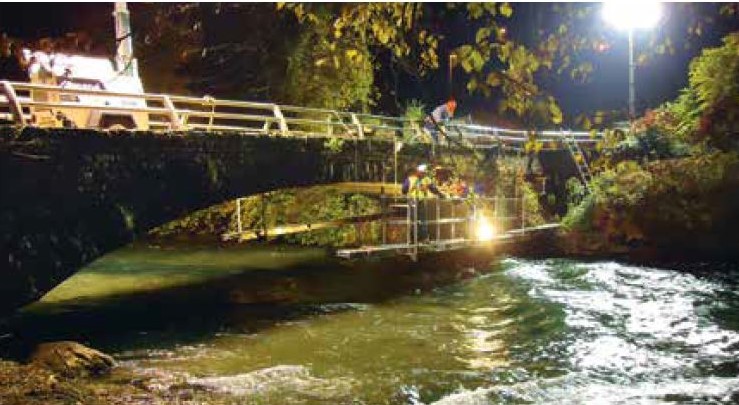
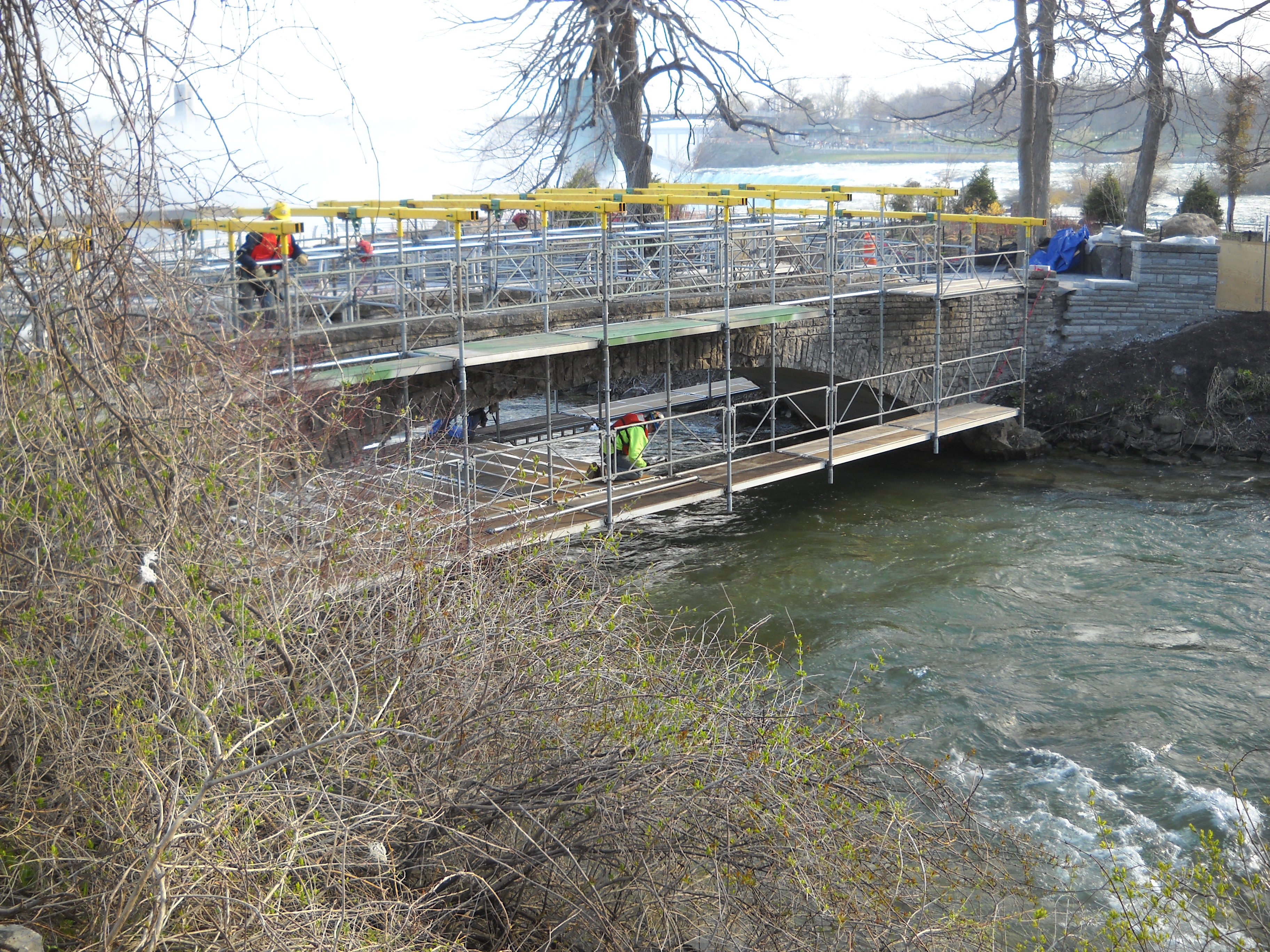
This white-knuckle account in the March 2020 of Civil Engineering magazine describes what had to be done: “… the team inspected the underside of the bridge at night – using specialized rigging – to avoid conflict with ongoing construction at Luna Island and the patrons occupying the Hurricane Deck 167 feet below… Supported by a system of cables and aluminum platforms suspended just two feet above the flowing river, the engineers performed their hands-on inspection of the existing stone-clad, cast-in-place concrete arch bridge.”
And how much fast-flowing, thundering water that is. On average, 3,160 tons of water flows over Niagara Falls every second. This accounts for 75,750 gallons of water per second over the American and Bridal Veil Falls, and 681,750 gallons per second over the Horseshoe Falls.
Above, engineers suspended above the brink of Bridal Veil Falls as they inspect the pedestrian bridge between Goat and Luna islands. (Photo credit – NYS Parks)
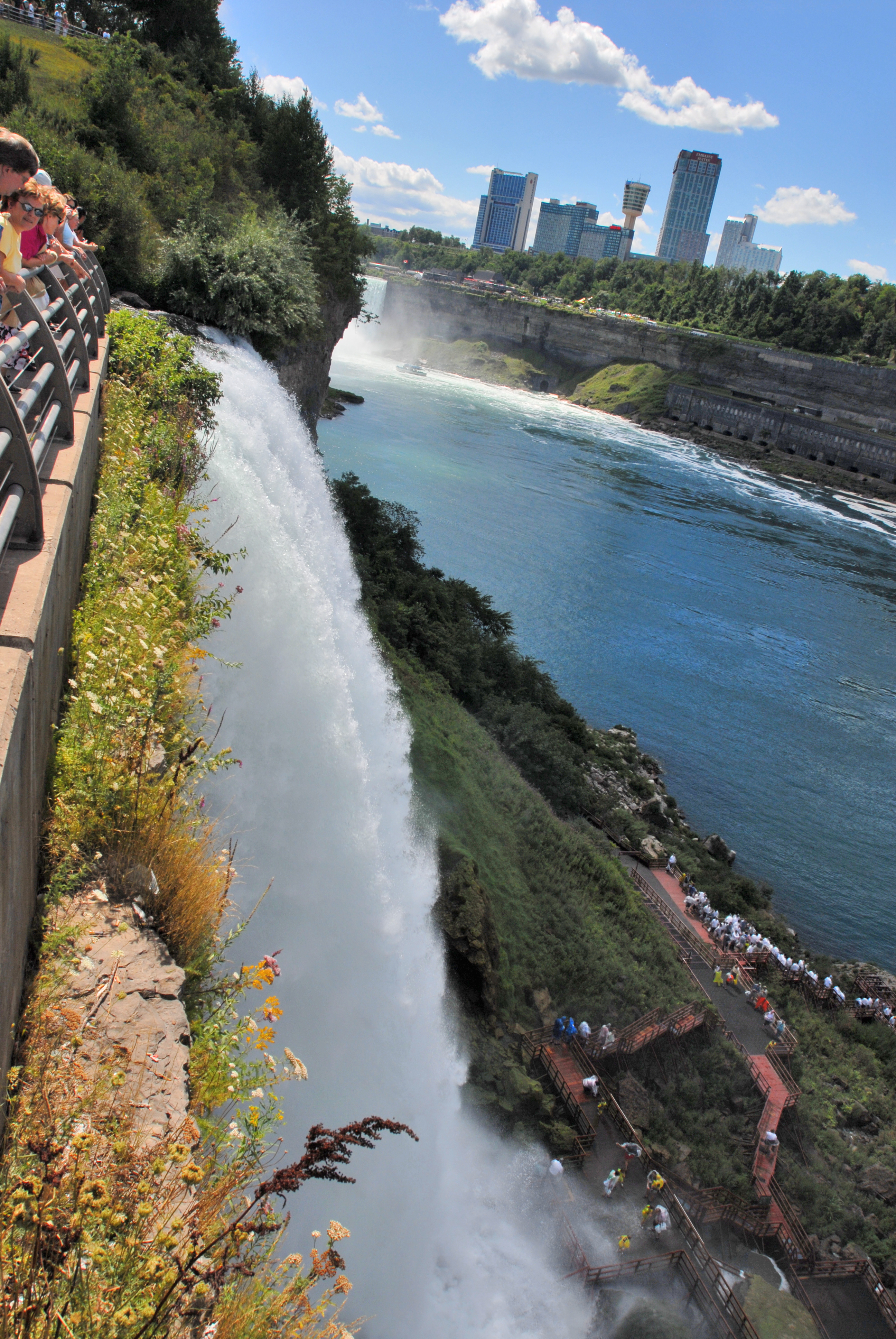
A few feet away from the workers was the brink of Bridal Veil Falls. And this is what it looks like over the edge to the base of the falls and the Cave of the Winds viewing decks…
Similar engineering and contracting work was required to bring new utilities – such as water and sewer, electrical service, fiber optics and telecommunications – from the mainland to Goat Island suspended underneath a 700-foot vehicle bridge over the river. Goat island separates Bridal Veil Falls from the American Falls.
This work “required safety harness tie-offs and specialized scaffolding – all of which required prior approval from the U.S. Army Corps of Engineers, the U.S. Coast Guard and the New York State Department of Transportation.”
At other times, engineers, landscape architects and work crews had to deal with ice caused by the freezing of the constant mist over the falls, and the damage that freezing and thawing would do to rocky surfaces where walls and railings would have to be anchored.
There were some unanticipated man-made obstacles found in what was a heavily developed industrial area prior to becoming a park and generations of infrastructure had to be vetted. Ground-penetrating radar and seismic monitoring equipment were used to map the underground structures to determine whether to excavate or build around them.
And even the ground itself could be unpredictable. As described in the Civil Engineering magazine: “The park presented varying subsurface and poor soil conditions, for example, hidden pockets of soil with a consistency akin to quicksand that created design challenges and potentially hazardous conditions for the contractors.”
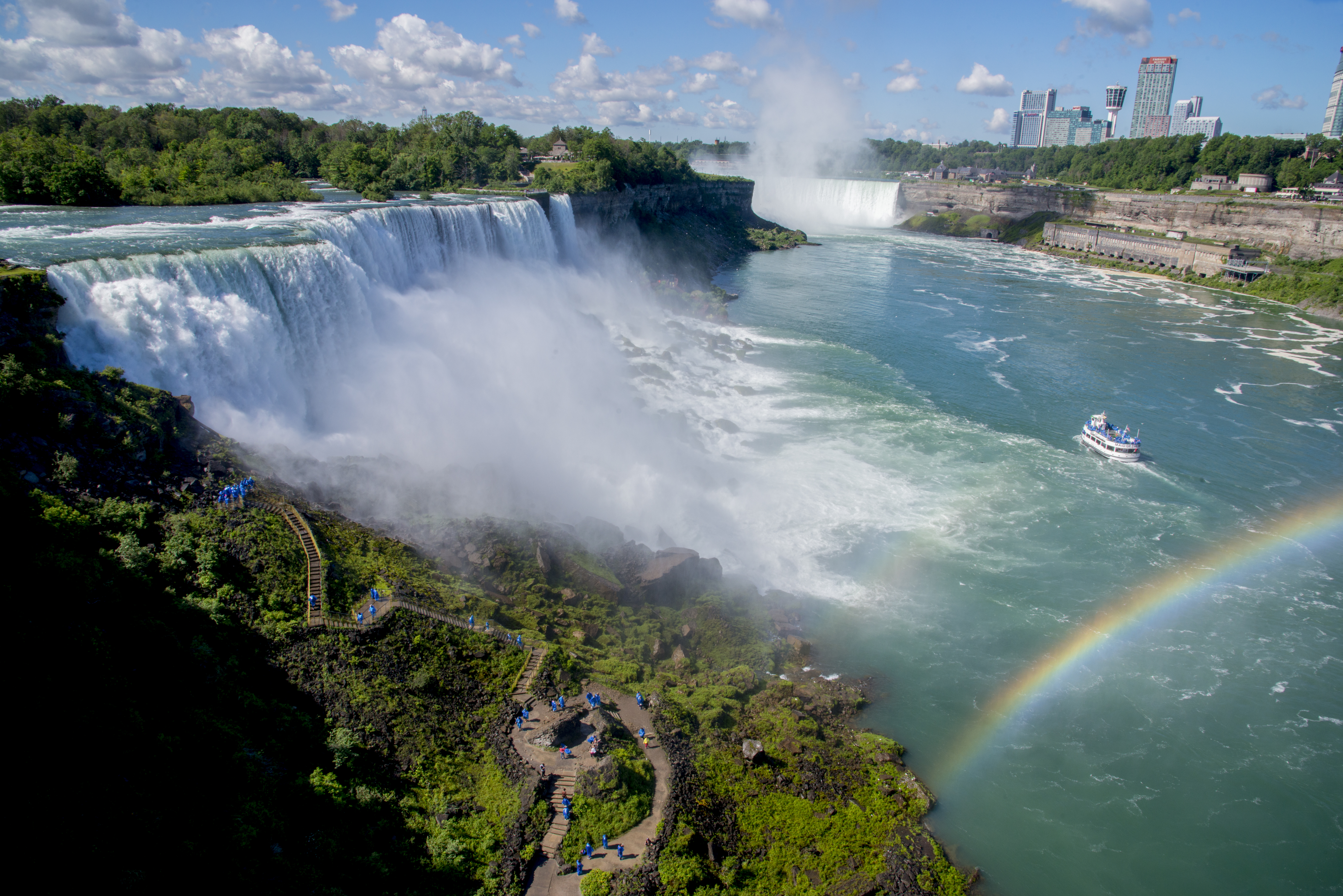
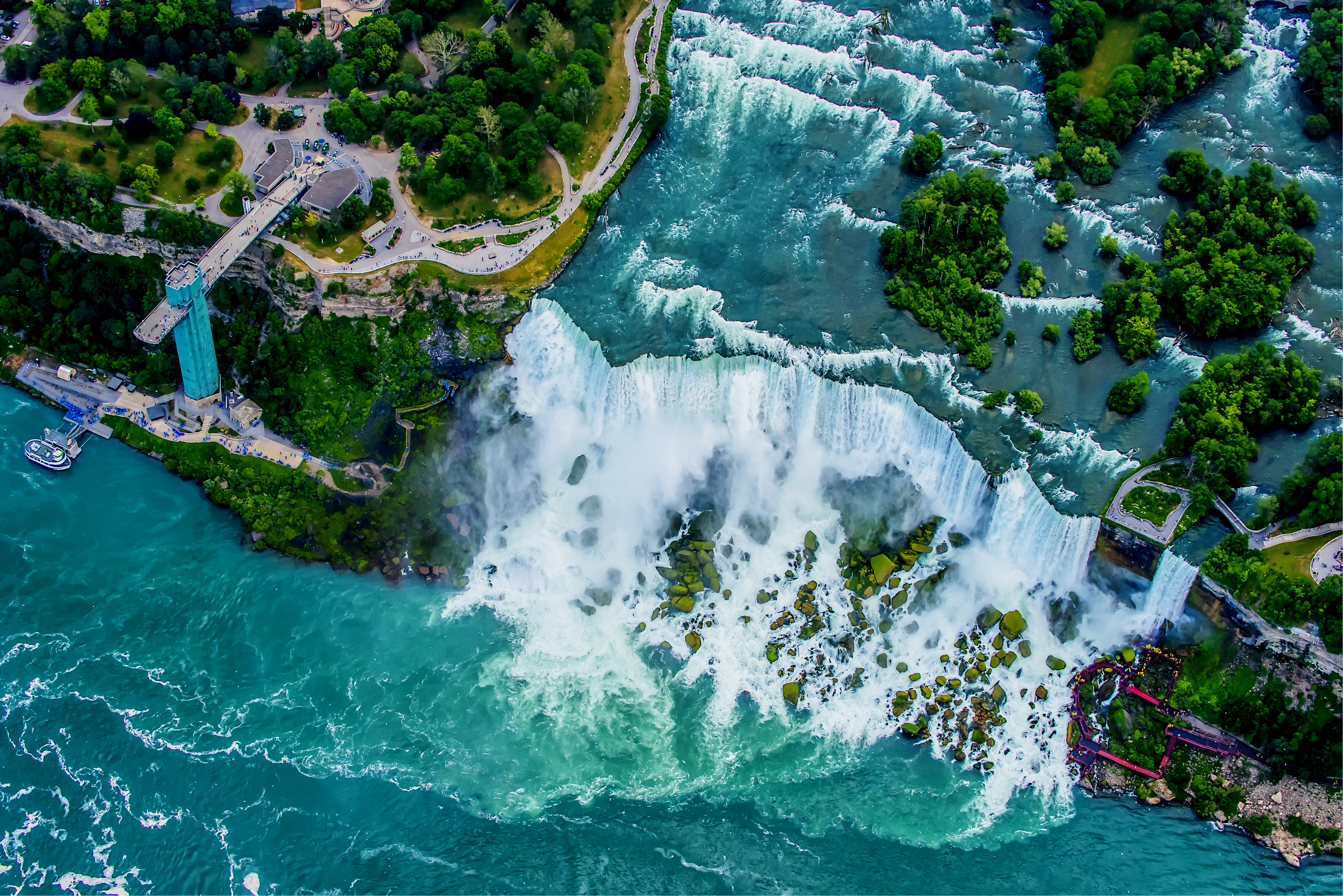
In an aerial shot of American Falls, the new Luna Island viewing area can be see at the right edge, with Bridal Veil Falls immediately to its right, , while the decks at the Cave of the Winds is at the bottom right. (Photo credits – NYS Parks)
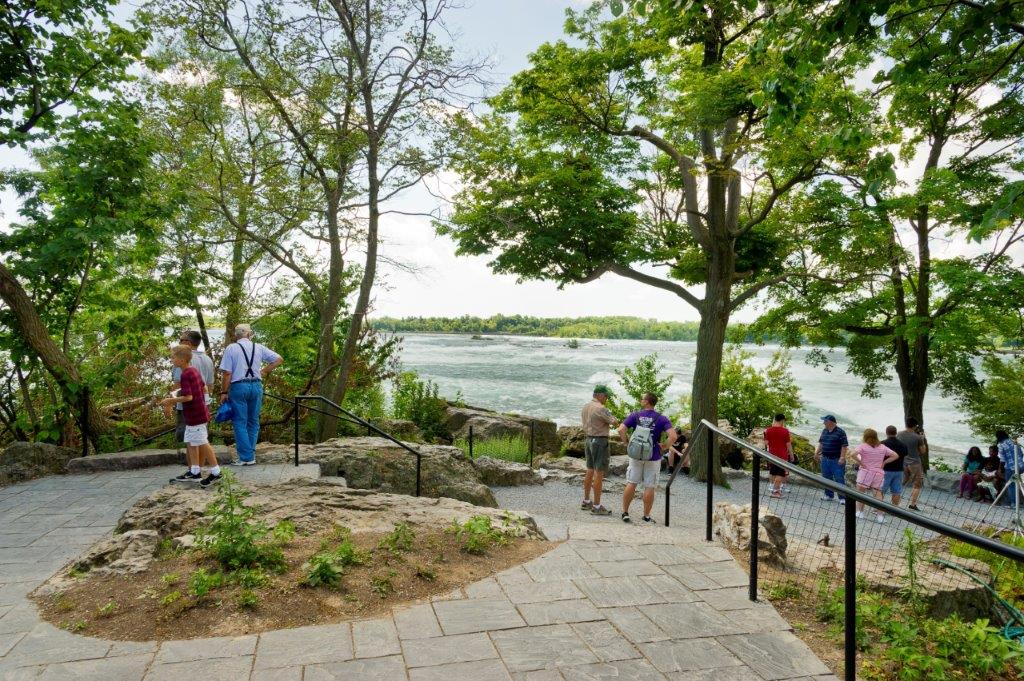
The new Luna Island viewing area at Bridal Veil Falls, which is ADA accessible. (Photo credit – NYS Parks)
Niagara Falls was rebuilt as one of State Parks flagships under the NY Parks 2020 initiative. In addition to the $65 million spent on these projects, over $55 million more as been spent expanding green space north and south of the park as well as creating a new welcome plaza. So, for those who have not been to Niagara Falls for a while, now is the time to see the new and improved State Park, where engineers and other workers prevailed in a harsh and challenging environment to help bring the park into the 21st century.
The project was funded through Governor Cuomo’s Parks 2020 initiative and the New York Power Authority, via the Niagara River Greenway Fund.
The team that helped make this work and national engineering honor happen included:
T.Y. Lin International managed a team of consultants that included the LA Group,Saratoga Springs, which provided landscape architecture services; McMahon & Mann Consulting Structural Engineers, Buffalo; Foit-Albert Associates, Buffalo/Albany/New York, which provided architecture, engineering and surveying support; PGAV Destinationsand Design Island, St. Louis/Pittsburgh, which created the new Cave of the Winds Experience.
The award winner and two runners-up be be chosen Oct. 8, 2021 during the ASCE Convention in Chicago, IL. ***UPDATE*** This project received the top honor from the American Society of Civil Engineers. Read about it here.
Use this slideshow below to tour the revitalized Niagara Falls State Park…
Niagara Falls State Park for for New York State Parks and The LA Group
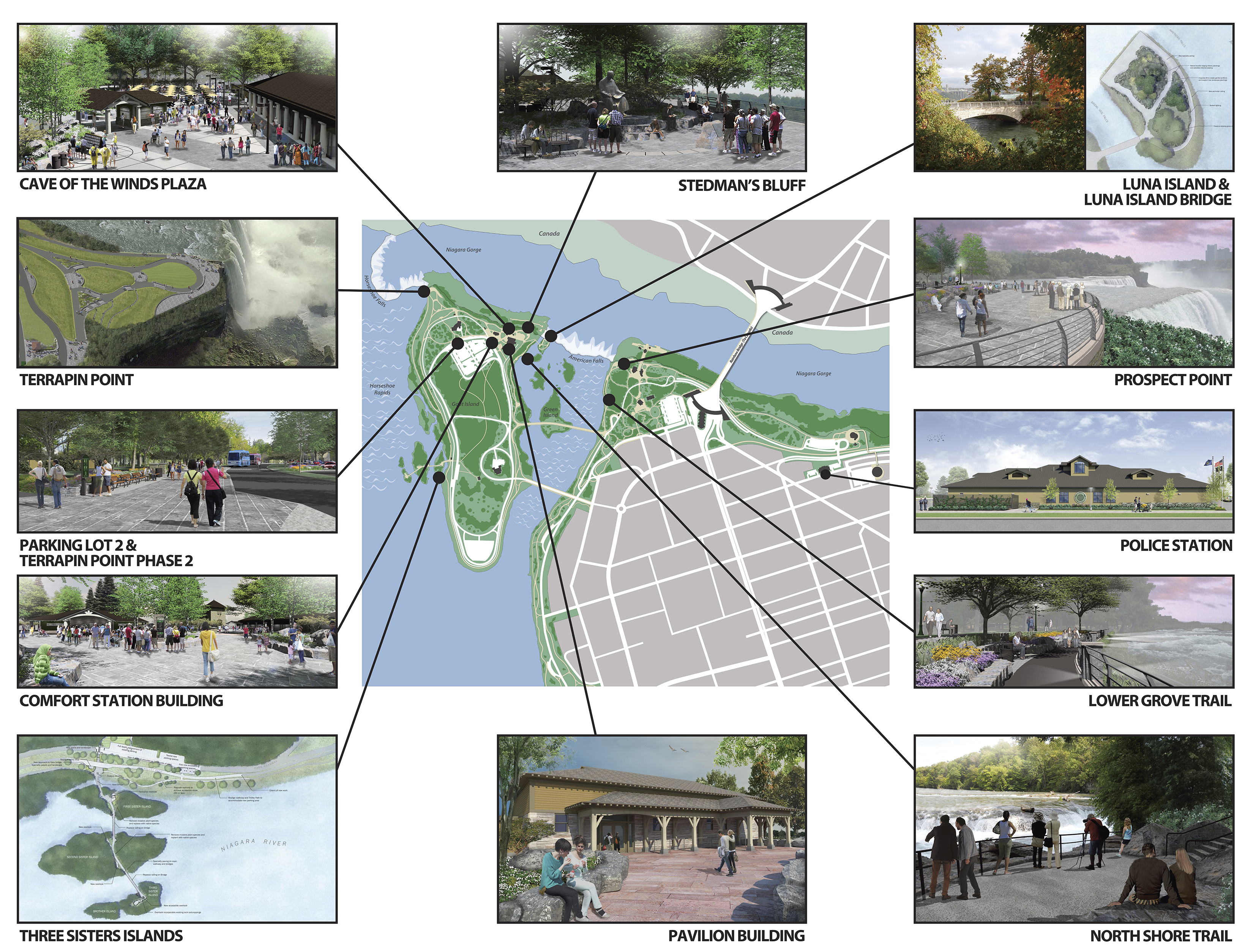
And the map below shows the layout of the falls, the islands and the various infrastructure projects in the park’s revitalization..
Use the slider bar on this map to locate Goat and Luna islands, and some of the projects involved in the revitalization of Niagara Falls State Park.
Post by Brian Nearing, Deputy Public Information Officer, NYS Parks
Learn more about how Frederick Law Olmstead advocated for the creation of Niagara Falls as the nation’s first state park in this 2011 book published by The Urban Design Project, School of Architecture and Planning, University at Buffalo.






















 New York State Parks and Historic Sites Blog