New York is a state of great eats. Some of the regional delicacies born here have conquered the world, like Buffalo’s wings and Saratoga’s potato chips. Others, like Utica’s tomato pie and Plattsburgh’s Michigans, remain fiercely local treasures. But they all pair magnificently with a state park or historic site!
Follow along as our team plays sommelier with the Empire State’s distinctive dishes — and our agency’s unforgettable destinations. Pack your bags and bring your appetite!
Our state golf courses host thousands of rounds each year. Everyone who puts a peg in the ground has a story to tell about themselves, their round, why they chose that club and that ball, or why they showed up to that course on that day. And what keeps them coming back.
With the Ryder Cup coming up at Bethpage State Park in September, we wanted to share stories we discovered during a recent visit to three other lesser-known but phenomenal courses — one in our Long Island Region and two others that are Hudson Valley staples. We hope you’ll pay a visit to these this year or find a favorite among the 19 in our state park system. Tee it high and let it fly – or tee it low and watch it go. Either way, we’ll see you out there!
As New York splashes the summer away, a dedicated team works behind the scenes to make sure our beaches are swim-ready.
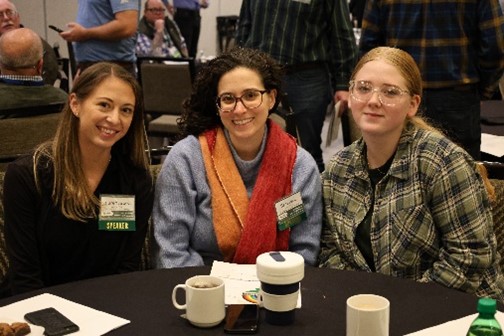
Meet the Water Quality Unit: Lauren Gallagher, Sarah Moss, and Veronica Mileski at a statewide convention. Since this photo was taken, Lauren Badinger has joined the unit as a seasonal assistant.
Consisting of three permanent staff and a summer intern, the Water Quality Unit at New York State Parks is charged with coordinating water sampling at the 75 monitoring stations at 49 beaches throughout New York State. Based in Albany they work closely with other agencies to report and track their results.
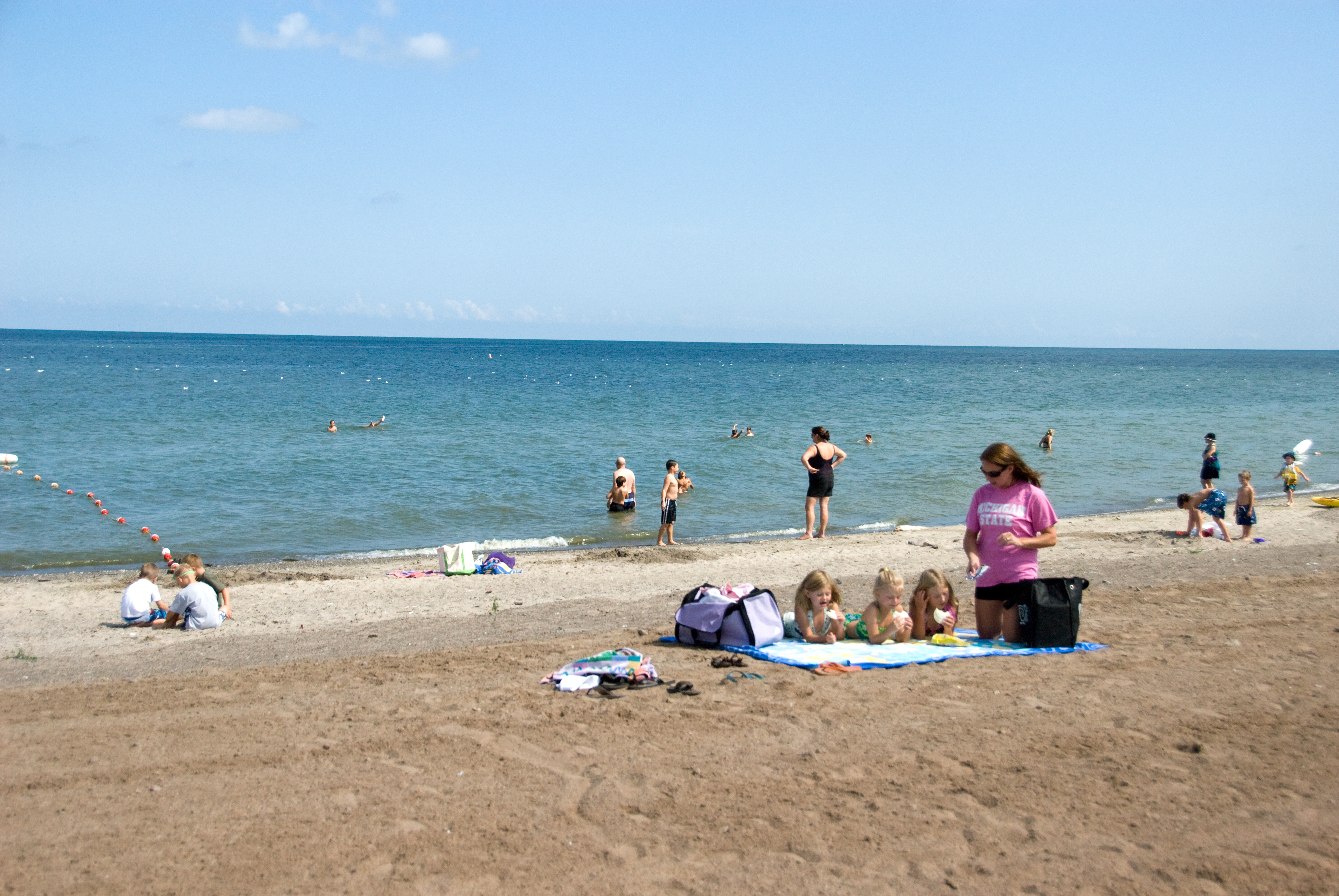
Guests enjoy Hamlin Beach on Lake Ontario, one of the 49 beaches monitored by our Water Quality Unit.
Water Quality Unit team members all agree that this is a job hiding in plain sight. While it’s essential to public health and appreciated by millions every summer, it’s generally under the radar of most of the people it benefits.
Knox Farm State Park (Knox), located in East Aurora, is the former country estate of the celebrated Knox family. Seymour H. Knox, founding partner of the F.W. Woolworth Company, purchased the property in the 1890’s to train Standardbred and carriage horses. The Knox family made significant contributions to the business, educational, and cultural legacy of Western New York and owned the property until 2000 when it was sold to the state. Today the park consists of 633 acres, roughly 400 of which are grasslands and 100 acres of woodlots and wetland areas.
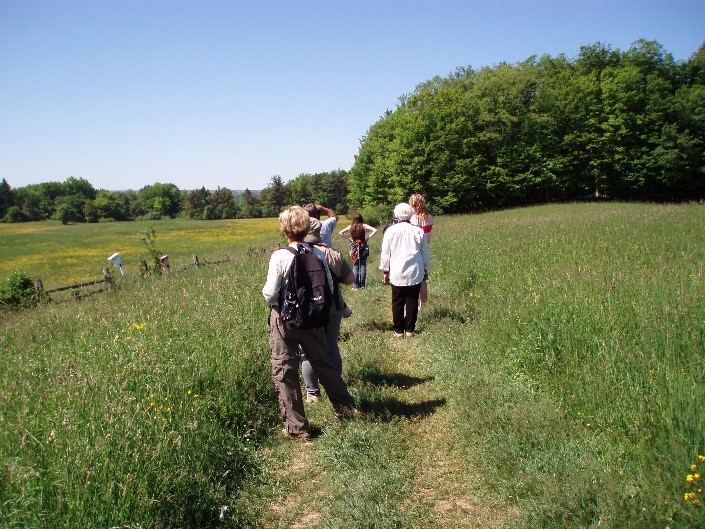
Enjoying one of the many vistas in the park, photo by Claudia Rosen.
The grasslands provide a unique opportunity to enjoy a diversity of life that cannot be found in many other places in Western New York. Visitors can hike, ride horseback, cross-country ski, or snowshoe through the scenic trails. No matter the season, Knox always provides a memorable experience.
Birding along the grassland trails, photo by Niagara Programs Office.
After the winter thaw, some of the most anticipated yearly arrivals to the park are the boisterous bobolinks and eastern meadowlarks. Both bird species only nest in grasslands and can be found in large numbers throughout the park. Bobolinks breeding in Knox may have migrated from as far away as Argentina, making them the longest migrator of any of the New World passerines, or perching birds! Males perform a captivating display flight making a series of buzzes and whistles that sound like R2-D2 from Star Wars.
Female bobolink, photo by Paul Bigelow
Male bobolink, photo by Paul Bigelow
Another grassland representative of the park, the eastern meadowlark, is usually heard before it is seen. They can be found along the trails singing their sweet, lazy whistles from atop a fence post or stalk of high grass. Like bobolinks, female eastern meadowlarks build their nests in a small depression on the ground, hidden amongst the tall grasses. Other grassland birds you may encounter are savannah sparrows, field sparrows, and eastern bluebirds.
Eastern meadowlark, photo by Paul Bigelow
While walking the trails you may also encounter a striking resident of the park, the Baltimore checkerspot butterfly (Euphydryas phaeton), named for the orange and black colors of George Calvert, the first Lord of Baltimore. The caterpillars of these beautifully marked butterflies can be found in wet areas of the park where they feed on white turtlehead (Chelone glabra). However, they are more frequently encountered along the grassland trails where they make use of English plantain (Plantago lanceolate). Adults can be found nectaring on common milkweed (Asclepias syriaca) and other flowers in the designated butterfly meadow.
Baltimore checkerspot caterpillar, photo by Niagara Programs Office
Baltimore checkerspot adult, photo by Niagara Programs Office
A walk through the grasslands of Knox will always yield an exciting surprise. From incredible vistas to the theatrical display flights of male bobolinks, you’re guaranteed to walk away with a feeling of bliss. All trails in the park are easy to walk and some paths are even paved, making them accessible to all. If you haven’t made a trip to Knox Farm yet, be sure to mark it on your list and enjoy this unique and diverse park.
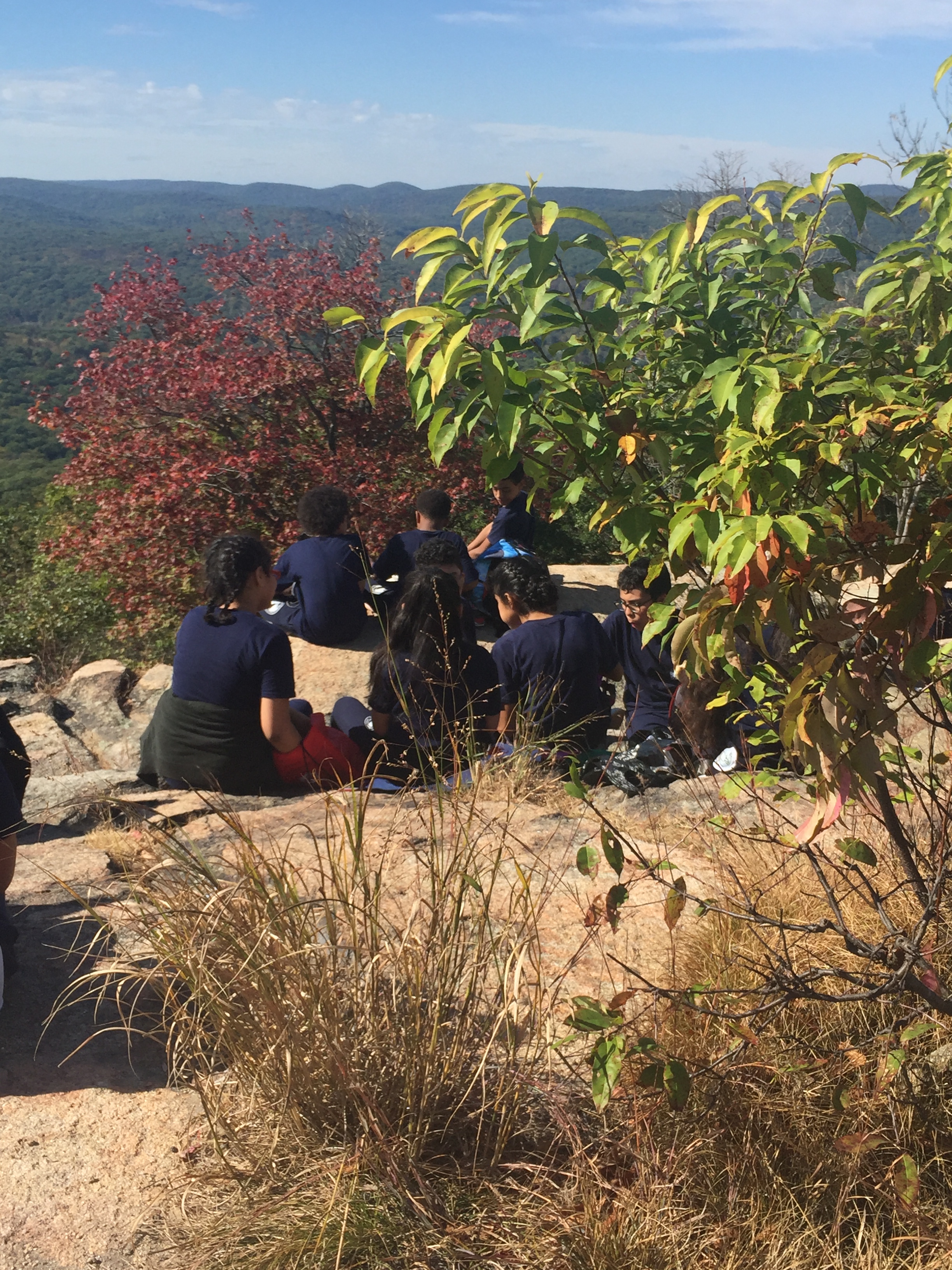
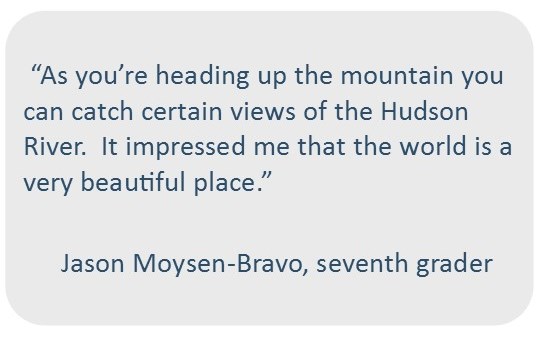
Since the fall of 2016, approximately 300 seventh graders from the P.S./I.S. 218 Rafael Hernandez Dual Language Magnet School in the Bronx have enjoyed an annual field trip to Bear Mountain State Park, thanks to the Connect Kids Field Trip Grant program run by State Parks. The hour-long journey from the school affords views of spectacular autumnal foliage and the Hudson River Valley to our urban students.
Students pause at the top of Bear Mountain, enjoying the views of the Hudson River
Arriving at the site the students divide into two groups: one group hikes a portion of the Appalachian Trail, while the other visits the animal exhibitions at the Trailside Museum and engages in organized outdoor play outside the Bear Mountain Inn. (Some of our students suffer from asthma and don’t choose the mountain hike.) They return to school thoroughly exercised, full of excitement from their experiences hiking or observing firsthand the animals at the Zoo. The trip coincides with an English Language Arts unit of study focused on memoir, or personal narrative. For many, the hike up the mountain has afforded the first opportunity to hike a woodland trail that our students have ever experienced, and they write about their experience and recall it throughout the year proudly.
Because we teachers applied late in the fall, we traveled to Bear Mountain in early December of 2016. The smell of the pines was intoxicating, but a light snow had just fallen, making the trail slippery and a bit treacherous on the way up. We conceded that the mountain top was beyond our reach that day, and did our best to lead the students back down the trail as carefully as we could. We wished we had foreseen the footwear that the students needed to better negotiate the trail under slippery conditions – some were wearing sneakers with little tread.
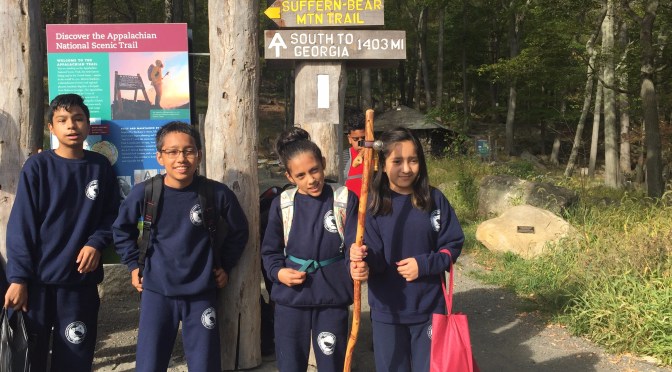
PS 218 students on the trail in early December
In our second year, we scheduled our trip in early October, and our mountain hikers encountered a blazing hot Indian summer day. Though we reached the top of Bear Mountain, a few children had inexplicably brought loaded backpacks, which created all kinds of challenges for our teacher crew. Yellow jackets were abundant near the picnic areas below; one student was stung! We realized later how much we needed to bring an abundant supply of water for the return trip home on the buses. Vomiting incidents drove home that there were risks related to the heat, but junk food and dehydration played a part as well.
This year, the buses were very late departing the school, which cut short our time and made it impossible to reach the top of the mountain. NYC morning rush hour traffic can be unpredictable; next year we will be sure to request our buses earlier. At the end of the day, a shortcut on a loosely pebbled trail led to multiple scraped knees.
Each year, we realize how we can plan better for the next! So, for your Kids Connect Trip, be sure you …
Require comfortable and appropriate footwear, depending on time of year; jackets if appropriate
Limit backpack weights. Test as kids leave bus (allow only lunches and a drink)
Outlaw sweet drinks, and chips or sweets for the ride! Students should eat a good breakfast!
Bring first aid kits for bee stings, cuts, bug bites
Stock an abundant supply of water on your buses
Secure contacts of individual bus driver
Remember your bus permit and paperwork to verify your site visit with a signature from Parks administrative staff
Post and photos by Heather Baker Sullivan, PS 218 Rafael Hernandez Dual Language Magnet School teacher







 New York State Parks and Historic Sites Blog