Beavers are native to New York State and play an important role in the natural landscape. They are ecosystem engineers – altering water levels by building strong dams using branches and mud; and creating wetland habitat where many plants and animals thrive. However in the wrong place, their dams can cause flooding and property damage. In 2016 a project was developed to minimize beaver impacts by building and installing Beaver Deceivers/ Flood Control Devices. Beaver deceivers stop the flooding caused by beavers, while continuing to allow beavers to live in State Park wetlands and other water bodies.
Beaver dam at Verona Beach State Park, photo by Lilly Schelling
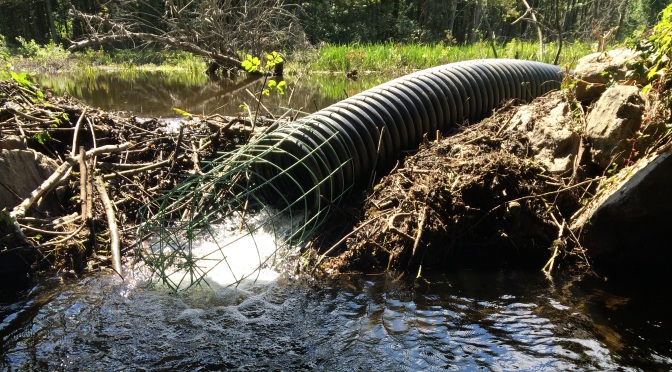
Beaver dam in a culvert at Grafton Lake State Park, photo by Lilly Schelling
What is a beaver deceiver?
There are typically two kinds of beaver deceivers; a Trapezoidal-shaped Exclusion Fence (or Trapezoidal Fence for short) and a Pond Leveling Device. Let’s learn the purpose for each:
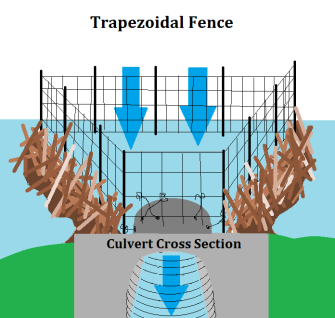
graphic by Lilly Schelling
The Trapezoidal Fence is intended for situations where the beavers’ dam is clogging a culvert and may cause damage to the culvert itself. The fence is placed in front of the culvert, extending out at least 12 feet out from shore with a closed floor so the beaver can’t dig under it. Beavers usually then build their dams along the sides of the fence but not the back – allowing water to flow through the fence into the culvert.
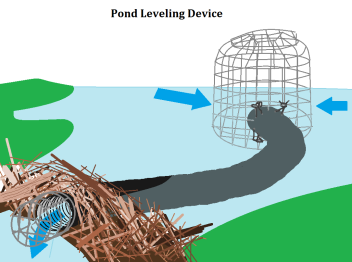
graphic by Lilly Schelling
A Pond Leveling Device is made using an existing beaver dam. The dam is dug out (notched) to drop the water body to a desired water level and a corrugated pipe is placed through the dam and then covered back up with dam materials. Both ends are caged off to ensure water flow. The pond leveling device allows the beavers to continue building their dam around the pipe without raising water levels. Thus it prevents flooding of nearby roads and other use areas.
Installation
Materials for this project included 12″ corrugated pipe sections, 6 gauge epoxy coated fencing, copper hog rings to hold the fence together, and cinder blocks to sink structures and pipe.
State Parks staff clearing a site for a pond-leveling device at Fahnestock State Park, photo by Lilly Schelling
The deceivers, trapezoidal and pond leveling were completely constructed on land before they were placed into the water, photo by Lilly Schelling.
Here’s a project where we dug out the beaver dam. It was fascinating to see how fast the water level dropped. Beavers are extremely efficient! We also saw about 20 trout swim upstream over the dam to the beaver pond, taking advantage of the new access to the habitat. Naturally, the trout would persist below the dam until the dam fell apart after the beavers moved to a new home – which they do periodically. But in this case, we saw how our deceivers are also able to benefit other native animals.
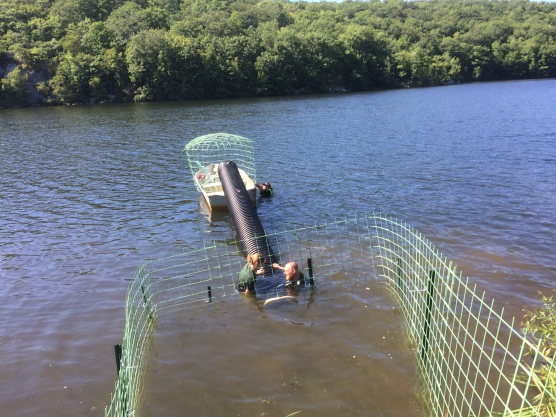
Occasionally, with very persistent beavers, the two deceiver methods may need to be combined (i.e. a Trapezoidal Fence with a Pond Leveling Device attached). This picture is the installation of the combined devices at the culvert under Route 301 on Canopus Lake in Clarence Fahnestock State Park. A boat was needed to move the dome and pipe around in the deep water. Photo by Lilly Schelling
Finished Product
Photo by Lilly Schelling
Photo by Lilly Schelling
A pond leveling device installed at the bridge on the School Rd. Trail. The objective of this device was to decrease water levels so the trail would stop flooding. The line on the tree was the water level prior to installation.
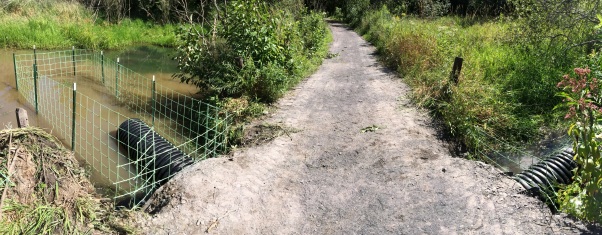
Trapezoidal Fence after installation on Beaver Pond Trail at Glimmer Glass State Park, photo by Lilly Schelling.
State Parks wildlife staff will monitor these beaver deceivers to ensure they continue to functioning properly and that they are still in place. Freezing and thawing during seasonal change may shift the placement of the device. Overall these devices have proven to be highly successful in solving beaver related flooding issues. It is great to solve human wildlife conflict in such a way that both human and wildlife can remain in the same area and neither is pushed out.
Post by Lilly Schelling, State Park Wildlife staff
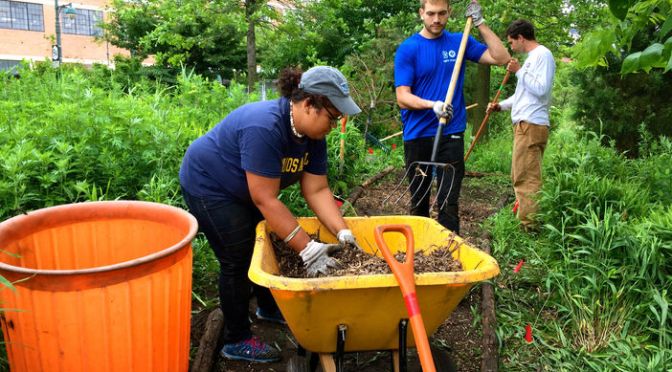
Since January, we have been members of the Excelsior Conservation Corps, an AmeriCortps program. We work in New York State Parks and state-owned campgrounds and improve the infrastructure (structures that we use to access and enjoy spaces – such as roads, trails, buildings, etc.) of these natural areas. One of our first experiences as members of this program took place in Saranac Lake, in the Adirondacks. Our project was to work with the New York State Department of Environmental Conservation (DEC) workers, and produce thunder boxes (box toilets), outhouses, and register boxes (for trailheads). We helped cut, paint, and attach all of the pieces, and then put them together in a way that would help people in the future easily assemble them in the field. Our crew enjoyed carpentry projects such as this. We did more than just improve our carpentry skills during those cold March days, we created friendships within our own crew and with the workers in Saranac Lake. To show their appreciation for our hard work, our project partner took us to the summit of White Face Mountain, the fifth tallest mountain in New York! We got to ride in an elevator made by the Civilian Conservation Corps – the group that our Corps is based on. We also explored the weather station that is situated at the summit and marvel at the gorgeous high peaks of the Adirondacks. This was a great time and was just an introduction to the adventures that would follow!
Marlena testing out one of the outhouses, photo by Michaela Aney
Marlena and Rebecca at the Summit of Whiteface Mountain, photo by Michaela Aney
In June, our crew ventured to Robert H. Treman State Park in Ithaca. Our job was to rebuild steps on the Gorge Trail. When we arrived, we found a steep trail covered by asphalt and parking barriers and we had the task to remove it all. We started by prying up the heavy concrete barriers and chipping away at the asphalt. Once removed, we then had to carry it all either up or down the hill, depending on what part of the trail we were on. We estimate that we moved more than 20 tons of material over the course of about 18 days! We then began cutting wood and digging dirt to install box steps – 147 steps to be exact! These steps were made from 3 pieces of wood, continuously stacked on top of each other and filled with gravel. The new steps are safer for hikers and will slow down trail erosion allowing park visitors to enjoy the trail for many years to come!
It was a lot of hard work, but we were rewarded with thousands of thank yous from park visitors, beautiful views (Ithaca really is gorges!), and the satisfaction that comes with another completed project.
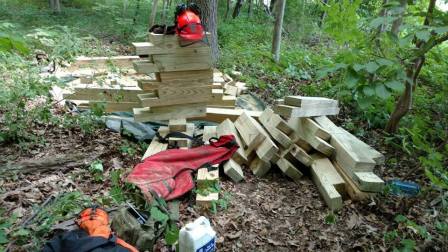
All of the steps were cut by a chainsaw! , photo by Michaela Aney
These were two of the amazing projects we completed this year.
Post by Michaela Aney and Marlena Vera-Schockner, 2016 ECC members
Between the months of April to September, monarch butterflies will travel up north from Mexico to New York as part of their annual migration and breeding season. During this time, multiple generations of monarch butterflies will breed and disperse across the Northeast region. With so many generations occurring in a short time period, it is vital that there are enough breeding areas, or waystations, for the monarchs to rely on for food and shelter. Over the past decade, the Eastern Monarch butterfly population has been on the decline due to logging of trees in overwintering areas, climate change, the possibility of disease and parasites, and the destruction of milkweed, which is the food source for the caterpillars. It is imperative that we prevent any further decline of their population for this massive migration results in pollination of many flowers throughout the monarch butterflies journey.
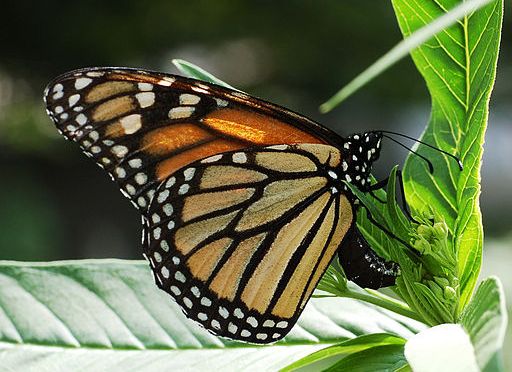
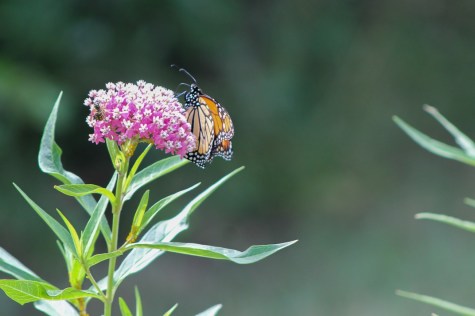
Monarch butterfly and a bee feeding on the nectar from a swamp milkweed in Wilson Tuscarora State Park in August 2016. Photo by J. Harris
One of the ways we can support the monarch is to prevent the loss of milkweed and other native flora throughout the migration path. The destruction of milkweed has been caused in part from the over use of herbicides and more extensive and frequent mowing along roadsides. By leaving more edges, meadows and fields unmown milkweed will often come back. Milkweed is important to every part of the monarch butterfly’s lifecycle because the plant provides the butterfly with a breeding ground to lay eggs on, a food source for the caterpillars after the eggs hatch, and the flowers provide nectar for the adults to feed on after their metamorphosis. Milkweed also helps protect monarch butterflies from predators due to the caterpillars ingesting toxins that the plant produces. After the caterpillars metamorphosis into butterflies, the toxins collected in their bodies makes them poisonous to eat. The nectar from the flowers on the milkweed, as well as other plant species, provides the adults with the energy to travel back down to Mexico and throughout the winter.
Budd Termin and Meg Janis with milkweed plants at Wilson-Tuscarora State Park in May 2016 Photo by an I Love My Parks day Volunteer
State Parks is working throughout the state on efforts to reduce mowing, support native milkweeds and other native flora, and to prevent loss of habitat to invasive species like swallowwort. A number of parks have established butterfly gardens or meadows to allow for up-close observation. In Western New York, State Parks has teamed up with Budd Termin from Niagara County Community College to create Monarch Watch gardens in the state parks as refuge for the butterflies during the migration season. Wilson-Tuscarora State Park has a monarch watch garden and plans for a garden are under way for Beaver Island State Park. Already established butterfly gardens at other state parks will eventually get certify under Monarch Watch as monarch waystations. The mission of these gardens is to provide the milkweed and other native plants for the monarchs, as well as other pollinators, in order to reestablish their population size. If anyone is curious on how the project is going, they can follow @Mission_Monarch on Twitter, or if anyone is interested in learning more about monarch conservation efforts and what they can do to contribute, they can visit Monarch Watch.
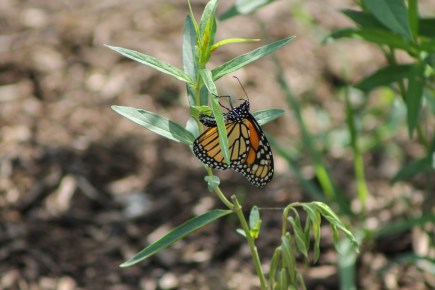
Monarch butterfly laying her eggs on a swamp milkweed located in the butterfly garden at Wilson Tuscarora State Park in August 2016. Photo by J. Harris
Freshwater benthic macroinvertebrates, usually simply called macroinvertebrates, are small animals that live in the water. They have three parts to their name: “Benthic” refers to the bottom part of a body of water, “macro” means that we can see it with our naked eye, and “invertebrate” means that it has no spine, or vertebrae. So, a benthic macroinvertebrate is an organism that lives at the bottom of streams, rivers, lakes, and ponds for part of its life, can be seen with the unaided eye, and has no backbone. Some macroinvertebrates have three life stages, while others have four. If the life cycle has four stages, it is called complete metamorphosis. If it only has three stages, the life cycle is called incomplete metamorphosis. The stages of complete metamorphosis are egg, larva, pupa, and winged or aquatic adult. The stages of incomplete metamorphosis are egg, nymph, and flying adult. Adult macroinvertebrates sometimes leave the water but live near it, and others continue to live in the water. Macroinvertebrates are a vital food source for fish, turtles, wading birds, and small mammals.
They are well suited to live in water, and many have interesting adaptations that allow them to thrive underwater. Caddisfly larvae build mobile protective cases out of stones, leaves, and small sticks to keep themselves safe. Mayfly nymphs have large gill areas to help them breathe. Predaceous diving beetles carry small bubbles of oxygen at the ends of their abdomens from the surface to use to breathe while underwater.
Another interesting thing about macroinvertebrates is that they can be used as an indicator of health for a body of water. This is because some species of macroinvertebrates are more sensitive to environmental stressors than others. Rivers, streams, and ponds with a variety of macroinvertebrates are considered healthy.
A mayfly nymph on the left; a mayfly adult on the right. Notice the gills along the back end of the nymph, this is how the animal gets oxygen from the water, similar to a fish.
Macroinvertebrates need dissolved oxygen in order to breathe in the water, just like fish. Dissolved oxygen references the microscopic bubbles of oxygen gas that are mixed with the water for aquatic creatures to breathe. Dissolved oxygen is sometimes measured in parts per million (ppm). Most fish do well in water with 5ppm of dissolved oxygen or higher. Pollution can cause water temperatures to rise, which reduces the amount of dissolved oxygen in the water. So, pollution decreases dissolved oxygen levels, making it hard for macroinvertebrates to breathe. A healthy body of water will have dissolved oxygen levels that are at or above 5ppm.
Macroinvertebrates as Indicators of Water Quality
There are many different types of macroinvertebrates, all with different sensitivities to temperatures, the amount of dissolved oxygen in the water, and pollution levels. Macroinvertebrates require similar dissolved oxygen levels as fish, but some species, such as mayflies, caddisflies, and stoneflies, need low temperatures and high levels of dissolved oxygen to survive. If you look for macroinvertebrates and find mayfly and stonefly nymphs in a stream, you can conclude that the stream is fairly healthy because those organisms could not survive otherwise. Those species are considered to be sensitive to pollution.
There are also species that are somewhat tolerant of pollution, like dragonflies, damselflies, and crayfish. These organisms do not need as much dissolved oxygen or as cool of temperatures as those that are sensitive to pollution and can stand a small amount of pollution in the water. If one were to find dragonfly nymphs in a stream but no mayfly, caddisfly, or stonefly nymphs, that could be an indicator that the stream has some pollution.
Finally, there are species that are tolerant of pollution. Some of these species are midges, backswimmers, and aquatic worms. These organisms can withstand a moderate amount of pollution, can live in warmer water, and do not need as much dissolved oxygen to survive. So, if one were to find many midge larvae and aquatic worms in a stream and little else, this would indicate that the water there is fairly polluted. Sometimes, tolerant macroinvertebrates can be abundant in degraded waters since they are not competing with others for resources like food and shelter.
Below is a list of several species of macroinvertebrates with their varying tolerances of pollution.
Sensitive to Pollution
(found in water with little or no pollution)
Somewhat Tolerant of Pollution
(found in water with little to some pollution)
Tolerant of Pollution
(found in water with little to substantial pollution)
Clay Pit Ponds State Park Preserve’s education team has done several surveys of the ponds within the park to get an idea of the water’s health. Clay Pit Ponds is the only NY state park on Staten Island; the park contains 265 acres of forest, fields, wetlands, and five ponds. The park offers an educational program all about macroinvertebrates called Pond Investigators. In this program, students learn to identify macroinvertebrates, understand them as an indicator of water quality, and conduct a survey of one of the ponds. The most recent survey was conducted in Goode’s Pond, which is located along the Clay Pit Pond trail (orange markers). To survey for macroinvertebrates, the students and the Clay Pit Ponds education team scraped the bottom substrate of the pond, including some aquatic vegetation, with a dip net. Off to the side, a tub was partially filled with pond water. The collections from the dip net were transferred into the tub, and any macroinvertebrates found were placed into separate cups. This was repeated three times, and then the students recorded their findings.
Goode’s Pond is very close to the West Shore Expressway, which makes it an interesting pond to study due to the likely presence of runoff pollution from the highway. These surveys were completed along with water quality tests to check pH, dissolved oxygen, water temperature, and salinity. During these surveys, the Clay Pit Ponds education team and students found damselfly nymphs, dragonfly nymphs, backswimmers, midge larvae, crane fly larvae, black fly larvae, mosquito larvae, aquatic beetles, snails, and aquatic worms. While no pollution sensitive species have been found, which would indicate cleaner water, the samples did include many species that do not tolerate heavily polluted water. From this study we learned that the water in the ponds is in fair to moderately good condition at this time. With continued efforts to clean up in and around the ponds, we can keep this important habitat clean and preserve opportunities to see a diversity of wildlife, from dragonflies to great blue herons.
Goode’s Pond is fairly healthy, based on students’ findings of macroinvertebrates. photo by Mikey Bard
If you would like to help Clay Pit Ponds State Park Preserve improve the health of its ponds, join in for the National Public Lands Day Clean-Up on Saturday, September 24th from 10:00AM to 1:00PM! Participants will clear litter from the highways that border the park to prevent it from being washed into the ponds. The clean-up will start at the Nature Interpretive Center located at 2351 Veterans Road West, Staten Island, NY. All ages are welcome! Please RSVP by contacting Emily Becker at emily.becker@parks.ny.gov or (718) 605-3970 x201.
Post by Mikey Bard, SCA/Americorps Member serving as Assistant Environmental Educator at Clay Pit Ponds State Park Preserve
Twenty miles east of New York City, on Long Island, over six million people every year head to Jones Beach State Park for some fun in the sun. This popular beach also happens to be one of the most popular spots in New York State for the endangered Piping plover to nest. The Piping plover is a small, sandy colored shorebird with yellow/orange legs, and a black band strapped across its neck. After they arrive, they chow down on a diet made up of mostly invertebrates (think insects and mollusks), and make their homes at the base of the dunes. Unfortunately, due to extensive hunting in the 19th century for their feathers along with increased beach recreation post-World War II their populations have seen a steep decline. Plover stewards are tasked with reversing this downward trend and protecting these shorebirds from the bevy of visitors. Every summer, the conservation efforts begin with the construction of a “symbolic fence.”
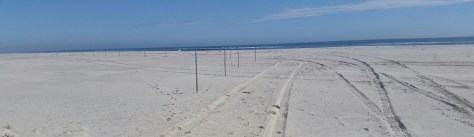
Symbolic fencing setup. Photo by Keegan Mobley
Symbolic fence is erected all along the beach in areas where plovers nest and is a simple combination of metal posts, orange string, and orange flagging. Once the fences are built and the plovers arrive, it’s up to the plover stewards to find the nests. Unlike a songbird, piping plovers nest on the ground in round, shallow depressions called “scrapes.” To create a scrape, male plovers walk around the dunes finding locations they would like to nest, then simply scoop out the sand with their feet. They make several scrapes, so females have a variety of spots to choose as a nest. Once they choose a scrape, the plovers will line the pit with shell fragments to reinforce the ground where the eggs will be laid. Plovers will leave and return to their scrape via the same routes forming “Highways.”
Piping plover broken wing display. Photo by Kim Rondinella.
A newly hatched Piping Plover chick! Photo by Kim Rondinella.
Running piping plover chick. Photo by Kim Rondinella.
Plover stewards use observable highways along with sightings of broken wing displays to determine how close they are to a nest. Plovers feign being injured to draw attention away from their nest and chicks. They lure the predator to follow them by stealthily walking out of the nest and pretending to have a broken wing. As they parade, they tempt the potentially voracious animals away from the nest, only to fly away at the last second before being captured! Even though they use sneaky tactics, the plovers still need some help. So, every year plover stewards build shelters called exclosures around the nests which keep out hungry animals. SUNY College of Environmental Science and Forestry is conducting a study to assess the effectiveness of exclosures. They do this by comparing predation of exclosed nests versus non- exclosed nests.
Installed piping plover nest exclosure. Photo by Kim Rondinella.
Come June, the exclosures become obsolete as the eggs begin to hatch. Newly hatched chicks can’t fly and are still in danger of being crushed by vehicles driving on the beach. Public vehicles are therefore not allowed on the beach during this time. At State Parks there is still a need for park vehicles to travel the beach for daily tasks, such as trash removal and maintaining the mounds of sand in front of the lifeguard chairs. Plover stewards escort the vehicles to help keep the chicks safe. It takes chicks between 28-35 days to fledge, or to learn how to fly. During this time the chick will transform from looking like a cotton ball on sticks to an almost identical version of its parents.
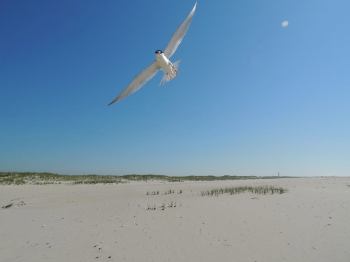
Least tern straight ahead! Photo by Kim Rondinella.
Long walks on the beach watching these plovers grow- up may sound glorious, but there are some occupational hazards to being a plover steward. During a plover survey walk it’s impossible to avoid another shorebird nesting in the dune habitat: the threatened Least tern. Unlike plovers, Least terns guard their nests viciously: dive-bombing, squawking, and even defecating on anything that comes near including a plover steward. Yet there are strategies that a plover steward can use to happily coexist with the Least terns! These are including but not limited to walking slowly and confidently and placing a long stick in his/her backpack.
By the end of August, the plovers along with the Least terns will fly thousands of miles south for their annual migration. For many plover stewards it is hard to see these tiny shorebirds leave after months of meticulous observation. But they will be back next year!
















 New York State Parks and Historic Sites Blog


