Category Archives: Park Projects

Happy Second Birthday Nature Times!


This slideshow requires JavaScript.

In this second year of Nature Times we have gotten to know snapping turtles, carnivorous plants, black squirrels, and Sammi, Trailside Museums’ 36 year old bald eagle.  We’ve learned how trails are mapped, how a flock of sheep and goats have become one of State Parks’ 21st century mowing crews, and ways to explore State Parks on foot, in kayaks, on snowmobiles, and on frozen lakes. The stories have featured all kinds of work that State Parks staff and volunteers do throughout the year to help preserve and protect some of New York’s unique and exceptional places. These range from protecting sand dunes on Lake Ontario and old-growth forest at Allegany, to creating native grasslands at Ganondagan State Historic Site, and monitoring invasive species infestations and removing invasive species both on land and water.

This slideshow requires JavaScript.

We mark this second birthday with 61 new followers and over 24,000 page hits!  And we thank the 32 staff, interns, and partner organizations who have shared their passion for State Parks through the blogs that they have written. We also want to recognize our partnership with the New York Natural Heritage Program who helped in initiating this feature and continues to provide support.

We look forward to continuing our celebration of State Parks in the months to come in Nature Times.  Hope to see you soon at one of our Parks or Historic Sites!

Does Parks do Invasive Species Work in the Winter?

One might think State Parks’ Invasive Species Staff are sitting around with their feet up, taking a break from the relentless tasks of the summer field season. That’s not at all the case. Winter months are filled to the brim with “To-Do” Lists. The seasonal break in the field season allows for more office related tasks, such as wrapping up the previous field season, checking data for quality control, working with volunteers, and prioritizing, planning, and preparing projects for the upcoming field season. These tasks require significant collaboration with other Park staff, NY Natural Heritage Program (who provides data and advice on protecting rare species and natural communities) and other agencies involved in invasive species management. But putting in the effort and office time early in the season truly pays off to make for a successful field season.

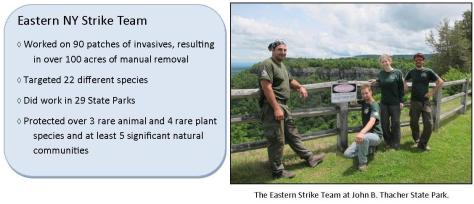
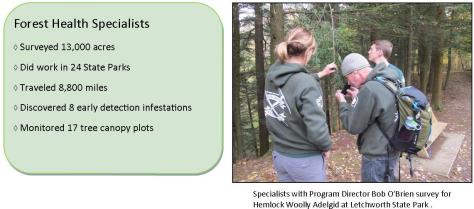
For the summer of 2015, we had two Invasive Species Strike Teams and one Forest Health Specialist Team working on State Park lands. The two strike teams each covered half the state, the Eastern Team covering from Long Island to Lake Champlain. The Western Team covered the State Parks west of the Binghamton-Syracuse line. The Forest Health Specialists also focused on Western NY, coming as far east as the Finger Lakes Region.

Check out what we accomplished this past year!

Western Strike Team
Photo by Alyssa Reid
Eastern Stike Team
Photo by Alyssa Reid
Forest Health
Photo by Alyssa Reid

That is a lot of effort, both on the planning end, and by our hardy crew members! Without the hard work and commitment to excellence of our seasonal staff, the program would accomplish only a tiny fraction of our goals. Their eyes on the ground keep us informed of the details of each treatment area and provide us with feedback on the success or any recommendations for further actions. We listen closely to feedback from the crews and other Parks staff and partners to continue to improve and strengthen the Invasive Species Program each year.

So even though there is snow on the ground and temperatures are cold, we are still working on invasives issues and preparing for what we hope to accomplish in the upcoming field season.

For more information on the State Parks Invasive Species Strike Teams, see this blog post.

For more information on the State Parks Forest Health Specialists, see this blog post.

Post and photos by Alyssa Reid, State Parks Invasive Species Field Project Specialist

Sampling Wildlife Populations in State Parks: White-tailed Deer

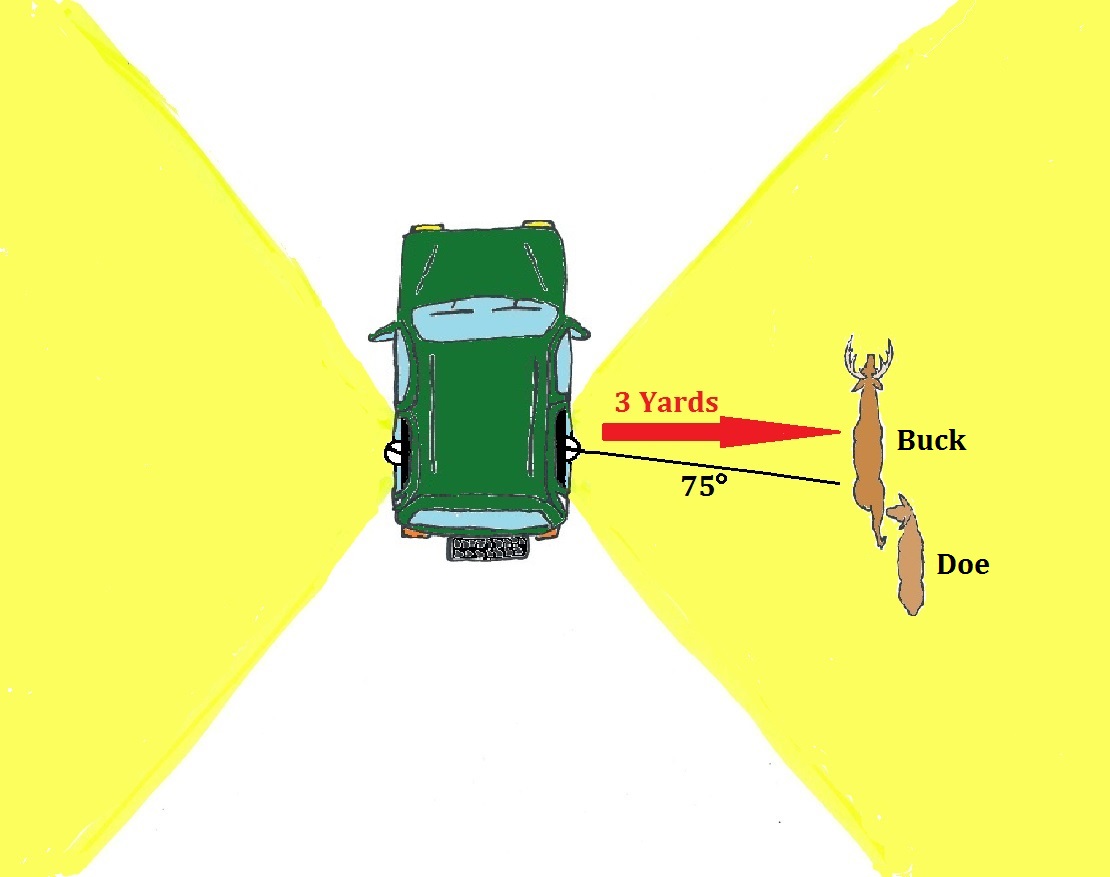
It is important to monitor wildlife populations to ascertain how a species is surviving and how that may impact other wildlife populations and forest biodiversity. In many of our state parks, especially in the Hudson Valley, we monitor the deer population and the effect that deer are having on the forest vegetation. One method we use to monitor the deer population is a “distance survey” conducted at night, using spotlights, a range finder (to determine the distance between the deer and the vehicle) and a protractor, for measuring the angle at which the deer were observed. Four people and a vehicle are needed in this survey. Two “spotlighters” sit in the back seat and search for deer, the driver keeps the vehicle at five mph and stops when a deer is seen to get the information on the deer, and a scribe sits in the passenger seat to record the data. Data recorded includes deer group size, sex, age, habitat type, distance in yards and angle from the vehicle. To determine a deer’s sex, the surveyor notes if the deer has antlers or not – age and sex are defined as fawn, doe or buck.

Deer Diagram

As an example, the above diagram shows a group of two deer at a distance of 3 yards and an angle of 75˚ from the side of the vehicle. The yellow color represents where the surveyors are shining their lights. The surveyor defines this as a  group of a buck, due to the antlers, and a doe. These observed deer are in a mowed hayfield, so this habitat type would be recorded as agriculture.

Click on an image above to read the caption.

After driving the predetermined distance sampling routes, we headed home for the evening. Back in the office, the data obtained will be entered into a statistical program that will calculate the number of deer per square mile in this particular park. This data will be compared to previous year’s data to track the deer population and will help determine future wildlife management decisions.

Post, diagram and photos by Lilly Schelling.


FORCES : College Students Support Stewardship in New York State Parks

As the summer months wind down, the FORCES Program staff of the Central and Finger Lakes Regions are busy both reflecting on the last few months and making plans for the next academic year.

FORCES stands for “Friends of Recreation, Conservation and Environmental Stewardship”, and the FORCES Program specifically focuses on building long-term, mutually beneficial partnerships between local state parks and colleges. Currently this includes one-day volunteer events, FORCES clubs at six colleges, dozens of stewards between the two regions, partnerships with faculty members and college administration, projects in over twenty parks and historic sites, and involvement with fourteen colleges and universities within the Finger Lakes and Central Regions.

This summer has been an exciting one, with the “FORCES family” including 37 stewards and seasonal employees! The FORCES interns and seasonal employees started together in June with the first annual “Trainapalooza,” which was held this year at Robert H. Treman State Park in the Finger Lakes Region. The stewards gathered for a two day training on invasive species identification and removals, iMap Invasives training, an overview of the geologic and human histories of the area, interesting features of some of the parks, and strategies for outreach and interpretation. The group also camped overnight at the park, and got to know each other while playing Frisbee, solving riddles, and enjoying s’mores.

After they were trained, the stewards separated again to begin projects throughout the two regions. Many projects focused on invasive species removal; stewards worked to remove water chestnut, pale swallowwort, slender false brome, and many other species of invasive plants. Other projects included the creation of a video about the FORCES program, historical research, assistance with the ongoing surveys for the Chittenango Ovate Amber Snail at Chittenango Falls State Park, water quality monitoring at Selkirk Shores State Park, and trail blazing at Two Rivers State Park… the list goes on and on!

The upcoming academic year will bring more excitement as FORCES welcomes new and returning stewards and club members. The semester started with the New York State Fair, where FORCES annually engages the public in building bluebird boxes- they assembled 1,250 boxes just this year! To date, FORCES at the State Fair has hosted over 180 students and involved 8 colleges. Plans are also in motion for the first annual FORCES Membership Gathering, which will take place in October and combine trainings with celebrations for club members, stewards, seasonal staff, and ambassadors- all members of the “FORCES family”.

In the spring, FORCES will hold its second annual Leadership Summit, which assembles club officers and FORCES “Ambassadors” from all FORCES schools to plan and strategize for the growth of the FORCES Program. The event was a huge success last April, with the FORCES staff being (again) blown away and inspired by the passion and dedication of the students.

Keep an eye out for FORCES stewards as you visit the parks, and chat with them about the projects they are working on. They’re accomplishing big things!

For more information visit our new web page.

Post by Becky Sibner, FORCES Program Specialist for the Finger Lakes Region.


See Through the Eyes of the Seneca at the Ganondagan Grassland Management Area

The Ganondagan State Historic Site located in Victor, NY boasts a historically accurate 17th century longhouse and will be opening a new Seneca Art and Culture Center this fall. However, there is a hidden gem at this historic site that not many realize exists! It is the Grassland Management Area at the corner of Boughton Hill Road and School Road which covers around 80 acres (over 60 football fields!) and is one of the most intriguing interpretive areas at the site!


In 2009 OPRHP restored 67.4 acres of the Grassland Management Area to represent oak opening communities in both plant composition and spatial arrangement. The Grassland Management Area has since spread to fill around 80 acres with the native plants seeded back in 2009.

The idea behind creating an oak opening came from Ganondagan’s past. Journal entries from French and English visitors to the site in the mid to late 1600’s described the landscape they saw when visiting the flourishing Seneca town of Ganondagan. Their descriptions of oak openings were used to create a scene that can transport the viewer back in time to when the Seneca were living at Ganondagan 400 years ago!

Oak openings are fire-dependent savannahs (grasslands) dominated by oak trees and are rare ecological areas, especially in upstate New York. The oak opening created at Ganondagan consists of warm-season grasses (grasses that thrive in the heat of the summer), wildflowers and large oak trees along the surrounding wood edge. Spring fire management promotes lush growth of warm-season grasses and oak trees. Controlled fires also suppress grassland succession (gradual changes in plant species in an ecosystem), provide fertilizer in the form of plant ash, reducing plant height to allow sunlight to reach new (young) plants and hinder the development of invasive species. The fire management of oak openings such as the Grassland Management Area have historically maintained their species composition mainly due to wildfires, to utilize this historic management technique OPRHP will be conducting a prescribed burn. A prescribed burn is a well-planned fire managed by trained firefighting professionals with specific plans in place to keep smoke high and away from the public.

Proper permits and permissions have been received for OPRHP staff to conduct a prescribed burn at the Grassland Management Area in spring of 2016. The burn will cover 20 acres in the first year and help maintain the plant communities of the Grassland Management Area that are representative of the Town of Ganondagan in the 17th century.

When you visit  Ganondagan’s oak opening, look for native plants include big bluestem (Andropogon gerardii), little bluestem (Schizachyrium scoparium), Indian grass (Sorghastrum nutans), black-eyed Susan (Rudbeckia hirta), tall white beardtongue (Penstemon digitalis), smooth blue aster (Aster laevis), New England aster (Aster novae-angliae), zigzag aster (Aster prenanthoides), and Indian hemp (Apocynum cannabinum).

Throughout the year, the grassland at Ganondagan are a delight to visit.  In spring, it is a lush open area of low, green grasses where chirps and buzzes can be heard above anything else. In the late summer it transforms itself into a beautiful 8-foot tall wonderland of wildflowers and golden brown grasses with different seed head patterns, where you can watch even the slightest of breezes wave through all 80 acres!

Post by Whitney Carleton, OPRHP. Photos by Whitney Carleton and Alexis Van Winkle, OPRHP.