Hope Takes Wing for Endangered Bird

Here in New York, we have residents nicknamed ‘snow birds’: People who enjoy summers on New York’s beaches, but escape our harsh winters by traveling south to Florida. Making that journey right along with them is another species of beach bum — the small, endangered shorebird called the Piping Plover.

Usually weighing about two ounces or less, the Piping Plover is a tiny bird that is undeniably and objectively cute; just ask anyone that is working to restore the population. It’s a bird that’s easy to fall in love with but that requires hard work to recover.

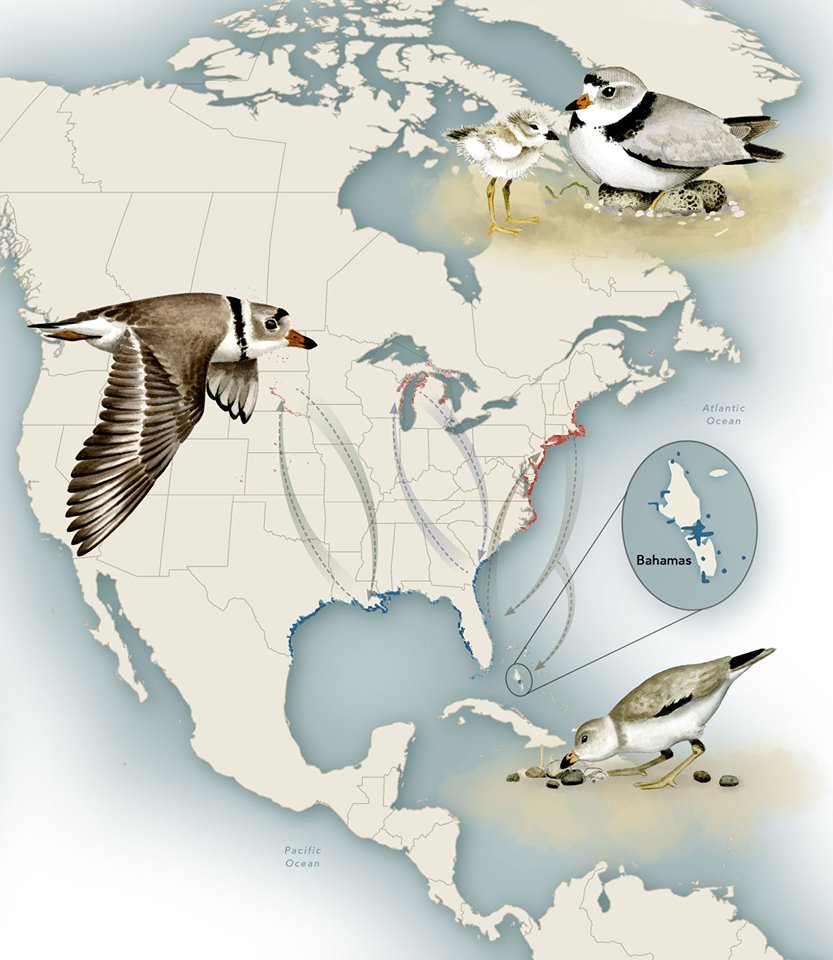
There are three distinct populations of Piping Plover: the Atlantic Coast and the Great Lakes, which both breed in New York State, and the Great Plains. Due to shoreline habitat loss and disturbance, all three populations significantly declined in the mid-twentieth century, leading to their listing under the Endangered Species Act as threatened (Atlantic and Great Plains populations) and endangered (Great Lakes population) in 1986.

The recovery of the Piping Plover has been a slow and intensive process. At the time of listing, the endangered Great Lakes population had only an estimated 17 breeding pairs — with no birds nesting on the Great Lakes shores of New York. For 29 years, no plover nests had been seen on New York’s lake shores.

Finally, in 2015 a pair of Piping Plovers showed up on the eastern shoreline of Lake Ontario in and around Sandy Island Beach State Park in Oswego County.

Sandy Island Beach State Park is located on the eastern shore of Lake Ontario. (Credit: Google Maps)

New York State Parks and Department of Environmental Conservation employees, Audubon New York employees, and volunteers teamed up to monitor the plovers and reduce disturbances from humans and predators in hopes that the birds would stick around and raise their young.

Although the birds were not successful that year, plovers kept returning each summer to the State Park, and in 2018 and again in 2019, were able to raise chicks

These adult Piping Plovers, banded with orange flags on their legs, successfully nested at Sandy Island Beach State Park in 2019. The male plover (right), can be distinguished from the female by its bolder brow and neck bands.

Throughout the spring and summer months when Piping Plovers are found at breeding sites, shorebird technicians monitor nests and chicks until young birds are fledged, meaning they are capable of sustaining flight. Researchers also band as many plovers as they can in the Great Lakes. Used for identification, bird banding is a common research practice, and is an extremely useful tool in understanding behavior, life expectancy, population sizes, and migrations of birds.

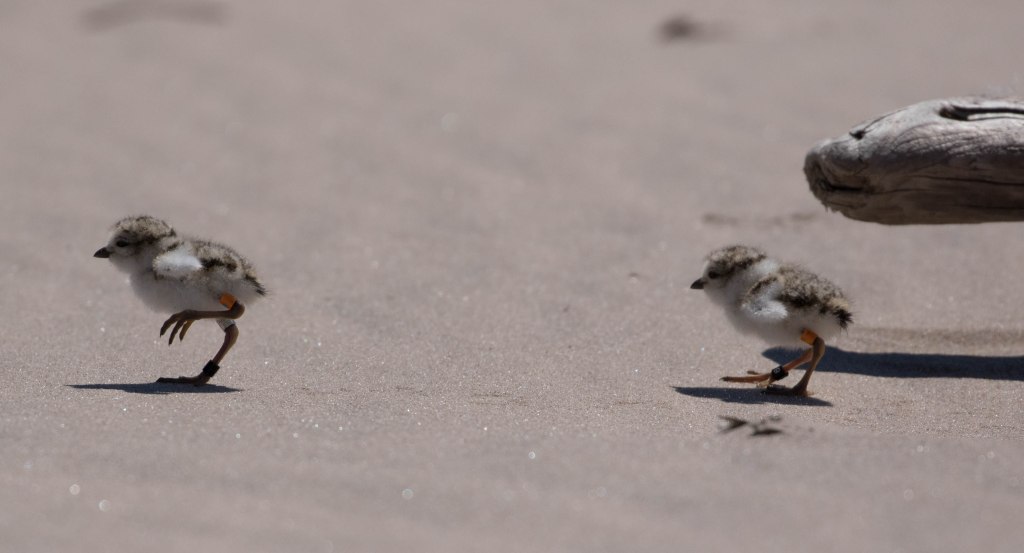
Above: A trained and licensed bander prepares to apply unique bands to a chick in 2018. Below: In 2018, the Piping Plover chicks had Lord of the Rings-inspired nicknames: Frodo (right) and Pippin (left) show off their new bands as they scurry back to their nearby parents. Photo Credit: Tom Morrissette.

For endangered populations, banding can provide essential information about site use that can guide future conservation in both breeding and wintering grounds. For the plovers at Sandy Island Beach State Park, bird banding helped researchers track two fledglings after migration, one to Georgia in 2018 and another to Florida in 2019. These were the first Great Lakes fledglings from New York to be spotted in their wintering grounds in the south.

The young birds are each marked with a unique combination of bands, like name tags, which allows staff to identify individual birds and assign fun nicknames to the newly hatched chicks. The fledge sighted in Georgia in 2018 was named Gimli, and our 2019 fledge, affectionately nicknamed Chewie (proper name Chewbacca) was spotted in Florida soon after it had left New York. The first fledge from the Great Lakes seen on wintering grounds in 2019, little Chewie had made the nearly 1,300-mile journey in only three to four days!

Chewie (background) and its sibling, Yoda (foreground) both successfully fledged from Sandy Island Beach State Park in 2019. They can be distinguished by the unique combination of colored bands on their legs.

This feat is no small matter, as plovers face many challenges before the eggs have even hatched. Coastal development has reduced available nesting habitat, and the open sand suitable for nesting is also the most desirable location for human recreation. Conflict with humans can lead to birds abandoning territory, nesting attempts, and even viable eggs. If a nest can be established, the threat of predation now looms.

Piping Plovers lay their eggs in the sand. These nests generally contain four eggs, and the adults often spend time “decorating” the nests with delicate rocks and shell fragments.

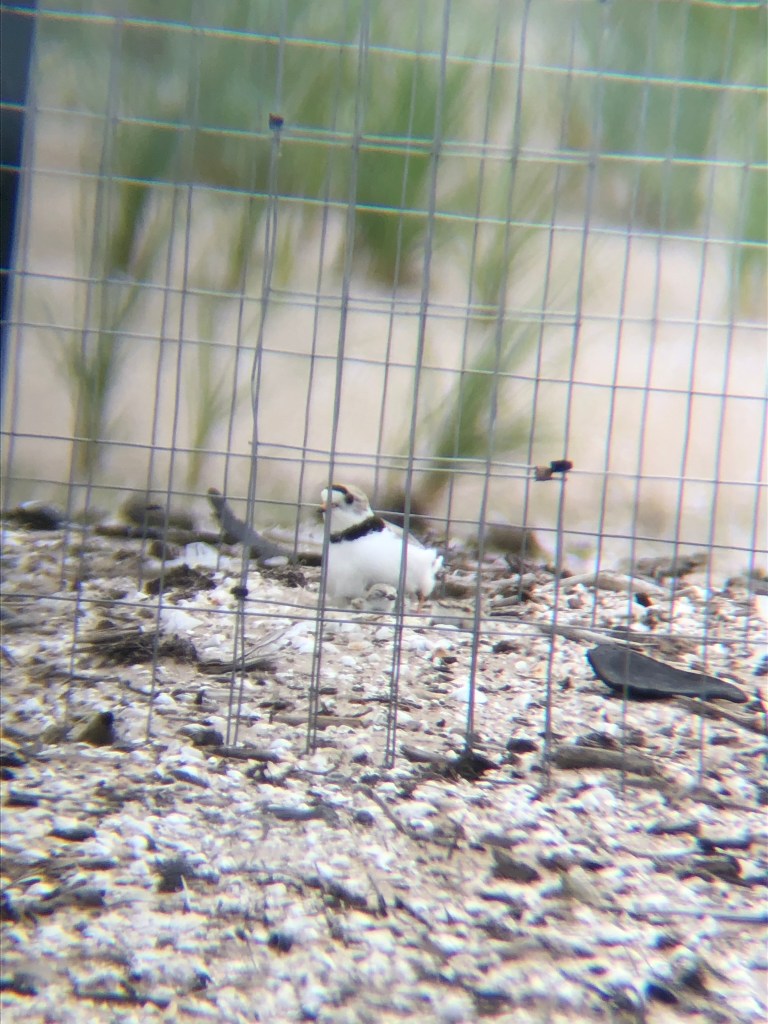
Plovers lay their well-camouflaged eggs in shallow depressions, called scrapes, on sparsely vegetated sand. This makes it easy for plovers to spot predators, but also provides no protection from critters that discover the nests. Therefore, it is common for shorebird stewards to build an exclosure around the nest. This is a fence with spaces large enough for plovers to pass through, but small enough to prevent predators from reaching the eggs (click here to learn more about the work of State Parks Plover Stewards). This can prevent eggs from becoming a meal for foxes, crows, gulls and other predators, but still does not guarantee hatching. Their beach home can get flooded by high water levels and the exposed sand can become very hot.

Still, Piping Plovers are adapted to these conditions and are dedicated and attentive parents. Exclosed nests have a high chance of reaching their hatch date.

The new chicks hatched safely within the wire of the predator exclosure that was placed around the nest. But they won’t stay in there for long!

But our small friends are not in the clear yet! The chicks are precocial, meaning they are able to leave the nest only a few hours after hatching. The highly mobile chicks obtain food on their own under the watchful eyes of their parents, but constant running can easily exhaust the hatchlings and makes them an easy target for predators.

Combined with the stressors of human recreation, it truly becomes a miracle to reach fledging age. Humans can disturb plovers, often unintentionally, by scaring adults off nests, preventing adults and young from feeding near the water, or even accidentally stepping on nests and eggs. Remember that these birds are very small with feathers and eggs that are well camouflaged for sandy beaches, so be sure to keep an eye out when visiting beaches with designated nesting areas!

It should be no surprise to learn that, on average, for every pair of plovers only about one chick typically survives to fledging. This one fledgling must then face a long journey south to wintering grounds on their own. That two young birds, including Chewie, were raised at Sandy Island Beach State Park and made it to their winter homes was a good sign. Continued monitoring in New York will tell us whether these plovers return to raise their own young.

This map shows the typical migration routes for all three populations of Piping Plover. Credit: Illustration by Megan Bishop/Cornell Lab of Ornithology and accessed via Facebook page for Great Lakes Piping Plover Recovery Effort.

From egg-laying and hatching to fledging and migrating, Piping Plovers face threats and obstacles at every turn. Since the return of the Piping Plovers to the eastern shores of Lake Ontario, there have been six successful fledges from Sandy Island Beach State Park. Until we know if the young survived their first migration south, it can be difficult to gauge the success of the recovery plan. Therefore, this incredible flight of young Chewie, documented by its unique bands, is a symbol of success and high hopes for the ongoing efforts to recover the population of this charismatic shorebird.


Post by Lindsey DeLuna, OPRHP Environmental Steward and Student Conservation Association member

Cover Photo: The fledgling from Sandy Island Beach State Park, nicknamed “Chewbacca,” after his arrival at a Florida beach in early August 2019. Photo Credit: Wendy Meehan.

To learn more about Piping Plover banding and how to report sightings, follow the links below:

https://www.greatlakespipingplover.org/reporting-plover-observations

https://www.fws.gov/northeast/pipingplover/report_bands.html

All photos, unless otherwise stated, were provided courtesy of Alivia Sheffield, the Great Lakes Piping Plover Coordinator at Sandy Island Beach State Park and a trained staff member. Remember to observe wildlife from a safe distance, and never approach nests or chicks.

Fire On The Mountain

As all park managers know, times of peace and quiet in the park are only temporary.

On a Friday afternoon last month, Hudson Highlands State Park in the Taconic Region felt the transition from tranquil to full-throttle, when after a trail steward with the New York-New Jersey Trail Conference, crossing the Newburgh-Beacon Bridge over the Hudson River, noticed smoke to the south. And it was coming from Sugarloaf Mountain in the park.

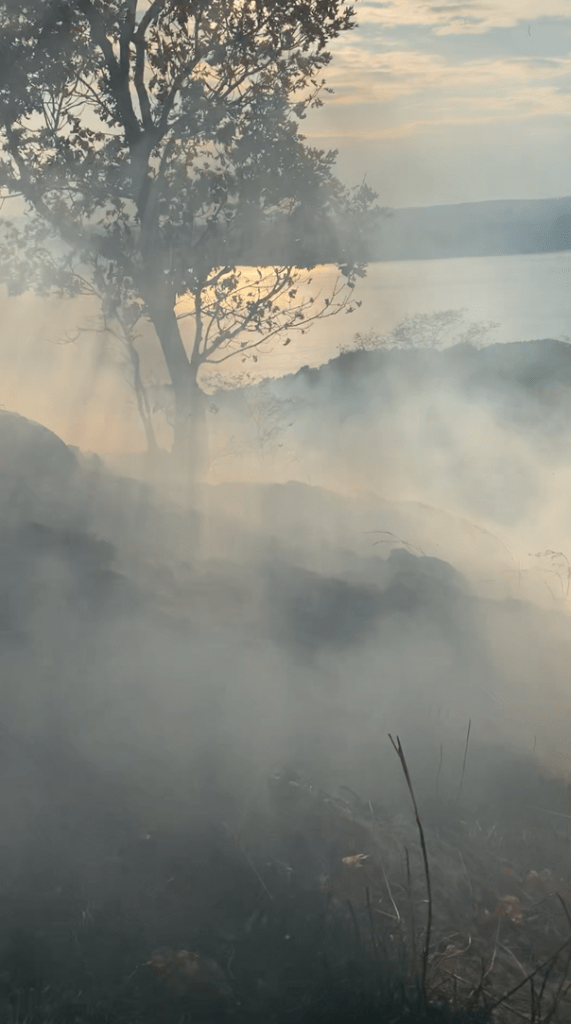
Smoke rises from Sugarloaf Mountain. (NYS Parks photo)

It was a little after 4 p.m. on September 20 when the steward reported his sighting to State Parks. Almost simultaneously, Hudson Highlands Park Manager Evan Thompson — elsewhere in the 8,000-acre park — was told by a patron of a potential fire on nearby Breakneck Ridge. That report turned out later to be of the Sugarloaf blaze, but added to initial uncertainty over possibly having two fires at the same time.

Gathering staff to investigate Sugarloaf and knowing that recent dry conditions had increased the danger from wildfires, Thompson also called the New York State Park Police, Parks Forest Rangers, and the Department of Environmental of Environmental Conservation for assistance. He learned that DEC officers were responding to a search at Minnewaska State Park Preserve and another fire at Cranberry Mountain, both several counties distant.

After additional contact with the Park Police, DEC sent Ranger Robbi Mecus to the park. Park Police officer Jeremy Pickering arrived at the trailhead as did Mecus, with the pair leading a crew of eight on a 2.4-mile hike up 900-foot Sugarloaf Mountain. There, they found a fire covering about nine acres at the rocky summit.

A state Police helicopter was called in, dropping water drawn from the nearby Hudson four times before dark in an effort to slow the spread of the fire. The crew stayed on the mountain digging fire lines — areas where dried grass, brush, trees and other flammable materials were cut and shoveled away to create a buffer line difficult for fire to cross. The ground crew only stopped when it became too dark to see safely.

Smoke covers the scorched summit of Sugarloaf Mountain . (NYS Parks photo)
On this map, Sugarloaf Mountain is located at the red trail labeled SL, with its summit marked by the binoculars icon.

By then — perhaps only four hours after the first report of the fire — Taconic’s Assistant Regional Director Tom Watt had asked for additional assistance from DEC and the State Parks’ adjoining Palisades Region. State Parks Forest Ranger Lt. Mickey Cahill from Palisades Region arrived, sharing Incident Commander responsibilities with DEC Forest Ranger Captain Greg Tyrrell.

Watt also started calling State Parks facility managers at home to gather manpower needed for the next day; he soon had a roster of twenty Parks staffers scheduled to report to an 8 a.m. briefing Saturday. Meanwhile, several other agencies and organizations offered help, including the Albany Pine Bush Preserve.

A crew of more than 30 was ready to climb the mountain by that morning, coming from State Park’s Palisades Region as well as from the far reaches of the Taconic Region on the other side of the Hudson. Splitting into two teams, the crews continued the physically-demanding process of hand-digging fire lines — also called fire breaks — around the perimeter of the rugged, rocky mountain top.

Crews on Sugarloaf Mountain use shovels and other hand tools to create the fire break meant to contain the blaze uphill from them. (NYS Parks photo)

At Sugarloaf, crews made these breaks by scraping the ground clean of combustible material for up to four feet, with a foot-wide, 6-inch deep cut into ‘mineral earth’ along the center of the break. Hazard trees nearby were downed, both to protect crews and prevent fire-weakened trees from falling across the fire containment line to act as a bridge for fire to spread. Digging these breaks was challenging due to the steep, rocky terrain and a thick layer of duff, which is decomposed organic material overlaying the soil.

From the air, a State Police helicopter continued dropping water gathered from the nearby Hudson River. And the fire itself was not the only hazard for those working the mountain. Crews had to watch out for fire-loosened rocks that tumbled down cliff faces without warning, as well as for rattlesnakes and ground-dwelling wasps. By Saturday evening, a preliminary line of fire breaks had been created to isolate the blaze, which by this point was estimated to cover about 14 acres.

A State Police helicopter brings a massive container of water from the Hudson River to drop onto the fire. (Photo by New York-New Jersey Trail Conference)

By Sunday’s 8 a.m. briefing, the fire-fighting crew had swelled to more than 75 people, with many working to strengthen fire lines in temperatures that soared to more than 90 degrees. In some instances, their work meant abandoning a section of line that would be difficult to defend — on a very steep slope, for instance, where burning material could tumble downhill across the line to spread — and dropping back to dig a new section.

Crews also created ‘cupped’ lines by piling material on the downhill side of lines meant stop burning material from sliding over and spreading. By this time, the fire covered about 25 acres.

On Sunday morning,  a complex network of fire hoses was laid out just outside the fire line. The hoses were routed to portable tanks at locations where tanker trucks could deliver water; gasoline-powered pumps provided water pressure to the hoses. Air operations by helicopter continued throughout the day. By nightfall on Sunday, the fire lines were as good as could be expected given the difficult terrain, but hardly impregnable.

A crew member uses a hose to water down the brush fire at Sugarloaf Mountain that has ignited dry grass. This summit is classified as one of the best examples in the state of a Rocky Summit Grassland natural community by the NY Natural Heritage Program. Learn more about this fire-adapted ecosystem in NYNHP’s Conservation Guides. (NYS Parks photo)

Monday dawned sunny and warm, with crewing working to improve the fire breaks. More than a mile of containment line was dug or improved on the rugged western flank of the fire, and by the end of the day, Park Rangers were confident that the lines were good. That evening, Rangers and Parks staff lit backfires on the east side of Sugarloaf to consume combustible material under controlled conditions. During the night, numerous large trees fell from roots being burned and weakened by the fire, with crews cutting trees that crossed the line.

The next day, Parks Rangers and DEC backburned privately-owned land to protect a cluster of houses at the north end of the mountain. With permission of the landowners, crews successively lit fires inside the containment lines and allowed the fires to consume burnable material. Crews then went to work to extinguish flames within 25 feet of the lines. That evening, crews again patrolled overnight to ensure that the fire remained ‘on the black side of the line.’

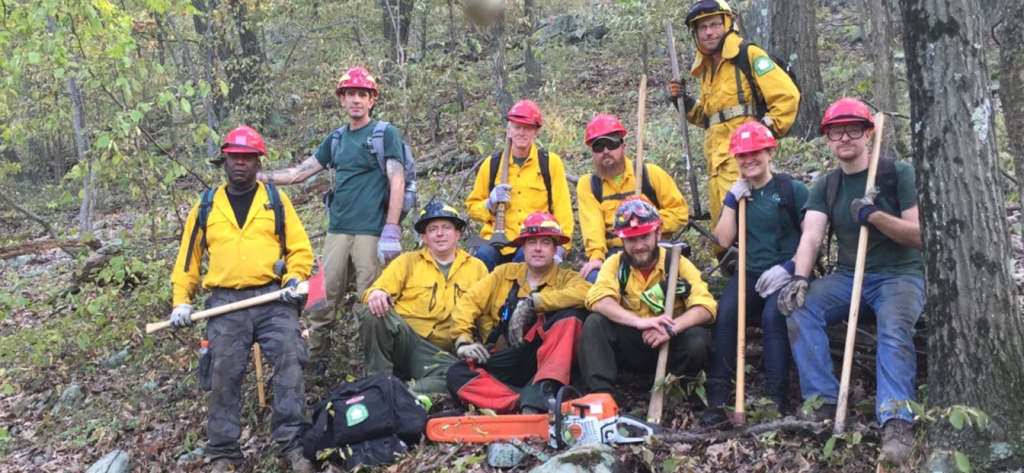
Crews keep working the fire break line. (NYS Parks photo)
Crews that manned the fire line. (NYS Parks photo)

By Wednesday morning, Sept. 23rd, the most immediate danger had passed, although the fire was still burning inside the break lines, which by this point contained about 50 acres. Secure breaks and less combustible material inside the lines meant that the hardest work was done.

The fire was contained, with no one hurt and no homes damaged. The Wilkinson Trail to Sugarloaf summit has since reopened, although part of the trail at the summit is rerouted to avoid steep, eroded and dangerous conditions.

A smaller team remained at the mountain for several days to conduct “mop-up” operations, like corralling equipment that had been distributed over miles of trails and patrolling for sparks or breaches of the fire line.

Given the nature of the soil and the terrain, the fire was expected to continue to smolder and burn until rains finally put it out. The cause of the fire remains under investigation, although initial reports suggested it might have been an illegal campfire. State Parks rules allow fires only in designated areas under supervision by an adult.


Post by Steve Oakes, manager of Old Croton Aqueduct State Historic Park and Philipse Manor Hall State Historic Site

How will the plants and animals that make up the Sugarloaf Mountain ecosystem respond and recover from this fire? Keep your eye on the NYS Parks Blog for a future post on that subject.

Ice, Ice Baby at Chenango Valley State Park

The Ice Age, which helped form Chenango Valley State Park in the Southern Tier about 12,000 years ago, is back in a big way.

After leaves are off the trees, but before the snow flies, park crews will create what is possibly the largest refrigerated outdoor ice rink in North America. And when they build it, hockey players young and old will come. 

At 24,200 square feet, this mechanically-generated ice sheet is more than 40 percent larger than the temporary outdoor facilities set up by the National Hockey League, which plays a handful of its contests outside each year.

Behold the frozen home of the Binghamton Pond Festival (called Pond Fest for short), a series of outdoor amateur hockey tournaments and youth events in the park that started in 2016, and now is drawing hundreds of youth and adult players to Broome County in January from as far away as California and Texas.

Teams compete at the Binghamton Pond Fest last year. Larger than an NHL rink, the Pond Fest refrigerated rink is divided into four sections.
Young skaters take to the ice.
A youth team member gets her game face on.

This year’s fest starts January 11 and again benefits the Mental Health Association of the Southern Tier and its programs focused on youth suicide prevention and youth mental health awareness.

Pond Fest owes it creation and growing success to two men — Tytus Haller, its founder, and Mike Boyle, manager at Chenango Valley State Park — and to the reliability of mechanical refrigeration to create and keep ice even when Mother Nature is not cooperating.

“Our first two years, in 2016 and 2017, we were running the tournament on the lake. We’d be out there checking the ice all the time,” said Haller.

And both years, unusually warm weather during the tournament left the ice in poor condition, which reduced the appeal to potential players. Said Haller, “The first couple of years, it was mainly a local crowd.”

Tytus Haller, founder and executive director of Binghamton Pond Fest, and his wife, Libbie.

But that all changed when Haller — the assistant director of the SUNY Broome Ice Center in nearby Binghamton — decided if winter was going to be unreliable, it was time to free Pond Fest from the weather with a mechanical refrigeration system.

Such systems use glycol, tubes, pumps, and “chiller” machines to drop the temperature of refrigerated tubing beneath a rink into the mid-teens. This forms an ice sheet that can be maintained even in warm weather.

All Haller had to do was figure out a way to get the equipment, which was going to cost a couple hundred thousand dollars.

With the help of state Sen. Fred Askhar, who got a $150,000 grant to help Chenango Valley buy much of the rink system, the 2018 tournament was the first played played on refrigerated ice.

“Things really took off then and in 2019, when word got out what we had and what we were doing,” Haller said. “I have not found anyone else in North America that has a refrigerated outdoor rink as large as ours.”

Now, the tournament in the park is drawing youth and adult teams from states beyond New York including New Jersey, Massachusetts, Florida, Texas, Georgia, Ohio, Virginia, Maryland, and California.

One of those coming in with a youth team in 2020 is Dallas resident Seth Turner. He has ties to Haller and the region after attending and playing hockey at Broome Community College some two decades ago.

He attended the initial Pond Fests without refrigeration, and saw how it all changed once the equipment was added. Now a youth hockey coach in Dallas, Turner pitched the idea of a January trip to upstate new York to local families, and eight are taking on the expense to send their kids to Pond Fest.

“Having refrigeration is the pitch,” Turner said. “I was able to tell parents that their kids would be playing, no matter what, whether it was raining, or sunny, or snowing. And that we would be playing in a beautiful park, in the woods. That made it an easy sell.”

Hockey is an increasingly popular sport in Dallas, he said, due to the presence of the city’s NHL team, the Stars. Local interest is even stronger now that the NHL will play its outside “Winter Classic” on a refrigerated ice sheet in that city’s Cotton Bowl in January.

At Pond Fest, adults have three-on-three and four-on-four tournaments. Youth teams have six and 16 players for a weekend of hockey and other fun in the park. Pond Fest also hosts a skills and skating clinic and will now offer private rentals of the ice sheet.

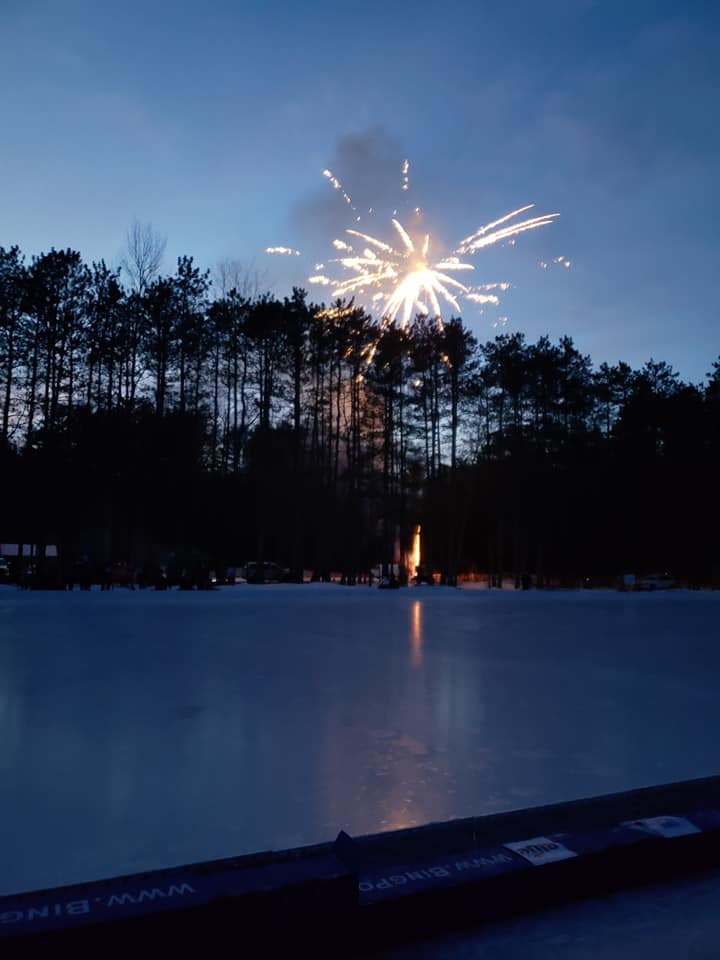
Fireworks reflect off the ice at Pond Fest.

Boyle said the festival draws fans and families into the 1,137-acre park along the Chenango River, which also features sledding and cross-country skiing in the winter. The park’s two lakes – Chenango and Lily – were formed as glaciers retreated at the end of the most recent Ice Age.

“We love this event,” Boyle said. “We hope this keeps going for years and years to come.”

The park has added a fire hydrant near the rink, to make it easier to spray water on the rink mat system. Water has to be sprayed repeatedly in thin layers to freeze in order to make the strongest ice, a process that can take about a week to get the proper thickness on such a large ice sheet.

“Our crew here at Chenango Valley State Park has been fantastic. We have learned a lot about making an ice rink,” said Boyle. “We could build an ice rink in Florida now, if we had to.”

An electrical power upgrade is also in the works, which will reduce the need for portable electric generators that Haller has been bringing to power his multiple chiller units and pumps that move the 2,750 gallons of chilled glycol through the rink’s tubing system. His not-for-profit organization, Broome Winterworks, devotes about $25,000 annually to cover equipment rental, which is just a small part of the expenses that go into the event.

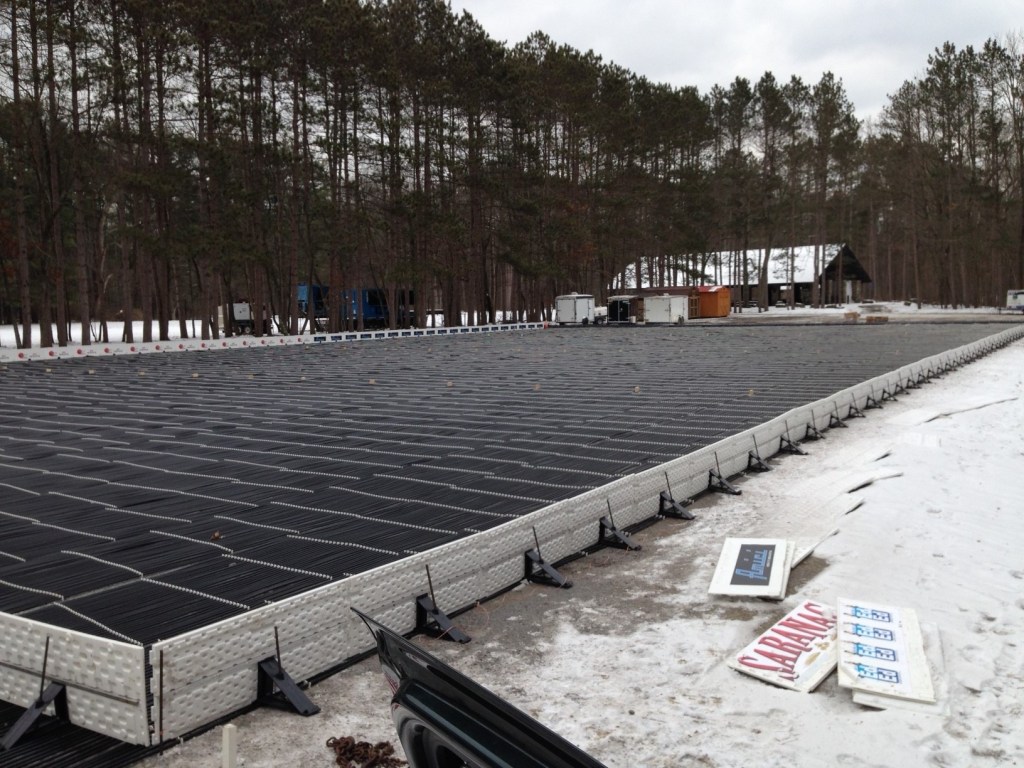
The rink refrigeration system set up before layers of water are sprayed inside to form the ice sheet. The freezing process takes about a week.
The finished rink.

Haller said the tournament in the park has turned into an economic benefit for the county, as visitors need lodging and meals.

“There are not a lot of outdoor tournaments that have a refrigerated system like we do. We are getting visitors coming up here from southern states, because they know we are going to have ice, even if it is 60 degrees and sunny,” he said. “It is no different than when people from New York State go south to the beaches during the winter. We have something here that they want and many of our players refer to the Binghamton area as a hidden gem.”

In addition to creating the wintertime fun, the multi-weekend event donates money to various youth programs including more than $23,000 so far to fight youth suicide, said Joanne Weir, development director of the Mental Health Association of the Southern Tier. The money supports the association’s DFID (Do It For Daron) program, named after a 14-year-old who died by suicide.

“We are thankful for the awareness that is provided to our association by this amazing event,” said Weir. “The Binghamton Pond Festival has continued to grow each year, and so have the conversations. Every step that we can take at breaking down the stigma associated with mental illness is a win – on or off the ice!”

Film and television star (and amateur hockey player) Steve Carell gets a look at a Pond Fest 2018 winner’s trophy with members of a women’s team from California after their return home.

Post by Brian Nearing, Deputy Public Information Officer, NYS Parks.


All photos courtesty of Binghamton Pond Festival

Have a team interested in playing at Pond Fest? Registration information is available here.

Interested in ice skating available at other State Parks this winter? Check out this list.

Connecting Kids to Parks Brings History Home

Thanks to support from the state’s Connect Kids to Parks field trip program, 30 campers  from the Denny Farrell Riverbank State Park summer camp visited the Franklin D. Roosevelt Four Freedoms State Park on Roosevelt Island.

This was just one of the 4,400 field trips for students across the state funded through the State Parks grant program since it started in 2016.

During their visit in July, the 11- and 12-year-olds learned from Riverbank about the former president who led America’s defeat of fascism, and his famous 1941 speech in which he described his vision for a post-war world.

The campers participated in a lesson focused on Roosevelt’s message that people must stand up when freedom is threatened and not expect others to defend it. To better understand that, the children created their own buttons with slogans and images as an exercise in free speech, which FDR cited as the first freedom.

Campers at FDR Four Freedoms State Park.

“Their day began with members of Four Freedoms Park Conservancy’s education team leading an inquiry-based investigation into Franklin Roosevelt’s presidency and his vision of a world order founded upon four freedoms: freedom of speech and expression, freedom of worship, freedom from want, and freedom from fear,” said Ryan Lockwood, Manager of Education at Four Freedoms State Park.

The campers also explored the Park, marveling at renowned architect Louis Kahn’s final project, while also examining primary sources from the FDR era to about what it was like to be a child during the Great Depression. To do this, campers used Depression-era photos by famous photographer Dorothea Lange and an excerpt from FDR’s 1941 State of the Union Address in which he outlined the Four Freedoms.


A portrait of a migrant mother, taken by Dorothea Lange during the Depression in 1936, is one of her most iconic photographs. (Photo Credit: U.S. Library of Congress)
At FDR Four Freedoms Park, the words of the president’s 1941 inaugural speech outline the four freedoms he envisioned for a post-war world.

Following a lunch break, staffers encouraged the young visitors to see themselves as activists capable of making the world a better place, just like FDR. After identifying current issues that mattered to them, the campers created “Activist Buttons” to persuade others to join them in creating the kind of world they would like to see in the future.

Many campers made buttons that demonstrated how the four freedoms are not static, said Lockwood. For instance, while in Roosevelt’s time freedom from fear from fear likely involved war, for today’s campers, freedom from fear meant not having to be afraid of another school shooting. 

Once they had their photo taken with their new buttons, the kids finished their visit playing fun games on the Park’s lawn like Jenga, Connect 4, Checkers and more. 

Game time at Four Freedoms Park.

This year, campers from Denny Farrell also have taken Connect Kids-supported field trips to Clay Pit Ponds State Park Preserve, Bear Mountain State Park, and Roberto Clemente State Park.

Four Freedoms Park is among several hundred state parks, nature centers, historic sites, or Department of Environmental Conservation nature centers or fish hatcheries, that more than 200,000 schoolchildren have visited during the three previous school years under the Connect Kids to Parks program.

The most popular destinations for trips have been Niagara Falls State Park, Fort Niagara State Park, Letchworth State Park, Buffalo Harbor State Park, and Midway State Park.

Since inception, the Connect Kids to Parks Field Trip Grant Program has grown from providing 777 field trips for 30,202 students in 2016-2017 to its current level of about 2,100 field trips for 101,000 students in 2018-2019.

Funding comes from the state Environmental Protection Fund’s enhanced Environmental Justice programming approved in the 2019-20 State Budget. Information for school districts and other eligible organizations on how to apply for the grant is available here and here.


All photographs courtesy of Four Freedoms Park unless otherwise credited.

Get Out and Explore … The Palisades Region

With autumn leaves now turned, hiking in the Palisades region of State Parks offers spectacular views of the Hudson Valley and the Catskills to go with a fascinating history that includes an outlaw’s lair, the state’s early iron industry, and a traitor’s secret meeting place.

Located on the west side of the Hudson River, this region between the Capital Region and New York City stretches through Rockland, Orange, Ulster and Sullivan counties, and contains 23 parks and seven historic sites.

As with all hikes, there are few things to remember beyond carrying a mobile phone. Wear sturdy yet comfortable shoes or boots, bring water and snacks, and perhaps carry a camera, to capture what you see. Be mindful of hikes on steep terrain or that go near cliff tops. Having a small first-aid kit available in case of emergency is never a bad idea

Hiking poles are useful, and can transfer some of the stress of hiking from your knees and legs to your arms and back. And use a trail map, which is available online at each park website at https://parks.ny.gov/ and at the main office at each park. Check the park’s individual website to see if its maps can be downloaded to your iOS Apple or Android device, but a paper map is a good backup in the event of device failure.

These maps include Park facilities such as parking, park offices, nature centers, campsites, and boat launches in addition to the location, name and distance of each designated trail in the park. For some facilities, data is available as a Google Earth KML file or a map is available to download to your iOS Apple and Android mobile devices in the free PDF-Maps app. Learn more

For the Palisades region, more information on hikes is also available online from the New York-New Jersey Trail Conference, and at the bookstore near Exit 17 on the Palisades Interstate Parkway.

It’s smart to know how long a trail is and how long it ought to take to finish. Since daylight is not an unlimited resource, especially in fall as days grow shorter, tossing a flashlight or headlamp into your backpack is a good form of insurance, should you unexpectedly find yourself on the trail as dusk approaches.

And, as the incidents of tick-borne diseases surge in the state, it is always important to check yourself for ticks after being outside, even if it is only time spent in your own backyard.

Rockland County

Rockland Lake State Park, 299 Rockland Lake Road, Valley Cottage, (845) 268-3020: The Nyack River Trail runs along the western short of the Hudson River between Haverstraw Beach State Park and Nyack Beach State Park. About five miles long, the level trail offers excellent river views. It is lined with crushed stone, and so is easy on the knees for a run, and also makes for an excellent bike ride or walk with a dog (must be leashed per NYS Parks rules). This trail also passes a county historical marker for the infamous “Treason Site,” where during the American Revolution in 1780 American General Benedict Arnold meet secretly with British spy Major John Andre to hand over plans for the capture of the strategic Patriot fortress at West Point. Thankfully, the plot was thwarted, with Arnold becoming one of the fledgling nation’s most despised figures.

Find a trail map here

Strolling along the Nyack River Trail.
A historical marker for the Treason Site erected by the Rockland County Historical Society (Photo from Wikipedia Commons.)

Harriman State Park, Seven Lakes Drive/Bear Mountain Circle, Ramapo, (845) 947-2444: At more than 47,500 acres, the second-largest State Park has more than 200 miles of hiking trails. At its northeastern edge, it borders Bear Mountain State Park as well as the U.S. Military Academy’s forest reserve. To the southwest lies the 18,000-acre Sterling Forest State Park. This vast park includes a large rocky shelter that was the remote hideout for a bandit named Claudius Smith, who led a gang of pro-British marauders during the American Revolution, known at the time by terrified local residents as “Cowboys.” To find it, go to the parking lot at the end of Old Johnstown Road, and look for the Blue Trail. Follow this steep trail to the top of Dater Mountain for its views, and then continue until you reach the rocky den, which had enough room to shelter both the gang and their horses. After taking in the panoramic views, which allowed the gang to see anyone coming, head down on the Tuxedo-Mount Ivy Trail to return to the parking lot. The hike is a five-mile trip, with one very steep section.

Find a trail map here

A vintage photograph of hikers exploring Claudius Smith’s Den.

Ulster County

Minnewaska State Park Preserve, 5281 Route 44-55, Kerhonkson, (845) 255-0752: Take in Catskills from atop the Stony Kills Falls at the northwestern edge of the park on this short, but challenging one-mile hike. Start at the parking area at the end of Shaft 2A Road and follow the gravel trail that crosses two wooden bridges on its way to the base of the 78-foot waterfall. Follow a set of stone stairs upward, using iron hand holds and railings for safety, to reach the top of the falls and its sweeping northerly views. You can either backtrack to the parking lot, or connect to the Stony Kill Falls carriage road atop the Shawangunk escarpment to make a longer hike.

Find a trail map here

Taking in the view at Stony Kills Falls.

Orange County

Bear Mountain State Park, Palisades Parkway or Route 9W North, Bear Mountain, (845) 786-2701: Take in the view of four states and even glimpse the Manhattan skyline from the Perkins Memorial Tower atop 1,289-foot Bear Mountain. Take the completely rebuilt Appalachian Trail, which features about 1,000 stone steps along a steep granite face. It took crews, including members of the New York-New Jersey Trail Conference, seven years of arduous labor to renovate the 1.5 mile trail up to the top. There is a new wooden bench at one of the lookouts for those who might find themselves in need of a breather on the way up.

The view from the top.

Also at Harriman, photographers will enjoy the trail to West Mountain that starts at the Anthony Wayne Recreation Area. Start on the Fawn Trail to the Timp-Torn Trail, which takes you to the mountain ridge to the West Mountain Shelter. From there, return using Timp-Torn to the intersection of the Appalachian Trail westbound, which will lead to Beechy Bottom Road that returns to the main parking area. The moderate hike is about five miles.

Find a trail map here

Looking out from the West Mountain Shelter.

Sterling Forest State Park, 116 Old Forge Road, Tuxedo, (845) 351-5907: For larger groups or school trips, there is the Lakeville Ironworks Trail Loop, which takes in the remains of an iron industry that once dominated the area. At about a mile long, the easy loop includes views of Sterling Furnace, the Lake Mine, and other mining remnants. This trail is among more than 30 trails, including the Appalachian Trail, within a 21,935-acre park in the midst of the nation’s most densely populated areas.

Find a trail map here

The former cable house at the ironworks.

Cover Photo of West Mountain summit view by Abigail Leo Parry, manager of Beaver Pond Campground at Harriman State Park.

All photos from NYS Parks unless otherwise credited.


Post by Brian Nearing, deputy public information officer at NYS Parks

The official blog for the New York State Office of Parks, Recreation & Historic Preservation